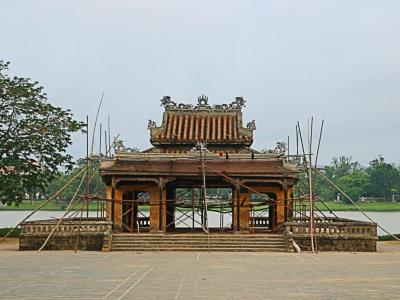


Nghinh Lương Đình (Luong Dinh Welcome Pavilion), Hue
Luong Dinh Welcome Pavilion (Nghinh Luong Dinh) is a serene riverside gem tucked on the northern bank of Hue’s Perfume River. Constructed in 1852 during Emperor Tu Duc's reign, it served as a summer retreat-a place where the ruler would fish, cool off, and appreciate the gentle river breeze. Nestled directly opposite the iconic Phu Van Lau pavilion, this intimate structure offers breathtaking, unobstructed views of the river and the Imperial Citadel beyond, making it a favored spot for photographers and history lovers.
Architecturally, Nghinh Luong Dinh is an exquisite example of Nguyen Dynasty elegance. Its compact, open-concept design includes a central chamber surrounded by four angled wings. The roof is adorned with imperial-yellow glazed tiles, crowned by elaborate dragon and sun motifs, while the side “crab-shell” extensions are ventilated through ornate wooden carvings that allowed for heat reduction and visual appeal. Three sides of the pavilion open onto the river, connected by thirteen stone steps descending to the water’s edge-an invitation to pause and reflect within the tranquil ambiance.
This pavilion underwent restorations in 1903 under Emperor Thanh Thai and again in 1918 during Khai Dinh’s rule, preserving its original grace and historic role as a royal recreational space. Today, visitors can stroll through its airy interior, admire intricate ceiling carvings-complete with mythological motifs-and take in the riverscape framed by vibrant gardens and gentle breezes.
Luong Dinh Welcome Pavilion’s cultural resonance extends beyond its physical form. It’s immortalized alongside Phu Van Lau on Vietnam’s 50,000 dong banknote, affirming its status as a national symbol and timeless emblem of Hue’s imperial heritage. For tourists visiting the old capital, a stop here offers a harmonious blend of art, history, architecture, and serene natural beauty, making it a must-visit moment in any itinerary.
Architecturally, Nghinh Luong Dinh is an exquisite example of Nguyen Dynasty elegance. Its compact, open-concept design includes a central chamber surrounded by four angled wings. The roof is adorned with imperial-yellow glazed tiles, crowned by elaborate dragon and sun motifs, while the side “crab-shell” extensions are ventilated through ornate wooden carvings that allowed for heat reduction and visual appeal. Three sides of the pavilion open onto the river, connected by thirteen stone steps descending to the water’s edge-an invitation to pause and reflect within the tranquil ambiance.
This pavilion underwent restorations in 1903 under Emperor Thanh Thai and again in 1918 during Khai Dinh’s rule, preserving its original grace and historic role as a royal recreational space. Today, visitors can stroll through its airy interior, admire intricate ceiling carvings-complete with mythological motifs-and take in the riverscape framed by vibrant gardens and gentle breezes.
Luong Dinh Welcome Pavilion’s cultural resonance extends beyond its physical form. It’s immortalized alongside Phu Van Lau on Vietnam’s 50,000 dong banknote, affirming its status as a national symbol and timeless emblem of Hue’s imperial heritage. For tourists visiting the old capital, a stop here offers a harmonious blend of art, history, architecture, and serene natural beauty, making it a must-visit moment in any itinerary.
Want to visit this sight? Check out these Self-Guided Walking Tours in Hue. Alternatively, you can download the mobile app "GPSmyCity: Walks in 1K+ Cities" from Apple App Store or Google Play Store. The app turns your mobile device to a personal tour guide and it works offline, so no data plan is needed when traveling abroad.
Download The GPSmyCity App



Nghinh Lương Đình (Luong Dinh Welcome Pavilion) on Map
Sight Name: Nghinh Lương Đình (Luong Dinh Welcome Pavilion)
Sight Location: Hue, Vietnam (See walking tours in Hue)
Sight Type: Attraction/Landmark
Sight Location: Hue, Vietnam (See walking tours in Hue)
Sight Type: Attraction/Landmark
Nearby Sights
Walking Tours in Hue, Vietnam

Create Your Own Walk in Hue
Creating your own self-guided walk in Hue is easy and fun. Choose the city attractions that you want to see and a walk route map will be created just for you. You can even set your hotel as the start point of the walk.
Imperial City Walking Tour
The Kings of the Nguyen Dynasty built their feudal capital along the fertile banks of the Perfume River, whose steady flow, centuries on, still sets up a languid pace that the rest of the city is happy to follow.
Situated within the walls of the Royal Citadel, The Imperial City in Hue is one of, if not the most prominent landmark in Vietnam, renowned for its wonderful collection of oriental... view more
Tour Duration: 2 Hours
Travel Distance: 2.9 Km or 1.8 Miles
Situated within the walls of the Royal Citadel, The Imperial City in Hue is one of, if not the most prominent landmark in Vietnam, renowned for its wonderful collection of oriental... view more
Tour Duration: 2 Hours
Travel Distance: 2.9 Km or 1.8 Miles
Hue Introduction Walking Tour
Once the seat of the imperial dynasty in the heart of Vietnam, Hue is chock-full of stories. During feudal times, for nearly 150 years - from 1802 to 1945, the city served as the national capital. The royal lifestyle and customs have had a strong impact on the lifestyle of locals, and this impact can still be felt today.
First cited about 200 BCE as the seat of the Chinese military authority in... view more
Tour Duration: 2 Hours
Travel Distance: 3.5 Km or 2.2 Miles
First cited about 200 BCE as the seat of the Chinese military authority in... view more
Tour Duration: 2 Hours
Travel Distance: 3.5 Km or 2.2 Miles