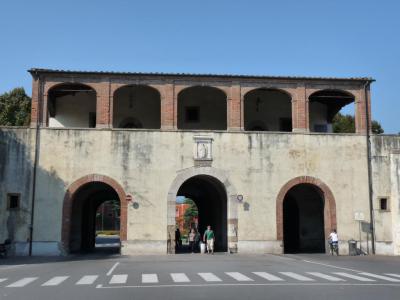


Porta Santa Maria (St. Mary's Gate), Lucca
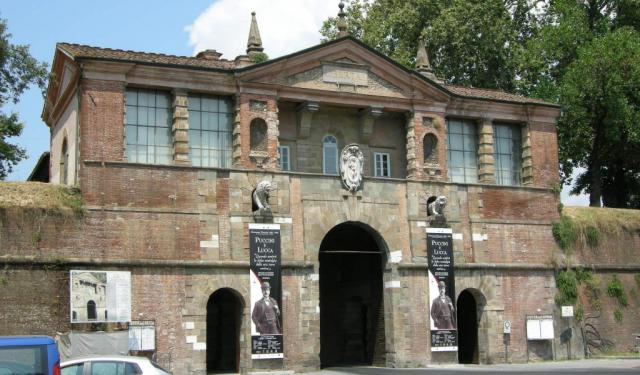
Saint Mary’s Gate, one of the grand entrances to Lucca’s historic center, stands on the northern side of the city's Renaissance walls. Built between 1592 and 1594, it once formed an important part of Lucca’s defensive system.
If you look at it from outside the city walls, you'll notice the imposing red-brick façade, decorated with pale stone details and divided into three large archways. Originally, there was just one central entrance. The two side openings were added later to accommodate increasing traffic.
Now, look directly above the central arch. In a stone niche, you'll see a marble statue of the Virgin Mary holding the infant Jesus. Dating from 1595, this sculpture reflects the city's religious traditions and gives the gate its name.
Next, shift your attention to the niches above the two smaller arches, one on either side. Here, you'll find two stone panthers, each holding a coat of arms. The panther is a traditional symbol of Lucca, representing the city's strength and independence.
As you approach the central passage, look up at the vaulted ceiling. Here, you can see traces of two frescoes depicting the Annunciation, with the Archangel Gabriel on one side and the Virgin Mary on the other.
Continue through the central arch and turn around to examine the gate's inner façade. Unlike the more elaborate exterior, this side is relatively simple. Look above the central passage for a historic marble relief featuring Saint Peter and the inscription "Libertas," meaning "Freedom." This was the motto of the Republic of Lucca, which maintained its independence for centuries.
The gate also has an interesting connection to the city's transport history. From 1883, a tramway connecting Lucca with Ponte a Moriano had its terminus outside the gate. In 1884, the tracks were extended through the passage toward Saint Peter's Gate. The tramway operated until 1932.
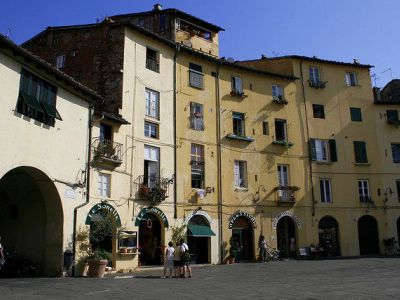
Today, the central arch is reserved for pedestrians, while vehicles use the side openings. On the inner side, you'll find Saint Mary's Square, with its surrounding historic buildings. From here, you can also appreciate how the gate connects Lucca's imposing Renaissance fortifications with the narrower streets of its medieval center.
Want to visit this sight? Check out these Self-Guided Walking Tours in Lucca. Alternatively, you can download the mobile app "GPSmyCity: Walks in 1K+ Cities" from Apple App Store or Google Play Store. The app turns your mobile device to a personal tour guide and it works offline, so no data plan is needed when traveling abroad.
Download The GPSmyCity App



Porta Santa Maria (St. Mary's Gate) on Map
Sight Name: Porta Santa Maria (St. Mary's Gate)
Sight Location: Lucca, Italy (See walking tours in Lucca)
Sight Type: Attraction/Landmark
Guide(s) Containing This Sight:
Sight Location: Lucca, Italy (See walking tours in Lucca)
Sight Type: Attraction/Landmark
Guide(s) Containing This Sight:
Nearby Sights
Walking Tours in Lucca, Italy
Create Your Own Walk in Lucca
Creating your own self-guided walk in Lucca is easy and fun. Choose the city attractions that you want to see and a walk route map will be created just for you. You can even set your hotel as the start point of the walk.
Lucca Old Town Walking Tour
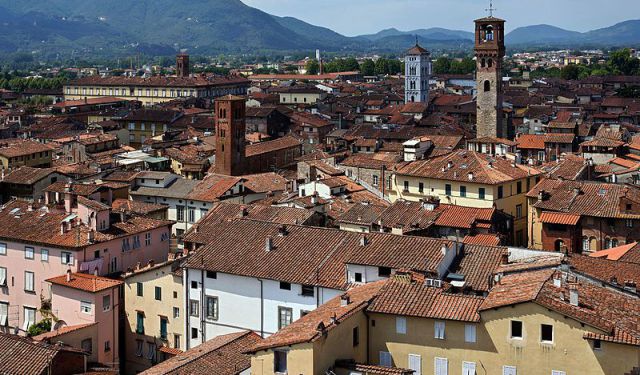
Lucca is known by many names: a city of art, churches, gardens, and towers. But perhaps its most distinctive feature is its remarkable city walls. Fortifications have surrounded Lucca since Roman times, and today, its Renaissance walls remain almost perfectly intact.
Inside the walls, Lucca still follows much of its ancient Roman street plan. Square San Michele occupies the site of the old... view more
Tour Duration: 2 Hours
Travel Distance: 2.9 Km or 1.8 Miles
Inside the walls, Lucca still follows much of its ancient Roman street plan. Square San Michele occupies the site of the old... view more
Tour Duration: 2 Hours
Travel Distance: 2.9 Km or 1.8 Miles
Lucca's City Wall and Gates Walking Tour
Lucca is one of Italy's most celebrated cities of art, renowned for its historic churches, medieval towers, and, above all, its remarkably well-preserved city walls. Encircling the historic center, these impressive fortifications have protected Lucca for centuries and remain one of its most distinctive features.
During the Middle Ages, Lucca's walls stood around 11 to 12 meters high,... view more
Tour Duration: 2 Hours
Travel Distance: 3.7 Km or 2.3 Miles
During the Middle Ages, Lucca's walls stood around 11 to 12 meters high,... view more
Tour Duration: 2 Hours
Travel Distance: 3.7 Km or 2.3 Miles
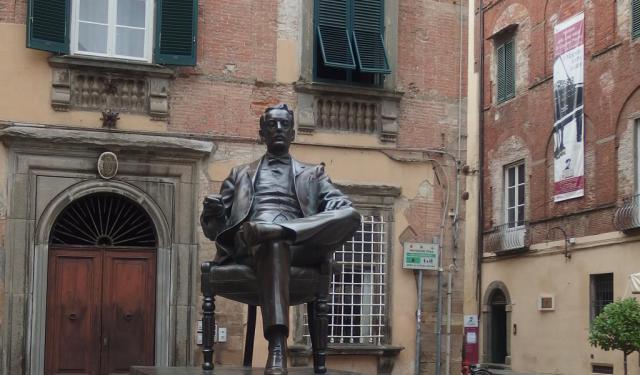
Discover Puccini's Lucca on Foot
One of the greatest musical talents of mankind, Italian composer Giacomo Puccini, was born and spent a substantial part of his life in the Tuscan city of Lucca. Today the legacy of Puccini resonates all over the world and even more so here.
Puccini's ancestors, also musicians, moved to Lucca in 1719. The future maestro was born in a house that had belonged to his family since 1815 - Casa... view more
Tour Duration: 1 Hour
Travel Distance: 1.5 Km or 0.9 Miles
Puccini's ancestors, also musicians, moved to Lucca in 1719. The future maestro was born in a house that had belonged to his family since 1815 - Casa... view more
Tour Duration: 1 Hour
Travel Distance: 1.5 Km or 0.9 Miles
City Walks Overview
