

Saint Elizabeth's Church, Nuremberg
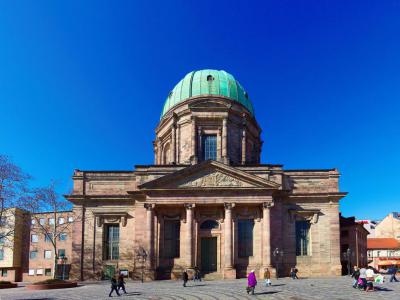
Saint Elizabeth’s Church, located in Nuremberg, is a significant Roman Catholic church dedicated to Saint Elizabeth of Hungary since 1235. Its history is deeply intertwined with the religious changes in Nuremberg. After the Reformation, it remained the city’s only Roman Catholic church in a predominantly Protestant community. The original building could no longer accommodate its growing congregation, leading to lengthy negotiations between the church and the city magistrate from 1718 to 1780.
An agreement was finally reached, and the old church was demolished in 1784. In its place, a Neoclassical structure designed by Franz Ignaz Michael Neumann was planned, with construction beginning the following year. After Neumann’s death in 1789, Peter Anton von Verschaffelt took over the project. However, escalating costs led him to resign that same year. The building was completed in 1802, and its dome was crowned with a golden cross in 1803.
The church was secularised in 1806 but returned to religious use in 1885, when it was acquired by the Roman Catholic Archdiocese of Bamberg. This acquisition led to further improvements and renovations, which continued until 1903. The church suffered severe damage during the Second World War and underwent extensive reconstruction between 1947 and 1959. A further phase of exterior restoration took place between 1975 and 1976, helping preserve this historic church for future generations.
Today, Saint Elizabeth’s Church remains an important Roman Catholic landmark in Nuremberg, reflecting the city’s complex religious history and architectural development.
An agreement was finally reached, and the old church was demolished in 1784. In its place, a Neoclassical structure designed by Franz Ignaz Michael Neumann was planned, with construction beginning the following year. After Neumann’s death in 1789, Peter Anton von Verschaffelt took over the project. However, escalating costs led him to resign that same year. The building was completed in 1802, and its dome was crowned with a golden cross in 1803.
The church was secularised in 1806 but returned to religious use in 1885, when it was acquired by the Roman Catholic Archdiocese of Bamberg. This acquisition led to further improvements and renovations, which continued until 1903. The church suffered severe damage during the Second World War and underwent extensive reconstruction between 1947 and 1959. A further phase of exterior restoration took place between 1975 and 1976, helping preserve this historic church for future generations.
Today, Saint Elizabeth’s Church remains an important Roman Catholic landmark in Nuremberg, reflecting the city’s complex religious history and architectural development.
Want to visit this sight? Check out these Self-Guided Walking Tours in Nuremberg. Alternatively, you can download the mobile app "GPSmyCity: Walks in 1K+ Cities" from Apple App Store or Google Play Store. The app turns your mobile device to a personal tour guide and it works offline, so no data plan is needed when traveling abroad.
Download The GPSmyCity App



Saint Elizabeth's Church on Map
Sight Name: Saint Elizabeth's Church
Sight Location: Nuremberg, Germany (See walking tours in Nuremberg)
Sight Type: Religious
Guide(s) Containing This Sight:
Sight Location: Nuremberg, Germany (See walking tours in Nuremberg)
Sight Type: Religious
Guide(s) Containing This Sight:
Nearby Sights

Walking Tours in Nuremberg, Germany

Create Your Own Walk in Nuremberg
Creating your own self-guided walk in Nuremberg is easy and fun. Choose the city attractions that you want to see and a walk route map will be created just for you. You can even set your hotel as the start point of the walk.
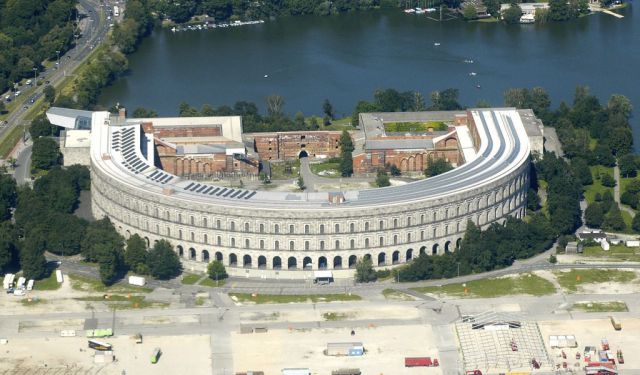
Hitler's Nuremberg Tour
Nuremberg’s association with Adolf Hitler and National Socialism is one of the darkest chapters in the city’s history. Although Nuremberg is known for its medieval architecture and storybook appearance, few German cities are as closely intertwined with the Nazi legacy. Hitler referred to it as the “City of the Party Rallies” and regarded it as a model for the ideal German city.
The... view more
Tour Duration: 2 Hour(s)
Travel Distance: 4.9 Km or 3 Miles
The... view more
Tour Duration: 2 Hour(s)
Travel Distance: 4.9 Km or 3 Miles
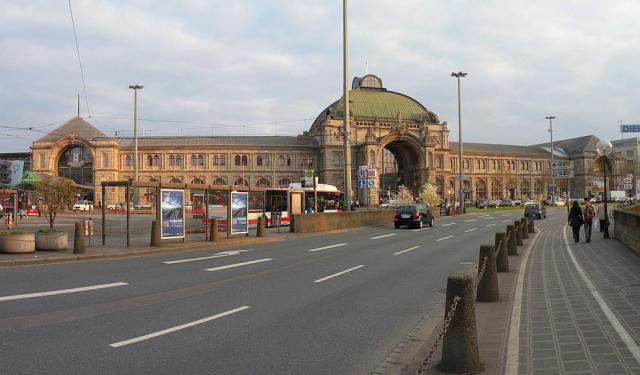
A Walk Through Nuremberg's Historical Old Town
American poet Henry Wadsworth Longfellow described Nuremberg as a “quaint old town of toil and traffic, quaint old town of art and song.”
Nuremberg has witnessed some of the most significant events in German history. For many people, the city is first associated with the rise of the Third Reich, the Nazi Party rallies, and the postwar trials of Nazi leaders. Indeed, Hitler regarded... view more
Tour Duration: 3 Hour(s)
Travel Distance: 3.8 Km or 2.4 Miles
Nuremberg has witnessed some of the most significant events in German history. For many people, the city is first associated with the rise of the Third Reich, the Nazi Party rallies, and the postwar trials of Nazi leaders. Indeed, Hitler regarded... view more
Tour Duration: 3 Hour(s)
Travel Distance: 3.8 Km or 2.4 Miles