Custom Walk in Ghent, Belgium by gdarroca834 created on 2019-08-13
Guide Location: Belgium » Ghent
Guide Type: Custom Walk
# of Sights: 14
Tour Duration: 3 Hour(s)
Travel Distance: 4.2 Km or 2.6 Miles
Share Key: AMXPB
Guide Type: Custom Walk
# of Sights: 14
Tour Duration: 3 Hour(s)
Travel Distance: 4.2 Km or 2.6 Miles
Share Key: AMXPB
How It Works
Please retrieve this walk in the GPSmyCity app. Once done, the app will guide you from one tour stop to the next as if you had a personal tour guide. If you created the walk on this website or come to the page via a link, please follow the instructions below to retrieve the walk in the app.
Retrieve This Walk in App
Step 1. Download the app "GPSmyCity: Walks in 1K+ Cities" on Apple App Store or Google Play Store.



Step 2. In the GPSmyCity app, download(or launch) the guide "Ghent Map and Walking Tours".
Step 3. Tap the menu button located at upper right corner of the "Walks" screen and select "Retrieve custom walk". Enter the share key: AMXPB

1) Ghent-Sint-Pieters
This custom location is created on gpsmycity.com website.
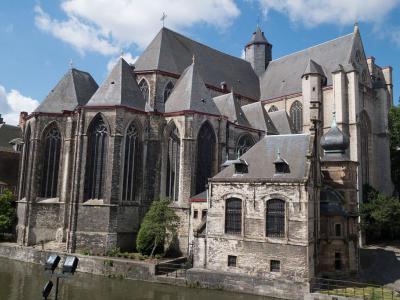
2) Sint-Michielskerk (Saint Michael's Church)
Saint Michael's Church (Sint-Michielskerk) in Ghent is a Roman Catholic church with a rich history dating back to 1105 when a chapel dedicated to Saint Michael was first documented on the site. The original chapel was destroyed by fire twice in the 12th century and rebuilt each time. The current late Gothic church began construction around 1440, unfolding in two major phases with a significant interruption between them.
The first phase of construction took place during the 15th and 16th centuries. By 1528, the western part of the church, including the three-aisled nave and the transept, had been completed. Work continued on the western tower, reaching two levels by 1566 before religious conflicts brought construction to a halt. The church suffered during the Protestant Reformation, with parts destroyed by Calvinists in 1578, and the old choir was demolished in 1579.
Construction resumed in 1623, and the Baroque sacristy in the northeast corner was built between 1650 and 1651. In 1662, local architect Lieven Cruyl designed a plan for the unfinished western tower, which, however, was never realized. The tower remained incomplete and was finally covered with a flat roof in 1828.
The interior of Saint Michael's Church is notable for its rich Neo-Gothic style, featuring a grand altar, an ornate pulpit, and numerous 18th-century statues. The church houses a collection of Baroque paintings, including works by renowned artists such as Anthony van Dyck's "Christ Dying on the Cross" and Otto Venius's "Resurrection of Lazarus." Additionally, the church preserves a collection of valuable silver and gold artifacts, including a relic of Saint Dorothea in silver, a sacred "Doorn" donated by Mary, Queen of Scots, and a piece of the true Cross, a gift from Archduke Albrecht and Isabella in 1619.
Saint Michael's Church stands as a significant historical and architectural landmark in Ghent, reflecting the city's turbulent religious history and its artistic heritage.
The first phase of construction took place during the 15th and 16th centuries. By 1528, the western part of the church, including the three-aisled nave and the transept, had been completed. Work continued on the western tower, reaching two levels by 1566 before religious conflicts brought construction to a halt. The church suffered during the Protestant Reformation, with parts destroyed by Calvinists in 1578, and the old choir was demolished in 1579.
Construction resumed in 1623, and the Baroque sacristy in the northeast corner was built between 1650 and 1651. In 1662, local architect Lieven Cruyl designed a plan for the unfinished western tower, which, however, was never realized. The tower remained incomplete and was finally covered with a flat roof in 1828.
The interior of Saint Michael's Church is notable for its rich Neo-Gothic style, featuring a grand altar, an ornate pulpit, and numerous 18th-century statues. The church houses a collection of Baroque paintings, including works by renowned artists such as Anthony van Dyck's "Christ Dying on the Cross" and Otto Venius's "Resurrection of Lazarus." Additionally, the church preserves a collection of valuable silver and gold artifacts, including a relic of Saint Dorothea in silver, a sacred "Doorn" donated by Mary, Queen of Scots, and a piece of the true Cross, a gift from Archduke Albrecht and Isabella in 1619.
Saint Michael's Church stands as a significant historical and architectural landmark in Ghent, reflecting the city's turbulent religious history and its artistic heritage.
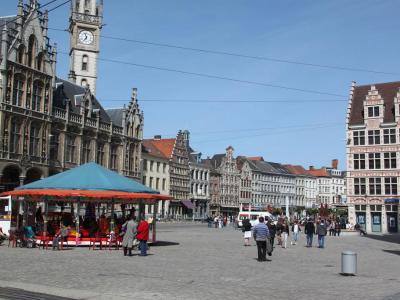
3) Korenmarkt (Wheat Market) (must see)
The Korenmarkt, or Wheat Market is a large square in the center of Ghent's historic district. It is called Wheat Market for the prosperous wheat trade beginning in the 10th and 11th centuries. Grain would be brought up the river Leie to Graslei (Grass Quai) and KorenLei (Wheat Quai). It then could be sold in the Wheat Market.
The Wheat Market is connected to two of Ghent's most active commercial streets, Veldstraat and Kortemunt on a north-south line. Saint Michael's Bridge reaches over the river Leie to Saint Nicholas Church on the east side. On the west side is access to the waterfront and the Grass Quai.
The picturesque buildings around the square house bars, restaurants and terraces. Alongside Saint Nicholas church there are the pubs of Klein Turkijie (Little Turky). The square was once the scene of bankruptcy auctions. The term "Little Turky" is actually a corruption of the expression "ter keie gaan", which means "hit rock bottom."
The Wheat Market is connected to two of Ghent's most active commercial streets, Veldstraat and Kortemunt on a north-south line. Saint Michael's Bridge reaches over the river Leie to Saint Nicholas Church on the east side. On the west side is access to the waterfront and the Grass Quai.
The picturesque buildings around the square house bars, restaurants and terraces. Alongside Saint Nicholas church there are the pubs of Klein Turkijie (Little Turky). The square was once the scene of bankruptcy auctions. The term "Little Turky" is actually a corruption of the expression "ter keie gaan", which means "hit rock bottom."
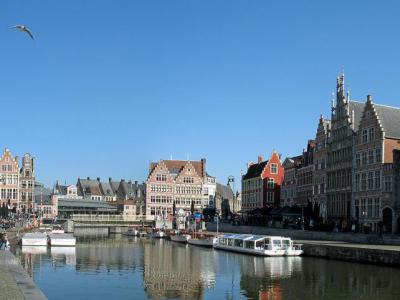
4) Gaslei (Grass Quai) & Korenlei (Wheat Quai) (must see)
Ghent was a center of the grain and cereal trade as early as the 5th century AD. Laid out along the shores of the river Leie, in the center of Ghent, were the two main quais of Ghent, Grass Quai and Wheat Quai. Grass Quai, on the right bank, was reserved for herbs and vegetables. On the opposite bank Wheat Quai received shipments of wheat and cereals.
Ships have been docking at the quais since the 11th century. Grass Quai and Wheat Quai are lined with medieval buildings restored and rebuilt. Behind many of the restored facades there are shops and offices dedicated to modern purposes but they look as they did in the golden age of Ghent.
The stepped gables of the old guild houses have watched over the city since the 13th century. The Wheat Measure House, where wheat was first weighed in 1527 is today an accessory store.
The banks of the river are lined with terraces and cafes and wonderful places to hang out. On the renovated facade of the Mariot Hotel at Wheat Quai, two gilded swans swim in opposite directions: left for women and right for drinks. One wonders what entertainments were happening in the 16th century.
Boat rides are a popular way to take in the historic sights along the river as they appeared so many years ago.
Tip:
Make sure to climb the steps of Sint-Michielsbrug (Saint Michael's Bridge), where Grass Quai and Wheat Quai can be viewed well with the canal. Another very nice viewpoint and photo spot is directly on Wheat Quai, looking in the direction of Grass Quai. From there you can see the building guild houses as well as some of the famous landmark buildings like the Belfry in the background. Take your time to look around, perhaps with binoculars.
Ships have been docking at the quais since the 11th century. Grass Quai and Wheat Quai are lined with medieval buildings restored and rebuilt. Behind many of the restored facades there are shops and offices dedicated to modern purposes but they look as they did in the golden age of Ghent.
The stepped gables of the old guild houses have watched over the city since the 13th century. The Wheat Measure House, where wheat was first weighed in 1527 is today an accessory store.
The banks of the river are lined with terraces and cafes and wonderful places to hang out. On the renovated facade of the Mariot Hotel at Wheat Quai, two gilded swans swim in opposite directions: left for women and right for drinks. One wonders what entertainments were happening in the 16th century.
Boat rides are a popular way to take in the historic sights along the river as they appeared so many years ago.
Tip:
Make sure to climb the steps of Sint-Michielsbrug (Saint Michael's Bridge), where Grass Quai and Wheat Quai can be viewed well with the canal. Another very nice viewpoint and photo spot is directly on Wheat Quai, looking in the direction of Grass Quai. From there you can see the building guild houses as well as some of the famous landmark buildings like the Belfry in the background. Take your time to look around, perhaps with binoculars.
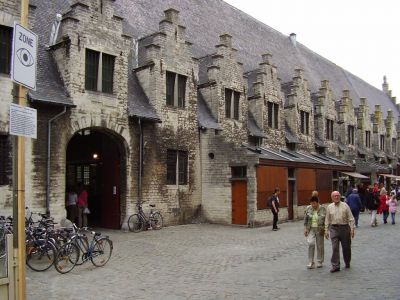
5) Groot Vleeshuis (Great Butcher's Hall)
The Great Butcher's Hall (Groot Vleeshuis) is a historic landmark in Ghent, originally serving as a covered market and guildhall for butchers. The first mention of the Hall appears in city documents from 1332-1333, referring to a smaller, wooden structure located on the Vismarkt, now known as the Vegetable Market (Groentenmarkt). By 1407, this older building had fallen into disrepair, prompting the butchers to relocate to a larger and more robust structure.
Between 1446 and 1448, a chapel with a meeting room was added to the southwestern corner of the building. To ensure a steady supply of fish, four canals were constructed beneath the hall, allowing flat fishing boats to access the market directly from the Lys River. The vaulted passages of these canals are still visible along the riverbank today.
In 1543, the Hall expanded to include 16 tripe houses, or shops, where viscera, intestinal fat, and other animal remains, as well as poultry, could be sold-items that were previously not permitted inside the main Hall. However, by the late 19th century, the Great Butcher's Hall became vacant after the butchers moved to a new meat house near the Vismijn on Sint-Veerleplein.
As part of preparations for the 1913 World's Fair, the Great Butcher's Hall and its tripe houses were restored to their pre-1744 condition under the direction of architect Van Hamme. The revamped building took on new roles, including serving as a market for fruits and vegetables, a Post and Telegraph office, a parking garage, and a partial fish trade.
Recognized for its unique architectural and historical value, the Great Butcher's Hall has been a protected monument since 1943. A major renovation in the late 1990s transformed the building into a promotion center for East Flemish regional products. Today, visitors can explore the Hall to find an array of Belgian specialties, such as chocolates and beer, along with various local souvenirs, celebrating the rich culinary and cultural heritage of the region.
Between 1446 and 1448, a chapel with a meeting room was added to the southwestern corner of the building. To ensure a steady supply of fish, four canals were constructed beneath the hall, allowing flat fishing boats to access the market directly from the Lys River. The vaulted passages of these canals are still visible along the riverbank today.
In 1543, the Hall expanded to include 16 tripe houses, or shops, where viscera, intestinal fat, and other animal remains, as well as poultry, could be sold-items that were previously not permitted inside the main Hall. However, by the late 19th century, the Great Butcher's Hall became vacant after the butchers moved to a new meat house near the Vismijn on Sint-Veerleplein.
As part of preparations for the 1913 World's Fair, the Great Butcher's Hall and its tripe houses were restored to their pre-1744 condition under the direction of architect Van Hamme. The revamped building took on new roles, including serving as a market for fruits and vegetables, a Post and Telegraph office, a parking garage, and a partial fish trade.
Recognized for its unique architectural and historical value, the Great Butcher's Hall has been a protected monument since 1943. A major renovation in the late 1990s transformed the building into a promotion center for East Flemish regional products. Today, visitors can explore the Hall to find an array of Belgian specialties, such as chocolates and beer, along with various local souvenirs, celebrating the rich culinary and cultural heritage of the region.
6) Vrijdagmarkt (Friday Market Square)
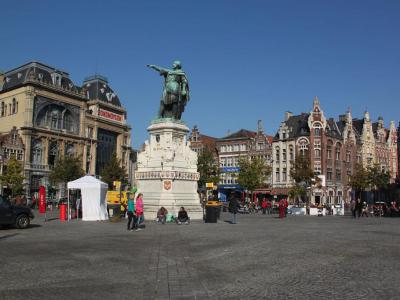
Every Friday there is a market in Vrijdagmarkt, Friday Market Square. Town markets have been held in the square since 1199. There is a statue of an armed man in the square. It is not the statue of a prince or a King or a mythological hero. It is a statue of a medieval businessman. He was also a politician and a bit of a dictator.
Jacob van Artevelde was a leader of the medieval guilds at a time when textiles were the life blood of Ghent industry. When the Count of Flanders, Louis I, abandoned Flanders in 1332, Van Artevelde became in effect, the ruler of Ghent. His administration was the first real option to feudalism. He was killed in the square by an envious business rival.
The square measures 100 X 100 meters. The buildings around the square are of different periods. The Tanners' Guild has a round tower and step gables. The Toreken Tower was used by the Cloth Guild. The Cloth Measurers House, dating from 1770 is on the north side of the square. The Art Nouveau "Our House" (1902) was home the the Socialist Party of Ghent.
The Friday Market Square has quite a few restaurants and cafes, most with outdoor seating. Markets are held on Fridays and Sundays. There is also a bird market on Monday.
Why You Should Visit:
Always a cool square to check out, with plenty of opportunities to take photos and soak up the atmosphere.
On Friday mornings, you can enjoy fresh produce, seafood, as well as clothes, collectibles and some gift items.
Jacob van Artevelde was a leader of the medieval guilds at a time when textiles were the life blood of Ghent industry. When the Count of Flanders, Louis I, abandoned Flanders in 1332, Van Artevelde became in effect, the ruler of Ghent. His administration was the first real option to feudalism. He was killed in the square by an envious business rival.
The square measures 100 X 100 meters. The buildings around the square are of different periods. The Tanners' Guild has a round tower and step gables. The Toreken Tower was used by the Cloth Guild. The Cloth Measurers House, dating from 1770 is on the north side of the square. The Art Nouveau "Our House" (1902) was home the the Socialist Party of Ghent.
The Friday Market Square has quite a few restaurants and cafes, most with outdoor seating. Markets are held on Fridays and Sundays. There is also a bird market on Monday.
Why You Should Visit:
Always a cool square to check out, with plenty of opportunities to take photos and soak up the atmosphere.
On Friday mornings, you can enjoy fresh produce, seafood, as well as clothes, collectibles and some gift items.
7) Bond Moyson Building
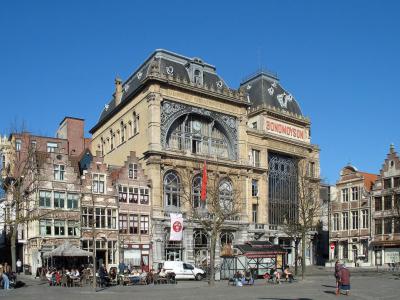
The Bond Moyson Building is an iconic structure located on Vrijdagmarkt (Friday Market Square) in Ghent. It is part of a grand complex with a monumental façade that has been a prominent feature of the square for over a century. The complex was designed by architect Ferdinand Dierkens and commissioned by the Belgian socialist politician Edward Anseele. Its architectural inspiration came from the Grands Magasins of Paris, reflecting a blend of styles that embody both aesthetic grandeur and social ideals.
Constructed in two phases, the right wing of the complex, known as Bond Moyson, was completed in 1899, and the left wing, called Volkshuis Ons Huis (People's House Our House), followed in 1902. The façade of Bond Moyson is particularly notable for its socialist allegorical scenes, crafted by Jules de Bleye. Made from bluestone, the building features a distinctive dome-shaped covering with a Neo-Renaissance "bull's-eye" window. Atop the dome sits a rooster, symbolizing a “new dawn” and the aspiration for an era of equality and happiness for all.
The façade features a coat of arms with “three eights,” symbolizing the early 20th-century workers' slogan: “Eight hours of work, eight hours of leisure, and eight hours of rest.” Fluted columns on the first two levels transition into Corinthian pilasters on the third, supporting an entablature with the inscription “Werklieden Aller Landen Vereenigt U” (Workers of all countries, unite!) in gold. Above it, a cartouche displays “Bond Moyson” in bold red, flanked by caryatids. The central section, added later, includes a large glazed surface, enhancing its modern appeal. The left-wing, Ons Huis, now serves as the headquarters for East Flanders’ socialist workers' associations and is known as the “Socialist Building.”
Constructed in two phases, the right wing of the complex, known as Bond Moyson, was completed in 1899, and the left wing, called Volkshuis Ons Huis (People's House Our House), followed in 1902. The façade of Bond Moyson is particularly notable for its socialist allegorical scenes, crafted by Jules de Bleye. Made from bluestone, the building features a distinctive dome-shaped covering with a Neo-Renaissance "bull's-eye" window. Atop the dome sits a rooster, symbolizing a “new dawn” and the aspiration for an era of equality and happiness for all.
The façade features a coat of arms with “three eights,” symbolizing the early 20th-century workers' slogan: “Eight hours of work, eight hours of leisure, and eight hours of rest.” Fluted columns on the first two levels transition into Corinthian pilasters on the third, supporting an entablature with the inscription “Werklieden Aller Landen Vereenigt U” (Workers of all countries, unite!) in gold. Above it, a cartouche displays “Bond Moyson” in bold red, flanked by caryatids. The central section, added later, includes a large glazed surface, enhancing its modern appeal. The left-wing, Ons Huis, now serves as the headquarters for East Flanders’ socialist workers' associations and is known as the “Socialist Building.”
8) Belfort (Belfry of Ghent) (must see)
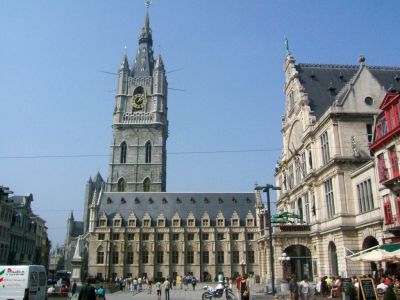
There are three medieval towers rising over the old city of Ghent: Saint Bavo Cathedral, Saint Nicholas' Church and the 298 foot Belfry of Ghent. The building of the Belfry tower began in 1313, following the designs of master mason Jan van Haelst. Wars, pestilence and politics slowed progress but the tower was completed in 1380.
At the peak of the tower sits the latest version of the gilded Dragon of Ghent. The original dragon, installed in 1382, was acquired by Count Baldwin IX of Flanders and brought to Bruges. It later became a war trophy of Ghent. Meant to protect charters and documents stored in the tower, the Dragon became a symbol of the city's power.
The upper reaches of the tower have been rebuilt occasionally to allow for a growing number of bells. The campanile was finished in 1771 with a spire designed by architect Louis 't Kindt. A neo-Gothic spire was installed in 1851. It was replaced in 1913 by the stone spire of today.
Historically the belfry bells were used to announce the time, sound warnings and announce victories. The great alarm bell called "Roland" was installed in 1325. After he had subdued an uprising in Ghent, Holy Roman Emperor Charles V ordered Roland removed.
Henry Wadsworth Longfellow wrote:
"...I am Roland! I am Roland!
There is victory in the land!"
Why You Should Visit:
Climbing this tower on your visit to Ghent is imperative! Not excessively high, but still allows a very pretty view of the city and of the Cathedral right next to it.
Tip:
Stick around for the chiming of the bells on the hour. You can watch how the bell mechanism works from the inside or stand outside on the corridor and just listen. The admission forms part of the CityCard Gent so if you plan to visit multiple attractions, you might save a few euros by buying a CityCard.
At the peak of the tower sits the latest version of the gilded Dragon of Ghent. The original dragon, installed in 1382, was acquired by Count Baldwin IX of Flanders and brought to Bruges. It later became a war trophy of Ghent. Meant to protect charters and documents stored in the tower, the Dragon became a symbol of the city's power.
The upper reaches of the tower have been rebuilt occasionally to allow for a growing number of bells. The campanile was finished in 1771 with a spire designed by architect Louis 't Kindt. A neo-Gothic spire was installed in 1851. It was replaced in 1913 by the stone spire of today.
Historically the belfry bells were used to announce the time, sound warnings and announce victories. The great alarm bell called "Roland" was installed in 1325. After he had subdued an uprising in Ghent, Holy Roman Emperor Charles V ordered Roland removed.
Henry Wadsworth Longfellow wrote:
"...I am Roland! I am Roland!
There is victory in the land!"
Why You Should Visit:
Climbing this tower on your visit to Ghent is imperative! Not excessively high, but still allows a very pretty view of the city and of the Cathedral right next to it.
Tip:
Stick around for the chiming of the bells on the hour. You can watch how the bell mechanism works from the inside or stand outside on the corridor and just listen. The admission forms part of the CityCard Gent so if you plan to visit multiple attractions, you might save a few euros by buying a CityCard.
9) Mageleinstraat (Magelein Street)
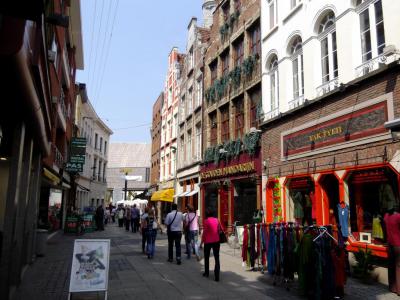
Magelein Street (Mageleinstraat) is a charming and historic street in the heart of Ghent, located near the iconic Belfry and Saint Bavo Cathedral. This lively street is one of the oldest in Ghent and is known for its bustling atmosphere and a delightful selection of small food shops. As you stroll down Magelein Street, you'll be tempted by the shop windows filled with Belgian pastries, chocolates, cheeses, and a variety of freshly baked bread.
Its central location makes Magelein Street one of the busiest shopping streets in Ghent, as it connects with other vibrant shopping areas and main roads. Historically, the street was part of the route of the Kalandeberg, running from Saint Baafsplein to the house of Jacob Van Artevelde at Kalandeberg no. 7. The origin of the street's name is debated; some believe it could be linked to the flower or spice marjoram, while others suggest it may be named after a noble lord, "Major Leyne," who supposedly lived there in 1680.
However, historian Professor Victor Fris suggests the name comes from the Magelein (or Machelins) family, prominent in Saint Bavo's Abbey area in the late twelfth century. They owned significant properties in the Kuip of Ghent and were involved in local politics and feuds, notably with the Borluut family. A Machelins' son served as alderman of the Keure in 1330 and of Gedeele in 1333.
Magelein Street also had a historical alley known as the Ganxken, located across from Bennesteeg. This alleyway led to a theatre that opened onto the courtyard of the hostel row "Het Roose Cransken" on Saint Jansstraat (now Emile Braunplein). The theatre, known as "Het Ganxken," was mentioned as early as 1666 and served various entertainment purposes from 1715 until 1737, including plays, singing performances, and later as a dance hall into the early 19th century. Magelein Street's rich history and vibrant present make it a fascinating part of Ghent's cultural tapestry.
Its central location makes Magelein Street one of the busiest shopping streets in Ghent, as it connects with other vibrant shopping areas and main roads. Historically, the street was part of the route of the Kalandeberg, running from Saint Baafsplein to the house of Jacob Van Artevelde at Kalandeberg no. 7. The origin of the street's name is debated; some believe it could be linked to the flower or spice marjoram, while others suggest it may be named after a noble lord, "Major Leyne," who supposedly lived there in 1680.
However, historian Professor Victor Fris suggests the name comes from the Magelein (or Machelins) family, prominent in Saint Bavo's Abbey area in the late twelfth century. They owned significant properties in the Kuip of Ghent and were involved in local politics and feuds, notably with the Borluut family. A Machelins' son served as alderman of the Keure in 1330 and of Gedeele in 1333.
Magelein Street also had a historical alley known as the Ganxken, located across from Bennesteeg. This alleyway led to a theatre that opened onto the courtyard of the hostel row "Het Roose Cransken" on Saint Jansstraat (now Emile Braunplein). The theatre, known as "Het Ganxken," was mentioned as early as 1666 and served various entertainment purposes from 1715 until 1737, including plays, singing performances, and later as a dance hall into the early 19th century. Magelein Street's rich history and vibrant present make it a fascinating part of Ghent's cultural tapestry.
10) Daskalidès Chocolatier
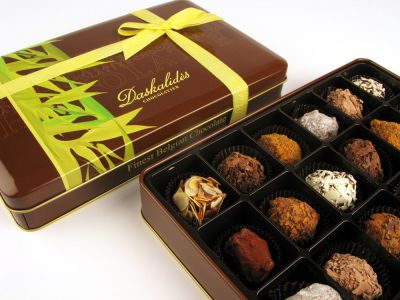
Daskalidès Chocolatier, a revered name in the world of fine chocolate, has been delivering pieces of pure chocolate happiness since its founding in 1931 in Ghent. Rooted in a rich family tradition that combines Belgian craftsmanship with a touch of Greek passion, Daskalidès has become synonymous with artisanal excellence and innovation in the chocolate industry.
The Daskalidès story began when a Greek family, the Daskalidès-Kestekides, settled in Ghent in 1923 and opened a tea room that would eventually evolve into a beloved chocolatier. Initially crafting and selling pralines, the business flourished under the leadership of Jean Daskalidès, who expanded the brand’s reach internationally. Today, the company is led by Alexandre Daskalidès, who continues to uphold the legacy of quality, tradition, and innovation that has characterized the brand for over 90 years.
Daskalidès chocolates are celebrated for their exceptional quality, crafted using traditional recipes, advanced techniques, and the finest ingredients. Each piece is a blend of timeless finesse and modern craftsmanship, wrapped in a crackling layer of family tradition. This dedication to excellence has not gone unnoticed; the brand was awarded the prestigious Laurier d'Or de la Qualité in France, recognizing the outstanding quality, beautiful shapes, and exquisite taste of its chocolates.
For those who seek flavor adventures, Daskalidès offers a playground of taste sensations. The chocolates are a vibrant mix of tradition and bold experimentation, reflecting both Ghent’s rich heritage and its contemporary spirit. Visitors to the House of Daskalidès in Ghent are invited to discover these surprising flavors and share special taste moments with loved ones.
The Daskalidès story began when a Greek family, the Daskalidès-Kestekides, settled in Ghent in 1923 and opened a tea room that would eventually evolve into a beloved chocolatier. Initially crafting and selling pralines, the business flourished under the leadership of Jean Daskalidès, who expanded the brand’s reach internationally. Today, the company is led by Alexandre Daskalidès, who continues to uphold the legacy of quality, tradition, and innovation that has characterized the brand for over 90 years.
Daskalidès chocolates are celebrated for their exceptional quality, crafted using traditional recipes, advanced techniques, and the finest ingredients. Each piece is a blend of timeless finesse and modern craftsmanship, wrapped in a crackling layer of family tradition. This dedication to excellence has not gone unnoticed; the brand was awarded the prestigious Laurier d'Or de la Qualité in France, recognizing the outstanding quality, beautiful shapes, and exquisite taste of its chocolates.
For those who seek flavor adventures, Daskalidès offers a playground of taste sensations. The chocolates are a vibrant mix of tradition and bold experimentation, reflecting both Ghent’s rich heritage and its contemporary spirit. Visitors to the House of Daskalidès in Ghent are invited to discover these surprising flavors and share special taste moments with loved ones.
11) Geeraard de Duivelsteen (Castle of Gerald the Devil)
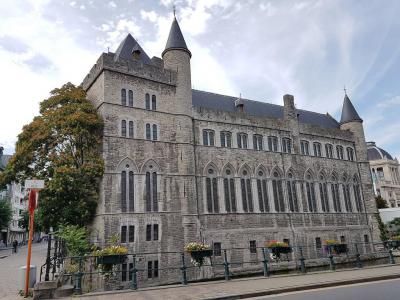
The Castle of Gerald the Devil (Geeraard de Duivelsteen) is a medieval fortress located in Ghent. Built in the 13th century, this Gothic-style edifice with Romanesque elements was originally constructed to defend the Portus aan de Reep, a trading settlement that marked the origins of the city of Ghent. The fortress's defensive features include thick walls, turrets, and a reduit for monitoring and protecting the area against attacks.
Despite its ominous name and appearance, no devil ever resided within its walls. The castle was named after Geeraard Vilain, a knight and the son of the 15th Viscount of Ghent, Zeger III. Vilain, known as "Geeraard the Devil" due to his dark hair and complexion, lived in the castle, which remained the residence of his descendants until the early 14th century when it transitioned to municipal ownership.
Over the centuries, the Castle of Gerald the Devil has served numerous roles. It has been a gathering place for noblemen, an arsenal, a monastery, a school, an episcopal seminary, and a prison. In 1807, it was repurposed as an orphanage for boys, and from 1815, it served as an asylum for the mentally ill. By 1830, the castle became a fire station. Towards the end of the 19th century, it was acquired by the Belgian government to house a national archive, with a new wing added for this purpose. The castle continued as an archive until 2015.
Currently, there are plans to transform the Castle of Gerald the Devil into a luxury block of flats and a youth center, marking yet another chapter in the long and varied history of this iconic medieval fortress.
Despite its ominous name and appearance, no devil ever resided within its walls. The castle was named after Geeraard Vilain, a knight and the son of the 15th Viscount of Ghent, Zeger III. Vilain, known as "Geeraard the Devil" due to his dark hair and complexion, lived in the castle, which remained the residence of his descendants until the early 14th century when it transitioned to municipal ownership.
Over the centuries, the Castle of Gerald the Devil has served numerous roles. It has been a gathering place for noblemen, an arsenal, a monastery, a school, an episcopal seminary, and a prison. In 1807, it was repurposed as an orphanage for boys, and from 1815, it served as an asylum for the mentally ill. By 1830, the castle became a fire station. Towards the end of the 19th century, it was acquired by the Belgian government to house a national archive, with a new wing added for this purpose. The castle continued as an archive until 2015.
Currently, there are plans to transform the Castle of Gerald the Devil into a luxury block of flats and a youth center, marking yet another chapter in the long and varied history of this iconic medieval fortress.
12) Brabantdam
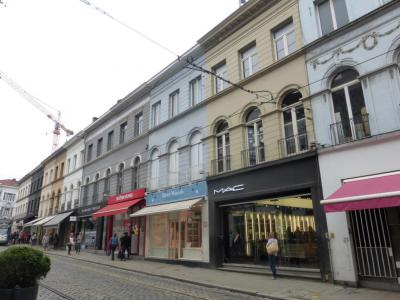
Brabantdam, located in the heart of Ghent, is a prominent shopping street that adds charm and variety to the city's extensive pedestrian shopping area-the largest in Belgium. Known for its blend of high-end fashion stores and unique boutiques, Brabantdam is a must-visit for anyone looking to experience Ghent’s vibrant retail scene. The street offers a couture blizzard of designer stores, with several boutiques that complement each other, creating a seamless shopping experience.
Whether you're exploring big-name clothing outlets or hunting for hidden gems among the smaller, authentic shops, Brabantdam caters to diverse tastes. A highlight for shopping enthusiasts is the first Sunday of each month when most shops are open, and special activities fill the city center, making it an ideal time to visit. While shops in the area are generally open on Sundays, they close on public holidays. So, if you’re in Ghent and eager to indulge in some retail therapy, don’t miss a stroll down Brabantdam and its stylish side streets.
Whether you're exploring big-name clothing outlets or hunting for hidden gems among the smaller, authentic shops, Brabantdam caters to diverse tastes. A highlight for shopping enthusiasts is the first Sunday of each month when most shops are open, and special activities fill the city center, making it an ideal time to visit. While shops in the area are generally open on Sundays, they close on public holidays. So, if you’re in Ghent and eager to indulge in some retail therapy, don’t miss a stroll down Brabantdam and its stylish side streets.
13) King Albert Park
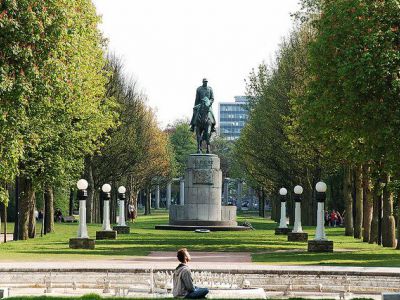
King Albert Park, also known as South Park (Zuidpark), is a city park in the southeastern part of Ghent, nestled between Woodrow Wilson Square and the exits of the B401 highway. This neo-Baroque park stands out among Ghent's green spaces, which are predominantly designed in the English landscape style. The park's origins date back to the 1930s when it was established on the former railway site of the demolished Gare du Midi, which had been replaced by the Gent-Sint-Pieters station. Following the death of King Albert I in 1934, the park was officially named King Albert Park.
Initially laid out in an Art Deco style, the park featured sleek geometric designs, an Art Deco post office at its northern end, and a bandstand. In 1956, the Propaganda Centre was added, along with an administrative building for the Municipal Electricity, Gas, and Water Services. Although architect Gaston Eysselinck had plans to construct exhibition palaces, these were never realized. Over time, the park also became home to a monument dedicated to King Albert, a monument for the fall of the world wars, a statue of a wounded swordsman, and a bust of Karel Van de Woestijne, which was later removed due to vandalism.
King Albert Park has seen major changes over the years. Before World War II, it was surrounded by low-rise buildings and mansions, which were replaced by offices and apartments after the war. In 1969-1970, part of the park was lost to a motorway connecting to the E17, increasing traffic. The city's Administrative Center was built to the north in the early 1990s, visually separating the park from Woodrow Wilson Square. Later in the 1990s, the park's plantations and flowerbeds were replaced with low-maintenance gardens, and its remaining Art Deco features were removed during a 2006 redevelopment.
Initially laid out in an Art Deco style, the park featured sleek geometric designs, an Art Deco post office at its northern end, and a bandstand. In 1956, the Propaganda Centre was added, along with an administrative building for the Municipal Electricity, Gas, and Water Services. Although architect Gaston Eysselinck had plans to construct exhibition palaces, these were never realized. Over time, the park also became home to a monument dedicated to King Albert, a monument for the fall of the world wars, a statue of a wounded swordsman, and a bust of Karel Van de Woestijne, which was later removed due to vandalism.
King Albert Park has seen major changes over the years. Before World War II, it was surrounded by low-rise buildings and mansions, which were replaced by offices and apartments after the war. In 1969-1970, part of the park was lost to a motorway connecting to the E17, increasing traffic. The city's Administrative Center was built to the north in the early 1990s, visually separating the park from Woodrow Wilson Square. Later in the 1990s, the park's plantations and flowerbeds were replaced with low-maintenance gardens, and its remaining Art Deco features were removed during a 2006 redevelopment.
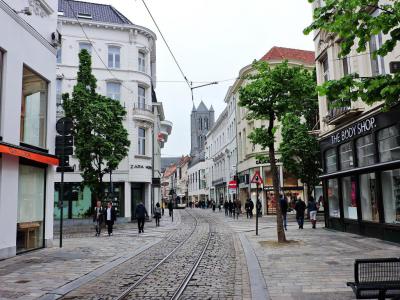
14) Veldstraat (Veld Street)
Veld Street (Veldstraat), located in the heart of Ghent, is the city's main shopping street and one of the most significant retail destinations in the country, often compared to other famous Belgian shopping streets like Brussels' Nieuwstraat and Antwerp's Meir. Stretching approximately 400 meters, Veld Street is a bustling hub of commerce and history.
Veld Street dates back to 1164 as Platea de Velde, originally a rural path through farmland outside Ghent. By the 12th and 13th centuries, it urbanized and became one of the city's first roads, attracting wealthy citizens who built stone houses in the 14th century. The street's architecture evolved from Romanesque stone and stepped gables, though little remains today. In the 18th and 19th centuries, it became known for large hotels, hosting notable guests like Louis XVIII, Wellington, and the American delegation at the signing of the Treaty of Ghent.
Veld Street's evolution into a major shopping street began in earnest at the end of the 19th century, marked by the widening of the street and the construction of new buildings, especially on the side adjacent to the Korenmarkt. This transformation established it as the premier retail destination in Ghent. Today, Veld Street's character is defined by its 19th-century architecture, though many of these historical buildings have been altered at street level to accommodate retail spaces that contrast with their upper façades.
The modern-day Veld Street is dominated by branches of large retail chains, such as H&M, Zara, Massimo Dutti, and Esprit. Over the years, the presence of independent stores has dwindled, with many family-run businesses closing their doors.
Veld Street dates back to 1164 as Platea de Velde, originally a rural path through farmland outside Ghent. By the 12th and 13th centuries, it urbanized and became one of the city's first roads, attracting wealthy citizens who built stone houses in the 14th century. The street's architecture evolved from Romanesque stone and stepped gables, though little remains today. In the 18th and 19th centuries, it became known for large hotels, hosting notable guests like Louis XVIII, Wellington, and the American delegation at the signing of the Treaty of Ghent.
Veld Street's evolution into a major shopping street began in earnest at the end of the 19th century, marked by the widening of the street and the construction of new buildings, especially on the side adjacent to the Korenmarkt. This transformation established it as the premier retail destination in Ghent. Today, Veld Street's character is defined by its 19th-century architecture, though many of these historical buildings have been altered at street level to accommodate retail spaces that contrast with their upper façades.
The modern-day Veld Street is dominated by branches of large retail chains, such as H&M, Zara, Massimo Dutti, and Esprit. Over the years, the presence of independent stores has dwindled, with many family-run businesses closing their doors.
