Custom Walk in San Francisco, California by lularosenbach_e83d3 created on 2025-05-22
Guide Location: USA » San Francisco
Guide Type: Custom Walk
# of Sights: 7
Tour Duration: 4 Hour(s)
Travel Distance: 11.1 Km or 6.9 Miles
Share Key: X5PP7
Guide Type: Custom Walk
# of Sights: 7
Tour Duration: 4 Hour(s)
Travel Distance: 11.1 Km or 6.9 Miles
Share Key: X5PP7
How It Works
Please retrieve this walk in the GPSmyCity app. Once done, the app will guide you from one tour stop to the next as if you had a personal tour guide. If you created the walk on this website or come to the page via a link, please follow the instructions below to retrieve the walk in the app.
Retrieve This Walk in App
Step 1. Download the app "GPSmyCity: Walks in 1K+ Cities" on Apple App Store or Google Play Store.



Step 2. In the GPSmyCity app, download(or launch) the guide "San Francisco Map and Walking Tours".
Step 3. Tap the menu button located at upper right corner of the "Walks" screen and select "Retrieve custom walk". Enter the share key: X5PP7
1) Palace of Fine Arts (must see)
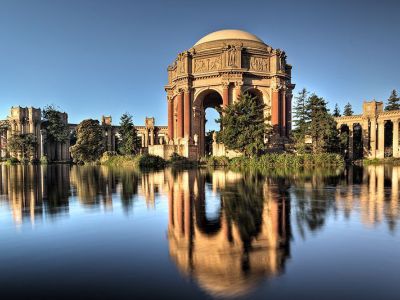
The Palace of Fine Arts stands as an impressive edifice situated in San Francisco's Marina District, originally erected for the 1915 Panama–Pacific International Exposition to showcase magnificent works of art. Though the passing years have taken their toll, the structure underwent a complete reconstruction from 1964 to 1974, making it the sole surviving building from the historical exposition.
Embracing a small man-made lagoon, the Palace of Fine Arts features a sprawling 1,100 feet (0.34 kilometer) pergola encircling a central rotunda, gracefully positioned near the water's edge. The designers drew inspiration from European classical settings, where serene bodies of water mirrored the grand architecture, offering a tranquil vista to behold from afar.
Adorning the rotunda's entablature, Bruno Zimm's three repeating panels portray "The Struggle for the Beautiful," a tribute to Greek culture. Additionally, sculptor Ulric Ellerhusen contributed the statues of weeping women atop the colonnade, along with a sculpted frieze and allegorical figures representing Contemplation, Wonderment, and Meditation.
Underneath the rotunda's dome, one can find eight substantial insets that once showcased murals by Robert Reid. Four of these depicted the inception and birth of Art, its relationship with the Earth, its progression, and its acceptance by human intellect. The remaining insets celebrated California's four "golds," symbolizing poppies, citrus fruits, metallic gold, and wheat.
Designed to evoke the essence of ancient Roman ruins, the Palace of Fine Arts has become an iconic landmark of San Francisco. In the early months of 2009, extensive renovations were carried out, revitalizing the lagoons, and walkways, and ensuring the structure's seismic resilience.
Why You Should Visit:
Historic architectural structure in a sweet area for picnic lunch!
Worth checking out especially if you are into photography.
Tip:
Go inside and see the museum if it's open. There's no fee and you can walk across the street and check out the bay right afterwards.
Embracing a small man-made lagoon, the Palace of Fine Arts features a sprawling 1,100 feet (0.34 kilometer) pergola encircling a central rotunda, gracefully positioned near the water's edge. The designers drew inspiration from European classical settings, where serene bodies of water mirrored the grand architecture, offering a tranquil vista to behold from afar.
Adorning the rotunda's entablature, Bruno Zimm's three repeating panels portray "The Struggle for the Beautiful," a tribute to Greek culture. Additionally, sculptor Ulric Ellerhusen contributed the statues of weeping women atop the colonnade, along with a sculpted frieze and allegorical figures representing Contemplation, Wonderment, and Meditation.
Underneath the rotunda's dome, one can find eight substantial insets that once showcased murals by Robert Reid. Four of these depicted the inception and birth of Art, its relationship with the Earth, its progression, and its acceptance by human intellect. The remaining insets celebrated California's four "golds," symbolizing poppies, citrus fruits, metallic gold, and wheat.
Designed to evoke the essence of ancient Roman ruins, the Palace of Fine Arts has become an iconic landmark of San Francisco. In the early months of 2009, extensive renovations were carried out, revitalizing the lagoons, and walkways, and ensuring the structure's seismic resilience.
Why You Should Visit:
Historic architectural structure in a sweet area for picnic lunch!
Worth checking out especially if you are into photography.
Tip:
Go inside and see the museum if it's open. There's no fee and you can walk across the street and check out the bay right afterwards.
2) Lombard Street (must see)
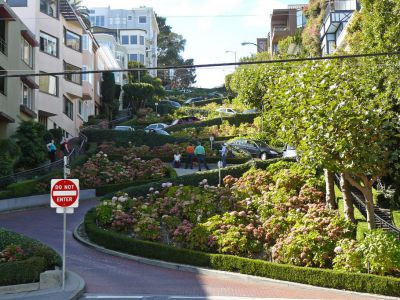
As a tourist magnet, Lombard Street is recognized as the most crooked street in the world. It takes eight turns on a 24-degree slope to make one feel that it is also, indeed, one of the steepest.
Even though walking or cycling this one-way (downhill) street may instill a sense of immediate vertigo, which can be risky at times, the reason for Lombard's crooked form, surprisingly, is safety. Given the natural grading of the land, the zig-zag pattern reduces the effect of the slope's steepness, making it easier to play on. As far back as 1920, it was suggested that scenic switchbacks to be added to bring a certain appeal to the surroundings, and apparently, it worked.
Year after year, Lombard Street manages to get more than its share of visitors who marvel at its scenic beauty and strangeness. Although zig-zag patterns may be enough to visit, a lesser-known fact about this street is that it houses some of San Francisco's most magnificent mansions. One of them – the Montandon House – is also reputed for being haunted.
For many, if not all, guests of San Francisco, a visit to Lombard Street is a must, if only to check it off their bucket list!
Tip:
Around 10 am is the best time to visit due to less crowd and sunshine. It is nice to start at the top and look down, then walk down and look up. Not only is it a lot easier, but if you carry on down the road, it will lead you to Coit Tower, another attraction in its own right, offering panoramic views over the city and the bay.
Even though walking or cycling this one-way (downhill) street may instill a sense of immediate vertigo, which can be risky at times, the reason for Lombard's crooked form, surprisingly, is safety. Given the natural grading of the land, the zig-zag pattern reduces the effect of the slope's steepness, making it easier to play on. As far back as 1920, it was suggested that scenic switchbacks to be added to bring a certain appeal to the surroundings, and apparently, it worked.
Year after year, Lombard Street manages to get more than its share of visitors who marvel at its scenic beauty and strangeness. Although zig-zag patterns may be enough to visit, a lesser-known fact about this street is that it houses some of San Francisco's most magnificent mansions. One of them – the Montandon House – is also reputed for being haunted.
For many, if not all, guests of San Francisco, a visit to Lombard Street is a must, if only to check it off their bucket list!
Tip:
Around 10 am is the best time to visit due to less crowd and sunshine. It is nice to start at the top and look down, then walk down and look up. Not only is it a lot easier, but if you carry on down the road, it will lead you to Coit Tower, another attraction in its own right, offering panoramic views over the city and the bay.
3) Washington Square
Washington Square—the green heart of San Francisco’s North Beach—is one of the city’s oldest and most cherished public parks. It was laid out in 1847 when surveyor Jasper O’Farrell penciled it into the city’s early street grid. Three years later, Mayor John W. Geary made it official, though back then it was less “picturesque picnic spot” and more “everything the city didn’t know what to do with.” Prior to becoming a public gathering space, it served as a dump, a pasture, a cemetery, and even a construction site—all on land once owned by Juana Briones, a Mexican rancher who raised her cattle and potatoes there long before brunch crowds claimed the turf.
During the 1860s, Washington Square became a setting for civic events such as Independence Day celebrations and later (as the surrounding neighborhood grew into a predominantly Italian enclave) for Italian-American festivities. When Columbus Avenue sliced diagonally through the square in the 1870s, it gave the park its current asymmetrical charm — a quirk that San Franciscans have been proud of ever since. After the 1906 earthquake, Washington Square doubled as a tent village for hundreds of displaced residents, proving once again that it’s the kind of place people naturally gravitate to when everything else falls apart.
Throughout the 20th century, the park remained a focal point of community life, though not without controversy—recurring schemes to dig an underground parking lot were met by the locals saying “no thanks” every single time. Visionary designers Lawrence Halprin and Douglas Baylis gave the square its modern, circular layout in 1958. Officially designated a San Francisco landmark in 2000, the square now thrives as a rare slice of continuity amid the city’s constant reinvention.
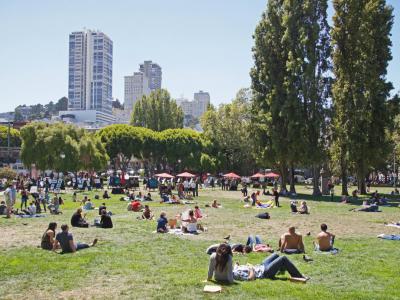
Today, the park is pure energy, with morning Tai Chi sessions, families picnicking under the sun, kids chasing pigeons, bells from the historic Saints Peter and Paul Church (the one often referred to as the “Italian Cathedral of the West”), and the hum of conversations in Italian, English, and caffeine. The bronze statue of Benjamin Franklin, installed in 1879 by philanthropist Henry Cogswell, conceals a time capsule beneath its feet, set to be opened every hundred years—proof that even history here comes with a wink and a deadline...
During the 1860s, Washington Square became a setting for civic events such as Independence Day celebrations and later (as the surrounding neighborhood grew into a predominantly Italian enclave) for Italian-American festivities. When Columbus Avenue sliced diagonally through the square in the 1870s, it gave the park its current asymmetrical charm — a quirk that San Franciscans have been proud of ever since. After the 1906 earthquake, Washington Square doubled as a tent village for hundreds of displaced residents, proving once again that it’s the kind of place people naturally gravitate to when everything else falls apart.
Throughout the 20th century, the park remained a focal point of community life, though not without controversy—recurring schemes to dig an underground parking lot were met by the locals saying “no thanks” every single time. Visionary designers Lawrence Halprin and Douglas Baylis gave the square its modern, circular layout in 1958. Officially designated a San Francisco landmark in 2000, the square now thrives as a rare slice of continuity amid the city’s constant reinvention.
Today, the park is pure energy, with morning Tai Chi sessions, families picnicking under the sun, kids chasing pigeons, bells from the historic Saints Peter and Paul Church (the one often referred to as the “Italian Cathedral of the West”), and the hum of conversations in Italian, English, and caffeine. The bronze statue of Benjamin Franklin, installed in 1879 by philanthropist Henry Cogswell, conceals a time capsule beneath its feet, set to be opened every hundred years—proof that even history here comes with a wink and a deadline...
4) Chinatown Gate (Dragon's Gate)
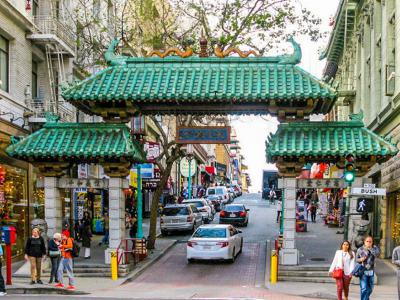
In keeping with Feng Shui principles, the southern edge of San Francisco’s Chinatown is marked by a towering gateway that straddles the bustle of Grant Avenue. This is the Dragon Gate, a flamboyant arch dressed in curling green dragons and traditional tiles. It might look timeless, but it’s actually a relative newcomer-unveiled only in 1970. Its materials were a gift from Taiwan, while the elegant design came from Chinese-American architect Clayton Lee, who modeled it after the ceremonial village gates of old China. Across the top, four carved Chinese characters proclaim a message of welcome: “All under heaven is for the good of the people.”
Guarding the arch are a pair of stone lions, known as fu dogs. On the west side, the male lion steadies a ball beneath his paw, symbolizing protection of the outside world. On the east, the lioness rests her paw on a playful cub, representing the nurturing of family. Together, they embody the balance of strength and care, ensuring that any evil spirits think twice before crossing the threshold.
Pass beneath the gate, and the character of the neighborhood unfolds in full color. In the 1920s, local merchants reinvented Chinatown’s appearance by adding pagoda-roofed façades and bright ornamental details-a pioneering initiative which created an identity that has drawn visitors ever since. The once-notorious red-light district gave way to lantern-strung streets. As evening sets in, the dragon-shaped streetlights flicker on, casting a warm glow across the lively thoroughfare, bustling with herbal shops, bakeries, tea houses, and jewelry stores.
Guarding the arch are a pair of stone lions, known as fu dogs. On the west side, the male lion steadies a ball beneath his paw, symbolizing protection of the outside world. On the east, the lioness rests her paw on a playful cub, representing the nurturing of family. Together, they embody the balance of strength and care, ensuring that any evil spirits think twice before crossing the threshold.
Pass beneath the gate, and the character of the neighborhood unfolds in full color. In the 1920s, local merchants reinvented Chinatown’s appearance by adding pagoda-roofed façades and bright ornamental details-a pioneering initiative which created an identity that has drawn visitors ever since. The once-notorious red-light district gave way to lantern-strung streets. As evening sets in, the dragon-shaped streetlights flicker on, casting a warm glow across the lively thoroughfare, bustling with herbal shops, bakeries, tea houses, and jewelry stores.
5) Painted Ladies
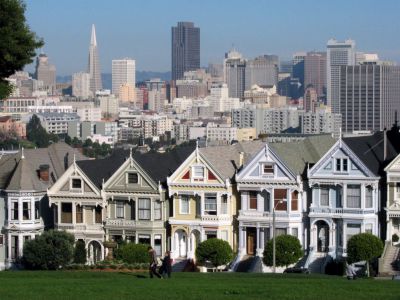
In American architecture, there exists a captivating style known as "Painted Ladies," which refers to Victorian and Edwardian houses and buildings adorned with vibrant colors to accentuate their architectural intricacies. This trend emerged during the 1960s and involved repainting these structures with three or more colors, creating a delightful visual spectacle. The term "Painted Ladies" was initially coined by writers Elizabeth Pomada and Michael Larsen in their 1978 book, "Painted Ladies: San Francisco's Resplendent Victorians," primarily focusing on the Victorian houses in San Francisco.
During the Victorian era, polychrome decoration was common, but the color combinations on these houses aren't historically accurate. In 1963, artist Butch Kardum started a trend by painting his Italianate-style Victorian house with intense blues and greens, inspiring others to do the same. This led to a colorist movement, impacting streets and neighborhoods throughout the 1970s and leaving a lasting mark on the cityscape, which continues today.
The famous "Painted Ladies" on 710–720 Steiner Street, known as "Postcard Row" or the "Seven Sisters," were built between 1892 and 1896 by developer Matthew Kavanaugh. Interestingly, Kavanaugh himself lived in the luxurious 1892 mansion at 722 Steiner Street. This block has become a popular spot in media and attracts tourists due to its appearances in about 70 movies, TV shows, and advertisements, including the iconic opening credits of "Full House" and "Fuller House."
During the Victorian era, polychrome decoration was common, but the color combinations on these houses aren't historically accurate. In 1963, artist Butch Kardum started a trend by painting his Italianate-style Victorian house with intense blues and greens, inspiring others to do the same. This led to a colorist movement, impacting streets and neighborhoods throughout the 1970s and leaving a lasting mark on the cityscape, which continues today.
The famous "Painted Ladies" on 710–720 Steiner Street, known as "Postcard Row" or the "Seven Sisters," were built between 1892 and 1896 by developer Matthew Kavanaugh. Interestingly, Kavanaugh himself lived in the luxurious 1892 mansion at 722 Steiner Street. This block has become a popular spot in media and attracts tourists due to its appearances in about 70 movies, TV shows, and advertisements, including the iconic opening credits of "Full House" and "Fuller House."
6) Castro District
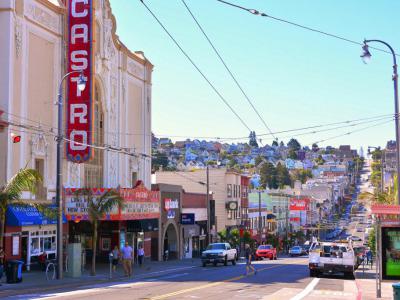
San Francisco, as a vibrant city, offers an abundance of captivating destinations to explore. From museums, churches, parks, and streets to unique local pockets, there is something for everyone. A visit to San Francisco would not be complete without experiencing the Castro District, the city's renowned LGBTQ+ neighborhood.
The Castro District is not only steeped in history but also showcases some of the finest architectural marvels and residences in San Francisco. Named after Jose Castro, a prominent Mexican leader during the Mexican-American War of 1846-48, this neighborhood emerged in the late 19th century when it became connected to Eureka Valley through Market Street.
Originally settled by immigrants from Sweden, Finland, Norway, and Denmark, the area earned the nickname "Little Scandinavia." Even today, traces of Scandinavian architectural influence can be admired in numerous buildings.
During World War II, the Castro District gained recognition as a haven for gay individuals when many servicemen were discharged from the military due to their sexual orientation. These brave ex-servicemen found refuge in the Castro District and, since then, the area has proudly welcomed people of diverse sexual orientations. Not only is the Castro District America's first openly gay neighborhood, but it also holds the distinction of being the largest gay neighborhood in the world.
The Castro District is not only steeped in history but also showcases some of the finest architectural marvels and residences in San Francisco. Named after Jose Castro, a prominent Mexican leader during the Mexican-American War of 1846-48, this neighborhood emerged in the late 19th century when it became connected to Eureka Valley through Market Street.
Originally settled by immigrants from Sweden, Finland, Norway, and Denmark, the area earned the nickname "Little Scandinavia." Even today, traces of Scandinavian architectural influence can be admired in numerous buildings.
During World War II, the Castro District gained recognition as a haven for gay individuals when many servicemen were discharged from the military due to their sexual orientation. These brave ex-servicemen found refuge in the Castro District and, since then, the area has proudly welcomed people of diverse sexual orientations. Not only is the Castro District America's first openly gay neighborhood, but it also holds the distinction of being the largest gay neighborhood in the world.
7) Dolores Park
Dolores Park, also known as Mission Dolores Park, is a spacious urban park situated in San Francisco. It resides just two blocks south of Mission Dolores, at the western boundary of the Mission District.
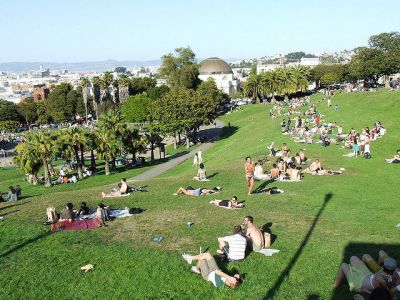
The park is bordered by 18th Street (north), 20th Street (south), Dolores Street (east), and Church Street (west). Mission High School is across from the park's northern end. Surrounding the park are residential buildings of varying heights and styles. South of the park is "Dolores Heights," and the Castro neighborhood is nearby. The park slopes from southwest to northeast, offering a clear view of downtown San Francisco, especially from the southwest corner.
Dolores Park offers a range of amenities, including numerous tennis courts, a basketball court, a multi-purpose court, a soccer field, a children's playground, and a designated area for dogs to play. The southern portion of the park is particularly noteworthy for its panoramic vistas of the Mission district, downtown San Francisco, San Francisco Bay, and the East Bay. Running along the park's western edge is the Muni Metro J-Church streetcar line.
Located east of Twin Peaks, Dolores Park enjoys a warm and sunny microclimate within the Mission neighborhood, which was recognized as one of the world's coolest neighborhoods in 2016. In recent years, the park's popularity among San Franciscans seeking outdoor relaxation and recreational activities has grown significantly.
The park is bordered by 18th Street (north), 20th Street (south), Dolores Street (east), and Church Street (west). Mission High School is across from the park's northern end. Surrounding the park are residential buildings of varying heights and styles. South of the park is "Dolores Heights," and the Castro neighborhood is nearby. The park slopes from southwest to northeast, offering a clear view of downtown San Francisco, especially from the southwest corner.
Dolores Park offers a range of amenities, including numerous tennis courts, a basketball court, a multi-purpose court, a soccer field, a children's playground, and a designated area for dogs to play. The southern portion of the park is particularly noteworthy for its panoramic vistas of the Mission district, downtown San Francisco, San Francisco Bay, and the East Bay. Running along the park's western edge is the Muni Metro J-Church streetcar line.
Located east of Twin Peaks, Dolores Park enjoys a warm and sunny microclimate within the Mission neighborhood, which was recognized as one of the world's coolest neighborhoods in 2016. In recent years, the park's popularity among San Franciscans seeking outdoor relaxation and recreational activities has grown significantly.
