Custom Walk in Catania, Italy by sobrino_pablo_l_96239 created on 2025-05-23
Guide Location: Italy » Catania
Guide Type: Custom Walk
# of Sights: 10
Tour Duration: 3 Hour(s)
Travel Distance: 5.9 Km or 3.7 Miles
Share Key: EAU75
Guide Type: Custom Walk
# of Sights: 10
Tour Duration: 3 Hour(s)
Travel Distance: 5.9 Km or 3.7 Miles
Share Key: EAU75
How It Works
Please retrieve this walk in the GPSmyCity app. Once done, the app will guide you from one tour stop to the next as if you had a personal tour guide. If you created the walk on this website or come to the page via a link, please follow the instructions below to retrieve the walk in the app.
Retrieve This Walk in App
Step 1. Download the app "GPSmyCity: Walks in 1K+ Cities" on Apple App Store or Google Play Store.



Step 2. In the GPSmyCity app, download(or launch) the guide "Catania Map and Walking Tours".
Step 3. Tap the menu button located at upper right corner of the "Walks" screen and select "Retrieve custom walk". Enter the share key: EAU75
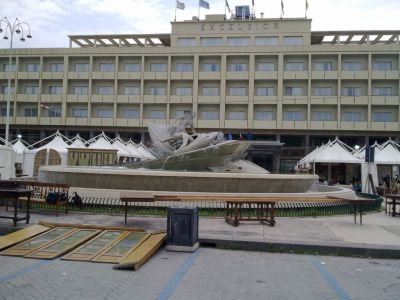
1) Fontana dei Malavoglia (Malavoglia Fountain)
The Malavoglia Fountain, a monumental landmark in Catania, graces Giovanni Verga Square as a poignant tribute to the city’s literary and cultural legacy. Designed by Carmelo Mendola, a self-taught sculptor from Catania, the fountain commemorates Giovanni Verga, one of Italy’s most renowned writers and the author of the iconic 1881 novel I Malavoglia (The House by the Medlar Tree). The sculptural group stylizes a dramatic episode from the novel, encapsulating the hardships faced by the Malavoglia family and, symbolically, the struggles of the Sicilian people.
Born from a 1956 municipal competition to honor Verga, the fountain took nearly two decades to complete. Mendola’s winning design prevailed despite skepticism from contemporary artists, and the final work was inaugurated on October 25, 1975, shortly before the artist's death in February 1976.
Central to the fountain is a bronze depiction of the fishing boat “Provvidenza” caught amidst turbulent waves. This imagery powerfully conveys the novel’s themes of resilience and struggle, rendering the fountain not just a piece of public art but a visual narrative of Sicilian life. The dramatic interplay of water jets and lighting amplifies its scenographic effect, captivating visitors and symbolizing hope amidst adversity.
In 2021, the fountain underwent a comprehensive restoration. Updates included new water diffusion and electrical recycling systems, restored lighting, and a return to its original coloration. It was ceremoniously reopened to the public on September 3, 2021, under the stewardship of Mayor Salvo Pogliese.
The Malavoglia Fountain stands today as more than a monument; it is a symbol of Catania’s cultural richness and enduring spirit, connecting the city’s historical past with its vibrant present.
Born from a 1956 municipal competition to honor Verga, the fountain took nearly two decades to complete. Mendola’s winning design prevailed despite skepticism from contemporary artists, and the final work was inaugurated on October 25, 1975, shortly before the artist's death in February 1976.
Central to the fountain is a bronze depiction of the fishing boat “Provvidenza” caught amidst turbulent waves. This imagery powerfully conveys the novel’s themes of resilience and struggle, rendering the fountain not just a piece of public art but a visual narrative of Sicilian life. The dramatic interplay of water jets and lighting amplifies its scenographic effect, captivating visitors and symbolizing hope amidst adversity.
In 2021, the fountain underwent a comprehensive restoration. Updates included new water diffusion and electrical recycling systems, restored lighting, and a return to its original coloration. It was ceremoniously reopened to the public on September 3, 2021, under the stewardship of Mayor Salvo Pogliese.
The Malavoglia Fountain stands today as more than a monument; it is a symbol of Catania’s cultural richness and enduring spirit, connecting the city’s historical past with its vibrant present.
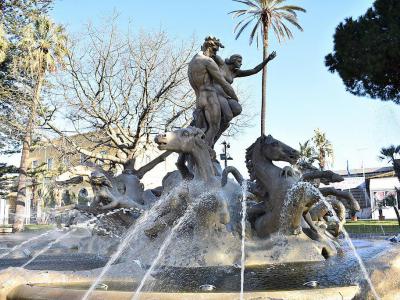
2) Fontana di Proserpina (Proserpina Fountain)
The Fountain of the Rape of Proserpina is a monumental landmark in Catania, showcasing the city's blend of artistic grandeur and mythological heritage. Constructed in 1904 by the sculptor Giulio Moschetti, with assistance from his son Mario, the fountain is situated at the end of Via VI Aprile, adjacent to the main building of Catania’s central station. The project was envisioned to embellish the area surrounding the railway station, which had been established in 1867.
The fountain's design draws from the Greek myth of Proserpina (Persephone), the daughter of Demeter, goddess of fertility. According to legend, Proserpina was abducted in Sicily near Enna by Hades, the god of the underworld, who made her his queen. Responding to Demeter's grief, Hades agreed to allow Proserpina to leave the underworld annually, marking the spring and summer seasons of growth and renewal. This story, symbolic of prosperity and cyclic journeys, is vividly captured in the fountain's centerpiece, which depicts the dramatic moment of the abduction.
The fountain's expansive basin, an innovative design for its time, was constructed from raw concrete-a material then rarely used in public art. This allowed for intricate shapes, with undulating edges and varying depths that create dynamic water reflections. The sculptural group includes Proserpina and Hades atop a rocky rise, surrounded by lively figures of sea horses and mermaids in expressive, dramatic poses.
In the late 20th century, the fountain underwent restoration to preserve its artistic and cultural significance. Today, it stands as a testament to Catania's rich history, offering visitors a glimpse into its mythological roots and the artistry of a bygone era.
The fountain's design draws from the Greek myth of Proserpina (Persephone), the daughter of Demeter, goddess of fertility. According to legend, Proserpina was abducted in Sicily near Enna by Hades, the god of the underworld, who made her his queen. Responding to Demeter's grief, Hades agreed to allow Proserpina to leave the underworld annually, marking the spring and summer seasons of growth and renewal. This story, symbolic of prosperity and cyclic journeys, is vividly captured in the fountain's centerpiece, which depicts the dramatic moment of the abduction.
The fountain's expansive basin, an innovative design for its time, was constructed from raw concrete-a material then rarely used in public art. This allowed for intricate shapes, with undulating edges and varying depths that create dynamic water reflections. The sculptural group includes Proserpina and Hades atop a rocky rise, surrounded by lively figures of sea horses and mermaids in expressive, dramatic poses.
In the late 20th century, the fountain underwent restoration to preserve its artistic and cultural significance. Today, it stands as a testament to Catania's rich history, offering visitors a glimpse into its mythological roots and the artistry of a bygone era.
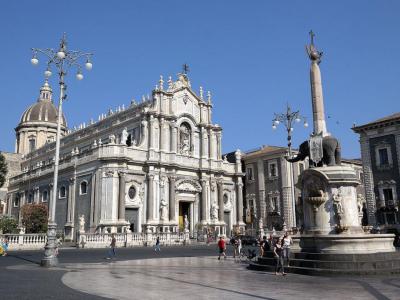
3) Piazza Duomo (Cathedral Square) (must see)
In the Cathedral Square there is a black lava elephant with an obelisk on his back. It is thought of as the symbol of Catania even if the inference is obscure. The elephant was brought here with his obelisk by Giovanni Battista Vaccarini. Giovanni was the architect charged with restoring the Square after the earthquake of 1693.
The Cathedral Square is the busy center of Catania. The Baroque square and the buildings around it are the restorations of architect Vaccarini, They are Uzeda Gate, from 1696, The great Cathedral, 1739, the Church of Saint Agatha, 1767, the Town Hall Building, 1741 and our friend, the Elephant, 1736. Altogether a stunning achievement.
Three streets connect to the square. First is Etnea Street. This is the cardo maximus, the north-south axis of the Ancient Roman City. Next is the Giuseppe Garibaldi Street, named for the great Italian patriot. Lastly we have the Vittorio Emanuele II Street, crossing the city from east to west.
The Town Hall Building, is on the north side of the square, facing the lava elephant of Vaccarini. On the opposite side the the Palace of the Clerics faces the Amenano fountain. The fountain is fed by the underground Amenano River.
The Festival of Saint Agatha is a three day celebration that starts on February 3 of each year. It involves a procession called "della luminaria", followed by a concert and fireworks.
The Cathedral Square is the busy center of Catania. The Baroque square and the buildings around it are the restorations of architect Vaccarini, They are Uzeda Gate, from 1696, The great Cathedral, 1739, the Church of Saint Agatha, 1767, the Town Hall Building, 1741 and our friend, the Elephant, 1736. Altogether a stunning achievement.
Three streets connect to the square. First is Etnea Street. This is the cardo maximus, the north-south axis of the Ancient Roman City. Next is the Giuseppe Garibaldi Street, named for the great Italian patriot. Lastly we have the Vittorio Emanuele II Street, crossing the city from east to west.
The Town Hall Building, is on the north side of the square, facing the lava elephant of Vaccarini. On the opposite side the the Palace of the Clerics faces the Amenano fountain. The fountain is fed by the underground Amenano River.
The Festival of Saint Agatha is a three day celebration that starts on February 3 of each year. It involves a procession called "della luminaria", followed by a concert and fireworks.
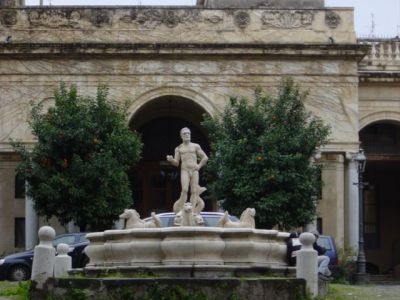
4) Palazzo Bruca (Bruca Palace)
The Bruca Palace, also known as Palazzo Scammacca della Bruca, stands as a testament to the grandeur and elegance of Catania’s Baroque period. Nestled in the heart of the city, just 150 meters from Cathedral Square (Piazza del Duomo), this 18th-century palace reflects the splendor of a bygone era. Originally built for the Scammacca della Bruca princes, it has retained much of its historical allure despite the passing of centuries.
One of the palace’s most striking features is its large walled inner courtyard, which boasts a magnificent Neoclassical fountain depicting Neptune, a symbol of power and majesty. Encircled by a loggia of Ionic columns, this courtyard is a sight to behold, often capturing the attention of curious passers-by who seize fleeting moments when the gates are open.
Palazzo Bruca’s history is deeply intertwined with the rebirth of Catania after the devastating earthquake of 1693. It was designed to project the wealth and influence of its aristocratic owners. Though time has left its mark, traces of its opulence remain. Notably, some rooms feature original painted ceilings from the 19th century, depicting scenes of grand parties hosted by Duke Scammacca Bruca.
Today, part of the palace has been transformed into an exclusive B&B, offering guests a unique opportunity to immerse themselves in history. Staying here is not just about enjoying modern comforts but also experiencing the enduring charm of a building that has witnessed Catania’s evolution through the centuries. The B&B is the only historic structure in the city center to preserve its original layout, including its storehouses, mezzanine, and main floors, untouched by 20th-century redesigns or post-war renovations.
The Bruca Palace is not just a place to stay-it’s a journey through the art, history, and legends of Sicily. Visitors are invited to explore its storied halls and hear captivating tales, making their time in Catania a truly unforgettable experience.
One of the palace’s most striking features is its large walled inner courtyard, which boasts a magnificent Neoclassical fountain depicting Neptune, a symbol of power and majesty. Encircled by a loggia of Ionic columns, this courtyard is a sight to behold, often capturing the attention of curious passers-by who seize fleeting moments when the gates are open.
Palazzo Bruca’s history is deeply intertwined with the rebirth of Catania after the devastating earthquake of 1693. It was designed to project the wealth and influence of its aristocratic owners. Though time has left its mark, traces of its opulence remain. Notably, some rooms feature original painted ceilings from the 19th century, depicting scenes of grand parties hosted by Duke Scammacca Bruca.
Today, part of the palace has been transformed into an exclusive B&B, offering guests a unique opportunity to immerse themselves in history. Staying here is not just about enjoying modern comforts but also experiencing the enduring charm of a building that has witnessed Catania’s evolution through the centuries. The B&B is the only historic structure in the city center to preserve its original layout, including its storehouses, mezzanine, and main floors, untouched by 20th-century redesigns or post-war renovations.
The Bruca Palace is not just a place to stay-it’s a journey through the art, history, and legends of Sicily. Visitors are invited to explore its storied halls and hear captivating tales, making their time in Catania a truly unforgettable experience.
5) Roman Theater of Catania (must see)
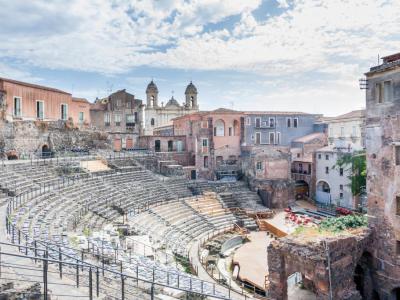
The Roman Theater of Catania is actually two open air semicircular theaters. The site is bordered by San Francesco Square, Vittorio Emanuele Street and Teatro Greco Street in central Catania. The large theater and the smaller one, called the Odeon, are part of Graeco-Roman Archaeological Park of Catania.
The theater was built in the 2nd century AD. It was not completely excavated until the 19th century. Seats rise up a hillside facing the sea. The orchestra and stage have a diameter of 84 feet. The cavea (seating) section has a depth of 322 feet. Twenty-one rows of seats could hold up to 7,000 spactators. Exits were below the seats.
After the fifth century AD the theater and Odeon were no longer used. Digging on the site began in the 18th century during the rule of Ignazio Paterno Castello, the Prince of Biscari.
Finally, in 1959 the site was cleared of houses that were encroaching on the area and the theater and the Odeon were exposed. Artifacts removed from the dig are displayed nearby in the Pandolfo House and Liberti House.
The theater was built in the 2nd century AD. It was not completely excavated until the 19th century. Seats rise up a hillside facing the sea. The orchestra and stage have a diameter of 84 feet. The cavea (seating) section has a depth of 322 feet. Twenty-one rows of seats could hold up to 7,000 spactators. Exits were below the seats.
After the fifth century AD the theater and Odeon were no longer used. Digging on the site began in the 18th century during the rule of Ignazio Paterno Castello, the Prince of Biscari.
Finally, in 1959 the site was cleared of houses that were encroaching on the area and the theater and the Odeon were exposed. Artifacts removed from the dig are displayed nearby in the Pandolfo House and Liberti House.
6) Odeon
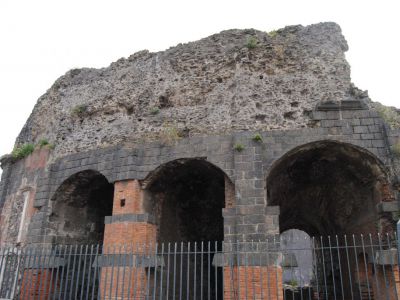
The Odeon of Catania stands as a testament to the city's rich ancient Roman heritage and architectural prowess. Constructed during the 2nd century AD as part of the Roman Theatre complex, this semicircular venue was primarily used for musical and poetic competitions, as well as rehearsals for performances in the main theatre. Located near San Francesco Square and nestled within the Greco-Roman Archaeological Park of Catania, the Odeon highlights the cultural and historical significance of Catania’s Roman past.
Built from lava rock, bricks, and marble, the Odeon could accommodate up to 1,500 spectators, offering a more intimate setting compared to its larger counterpart, the Roman Theatre. Its orchestra, a marble-paved semicircular area, remains a focal point of the structure. This careful integration of durable materials not only demonstrates the ingenuity of Roman engineering but also reflects the natural resources available in the region.
The Roman Theatre complex, of which the Odeon is a part, showcases a design typical of Roman theatres, with seats rising along the natural slope of the Montevergine hill. The larger theatre within the complex could hold nearly 7,000 spectators, with its intricately decorated scaenae frons and monumental entrances adding to its grandeur.
Both the Odeon and the larger theatre underwent several phases of construction and modification during the 1st through 4th centuries AD, achieving their lavish form in the 2nd century. However, by the 5th and 6th centuries, they fell out of use, eventually being buried under urban developments. Archaeological excavations in the 19th and 20th centuries, particularly during the 1960s, revealed much of the Odeon’s structure, although the function of some restored rooms remains unclear.
Visitors today can explore this ancient monument along with artifacts and marbles displayed in the nearby Casa Pandolfo and Casa Liberti, which serve as antiquaria. The Odeon provides an evocative glimpse into the vibrant cultural and artistic life of Roman Catania.
Built from lava rock, bricks, and marble, the Odeon could accommodate up to 1,500 spectators, offering a more intimate setting compared to its larger counterpart, the Roman Theatre. Its orchestra, a marble-paved semicircular area, remains a focal point of the structure. This careful integration of durable materials not only demonstrates the ingenuity of Roman engineering but also reflects the natural resources available in the region.
The Roman Theatre complex, of which the Odeon is a part, showcases a design typical of Roman theatres, with seats rising along the natural slope of the Montevergine hill. The larger theatre within the complex could hold nearly 7,000 spectators, with its intricately decorated scaenae frons and monumental entrances adding to its grandeur.
Both the Odeon and the larger theatre underwent several phases of construction and modification during the 1st through 4th centuries AD, achieving their lavish form in the 2nd century. However, by the 5th and 6th centuries, they fell out of use, eventually being buried under urban developments. Archaeological excavations in the 19th and 20th centuries, particularly during the 1960s, revealed much of the Odeon’s structure, although the function of some restored rooms remains unclear.
Visitors today can explore this ancient monument along with artifacts and marbles displayed in the nearby Casa Pandolfo and Casa Liberti, which serve as antiquaria. The Odeon provides an evocative glimpse into the vibrant cultural and artistic life of Roman Catania.
7) Via dei Crociferi
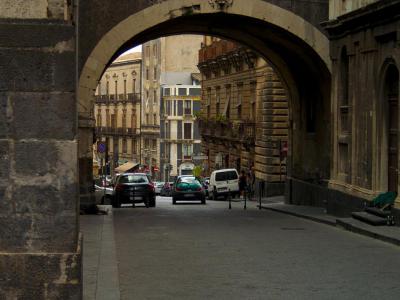
Via dei Crociferi in Catania is a masterpiece of 18th-century urban design and one of the finest examples of Baroque unity in Italy. Stretching a mere 410 meters, this monumental street is a visual feast of churches, monasteries, and select civilian houses. Beginning at San Francesco d'Assisi Square, the street is accessed through the graceful Arch of San Benedetto, which serves as a gateway to this Baroque treasure trove.
The first landmark is the Church of San Benedetto, situated on the west side. This church is intricately connected to the Benedictine convent via the namesake arch, which links the Badia Grande and Badia Piccola. The church is elevated above the street, accessible by a staircase framed by a wrought iron gate, adding to its imposing charm.
Further along the west side, the Church of San Francesco Borgia greets visitors with dual staircases leading to its grand entrance. This church is separated from San Benedetto by Via San Benedetto, a small street that leads to the elegant Asmundo Francica-Nava Palace, which overlooks Asmundo Square. Adjacent to the church is the former Jesuit College, now housing the old Art Institute. This structure boasts a magnificent cloister with columned porticoes and arches, a serene retreat amidst the bustling city.
Directly opposite the college stands the Church of San Giuliano, a pinnacle of Catania’s Baroque architecture attributed to Giovan Battista Vaccarini. Its convex façade and clean, harmonious lines make it a standout structure. Continuing further and crossing Via Antonino Di Sangiuliano, visitors encounter the Convent of the Crociferi and the Church of San Camillo.
The street concludes with Villa Cerami, a historic building now home to the Faculty of Law of the University of Catania. This villa, nestled at the end of Via dei Crociferi, adds a touch of academic prestige to the artistic splendor of the street.
The first landmark is the Church of San Benedetto, situated on the west side. This church is intricately connected to the Benedictine convent via the namesake arch, which links the Badia Grande and Badia Piccola. The church is elevated above the street, accessible by a staircase framed by a wrought iron gate, adding to its imposing charm.
Further along the west side, the Church of San Francesco Borgia greets visitors with dual staircases leading to its grand entrance. This church is separated from San Benedetto by Via San Benedetto, a small street that leads to the elegant Asmundo Francica-Nava Palace, which overlooks Asmundo Square. Adjacent to the church is the former Jesuit College, now housing the old Art Institute. This structure boasts a magnificent cloister with columned porticoes and arches, a serene retreat amidst the bustling city.
Directly opposite the college stands the Church of San Giuliano, a pinnacle of Catania’s Baroque architecture attributed to Giovan Battista Vaccarini. Its convex façade and clean, harmonious lines make it a standout structure. Continuing further and crossing Via Antonino Di Sangiuliano, visitors encounter the Convent of the Crociferi and the Church of San Camillo.
The street concludes with Villa Cerami, a historic building now home to the Faculty of Law of the University of Catania. This villa, nestled at the end of Via dei Crociferi, adds a touch of academic prestige to the artistic splendor of the street.
8) Roman Amphitheater
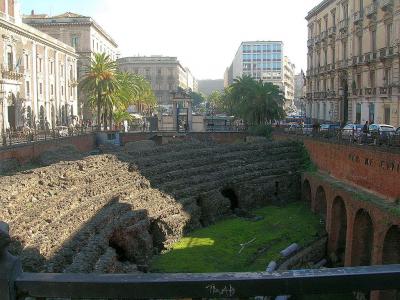
There is the Coloseum, the Ampithraetre of Capua, and the Verona Arena. They are in the groups of the largest arenas. The amphitheater of Catania, eroded, dismantled and mostly buried is also among that group. The amphitheater of Catania was built around 200 AD. It lies below the slopes of Montevergine Hill on the northern side of town.
Only a piece of it can be seen. It is close to the Stesorico Square. It is a part of the exhibit of the Greek-Roman Archaeological Park of Catania. It was an elliptical arena with radial walls and vaults to support the seats.
A gallery with a facade encircled the exterior. The ellipse of the arena had a large diameter of 268 feet. The small diameter was 164 feet. The outside diameters were 478 feet and 345 feet. The outside circumference was 1,015 feet. A respectable size overall. The materials used in the walls show some degree of recycling.
Seating capacity was about 15,000. More could have been accommodated by adding standing room only bleachers of wood. The theatre was able to stage sea battles, making use of the city's aqueduct. An iron gate is presently used for access. Two ionic columns flank the gate and support an architrave with the inscription, "Ampitheatrum Insigne".
Legend has it that the theatre was spared burial by lava in the eruption of Mount Etna in 251. It was in that year Saint Agatha died. Her spiritual intervention might have saved many. However, the lava stopped before reaching Catania. There is no evidence she favored sports arenas, but then she did favor Catania.
In 1693 the arena was buried by the earthquake of that year. Giovanni Gioeni used rubble to build homes and a neo-classical facade for the Church of San Biagio. The ground that buried the amphitheater was used as a garden. The amphitheater of Catania had just disappeared. It reappeared in excavations of the 1700s.
Only a tenth of the amphitheater is visible today.
Only a piece of it can be seen. It is close to the Stesorico Square. It is a part of the exhibit of the Greek-Roman Archaeological Park of Catania. It was an elliptical arena with radial walls and vaults to support the seats.
A gallery with a facade encircled the exterior. The ellipse of the arena had a large diameter of 268 feet. The small diameter was 164 feet. The outside diameters were 478 feet and 345 feet. The outside circumference was 1,015 feet. A respectable size overall. The materials used in the walls show some degree of recycling.
Seating capacity was about 15,000. More could have been accommodated by adding standing room only bleachers of wood. The theatre was able to stage sea battles, making use of the city's aqueduct. An iron gate is presently used for access. Two ionic columns flank the gate and support an architrave with the inscription, "Ampitheatrum Insigne".
Legend has it that the theatre was spared burial by lava in the eruption of Mount Etna in 251. It was in that year Saint Agatha died. Her spiritual intervention might have saved many. However, the lava stopped before reaching Catania. There is no evidence she favored sports arenas, but then she did favor Catania.
In 1693 the arena was buried by the earthquake of that year. Giovanni Gioeni used rubble to build homes and a neo-classical facade for the Church of San Biagio. The ground that buried the amphitheater was used as a garden. The amphitheater of Catania had just disappeared. It reappeared in excavations of the 1700s.
Only a tenth of the amphitheater is visible today.
9) Piazza Roma (Roma Square)
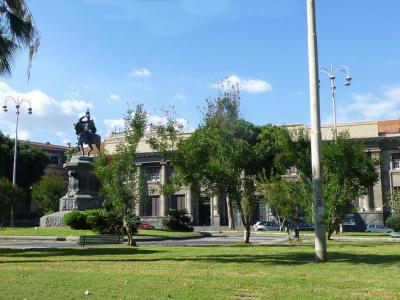
Roma Square (Piazza Roma), located in the Biancavilla area of Catania, is a square that elegantly blends historical significance with vibrant urban life. Nestled near the Church of Santa Maria dell'Elemosina and close to the Biancavilla Colombo railway stop, the square is a hub of local activity and a showcase of Italy's rich cultural heritage.
At the heart of Roma Square stands the Monument to Vittorio Emanuele II, a striking equestrian statue that pays tribute to Italy's first king and a key figure in the unification of the country. Depicting him as a valiant warrior astride a horse, the monument is a powerful reminder of Italy's journey toward unity and freedom.
The square is bordered by picturesque Italian villas and elegant Baroque-style buildings, a hallmark of Catania's architectural charm. It offers a blend of green spaces, shaded benches, and a central gathering point, making it a popular destination for relaxation and social interaction. The surrounding cafés and shops provide a lively backdrop, perfect for savoring a Sicilian espresso or exploring local specialties.
Roma Square also serves as a stage for cultural events and seasonal markets, where the energy of Catanese life is on full display. Whether you're drawn to its historical monuments, its architectural beauty, or its vibrant community spirit, Roma Square encapsulates the essence of Catania-an enchanting mix of tradition and modernity.
At the heart of Roma Square stands the Monument to Vittorio Emanuele II, a striking equestrian statue that pays tribute to Italy's first king and a key figure in the unification of the country. Depicting him as a valiant warrior astride a horse, the monument is a powerful reminder of Italy's journey toward unity and freedom.
The square is bordered by picturesque Italian villas and elegant Baroque-style buildings, a hallmark of Catania's architectural charm. It offers a blend of green spaces, shaded benches, and a central gathering point, making it a popular destination for relaxation and social interaction. The surrounding cafés and shops provide a lively backdrop, perfect for savoring a Sicilian espresso or exploring local specialties.
Roma Square also serves as a stage for cultural events and seasonal markets, where the energy of Catanese life is on full display. Whether you're drawn to its historical monuments, its architectural beauty, or its vibrant community spirit, Roma Square encapsulates the essence of Catania-an enchanting mix of tradition and modernity.
10) Orto Botanico (Botanical Garden)
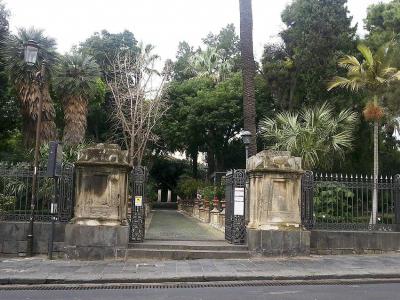
The Botanical Garden of the University of Catania (Orto Botanico dell'Università di Catania) is a prominent botanical garden covering an area of 16,000 square meters. It is managed by the University of Catania's botany department and holds membership in the Botanic Gardens Conservation International (BGCI).
The garden’s origins trace back to 1847 when an initial attempt to establish it was disrupted by the revolutions of 1848. It was successfully founded in 1858 by Francis Roccaforte Tornabene, a Benedictine monk and botanist. The first plantings, in 1862, featured specimens sourced from botanical gardens in Sweden, France, Naples, and Palermo. In 1865, thanks to a generous donation from Mario Coltraro, the garden expanded to include an area dedicated to indigenous Sicilian flora. In the early 1900s, the garden was further enriched by the creation of the Giardino Botanico "Nuova Gussonea" on Mount Etna, focusing on native mountain plants.
The Botanical Garden, revitalized after World War II damage and the 1958 loss of its Tepidario greenhouse, now spans two sections. The 13,000 square meters Hortus Generalis hosts exotic plants in limestone-bordered squares, with greenhouses for succulents, tropical species, and aquatic tanks. The 3,000 square meters Hortus Siculus focuses on Sicilian species, featuring lava-stone-bordered beds arranged by the botanical family.
The garden also boasts a striking neoclassical departmental building, adding architectural charm to this scientific and cultural landmark. The Orto Botanico stands as a testament to botanical heritage and research, offering visitors a unique glimpse into both exotic and native Sicilian plant species.
The garden’s origins trace back to 1847 when an initial attempt to establish it was disrupted by the revolutions of 1848. It was successfully founded in 1858 by Francis Roccaforte Tornabene, a Benedictine monk and botanist. The first plantings, in 1862, featured specimens sourced from botanical gardens in Sweden, France, Naples, and Palermo. In 1865, thanks to a generous donation from Mario Coltraro, the garden expanded to include an area dedicated to indigenous Sicilian flora. In the early 1900s, the garden was further enriched by the creation of the Giardino Botanico "Nuova Gussonea" on Mount Etna, focusing on native mountain plants.
The Botanical Garden, revitalized after World War II damage and the 1958 loss of its Tepidario greenhouse, now spans two sections. The 13,000 square meters Hortus Generalis hosts exotic plants in limestone-bordered squares, with greenhouses for succulents, tropical species, and aquatic tanks. The 3,000 square meters Hortus Siculus focuses on Sicilian species, featuring lava-stone-bordered beds arranged by the botanical family.
The garden also boasts a striking neoclassical departmental building, adding architectural charm to this scientific and cultural landmark. The Orto Botanico stands as a testament to botanical heritage and research, offering visitors a unique glimpse into both exotic and native Sicilian plant species.
