Custom Walk in Lucerne, Switzerland by charlesandrenee_a559d created on 2025-09-17
Guide Location: Switzerland » Lucerne
Guide Type: Custom Walk
# of Sights: 10
Tour Duration: 2 Hour(s)
Travel Distance: 3.9 Km or 2.4 Miles
Share Key: 42J9F
Guide Type: Custom Walk
# of Sights: 10
Tour Duration: 2 Hour(s)
Travel Distance: 3.9 Km or 2.4 Miles
Share Key: 42J9F
How It Works
Please retrieve this walk in the GPSmyCity app. Once done, the app will guide you from one tour stop to the next as if you had a personal tour guide. If you created the walk on this website or come to the page via a link, please follow the instructions below to retrieve the walk in the app.
Retrieve This Walk in App
Step 1. Download the app "GPSmyCity: Walks in 1K+ Cities" on Apple App Store or Google Play Store.



Step 2. In the GPSmyCity app, download(or launch) the guide "Lucerne Map and Walking Tours".
Step 3. Tap the menu button located at upper right corner of the "Walks" screen and select "Retrieve custom walk". Enter the share key: 42J9F
1) Lion Monument (must see)
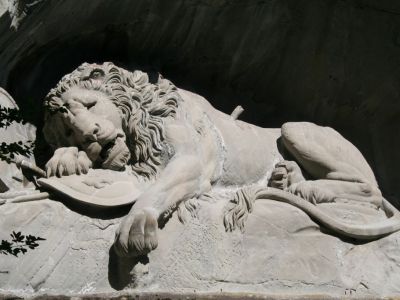
The Lion Monument, also known as the Lion of Lucerne, is a carved rock sculpture located in Lucerne, Switzerland. It was crafted in 1820 to honor the memory of the Swiss Guards who tragically lost their lives in 1792 during the French Revolution. This somber event occurred when revolutionaries attacked the Tuileries Palace in Paris. The Lion Monument stands as one of Switzerland's most renowned landmarks and draws approximately 1.4 million tourists annually.
Starting in the early 17th century, a Swiss Guards regiment had been a part of the Royal Army of France. On August 10th, 1792, as revolutionaries overran the palace, conflict erupted spontaneously after the royal family had been evacuated from the Tuileries to seek shelter with the Legislative Assembly. The Swiss Guards found themselves running out of ammunition and were ultimately overwhelmed by the numerically superior revolutionary forces.
In the course of the fighting or in the aftermath of their surrender, approximately 760 Swiss Guards who had defended the Tuileries lost their lives. An additional two hundred succumbed to their injuries while in prison or fell victim to the September Massacres that ensued.
The Lion Monument, an impressive piece of rock art carved into a cliff face, measures an imposing ten meters in length and six meters in height. It is dedicated to honoring the loyalty and courage of the Swiss. The sculpture depicts a dying lion impaled by a spear, with a shield bearing the emblem of the French monarchy covering its body. Adjacent to the lion, there is another shield bearing the coat of arms of Switzerland.
Mark Twain famously referred to this sculpture of a mortally wounded lion as "the most mournful and moving piece of stone in the world."
Starting in the early 17th century, a Swiss Guards regiment had been a part of the Royal Army of France. On August 10th, 1792, as revolutionaries overran the palace, conflict erupted spontaneously after the royal family had been evacuated from the Tuileries to seek shelter with the Legislative Assembly. The Swiss Guards found themselves running out of ammunition and were ultimately overwhelmed by the numerically superior revolutionary forces.
In the course of the fighting or in the aftermath of their surrender, approximately 760 Swiss Guards who had defended the Tuileries lost their lives. An additional two hundred succumbed to their injuries while in prison or fell victim to the September Massacres that ensued.
The Lion Monument, an impressive piece of rock art carved into a cliff face, measures an imposing ten meters in length and six meters in height. It is dedicated to honoring the loyalty and courage of the Swiss. The sculpture depicts a dying lion impaled by a spear, with a shield bearing the emblem of the French monarchy covering its body. Adjacent to the lion, there is another shield bearing the coat of arms of Switzerland.
Mark Twain famously referred to this sculpture of a mortally wounded lion as "the most mournful and moving piece of stone in the world."
2) Bourbaki Panorama (must see)
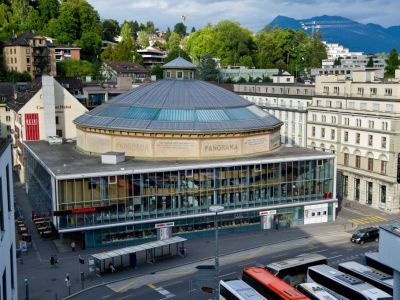
The Bourbaki Panorama is a giant, panoramic painting that pays homage to the internment of the 87,000 French Bourbaki soldiers who made their way from Prussia to Switzerland during the winter of 1871. The artist, Edouard Castres, had a first-hand account of this occurrence. He created the painting after seeing the horrors of war as a Red Cross worker.
The incident happened during the Franco-Prussian War. General Charles Bourbaki's French forces fled to Switzerland. They were starving and facing disease, but the Swiss army found homes for them where they could rest during the harsh winter.
The Bourbaki Panorama is on a 112x10 meter canvas. It is thought to be the inspiration for 360 degree filming and virtual reality due to its size and shape. Visitors can go to the museum to see this important painting any day of the week. It opens at 10 am throughout the year. The museum closes at 5 pm from November to March and at 6 pm from April through October.
Tip:
The Bourbaki Panorama is actually comprised of two levels; the first is a video/slide presentation (plus several artifacts), while the upper level is a spectacular 3D presentation with life-size figures in front of the actual painting. Be sure to study the story in order to understand the situation depicted.
The incident happened during the Franco-Prussian War. General Charles Bourbaki's French forces fled to Switzerland. They were starving and facing disease, but the Swiss army found homes for them where they could rest during the harsh winter.
The Bourbaki Panorama is on a 112x10 meter canvas. It is thought to be the inspiration for 360 degree filming and virtual reality due to its size and shape. Visitors can go to the museum to see this important painting any day of the week. It opens at 10 am throughout the year. The museum closes at 5 pm from November to March and at 6 pm from April through October.
Tip:
The Bourbaki Panorama is actually comprised of two levels; the first is a video/slide presentation (plus several artifacts), while the upper level is a spectacular 3D presentation with life-size figures in front of the actual painting. Be sure to study the story in order to understand the situation depicted.
3) Zytturm / Zeitturm (Time Tower)
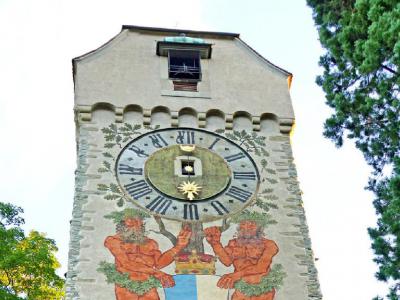
The most unique of the Musegg Wall towers – the Zytturm or Zeitturm (Time Tower) – was named so for being purposely designed to accommodate the city clock.
The tower was built in 1403 (some sources place the construction year at 1442), with certain wall sections reportedly dating to 1386. Originally, the building had a crenelated wreath and an inner pent roof that was replaced, later in the 15th century, with a half-hip roof that is seen today.
The tower stands 31 meters high and has a footprint of 9.1 x 7.25 meters. The clock dial measures 3 to 4 meters “carried” by two giant figures painted on the south façade. Placed in such a way that one could read the time from afar, the digits were made large enough to be seen by fishermen on the lake. Both the dial and the painting were first documented in Diebold Schilling's 16th century Lucerne Chronicle; their most recent renovation took place in 1939.
The Zytturm clockwork is the oldest in Lucerne and all of central Switzerland; the first mechanism – complete with stone weights and pendulum – was made in 1385 and then replaced by the current one in 1535.
Since the late Middle Ages the Time Tower has had the privilege of the first strike – its clock chimes the hour one minute before any other public clock in Lucerne. Its bell, the Leonhardsglocke – adorned with reliefs of the Crucifixion and Lucerne's coat of arms – was originally cast in 1370 and first hung in Saint Peter's Chapel on Kapellplatz.
Since the late Middle Ages, there has been a person tasked with winding the clock on a daily basis. The operating manual, dated 1386, is kept at the Lucerne State Archives.
As of 1951 the Zytturm has been open to the public: from April 1 to November 1. Admission is free.
Why You Should Visit:
One of Europe's most unique clock towers!
A climb to the top offers a great up-close view of the Old Town, the lake and the mountains.
Tip:
Be there on the hour to watch the inner clock workings, as the bells chime.
There are nine more historic clocks exhibited inside.
The tower was built in 1403 (some sources place the construction year at 1442), with certain wall sections reportedly dating to 1386. Originally, the building had a crenelated wreath and an inner pent roof that was replaced, later in the 15th century, with a half-hip roof that is seen today.
The tower stands 31 meters high and has a footprint of 9.1 x 7.25 meters. The clock dial measures 3 to 4 meters “carried” by two giant figures painted on the south façade. Placed in such a way that one could read the time from afar, the digits were made large enough to be seen by fishermen on the lake. Both the dial and the painting were first documented in Diebold Schilling's 16th century Lucerne Chronicle; their most recent renovation took place in 1939.
The Zytturm clockwork is the oldest in Lucerne and all of central Switzerland; the first mechanism – complete with stone weights and pendulum – was made in 1385 and then replaced by the current one in 1535.
Since the late Middle Ages the Time Tower has had the privilege of the first strike – its clock chimes the hour one minute before any other public clock in Lucerne. Its bell, the Leonhardsglocke – adorned with reliefs of the Crucifixion and Lucerne's coat of arms – was originally cast in 1370 and first hung in Saint Peter's Chapel on Kapellplatz.
Since the late Middle Ages, there has been a person tasked with winding the clock on a daily basis. The operating manual, dated 1386, is kept at the Lucerne State Archives.
As of 1951 the Zytturm has been open to the public: from April 1 to November 1. Admission is free.
Why You Should Visit:
One of Europe's most unique clock towers!
A climb to the top offers a great up-close view of the Old Town, the lake and the mountains.
Tip:
Be there on the hour to watch the inner clock workings, as the bells chime.
There are nine more historic clocks exhibited inside.
4) Museggmauer (Musegg Wall) (must see)
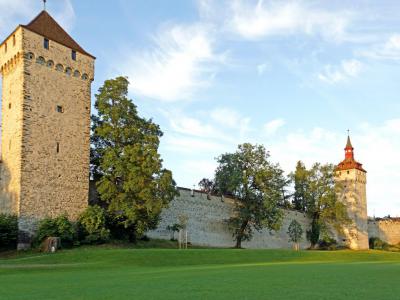
The historic city wall was once part of the fortification of Lucerne. Today Musegg Wall is a beautiful reminder of the past that can be explored up close or viewed from afar.
The wall and nine towers were built in the 13th century. They originally consisted of an inner ring and an outer ring. With much of it still preserved, it is one of the longest defensive walls still standing in the country. Those wishing to walk by the nine towers may do so at anytime as they are all floodlit at night. However, only four are open to public: Mannli, Zyt, Wacht and Schirmer.
Mannli, meaning "little man" is the second tower on the ascending ridge. It was used for military purposes through the end of World War II before it was eventually opened to the public. Wacht Tower, also called Heu Tower, was used for storing gunpowder. It was rebuilt after a 1701 lightning strike caused an explosion. Zyt Tower is a clock tower whose bell, the Leodegar Bell, strikes the hour prior to the city's church clocks. Schirmer Tower holds the city gate.
Musegg Wall and four of its nine towers are open to the public from 8 AM to 7 PM from April through November.
The wall and nine towers were built in the 13th century. They originally consisted of an inner ring and an outer ring. With much of it still preserved, it is one of the longest defensive walls still standing in the country. Those wishing to walk by the nine towers may do so at anytime as they are all floodlit at night. However, only four are open to public: Mannli, Zyt, Wacht and Schirmer.
Mannli, meaning "little man" is the second tower on the ascending ridge. It was used for military purposes through the end of World War II before it was eventually opened to the public. Wacht Tower, also called Heu Tower, was used for storing gunpowder. It was rebuilt after a 1701 lightning strike caused an explosion. Zyt Tower is a clock tower whose bell, the Leodegar Bell, strikes the hour prior to the city's church clocks. Schirmer Tower holds the city gate.
Musegg Wall and four of its nine towers are open to the public from 8 AM to 7 PM from April through November.
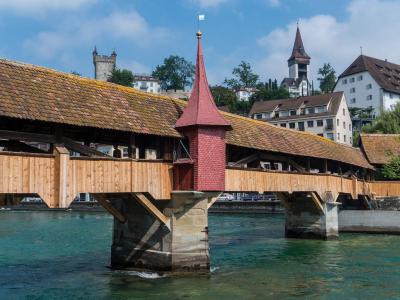
5) Spreuer Bridge (must see)
Spreuer Bridge is a covered, wooden footbridge that begins in the Mills Square in old town and ends in Pfister Alley. Also called the Mills Bridge, it is a popular spot for tourists who wish to see both the stunning architecture and the interior paintings.
The original bridge was constructed in the 13th century but was destroyed by a flood in 1566. It was rebuilt shortly thereafter, which was when the paintings were added. The paintings are the largest known paintings of the Dance of Death during the late Middle Ages.
Kaspar Meglinger directed the 67 paintings from 1616 to 1637. Most paintings contain information about the donors, including their names and family coat-of-arms. Some also have portraits of the donors. Forty-five of those paintings have survived. The paintings at Spreuer Bridge have also created the nickname "The Dance of Death Bridge."
Visitors are welcome to walk across the pedestrian bridge at any time, though the paintings are best viewed with natural daylight.
The original bridge was constructed in the 13th century but was destroyed by a flood in 1566. It was rebuilt shortly thereafter, which was when the paintings were added. The paintings are the largest known paintings of the Dance of Death during the late Middle Ages.
Kaspar Meglinger directed the 67 paintings from 1616 to 1637. Most paintings contain information about the donors, including their names and family coat-of-arms. Some also have portraits of the donors. Forty-five of those paintings have survived. The paintings at Spreuer Bridge have also created the nickname "The Dance of Death Bridge."
Visitors are welcome to walk across the pedestrian bridge at any time, though the paintings are best viewed with natural daylight.
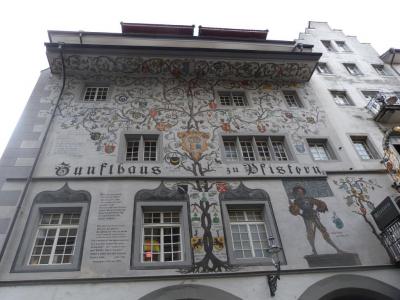
6) Zunfthaus zu Pfistern (Pfistern Guild Hall)
This is one of Lucerne’s most eye-catching buildings, boasting extensive exterior fresco decoration – a mural of the Pfistern family tree hung with coats of arms. Indeed, this is one of the last standing guild halls in the city. The name Pfister comes from the Latin “pistor”, which was what the Romans called bakers. The Germanization of the word turned it into “Pfister”.
The Pfister Guild initially united artisans, bakers and millers, and was founded in 1408. Later, it was joined by boat crews and pie bakers – in 1598 and 1697, respectively. The guild house was the noble gentlemen's meeting place to discuss politics and business, not forgetting some great food and drinks during the process.
Shortly before the guild was dissolved in 1875, the house was auctioned for 80,000 Francs. A century later – in 1977 – after numerous ownership changes, the property was acquired by the Lucerne Association of Pastry Bakers, thus reverting to its original purpose. Now fully reinstated, the house accommodates Pfistern restaurant serving Swiss specialties.
The Pfister Guild initially united artisans, bakers and millers, and was founded in 1408. Later, it was joined by boat crews and pie bakers – in 1598 and 1697, respectively. The guild house was the noble gentlemen's meeting place to discuss politics and business, not forgetting some great food and drinks during the process.
Shortly before the guild was dissolved in 1875, the house was auctioned for 80,000 Francs. A century later – in 1977 – after numerous ownership changes, the property was acquired by the Lucerne Association of Pastry Bakers, thus reverting to its original purpose. Now fully reinstated, the house accommodates Pfistern restaurant serving Swiss specialties.
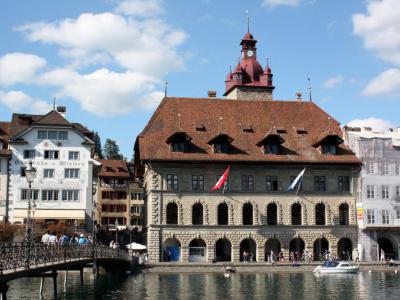
7) Rathaus (Town Hall)
The Lucerne Town Hall, known as Rathaus, is an Italian Renaissance style building that is considered by many to be one of the most beautiful historical buildings in Lucerne. Construction began on Rathaus in 1602 and was completed in 1606. It was designed by architect Anton Isenmann.
Rathaus is located in the heart of Old Town. Its location on the River Reuss offers perfect photo ops for visitors who want a great view of the Chapel Bridge. This is particularly true on Tuesdays and Saturdays from 6 AM to 1 PM when market stalls open and tourists can partake in shopping while admiring the architecture.
Inside the building, visitors will find an exhibit hall and a concert hall. They may view the paintings and coffered ceilings from long ago as they find their way to the dovecote. Located in the Rathaus attic, the dovecote lets visitors both watch and feed the birds. They can even enjoy an exhibit that details the history of the Rathaus doves.
Rathaus is located in the heart of Old Town. Its location on the River Reuss offers perfect photo ops for visitors who want a great view of the Chapel Bridge. This is particularly true on Tuesdays and Saturdays from 6 AM to 1 PM when market stalls open and tourists can partake in shopping while admiring the architecture.
Inside the building, visitors will find an exhibit hall and a concert hall. They may view the paintings and coffered ceilings from long ago as they find their way to the dovecote. Located in the Rathaus attic, the dovecote lets visitors both watch and feed the birds. They can even enjoy an exhibit that details the history of the Rathaus doves.
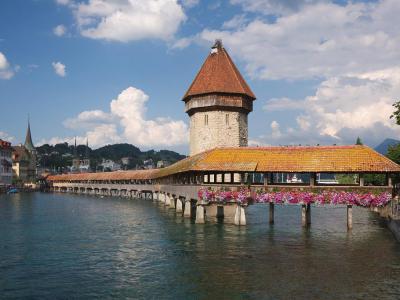
8) Chapel Bridge (must see)
The Chapel Bridge is a wooden foot bridge that stretches diagonally across the Reuss River in Lucerne. It got its name from Saint Peter's Chapel nearby. What makes this bridge special is that it has some old paintings inside from the 17th century. Unfortunately, many of these paintings were destroyed in a fire that happened in 1993, which also damaged most of the bridge. Thankfully, they fixed it up afterward. This bridge is not just any bridge; it's actually the oldest covered wooden bridge in Europe and the world's oldest surviving truss bridge. People in Lucerne really like it, and it's a famous tourist spot in Switzerland.
Originally, they built this bridge in 1333 as part of Lucerne's defenses. It connected the old town on one side of the river to the new town on the other side, which helped protect the city from attacks coming from the south of Lake Lucerne. At first, it was more than 200 meters long, but over time, they made it shorter and did some work on the riverbanks, so now it's 170 meters long.
Lucerne is special because it has three wooden pedestrian bridges: the Hof Bridge from the 14th century (but that one's gone now), the Chapel Bridge, and the Spreuer Bridge from the 16th century. All of them have paintings on the inside in triangle-shaped frames. No other wooden footbridges in Europe have this. The paintings on the Chapel Bridge were made in the 17th century by a local Catholic painter named Hans Heinrich Wagmann. They show things from Lucerne's history. There used to be 147 paintings on the bridge before the fire in 1993, but they could only fully restore 30 of them.
Tip:
Experience it at night with the city lights, swans, flowers and romantic atmosphere. Both banks are full of great shopping and fantastic restaurants.
Originally, they built this bridge in 1333 as part of Lucerne's defenses. It connected the old town on one side of the river to the new town on the other side, which helped protect the city from attacks coming from the south of Lake Lucerne. At first, it was more than 200 meters long, but over time, they made it shorter and did some work on the riverbanks, so now it's 170 meters long.
Lucerne is special because it has three wooden pedestrian bridges: the Hof Bridge from the 14th century (but that one's gone now), the Chapel Bridge, and the Spreuer Bridge from the 16th century. All of them have paintings on the inside in triangle-shaped frames. No other wooden footbridges in Europe have this. The paintings on the Chapel Bridge were made in the 17th century by a local Catholic painter named Hans Heinrich Wagmann. They show things from Lucerne's history. There used to be 147 paintings on the bridge before the fire in 1993, but they could only fully restore 30 of them.
Tip:
Experience it at night with the city lights, swans, flowers and romantic atmosphere. Both banks are full of great shopping and fantastic restaurants.
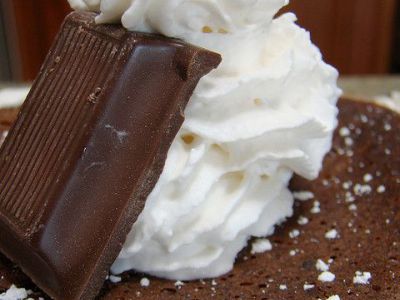
9) Confectionary Bachmann
The Bachmann Confectionery is a well-established and leading producer of premium bakery, pastry, and confectionery items. They also offer unique cakes and Apéro treats to their customers. Their bakery, located in the heart of Lucerne, uses a combination of traditional recipes passed down through generations and modern technology to create fresh products.
The main shop, which spans 400 square meters, is stocked with a wide variety of delicious treats. Notably, there is a captivating Flowing Chocolate Wall weighing 750 kilograms. However, it's important to note that this chocolate is not edible; it's made from cocoa extract intended solely for decoration purposes. Visitors can also enjoy a cup of hot chocolate or one of Bachmann's specialty items in the on-site cafeteria.
This bakery and confectionery business is a forward-thinking family enterprise currently in its fourth generation. Over the course of 120 years, the Bachmann family has continued to produce over 500 different products daily, blending traditional recipes with cutting-edge technology.
The main shop, which spans 400 square meters, is stocked with a wide variety of delicious treats. Notably, there is a captivating Flowing Chocolate Wall weighing 750 kilograms. However, it's important to note that this chocolate is not edible; it's made from cocoa extract intended solely for decoration purposes. Visitors can also enjoy a cup of hot chocolate or one of Bachmann's specialty items in the on-site cafeteria.
This bakery and confectionery business is a forward-thinking family enterprise currently in its fourth generation. Over the course of 120 years, the Bachmann family has continued to produce over 500 different products daily, blending traditional recipes with cutting-edge technology.
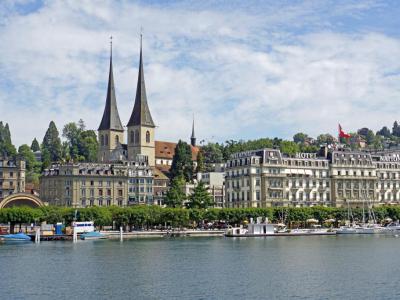
10) Lake Lucerne Promenade
The Lake Lucerne Promenade is arguably the best place in the city to take an easy walk. Visitors can join the locals as they stroll along the shore of Lake Lucerne. They can stop to watch the boats, gaze at the Alps, play games or sample one of the local restaurants. Many tourists simply enjoy having a place to sit and relax.
Some of the most popular draws of the Lake Lucerne Promenade are the summer concerts. Free, public concerts are available in the pavilion to anyone who wishes to enjoy listening to music in the open air. This tradition has been going strong since 1908. The evening concerts take place from May to September on Tuesdays and Fridays at 8:15 PM. Morning concerts are available at 10:15 AM.
The promenade is in a central location that has easy to access to other tourist sites. Visitors to Lucerne can easily add a side trip to the promenade as they explore the Church of Saint Leodegar, which is only a three minute walk. Just a bit further is the Bourbaki Panorama. Neither should be missed on a trip to Lucerne.
Some of the most popular draws of the Lake Lucerne Promenade are the summer concerts. Free, public concerts are available in the pavilion to anyone who wishes to enjoy listening to music in the open air. This tradition has been going strong since 1908. The evening concerts take place from May to September on Tuesdays and Fridays at 8:15 PM. Morning concerts are available at 10:15 AM.
The promenade is in a central location that has easy to access to other tourist sites. Visitors to Lucerne can easily add a side trip to the promenade as they explore the Church of Saint Leodegar, which is only a three minute walk. Just a bit further is the Bourbaki Panorama. Neither should be missed on a trip to Lucerne.
