Custom Walk in Porto, Portugal by piccirford_eb333 created on 2025-05-29
Guide Location: Portugal » Porto
Guide Type: Custom Walk
# of Sights: 12
Tour Duration: 3 Hour(s)
Travel Distance: 6.8 Km or 4.2 Miles
Share Key: 3XBBG
Guide Type: Custom Walk
# of Sights: 12
Tour Duration: 3 Hour(s)
Travel Distance: 6.8 Km or 4.2 Miles
Share Key: 3XBBG
How It Works
Please retrieve this walk in the GPSmyCity app. Once done, the app will guide you from one tour stop to the next as if you had a personal tour guide. If you created the walk on this website or come to the page via a link, please follow the instructions below to retrieve the walk in the app.
Retrieve This Walk in App
Step 1. Download the app "GPSmyCity: Walks in 1K+ Cities" on Apple App Store or Google Play Store.



Step 2. In the GPSmyCity app, download(or launch) the guide "Porto Map and Walking Tours".
Step 3. Tap the menu button located at upper right corner of the "Walks" screen and select "Retrieve custom walk". Enter the share key: 3XBBG
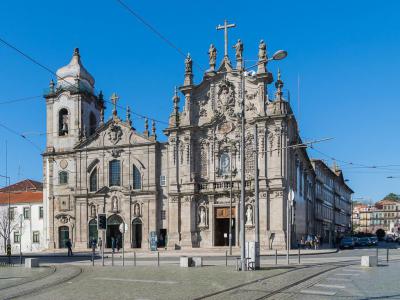
1) Igreja do Carmo (Carmo Church)
One of the oldest buildings in the historic part of Porto, Igreja do Carmo is actually a combination of two buildings: one dating from the 1600s and the other from the 1700s. Originally, it was built for the Carmelite order of the Roman Catholic Church and was used as a convent. The Baroque style structure features golden woodwork in the interior along with neoclassical tiles. It has a classic façade with a bell tower. The oldest of the two parts of the church – built with a single nave – has seven altars created by Francisco Pereira Campanhã.
The exterior wall of the building is covered in tiles depicting the history of the Carmelite order. Connecting the right and the left side of the structure is a narrow building which measures only one meter in width and was meant originally to keep the monks separated from the nuns of the convent, thus preserving the nuns' chastity and helping the monks keep their vows of celibacy.
Why You Should Visit:
Stunning inside and out; a glorious example of Porto's traditional 'azulejos' (tiles), which are often blue and white and have been handpainted.
The organ is a piece of art and highly unusual, in that there are horizontal horns protruding from the pipe area.
Tip:
Be sure to visit the 1-meter wide house separating the two churches – one of the world's narrowest buildings.
The exterior wall of the building is covered in tiles depicting the history of the Carmelite order. Connecting the right and the left side of the structure is a narrow building which measures only one meter in width and was meant originally to keep the monks separated from the nuns of the convent, thus preserving the nuns' chastity and helping the monks keep their vows of celibacy.
Why You Should Visit:
Stunning inside and out; a glorious example of Porto's traditional 'azulejos' (tiles), which are often blue and white and have been handpainted.
The organ is a piece of art and highly unusual, in that there are horizontal horns protruding from the pipe area.
Tip:
Be sure to visit the 1-meter wide house separating the two churches – one of the world's narrowest buildings.
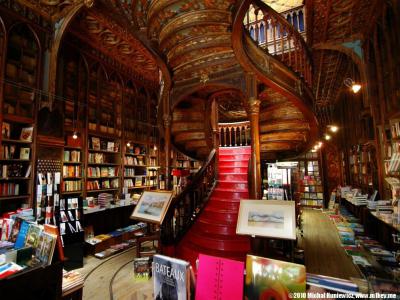
2) Livraria Lello (Lello Bookstore)
The Livraria Lello is considered to be one of the most beautiful bookstores in the world. It is located in the heart of Porto on the historic Rua dos Clerics. Full of Art Deco elements, visitors to the metropolis will want to spend time exploring this famous structure. The store has been managed by the same company, Lugan & Geneliousx Sucessores, throughout its history.
The Art Deco style is known for its linear and symmetrical elements which drew inspiration from ancient Egypt. The building was first opened in 1906 and contains a fabulous stained glass ceiling, vivid wooden staircase and lavish embellishments. Designed by architect and engineer, Xavier Esteves, the bookstore has been built to withstand the wear and tear of time. The façade of the construction is a combination of Art Nouveau elements and Gothic Revival features. The wooden features, including the shelves are well worth the time to examine.
The shelves reach from floor to ceiling and are covered in phenomenally carved wood. The wooden staircase is filled with the same beautifully carved details. The glass ceiling provides and interesting element and casts warm diffused lighting throughout the entire building.
The Art Deco style is known for its linear and symmetrical elements which drew inspiration from ancient Egypt. The building was first opened in 1906 and contains a fabulous stained glass ceiling, vivid wooden staircase and lavish embellishments. Designed by architect and engineer, Xavier Esteves, the bookstore has been built to withstand the wear and tear of time. The façade of the construction is a combination of Art Nouveau elements and Gothic Revival features. The wooden features, including the shelves are well worth the time to examine.
The shelves reach from floor to ceiling and are covered in phenomenally carved wood. The wooden staircase is filled with the same beautifully carved details. The glass ceiling provides and interesting element and casts warm diffused lighting throughout the entire building.
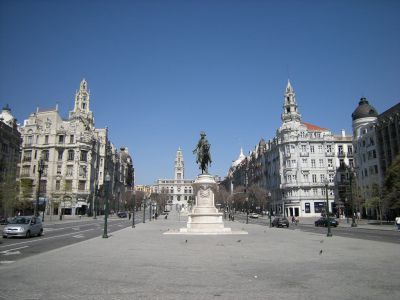
3) Praça da Liberdade (Liberty Square) (must see)
In the lower town or Baixa district of Porto, on the south side of the Avenue of the Allies, lies Liberty Square. This is a largish area of more than three square miles. Originally called New Square, Liberty Square is a product of the 1718 urbanization movement of Porto.
In 1788 the religious order of Saint Eligius, Patron Saint of veterinarians, horses, goldsmiths and blacksmiths, built a convent on the south edge of the square. They demolished part of the medieval wall of the city, replacing it with the convent, an impressive neoclassical building, still standing as the Cardosas Palace.
In 1866 a monument honoring King Peter IV was erected in the square. Peter IV was not only King of Portugal as Peter IV, he was also Emperor of Brazil as Peter I.
As each of the two Peters, he fought to preserve the liberal constitution in Portugal and liberty in Brazil. His monument, designed by sculptor Anatole Calmels, is a statue of Peter IV mounted and holding the constitution he had fought for in the Liberal Wars.
The square underwent a change in 1916 when the modern Avenue of the Allies was pushed through to the north of the square. The buildings around the square today are banks, hotels, offices and restaurants. The monument to Peter IV dominates the huge square. Other notable sights would include the Bank of Portugal and the Cardosas Palace.
In 1788 the religious order of Saint Eligius, Patron Saint of veterinarians, horses, goldsmiths and blacksmiths, built a convent on the south edge of the square. They demolished part of the medieval wall of the city, replacing it with the convent, an impressive neoclassical building, still standing as the Cardosas Palace.
In 1866 a monument honoring King Peter IV was erected in the square. Peter IV was not only King of Portugal as Peter IV, he was also Emperor of Brazil as Peter I.
As each of the two Peters, he fought to preserve the liberal constitution in Portugal and liberty in Brazil. His monument, designed by sculptor Anatole Calmels, is a statue of Peter IV mounted and holding the constitution he had fought for in the Liberal Wars.
The square underwent a change in 1916 when the modern Avenue of the Allies was pushed through to the north of the square. The buildings around the square today are banks, hotels, offices and restaurants. The monument to Peter IV dominates the huge square. Other notable sights would include the Bank of Portugal and the Cardosas Palace.
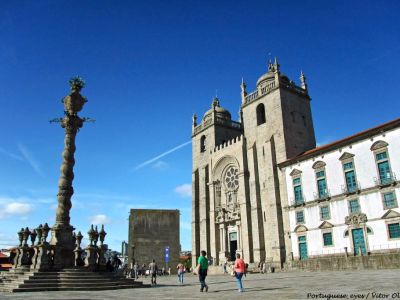
4) Sé Catedral do Porto (Porto Cathedral) (must see)
In 868, Vimara Peres, an Asturias nobleman born in 820, conquered Moorish held lands north of the river Douro. One of the towns he took went by the name Portus Cale. Portus Cale became Portucale, the county he would rule. The town became Porto. Penaventosa, the highest hill in Portus Cale, became the site of Porto Cathedral.
The hill was once the location of a Suebian Church. Work began on the Cathedral in the 12th century. There were fits and starts over the years, but the building was finally considered complete in 1737. It is the most impressive Romanesque style edifice in Porto. On top of Penaventosa it sits, fortress-like, overlooking the town.
The cathedral is flanked by twin square towers. Each tower is buttressed and topped with a cupola. The western façade has 15th century Gothic ornamentation. There is also an impressive Gothic cloister installed in 1736 by Nicolau Nasoni, an architect from Tuscany who settled in Portugal.
On the northern side of the cathedral is a baroque porch and a Romanesque rose window under a crenelated arch. The crenellations reinforce the impression of a fortress. The nave is not wide. It is covered with a barrel vault.
The baroque apse is decorated with paintings by Nasoni. The altarpiece of the chapel was designed by Santos Pacheco. The south transept is decorated with blue azulejo tiles.
Mass is celebrated every day at 11am.
Why You Should Visit:
You wouldn't want to miss the city's oldest and most visited monument! The square also offers impressive views over the city, the Douro River and the wine cellars on the waterfront.
Tip:
While admission to the Porto Cathedral is free, there's a small fee to get into the Sacred Art Museum and the magnificent Gothic cloisters attached to the church. If you're feeling fit you can also climb the tower (steps are steep and numerous!) for amazing views, including at the bits of the cathedral you can't see from further down.
The hill was once the location of a Suebian Church. Work began on the Cathedral in the 12th century. There were fits and starts over the years, but the building was finally considered complete in 1737. It is the most impressive Romanesque style edifice in Porto. On top of Penaventosa it sits, fortress-like, overlooking the town.
The cathedral is flanked by twin square towers. Each tower is buttressed and topped with a cupola. The western façade has 15th century Gothic ornamentation. There is also an impressive Gothic cloister installed in 1736 by Nicolau Nasoni, an architect from Tuscany who settled in Portugal.
On the northern side of the cathedral is a baroque porch and a Romanesque rose window under a crenelated arch. The crenellations reinforce the impression of a fortress. The nave is not wide. It is covered with a barrel vault.
The baroque apse is decorated with paintings by Nasoni. The altarpiece of the chapel was designed by Santos Pacheco. The south transept is decorated with blue azulejo tiles.
Mass is celebrated every day at 11am.
Why You Should Visit:
You wouldn't want to miss the city's oldest and most visited monument! The square also offers impressive views over the city, the Douro River and the wine cellars on the waterfront.
Tip:
While admission to the Porto Cathedral is free, there's a small fee to get into the Sacred Art Museum and the magnificent Gothic cloisters attached to the church. If you're feeling fit you can also climb the tower (steps are steep and numerous!) for amazing views, including at the bits of the cathedral you can't see from further down.
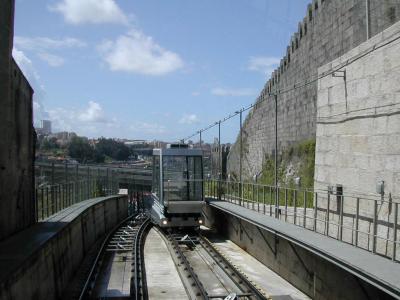
5) Funicular dos Guindais (Guindais Funicular)
The Guindais Funicular (Funicular dos Guindais) is a unique railway located in Porto, within the civil parish of Cedofeita, Santo Ildefonso, Sé, Miragaia, São Nicolau e Vitória. Originally opened on June 3, 1891, this funicular had a rocky start, with an accident caused by excessive speed leading to its decommissioning just two years later, on June 5, 1893. After the original line closed, the funicular’s station was repurposed several times, notably serving as an atelier for sculptor Henrique Moreira and later as a meeting hall for local Jehovah’s Witnesses.
A new funicular following the original line was inaugurated on February 19, 2004. The funicular descends the cliff along the Freiras Wall, connecting the Guindais quay to Rua da Batalha, near the Civil Governor’s building. Owned and operated by Porto Metro, the funicular features a single track with a central loop system, spanning 281 meters (922 feet) and descending 61 meters (200 feet). A key feature is the self-leveling platforms in the cars, which keep the floor horizontal regardless of the steep gradient, particularly noticeable in the lower section below the passing loop.
Two cars, each accommodating up to 25 passengers, run the line at a maximum speed of 5 meters per second (16 feet/second). The brief journey lasts about three minutes, and as the funicular emerges from the upper tunnel, passengers are treated to panoramic views of the Dom Luís I Bridge, the scenic river margins, Porto’s Ribeira quay, Cais de Gaia, and the iconic Port wine warehouses along the Douro River. The Guindais Funicular serves as a convenient mode of transport for locals and commuters, linking the riverside with metro services, including connections at São Bento station.
A new funicular following the original line was inaugurated on February 19, 2004. The funicular descends the cliff along the Freiras Wall, connecting the Guindais quay to Rua da Batalha, near the Civil Governor’s building. Owned and operated by Porto Metro, the funicular features a single track with a central loop system, spanning 281 meters (922 feet) and descending 61 meters (200 feet). A key feature is the self-leveling platforms in the cars, which keep the floor horizontal regardless of the steep gradient, particularly noticeable in the lower section below the passing loop.
Two cars, each accommodating up to 25 passengers, run the line at a maximum speed of 5 meters per second (16 feet/second). The brief journey lasts about three minutes, and as the funicular emerges from the upper tunnel, passengers are treated to panoramic views of the Dom Luís I Bridge, the scenic river margins, Porto’s Ribeira quay, Cais de Gaia, and the iconic Port wine warehouses along the Douro River. The Guindais Funicular serves as a convenient mode of transport for locals and commuters, linking the riverside with metro services, including connections at São Bento station.
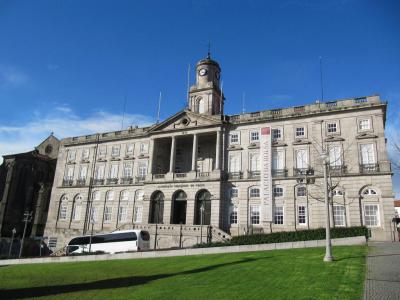
6) Palácio da Bolsa (Stock Exchange Palace) (must see)
The cloisters of Saint Francis Convent were burnt during the Liberal wars in 1832. In 1841 Queen Mary II donated the ruins to the merchants of Porto. They used the site to build the new Commercial Association. Architect Joaquim da Costa Lima Junior designed a Palladian neoclassical palace that harmonized with previous structures of the city.
The Palace was generally completed by 1850 but details which include the staircase and the Arab Room, courtyard dome, and Tribunal were later added.
The octagonal dome has glass panels and the coats-of-arms of Portugal and the countries trading with Portugal in the 19th century. In the rear of the courtyard is a sumptuous stairway, lined with busts by famous sculptors.
The star of the show however, is the Arab Room. Done in the Moorish Revival style, it is used primarily for receptions for visiting heads of state.
The Stock Exchange Palace is located in the Infante D. Henrique Square in the center of Porto.
Why You Should Visit:
The guided tour takes you through many of the exquisitely decorated rooms of this amazing building. Some are a little over-the-top but they are really something to see, each decorated in a completely unique way.
Tip:
The Palace can only be visited on a guided tour. Upon arrival, there's a computerized screen telling you which tours in which languages are available. The guided tour lasts approximately 45 minutes.
The Palace was generally completed by 1850 but details which include the staircase and the Arab Room, courtyard dome, and Tribunal were later added.
The octagonal dome has glass panels and the coats-of-arms of Portugal and the countries trading with Portugal in the 19th century. In the rear of the courtyard is a sumptuous stairway, lined with busts by famous sculptors.
The star of the show however, is the Arab Room. Done in the Moorish Revival style, it is used primarily for receptions for visiting heads of state.
The Stock Exchange Palace is located in the Infante D. Henrique Square in the center of Porto.
Why You Should Visit:
The guided tour takes you through many of the exquisitely decorated rooms of this amazing building. Some are a little over-the-top but they are really something to see, each decorated in a completely unique way.
Tip:
The Palace can only be visited on a guided tour. Upon arrival, there's a computerized screen telling you which tours in which languages are available. The guided tour lasts approximately 45 minutes.
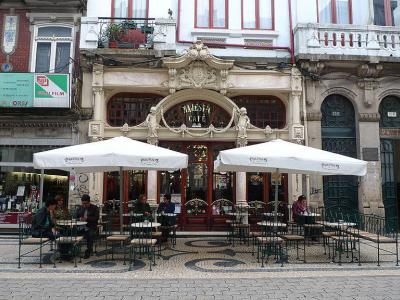
7) Café Majestic
It was 1921. Aviator Gago Coutinho had just flown in from the island of Madeira. He dropped in for a drink at the new Art Nouveau Cafe "Elite." He found himself in a chic crowd of artists and celebrities. They were observing the grand opening of the cafe. He became enchanted at the lavish splendor of the decor.
Later, the name of the cafe was changed to "Majestic." Everyone approved. The Majestic became a haunt for students and teachers from the Porto School of Fine Arts. Gago was impressed by gatherings that included the sculptor Jose Rodrigues, the philosopher Leonardo Coimbra, the painters Armando Alves, Angelo de Sousa and Jorge Pinheiro.
More recently, the Majestic book of honor has been signed by others, among them Mario Soares, Jorge Sampaio, Jaques Chirac and Cavaco Silva. Today the cafe continues on with poetry readings, concerts, exhibitions and performances. It is said author J.K. Rowling spent afternoons at the Majestic writing Harry Potter and the Philosopher's Stone.
Outside, the marble facade, decked out with twisting floral shapes and three graceful columns, invites travelers to enter. Inside, curved wooden frames and decorations capture attention. Stucco faces and nude figures emphasize sensuality.
Later, the name of the cafe was changed to "Majestic." Everyone approved. The Majestic became a haunt for students and teachers from the Porto School of Fine Arts. Gago was impressed by gatherings that included the sculptor Jose Rodrigues, the philosopher Leonardo Coimbra, the painters Armando Alves, Angelo de Sousa and Jorge Pinheiro.
More recently, the Majestic book of honor has been signed by others, among them Mario Soares, Jorge Sampaio, Jaques Chirac and Cavaco Silva. Today the cafe continues on with poetry readings, concerts, exhibitions and performances. It is said author J.K. Rowling spent afternoons at the Majestic writing Harry Potter and the Philosopher's Stone.
Outside, the marble facade, decked out with twisting floral shapes and three graceful columns, invites travelers to enter. Inside, curved wooden frames and decorations capture attention. Stucco faces and nude figures emphasize sensuality.
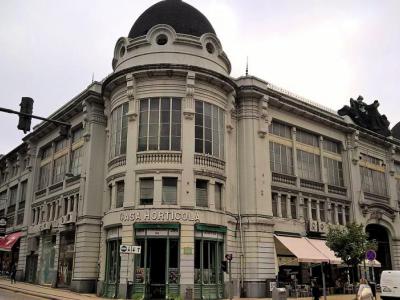
8) Mercado do Bolhao (Bolhao Market)
The Bolhão Market in Porto is a beloved and emblematic marketplace that stands as a hallmark of the city’s traditional commerce. This iconic market is situated in the parish of Santo Ildefonso in downtown Porto. It serves as a bustling hub primarily for fresh products, featuring specialized sections for fishmongers, butchers, vegetable vendors, and florists, alongside a variety of shops offering everything from clothing to cafes and perfumeries.
The market’s roots date back to 1839 when the Porto city council transformed a meadow with a stream, which formed a bubble or "bolhão" in Portuguese, into a bustling square with wooden stalls. The current Neoclassical market building, designed by architect Correia da Silva, was constructed in 1914, featuring a robust blend of reinforced concrete, metal structures, wooden roofs, and granite stonework. Over the years, it underwent several modifications, including notable changes in the 1940s.
Recognized for its architectural and cultural significance, Bolhão Market was declared a Property of Public Interest in 2006 and a monument of public interest in 2013. After a significant four-year renovation, the market reopened on September 15, 2022, with modern enhancements such as direct metro access and improved logistics with a newly built basement to handle deliveries efficiently and eliminate street congestion. The renovation preserved the market’s original charm, including the restoration of original tiles and thoughtful touches inspired by the vendors’ preferences.
Today, Bolhão Market spans an impressive façade of over eight thousand square meters and a roof area exceeding five thousand square meters. It boasts 81 stalls, 38 street-facing shops, and 10 restaurants that proudly source their ingredients from the market itself. This blend of historic charm and modern amenities makes Bolhão Market not just a shopping destination but a living monument to Porto’s vibrant culture and heritage.
The market’s roots date back to 1839 when the Porto city council transformed a meadow with a stream, which formed a bubble or "bolhão" in Portuguese, into a bustling square with wooden stalls. The current Neoclassical market building, designed by architect Correia da Silva, was constructed in 1914, featuring a robust blend of reinforced concrete, metal structures, wooden roofs, and granite stonework. Over the years, it underwent several modifications, including notable changes in the 1940s.
Recognized for its architectural and cultural significance, Bolhão Market was declared a Property of Public Interest in 2006 and a monument of public interest in 2013. After a significant four-year renovation, the market reopened on September 15, 2022, with modern enhancements such as direct metro access and improved logistics with a newly built basement to handle deliveries efficiently and eliminate street congestion. The renovation preserved the market’s original charm, including the restoration of original tiles and thoughtful touches inspired by the vendors’ preferences.
Today, Bolhão Market spans an impressive façade of over eight thousand square meters and a roof area exceeding five thousand square meters. It boasts 81 stalls, 38 street-facing shops, and 10 restaurants that proudly source their ingredients from the market itself. This blend of historic charm and modern amenities makes Bolhão Market not just a shopping destination but a living monument to Porto’s vibrant culture and heritage.
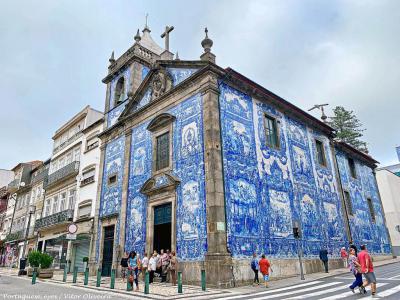
9) Capela das Almas (Chapel of Souls) (must see)
At the end of the eighteenth century the Brotherhood of Souls moved from the Monastery of Santa Clara to the chapel of Santa Catarina. The addition of the Brotherhood swelled the size of the Santa Catarina faction of devotees to the point where a new building was needed. The chapel therefore was expanded and restored in 1801.
The facade has a framed door under a circular pediment. A coat of arms is set on the tympanum showing Saint Francis of Assisi and Santa Catarina. The bell tower has two floors. On the first floor is a door with a window. The second floor has four windows and a balcony. Atop the dome is an iron cross.
The style of the church is basically neoclassical, but the church is noted for its covering of azulejo tiles. The tiles were made at the Viuva Lamego Ceramic Workshop in Lisbon. The 16,000 glowing blue and white tiles depict scenes from the lives of Saint Catherine and Saint Francis of Assisi.
The stained glass windows, made by Amandio Silva, show the souls in Purgatory washed with the redeeming blood of Christ. Inside the chapel is the 18th century image, Virgin of Souls. On the main altar is the large painting called "The Ascension of the Lord" by Joaquin Rafael, a professor of Fine Arts in Lisbon.
This is without a doubt, the most beautiful church in Porto. It must not be overlooked.
The facade has a framed door under a circular pediment. A coat of arms is set on the tympanum showing Saint Francis of Assisi and Santa Catarina. The bell tower has two floors. On the first floor is a door with a window. The second floor has four windows and a balcony. Atop the dome is an iron cross.
The style of the church is basically neoclassical, but the church is noted for its covering of azulejo tiles. The tiles were made at the Viuva Lamego Ceramic Workshop in Lisbon. The 16,000 glowing blue and white tiles depict scenes from the lives of Saint Catherine and Saint Francis of Assisi.
The stained glass windows, made by Amandio Silva, show the souls in Purgatory washed with the redeeming blood of Christ. Inside the chapel is the 18th century image, Virgin of Souls. On the main altar is the large painting called "The Ascension of the Lord" by Joaquin Rafael, a professor of Fine Arts in Lisbon.
This is without a doubt, the most beautiful church in Porto. It must not be overlooked.
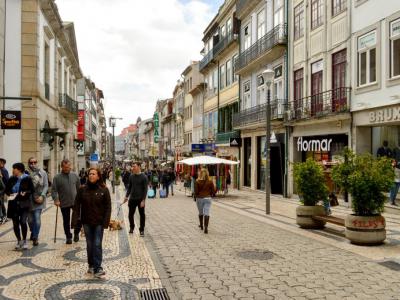
10) Rua Santa Catarina (St. Catherine Street) (must see)
Saint Catherine Street is Porto's main shopping thoroughfare. It is totally pedestrianized and it extends from Marques de Pombal Park in the north to Batalha Park in the south. It runs between buildings with Art Deco facades. It is named for the Chapel of Souls and Saint Catherine of Alexandria.
Shop on Marques de Pombal for clothing, haberdashery goods, and shoes. The Via Catarina shopping center, many street vendors, and cafes make for a busy day for visitors.
Landmarks encountered are the Latina New Art Bookstore at Batalha Park and Palladium Gallery at the intersection of Passos Manuel Street. The Cafe Majestic, since 1921 a watering hole for Porto's intelligencia, is next to the Imperiel Tea Room, also a historic landmark.
The prestigious Porto Grand Hotel is next, since 1880 a haven for the famous. It was a place to die in 1889 for Teresa Cristina, Empress of Brazil. Prime Minister Afonso Costa was held prisoner here in 1917 during a coup d'etat.
At last, there is the Chapel of Santa Catarina also known as Chapel of Souls on the corner of Fernandes Tomas Street.
Shop on Marques de Pombal for clothing, haberdashery goods, and shoes. The Via Catarina shopping center, many street vendors, and cafes make for a busy day for visitors.
Landmarks encountered are the Latina New Art Bookstore at Batalha Park and Palladium Gallery at the intersection of Passos Manuel Street. The Cafe Majestic, since 1921 a watering hole for Porto's intelligencia, is next to the Imperiel Tea Room, also a historic landmark.
The prestigious Porto Grand Hotel is next, since 1880 a haven for the famous. It was a place to die in 1889 for Teresa Cristina, Empress of Brazil. Prime Minister Afonso Costa was held prisoner here in 1917 during a coup d'etat.
At last, there is the Chapel of Santa Catarina also known as Chapel of Souls on the corner of Fernandes Tomas Street.
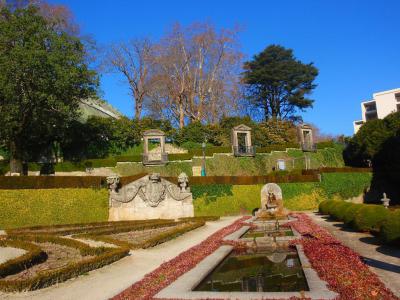
11) Jardim do Palácio de Cristal (Crystal Palace Garden)
When visiting Porto, guests will not want to miss the opportunity to stroll through the Crystal Palace Garden (Jardim do Palácio de Cristal). This tree-lined and pristinely landscaped park offers a sports pavilion, incredible native foliage, and an inconceivable view of the Douro River. The park was originally part of the Crystal Palace which has a history that goes back to the middle part of the 19th century. In current times, what once stood as the Crystal Palace has been replaced by a massive sports pavilion that holds over 10,000 visitors. The incredible domed pavilion of iron and glass is a main focal point and the namesake of the locale. It was constructed in 1956.
The park is broken into various venues and includes gardens designed by renowned landscape architects. One such garden is the Garden Emilio David which features many exotic flowers, fountains, and sculptures. In addition to the incredible foliage, tourists will truly enjoy seeing the peacocks that roam freely throughout the area. The Lime Tree Avenue, which runs through the middle of the park, will lead visitors to the many historic features and facilities within – including the Acoustic Shell, the Chapel of Charles Albert of Sardinia, and the Almeida Garrett Municipal Library.
Why You Should Visit:
Enjoy unbeatable views of the Douro, bridges, and the waterfront, as well as the company of hens, ducks, and peacocks that are not shy to come up to you.
Tip:
Free entry. Early evening, before sunset, is a great time to visit.
Bring some seeds and hang out with the beautiful and friendly birds!
The park is broken into various venues and includes gardens designed by renowned landscape architects. One such garden is the Garden Emilio David which features many exotic flowers, fountains, and sculptures. In addition to the incredible foliage, tourists will truly enjoy seeing the peacocks that roam freely throughout the area. The Lime Tree Avenue, which runs through the middle of the park, will lead visitors to the many historic features and facilities within – including the Acoustic Shell, the Chapel of Charles Albert of Sardinia, and the Almeida Garrett Municipal Library.
Why You Should Visit:
Enjoy unbeatable views of the Douro, bridges, and the waterfront, as well as the company of hens, ducks, and peacocks that are not shy to come up to you.
Tip:
Free entry. Early evening, before sunset, is a great time to visit.
Bring some seeds and hang out with the beautiful and friendly birds!
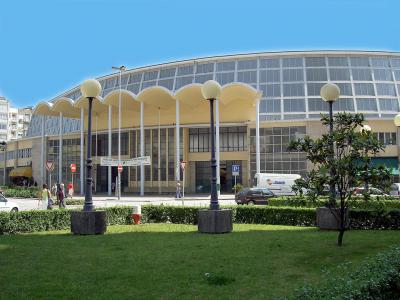
12) Mercado Bom Sucesso (Bom Sucesso Market)
Bom Sucesso Market is one of Porto's key municipal fresh markets. Commissioned by the Porto City Council, ARS Architects were tasked with designing a new market space. The project began in 1949 and was completed in 1952. The market stands out for its modern architectural style, characterized by a reinforced concrete structure and an innovative vaulted roof with large windows that allow natural light to pour into the interior.
The building was cleverly designed to integrate with the natural slope of the site, boasting three floors with a perimeter occupied by independent shops. A unique feature of the original layout was the zonal separation within the market: the fishmongers were strategically placed on a lower level to enhance ventilation, and a surrounding gallery on the first floor provided access to additional vendors such as butchers and bakeries. Much of this gallery remains intact following a significant renovation completed in 2013.
Today, the Bom Sucesso Market artfully blends its historic charm with contemporary flair. Visitors are greeted by the vibrant colors and familiar scents of fresh produce, evoking nostalgic echoes of market vendors calling out their wares. Yet, it has evolved beyond the traditional, offering a wide array of new delicacies and flavors that appeal to the local community and international visitors.
The market is not just a place for shopping; it is a sensory experience where the past meets the present. It serves as a lively gathering spot where friends can unwind after a long day, sharing snacks, and stories, and perhaps rekindling old memories. It's a space where life slows down amid a backdrop of bustling energy, vibrant interactions, and fleeting moments of joy.
The building was cleverly designed to integrate with the natural slope of the site, boasting three floors with a perimeter occupied by independent shops. A unique feature of the original layout was the zonal separation within the market: the fishmongers were strategically placed on a lower level to enhance ventilation, and a surrounding gallery on the first floor provided access to additional vendors such as butchers and bakeries. Much of this gallery remains intact following a significant renovation completed in 2013.
Today, the Bom Sucesso Market artfully blends its historic charm with contemporary flair. Visitors are greeted by the vibrant colors and familiar scents of fresh produce, evoking nostalgic echoes of market vendors calling out their wares. Yet, it has evolved beyond the traditional, offering a wide array of new delicacies and flavors that appeal to the local community and international visitors.
The market is not just a place for shopping; it is a sensory experience where the past meets the present. It serves as a lively gathering spot where friends can unwind after a long day, sharing snacks, and stories, and perhaps rekindling old memories. It's a space where life slows down amid a backdrop of bustling energy, vibrant interactions, and fleeting moments of joy.
