Custom Walk in Strasbourg, France by sinanomer67_23fc9 created on 2025-05-29
Guide Location: France » Strasbourg
Guide Type: Custom Walk
# of Sights: 8
Tour Duration: 2 Hour(s)
Travel Distance: 2.9 Km or 1.8 Miles
Share Key: KGGJ3
Guide Type: Custom Walk
# of Sights: 8
Tour Duration: 2 Hour(s)
Travel Distance: 2.9 Km or 1.8 Miles
Share Key: KGGJ3
How It Works
Please retrieve this walk in the GPSmyCity app. Once done, the app will guide you from one tour stop to the next as if you had a personal tour guide. If you created the walk on this website or come to the page via a link, please follow the instructions below to retrieve the walk in the app.
Retrieve This Walk in App
Step 1. Download the app "GPSmyCity: Walks in 1K+ Cities" on Apple App Store or Google Play Store.



Step 2. In the GPSmyCity app, download(or launch) the guide "Strasbourg Map and Walking Tours".
Step 3. Tap the menu button located at upper right corner of the "Walks" screen and select "Retrieve custom walk". Enter the share key: KGGJ3
1) Barrage Vauban (Vauban Dam) (must see)
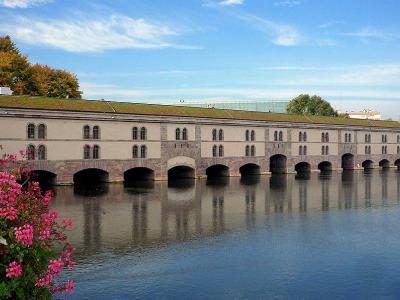
The Vauban Dam is a bridge, weir and defensive system erected in the 17th century on the River Ill in Strasbourg. It was a 17th century engineering marvel built according to the plans laid out by Marquis Vauban, the leading French military engineer of the time. At that time, it was known as the Great Lock, although it does not function as a navigation lock in the modern sense. Today it serves to display sculptures and has a viewing terrace on its roof, with views of the earlier Covered Bridge and Petite France quarter. It has been classified as a Historical Monument since 1971.
The dam was constructed from 1686 to 1690 in pink Vosges sandstone and its principal defensive function of the dam was to, in the event of an attack, raise the water level of the River Ill and thus flood the land south of the city, making it impassable to the enemy. This defensive measure was deployed in 1870, when Strasbourg was besieged by Prussian forces during the Franco-Prussian War, and resulted in the complete flooding of the northern part of the suburb of Neudorf.
The dam has 13 arches and is 120 meters (390 feet) in length. Within the structure an enclosed corridor links the two banks and a lapidarium serves to display ancient plaster casts and copies of statues and gargoyles from Strasbourg Cathedral and Rohan Palace. Three of the arches are raised to permit navigation, and the corridor is carried across these by drawbridges. The roof was rebuilt in 1965-66 in order to construct the panoramic terrace. Admission to the dam and terrace is free, and they are open daily from 9 am to 7:30 pm.
The dam was constructed from 1686 to 1690 in pink Vosges sandstone and its principal defensive function of the dam was to, in the event of an attack, raise the water level of the River Ill and thus flood the land south of the city, making it impassable to the enemy. This defensive measure was deployed in 1870, when Strasbourg was besieged by Prussian forces during the Franco-Prussian War, and resulted in the complete flooding of the northern part of the suburb of Neudorf.
The dam has 13 arches and is 120 meters (390 feet) in length. Within the structure an enclosed corridor links the two banks and a lapidarium serves to display ancient plaster casts and copies of statues and gargoyles from Strasbourg Cathedral and Rohan Palace. Three of the arches are raised to permit navigation, and the corridor is carried across these by drawbridges. The roof was rebuilt in 1965-66 in order to construct the panoramic terrace. Admission to the dam and terrace is free, and they are open daily from 9 am to 7:30 pm.
2) Musée Alsacien (Alsatian Museum) (must see)
Alsace is the cultural region identified by a blend of French and German cultures, of which Strasbourg is the largest city. This eastern region of France borders Switzerland and the Rhine region of Germany.
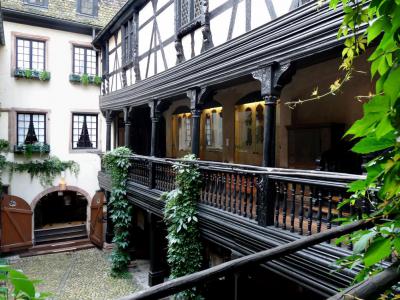
The Alsatian Museum in Strasbourg showcases all aspects that make Alsace a unique region. Daily life from pre-industrial times and rural life are featured prominently. There are over 5,000 exhibits in the museum.
The museum is presented in several Renaissance timber-framed houses. The houses are reconstructions but are appointed well and provide an extraordinary insight into the lives of the medieval city's inhabitants.
Beyond the homes and their furnishings, you'll enjoy displays dedicated to clothing, paintings, and decoration. You'll learn about the religions that locals have practiced, including Catholicism, Protestantism, and Judaism.
Why You Should Visit:
Strasbourg and Alsace are special places because of the unique blends of multiple cultures and a shared history. The Alsatian Museum is the best place in town to learn about what makes this region notable.
While the museum's collection of artifacts is impressive, the buildings are gorgeous and worth visiting too.
Tips:
This is an excellent museum for children, with many displays that connect with viewers to share everyday Alsacien life. There are everyday objects that kids will identify with, like toys, kitchen tools, and clothes.
Many people wish they had more time to spend at this museum, so plan a few more minutes than you usually would for a museum of this size. Don't miss the audio guide that is included with admission--it's a great help to understanding the exhibits.
The Alsatian Museum in Strasbourg showcases all aspects that make Alsace a unique region. Daily life from pre-industrial times and rural life are featured prominently. There are over 5,000 exhibits in the museum.
The museum is presented in several Renaissance timber-framed houses. The houses are reconstructions but are appointed well and provide an extraordinary insight into the lives of the medieval city's inhabitants.
Beyond the homes and their furnishings, you'll enjoy displays dedicated to clothing, paintings, and decoration. You'll learn about the religions that locals have practiced, including Catholicism, Protestantism, and Judaism.
Why You Should Visit:
Strasbourg and Alsace are special places because of the unique blends of multiple cultures and a shared history. The Alsatian Museum is the best place in town to learn about what makes this region notable.
While the museum's collection of artifacts is impressive, the buildings are gorgeous and worth visiting too.
Tips:
This is an excellent museum for children, with many displays that connect with viewers to share everyday Alsacien life. There are everyday objects that kids will identify with, like toys, kitchen tools, and clothes.
Many people wish they had more time to spend at this museum, so plan a few more minutes than you usually would for a museum of this size. Don't miss the audio guide that is included with admission--it's a great help to understanding the exhibits.
3) Musée de l’Œuvre Notre-Dame (Notre-Dame Artwork Museum) (must see)
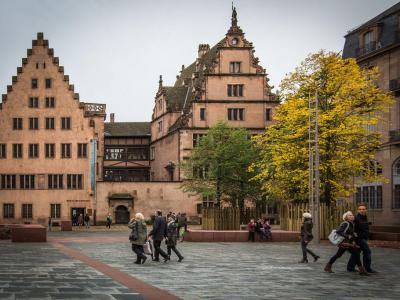
The Notre-Dame Artwork Museum finds its home within the Gothic/Renaissance edifice of the Notre-Dame Artwork Foundation. It is also nestled among the early Baroque structures encircling the Place du Chateau, situated adjacent to the Notre-Dame Cathedral.
Within the museum's confines, a captivating display of fine and decorative arts from the Upper Rhine region spanning the early Middle Ages to 1681 is showcased. The collection encompasses original sculptures and architectural fragments that bore the brunt of damage during the turbulence of the French Revolution. Additionally, the museum proudly exhibits stained glass windows crafted by Peter Hemmel von Andlau, along with paintings created by notable artists such as Hans Baldung, Sebastien Strokopff, and Konrad Witz.
Furthermore, the collection encompasses treasured elements sourced from other ecclesiastical establishments in Strasbourg. Among these are remnants from the Temple Neuf, tragically demolished in 1870, the Saint-Pierre-le-Vieux Church, which underwent renovation in 1867, and the Sainte-Madeleine Church, sadly consumed by fire in 1904. Noteworthy mentions also extend to the Romanesque components like the cloister and baptismal font from St. Trophimus' Church in Eschau, as well as the resplendent stained glass windows adorning Saint Peter and Saint Paul's Church in Wissembourg and Mutzig.
Tip:
There's an audio-guide available, free and well worth getting for all the information it gives. Don't miss the medieval garden, but be warned that it's closed in bad weather, including thundershowers.
Within the museum's confines, a captivating display of fine and decorative arts from the Upper Rhine region spanning the early Middle Ages to 1681 is showcased. The collection encompasses original sculptures and architectural fragments that bore the brunt of damage during the turbulence of the French Revolution. Additionally, the museum proudly exhibits stained glass windows crafted by Peter Hemmel von Andlau, along with paintings created by notable artists such as Hans Baldung, Sebastien Strokopff, and Konrad Witz.
Furthermore, the collection encompasses treasured elements sourced from other ecclesiastical establishments in Strasbourg. Among these are remnants from the Temple Neuf, tragically demolished in 1870, the Saint-Pierre-le-Vieux Church, which underwent renovation in 1867, and the Sainte-Madeleine Church, sadly consumed by fire in 1904. Noteworthy mentions also extend to the Romanesque components like the cloister and baptismal font from St. Trophimus' Church in Eschau, as well as the resplendent stained glass windows adorning Saint Peter and Saint Paul's Church in Wissembourg and Mutzig.
Tip:
There's an audio-guide available, free and well worth getting for all the information it gives. Don't miss the medieval garden, but be warned that it's closed in bad weather, including thundershowers.
4) Cathédrale Notre-Dame de Strasbourg (Strasbourg Cathedral) (must see)
Until 1874 the Strasbourg Cathedral was the world's tallest building; today it is the 6th tallest church and its tower dominates the Strasbourg skyline.
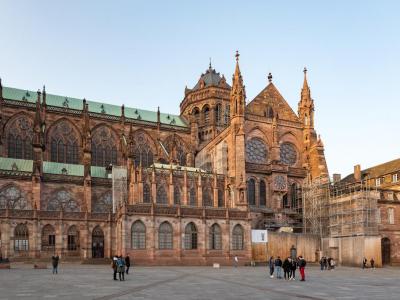
Described by Victor Hugo as a "gigantic and delicate marvel", and by Goethe as a "sublimely towering, wide-spreading tree of God", the cathedral is visible far across the plains of Alsace and can be seen from as far off as the Vosges Mountains or the Black Forest on the other side of the Rhine. Sandstone from Vosges, used in construction, gives the cathedral its characteristic pink hue.
The building took many centuries to finish and has three distinctive styles. Its crypt, dating back to 1015, has been expanded over the centuries. The North Tower, built in 1439, stands 142 meters high and on a clear day you can see for over 30 kilometers from its observation deck. The Lawrence Portal in the North Transept was finished in 1505 in a markedly post-Gothic, early-Renaissance style.
Most of the statues in the cathedral are copies of the originals kept at the Oeuvre Notre-Dame Museum. The stunning Astronomical Clock, built in 1843 to replace an earlier clock, is 18 meters high and is one of the largest in the world.
The clock show, including a 30-minute movie presentation with English subtitles, is at 12:30 pm in the summer, but you must be there at around 11:30 am to book your entry at the back door of the Cathedral, since the places are limited. Climbing up the tower is not difficult, as long as you can manage 330 steps - and it's worth the effort!
Described by Victor Hugo as a "gigantic and delicate marvel", and by Goethe as a "sublimely towering, wide-spreading tree of God", the cathedral is visible far across the plains of Alsace and can be seen from as far off as the Vosges Mountains or the Black Forest on the other side of the Rhine. Sandstone from Vosges, used in construction, gives the cathedral its characteristic pink hue.
The building took many centuries to finish and has three distinctive styles. Its crypt, dating back to 1015, has been expanded over the centuries. The North Tower, built in 1439, stands 142 meters high and on a clear day you can see for over 30 kilometers from its observation deck. The Lawrence Portal in the North Transept was finished in 1505 in a markedly post-Gothic, early-Renaissance style.
Most of the statues in the cathedral are copies of the originals kept at the Oeuvre Notre-Dame Museum. The stunning Astronomical Clock, built in 1843 to replace an earlier clock, is 18 meters high and is one of the largest in the world.
The clock show, including a 30-minute movie presentation with English subtitles, is at 12:30 pm in the summer, but you must be there at around 11:30 am to book your entry at the back door of the Cathedral, since the places are limited. Climbing up the tower is not difficult, as long as you can manage 330 steps - and it's worth the effort!
5) Place Gutenberg (Gutenberg Square) (must see)
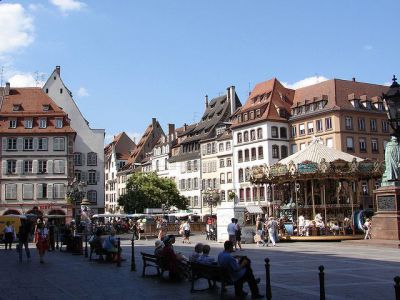
One destination that should be on your “must-see” list is the Place Gutenberg which lies in the center of medieval Strasbourg, not far from the Cathedral.
This large square is a favorite for locals and tourists alike as it has a lot of excellent cafes and restaurants. The Chamber of Commerce building occupies one side of the square and is easily recognizable with its Renaissance style, but with the sloping roof that is typical of Alsace, where winter snow is a way of life.
There is a 16th-century hotel on the square where Arthur Young was staying when revolutionists destroyed the city’s magistrates records and where today art exhibitions are held on the ground floor. Another attraction is the flea markets that often set up around the statue in the center of the square.
The statue is, quite obviously, dedicated to Johannes Gutenberg; it was sculpted by David d’Angers in 1840 and features the famous printer holding a piece of parchment on which is inscribed the words “Et la lumière fut” (And behold, there was light) from the Book of Genesis. Around the base of the statue, bas reliefs depict notable scenes from Gutenberg’s life.
Not many people know that apart from being the inventor of the first mechanical, movable printing press in Europe in 1439 and the publisher of the Gutenberg Bible in 1455, Gutenberg lived in Strasbourg between 1434-44, where he was an apprentice goldsmith, set to follow in his father’s footsteps.
This large square is a favorite for locals and tourists alike as it has a lot of excellent cafes and restaurants. The Chamber of Commerce building occupies one side of the square and is easily recognizable with its Renaissance style, but with the sloping roof that is typical of Alsace, where winter snow is a way of life.
There is a 16th-century hotel on the square where Arthur Young was staying when revolutionists destroyed the city’s magistrates records and where today art exhibitions are held on the ground floor. Another attraction is the flea markets that often set up around the statue in the center of the square.
The statue is, quite obviously, dedicated to Johannes Gutenberg; it was sculpted by David d’Angers in 1840 and features the famous printer holding a piece of parchment on which is inscribed the words “Et la lumière fut” (And behold, there was light) from the Book of Genesis. Around the base of the statue, bas reliefs depict notable scenes from Gutenberg’s life.
Not many people know that apart from being the inventor of the first mechanical, movable printing press in Europe in 1439 and the publisher of the Gutenberg Bible in 1455, Gutenberg lived in Strasbourg between 1434-44, where he was an apprentice goldsmith, set to follow in his father’s footsteps.
6) Place Kléber (Kleber Square) (must see)
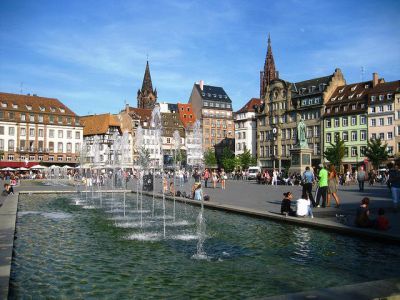
It is well worth taking time to visit the Place Kleber which is the biggest square in the heart of the city’s commercial district. The square has been a central meeting place since it was laid out in the 14th century and it took its name in 1840 after the General Jean Baptiste Kleber, whose statue stands in the center of the square. The general served in Napoleon’s army during the campaign in Egypt in 1798 and 1799. The statue was erected in 1838 by Philippe Grass.
When Napoleon returned to Paris, he named the Kleber Commander of the French Forces. Kleber was assassinated in 1800 in Cairo. His body was repatriated and kept in the Chateau d’If off the Marseille coast until being interred in his native Strasbourg thirty years later. The general’s remains are in a vault under the statue.
An interesting building along the north side of the square is the Aubette building, built in 1772 by Jacque-François Blondel. Once a military post, it was given its name in the 19th century, from the dawn (aube) changing of the guard. In 1928 three avant-garde artists Jean Arp, Theo van Doesburg and Sophie Taeuber-Arp decorated the interior of the building. This work of art is often called the "Sistine Chapel of Abstract Art" for its artistic beauty. Nowadays, the Aubette building is an artistic and historical landmark with on Place Kléber and is enjoyed by locals and tourists alike. Admission to the building is free.
When Napoleon returned to Paris, he named the Kleber Commander of the French Forces. Kleber was assassinated in 1800 in Cairo. His body was repatriated and kept in the Chateau d’If off the Marseille coast until being interred in his native Strasbourg thirty years later. The general’s remains are in a vault under the statue.
An interesting building along the north side of the square is the Aubette building, built in 1772 by Jacque-François Blondel. Once a military post, it was given its name in the 19th century, from the dawn (aube) changing of the guard. In 1928 three avant-garde artists Jean Arp, Theo van Doesburg and Sophie Taeuber-Arp decorated the interior of the building. This work of art is often called the "Sistine Chapel of Abstract Art" for its artistic beauty. Nowadays, the Aubette building is an artistic and historical landmark with on Place Kléber and is enjoyed by locals and tourists alike. Admission to the building is free.
7) Petite France (Little France) (must see)
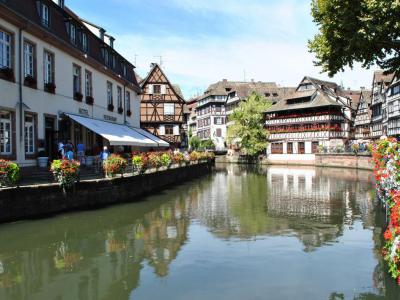
Petite France is an area in Strasbourg that is often called the Venice of the North because of its narrow streets and canals. It is a delightful area to visit as it takes you back to Medieval Strasbourg.
In the Middle Ages the beautiful half-timbered houses were the homes of fishermen, millers and tanners, and indeed many of the streets bear the names of the crafts carried out: Millers Street, Tanners Ditch and Lace Street, for example. The houses have the traditional tiered sloping roofs and hides were once hung up to dry on the topmost rafters.
In the late 15th century a hospice was built on the island for small-pox victims and later for French soldiers suffering from syphilis – which the Germans called it “French Disease” to stop the local girls from sleeping with the soldiers! The area became known as “Little France”, more out of derision than patriotism. The name stuck and today it is one of the most expensive quarters in the city.
Just to the west of Petite France, you can visit the Barrage Vauban – a weir that crosses the River Ill. It was built in 1686 from the plan by Marquis Vauban. The weir has two stories with wonderful sculptures on the main level, as well as a roof terrace where you can take superb photos of Petite France.
Why You Should Visit:
The most romantic neighborhood in Strasburg by far, especially at nightfall. There are also plenty of shops and places to try authentic French dishes. Places are open late and buildings are lit up after dark.
Tip:
Walk around here early in the morning if you wish to get photos without thousands of tourists in your shots. If you have issues walking on cobblestones, you can also take the boat or a little touristic train that goes around the Petit France.
In the Middle Ages the beautiful half-timbered houses were the homes of fishermen, millers and tanners, and indeed many of the streets bear the names of the crafts carried out: Millers Street, Tanners Ditch and Lace Street, for example. The houses have the traditional tiered sloping roofs and hides were once hung up to dry on the topmost rafters.
In the late 15th century a hospice was built on the island for small-pox victims and later for French soldiers suffering from syphilis – which the Germans called it “French Disease” to stop the local girls from sleeping with the soldiers! The area became known as “Little France”, more out of derision than patriotism. The name stuck and today it is one of the most expensive quarters in the city.
Just to the west of Petite France, you can visit the Barrage Vauban – a weir that crosses the River Ill. It was built in 1686 from the plan by Marquis Vauban. The weir has two stories with wonderful sculptures on the main level, as well as a roof terrace where you can take superb photos of Petite France.
Why You Should Visit:
The most romantic neighborhood in Strasburg by far, especially at nightfall. There are also plenty of shops and places to try authentic French dishes. Places are open late and buildings are lit up after dark.
Tip:
Walk around here early in the morning if you wish to get photos without thousands of tourists in your shots. If you have issues walking on cobblestones, you can also take the boat or a little touristic train that goes around the Petit France.
8) Pont Couverts (Covered Bridges) (must see)
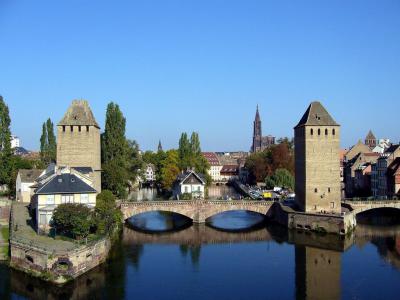
To protect the ancient city of Strasbourg, the Covered Bridges were constructed in the 1200s. There are three bridges crossing the River Ill. Additionally, there are four defensive towers set up between them.
In the late 1600s, the bridges were covered with wooden roofs. These were intended to cover soldiers and defenders who were stationed on the bridges during times of war. The covers were removed in 1784, but the name "Covered Bridges" has stuck.
While the bridges and towers remain, their task of defending the city was taken by the nearby the Vauban Dam. The Vauban Dam is the combination bridge and weir just west of the Covered Bridges.
If you want some postcard-perfect photos, stop by the Covered Bridges just after dark. The bridges and city are lit spectacularly. The best place to view and photograph the Covered Bridges is from near or on the Vauban Damn.
In the late 1600s, the bridges were covered with wooden roofs. These were intended to cover soldiers and defenders who were stationed on the bridges during times of war. The covers were removed in 1784, but the name "Covered Bridges" has stuck.
While the bridges and towers remain, their task of defending the city was taken by the nearby the Vauban Dam. The Vauban Dam is the combination bridge and weir just west of the Covered Bridges.
If you want some postcard-perfect photos, stop by the Covered Bridges just after dark. The bridges and city are lit spectacularly. The best place to view and photograph the Covered Bridges is from near or on the Vauban Damn.
