Custom Walk in Palma de Mallorca, Spain by yannick_lallement_7ba39 created on 2025-05-30
Guide Location: Spain » Palma de Mallorca
Guide Type: Custom Walk
# of Sights: 7
Tour Duration: 1 Hour(s)
Travel Distance: 1.9 Km or 1.2 Miles
Share Key: 43Q2U
Guide Type: Custom Walk
# of Sights: 7
Tour Duration: 1 Hour(s)
Travel Distance: 1.9 Km or 1.2 Miles
Share Key: 43Q2U
How It Works
Please retrieve this walk in the GPSmyCity app. Once done, the app will guide you from one tour stop to the next as if you had a personal tour guide. If you created the walk on this website or come to the page via a link, please follow the instructions below to retrieve the walk in the app.
Retrieve This Walk in App
Step 1. Download the app "GPSmyCity: Walks in 1K+ Cities" on Apple App Store or Google Play Store.



Step 2. In the GPSmyCity app, download(or launch) the guide "Palma de Mallorca Map and Walking Tours".
Step 3. Tap the menu button located at upper right corner of the "Walks" screen and select "Retrieve custom walk". Enter the share key: 43Q2U
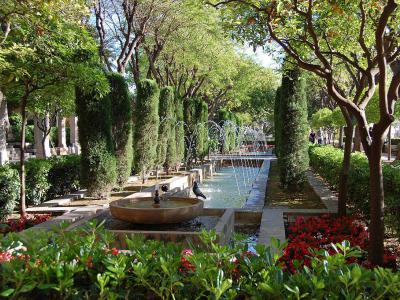
1) S'Hort del Rei (Royal Garden)
Within the Almudaina Palace in the 14th century were the Royal Gardens. The gardens were laid out in the Andalusian style with fruit trees, vegetables, medicinal herbs, ornamentals and flowers. Until 1847 the garden was closed in by walls, the seashore and the gardener's house.
From 1847 to 1918 the area of the garden was redeveloped. Buildings were erected on the end of the Royal Gardens. The Alhombra Hotel, the lyric Theatre and small shops, newspaper offices and a shipping office stood in place of much of the garden. In 1966 architect Gabriel Alomar i Esteve executed his plan to revitalize the city of Palma.
The plan was to demolish the buildings that had taken over the garden plots and reinstall the royal gardens. In remodeling the royal gardens, Gabriel was strongly influenced by traditional Andalusian styles. In the garden today are cypresses, fountains, orange trees, shady arcades and a large pond with black swans.
There is an original Islamic arch over the pond. There are also several sculptures. The most famous is a bronze figure called the "Stone Slinger." The sculptures are the works of Llorenc Rosello and Josep Maria Subirachs and Alexander Calder.
From 1847 to 1918 the area of the garden was redeveloped. Buildings were erected on the end of the Royal Gardens. The Alhombra Hotel, the lyric Theatre and small shops, newspaper offices and a shipping office stood in place of much of the garden. In 1966 architect Gabriel Alomar i Esteve executed his plan to revitalize the city of Palma.
The plan was to demolish the buildings that had taken over the garden plots and reinstall the royal gardens. In remodeling the royal gardens, Gabriel was strongly influenced by traditional Andalusian styles. In the garden today are cypresses, fountains, orange trees, shady arcades and a large pond with black swans.
There is an original Islamic arch over the pond. There are also several sculptures. The most famous is a bronze figure called the "Stone Slinger." The sculptures are the works of Llorenc Rosello and Josep Maria Subirachs and Alexander Calder.
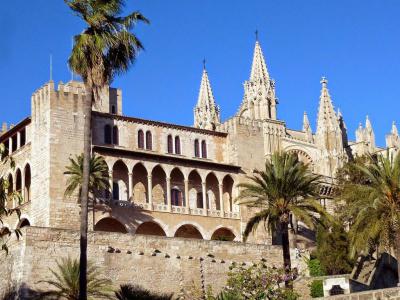
2) Royal Palace of La Almudaina (must see)
The Royal Palace of La Almudaina is an "alcazar", a fortified palace. In 1309 it was rebuilt by King James II of Majorca. The rebuilt was based on the Royal Palace of Perpignan. La Almudaina today follows a layout established in the 14th century. There are spaces for the ruling family, a chapel dedicated to Saint Anne, and the baths.
The spaces are differentiated into ways. On the ground floor a medieval ambience is maintained with art and furnishings dating from the 15th century. The upper floor is reserved for official Royal acts and it is decorated with objects and art from the 17th, 18th and 20th centuries.
The palace is the official summer residence of the Spanish Royal Family. The family also resides at the Palace of Marivent and the Zarzuela Palace in Madrid when not in Mallorca. The Palace and Palma Cathedral are next door neighbors. Both rise over palma de Mallorca harbor, providing great views of the sea.
The Palace is open Thursdays to Sundays from 10am to 6pm. Hours may be longer in the summer. There is a small admission fee.
The spaces are differentiated into ways. On the ground floor a medieval ambience is maintained with art and furnishings dating from the 15th century. The upper floor is reserved for official Royal acts and it is decorated with objects and art from the 17th, 18th and 20th centuries.
The palace is the official summer residence of the Spanish Royal Family. The family also resides at the Palace of Marivent and the Zarzuela Palace in Madrid when not in Mallorca. The Palace and Palma Cathedral are next door neighbors. Both rise over palma de Mallorca harbor, providing great views of the sea.
The Palace is open Thursdays to Sundays from 10am to 6pm. Hours may be longer in the summer. There is a small admission fee.
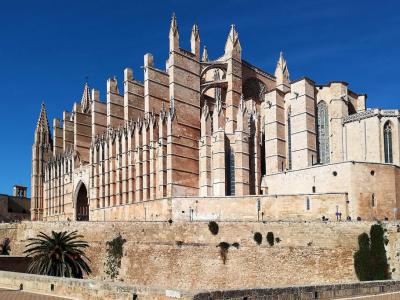
3) Palma Cathedral (must see)
James I of Aragon was in grave danger. On his way to conquer the Balearic Islands in December, 1229, his fleet of ships was overtaken by a violent storm. In peril of foundering, young James swore to God that if he survived and conquered Mallorca, he would build there a great cathedral.
God held him to it. Construction began in 1230 on the Palma Cathedral or La Seu, as it is popularly known. Building went on for 350 years. Finally the nave and the main portal, the last elements, were finished. James had really kept his promise. The dimensions of the church are vast: width, 108 feet; height, 145 feet; length, 361 feet.
The nave, last to be finished, is among the largest in Europe. A Gothic rose window dominates the eastern wall. It has a diameter of 41 feet and it is composed of around 1200 pieces of stained glass. Every sunrise the cathedral interior is flooded with sparkling reflections of colors in the morning light. But there is more to this light.
There is a game, called "Light Game of the Eight." The game occurs just twice a year, on February 2nd and November 11th. At 8am the rays of the sun shine through the rosette window on the eastern wall and project the image of the window exactly on the opposite wall below the rosette of the main facade.
But there is yet more to this light. Twenty days on each side of the winter solstice the sunrise is viewable through both enormous rosettes.
The cathedral shows a range of architectural styles. There are clearly Gothic influences in the seaward facing portal that date from the 13th century. The portal on the opposite side is late Gothic from the 16th century. The Gothic is replaced by the Renaissance. The chapels are Baroque. There is Classicism in the Baptistry.
Two kings, James II and James III, are laid to rest in the Trinity Chapel. The chapel is not open to the public. Visitors are charged a small entrance fee. The cathedral is open after 10 am.
Why You Should Visit:
Here is all uplifting spirit of Mallorca spelled out in stone and light. The great cathedral reaches for the sky as the soul might reach for heaven.
God held him to it. Construction began in 1230 on the Palma Cathedral or La Seu, as it is popularly known. Building went on for 350 years. Finally the nave and the main portal, the last elements, were finished. James had really kept his promise. The dimensions of the church are vast: width, 108 feet; height, 145 feet; length, 361 feet.
The nave, last to be finished, is among the largest in Europe. A Gothic rose window dominates the eastern wall. It has a diameter of 41 feet and it is composed of around 1200 pieces of stained glass. Every sunrise the cathedral interior is flooded with sparkling reflections of colors in the morning light. But there is more to this light.
There is a game, called "Light Game of the Eight." The game occurs just twice a year, on February 2nd and November 11th. At 8am the rays of the sun shine through the rosette window on the eastern wall and project the image of the window exactly on the opposite wall below the rosette of the main facade.
But there is yet more to this light. Twenty days on each side of the winter solstice the sunrise is viewable through both enormous rosettes.
The cathedral shows a range of architectural styles. There are clearly Gothic influences in the seaward facing portal that date from the 13th century. The portal on the opposite side is late Gothic from the 16th century. The Gothic is replaced by the Renaissance. The chapels are Baroque. There is Classicism in the Baptistry.
Two kings, James II and James III, are laid to rest in the Trinity Chapel. The chapel is not open to the public. Visitors are charged a small entrance fee. The cathedral is open after 10 am.
Why You Should Visit:
Here is all uplifting spirit of Mallorca spelled out in stone and light. The great cathedral reaches for the sky as the soul might reach for heaven.
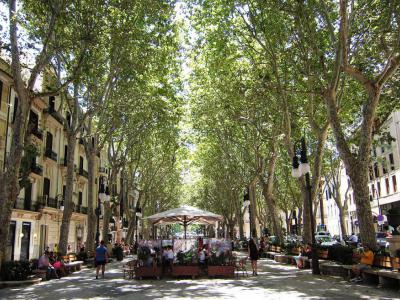
4) Passeig des Born (Born Passage) (must see)
For more than one hundred years, the tree-lined Born Passage has held feasts, demos, events and peaceful strollers. There is a wide promenade and two traffic lanes on either side of the promenade. The promenade was built over the riverbed of the Riera torrent which once divided the city.
The two traffic lanes were laid out for traffic in each direction but now one is mostly pedestrian. The old Born cinema is now a Zara store. The cinema shares space on the promenade with Casal Solleric, an exhibition space formerly a palace. The grand old houses have galleries at street level.
The promenade extends to the Queen's Square and joins the Paseo Maritimo. Jaime III Aenue leads to Juan Carlos I Square, a main commercial spot of Palma. Union Street joins the promenade with Las Ramblas.
Pretend to be stranded and spend an evening walk on the Born Passage. See the Royal Palace of La Almudaina and the Palma Cathedral at night. Then sample some vegan ice cream at a place called Dolce.
In his obsession to possess everything, Francisco Franco called the Born Passage "Paseo Franco" but everyone else preferred "Born".
The two traffic lanes were laid out for traffic in each direction but now one is mostly pedestrian. The old Born cinema is now a Zara store. The cinema shares space on the promenade with Casal Solleric, an exhibition space formerly a palace. The grand old houses have galleries at street level.
The promenade extends to the Queen's Square and joins the Paseo Maritimo. Jaime III Aenue leads to Juan Carlos I Square, a main commercial spot of Palma. Union Street joins the promenade with Las Ramblas.
Pretend to be stranded and spend an evening walk on the Born Passage. See the Royal Palace of La Almudaina and the Palma Cathedral at night. Then sample some vegan ice cream at a place called Dolce.
In his obsession to possess everything, Francisco Franco called the Born Passage "Paseo Franco" but everyone else preferred "Born".
5) Plaza Mayor (Main Square)
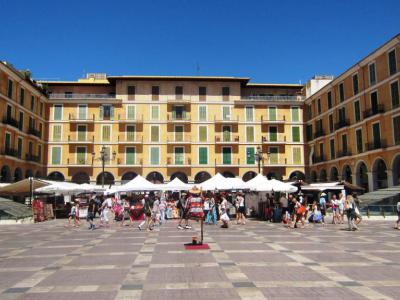
The old convent of San Felipe Neri in Palma de Mallorca was torn down in 1823. That was a good thing. Few people, if any, were nostalgic for the Inquisition and the old convent in the city had been essentially Inquisition Central. Ten years after the convent and associated buildings were pulled down, work on the Main Square began.
Work continued, off and on, until the 20th century. When completed, the square featured an underground car park, businesses and commercial galleries.
The square is a big rectangle. Porticoed three and four-storied houses line the edges. The square is close to the Churches of San Miguel and Santa Eulalia. Other important buildings nearby include the Town Hall and the Main Theater. The streets of San Miguel, Jaime II, Colon and Sindicato stretch from the Main Square to the city limits.
Restaurants, cafes, art galleries and street performers abound in the square. An artisan market is held every week. Streets leading out of the square are also jammed with cafes and shops. The square tiled and closed to motor traffic. Main Square is a social and cultural watering hole for visitors and locals alike.
Work continued, off and on, until the 20th century. When completed, the square featured an underground car park, businesses and commercial galleries.
The square is a big rectangle. Porticoed three and four-storied houses line the edges. The square is close to the Churches of San Miguel and Santa Eulalia. Other important buildings nearby include the Town Hall and the Main Theater. The streets of San Miguel, Jaime II, Colon and Sindicato stretch from the Main Square to the city limits.
Restaurants, cafes, art galleries and street performers abound in the square. An artisan market is held every week. Streets leading out of the square are also jammed with cafes and shops. The square tiled and closed to motor traffic. Main Square is a social and cultural watering hole for visitors and locals alike.
6) Olivar Market (must see)
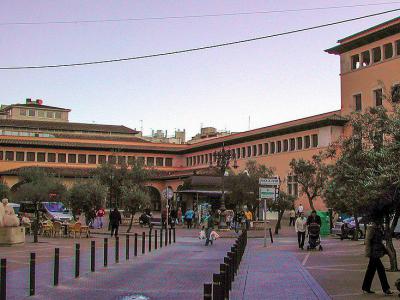
In the center of Palma de Mallorca sits the Olivar Market. If you like food, all kinds of food, this is definitely the place to be. How does one who has never been here know this? Watch the locals. See where they go for snacks, take-away, shopping, and meals-in-place. Follow them. Do as they do and enjoy.
Olivar Market has been in place since 1951. It has a full range of stalls, bars, restaurants and cafes and cafeterias. There are few supermarkets in Palma, so this is the go to place for residents and tourists. Sea food, sushi, meats, fresh fruit, vegetables and dairy products are all here.
On the ground floor (first floor in USA) find stalls for vegetables, meats and gourmet foods. There are escalators and elevators to the upper floor and the parking area. On the upper floor is a shopping arcade, a cooking school, hairdressing salon, restaurants and bars and boutiques, plus a supermarket, a children's area and a library.
Olivar Market has been in place since 1951. It has a full range of stalls, bars, restaurants and cafes and cafeterias. There are few supermarkets in Palma, so this is the go to place for residents and tourists. Sea food, sushi, meats, fresh fruit, vegetables and dairy products are all here.
On the ground floor (first floor in USA) find stalls for vegetables, meats and gourmet foods. There are escalators and elevators to the upper floor and the parking area. On the upper floor is a shopping arcade, a cooking school, hairdressing salon, restaurants and bars and boutiques, plus a supermarket, a children's area and a library.
7) Plaza de España (Spain Square)
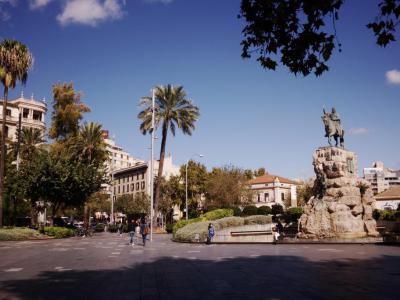
A statue of James I, 13th century King of Aragon, aka The Conqueror, rides high in the Spain Square in Palma de Mallorca. James took Mallorca from Aba Yahya, the Almohad governor, on September 5, 1229. The bronze statue of James, mounted on his steed, was made by sculptor Enrique Claraso y Daudi.
James' life was not always peaceful and neither is the square he oversees. There are cafes and places to sit and watch the world go by. There are also buses, cars, electric scooters buzzing about and people meeting and parting under the watchful bronze eyes of King James.
The square is like a nerve center of Mallorca. The Plaza is the location of the city's modern Estacion Intermodal, the terminal for most buses and trains. The buses connect with towns around the island. Trains go to Inca san Pablo, Manacor and Marratxi.
The Station Park is behind the station terminal. It offers a landscaped refuge from the hustle and bustle of the square and a children's play park. The square itself is across the road from the station. There are cafes and restaurants and open air terraces and of course, King James.
There is a confluence of streets in the square. Alexandre Roselio Avenue leads to El Corte Ingles, Spain's largest department store. The food market Olivar Market is here. Other streets are La Rambla, Avenida Juan March Avenue, Eusebio Estada Street and San Miguel.
James' life was not always peaceful and neither is the square he oversees. There are cafes and places to sit and watch the world go by. There are also buses, cars, electric scooters buzzing about and people meeting and parting under the watchful bronze eyes of King James.
The square is like a nerve center of Mallorca. The Plaza is the location of the city's modern Estacion Intermodal, the terminal for most buses and trains. The buses connect with towns around the island. Trains go to Inca san Pablo, Manacor and Marratxi.
The Station Park is behind the station terminal. It offers a landscaped refuge from the hustle and bustle of the square and a children's play park. The square itself is across the road from the station. There are cafes and restaurants and open air terraces and of course, King James.
There is a confluence of streets in the square. Alexandre Roselio Avenue leads to El Corte Ingles, Spain's largest department store. The food market Olivar Market is here. Other streets are La Rambla, Avenida Juan March Avenue, Eusebio Estada Street and San Miguel.
