Custom Walk in Bangkok, Thailand by kristinagalvarez_e32f3 created on 2025-06-06
Guide Location: Thailand » Bangkok
Guide Type: Custom Walk
# of Sights: 6
Tour Duration: 1 Hour(s)
Travel Distance: 2.7 Km or 1.7 Miles
Share Key: 6AJL4
Guide Type: Custom Walk
# of Sights: 6
Tour Duration: 1 Hour(s)
Travel Distance: 2.7 Km or 1.7 Miles
Share Key: 6AJL4
How It Works
Please retrieve this walk in the GPSmyCity app. Once done, the app will guide you from one tour stop to the next as if you had a personal tour guide. If you created the walk on this website or come to the page via a link, please follow the instructions below to retrieve the walk in the app.
Retrieve This Walk in App
Step 1. Download the app "GPSmyCity: Walks in 1K+ Cities" on Apple App Store or Google Play Store.



Step 2. In the GPSmyCity app, download(or launch) the guide "Bangkok Map and Walking Tours".
Step 3. Tap the menu button located at upper right corner of the "Walks" screen and select "Retrieve custom walk". Enter the share key: 6AJL4
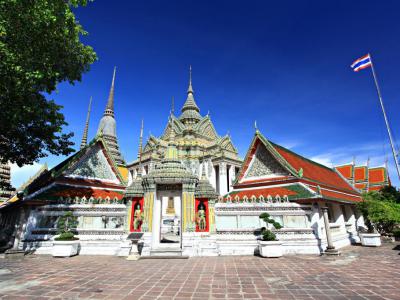
1) Wat Pho (Temple of the Reclining Buddha) (must see)
Wat Pho (the Temple of the Reclining Buddha) is the oldest Buddhist temple in Bangkok, located behind the splendid Temple of the Emerald Buddha, and is one of the city's largest. Built around 200 years before Bangkok became Thailand's capital, the temple is mainly famous for housing the huge Reclining Buddha statue along with the largest number of Buddha images within. The Wat was almost entirely rebuilt during the reign of Rama I, when the capital was moved to Bangkok.
The highly impressive gold-plated Reclining Buddha is 46 meters long and 15 meters high, and is designed to illustrate the passing of the Buddha into nirvana. The feet and the eyes are engraved with mother-of-pearl decoration. The bottoms of the Buddha's feet are intricately decorated with 108 auspicious scenes in Chinese and Indian styles.
The Wat Pho complex consists of two walled compounds, bisected north-south by Sanamchai Road running east-west. Reclining Buddha and a massage school are found in the northern walled compound. People visit mostly this section which comprises a large temple hall enclosed by 394 bronze Buddha images. There are also 91 chedis of varying sizes around the ground. The library, impressively decorated with figures and pagodas made of porcelain, is also present nearby. The large grounds of Wat Pho contain more than 1,000 Buddha images in total, most brought from the ruins of the former capitals Ayuthaya and Sukhothai.
Wat Pho is also famous as Thailand's first university, as well as the birthplace and training center of traditional Thai massage. Stimulating rather than relaxing, and incorporating yoga style postures to relieve stress and improve blood circulation, traditional Thai massage is quite different from the other forms of therapeutic massage. Wat Pho is a good place to try it – many of the rich and famous are known to have come here specifically for that. Try and see if you like it!
Traditional Thai dance and music are also taught within the temple, on Sundays. Astrologers and palm readers are likewise available for consultation. For a very small donation, that helps to maintain the temple, you can also receive a blessing from a monk.
Tip:
Make sure to bring exact THB amount for the entry tickets because, for some weird reason, they won't give any change.
It takes about 2 hours to just go round and make photos, but you can easily spend 4-5 hours in this huge complex altogether.
The admission ticket comes with a bottle of water and there are refill stations with cool clean water inside.
Women and men must wear long pants (covering knees) and shirts with long sleeves.
To enter the sanctum sanctorum, you'll have to take your shoes off.
The highly impressive gold-plated Reclining Buddha is 46 meters long and 15 meters high, and is designed to illustrate the passing of the Buddha into nirvana. The feet and the eyes are engraved with mother-of-pearl decoration. The bottoms of the Buddha's feet are intricately decorated with 108 auspicious scenes in Chinese and Indian styles.
The Wat Pho complex consists of two walled compounds, bisected north-south by Sanamchai Road running east-west. Reclining Buddha and a massage school are found in the northern walled compound. People visit mostly this section which comprises a large temple hall enclosed by 394 bronze Buddha images. There are also 91 chedis of varying sizes around the ground. The library, impressively decorated with figures and pagodas made of porcelain, is also present nearby. The large grounds of Wat Pho contain more than 1,000 Buddha images in total, most brought from the ruins of the former capitals Ayuthaya and Sukhothai.
Wat Pho is also famous as Thailand's first university, as well as the birthplace and training center of traditional Thai massage. Stimulating rather than relaxing, and incorporating yoga style postures to relieve stress and improve blood circulation, traditional Thai massage is quite different from the other forms of therapeutic massage. Wat Pho is a good place to try it – many of the rich and famous are known to have come here specifically for that. Try and see if you like it!
Traditional Thai dance and music are also taught within the temple, on Sundays. Astrologers and palm readers are likewise available for consultation. For a very small donation, that helps to maintain the temple, you can also receive a blessing from a monk.
Tip:
Make sure to bring exact THB amount for the entry tickets because, for some weird reason, they won't give any change.
It takes about 2 hours to just go round and make photos, but you can easily spend 4-5 hours in this huge complex altogether.
The admission ticket comes with a bottle of water and there are refill stations with cool clean water inside.
Women and men must wear long pants (covering knees) and shirts with long sleeves.
To enter the sanctum sanctorum, you'll have to take your shoes off.
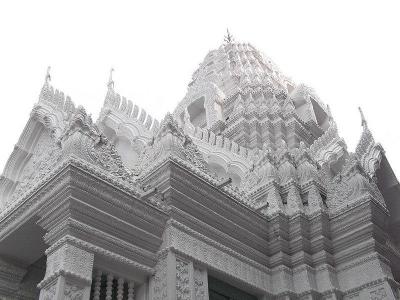
2) Wat Ratchapradit
Located to the north of Suan Saranrom, not far from the Grand Palace and Wat Po, Wat Ratchapradit, also known as Wat Rajapradit, is a relatively small Buddhist temple covering a total area of approximately 2 rai. According to an old tradition, three major temples are required to be situated within the capital and, in part, this temple was built to serve this purpose during the reign of King Rama IV, in 1864, for the monks of the Dhammayutika sect.
The central building of Wat Ratchapradit is its viharn, or main chapel, called Phra Vihara Luang. Foundation of the temple had to be reinforced with garlic pots as landfill when, during the construction, it was discovered that the soft soil of the area might cause the building to sink and collapse.
Originally, back in the days of King Rama III, this plot of land was a royal coffee plantation, and was later bought by King Rama IV with his own money. The king constructed a small temple here and called it Wat Ratchapradit Sathitthammayutikaram. Later, he changed the name to Wat Ratchapradit Sathitmahasimaram.
Inside the Phra Vihara Luang are the murals showing royal ceremonies of the calendar year. One of them depicts King Rama IV using a telescope as part of his astronomical studies.
As you pass through the gate, there's a short stairway leading up to a platform supporting the ubosot surrounded by several prangs with a large chedi behind. The inside decor gives an illusion of a checkerboard pattern due to the fact that the ubosot, including its round columns, and the chedi are completely covered in small square tiles of grey and white marble.
On either side of the ubosot are the large prangs with a noticeable Khmer influence. Contrary to the heat outside, inside the ubosot is all dark and cool. The main Buddha image on the altar is backed by a shimmering blue mosaic of mirrors. The ceiling is typically finished in red and gold, with crystalline stars in gold rosettes.
A regular flow of visitors to this little temple suggests that it definitely deserves, albeit a short, visit on your way to the Grand Palace.
The central building of Wat Ratchapradit is its viharn, or main chapel, called Phra Vihara Luang. Foundation of the temple had to be reinforced with garlic pots as landfill when, during the construction, it was discovered that the soft soil of the area might cause the building to sink and collapse.
Originally, back in the days of King Rama III, this plot of land was a royal coffee plantation, and was later bought by King Rama IV with his own money. The king constructed a small temple here and called it Wat Ratchapradit Sathitthammayutikaram. Later, he changed the name to Wat Ratchapradit Sathitmahasimaram.
Inside the Phra Vihara Luang are the murals showing royal ceremonies of the calendar year. One of them depicts King Rama IV using a telescope as part of his astronomical studies.
As you pass through the gate, there's a short stairway leading up to a platform supporting the ubosot surrounded by several prangs with a large chedi behind. The inside decor gives an illusion of a checkerboard pattern due to the fact that the ubosot, including its round columns, and the chedi are completely covered in small square tiles of grey and white marble.
On either side of the ubosot are the large prangs with a noticeable Khmer influence. Contrary to the heat outside, inside the ubosot is all dark and cool. The main Buddha image on the altar is backed by a shimmering blue mosaic of mirrors. The ceiling is typically finished in red and gold, with crystalline stars in gold rosettes.
A regular flow of visitors to this little temple suggests that it definitely deserves, albeit a short, visit on your way to the Grand Palace.
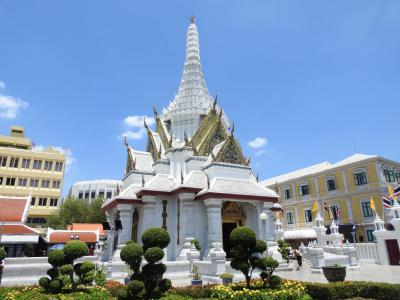
3) Lak Mueang (City Pillar Shrine)
City pillars, known as Lak Mueang, are common in Thai cities. They house the city spirit deity, Chao Pho Lak Mueang, in a shrine. This tradition originates from a Brahman ritual where a single acacia pillar, Chaiyaphreuk ("tree of victory"), was erected as the city's spiritual heart before construction began. Citizens revered it for prosperity and protection.
King Rama I established Bangkok's city pillar on April 21, 1782, marking the relocation of the capital from Thonburi. This shrine, predating the royal palace, is among Thailand's oldest and most revered.
The first pillar stood 470 centimeters (190 inches) high, buried 200 centimeters (79 inches) deep, and measuring 74 centimeters (29 inches) in diameter. Inside it there was a horoscope for Bangkok. In the mid 19th century the original shrine was rebuilt and the pillar refitted with a fresh horoscope. In 1852, another pillar was added – 5.115 meters (201.4 inches) tall, 47 centimeters (18.8 inches) in diameter at the bottom, with a base of 180 centimeters (71 inches) wide. The refurbished pavilion, with a spire (prang) modeled on the shrine of Ayudhya, was inaugurated on 1 May 1853.
Legend tells of a sacrifice ritual during construction, where people responding to the call "in–chan–mun–kong" (signifying directions) were buried at the site to protect the city. This tale, however, lacks historical proof.
Worshippers at the shrine typically offer three incense sticks, a candle, gold foil, two lotuses, two flower garlands, and a three-color taffeta.
King Rama I established Bangkok's city pillar on April 21, 1782, marking the relocation of the capital from Thonburi. This shrine, predating the royal palace, is among Thailand's oldest and most revered.
The first pillar stood 470 centimeters (190 inches) high, buried 200 centimeters (79 inches) deep, and measuring 74 centimeters (29 inches) in diameter. Inside it there was a horoscope for Bangkok. In the mid 19th century the original shrine was rebuilt and the pillar refitted with a fresh horoscope. In 1852, another pillar was added – 5.115 meters (201.4 inches) tall, 47 centimeters (18.8 inches) in diameter at the bottom, with a base of 180 centimeters (71 inches) wide. The refurbished pavilion, with a spire (prang) modeled on the shrine of Ayudhya, was inaugurated on 1 May 1853.
Legend tells of a sacrifice ritual during construction, where people responding to the call "in–chan–mun–kong" (signifying directions) were buried at the site to protect the city. This tale, however, lacks historical proof.
Worshippers at the shrine typically offer three incense sticks, a candle, gold foil, two lotuses, two flower garlands, and a three-color taffeta.
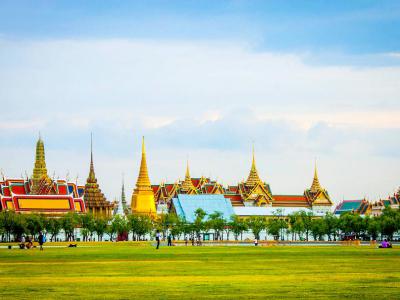
4) Sanam Luang Square
Sanam Luang is a well-known public open space located in front of the Temple of the Emerald Buddha and the Grand Palace in Bangkok. Originally called Thung Phra Men, this area was primarily used as a royal cremation ground, where the cremations of kings, queens, and princes were conducted. This tradition began during the reign of King Rama I.
During King Rama III's reign from 1824 to 1851, amidst a conflict with Vietnam over the Cambodian border, the area was transformed into a rice plantation to showcase Thailand's fertility and prosperity.
In 1855, King Rama IV renamed the field Thong Sanam Luang, which is commonly referred to as Sanam Luang. He also established a venue for the Royal Ploughing Ceremony, constructed a hall for Buddha's image, several pavilions, and a stage for propitiating the gods.
King Rama V later demolished these structures and expanded Sanam Luang to commemorate the centennial celebration of Bangkok in 1897. Inspired by his visit to Java and the splendid palace gardens he saw there, he also ordered the planting of two rows of tamarind trees around the field.
Over time, Sanam Luang has been utilized for various purposes, such as kite flying, racing, and even as a golf course. In addition to annual events like the Ploughing Ceremony and Calling of the Rain in May, significant celebrations like the Bi-Centennial Celebration of Bangkok in 1982 and the grand celebration of the Golden Jubilee Royal Ceremony in 1996 were held here.
Furthermore, Sanam Luang has continued to serve as a royal cremation ground. Notable individuals, including King Ananda Mahidol in 1950, Queen Savang Vadhana in 1956, Queen Rambhai Barni of King Rama VII in 1986, Princess Mother Srinagarindra in 1996, Princess Galyani Vadhana in 2008, and Princess Bejaratana Rajasuda in 2012, were cremated here.
During King Rama III's reign from 1824 to 1851, amidst a conflict with Vietnam over the Cambodian border, the area was transformed into a rice plantation to showcase Thailand's fertility and prosperity.
In 1855, King Rama IV renamed the field Thong Sanam Luang, which is commonly referred to as Sanam Luang. He also established a venue for the Royal Ploughing Ceremony, constructed a hall for Buddha's image, several pavilions, and a stage for propitiating the gods.
King Rama V later demolished these structures and expanded Sanam Luang to commemorate the centennial celebration of Bangkok in 1897. Inspired by his visit to Java and the splendid palace gardens he saw there, he also ordered the planting of two rows of tamarind trees around the field.
Over time, Sanam Luang has been utilized for various purposes, such as kite flying, racing, and even as a golf course. In addition to annual events like the Ploughing Ceremony and Calling of the Rain in May, significant celebrations like the Bi-Centennial Celebration of Bangkok in 1982 and the grand celebration of the Golden Jubilee Royal Ceremony in 1996 were held here.
Furthermore, Sanam Luang has continued to serve as a royal cremation ground. Notable individuals, including King Ananda Mahidol in 1950, Queen Savang Vadhana in 1956, Queen Rambhai Barni of King Rama VII in 1986, Princess Mother Srinagarindra in 1996, Princess Galyani Vadhana in 2008, and Princess Bejaratana Rajasuda in 2012, were cremated here.
5) National Museum Bangkok
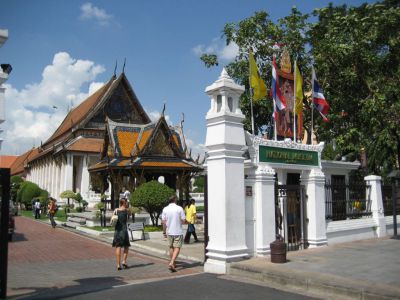
The National Museum Bangkok features exhibits of Thai art and history all the way back to Neolithic times. Opened in 1874 by His Majesty King Rama V, this is the first public venue to display the royal collection of King Rama IV and other objects of general interest. The museum occupies the 18th-century Wang Na Palace, which had previously been the residence of the Prince Successor. Originally, it was intended to exhibit the antiques and gifts bestowed to Rama V by his father.
First named the Bangkok Museum, opened by King Rama VII in 1926, the institution had subsequently been transformed, under the direction of the Department of Fine Arts, into the National Museum Bangkok by 1934. Initially a non-organized gathering of dusty relics, it now features exhibits arranged into three areas consistent with Thai history. A good English-language description is provided for all artifacts.
The Thai History Gallery, covering the periods from Sukothai to the Rattanakosin, is found at the front of the Sivamokhaphiman Hall. The Archaeological and Art History Collection features items from the prehistoric period to the modern Kingdom, including many ancient sculptures. Decorative Arts and Ethnological Collection showcases Chinese weaponry, gold treasures, precious stones, masks and many items of historical importance from all over Southeast Asia. Other exhibits include a funeral chariot hall, featuring carriages used for royal cremations, along with many excellent examples of Thai architecture.
Tip:
There are excellent free tour guides in English, French (Wed, Thu), Japanese (Wed) and German (Thu) at 9:30am.
First named the Bangkok Museum, opened by King Rama VII in 1926, the institution had subsequently been transformed, under the direction of the Department of Fine Arts, into the National Museum Bangkok by 1934. Initially a non-organized gathering of dusty relics, it now features exhibits arranged into three areas consistent with Thai history. A good English-language description is provided for all artifacts.
The Thai History Gallery, covering the periods from Sukothai to the Rattanakosin, is found at the front of the Sivamokhaphiman Hall. The Archaeological and Art History Collection features items from the prehistoric period to the modern Kingdom, including many ancient sculptures. Decorative Arts and Ethnological Collection showcases Chinese weaponry, gold treasures, precious stones, masks and many items of historical importance from all over Southeast Asia. Other exhibits include a funeral chariot hall, featuring carriages used for royal cremations, along with many excellent examples of Thai architecture.
Tip:
There are excellent free tour guides in English, French (Wed, Thu), Japanese (Wed) and German (Thu) at 9:30am.
6) Khaosan Road
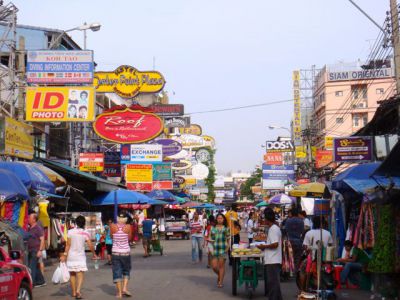
Khaosan Road, often called "the place to disappear" or described poetically as "a short road with the longest dream," is surprisingly brief, stretching just 410 meters. This road was built in 1892 during King Rama V's rule. The name "Khaosan" means "milled rice," pointing back to its history as a key rice trading spot.
In the past 40 years, Khaosan Road has become a globally known hub for budget travelers, offering a range of affordable accommodations. These range from very basic rooms to more comfortable 3-star hotels. During peak tourist season, the road welcomes between 40,000 and 50,000 visitors daily, while off-peak times see about 20,000 daily visitors.
Khaosan Road is a melting pot of diverse individuals. You'll find young Westerners taking a break from their privileged lives, high school graduates on their gap year, Israelis recently finished with military service, university students on vacation or a sabbatical, young Japanese experiencing a coming-of-age ritual, typical vacationers, former volunteers from different organizations, and others.
The area's shops offer various items including handicrafts, art, clothing, local fruit, pirated CDs and DVDs, a variety of fake IDs, second-hand books, and other items essential for backpackers. After sunset, the atmosphere shifts as bars open up, music fills the air, street food vendors offer exotic snacks like barbecued insects, and promoters advertise unique shows. Khaosan Road is especially lively before the Thai New Year (Songkran festival) in mid-April, known for its massive water fights.
Additionally, the historic Wat Chana Songkram Buddhist temple, under royal patronage, sits across from Khaosan Road to the west. The area to the northwest is home to an Islamic community and several small mosques.
In the past 40 years, Khaosan Road has become a globally known hub for budget travelers, offering a range of affordable accommodations. These range from very basic rooms to more comfortable 3-star hotels. During peak tourist season, the road welcomes between 40,000 and 50,000 visitors daily, while off-peak times see about 20,000 daily visitors.
Khaosan Road is a melting pot of diverse individuals. You'll find young Westerners taking a break from their privileged lives, high school graduates on their gap year, Israelis recently finished with military service, university students on vacation or a sabbatical, young Japanese experiencing a coming-of-age ritual, typical vacationers, former volunteers from different organizations, and others.
The area's shops offer various items including handicrafts, art, clothing, local fruit, pirated CDs and DVDs, a variety of fake IDs, second-hand books, and other items essential for backpackers. After sunset, the atmosphere shifts as bars open up, music fills the air, street food vendors offer exotic snacks like barbecued insects, and promoters advertise unique shows. Khaosan Road is especially lively before the Thai New Year (Songkran festival) in mid-April, known for its massive water fights.
Additionally, the historic Wat Chana Songkram Buddhist temple, under royal patronage, sits across from Khaosan Road to the west. The area to the northwest is home to an Islamic community and several small mosques.
