Custom Walk in Marseille, France by candacedemars_f8274 created on 2025-06-18
Guide Location: France » Marseille
Guide Type: Custom Walk
# of Sights: 7
Tour Duration: 4 Hour(s)
Travel Distance: 9.4 Km or 5.8 Miles
Share Key: FX7UB
Guide Type: Custom Walk
# of Sights: 7
Tour Duration: 4 Hour(s)
Travel Distance: 9.4 Km or 5.8 Miles
Share Key: FX7UB
How It Works
Please retrieve this walk in the GPSmyCity app. Once done, the app will guide you from one tour stop to the next as if you had a personal tour guide. If you created the walk on this website or come to the page via a link, please follow the instructions below to retrieve the walk in the app.
Retrieve This Walk in App
Step 1. Download the app "GPSmyCity: Walks in 1K+ Cities" on Apple App Store or Google Play Store.



Step 2. In the GPSmyCity app, download(or launch) the guide "Marseille Map and Walking Tours".
Step 3. Tap the menu button located at upper right corner of the "Walks" screen and select "Retrieve custom walk". Enter the share key: FX7UB
1) Vallon des Auffes (must see)
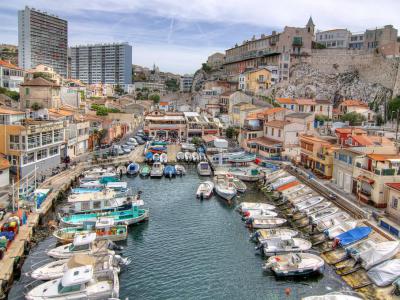
The Vallon des Auffes, located in the 7th arrondissement of Marseille, is a charming traditional fishing haven. Situated approximately 2.5 kilometers southwest of the Old Port, it lies between the Catalans Beach and Malmousque Bay, accessible via the Corniche Kennedy.
This quaint valley houses around fifty fishermen's cabins and small traditional fishing boats, including the iconic pointu boats. The fishermen's catch is primarily reserved for local restaurants, adding to the authentic experience of the place. The name "Vallon des Auffes" originates from "l'auffe" or "alfa" in the Provençal dialect, referring to a type of grass used in the production of ropes, braids, and fishing nets.
A striking feature of the area is the reinforced concrete arched bridge, constructed with stone masonry, which spans the port with three semicircular arches, each towering 17 meters (56 feet) high. The bridge stretches a total length of 60 meters (200 feet) and was built as part of the Corniche of President John F. Kennedy.
In 1927, the monument to the fallen soldiers of the East Army and distant lands was inaugurated by President of France, Gaston Doumergue. This monument features a 5-meter-tall bronze statue of a woman with her arms raised to the sky, gazing towards the Mediterranean Sea. It was later designated as a Historic Monument on July 23, 2009.
Over the years, the Vallon des Auffes has witnessed various murals adorning its landscape. From 1998 to 2006, a large painted mural of the renowned Marseille footballer, Zinedine Zidane, was displayed by Adidas, boasting the phrase "Made in Marseille." This was later replaced by a Coca-Cola advertisement.
In 2013, during Marseille's stint as the European capital of culture, the artist JR unveiled a poster featuring an unidentified woman from Marseille, Annick Perrot-Bishop, as a tribute to the famous footballer, symbolizing Marseille's connection to the world. Subsequently, this portrait made way for an advertisement showcasing a well-known brand of sunglasses.
This quaint valley houses around fifty fishermen's cabins and small traditional fishing boats, including the iconic pointu boats. The fishermen's catch is primarily reserved for local restaurants, adding to the authentic experience of the place. The name "Vallon des Auffes" originates from "l'auffe" or "alfa" in the Provençal dialect, referring to a type of grass used in the production of ropes, braids, and fishing nets.
A striking feature of the area is the reinforced concrete arched bridge, constructed with stone masonry, which spans the port with three semicircular arches, each towering 17 meters (56 feet) high. The bridge stretches a total length of 60 meters (200 feet) and was built as part of the Corniche of President John F. Kennedy.
In 1927, the monument to the fallen soldiers of the East Army and distant lands was inaugurated by President of France, Gaston Doumergue. This monument features a 5-meter-tall bronze statue of a woman with her arms raised to the sky, gazing towards the Mediterranean Sea. It was later designated as a Historic Monument on July 23, 2009.
Over the years, the Vallon des Auffes has witnessed various murals adorning its landscape. From 1998 to 2006, a large painted mural of the renowned Marseille footballer, Zinedine Zidane, was displayed by Adidas, boasting the phrase "Made in Marseille." This was later replaced by a Coca-Cola advertisement.
In 2013, during Marseille's stint as the European capital of culture, the artist JR unveiled a poster featuring an unidentified woman from Marseille, Annick Perrot-Bishop, as a tribute to the famous footballer, symbolizing Marseille's connection to the world. Subsequently, this portrait made way for an advertisement showcasing a well-known brand of sunglasses.
2) Palais du Pharo (Pharo Palace)
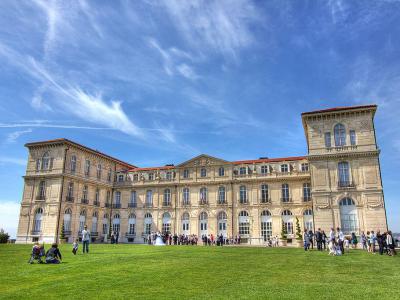
The Pharo Palace stands proudly on a rocky promontory at the entrance to Marseille’s Old Port. The site’s name comes from the nearby Pharo Bay, while the hill on which it was built was once known as “Moor’s Head”. The location was chosen for its strategic position, allowing an imperial residence to dominate both land and sea.
In 1852, Prince Louis-Napoleon, soon to become Napoleon III, commissioned architect Vaucher to design a grand seaside palace fit for imperial visits. The city of Marseille donated the land, and the project was later taken over by architect Lefuel, best known for his work on the Louvre Palace in Paris. Construction continued for two decades, but fate intervened: Napoleon III never stayed there, and after his death, Empress Eugénie generously gifted the Pharo Palace back to the city.
By 1904, the palace had found a new purpose as a medical school. Later, it was converted into a conference and cultural venue, and today the building regularly hosts international meetings, exhibitions, and fairs. Its restored halls and modern extensions can accommodate up to 2,500 people, blending historic architecture with contemporary function.
Architecturally, the Pharo Palace showcases the confident style of the Second Empire, with its symmetrical façade, grand terraces, and arched windows overlooking the sea. After the fall of the Empire in 1870, all imperial emblems were removed from the façade, leaving behind a dignified civic monument rather than a royal residence. The surrounding Pharo Garden is open to the public and offers one of the most breathtaking panoramic views.
In 1852, Prince Louis-Napoleon, soon to become Napoleon III, commissioned architect Vaucher to design a grand seaside palace fit for imperial visits. The city of Marseille donated the land, and the project was later taken over by architect Lefuel, best known for his work on the Louvre Palace in Paris. Construction continued for two decades, but fate intervened: Napoleon III never stayed there, and after his death, Empress Eugénie generously gifted the Pharo Palace back to the city.
By 1904, the palace had found a new purpose as a medical school. Later, it was converted into a conference and cultural venue, and today the building regularly hosts international meetings, exhibitions, and fairs. Its restored halls and modern extensions can accommodate up to 2,500 people, blending historic architecture with contemporary function.
Architecturally, the Pharo Palace showcases the confident style of the Second Empire, with its symmetrical façade, grand terraces, and arched windows overlooking the sea. After the fall of the Empire in 1870, all imperial emblems were removed from the façade, leaving behind a dignified civic monument rather than a royal residence. The surrounding Pharo Garden is open to the public and offers one of the most breathtaking panoramic views.
3) Cathédrale de la Major (Marseille Cathedral) (must see)
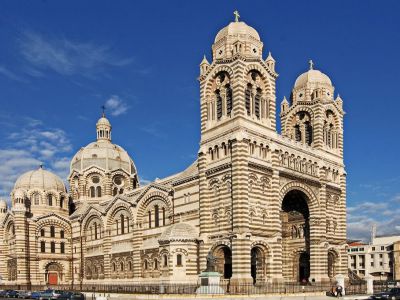
The Marseille Cathedral, also known as the Cathedral of Saint Mary Major, unites two eras of faith and architecture. The site includes both the Old Marseille Cathedral, dating to the 12th century, and the New Marseille Cathedral, constructed under Emperor Napoleon III in the late 19th century. Napoleon ordered the older Provençal Romanesque building replaced but preserved part of it—the choir and one bay of the nave—after public protests over its demolition.
The New Marseille Cathedral dominates the waterfront with its vast Romanesque-Byzantine Revival design. Stretching 469 feet in length, with a main dome reaching 231 feet in height, it can hold about 3,000 worshippers. Its façade alternates bands of white and dark stone, a combination of Florentine limestone and Ligurian green porphyry, producing a striped pattern affectionately nicknamed “the Pajamas” by locals. Inside, the cathedral reveals a rich blend of imported materials: white Carrara marble from Italy, onyx from Tunisia, and dazzling Venetian mosaics that illuminate its chapels and domes.
Beside this grand 19th-century structure lie the remains of the Old Cathedral, a humble yet evocative remnant of Marseille’s medieval heritage. The surviving chancel and apse feature smaller side chapels and a cylindrical vault crowned with octagonal and heptagonal domes. Archaeological traces beneath the site even reveal earlier Christian structures dating to the 5th century, showing that this location has been a place of worship for over fifteen centuries.
A visit to Marseille Cathedral offers not just architectural splendor but also some of the best panoramic views of the port and the Mediterranean. Rising between sea and city, the cathedral stands as both a symbol of continuity and a beacon of faith—undeniably one of Marseille’s must-see attractions.
The New Marseille Cathedral dominates the waterfront with its vast Romanesque-Byzantine Revival design. Stretching 469 feet in length, with a main dome reaching 231 feet in height, it can hold about 3,000 worshippers. Its façade alternates bands of white and dark stone, a combination of Florentine limestone and Ligurian green porphyry, producing a striped pattern affectionately nicknamed “the Pajamas” by locals. Inside, the cathedral reveals a rich blend of imported materials: white Carrara marble from Italy, onyx from Tunisia, and dazzling Venetian mosaics that illuminate its chapels and domes.
Beside this grand 19th-century structure lie the remains of the Old Cathedral, a humble yet evocative remnant of Marseille’s medieval heritage. The surviving chancel and apse feature smaller side chapels and a cylindrical vault crowned with octagonal and heptagonal domes. Archaeological traces beneath the site even reveal earlier Christian structures dating to the 5th century, showing that this location has been a place of worship for over fifteen centuries.
A visit to Marseille Cathedral offers not just architectural splendor but also some of the best panoramic views of the port and the Mediterranean. Rising between sea and city, the cathedral stands as both a symbol of continuity and a beacon of faith—undeniably one of Marseille’s must-see attractions.
4) Vieux-Port (Old Port) (must see)
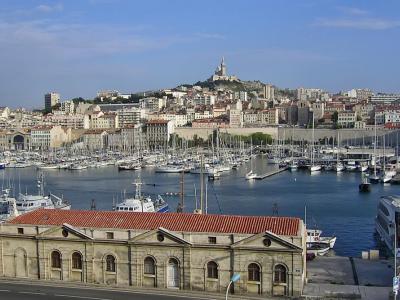
The Old Port is the city’s historic heart and one of the most evocative harbours in Europe, being a centre of maritime life for over 2,600 years. The site was first used as a trading post by the Phoenicians, long before the Greek settlers from Phocaea officially established it in 600 BCE as the port of Massalia, making it the birthplace of the city itself.
Through the centuries, the Old Port became a hub of Mediterranean commerce and naval activity. Kings Louis XII and Louis XIII expanded the shipyards in the 15th and 16th centuries, while King Louis XIV added the imposing Fort Saint John and Fort Saint Nicholas to defend the entrance of the harbour. The port reached its commercial peak in the 19th century, when up to 18,000 merchant vessels docked here annually, rivaling the activity of major ports such as Liverpool and Le Havre. However, with the arrival of large steamships that required deeper waters, Marseille shifted much of its industrial trade to the Port of La Joliette, located farther north.
The Old Port suffered immense damage during World War II, when German forces, assisted by French police, demolished much of the area to block access to Allied troops. Postwar reconstruction reshaped the district, and by the late 20th century, major urban renewal projects restored the port’s vitality. Architect Norman Foster’s redesign, featuring the The Shade Pavilion, a mirrored canopy that reflects the harbour below, marked a new era of pedestrian-friendly space and modern elegance.
Today, the Port serves as a marina for yachts, ferries, and fishing boats, as well as the site of a daily fish market that preserves centuries-old local tradition. Lined with cafés, restaurants, and open-air terraces, it remains a favourite gathering place for both locals and visitors.
Through the centuries, the Old Port became a hub of Mediterranean commerce and naval activity. Kings Louis XII and Louis XIII expanded the shipyards in the 15th and 16th centuries, while King Louis XIV added the imposing Fort Saint John and Fort Saint Nicholas to defend the entrance of the harbour. The port reached its commercial peak in the 19th century, when up to 18,000 merchant vessels docked here annually, rivaling the activity of major ports such as Liverpool and Le Havre. However, with the arrival of large steamships that required deeper waters, Marseille shifted much of its industrial trade to the Port of La Joliette, located farther north.
The Old Port suffered immense damage during World War II, when German forces, assisted by French police, demolished much of the area to block access to Allied troops. Postwar reconstruction reshaped the district, and by the late 20th century, major urban renewal projects restored the port’s vitality. Architect Norman Foster’s redesign, featuring the The Shade Pavilion, a mirrored canopy that reflects the harbour below, marked a new era of pedestrian-friendly space and modern elegance.
Today, the Port serves as a marina for yachts, ferries, and fishing boats, as well as the site of a daily fish market that preserves centuries-old local tradition. Lined with cafés, restaurants, and open-air terraces, it remains a favourite gathering place for both locals and visitors.
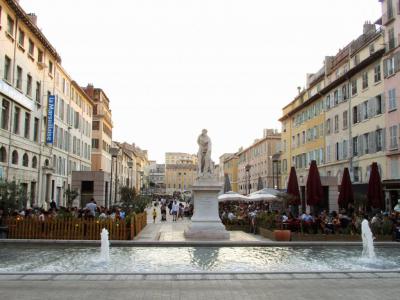
5) Cours Honoré-d'Estienne-d'Orves (Henri Estienne d'Orves Square)
The Henri Estienne d’Orves Square, one of Marseille’s most atmospheric gathering places, is named after Henry Estienne d’Orves, a French naval officer and hero of the Resistance who was executed by German occupation forces in 1941.
The area has deep maritime roots. In 1488, King Charles VIII established here a royal galley base for the French navy, complete with a garrison and nearly 8,000 prisoners who rowed the ships—echoes of this era appear even in Victor Hugo’s "The Miserable Ones", where Jean Valjean begins his life as a galley convict. When galleys became obsolete, the base passed to the city, and over the centuries the district evolved into a bustling harbour zone. Two of the original galley arsenals, numbers 23 and 25, still survive and have been transformed into a library, gallery, boutique, and restaurant complex known as “The Arsenals”.
By the mid-20th century, the site had fallen into neglect, but in 1989, under the guidance of urban planner Charlie Bové, the square was reborn. The renovation preserved the old stone façades of the warehouses, blending them with modern architecture and creating a lively pedestrian space lined with cafés, bars, boutiques, and art galleries. The square hosts art festivals, street performances, concerts, and even an ice rink in winter.
The area has deep maritime roots. In 1488, King Charles VIII established here a royal galley base for the French navy, complete with a garrison and nearly 8,000 prisoners who rowed the ships—echoes of this era appear even in Victor Hugo’s "The Miserable Ones", where Jean Valjean begins his life as a galley convict. When galleys became obsolete, the base passed to the city, and over the centuries the district evolved into a bustling harbour zone. Two of the original galley arsenals, numbers 23 and 25, still survive and have been transformed into a library, gallery, boutique, and restaurant complex known as “The Arsenals”.
By the mid-20th century, the site had fallen into neglect, but in 1989, under the guidance of urban planner Charlie Bové, the square was reborn. The renovation preserved the old stone façades of the warehouses, blending them with modern architecture and creating a lively pedestrian space lined with cafés, bars, boutiques, and art galleries. The square hosts art festivals, street performances, concerts, and even an ice rink in winter.
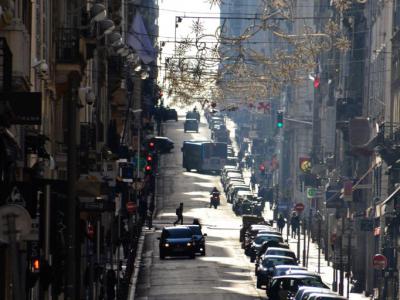
6) Rue Paradis (Paradise Street)
Yes, it is well named. Shoppers will think they have died and gone to heaven, shoppers' heaven, that is. Rue Paradis (Paradise Street) is located between the squares of Estrangin and General de Gaulle on the way to La Canebiere. In the 15th century the street name was changed to rue Paradis, as it held the parish of Saint Pierre de Paradis.
Rue Paradis, rue Rome and rue Saint Ferreol are the three most famous shopping streets in Marseille. One may shop from the city center to the old Port, to the Canebiere and the markets. This shoppers' paradise street is the third longest street in Marseille. It crosses the first, sixth and eighth arrondissements of the city.
The street has had many changes since it was established around 1044. The first urbanization took place in 1666, during the reign of Louis XIV. In 2018 it had a major overhaul. Sidewalks were were widened, trees planted, parking and delivery areas created. All of this was done between the squares of Estrangin and General de Gaulle.
Rue Paradis, rue Rome and rue Saint Ferreol are the three most famous shopping streets in Marseille. One may shop from the city center to the old Port, to the Canebiere and the markets. This shoppers' paradise street is the third longest street in Marseille. It crosses the first, sixth and eighth arrondissements of the city.
The street has had many changes since it was established around 1044. The first urbanization took place in 1666, during the reign of Louis XIV. In 2018 it had a major overhaul. Sidewalks were were widened, trees planted, parking and delivery areas created. All of this was done between the squares of Estrangin and General de Gaulle.
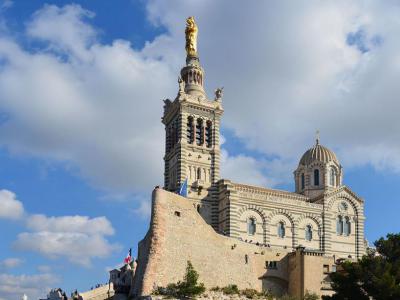
7) Notre-Dame de la Garde (must see)
Notre-Dame de la Garde stands proudly as an opulent Neo-Byzantine church situated atop the highest natural point in Marseille, perched upon a 532 feet limestone outcrop on the south side of the Old Port. This majestic site has become a cherished destination for an annual pilgrimage on Assumption Day.
Conceived by the talented architect Henri-Jacques Espérandieu, the basilica received its consecration on the 5th of June in 1864. Its origins trace back to a church with the same name, first erected in 1214 and later reconstructed during the 15th century. Remarkably, the basilica's foundations rest upon a 16th-century fortress built by Francis I of France to fend off Emperor Charles V's siege of the city in 1536.
The basilica comprises two distinct sections: a lower church or crypt, artistically carved into the rock in the Romanesque style, and an upper church boasting Neo-Byzantine elegance adorned with breathtaking mosaics. Towering above is a square bell-tower, reaching a height of 135 feet, crowned with a belfry standing at 42 feet. At its peak, a monumental statue of the Madonna and Child, crafted from copper gilded with gold leaf, soars to an impressive 27 feet.
During its history, the basilica encountered challenges, particularly regarding the stone used in its construction, which proved susceptible to atmospheric corrosion. In response, extensive restoration work took place from 2001 to 2008. This effort encompassed the meticulous repair of the mosaics, damaged by candle smoke over the years, as well as by bullets during the Liberation of France at the end of World War II.
Conceived by the talented architect Henri-Jacques Espérandieu, the basilica received its consecration on the 5th of June in 1864. Its origins trace back to a church with the same name, first erected in 1214 and later reconstructed during the 15th century. Remarkably, the basilica's foundations rest upon a 16th-century fortress built by Francis I of France to fend off Emperor Charles V's siege of the city in 1536.
The basilica comprises two distinct sections: a lower church or crypt, artistically carved into the rock in the Romanesque style, and an upper church boasting Neo-Byzantine elegance adorned with breathtaking mosaics. Towering above is a square bell-tower, reaching a height of 135 feet, crowned with a belfry standing at 42 feet. At its peak, a monumental statue of the Madonna and Child, crafted from copper gilded with gold leaf, soars to an impressive 27 feet.
During its history, the basilica encountered challenges, particularly regarding the stone used in its construction, which proved susceptible to atmospheric corrosion. In response, extensive restoration work took place from 2001 to 2008. This effort encompassed the meticulous repair of the mosaics, damaged by candle smoke over the years, as well as by bullets during the Liberation of France at the end of World War II.
