Custom Walk in Oxford, England by pennyleighfairbrother_9278f created on 2025-06-24
Guide Location: England » Oxford
Guide Type: Custom Walk
# of Sights: 10
Tour Duration: 2 Hour(s)
Travel Distance: 3.5 Km or 2.2 Miles
Share Key: 9LU9H
Guide Type: Custom Walk
# of Sights: 10
Tour Duration: 2 Hour(s)
Travel Distance: 3.5 Km or 2.2 Miles
Share Key: 9LU9H
How It Works
Please retrieve this walk in the GPSmyCity app. Once done, the app will guide you from one tour stop to the next as if you had a personal tour guide. If you created the walk on this website or come to the page via a link, please follow the instructions below to retrieve the walk in the app.
Retrieve This Walk in App
Step 1. Download the app "GPSmyCity: Walks in 1K+ Cities" on Apple App Store or Google Play Store.



Step 2. In the GPSmyCity app, download(or launch) the guide "Oxford Map and Walking Tours".
Step 3. Tap the menu button located at upper right corner of the "Walks" screen and select "Retrieve custom walk". Enter the share key: 9LU9H
1) Oxford Castle (must see)
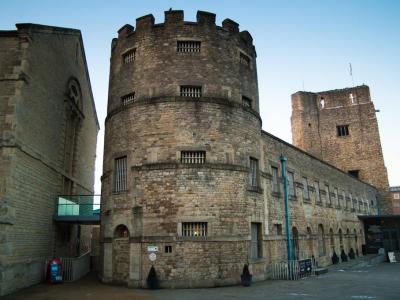
Oxford takes great pride in its rich history and dedicates significant resources to maintaining its ancient structures, as evidenced by the preservation efforts at Oxford Castle. This partially ruined Norman castle stands on the western outskirts of the town, just off New Road. Initially, it consisted of a wooden motte and bailey castle, which was later replaced by stone buildings in the 11th century.
During the conflict between England and Normandy from 1135 to 1153, the castle served as a strategic base for Empress Matilda, the daughter of King Henry I, in her quest to claim the English throne from her cousin, King Stephen. King Stephen besieged the castle with siege engines, but Matilda managed to escape, leading to the surrender of the castle's occupants before a full-scale battle could commence.
In the 13th century, further fortifications were added, including the construction of the Round Tower and the restoration of the chapel. King Henry III utilized the castle as a prison. However, during the English Civil War, the castle suffered significant damage and continued to function as a prison after the war's conclusion.
In 1888, the prison underwent expansion and operated as HM Prison Oxford until its closure in 1996. Today, only the motte and Saint George's Tower remain as remnants of the original castle.
The former prison buildings have been repurposed into a luxury hotel, office spaces, a shopping center, and a heritage complex. The castle's courtyard now hosts an open market and frequently features theater performances.
Additionally, Oxford Castle offers guided tours led by guides dressed in period costumes, providing insights into the castle's history. Visitors can explore Saint George's Tower, visit the crypt, and access the motte with its vaulted Well Chamber as part of the tour experience.
During the conflict between England and Normandy from 1135 to 1153, the castle served as a strategic base for Empress Matilda, the daughter of King Henry I, in her quest to claim the English throne from her cousin, King Stephen. King Stephen besieged the castle with siege engines, but Matilda managed to escape, leading to the surrender of the castle's occupants before a full-scale battle could commence.
In the 13th century, further fortifications were added, including the construction of the Round Tower and the restoration of the chapel. King Henry III utilized the castle as a prison. However, during the English Civil War, the castle suffered significant damage and continued to function as a prison after the war's conclusion.
In 1888, the prison underwent expansion and operated as HM Prison Oxford until its closure in 1996. Today, only the motte and Saint George's Tower remain as remnants of the original castle.
The former prison buildings have been repurposed into a luxury hotel, office spaces, a shopping center, and a heritage complex. The castle's courtyard now hosts an open market and frequently features theater performances.
Additionally, Oxford Castle offers guided tours led by guides dressed in period costumes, providing insights into the castle's history. Visitors can explore Saint George's Tower, visit the crypt, and access the motte with its vaulted Well Chamber as part of the tour experience.
2) Alice's Shop
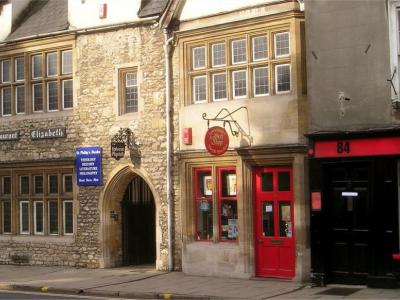
Oxford is full of surprises and quaint stores and one of the best is Alice’s Shop, which you will find on Saint Aldate’s. It’s the perfect place to find a present for adults and children alike.
150 years ago the shop was a grocer’s store that also sold sweets. Alice Liddell and her sisters often visited it. Alice inspired the main character in Lewis Carroll’s books: “Alice in Wonderland”, “Through the Looking Glass” and “What she Saw There”.
The shop appears in “Through the Looking Glass”, where it is run by a sheep. In the book it is full of wondrous objects that float away whenever Alice gets too close to them.
Today it is a famous gift shop where you can buy Alice-related souvenirs, such as lockets, charm bracelets, rings and earrings with tiny figurines of characters including the Cheshire Cat, the Herald and the Queen of Hearts.
Among the best selling items are the watches and clocks. Anyone would be delighted with the White Rabbit’s pocket watch in silver and chrome, or a wooden Mad Hatter clock, a ceramic-tile Humpty-Dumpty clock or even the very strange Queen of Hearts Backward Clock, which you have to look at in a mirror to get the time.
Other gift items include stationary, postcards, posters, t-towels, toys and delicate ornaments in stone resin or in hand-cast pewter and enamel. About the only thing the shop doesn’t sell is books, so if you want to introduce your children to Lewis Carroll’s delightful stories, you’ll have to go to the Museum of Oxford’s gift shop.
150 years ago the shop was a grocer’s store that also sold sweets. Alice Liddell and her sisters often visited it. Alice inspired the main character in Lewis Carroll’s books: “Alice in Wonderland”, “Through the Looking Glass” and “What she Saw There”.
The shop appears in “Through the Looking Glass”, where it is run by a sheep. In the book it is full of wondrous objects that float away whenever Alice gets too close to them.
Today it is a famous gift shop where you can buy Alice-related souvenirs, such as lockets, charm bracelets, rings and earrings with tiny figurines of characters including the Cheshire Cat, the Herald and the Queen of Hearts.
Among the best selling items are the watches and clocks. Anyone would be delighted with the White Rabbit’s pocket watch in silver and chrome, or a wooden Mad Hatter clock, a ceramic-tile Humpty-Dumpty clock or even the very strange Queen of Hearts Backward Clock, which you have to look at in a mirror to get the time.
Other gift items include stationary, postcards, posters, t-towels, toys and delicate ornaments in stone resin or in hand-cast pewter and enamel. About the only thing the shop doesn’t sell is books, so if you want to introduce your children to Lewis Carroll’s delightful stories, you’ll have to go to the Museum of Oxford’s gift shop.
3) Magdalen College (must see)
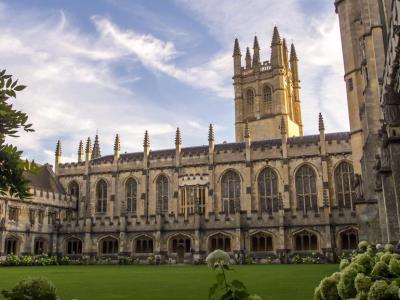
Magdalen College, one of Oxford University's prestigious institutions, is widely regarded as the most beautiful among its colleges. Established in 1458 by William of Waynflete, the Bishop of Winchester, it occupies a picturesque location next to the River Cherwell and the Oxford Botanic Garden. The college boasts a charming campus with the Meadow, Fellows Garden, and the Grove, where you can see deer in winter and spring. Addison's Walk links the Meadow to Fellows Garden, and a bridge connects it to the main campus.
Magdalen College's history is rooted in the dissolution of Saint John the Baptist Hospital in 1457, whose buildings were repurposed for the college. The Old Kitchen Bar, now serving as the college bar, was once the hospital's kitchen. Construction work commenced in 1470 under the guidance of mason William Orchard. He oversaw the creation of various structures, including the Chapel, the Hall, and the Cloister, which includes the Muniment and Founder's Towers.
A prominent feature of Magdalen College is the Magdalen Tower, a well-known landmark. Since the reign of King Henry VII, the college choir has performed at the top of the tower every May Day at 6 am. The Great Quad, constructed in 1474, showcases architectural grandeur, although the north side was reconstructed in 1822. The New Building, dating back to 1733, adds to the college's architectural diversity. In 1990, the Grove Buildings were erected as the most recent addition to the college's facilities.
Today, Magdalen College stands as one of Oxford's wealthiest and academically renowned colleges. It boasts a legacy of educating members of various royal families, including King Edward VIII of England in 1912–1914, King Jigme Khesar Namgyel Wangchuck of Bhutan in 2000, and Crown Prince Haji Al-Muhtadee Billah, the heir to the throne of Brunei, in 1995. Notable recent alumni include Malcolm Fraser, the former Prime Minister of Australia, and John Turner, the former Prime Minister of Canada.
In the world of literature and academia, Oscar Wilde studied "Greats" at Magdalen College from 1874 to 1878, earning a double first-class degree. C. S. Lewis, a celebrated writer and University College alumnus, was a Fellow and English tutor at Magdalen from 1925 to 1954. Lewis was a member of the Inklings, a literary group that included J. R. R. Tolkien, and they held their meetings in Lewis' Magdalen College rooms.
Magdalen College's history is rooted in the dissolution of Saint John the Baptist Hospital in 1457, whose buildings were repurposed for the college. The Old Kitchen Bar, now serving as the college bar, was once the hospital's kitchen. Construction work commenced in 1470 under the guidance of mason William Orchard. He oversaw the creation of various structures, including the Chapel, the Hall, and the Cloister, which includes the Muniment and Founder's Towers.
A prominent feature of Magdalen College is the Magdalen Tower, a well-known landmark. Since the reign of King Henry VII, the college choir has performed at the top of the tower every May Day at 6 am. The Great Quad, constructed in 1474, showcases architectural grandeur, although the north side was reconstructed in 1822. The New Building, dating back to 1733, adds to the college's architectural diversity. In 1990, the Grove Buildings were erected as the most recent addition to the college's facilities.
Today, Magdalen College stands as one of Oxford's wealthiest and academically renowned colleges. It boasts a legacy of educating members of various royal families, including King Edward VIII of England in 1912–1914, King Jigme Khesar Namgyel Wangchuck of Bhutan in 2000, and Crown Prince Haji Al-Muhtadee Billah, the heir to the throne of Brunei, in 1995. Notable recent alumni include Malcolm Fraser, the former Prime Minister of Australia, and John Turner, the former Prime Minister of Canada.
In the world of literature and academia, Oscar Wilde studied "Greats" at Magdalen College from 1874 to 1878, earning a double first-class degree. C. S. Lewis, a celebrated writer and University College alumnus, was a Fellow and English tutor at Magdalen from 1925 to 1954. Lewis was a member of the Inklings, a literary group that included J. R. R. Tolkien, and they held their meetings in Lewis' Magdalen College rooms.
4) Magdalen Bridge
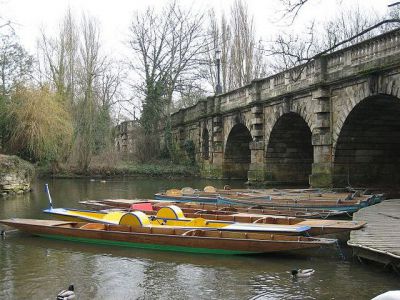
To travel between the Plain and the High Street, or in the opposite direction, you will need to cross Magdalen Bridge, which stretches over the River Cherwell and is separated by a small island at this location.
A bridge has existed at this location for many centuries. The earliest records of a bridge here date back to just before the year 1002, and it was initially a narrow wooden structure. Subsequent wooden bridges replaced the original one until the 16th century when the first stone bridge was constructed. This stone bridge measured 460 meters in length and featured 20 arches.
By the year 1769, the bridge had become too narrow to accommodate the increasing traffic to and from the expanding city center. Additionally, it suffered from deterioration due to inadequate maintenance and the frequent flooding of the river, which occurred several times a year. Ultimately, during the spring floods of 1772, several arches on the western side of the bridge deteriorated, leading to its closure.
The present-day bridge was designed by John Gwynn and constructed between 1772 and 1790 by John Randall. It comprises 11 arches, with the central one spanning the island and containing water only during periods of island flooding. Three arches span the two branches of the river, each flanked by two smaller arches on the outer banks. Initially, the bridge was 8 meters wide when it was built, but it was widened to 14 meters in 1882.
A recent tradition among students involves jumping off the bridge during the May Day celebrations. However, the water beneath the bridge is not very deep, and there have been accidents in the past. Consequently, the bridge is now closed to the public on May Day.
A bridge has existed at this location for many centuries. The earliest records of a bridge here date back to just before the year 1002, and it was initially a narrow wooden structure. Subsequent wooden bridges replaced the original one until the 16th century when the first stone bridge was constructed. This stone bridge measured 460 meters in length and featured 20 arches.
By the year 1769, the bridge had become too narrow to accommodate the increasing traffic to and from the expanding city center. Additionally, it suffered from deterioration due to inadequate maintenance and the frequent flooding of the river, which occurred several times a year. Ultimately, during the spring floods of 1772, several arches on the western side of the bridge deteriorated, leading to its closure.
The present-day bridge was designed by John Gwynn and constructed between 1772 and 1790 by John Randall. It comprises 11 arches, with the central one spanning the island and containing water only during periods of island flooding. Three arches span the two branches of the river, each flanked by two smaller arches on the outer banks. Initially, the bridge was 8 meters wide when it was built, but it was widened to 14 meters in 1882.
A recent tradition among students involves jumping off the bridge during the May Day celebrations. However, the water beneath the bridge is not very deep, and there have been accidents in the past. Consequently, the bridge is now closed to the public on May Day.
5) New College (must see)
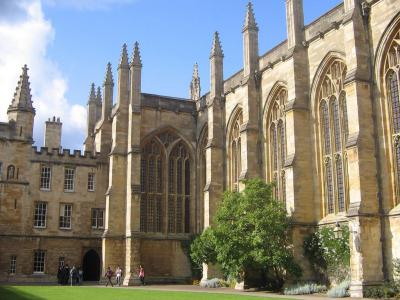
New College, one of the prestigious constituent colleges of the University of Oxford in the United Kingdom, stands out for its rich history and significant contributions to academia and culture. Founded in 1379 by William of Wykeham, the Bishop of Winchester, it was originally named "Saint Mary College of Winchester in Oxenford." Wykeham established New College alongside Winchester College, which served as its feeder school. Remarkably, New College was among the first in the university to admit and tutor undergraduate students.
Despite its misleading name, New College is one of Oxford's oldest colleges. In 2017, it achieved the top rank in the Norrington Table, which assesses the performance of Oxford undergraduates in final exams. Historically, it consistently ranks high, with a remarkable 3rd highest average in the Norrington Table over the past decade.
Reflecting societal changes, New College welcomed its first mixed-sex cohort in 1979, transitioning from a six-century tradition of being a male-only institution.
New College is also celebrated for its choral tradition, being one of the main choral foundations of the University of Oxford. Its choir is considered one of the world's leading choirs, a testament to which is its extensive discography and the two Gramophone Awards it has won.
New College is architecturally rich with historical significance. Originally built in the "perpendicular style," it has seen various additions and changes over the centuries. The Great Quad, initially constructed with attics in the sixteenth century, got a proper third storey in 1674. The oval turf at the center of the quad dates back to the eighteenth century. Many college buildings are known for their unique architectural and historical value. 'New Buildings' along Holywell Street showcase different architectural styles, including High Victorian and late Victorian by George Gilbert Scott and Basil Champneys, respectively.
***Harry Potter Walk***
The New College Cloisters appear in Harry Potter and the Goblet of Fire a good number of times – many of the corridor scenes within the film are shot here, including that in which Harry has to push through all the Gryffyndor students wearing Potter stinks badges to go and have a word with Cedric.
The New College Courtyard also served as a filming location for Harry Potter and the Goblet of Fire – the scene in which Harry tips off Cedric about the dragons which they will be battling in the first of the trials in the Triwizard Tournament. In the same movie, Harry comes face to face with Malfoy, who is sitting on a gigantic oak tree and where he is then turned into a ferret by Mad-Eye Moody. This particular tree is found in the New College Cloisters.
If you come to explore all things Harry Potter at Oxford during the colder period (October through March), then the entry to New College is free. However, if you go during the warmer months (March to October), you will need to buy a ticket.
Despite its misleading name, New College is one of Oxford's oldest colleges. In 2017, it achieved the top rank in the Norrington Table, which assesses the performance of Oxford undergraduates in final exams. Historically, it consistently ranks high, with a remarkable 3rd highest average in the Norrington Table over the past decade.
Reflecting societal changes, New College welcomed its first mixed-sex cohort in 1979, transitioning from a six-century tradition of being a male-only institution.
New College is also celebrated for its choral tradition, being one of the main choral foundations of the University of Oxford. Its choir is considered one of the world's leading choirs, a testament to which is its extensive discography and the two Gramophone Awards it has won.
New College is architecturally rich with historical significance. Originally built in the "perpendicular style," it has seen various additions and changes over the centuries. The Great Quad, initially constructed with attics in the sixteenth century, got a proper third storey in 1674. The oval turf at the center of the quad dates back to the eighteenth century. Many college buildings are known for their unique architectural and historical value. 'New Buildings' along Holywell Street showcase different architectural styles, including High Victorian and late Victorian by George Gilbert Scott and Basil Champneys, respectively.
***Harry Potter Walk***
The New College Cloisters appear in Harry Potter and the Goblet of Fire a good number of times – many of the corridor scenes within the film are shot here, including that in which Harry has to push through all the Gryffyndor students wearing Potter stinks badges to go and have a word with Cedric.
The New College Courtyard also served as a filming location for Harry Potter and the Goblet of Fire – the scene in which Harry tips off Cedric about the dragons which they will be battling in the first of the trials in the Triwizard Tournament. In the same movie, Harry comes face to face with Malfoy, who is sitting on a gigantic oak tree and where he is then turned into a ferret by Mad-Eye Moody. This particular tree is found in the New College Cloisters.
If you come to explore all things Harry Potter at Oxford during the colder period (October through March), then the entry to New College is free. However, if you go during the warmer months (March to October), you will need to buy a ticket.
6) Blackwell Books
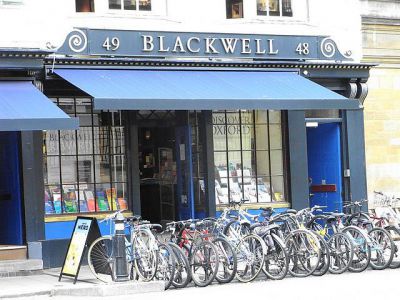
Blackwell's Books, situated in Oxford, is a renowned bookseller, attracting not only for its extensive book collection but also as a significant tourist attraction. Established by Benjamin Blackwell back in 1879, this family-run enterprise has evolved from its humble origins – a mere 12-foot square space located at 50 Broad Street, initially housing 700 second-hand books – into a sprawling network of specialized stores.
The flagship establishment of Blackwell's, found at 48-51 Broad Street, is particularly renowned for the Norrington Room. This remarkable subterranean space spans an impressive 10,000 square feet and was constructed by excavating beneath Trinity College Gardens. This architectural marvel claims fame as the largest single room in Europe dedicated exclusively to the sale of books. It offers patrons a unique shopping experience nestled beneath the gardens of the college.
The Oxford branch of Blackwell's is not just a single bookstore but rather a conglomerate of nine specialized shops, each catering to the diverse interests and requirements of its clientele. These include dedicated stores for Art, Music, Rare Books, Paperbacks, Maps and Travel, Medicine, Children's Books, and a University bookstore. The main store itself boasts an extensive collection of 250,000 volumes, along with a substantial section dedicated to used books.
Originally serving primarily the academic market, Blackwell's has expanded its scope over the years. Since the 1920s, it has ventured into publishing its own range of textbooks, medical texts, and periodicals, further solidifying its position as an integral part of Oxford's academic and literary community.
Today, Blackwell's continues to share its love for books with customers from all walks of life, remaining a pivotal presence in Oxford's cultural landscape.
The flagship establishment of Blackwell's, found at 48-51 Broad Street, is particularly renowned for the Norrington Room. This remarkable subterranean space spans an impressive 10,000 square feet and was constructed by excavating beneath Trinity College Gardens. This architectural marvel claims fame as the largest single room in Europe dedicated exclusively to the sale of books. It offers patrons a unique shopping experience nestled beneath the gardens of the college.
The Oxford branch of Blackwell's is not just a single bookstore but rather a conglomerate of nine specialized shops, each catering to the diverse interests and requirements of its clientele. These include dedicated stores for Art, Music, Rare Books, Paperbacks, Maps and Travel, Medicine, Children's Books, and a University bookstore. The main store itself boasts an extensive collection of 250,000 volumes, along with a substantial section dedicated to used books.
Originally serving primarily the academic market, Blackwell's has expanded its scope over the years. Since the 1920s, it has ventured into publishing its own range of textbooks, medical texts, and periodicals, further solidifying its position as an integral part of Oxford's academic and literary community.
Today, Blackwell's continues to share its love for books with customers from all walks of life, remaining a pivotal presence in Oxford's cultural landscape.
7) Bridge of Sighs (must see)
Unfortunately, if you are not a student of Hertford College, you won’t be able to cross the Bridge of Sighs, but you can certainly admire it from street level and add a photo of it to your collection of Oxford’s marvellous structures.
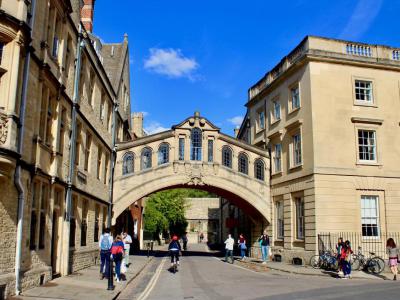
The real name of the bridge is the Hertford Bridge and it was built in 1914 by Sir Thomas Jackson. It took its popular name from the fact that it is supposed to look just like the bridge of the same name in Venice. Actually, it resembles the Rialto Bridge more than anything else, but the Bridge of Sighs sounds more romantic.
The bridge is a fine example of the Quadrature of the Parabola, developed by Archimedes in the 3rd century BC – a rather difficult geometrical concept in that the area of a parabolic segment is 4/3 of a certain inscribed triangle. It all comes down to the triangle (top) of the bridge being supported by the arch (parabola) because they are of the same base length and height.
Leaving the Maths lesson behind, the bridge is covered and glass panelled and links the college’s Old Quad with the New Quad. According to popular legend, the college once closed the bridge to overweight students, forcing them to get some exercise by taking the long route from one building to another.
***Harry Potter Walk***
Conveniently easy to spot behind Oxford’s very own Bridge of Sighs, the ancient (almost 200-year-old) giant Oak Tree, featured during a duel between Harry Potter and Draco Malfoy in Harry Potter and the Goblet of Fire, can be seen in New College Cloisters. And while the cloisters themselves are closed to the public, a photo of the tree can still be snapped from the roadside!
The real name of the bridge is the Hertford Bridge and it was built in 1914 by Sir Thomas Jackson. It took its popular name from the fact that it is supposed to look just like the bridge of the same name in Venice. Actually, it resembles the Rialto Bridge more than anything else, but the Bridge of Sighs sounds more romantic.
The bridge is a fine example of the Quadrature of the Parabola, developed by Archimedes in the 3rd century BC – a rather difficult geometrical concept in that the area of a parabolic segment is 4/3 of a certain inscribed triangle. It all comes down to the triangle (top) of the bridge being supported by the arch (parabola) because they are of the same base length and height.
Leaving the Maths lesson behind, the bridge is covered and glass panelled and links the college’s Old Quad with the New Quad. According to popular legend, the college once closed the bridge to overweight students, forcing them to get some exercise by taking the long route from one building to another.
***Harry Potter Walk***
Conveniently easy to spot behind Oxford’s very own Bridge of Sighs, the ancient (almost 200-year-old) giant Oak Tree, featured during a duel between Harry Potter and Draco Malfoy in Harry Potter and the Goblet of Fire, can be seen in New College Cloisters. And while the cloisters themselves are closed to the public, a photo of the tree can still be snapped from the roadside!
8) Radcliffe Camera (must see)
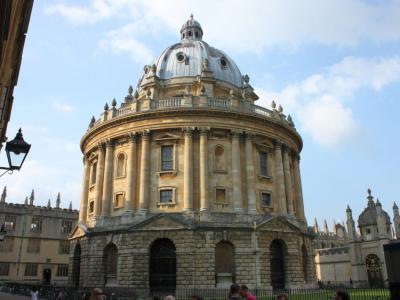
The Radcliffe Camera, despite its name, isn't a camera in the technical sense; rather, it is the first circular library ever constructed in the United Kingdom. In this context, "camera" is synonymous with "chamber."
John Radcliffe, a royal physician, expressed his desire to build a library at the University to house his collection of scientific materials. This led to a debate among several colleges over which of them should have the honor of hosting the library. Ultimately, none of the colleges were chosen.
To make room for the library, several terraced houses on Cattle Street, the Black Hall, and some outbuildings from Brasenose College were demolished. Constructed in 1749 by James Gibbes in the English Palladian architectural style, the exterior of the Radcliffe Camera appears to have three stories. The ground floor is rusticated, while the first floor is divided into sections by ten pairs of Corinthian columns. Above this section is a lantern and a dome covered in lead.
Inside the building, the first floor serves as an open gallery that runs along the walls. There is a 2-meter-high statue of John Radcliffe, sculpted by John Rysbrack. In 1912, an underground archives room was established, connected to the Bodleian Library through a passage.
The Radcliffe Camera houses an impressive collection of over 600,000 books and now functions as a reading room affiliated with the Bodleian Library. Unfortunately, it is not accessible to the general public.
John Radcliffe, a royal physician, expressed his desire to build a library at the University to house his collection of scientific materials. This led to a debate among several colleges over which of them should have the honor of hosting the library. Ultimately, none of the colleges were chosen.
To make room for the library, several terraced houses on Cattle Street, the Black Hall, and some outbuildings from Brasenose College were demolished. Constructed in 1749 by James Gibbes in the English Palladian architectural style, the exterior of the Radcliffe Camera appears to have three stories. The ground floor is rusticated, while the first floor is divided into sections by ten pairs of Corinthian columns. Above this section is a lantern and a dome covered in lead.
Inside the building, the first floor serves as an open gallery that runs along the walls. There is a 2-meter-high statue of John Radcliffe, sculpted by John Rysbrack. In 1912, an underground archives room was established, connected to the Bodleian Library through a passage.
The Radcliffe Camera houses an impressive collection of over 600,000 books and now functions as a reading room affiliated with the Bodleian Library. Unfortunately, it is not accessible to the general public.
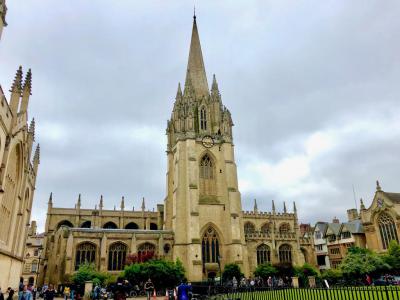
9) University Church of Saint Mary the Virgin (must see)
The University Church of Saint Mary the Virgin is the largest parish church in Oxford. It stands on High Street and is surrounded by colleges, which is why it is so popular with the students and professors.
The first church on this site was built in 1086 and when the university was founded in the 13th century, it was considered to be its first building. In 1320, a two-storey edifice was constructed on the north side of the chancel; the ground floor was the university’s Convocation House and today it houses Vault Café. The upper floor became the university’s first library, with books donated by Thomas Cobham.
The church’s Baroque porch was designed by Nicholas Stone. Its 13th century tower affords excellent views, and is open to the public. The steeple is reputed to be the most beautiful in England.
In 1555, the Oxford Martyrs were tried and condemned inside this church. You will notice that a section of the pillar opposite the pulpit is missing. This was cut out to support a small platform where the former Archbishop of Canterbury, Thomas Cranmer, stood while withdrawing his recantation of his Protestant faith, before being taken out and burnt at the stake.
At the end of the 15th and the early 16th centuries, most of the church was rebuilt in the Perpendicular style, only the tower and the spire remained untouched. Out of the 12 statues, 11 were replaced in 1894 by George Frampton.
Into the 17th century, the church was used for graduation ceremonies, until the church officials got fed up with the very un-Christian parties held afterwards, and therefore they had the Sheldonian Theatre built to host the ceremonies instead.
The first church on this site was built in 1086 and when the university was founded in the 13th century, it was considered to be its first building. In 1320, a two-storey edifice was constructed on the north side of the chancel; the ground floor was the university’s Convocation House and today it houses Vault Café. The upper floor became the university’s first library, with books donated by Thomas Cobham.
The church’s Baroque porch was designed by Nicholas Stone. Its 13th century tower affords excellent views, and is open to the public. The steeple is reputed to be the most beautiful in England.
In 1555, the Oxford Martyrs were tried and condemned inside this church. You will notice that a section of the pillar opposite the pulpit is missing. This was cut out to support a small platform where the former Archbishop of Canterbury, Thomas Cranmer, stood while withdrawing his recantation of his Protestant faith, before being taken out and burnt at the stake.
At the end of the 15th and the early 16th centuries, most of the church was rebuilt in the Perpendicular style, only the tower and the spire remained untouched. Out of the 12 statues, 11 were replaced in 1894 by George Frampton.
Into the 17th century, the church was used for graduation ceremonies, until the church officials got fed up with the very un-Christian parties held afterwards, and therefore they had the Sheldonian Theatre built to host the ceremonies instead.
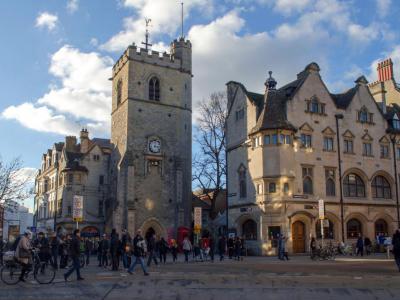
10) Carfax Tower (must see)
Carfax Tower stands at the junction of four streets – Cornmarket Street to the north, Saint Aldate’s to the south, High Street to the east, and Queen Street to the west – which is probably the exact geographical centre of Oxford.
The tower stands on the north-east corner of the junction and is the only remnant of the 13th century Saint Martin’s Church. From 1122 to 1896, this had been the City Church of Oxford until it was partially demolished to make way for a new road. Further road widening led to the rest of the church being pulled down in 1900.
The tower stands 23 metres high and no other building in the city is allowed to be higher. It has a ring of six bells that were cast in 1676 by Richard Keene. They still ring out the quarter hour, but the two quarter boys that used to strike them are no longer in use. The bells are rung on special occasions by the Oxford Society of Change Ringers.
Behind the tower you will see a solitary tombstone. It is that of William Butler, who was once the mayor of Oxford. He was buried here in 1865, but when the church was demolished, the tombstone was forgotten and, together with the tower, it is now classed as a Grade II listed building.
The tower stands on the north-east corner of the junction and is the only remnant of the 13th century Saint Martin’s Church. From 1122 to 1896, this had been the City Church of Oxford until it was partially demolished to make way for a new road. Further road widening led to the rest of the church being pulled down in 1900.
The tower stands 23 metres high and no other building in the city is allowed to be higher. It has a ring of six bells that were cast in 1676 by Richard Keene. They still ring out the quarter hour, but the two quarter boys that used to strike them are no longer in use. The bells are rung on special occasions by the Oxford Society of Change Ringers.
Behind the tower you will see a solitary tombstone. It is that of William Butler, who was once the mayor of Oxford. He was buried here in 1865, but when the church was demolished, the tombstone was forgotten and, together with the tower, it is now classed as a Grade II listed building.
