Custom Walk in Vienna, Austria by ajeggli_476b4 created on 2025-09-03
Guide Location: Austria » Vienna
Guide Type: Custom Walk
# of Sights: 13
Tour Duration: 4 Hour(s)
Travel Distance: 9.9 Km or 6.2 Miles
Share Key: H7DV5
Guide Type: Custom Walk
# of Sights: 13
Tour Duration: 4 Hour(s)
Travel Distance: 9.9 Km or 6.2 Miles
Share Key: H7DV5
How It Works
Please retrieve this walk in the GPSmyCity app. Once done, the app will guide you from one tour stop to the next as if you had a personal tour guide. If you created the walk on this website or come to the page via a link, please follow the instructions below to retrieve the walk in the app.
Retrieve This Walk in App
Step 1. Download the app "GPSmyCity: Walks in 1K+ Cities" on Apple App Store or Google Play Store.



Step 2. In the GPSmyCity app, download(or launch) the guide "Vienna Map and Walking Tours".
Step 3. Tap the menu button located at upper right corner of the "Walks" screen and select "Retrieve custom walk". Enter the share key: H7DV5
1) Hohes Haus
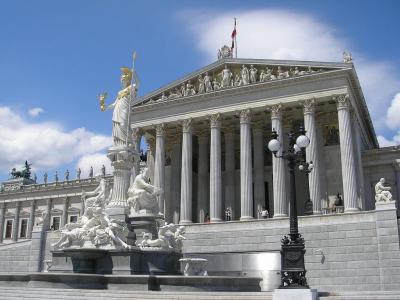
Hohes Haus ( Parliament Building) in Vienna stands proudly on the Ringstraße boulevard within the first district, known as Innere Stadt. It's situated in close proximity to the Hofburg Palace and the Palace of Justice. The construction of this iconic building began in 1874, with its completion occurring in 1883. The brilliant architect behind its Greek revival style was Theophil Edvard Hansen. Hansen took a holistic approach to design, ensuring architectural elements and interior decorations harmonized. His exceptional work earned him the title of Baron from Emperor Franz Joseph upon project completion.
One of the most famous features of the building is the Pallas Athena fountain positioned in front of the main entrance. This fountain, crafted by Hansen from 1898 to 1902, remains a prominent attraction for visitors to Vienna.
The parliament building sprawls across an impressive 13,500 square meters, ranking it as one of the largest structures along the Ringstraße. Inside, it houses more than one hundred rooms, with the Chambers of the National Council, the Federal Council, and the former Imperial House of Representatives (Abgeordnetenhaus) being among the most significant.
In addition, the building accommodates various committee rooms, libraries, lobbies, dining areas, bars, and even gymnasiums. It serves as a site of great importance for state ceremonies, notably hosting the swearing-in ceremony of the President of Austria and the annual state speech on National Day, which takes place every October 26th. The building is inextricably linked to the two parliamentary bodies, exemplified by the use of the term "Hohes Haus" as a metonym for the "Parliament."
One of the most famous features of the building is the Pallas Athena fountain positioned in front of the main entrance. This fountain, crafted by Hansen from 1898 to 1902, remains a prominent attraction for visitors to Vienna.
The parliament building sprawls across an impressive 13,500 square meters, ranking it as one of the largest structures along the Ringstraße. Inside, it houses more than one hundred rooms, with the Chambers of the National Council, the Federal Council, and the former Imperial House of Representatives (Abgeordnetenhaus) being among the most significant.
In addition, the building accommodates various committee rooms, libraries, lobbies, dining areas, bars, and even gymnasiums. It serves as a site of great importance for state ceremonies, notably hosting the swearing-in ceremony of the President of Austria and the annual state speech on National Day, which takes place every October 26th. The building is inextricably linked to the two parliamentary bodies, exemplified by the use of the term "Hohes Haus" as a metonym for the "Parliament."
2) Rathaus (City Hall) (must see)
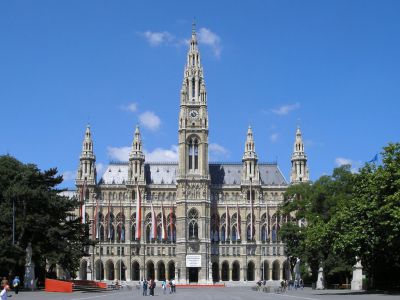
Vienna City Hall-a place where both the municipal government and the legislative assembly get down to business. By no means a dull office block, this neo-Gothic showstopper was built between 1872 and 1883 by architect Friedrich von Schmidt, who, rather humbly, now stands in a statue form just behind the building, keeping an eye on things from his very own square.
Drawing inspiration from the medieval architecture of Flanders and Brabant, the City Hall flaunts five towers like a crown. The tallest of them pierces the skyline at 98 meters, topped with the "City Hall Man"-not a superhero, but close... Clad in armor inspired by Emperor Maximilian I, this statue has been watching over Vienna since 1882 and has become something of a local mascot.
Inside, the building doesn’t just rest on its aesthetic laurels. There's the "City Hall Cellar"-a grand baroque dining hall where you can dig into proper Viennese culinary classics without a hint of modern guilt. “Schnitzel under chandeliers? Yes, please...”
The façade is a sculptural buffet in its own right, brimming with emperors, virtues like Power and Justice, and even good ol’ Vindobona, the Roman forebear of Vienna, lounging surrounded by heraldic flair. Think of it as Vienna’s resume carved in stone.
And on the flanks is a lineup of statues dedicated to trades and professions-because in this city, bakers, builders, and bookbinders all get a standing ovation in stone!
Now, if you're feeling adventurous (and are in good shape), brave the 331 steps up to the central tower that’s worth every groan from your knees. Your reward will be the sweeping views of Vienna in all its baroque-meets-modern glory-plus bragging rights for conquering the city one stair at a time. Trust us-Vienna looks even better from above.
Tip:
For the inside scoop, join the free German-language guided tour on Mondays, Wednesdays, and Fridays at 1 pm. Not fluent in German? No problem-audio guides are available in multiple languages. Just be ready to temporarily part ways with your passport. The view-and the tales-are absolutely worth it.
Drawing inspiration from the medieval architecture of Flanders and Brabant, the City Hall flaunts five towers like a crown. The tallest of them pierces the skyline at 98 meters, topped with the "City Hall Man"-not a superhero, but close... Clad in armor inspired by Emperor Maximilian I, this statue has been watching over Vienna since 1882 and has become something of a local mascot.
Inside, the building doesn’t just rest on its aesthetic laurels. There's the "City Hall Cellar"-a grand baroque dining hall where you can dig into proper Viennese culinary classics without a hint of modern guilt. “Schnitzel under chandeliers? Yes, please...”
The façade is a sculptural buffet in its own right, brimming with emperors, virtues like Power and Justice, and even good ol’ Vindobona, the Roman forebear of Vienna, lounging surrounded by heraldic flair. Think of it as Vienna’s resume carved in stone.
And on the flanks is a lineup of statues dedicated to trades and professions-because in this city, bakers, builders, and bookbinders all get a standing ovation in stone!
Now, if you're feeling adventurous (and are in good shape), brave the 331 steps up to the central tower that’s worth every groan from your knees. Your reward will be the sweeping views of Vienna in all its baroque-meets-modern glory-plus bragging rights for conquering the city one stair at a time. Trust us-Vienna looks even better from above.
Tip:
For the inside scoop, join the free German-language guided tour on Mondays, Wednesdays, and Fridays at 1 pm. Not fluent in German? No problem-audio guides are available in multiple languages. Just be ready to temporarily part ways with your passport. The view-and the tales-are absolutely worth it.
3) Rathausplatz (City Hall Square and Park)
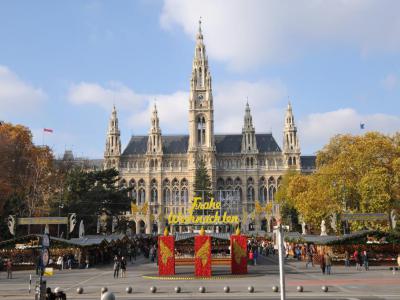
City Hall Square-or as the locals say, Rat-haus-platz-is Vienna’s grande outdoor living room, with a flair for drama, history, and seasonal costume changes.
Back in the day, this spot was basically the city’s backyard-well outside the medieval walls and mostly used for marching, saluting, and other military routines. It wasn’t until the late 19th century, when the new City Hall rose in neo-Gothic glory, that someone thought, “How about building a proper square?” And so they did-big, grand, and perfect for future festivals.
Now, here’s where the plot thickens. Over the years, the square got a few name changes... thanks to politics! In 1938, it even bore the name “Adolf Hitler Square”-yikes-but Vienna, being true to herself, gave history a firm correction and restored the name Rathausplatz in 1945.
Today, this square is a year-round stage for some of the city's best-loved events. In winter, it transforms into the Vienna Ice Dream, complete with twinkling lights and a dreamy skating rink. Come December, it’s all mulled wine and gingerbread with the Christmas Market. Spring sees the Vienna Festival kick off here, and summer-open-air film nights with classical scores floating on warm breezes.
And let’s not forget the Life Ball, where glam, glitter, and good causes collide under the neo-Gothic arches of the City Hall. Oh, and since 1959, one of Austria’s federal states has gifted Vienna a giant Christmas tree each year, right here in the square-because nothing keeps holiday spirit up like interregional diplomacy in fir form...
Just behind the square is City Hall Park, one of Vienna’s favorite green lungs. Built in 1873 on a former military parade ground, it’s now home to cozy benches, shady paths, and statues of Austria’s cultural VIPs, like composers Johann Strauss Sr. and Josef Lanner.
And if you’re into trees with gravitas, look out for the London plane tree. Planted way back in 1783-before the park even existed-it now stands 30 meters tall with a trunk circumference that would make a sumo wrestler blush.
So, whether you're skating, sipping, strolling, or simply star-gazing, City Hall Square is the place where Vienna does its best impression of a civic fairy tale.
Back in the day, this spot was basically the city’s backyard-well outside the medieval walls and mostly used for marching, saluting, and other military routines. It wasn’t until the late 19th century, when the new City Hall rose in neo-Gothic glory, that someone thought, “How about building a proper square?” And so they did-big, grand, and perfect for future festivals.
Now, here’s where the plot thickens. Over the years, the square got a few name changes... thanks to politics! In 1938, it even bore the name “Adolf Hitler Square”-yikes-but Vienna, being true to herself, gave history a firm correction and restored the name Rathausplatz in 1945.
Today, this square is a year-round stage for some of the city's best-loved events. In winter, it transforms into the Vienna Ice Dream, complete with twinkling lights and a dreamy skating rink. Come December, it’s all mulled wine and gingerbread with the Christmas Market. Spring sees the Vienna Festival kick off here, and summer-open-air film nights with classical scores floating on warm breezes.
And let’s not forget the Life Ball, where glam, glitter, and good causes collide under the neo-Gothic arches of the City Hall. Oh, and since 1959, one of Austria’s federal states has gifted Vienna a giant Christmas tree each year, right here in the square-because nothing keeps holiday spirit up like interregional diplomacy in fir form...
Just behind the square is City Hall Park, one of Vienna’s favorite green lungs. Built in 1873 on a former military parade ground, it’s now home to cozy benches, shady paths, and statues of Austria’s cultural VIPs, like composers Johann Strauss Sr. and Josef Lanner.
And if you’re into trees with gravitas, look out for the London plane tree. Planted way back in 1783-before the park even existed-it now stands 30 meters tall with a trunk circumference that would make a sumo wrestler blush.
So, whether you're skating, sipping, strolling, or simply star-gazing, City Hall Square is the place where Vienna does its best impression of a civic fairy tale.
4) Burgtheater (Austrian National Theater)
The Burgtheater, also known as the Court Theatre and affectionately called "die Burg" by locals, holds a special place in Austria's cultural landscape. This national theater has a rich history, opening its doors for the first time on March 14, 1741, thanks to Empress Maria Theresa, a notable supporter of the arts.
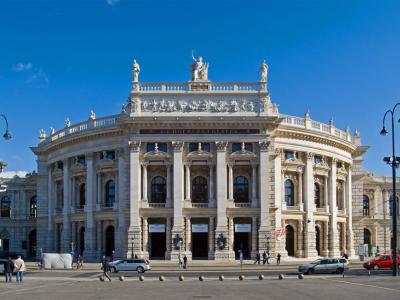
Originally, the theater was located on Ringstrasse, right next to the Hofburg Imperial Palace, serving as a home for the theatrical troupe. However, in 1888, the troupe relocated to a new spot, and the theater underwent a transformation, receiving a magnificent Italian Renaissance building designed by Karl von Hasenauer and Gottfried Semper. This new structure featured Europe's largest revolving stage, changing sets in just 40 seconds, ideal for diverse performances.
A decade later, due to a design flaw that left some seats with no view of the stage, a complete remodeling of the auditorium became necessary. During World War II, the theater suffered significant damage from a bomb, with only the side wings, containing the impressive Grand Staircases, surviving. From 1952 to 1955, the central part of the building was fully restored, making it hard to distinguish from its original state today.
As visitors approach the theater, they are welcomed by artistic symbols on the facade, including a grand frieze featuring Bacchus, the god of drama, along with his wife Ariadne and a lively entourage. Inside the Burgtheater, two grand staircases in the North and South wings welcome patrons. They feature busts of playwrights and exquisite ceiling frescoes painted by Gustav and Ernst Klimt, along with Franz Matsch in 1886. Among these artworks, there is a painting by Gustav Klimt featuring Shakespeare's Globe, which includes the only known self-portrait of the artist.
Why You Should Visit:
One of the most prestigious German-language theaters in the world, the Burg enjoys worldwide acclaim, staging a diverse range of plays, from ancient Greek tragedies to modern day classics by Arthur Miller. It is particularly renowned for their interpretation of German writers, composers and playwrights. Three of Mozart’s operas, including The Marriage of Figaro, as well as Beethoven’s 1st Symphony were premiered here. There is also a rather unique speech and style to the plays, typical of the Burgtheater, that has been created by the famed company over the years.
Tip:
Many a ticket can be purchased for as little as 25 Euros. If you call the day of the play, any leftover tickets may be on sale for up to 50% discount.
Daily guided tours (in German and English) allow visitors a glimpse into the inner workings of the theater.
Performances are in German, but selected shows are subtitled in English.
Originally, the theater was located on Ringstrasse, right next to the Hofburg Imperial Palace, serving as a home for the theatrical troupe. However, in 1888, the troupe relocated to a new spot, and the theater underwent a transformation, receiving a magnificent Italian Renaissance building designed by Karl von Hasenauer and Gottfried Semper. This new structure featured Europe's largest revolving stage, changing sets in just 40 seconds, ideal for diverse performances.
A decade later, due to a design flaw that left some seats with no view of the stage, a complete remodeling of the auditorium became necessary. During World War II, the theater suffered significant damage from a bomb, with only the side wings, containing the impressive Grand Staircases, surviving. From 1952 to 1955, the central part of the building was fully restored, making it hard to distinguish from its original state today.
As visitors approach the theater, they are welcomed by artistic symbols on the facade, including a grand frieze featuring Bacchus, the god of drama, along with his wife Ariadne and a lively entourage. Inside the Burgtheater, two grand staircases in the North and South wings welcome patrons. They feature busts of playwrights and exquisite ceiling frescoes painted by Gustav and Ernst Klimt, along with Franz Matsch in 1886. Among these artworks, there is a painting by Gustav Klimt featuring Shakespeare's Globe, which includes the only known self-portrait of the artist.
Why You Should Visit:
One of the most prestigious German-language theaters in the world, the Burg enjoys worldwide acclaim, staging a diverse range of plays, from ancient Greek tragedies to modern day classics by Arthur Miller. It is particularly renowned for their interpretation of German writers, composers and playwrights. Three of Mozart’s operas, including The Marriage of Figaro, as well as Beethoven’s 1st Symphony were premiered here. There is also a rather unique speech and style to the plays, typical of the Burgtheater, that has been created by the famed company over the years.
Tip:
Many a ticket can be purchased for as little as 25 Euros. If you call the day of the play, any leftover tickets may be on sale for up to 50% discount.
Daily guided tours (in German and English) allow visitors a glimpse into the inner workings of the theater.
Performances are in German, but selected shows are subtitled in English.
5) Volksgarten (People's Garden)
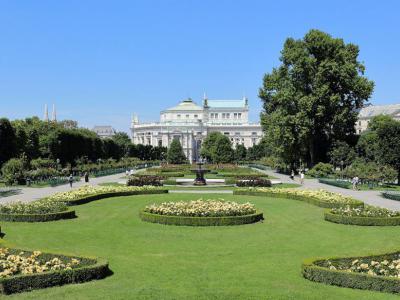
While in Vienna, in case you ever wondered, “Where can I sit, sip, and feel mildly royal without actually being royalty?”, the elegant answer to that would be the People’s Garden.
Tucked into the Inner City and folded neatly into the grand Hofburg Palace complex, this leafy retreat sprouted up in 1821 on the rubble of old city walls flattened by Napoleon in 1809. That’s right: one man’s imperial invasion is another city’s future picnic spot. By 1823, it officially opened to the public, proudly claiming the title of Vienna’s first public park. Democratized fresh air for all!
At its heart stands the Theseus Temple, a small but mighty neoclassical structure originally built to shelter a heroic sculpture of Theseus wrestling a centaur. The sculpture now lives in the Museum of Fine Arts, leaving the temple feeling a little empty but still photogenic-perfect for dramatic poses or mildly philosophical daydreams.
Music lovers, take note: the park once echoed with the melodies of Johann Strauss Sr. and Joseph Lanner, who performed at the garden’s two charming coffee houses-Cortisches and Café Meierei. Yes, your coffee might not come with a waltz today, but the ambiance still hums with history.
Wandering north, you’ll find Empress Elisabeth-immortalized in marble and carved from a block weighing eight tons. She sits amidst the greenery, elegant as ever, embodying royal melancholy like only she could.
Head south, and you’ll bump into Franz Grillparzer, Austria’s literary lion, forever caught mid-thought with a book in hand and that “do not disturb, I’m writing in my mind” look on his face.
And if all that cultural weight feels a bit too much, don’t worry. The rose gardens are here to soothe you. Over 3,000 rose bushes, flaunting around 400 varieties, bloom with the confidence of divas at an opera gala.
So, be it a quiet bench, a literary stare-down, or a caffeine break with ghosts of composers past that you're after, the People’s Garden is Vienna’s green room of history, art, and botanical flair-all ready for your visit.
Tucked into the Inner City and folded neatly into the grand Hofburg Palace complex, this leafy retreat sprouted up in 1821 on the rubble of old city walls flattened by Napoleon in 1809. That’s right: one man’s imperial invasion is another city’s future picnic spot. By 1823, it officially opened to the public, proudly claiming the title of Vienna’s first public park. Democratized fresh air for all!
At its heart stands the Theseus Temple, a small but mighty neoclassical structure originally built to shelter a heroic sculpture of Theseus wrestling a centaur. The sculpture now lives in the Museum of Fine Arts, leaving the temple feeling a little empty but still photogenic-perfect for dramatic poses or mildly philosophical daydreams.
Music lovers, take note: the park once echoed with the melodies of Johann Strauss Sr. and Joseph Lanner, who performed at the garden’s two charming coffee houses-Cortisches and Café Meierei. Yes, your coffee might not come with a waltz today, but the ambiance still hums with history.
Wandering north, you’ll find Empress Elisabeth-immortalized in marble and carved from a block weighing eight tons. She sits amidst the greenery, elegant as ever, embodying royal melancholy like only she could.
Head south, and you’ll bump into Franz Grillparzer, Austria’s literary lion, forever caught mid-thought with a book in hand and that “do not disturb, I’m writing in my mind” look on his face.
And if all that cultural weight feels a bit too much, don’t worry. The rose gardens are here to soothe you. Over 3,000 rose bushes, flaunting around 400 varieties, bloom with the confidence of divas at an opera gala.
So, be it a quiet bench, a literary stare-down, or a caffeine break with ghosts of composers past that you're after, the People’s Garden is Vienna’s green room of history, art, and botanical flair-all ready for your visit.
6) Osterreichische Nationalbibliothek (Austrian National Library)
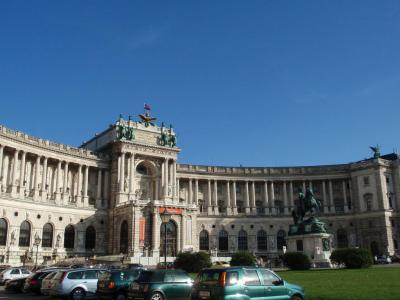
The Austrian National Library stands as the largest library in Austria, boasting a vast collection of over 12 million items across various categories. This institution is situated within the Neue Burg Wing of the Hofburg, which is located in the heart of Vienna. Since 2005, a portion of its collections has been housed in the splendid Baroque surroundings of the Palais Mollard-Clary.
Originally established by the Habsburgs, this library was initially known as the Imperial Court Library. However, the name was altered in 1920, following the dissolution of the Habsburg Monarchy and the establishment of the Austrian Republic. The library complex is not limited to its expansive collection; it also encompasses four museums along with numerous specialized collections and archives.
The Prunksaal, or State Hall, at the Hofburg palace was the core of the former imperial library. Divided into "war" and "peace" sections, it reflects the original book categorization. The hall features striking wall frescoes by Daniel Gran and a central dome with a fresco of Emperor Charles VI, supported by Hercules and Apollo. It houses marble statues of emperors, with Emperor Charles VI at the center, sculpted by Peter and Paul Strudel, as well as four large globes by Vincenzo Coronelli.
One of the primary functions of the Austrian National Library is to systematically gather and preserve all publications originating in Austria, encompassing electronic media as well. Furthermore, it diligently collects the works of Austrian authors published abroad, as well as literature related to Austria or reflecting its cultural essence and spirit. Foreign publications are also acquired, with a focus on the humanities.
Why You Should Visit:
One of the most picturesque libraries in the world, and reminiscent of 'Beauty and the Beast' with its Baroque style.
Tip:
It is best to go there early in the morning or lunchtime so you don't have a lot of visitors obstructing your photographs.
Unlike some other historic libraries, you’re allowed to wander around taking photos without paying for a permit (just turn off your flash).
Originally established by the Habsburgs, this library was initially known as the Imperial Court Library. However, the name was altered in 1920, following the dissolution of the Habsburg Monarchy and the establishment of the Austrian Republic. The library complex is not limited to its expansive collection; it also encompasses four museums along with numerous specialized collections and archives.
The Prunksaal, or State Hall, at the Hofburg palace was the core of the former imperial library. Divided into "war" and "peace" sections, it reflects the original book categorization. The hall features striking wall frescoes by Daniel Gran and a central dome with a fresco of Emperor Charles VI, supported by Hercules and Apollo. It houses marble statues of emperors, with Emperor Charles VI at the center, sculpted by Peter and Paul Strudel, as well as four large globes by Vincenzo Coronelli.
One of the primary functions of the Austrian National Library is to systematically gather and preserve all publications originating in Austria, encompassing electronic media as well. Furthermore, it diligently collects the works of Austrian authors published abroad, as well as literature related to Austria or reflecting its cultural essence and spirit. Foreign publications are also acquired, with a focus on the humanities.
Why You Should Visit:
One of the most picturesque libraries in the world, and reminiscent of 'Beauty and the Beast' with its Baroque style.
Tip:
It is best to go there early in the morning or lunchtime so you don't have a lot of visitors obstructing your photographs.
Unlike some other historic libraries, you’re allowed to wander around taking photos without paying for a permit (just turn off your flash).
7) Karlskirche (St. Karl's Church)
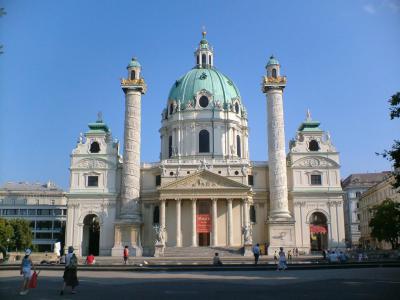
Vienna’s unapologetic showpiece of Baroque drama perched on the southern edge of Karl's Square, the dazzling Saint Karl’s Church is like a powdered wig on a powdered face. Commissioned in 1713 by Emperor Karl VI as a divine “thank you” for surviving the plague, this architectural stunner is dedicated to Karl Borromeo, a 16th-century saint famous for fighting epidemics and spiritual malaise in equal measure.
Now, if you’re sensing a bit of a style mash-up, you’re absolutely right. Completed in 1737, the church is part Roman temple, part imperial flex. It flaunts a lofty elongated dome, flanked by twin columns that look like they’ve time-traveled straight from ancient Rome-specifically modeled after Trajan’s Column, but with a Baroque Viennese twist. The columns aren’t just decorative-they’re a not-so-subtle nod to the Habsburgs’ self-image: as mighty as the mythological Pillars of Hercules.
Step inside, and you're wrapped in marble, gold, and the kind of symbolic artistry that screams “imperial ambition meets holy devotion.” Look up, and you’ll see a dramatic fresco of Saint Karl interceding on behalf of humanity-because why keep your miracles subtle? The pulpit, carved from rich walnut, is a storytelling masterpiece of its own, fully restored in the early 2000s to show off every curve and flourish in glorious detail.
Still, Saint Karl’s isn’t just about stone and symbolism-it’s got star power, too. Composer Antonio Vivaldi, who died nearby in 1741, is honored here with regular concerts that make the walls practically hum with violins. In 1878, Johann Strauss said “I do” to his second wife at this very altar… although she didn’t care much for his music, which probably explains why she said “I don’t” four years later. Oh, and Hollywood legend Hedy Lamarr got hitched here in 1933-just in case you needed one more reason to stare at the pews.
So, regardless of whether you're here for the saints, the stucco, or the scandals, Saint Karl’s Church delivers Baroque brilliance with a Viennese wink all the same...
Tip:
Yes, there’s an entry fee, but it's absolutely worth it (students, rejoice-discounts apply).
A nifty elevator takes you right up to the dome, where you can admire the ceiling frescoes face-to-face. And don’t forget to sneak a peek out the dome window-the view of Vienna alone is worth the ride...
Now, if you’re sensing a bit of a style mash-up, you’re absolutely right. Completed in 1737, the church is part Roman temple, part imperial flex. It flaunts a lofty elongated dome, flanked by twin columns that look like they’ve time-traveled straight from ancient Rome-specifically modeled after Trajan’s Column, but with a Baroque Viennese twist. The columns aren’t just decorative-they’re a not-so-subtle nod to the Habsburgs’ self-image: as mighty as the mythological Pillars of Hercules.
Step inside, and you're wrapped in marble, gold, and the kind of symbolic artistry that screams “imperial ambition meets holy devotion.” Look up, and you’ll see a dramatic fresco of Saint Karl interceding on behalf of humanity-because why keep your miracles subtle? The pulpit, carved from rich walnut, is a storytelling masterpiece of its own, fully restored in the early 2000s to show off every curve and flourish in glorious detail.
Still, Saint Karl’s isn’t just about stone and symbolism-it’s got star power, too. Composer Antonio Vivaldi, who died nearby in 1741, is honored here with regular concerts that make the walls practically hum with violins. In 1878, Johann Strauss said “I do” to his second wife at this very altar… although she didn’t care much for his music, which probably explains why she said “I don’t” four years later. Oh, and Hollywood legend Hedy Lamarr got hitched here in 1933-just in case you needed one more reason to stare at the pews.
So, regardless of whether you're here for the saints, the stucco, or the scandals, Saint Karl’s Church delivers Baroque brilliance with a Viennese wink all the same...
Tip:
Yes, there’s an entry fee, but it's absolutely worth it (students, rejoice-discounts apply).
A nifty elevator takes you right up to the dome, where you can admire the ceiling frescoes face-to-face. And don’t forget to sneak a peek out the dome window-the view of Vienna alone is worth the ride...
8) Hundertwasser House
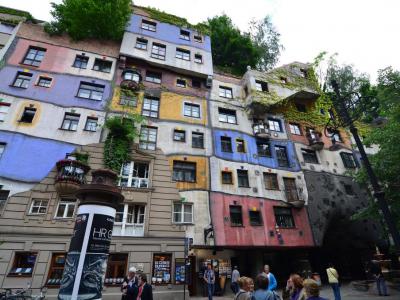
A relatively recent addition to Vienna's architectural heritage, the Hundertwasser House is a great example of 20th-century urban experimentation. If the surrounding architecture whispers "classical elegance," this one belts out "psychedelic daydream" through a megaphone!!!
Sitting as an antithetical statement about what architecture can be-a sort of riotous rebuttal to boring buildings- this gloriously eclectic (if not, say, surreal) block of flats explodes with color and curve. From a distance, it looks almost like a lovechild of Gaudí, a Lego set, and a fever dream combined. Consisting of a frenzy of oriel windows, loggias, gilded onion domes, ceramic columns, glass sparkles, roof gardens-and yes, even a salvaged slice of what stood here before 1983-it’s part sculpture, part protest, and part urban jungle. A rainbow having a rave, basically...
Designed in 1985 by the ever-unconventional, avant-garde artist Friedensreich Hundertwasser, this idiosyncratic building was his answer to what he perceived as the rather soulless modern concrete monotony sprouting across Vienna's suburbs. Further to his credit, and just to make sure his message landed, Hundertwasser refused payment for his work, declaring that the investment was worth it to "prevent something ugly from going up in its place". Mission absolutely accomplished...
So, whenever you're in Vienna, make sure to swing by this photogenic rebel-pure architectural exuberance, gleefully thumbing its nose at the capital’s polished palaces and baroque facades. Because your eyes deserve a holiday too...
Tip:
While the building itself is residential-so no snooping inside is possible-across the street you’ll find Hundertwasser Village. Open daily, from 9 am to 6 pm, this is a quirky marketplace-turned-art piece with shops, cafés, and enough eccentricity to keep your camera and curiosity well-fed.
Sitting as an antithetical statement about what architecture can be-a sort of riotous rebuttal to boring buildings- this gloriously eclectic (if not, say, surreal) block of flats explodes with color and curve. From a distance, it looks almost like a lovechild of Gaudí, a Lego set, and a fever dream combined. Consisting of a frenzy of oriel windows, loggias, gilded onion domes, ceramic columns, glass sparkles, roof gardens-and yes, even a salvaged slice of what stood here before 1983-it’s part sculpture, part protest, and part urban jungle. A rainbow having a rave, basically...
Designed in 1985 by the ever-unconventional, avant-garde artist Friedensreich Hundertwasser, this idiosyncratic building was his answer to what he perceived as the rather soulless modern concrete monotony sprouting across Vienna's suburbs. Further to his credit, and just to make sure his message landed, Hundertwasser refused payment for his work, declaring that the investment was worth it to "prevent something ugly from going up in its place". Mission absolutely accomplished...
So, whenever you're in Vienna, make sure to swing by this photogenic rebel-pure architectural exuberance, gleefully thumbing its nose at the capital’s polished palaces and baroque facades. Because your eyes deserve a holiday too...
Tip:
While the building itself is residential-so no snooping inside is possible-across the street you’ll find Hundertwasser Village. Open daily, from 9 am to 6 pm, this is a quirky marketplace-turned-art piece with shops, cafés, and enough eccentricity to keep your camera and curiosity well-fed.
9) Haas House
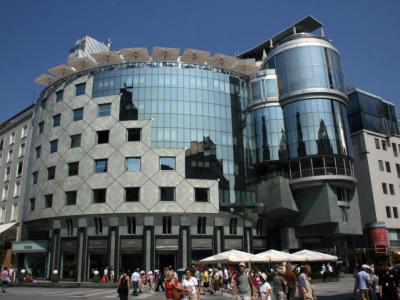
Imagine being asked to build a shiny, modern building right across from the Gothic grandeur of Saint Stephen’s Cathedral-the architectural equivalent of dancing next to a brooding vampire in neon sneakers. That’s exactly what the city of Vienna asked of Hans Hollein, Austria’s Postmodernist maestro known for his dazzling, no-compromise jewelry stores on the elegant Graben and Kohlmarkt streets. His answer was the Haas Haus, unveiled in 1990 like a mirror-polished shrug at tradition.
This gleaming, partly mirrored marvel made of glass, steel, and blue-green marble doesn’t just sit across from the cathedral-it poses across from it. Its curves lean confidently into the street, reflecting the spires opposite like a futuristic wink at the past. The design is all pleasing asymmetry: lopsided marble cubes glued to the façade like sculptural confetti, a mysterious platform high up that looks like a diving board for very brave architects, and even a Zen-like bridge inside for those who seek inner peace between shops and lattes.
Rather than bowing to the stiff collar of Historicism or charging ahead with cold Modernism, Hollein delivered something smarter: a stylish peace treaty between eras. Haas Haus respects its Gothic neighbor by daring to be different, yet harmonizing through reflection-literally.
Inside, the building is more than a pretty face. It houses a collection of cafes, chic shops, a fine restaurant, and the upscale DO & CO Hotel, where the views are as premium as the service.
Pro tip: Take the elevator to the rooftop café and savor the spectacular view of Saint Stephen’s while sipping your coffee like an enlightened time traveler.
Or if you're feeling more tea than tech, stroll over to the nearby HAAS & HAAS Teahouse, tucked just beside the Cathedral. Open Monday to Saturday from 8 am to 8 pm (and a touch sleepier on Sundays and holidays), it’s the perfect blend of Old World charm and steeped serenity.
Because in Vienna, even the contrasts know how to get along...
This gleaming, partly mirrored marvel made of glass, steel, and blue-green marble doesn’t just sit across from the cathedral-it poses across from it. Its curves lean confidently into the street, reflecting the spires opposite like a futuristic wink at the past. The design is all pleasing asymmetry: lopsided marble cubes glued to the façade like sculptural confetti, a mysterious platform high up that looks like a diving board for very brave architects, and even a Zen-like bridge inside for those who seek inner peace between shops and lattes.
Rather than bowing to the stiff collar of Historicism or charging ahead with cold Modernism, Hollein delivered something smarter: a stylish peace treaty between eras. Haas Haus respects its Gothic neighbor by daring to be different, yet harmonizing through reflection-literally.
Inside, the building is more than a pretty face. It houses a collection of cafes, chic shops, a fine restaurant, and the upscale DO & CO Hotel, where the views are as premium as the service.
Pro tip: Take the elevator to the rooftop café and savor the spectacular view of Saint Stephen’s while sipping your coffee like an enlightened time traveler.
Or if you're feeling more tea than tech, stroll over to the nearby HAAS & HAAS Teahouse, tucked just beside the Cathedral. Open Monday to Saturday from 8 am to 8 pm (and a touch sleepier on Sundays and holidays), it’s the perfect blend of Old World charm and steeped serenity.
Because in Vienna, even the contrasts know how to get along...
10) Cafe Central (must see)
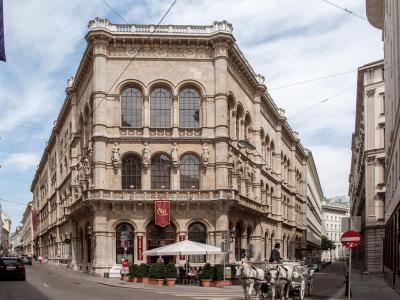
Café Central stands as a quintessential Viennese coffeehouse, nestled on the ground floor of the Palais Ferstel, formerly known as the Bank and Stockmarket Building, designed by architect Heinrich von Ferstel.
Established back in 1876, this café gained significant prominence during the late 19th century, evolving into a pivotal hub for Vienna's intellectual elite. Distinguished regulars included luminaries such as Peter Altenberg, Theodor Herzl, Alfred Adler, Egon Friedell, Hugo von Hofmannsthal, Anton Kuh, Adolf Loos, Leo Perutz, Robert Musil, Stefan Zweig, Alfred Polgar, Adolf Hitler, and Leon Trotsky. Remarkably, in January 1913 alone, notable figures like Josip Broz Tito, Sigmund Freud, and the ever-present Trotsky frequented this establishment.
It was often colloquially referred to as the "Chess school" (Die Schachhochschule), owing to the prevalence of chess enthusiasts who gathered on the first floor to engage in their games. The Vienna Circle, a group of logical positivists, convened numerous meetings here both before and after World War I.
One intriguing anecdote recalls a conversation between Victor Adler and Count Berchtold, the foreign minister of Austria-Hungary, where Adler warned that war might incite revolution in Russia, if not within the Habsburg monarchy itself. In response, Berchtold facetiously queried, "And who will lead this revolution? Perhaps Mr. Bronstein (Leon Trotsky) sitting over there at the Cafe Central?"
Following the conclusion of World War II, the café ceased its operations. However, in 1975, the Palais Ferstel underwent a renovation, and Café Central was resurrected in a different part of the building. Subsequently, in 1986, it underwent another comprehensive renovation.
Today, Café Central remains a cherished tourist attraction and a popular coffeehouse, revered for its enduring place in literary history.
Established back in 1876, this café gained significant prominence during the late 19th century, evolving into a pivotal hub for Vienna's intellectual elite. Distinguished regulars included luminaries such as Peter Altenberg, Theodor Herzl, Alfred Adler, Egon Friedell, Hugo von Hofmannsthal, Anton Kuh, Adolf Loos, Leo Perutz, Robert Musil, Stefan Zweig, Alfred Polgar, Adolf Hitler, and Leon Trotsky. Remarkably, in January 1913 alone, notable figures like Josip Broz Tito, Sigmund Freud, and the ever-present Trotsky frequented this establishment.
It was often colloquially referred to as the "Chess school" (Die Schachhochschule), owing to the prevalence of chess enthusiasts who gathered on the first floor to engage in their games. The Vienna Circle, a group of logical positivists, convened numerous meetings here both before and after World War I.
One intriguing anecdote recalls a conversation between Victor Adler and Count Berchtold, the foreign minister of Austria-Hungary, where Adler warned that war might incite revolution in Russia, if not within the Habsburg monarchy itself. In response, Berchtold facetiously queried, "And who will lead this revolution? Perhaps Mr. Bronstein (Leon Trotsky) sitting over there at the Cafe Central?"
Following the conclusion of World War II, the café ceased its operations. However, in 1975, the Palais Ferstel underwent a renovation, and Café Central was resurrected in a different part of the building. Subsequently, in 1986, it underwent another comprehensive renovation.
Today, Café Central remains a cherished tourist attraction and a popular coffeehouse, revered for its enduring place in literary history.
11) Pasqualati House (Beethoven's Former Residence)
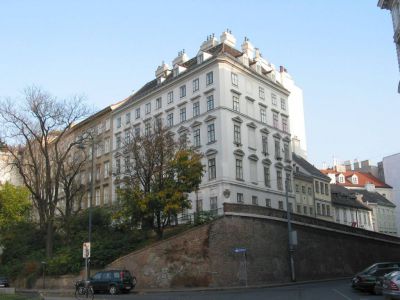
The Pasqualati House is no different in appearance from any of the other houses along the quiet street of Mölker Bastei (built on a former bastion of the city walls), but it is the most famous of more than 30 places where Ludwig van Beethoven resided during his 35 years in Vienna.
Named after its original owner, Baron von Pasqualati, it was twice Beethoven's home from 1804 to 1815 – the mid-life period. He composed many of his best-loved works here, including Symphonies Nos. 4, 5, 7 and 8, Piano Concerto No. 4, numerous string quartets, as well as the magnificent – and solitary – opera "Fidelio".
Today, the two rooms on the 4th floor, which the composer occupied (plus another two from a neighbouring apartment), have been converted into a small museum with various intriguing memorabilia on display, such as a lock of Beethoven's hair, his salt and pepper pots, a photo of his grave at the Jewish cemetery in Währing, a rather gruesome death bed engraving, and early editions of his scores. The museum also contains busts and paintings of the great composer, including a famous portrait by J.W. Mähler, and a fine painting of his patron Prince Razumovsky, the Russian ambassador to Vienna.
Tip:
Note particularly the prints showing what the window view out over the Mölker bastion was like when Beethoven lived here, and the current view too – a fantastic 4th-floor look out onto the famous Ringstrasse.
Named after its original owner, Baron von Pasqualati, it was twice Beethoven's home from 1804 to 1815 – the mid-life period. He composed many of his best-loved works here, including Symphonies Nos. 4, 5, 7 and 8, Piano Concerto No. 4, numerous string quartets, as well as the magnificent – and solitary – opera "Fidelio".
Today, the two rooms on the 4th floor, which the composer occupied (plus another two from a neighbouring apartment), have been converted into a small museum with various intriguing memorabilia on display, such as a lock of Beethoven's hair, his salt and pepper pots, a photo of his grave at the Jewish cemetery in Währing, a rather gruesome death bed engraving, and early editions of his scores. The museum also contains busts and paintings of the great composer, including a famous portrait by J.W. Mähler, and a fine painting of his patron Prince Razumovsky, the Russian ambassador to Vienna.
Tip:
Note particularly the prints showing what the window view out over the Mölker bastion was like when Beethoven lived here, and the current view too – a fantastic 4th-floor look out onto the famous Ringstrasse.
12) Sigmund Freud House Museum
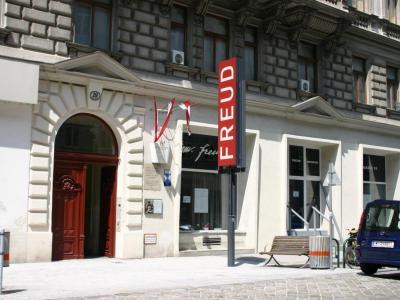
A Vienna resident for more than five decades, Sigmund Freud is as synonymous with the Austrian capital as coffee houses and the waltz. His former 19th-century apartment at Berggasse 19, where he wrote many of his greatest works, is now something of a shrine and place of pilgrimage, though he took almost all his possessions – except his library, which he hurriedly sold – into exile (where they are displayed in London's Freud Museum).
The father of psychoanalysis, Sigmund Freud lived, worked and received patients here from 1891 until his unwilling departure from Vienna in 1938, to escape Nazi persecution. There are more than 420 items of memorabilia on display, including letters, telegrams and original editions of books, photos documenting Freud's long life, waiting-room furniture and various antiquities. A few rooms feature Freud-inspired art, a library and a shop, while a video room shows unique home-movie footage of the Freud family in the 1930s with a commentary by none other than Anna Freud.
The father of psychoanalysis, Sigmund Freud lived, worked and received patients here from 1891 until his unwilling departure from Vienna in 1938, to escape Nazi persecution. There are more than 420 items of memorabilia on display, including letters, telegrams and original editions of books, photos documenting Freud's long life, waiting-room furniture and various antiquities. A few rooms feature Freud-inspired art, a library and a shop, while a video room shows unique home-movie footage of the Freud family in the 1930s with a commentary by none other than Anna Freud.
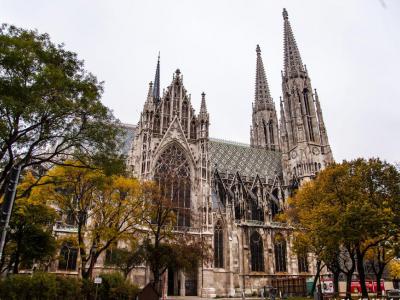
13) Votivkirche
The Votive Church, known as Votivkirche in German, is a neo-Gothic church situated on the Ringstraße. Its construction was initiated in the aftermath of an assassination attempt on Emperor Franz Joseph in 1853. Archduke Ferdinand Maximilian, the Emperor's brother, launched a campaign to build the church as a gesture of gratitude to God for saving the Emperor's life. Funds for the construction were collected from across the Empire, and the church was consecrated in 1879, marking the 25th anniversary of Emperor Franz Joseph and Empress Elisabeth.
The architectural design of the Votivkirche follows the typical Gothic cathedral structure, featuring a front facade with two slender towers, three gabled entrances with ornate archivolts, a gallery adorned with statues above the entrances, a central entrance that is twice as wide as the side entrances, a rose window, and a roof gable over the nave. The church also includes belfries, a transept spire, buttresses, abutments, and flying buttresses. The overall design of the church is visually cohesive, characterized by well-proportioned elements, a thoughtfully arranged layout, spaciousness, and a consistent Gothic style.
One notable feature was the Emperor window, a gift from the City of Vienna, which originally depicted the Emperor's rescue from assassination by Maximilian Graf O'Donnell von Tyrconnell. Unfortunately, during World War II, the original windows were destroyed, leading to the creation of replacement windows in 1964, sponsored by the City of Vienna. Although these replacement windows retained the original design in most aspects, they shifted away from a strictly monarchical theme and took on a more religious tone. Regrettably, the precise depiction of the Emperor's rescue was lost in the process.
The architectural design of the Votivkirche follows the typical Gothic cathedral structure, featuring a front facade with two slender towers, three gabled entrances with ornate archivolts, a gallery adorned with statues above the entrances, a central entrance that is twice as wide as the side entrances, a rose window, and a roof gable over the nave. The church also includes belfries, a transept spire, buttresses, abutments, and flying buttresses. The overall design of the church is visually cohesive, characterized by well-proportioned elements, a thoughtfully arranged layout, spaciousness, and a consistent Gothic style.
One notable feature was the Emperor window, a gift from the City of Vienna, which originally depicted the Emperor's rescue from assassination by Maximilian Graf O'Donnell von Tyrconnell. Unfortunately, during World War II, the original windows were destroyed, leading to the creation of replacement windows in 1964, sponsored by the City of Vienna. Although these replacement windows retained the original design in most aspects, they shifted away from a strictly monarchical theme and took on a more religious tone. Regrettably, the precise depiction of the Emperor's rescue was lost in the process.
