Custom Walk in San Juan, Puerto Rico by eddiei1953_4f53f created on 2025-09-19
Guide Location: Puerto Rico » San Juan
Guide Type: Custom Walk
# of Sights: 11
Tour Duration: 3 Hour(s)
Travel Distance: 6 Km or 3.7 Miles
Share Key: HXVCR
Guide Type: Custom Walk
# of Sights: 11
Tour Duration: 3 Hour(s)
Travel Distance: 6 Km or 3.7 Miles
Share Key: HXVCR
How It Works
Please retrieve this walk in the GPSmyCity app. Once done, the app will guide you from one tour stop to the next as if you had a personal tour guide. If you created the walk on this website or come to the page via a link, please follow the instructions below to retrieve the walk in the app.
Retrieve This Walk in App
Step 1. Download the app "GPSmyCity: Walks in 1K+ Cities" on Apple App Store or Google Play Store.



Step 2. In the GPSmyCity app, download(or launch) the guide "San Juan Map and Walking Tours".
Step 3. Tap the menu button located at upper right corner of the "Walks" screen and select "Retrieve custom walk". Enter the share key: HXVCR
1) San Gerónimo Fort
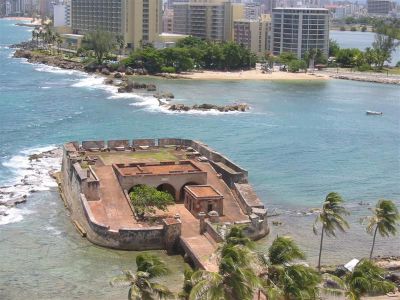
Fortín de San Gerónimo del Boquerón is a small fort located at the entrance of what is known today as Condado Lagoon. It was built during the 17th century to replace the smaller El Boquerón, which stood at the easternmost end of San Juan. The original Boquerón battery defended San Juan from attacks by Sir Francis Drake in 1595 and Sir George Clifford, 3rd Earl of Cumberland in 1598, who destroyed it after his attack.
San Gerónimo became part of San Juan's line of defense, along with San Antonio Fort/Bridge and Escambrón Fort and Castillo de San Cristóbal. It was listed in the National Register of Historic Places on October 11, 1983.
Unlike similar forts near Old San Juan, it is not part of San Juan National Historic Site. San Gerónimo is owned by the Institute of Puerto Rican Culture, but is managed by the Hilton. The hotel occasionally used it for private gatherings, but during recent times it has fallen into such disrepair that visitors are no longer allowed.
San Gerónimo became part of San Juan's line of defense, along with San Antonio Fort/Bridge and Escambrón Fort and Castillo de San Cristóbal. It was listed in the National Register of Historic Places on October 11, 1983.
Unlike similar forts near Old San Juan, it is not part of San Juan National Historic Site. San Gerónimo is owned by the Institute of Puerto Rican Culture, but is managed by the Hilton. The hotel occasionally used it for private gatherings, but during recent times it has fallen into such disrepair that visitors are no longer allowed.
Sight description based on Wikipedia.
2) El Capitolio (The Capitol)
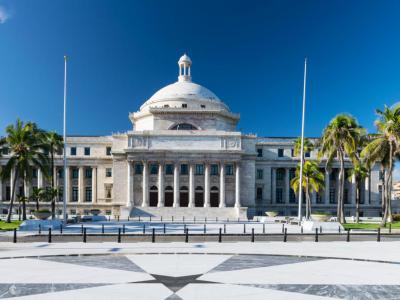
El Capitolio is the home of the Legislative Assembly of Puerto Rico and is located in San Juan, the capital of Puerto Rico. The building is an important landmark in the city, and has a fascinating history that spans more than a century.
The idea for the construction of a capitol building in Puerto Rico was first proposed in the late 19th century, during the island's transition from Spanish to American colonial rule. However, it wasn't until the 1920s that the project gained momentum, as the island's political leaders sought to create a building that would reflect Puerto Rico's cultural and political identity.
Construction of El Capitolio began in 1925 and was completed in 1929. The building was designed by Rafael Carmoega and was heavily influenced by the Spanish Revival style of architecture. The structure is built of concrete and is topped by a large dome, which is decorated with a bronze sculpture by Italian artist Angelo Lanzarotti.
El Capitolio was inaugurated on February 11, 1929, and since then it has served as the seat of government for the Legislative Assembly of Puerto Rico. Visitors to the building can take guided tours of the interior, which includes an impressive collection of artwork and historical artifacts. The building is also the site of many important political and cultural events, including exhibitions, concerts, and official ceremonies.
The idea for the construction of a capitol building in Puerto Rico was first proposed in the late 19th century, during the island's transition from Spanish to American colonial rule. However, it wasn't until the 1920s that the project gained momentum, as the island's political leaders sought to create a building that would reflect Puerto Rico's cultural and political identity.
Construction of El Capitolio began in 1925 and was completed in 1929. The building was designed by Rafael Carmoega and was heavily influenced by the Spanish Revival style of architecture. The structure is built of concrete and is topped by a large dome, which is decorated with a bronze sculpture by Italian artist Angelo Lanzarotti.
El Capitolio was inaugurated on February 11, 1929, and since then it has served as the seat of government for the Legislative Assembly of Puerto Rico. Visitors to the building can take guided tours of the interior, which includes an impressive collection of artwork and historical artifacts. The building is also the site of many important political and cultural events, including exhibitions, concerts, and official ceremonies.
3) Casa de España (The Spain House)
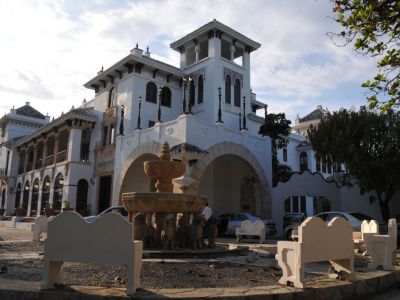
Casa de España is a beautiful historic building located on Ponce de León Avenue, near El Capitolio. Built in 1932 and designed by the famous Puerto Rican architect, Pedro de Castro, it serves as a private civic and cultural association dedicated to Puerto Rico’s Spanish heritage. Although it is named "Casa", it has never been a dwelling place for a family; rather it is a "house" whose members claim common ancestry. It was listed on the National Register of Historic Places in 1983. It is not open to the public, but that should not stop anyone from appreciating its beauty from the outside.
Sight description based on Wikipedia.
4) Castillo San Cristóbal (Fort San Cristobal) (must see)
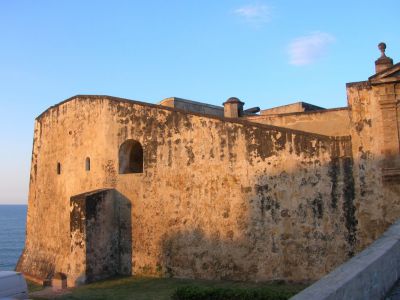
Standing guard at the eastern gate, north of Columbus Square, is an imposing 18th-century fortress, called San Cristóbal. Contrary to her sister, El Morro, which was designed to protect from attacks by sea, the San Cristóbal Fort guarded the city against the enemy approaching by land, for which purpose it created a crossfire with El Morro over the bay. The citadel construction began in 1634 and was meant to strengthen the Spanish position in the face of imminent English and Dutch invasion.
The fort was named San Cristóbal in celebration of the Spanish victories which enabled ejecting of the English and Dutch interlopers from the island of the same name in the Lesser Antilles, which was then part of the insular territorial glacis of Puerto Rico.
When finished in 1783, the Fort San Cristóbal covered nearly 27 acres of land and practically wrapped around the whole of San Juan, with the entry to the city sealed by the San Cristóbal's double gates. After almost 100 years of relative peace, about a third of the fortification was demolished, in 1897, to help ease the flow of traffic in and out of the walled city.
The Fort San Cristóbal is now a listed National Historic Site. It is particularly worth visiting as the largest fortification ever built by the Spanish in the New World, where the first shots of the Spanish-American War were fired. If you're a keen photographer, San Cristobal is a goldmine of panoramic views of the coast, from Old San Juan to Condado and beyond.
Tip:
Guided tours by local rangers visit the extensive tunnel system connecting various sections of the fort. There is an exhibition of military clothing. Be sure to visit the overlook for the Devil's Sentry Box ("Garita del Diablo"), from which, according to legends, soldiers mysteriously disappeared. Tickets to San Cristobal or El Morro can be used to enter either of the forts.
The fort was named San Cristóbal in celebration of the Spanish victories which enabled ejecting of the English and Dutch interlopers from the island of the same name in the Lesser Antilles, which was then part of the insular territorial glacis of Puerto Rico.
When finished in 1783, the Fort San Cristóbal covered nearly 27 acres of land and practically wrapped around the whole of San Juan, with the entry to the city sealed by the San Cristóbal's double gates. After almost 100 years of relative peace, about a third of the fortification was demolished, in 1897, to help ease the flow of traffic in and out of the walled city.
The Fort San Cristóbal is now a listed National Historic Site. It is particularly worth visiting as the largest fortification ever built by the Spanish in the New World, where the first shots of the Spanish-American War were fired. If you're a keen photographer, San Cristobal is a goldmine of panoramic views of the coast, from Old San Juan to Condado and beyond.
Tip:
Guided tours by local rangers visit the extensive tunnel system connecting various sections of the fort. There is an exhibition of military clothing. Be sure to visit the overlook for the Devil's Sentry Box ("Garita del Diablo"), from which, according to legends, soldiers mysteriously disappeared. Tickets to San Cristobal or El Morro can be used to enter either of the forts.
Sight description based on Wikipedia.
5) Calle de la Fortaleza (Fortaleza Street) (must see)
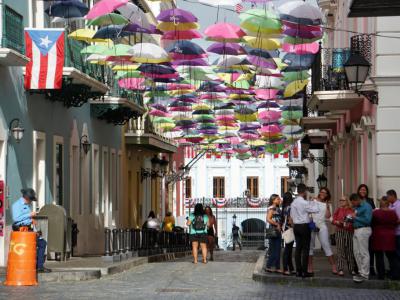
Proudly presiding over the bay of San Juan is the imposing La Fortaleza (Fortress), formally known as the Palace of Santa Catalina, the official residence of the Governor of Puerto Rico. The narrow road leading to the building, called Fortaleza Street, is the main artery of San Juan's historic quarter, cutting through most of it, and is also the oldest street in the area. It starts from Columbus Square and for the whole of its duration is lined with governmental buildings, hotels, perfumeries, craft shops, jewelry stores, and restaurants, gradually transforming into Avenue Juan Ponce de León in the east.
Just like many other colorful cobblestone streets in Old San Juan, each one more photogenic than the other, this thoroughfare is an important tourist attraction, in large part due to its historical and cultural significance. Visiting Fortaleza Street should be an integral part of every Old San Juan itinerary.
While the walled-in Old City has no shortage of vibrant photo spots, Fortaleza Street stands out above the rest due to the display of umbrellas – at the end of the street, near La Fortaleza itself – creating an overhead canopy that makes it particularly recognizable. These umbrellas tend to change colors during the year, from rainbow to all pink. Before the umbrellas, La Fortaleza Street was adorned with colorful kites.
Just like many other colorful cobblestone streets in Old San Juan, each one more photogenic than the other, this thoroughfare is an important tourist attraction, in large part due to its historical and cultural significance. Visiting Fortaleza Street should be an integral part of every Old San Juan itinerary.
While the walled-in Old City has no shortage of vibrant photo spots, Fortaleza Street stands out above the rest due to the display of umbrellas – at the end of the street, near La Fortaleza itself – creating an overhead canopy that makes it particularly recognizable. These umbrellas tend to change colors during the year, from rainbow to all pink. Before the umbrellas, La Fortaleza Street was adorned with colorful kites.
Sight description based on Wikipedia.
6) La Fortaleza (The Fortress) (must see)
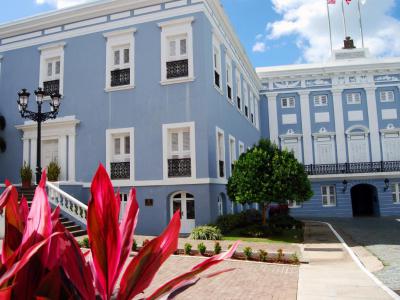
La Fortaleza, or the Fortress, is the current official residence of the Governor of Puerto Rico. Built between 1533 and 1540 to defend the harbor of San Juan, it is the oldest executive mansion in the New World. During the 1640 reconstruction, the chapel of Santa Catalina, then located outside the city walls, was demolished and integrated into the complex, which, upon that, assumed the new (current) name, Palacio de Santa Catalina.
La Fortaleza was the first defensive fortification built in San Juan, and the first of the series of military installations designed to protect the city, among which were the Fort San Felipe del Morro and Fort San Cristóbal. The construction was authorized by Charles V, the Holy Roman Emperor, as a defensive measure against the attacks from Carib Indians and the rivaling European powers.
The fortress underwent massive reconstruction in 1846 to convert from military use to a palatial residence. Since then, La Fortaleza has been the home to more than 170 governors of Puerto Rico and hosted various dignitaries, including President John F. Kennedy and his wife, Jacqueline Kennedy, who stayed here in 1961. At present, the complex consists of a few attached buildings with formal living quarters on the second floor, and private quarters on the third. The palace overlooks the high city walls fronting the bay, and its northern part contains sheltered gardens and a swimming pool.
The complex has been a UNESCO World Heritage Site since 1983 and as such may present definite interest to both history and architecture buffs with a taste for Spanish designs.
La Fortaleza was the first defensive fortification built in San Juan, and the first of the series of military installations designed to protect the city, among which were the Fort San Felipe del Morro and Fort San Cristóbal. The construction was authorized by Charles V, the Holy Roman Emperor, as a defensive measure against the attacks from Carib Indians and the rivaling European powers.
The fortress underwent massive reconstruction in 1846 to convert from military use to a palatial residence. Since then, La Fortaleza has been the home to more than 170 governors of Puerto Rico and hosted various dignitaries, including President John F. Kennedy and his wife, Jacqueline Kennedy, who stayed here in 1961. At present, the complex consists of a few attached buildings with formal living quarters on the second floor, and private quarters on the third. The palace overlooks the high city walls fronting the bay, and its northern part contains sheltered gardens and a swimming pool.
The complex has been a UNESCO World Heritage Site since 1983 and as such may present definite interest to both history and architecture buffs with a taste for Spanish designs.
Sight description based on Wikipedia.
7) Capilla del Cristo (Chapel of Christ) (must see)
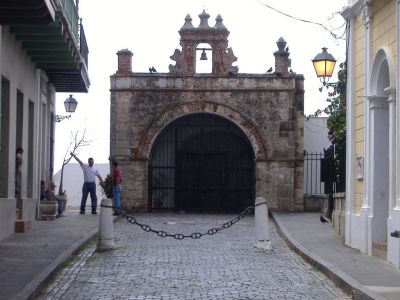
Capilla del Cristo (Chapel of Christ), is a small chapel located in the Old San Juan Historic District of Puerto Rico. Built in the 18th century, the structure has become a cultural icon of Puerto Rico and was saved from demolition in the 20th century. Most of the articles located at its altar are from 1753.
The chapel with its belfry is located in the Old San Juan Historic District in the western section of San Juan Islet, at the end of Cristo Street, now a pedestrian walkway. It sits on top of the old city walk. The chapel is a major tourist attraction in San Juan. Inside the chapel there is a famous painting called El Milagro ("The Miracle").
According to the legend, during a horse race that was taking place on the street where the chapel is located, a young rider and his horse took a bad fall and the rider went over the city wall but was miraculously saved. In a famous book about Puerto Rican legends, it says that the horse was killed but the rider lived. Afterwards, permission was granted to build the Catholic chapel and many festivals have been held, over the years, at the location to celebrate the miracle.
The chapel is open to publish on Saturday and Sunday from 12:00 to 18:00.
The chapel with its belfry is located in the Old San Juan Historic District in the western section of San Juan Islet, at the end of Cristo Street, now a pedestrian walkway. It sits on top of the old city walk. The chapel is a major tourist attraction in San Juan. Inside the chapel there is a famous painting called El Milagro ("The Miracle").
According to the legend, during a horse race that was taking place on the street where the chapel is located, a young rider and his horse took a bad fall and the rider went over the city wall but was miraculously saved. In a famous book about Puerto Rican legends, it says that the horse was killed but the rider lived. Afterwards, permission was granted to build the Catholic chapel and many festivals have been held, over the years, at the location to celebrate the miracle.
The chapel is open to publish on Saturday and Sunday from 12:00 to 18:00.
8) Cathedral of San Juan Bautista (must see)
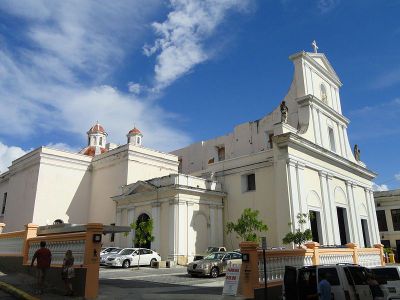
The Cathedral of San Juan Bautista is the Roman Catholic temple and the seat of the Archdiocese of San Juan de Puerto Rico. This is one of the oldest buildings in San Juan and the second-oldest operational church in the Americas. Traditionally, travelers entering San Juan Gate would make this cathedral their first stop in the city to thank God for their safe journey.
It sits on the site of a grammar school, established in 1513 by Bishop Alonso Manso. This was the first school in Puerto Rico (and the oldest school in the United States after Puerto Rico became a US territory). Here, the Latin language, literature, history, science, art, philosophy, and theology were taught free of charge.
The very first, wooden, church on this spot was built in 1521. It was destroyed by a hurricane, and the current temple of stone was built in its place, in 1540. The church was remodeled several times over the course of centuries, most recently in 1917.
The cathedral contains the tomb of the Spanish explorer Juan Ponce de León. It also houses a shrine dedicated to the Blessed Carlos Manuel Rodríguez Santiago, the first Puerto Rican and the first Caribbean-born layperson (much as the first layperson in the history of the United States) to be beatified.
The Cathedral of San Juan Bautista is also unique as a rare example of medieval Spanish architecture in the New World.
It sits on the site of a grammar school, established in 1513 by Bishop Alonso Manso. This was the first school in Puerto Rico (and the oldest school in the United States after Puerto Rico became a US territory). Here, the Latin language, literature, history, science, art, philosophy, and theology were taught free of charge.
The very first, wooden, church on this spot was built in 1521. It was destroyed by a hurricane, and the current temple of stone was built in its place, in 1540. The church was remodeled several times over the course of centuries, most recently in 1917.
The cathedral contains the tomb of the Spanish explorer Juan Ponce de León. It also houses a shrine dedicated to the Blessed Carlos Manuel Rodríguez Santiago, the first Puerto Rican and the first Caribbean-born layperson (much as the first layperson in the history of the United States) to be beatified.
The Cathedral of San Juan Bautista is also unique as a rare example of medieval Spanish architecture in the New World.
Sight description based on Wikipedia.
9) Paseo de la Princesa (Princess Promenade) (must see)
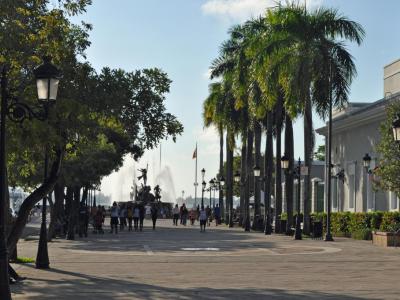
No trip to San Juan is complete without a stroll along the beautiful Princess Promenade, a carefully restored historic landmark, one of the most visited in the capital. Built in 1853, this esplanade skirts the curved city walls on the southern side of Old San Juan and is quite picture-perfect, with the San Juan Bay on the one side and the impressive fortification walls on the other.
The Promenade is equally suited for both walking and people-watching. It is also a great place to visit for families with children – easily accessible and traffic-free. The abundance of trees here provides plenty of shade, and there are lots of artisan stalls and street vendors selling local food. The area also often hosts festivals and fairs on weekends.
From here, you can make a slight detour to the narrow path, known as Paseo El Morro, leading to the historic El Morro Fort and the nearby San Juan Gate, which is the only city gate remaining from the colonial period.
Princess Promenade gets its name from an old 1837 building, located here, known as La Princesa. Originally, this building served as a municipal prison, although presently it houses the headquarters of the Puerto Rico Tourism Company and an art gallery.
The Promenade is equally suited for both walking and people-watching. It is also a great place to visit for families with children – easily accessible and traffic-free. The abundance of trees here provides plenty of shade, and there are lots of artisan stalls and street vendors selling local food. The area also often hosts festivals and fairs on weekends.
From here, you can make a slight detour to the narrow path, known as Paseo El Morro, leading to the historic El Morro Fort and the nearby San Juan Gate, which is the only city gate remaining from the colonial period.
Princess Promenade gets its name from an old 1837 building, located here, known as La Princesa. Originally, this building served as a municipal prison, although presently it houses the headquarters of the Puerto Rico Tourism Company and an art gallery.
10) Casa Rosa (The Pink House)
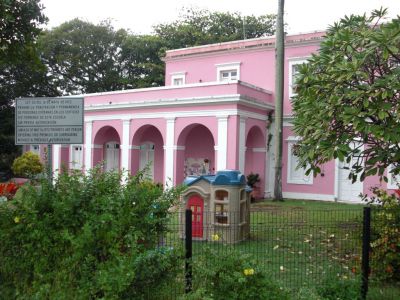
Casa Rosa or Casa Rosada, also known as the Pink House, is a historic house located in Old San Juan. The house was built in 1812 as a barrack for the troops assigned to the San Agustin Bastion. It was converted to an officers quarters in 1881 by the Spanish Army. The building was later converted to a museum for Puerto Rican crafts. Today it operates as a day care center for the children of employees of the government of Puerto Rico.
Sight description based on Wikipedia.
11) El Castillo San Felipe del Morro (Fort El Morro) (must see)
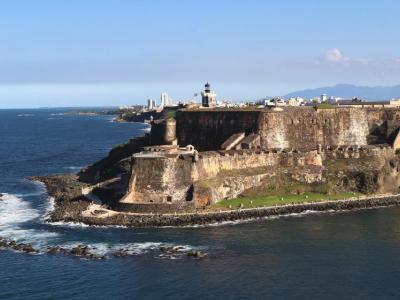
The Fort San Felipe del Morro, or simply El Morro, is a 16th-century citadel on the northwestern tip of the San Juan islet, named in honor of King Philip II of Spain. It was the second military installation, after La Fortaleza, built in what is now known as the Old Town.
The construction began in 1539, authorized by King Charles V, and was finished in 1790. During that period, El Morro had been transformed from a promontory mounted with a cannon to a six-level fortress designed to guard the entrance to the bay of San Juan from seaborne invaders. Many more structures were added to the complex over the next 400 years; the outer walls, built initially 6 feet (1.8 m) thick, were augmented to 18 feet (5.5 m) by the end of the 18th century.
Thanks to El Morro, the Spanish were able to defend Puerto Rico from invasions by the British and the Dutch, as well as pirates. In 1898, following the Spanish-American War, the island changed hands from Spain to the United States. El Morro was actively used as a military installation during the First and Second World Wars.
In 1961, the US Army retired El Morro, passing it on to the National Park Service to use it as a museum. In 1983, El Morro and the walled city of Old San Juan were declared UNESCO World Heritage Sites.
Tips:
A ticket to El Morro allows entry to the Castillo San Cristóbal (and vice versa) for a single fee.
The construction began in 1539, authorized by King Charles V, and was finished in 1790. During that period, El Morro had been transformed from a promontory mounted with a cannon to a six-level fortress designed to guard the entrance to the bay of San Juan from seaborne invaders. Many more structures were added to the complex over the next 400 years; the outer walls, built initially 6 feet (1.8 m) thick, were augmented to 18 feet (5.5 m) by the end of the 18th century.
Thanks to El Morro, the Spanish were able to defend Puerto Rico from invasions by the British and the Dutch, as well as pirates. In 1898, following the Spanish-American War, the island changed hands from Spain to the United States. El Morro was actively used as a military installation during the First and Second World Wars.
In 1961, the US Army retired El Morro, passing it on to the National Park Service to use it as a museum. In 1983, El Morro and the walled city of Old San Juan were declared UNESCO World Heritage Sites.
Tips:
A ticket to El Morro allows entry to the Castillo San Cristóbal (and vice versa) for a single fee.
Sight description based on Wikipedia.
