Custom Walk in Rhodes, Greece by raman_773_4bfce created on 2025-09-23
Guide Location: Greece » Rhodes
Guide Type: Custom Walk
# of Sights: 9
Tour Duration: 1 Hour(s)
Travel Distance: 1.5 Km or 0.9 Miles
Share Key: D6GHW
Guide Type: Custom Walk
# of Sights: 9
Tour Duration: 1 Hour(s)
Travel Distance: 1.5 Km or 0.9 Miles
Share Key: D6GHW
How It Works
Please retrieve this walk in the GPSmyCity app. Once done, the app will guide you from one tour stop to the next as if you had a personal tour guide. If you created the walk on this website or come to the page via a link, please follow the instructions below to retrieve the walk in the app.
Retrieve This Walk in App
Step 1. Download the app "GPSmyCity: Walks in 1K+ Cities" on Apple App Store or Google Play Store.



Step 2. In the GPSmyCity app, download(or launch) the guide "Rhodes Map and Walking Tours".
Step 3. Tap the menu button located at upper right corner of the "Walks" screen and select "Retrieve custom walk". Enter the share key: D6GHW
1) Temple of Aphrodite
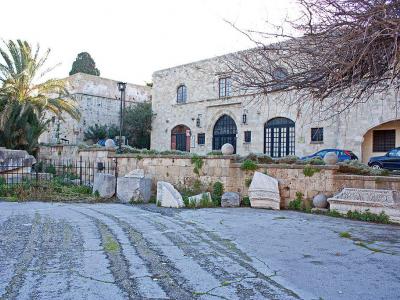
Stand on Symi Square, the remains of what is commonly identified as the Temple of Aphrodite, recall the importance of the ancient city that once occupied this area, although only fragments survive today. The sanctuary is generally dated to the Hellenistic period, around the 3rd century BC, and is associated with the cult of Aphrodite, the Greek goddess of love and beauty.
Archaeological evidence suggests that this location formed part of a broader sacred complex near the ancient harbor zone, an area closely connected to civic and religious life. A statue traditionally identified as Greek goddess Aphrodite, now housed in the Archaeological Museum of Rhodes, is often linked to the sanctuary and is believed by some scholars to have originated from this area.
Today, the remains of the former temple are enclosed by a low protective fence. While the site itself is not accessible to the public, an information board positioned outside the enclosure provides an overview of the sanctuary and its historical context. The explanatory text is presented in both Greek and English.
Visitors who linger at the temple's perimeter can still observe sections of ancient masonry, reused building blocks, and fragments of fallen columns. With careful attention, it is possible to discern traces of inscriptions on some of the surviving stone slabs, offering a tangible link to the sacred landscape of ancient Rhodes that once extended well beyond the medieval walls.
Archaeological evidence suggests that this location formed part of a broader sacred complex near the ancient harbor zone, an area closely connected to civic and religious life. A statue traditionally identified as Greek goddess Aphrodite, now housed in the Archaeological Museum of Rhodes, is often linked to the sanctuary and is believed by some scholars to have originated from this area.
Today, the remains of the former temple are enclosed by a low protective fence. While the site itself is not accessible to the public, an information board positioned outside the enclosure provides an overview of the sanctuary and its historical context. The explanatory text is presented in both Greek and English.
Visitors who linger at the temple's perimeter can still observe sections of ancient masonry, reused building blocks, and fragments of fallen columns. With careful attention, it is possible to discern traces of inscriptions on some of the surviving stone slabs, offering a tangible link to the sacred landscape of ancient Rhodes that once extended well beyond the medieval walls.
2) Street of the Knights (must see)
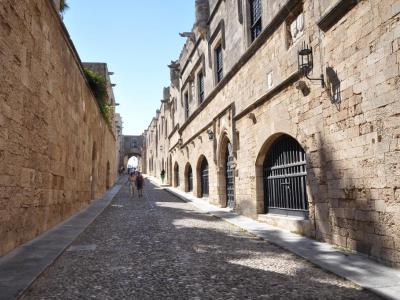
The Street of the Knights is lined with the former inns of the Knights Hospitaller, each once housing members of a specific langue of the Order. The street is widely regarded as one of the best-preserved medieval streets in Europe, notable for the coherence of its architecture and its limited later alteration. The buildings on both sides are constructed primarily of local limestone, carefully dressed to present a unified and imposing facade that remains consistent from start to finish.
At the upper end of the street, immediately after leaving the Palace of the Grand Master, the route is visually anchored by a stone archway spanning the roadway, marking the transition from the palace complex into the residential quarter of the Knights. As you proceed downhill along the center of the street, the facades are punctuated by small square windows set high in the walls and arched doorways at ground level, proportioned to admit mounted riders or carts. Along the way, carved coats of arms, inscriptions, and commemorative plaques appear on both sides, identifying individual patrons and phases of construction as you continue toward the lower town.
Roughly halfway down the street, the Inn of France comes into view on your left-hand side. Continuing toward the lower end of the street, look across to your left to see a small enclosed garden with an Ottoman fountain. This garden forms part of the courtyard of the 15th-century Villaragut Mansion, restored in 2002. The courtyard is generally closed to the public and accessible only on special occasions or through institutional arrangements. Near the lower end of the street, on the north side, the route opens toward the Archaeological Museum of Rhodes, housed in the former Knights’ Hospital.
During the day, as you walk this stretch, the street is heavily trafficked by visitors and tour groups, which can obscure its original function as a ceremonial and administrative route linking the Knights’ residences to the Palace of the Grand Master. In the evening, with fewer people moving along the route, the architectural sequence, from palace to inns to lower town, becomes easier to read, clearly revealing the street’s original role within the medieval city.
At the upper end of the street, immediately after leaving the Palace of the Grand Master, the route is visually anchored by a stone archway spanning the roadway, marking the transition from the palace complex into the residential quarter of the Knights. As you proceed downhill along the center of the street, the facades are punctuated by small square windows set high in the walls and arched doorways at ground level, proportioned to admit mounted riders or carts. Along the way, carved coats of arms, inscriptions, and commemorative plaques appear on both sides, identifying individual patrons and phases of construction as you continue toward the lower town.
Roughly halfway down the street, the Inn of France comes into view on your left-hand side. Continuing toward the lower end of the street, look across to your left to see a small enclosed garden with an Ottoman fountain. This garden forms part of the courtyard of the 15th-century Villaragut Mansion, restored in 2002. The courtyard is generally closed to the public and accessible only on special occasions or through institutional arrangements. Near the lower end of the street, on the north side, the route opens toward the Archaeological Museum of Rhodes, housed in the former Knights’ Hospital.
During the day, as you walk this stretch, the street is heavily trafficked by visitors and tour groups, which can obscure its original function as a ceremonial and administrative route linking the Knights’ residences to the Palace of the Grand Master. In the evening, with fewer people moving along the route, the architectural sequence, from palace to inns to lower town, becomes easier to read, clearly revealing the street’s original role within the medieval city.
3) Archaeological Museum of Rhodes (must see)
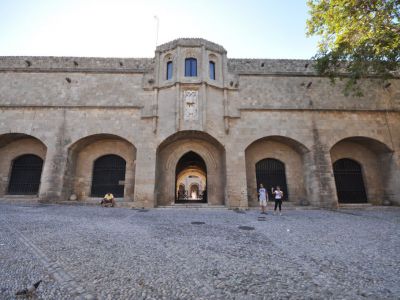
One of the most significant buildings in the Old Town, the Knights’ New Hospital now houses the Archaeological Museum of Rhodes. The structure not only preserves finds from ancient sites across the island but also reflects the wealth, organization, and engineering skill of the Knights Hospitaller during their rule. Construction of the hospital began in 1440 and was completed in 1489 under Grand Master Pierre d’Aubusson.
At the center of the complex lies a large rectangular courtyard, surrounded by arched porticoes. One section is marked by a Hellenistic lion statue, while other areas display stone cannonballs recovered from several sieges of the city, including those of 1480 and 1522. From the courtyard, a broad stone staircase leads to the former infirmary hall, a vast vaulted space supported by stone columns. Once sparsely equipped, the hall now displays medieval artifacts, including carved tombstones of Knights, many bearing heraldic coats of arms.
The remaining rooms on the upper floor, including the former refectory, have been divided into gallery spaces presenting pottery, grave goods, and architectural fragments from sites such as Ialysos and Kameiros, much of it uncovered during Italian-era excavations. These galleries are arranged chronologically, guiding visitors through Archaic, Classical, Hellenistic, and Roman periods.
Another section of the museum, located in the former service areas of the hospital, displays Classical sculpture and funerary steles, including a notable stele dedicated by Krito to her mother Timarista, dated to around 410 BC and carved in the Athenian style. Nearby are an Archaic kouros and a small marble head of Zeus found near his sanctuary on Mount Atávyros.
Additional rooms feature Hellenistic and Roman statuary, including two celebrated representations of Aphrodite. One, known as Aphrodite Thalassia, is notable for the erosion of her facial features caused by prolonged contact with seawater. The other, Aphrodite Bathing, depicts the goddess crouching as she arranges her hair and dates to the 1st century BC, likely a Roman copy of a 3rd-century BC original. Nearby, a sculpture garden presents a mix of stylized animals set among planted courtyards.
At the center of the complex lies a large rectangular courtyard, surrounded by arched porticoes. One section is marked by a Hellenistic lion statue, while other areas display stone cannonballs recovered from several sieges of the city, including those of 1480 and 1522. From the courtyard, a broad stone staircase leads to the former infirmary hall, a vast vaulted space supported by stone columns. Once sparsely equipped, the hall now displays medieval artifacts, including carved tombstones of Knights, many bearing heraldic coats of arms.
The remaining rooms on the upper floor, including the former refectory, have been divided into gallery spaces presenting pottery, grave goods, and architectural fragments from sites such as Ialysos and Kameiros, much of it uncovered during Italian-era excavations. These galleries are arranged chronologically, guiding visitors through Archaic, Classical, Hellenistic, and Roman periods.
Another section of the museum, located in the former service areas of the hospital, displays Classical sculpture and funerary steles, including a notable stele dedicated by Krito to her mother Timarista, dated to around 410 BC and carved in the Athenian style. Nearby are an Archaic kouros and a small marble head of Zeus found near his sanctuary on Mount Atávyros.
Additional rooms feature Hellenistic and Roman statuary, including two celebrated representations of Aphrodite. One, known as Aphrodite Thalassia, is notable for the erosion of her facial features caused by prolonged contact with seawater. The other, Aphrodite Bathing, depicts the goddess crouching as she arranges her hair and dates to the 1st century BC, likely a Roman copy of a 3rd-century BC original. Nearby, a sculpture garden presents a mix of stylized animals set among planted courtyards.
4) Church of Our Lady of the Castle (Museum Square)
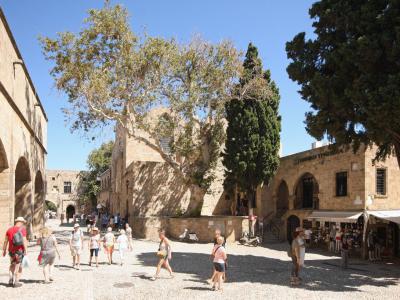
Museum Square is defined by several key monuments that reflect the layered religious and administrative history of Rhodes. Standing on the northern side of the square, the Church of Our Lady of the Castle dominates the space and is one of the most important ecclesiastical buildings in the Old Town. The structure originated in the 11th century as an Orthodox Byzantine cathedral. In the early 14th century, between 1319 and 1334, the Knights Hospitaller reconstructed it into a Gothic three-aisled basilica, adapting it to serve as their Latin cathedral.
During the Ottoman period, the building was converted into a mosque known as the Enderun Mosque, with additions such as a minaret, later removed during restorations carried out in the Italian period. Today, as you approach the main entrance facing the square, the church houses a permanent exhibition of icons, medieval sculptures, and ecclesiastical artifacts.
At the southeastern edge of the square, near the Arnáldou Gate, stands the Inn of England. When facing the gate, the building appears just inside the medieval walls, marking the point where the fortified Collachium, the Knights’ administrative quarter, gives way to the commercial town beyond. Originally constructed in 1483 to house members of the English langue of the Knights Hospitaller, the building was destroyed in the gunpowder explosion of 1856 and later reconstructed in 1919 during the Italian period, following the original plans.
During the Ottoman period, the building was converted into a mosque known as the Enderun Mosque, with additions such as a minaret, later removed during restorations carried out in the Italian period. Today, as you approach the main entrance facing the square, the church houses a permanent exhibition of icons, medieval sculptures, and ecclesiastical artifacts.
At the southeastern edge of the square, near the Arnáldou Gate, stands the Inn of England. When facing the gate, the building appears just inside the medieval walls, marking the point where the fortified Collachium, the Knights’ administrative quarter, gives way to the commercial town beyond. Originally constructed in 1483 to house members of the English langue of the Knights Hospitaller, the building was destroyed in the gunpowder explosion of 1856 and later reconstructed in 1919 during the Italian period, following the original plans.
5) Hippocrates Square
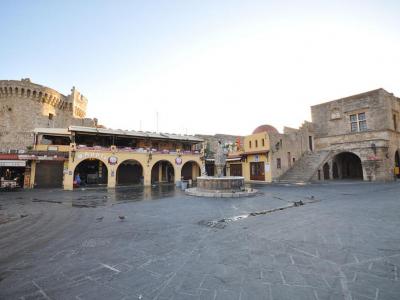
Upon entering the Old Town through the Marine Gate and its imposing towers, visitors arrive at Hippocrates Square, a natural starting point for exploring this UNESCO World Heritage Site. The square functions as one of the Old Town’s main gathering places and is centered on the Syndriváni, a fountain introduced during the Italian period, easily recognized by its decorative upper element and the pigeons that congregate around it.
Standing at the southeastern corner, the long, arcaded facade belongs to the Kastellanía, originally the commercial tribunal and courthouse of the Knights Hospitaller. Completed in 1507 and restored during the Italian administration between 1925 and 1935, the building now houses the municipal library and historical archives. On the northern side stands the small Syndriváni Mosque, a modest Ottoman-era structure dating to the late 18th century.
Turning your attention to the western side of the square, Socrates Street begins here, drawing visitors deeper into the Old Town. The surrounding buildings are a mix of medieval structures and later Ottoman- and Italian-period adaptations, many featuring arcades at street level and upper floors converted into cafes, shops, and terraces. Several of these buildings incorporate reused medieval stonework, visible in door frames and wall sections.
Standing at the southeastern corner, the long, arcaded facade belongs to the Kastellanía, originally the commercial tribunal and courthouse of the Knights Hospitaller. Completed in 1507 and restored during the Italian administration between 1925 and 1935, the building now houses the municipal library and historical archives. On the northern side stands the small Syndriváni Mosque, a modest Ottoman-era structure dating to the late 18th century.
Turning your attention to the western side of the square, Socrates Street begins here, drawing visitors deeper into the Old Town. The surrounding buildings are a mix of medieval structures and later Ottoman- and Italian-period adaptations, many featuring arcades at street level and upper floors converted into cafes, shops, and terraces. Several of these buildings incorporate reused medieval stonework, visible in door frames and wall sections.
6) Socrates Street
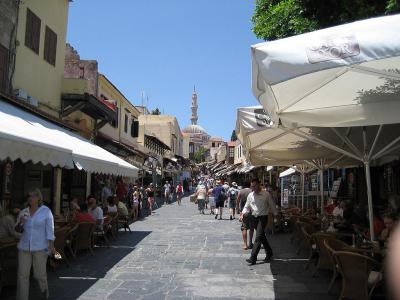
Every historic resort town has a principal shopping street, and Rhodes is no exception with its lively Socrates Street. Named after the ancient Greek philosopher, this cobblestoned artery is lined with shops, cafes, bars, eateries, and small entertainment venues. Activity builds steadily through the afternoon and evening, often continuing late into the night, giving the street a constant sense of movement.
A walk along Socrates Street can easily turn into a longer exploration. Stalls and storefronts display clothing, textiles, footwear, sweets, souvenir figurines inspired by ancient Greek themes, and a wide range of local handicrafts. Many vendors are multilingual, reflecting the international character of the Old Town and adding to the animated, colorful atmosphere that attracts visitors throughout the day.
As you move along the street, layers of the city’s past come into view. Nearby are stretches of the medieval fortifications of the Old Town, along with Byzantine churches, Ottoman mosques, and small squares, gardens, and courtyards branching off the main route. As you reach the upper end of the street, you come upon the Suleymaniye Mosque, an early Ottoman monument completed in 1522.
A walk along Socrates Street can easily turn into a longer exploration. Stalls and storefronts display clothing, textiles, footwear, sweets, souvenir figurines inspired by ancient Greek themes, and a wide range of local handicrafts. Many vendors are multilingual, reflecting the international character of the Old Town and adding to the animated, colorful atmosphere that attracts visitors throughout the day.
As you move along the street, layers of the city’s past come into view. Nearby are stretches of the medieval fortifications of the Old Town, along with Byzantine churches, Ottoman mosques, and small squares, gardens, and courtyards branching off the main route. As you reach the upper end of the street, you come upon the Suleymaniye Mosque, an early Ottoman monument completed in 1522.
7) Medieval Clock Tower (must see)
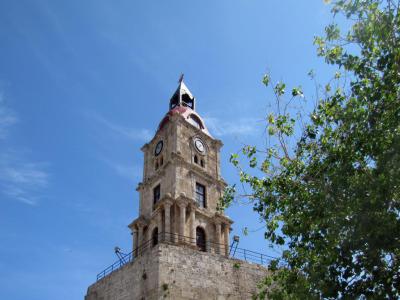
The Clock Tower of Rhodes stands at one of the highest points within the Old Town. The structure visible today dates primarily to the Ottoman period, although an earlier tower is known to have existed on the same site. In 1856, a gunpowder explosion, caused by stored munitions in the nearby Church of Saint John, severely damaged large sections of the medieval city, including the earlier clock tower. Following this event, the tower was rebuilt under the supervision of Fethi Pasha, an Ottoman statesman and military official active in Rhodes during the mid-19th century. The reconstruction introduced decorative elements influenced by Baroque architecture.
During Ottoman rule, the clock tower served as a public timekeeping structure for the walled city. In an urban environment where commercial activity, administrative schedules, and access through gates were regulated, a centrally visible clock provided a shared temporal reference.
The tower has a square plan and rises through multiple interior levels connected by a narrow wooden staircase consisting of fifty-three steps. These steps lead to a small upper chamber beneath the clock mechanism. The ascent passes through confined interior spaces where photographic displays and informational panels document the tower’s damage, rebuilding, and subsequent restoration phases carried out in the 20th century.
From the upper level, visitors obtain open views across the Old Town’s dense roofscape, the surrounding fortifications, Mandraki Harbor, and the coastline beyond the city walls. The tower remains mechanically functional, and its clock faces continue to mark time. Admission to the tower includes access to the terrace cafe located at ground level, adjacent to the entrance, which occupies part of the surrounding historic structure.
During Ottoman rule, the clock tower served as a public timekeeping structure for the walled city. In an urban environment where commercial activity, administrative schedules, and access through gates were regulated, a centrally visible clock provided a shared temporal reference.
The tower has a square plan and rises through multiple interior levels connected by a narrow wooden staircase consisting of fifty-three steps. These steps lead to a small upper chamber beneath the clock mechanism. The ascent passes through confined interior spaces where photographic displays and informational panels document the tower’s damage, rebuilding, and subsequent restoration phases carried out in the 20th century.
From the upper level, visitors obtain open views across the Old Town’s dense roofscape, the surrounding fortifications, Mandraki Harbor, and the coastline beyond the city walls. The tower remains mechanically functional, and its clock faces continue to mark time. Admission to the tower includes access to the terrace cafe located at ground level, adjacent to the entrance, which occupies part of the surrounding historic structure.
8) Palace of the Grand Master of the Knights of Rhodes (must see)
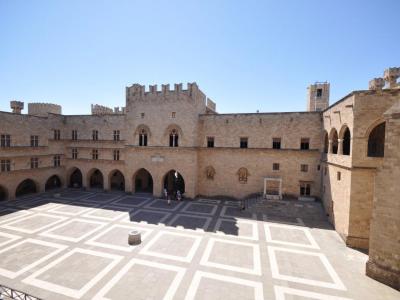
The Palace of the Grand Master was once the administrative seat of the Knights Hospitaller and the symbolic heart of the Knights’ Quarter. During the Ottoman period, the building fell into neglect and was later used as a prison. In 1856, a gunpowder explosion caused severe damage, leaving much of the structure in ruins. The palace was extensively reconstructed during the Italian administration in the 1930s. The rebuilding did not follow the original medieval layout and introduced new interior elements, including sculptures and mosaics transferred from other Dodecanese islands.
Despite these issues, the palace remains visually commanding, dominating one of the highest points of the Old Town. The interior incorporates architectural fragments such as columns and capitals reused from ancient sites. The reconstructed rooms feature coffered wooden ceilings and windows fitted with translucent stone panels that soften the interior light. Many of the grand halls are decorated with large-scale Hellenistic and Roman mosaics, primarily brought from Kos.
Visitors enter between two imposing semicircular towers and ascend a broad marble staircase to the upper level, where spacious ceremonial rooms are intentionally sparsely furnished to emphasize architectural form and mosaic decoration. Among the most notable scenes are representations of the Nine Muses, a sea nymph riding a hippocamp, and the head of Medusa, along with marine motifs featuring fish and dolphins.
The ground floor, once used for storage and logistical purposes during sieges, encloses a large courtyard populated with classical-style statues. Today, this level hosts permanent and temporary exhibitions that outline the history of Rhodes from antiquity through the medieval period and up to the Ottoman conquest, offering broader historical context alongside the palace’s own story.
Despite these issues, the palace remains visually commanding, dominating one of the highest points of the Old Town. The interior incorporates architectural fragments such as columns and capitals reused from ancient sites. The reconstructed rooms feature coffered wooden ceilings and windows fitted with translucent stone panels that soften the interior light. Many of the grand halls are decorated with large-scale Hellenistic and Roman mosaics, primarily brought from Kos.
Visitors enter between two imposing semicircular towers and ascend a broad marble staircase to the upper level, where spacious ceremonial rooms are intentionally sparsely furnished to emphasize architectural form and mosaic decoration. Among the most notable scenes are representations of the Nine Muses, a sea nymph riding a hippocamp, and the head of Medusa, along with marine motifs featuring fish and dolphins.
The ground floor, once used for storage and logistical purposes during sieges, encloses a large courtyard populated with classical-style statues. Today, this level hosts permanent and temporary exhibitions that outline the history of Rhodes from antiquity through the medieval period and up to the Ottoman conquest, offering broader historical context alongside the palace’s own story.
9) Fortifications of Rhodes (must see)
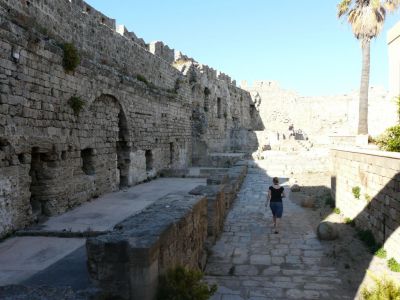
The first and most defining feature of Rhodes’ Old Town is its system of fortified walls. Extending for roughly four kilometers, these massive defenses were designed to protect the city from invading powers and corsairs who controlled the Mediterranean and Aegean sea routes during the Middle Ages. Long considered among the strongest fortifications of their time, the walls ultimately fell to the Ottoman forces in 1522 after a prolonged siege.
Much of the fortification visible today reflects the extensive strengthening carried out by the Knights Hospitaller in the late 15th century, particularly in anticipation of the siege of 1480. Building on earlier Byzantine defenses, the Knights transformed the city into a highly sophisticated fortified complex. The walls were divided into distinct sectors, each maintained by one of the Order’s langues, or national divisions, a system that shaped both construction and defense strategies.
The circuit includes an intricate combination of curtain walls, bastions, towers, gates, and a broad defensive moat. Several gates survive, each differing in form and scale according to its function and period of construction. At certain times of day: at sunrise, or after dark when the walls are illuminated, the stonework takes on a dramatic presence that emphasizes both its scale and craftsmanship.
Sections of the fortifications are accessible to visitors, including portions of the ramparts and selected towers, offering insight into medieval military engineering and daily defensive life. Access points and ticketing vary depending on the area, and some sections are reached independently rather than through a single entrance.
Much of the fortification visible today reflects the extensive strengthening carried out by the Knights Hospitaller in the late 15th century, particularly in anticipation of the siege of 1480. Building on earlier Byzantine defenses, the Knights transformed the city into a highly sophisticated fortified complex. The walls were divided into distinct sectors, each maintained by one of the Order’s langues, or national divisions, a system that shaped both construction and defense strategies.
The circuit includes an intricate combination of curtain walls, bastions, towers, gates, and a broad defensive moat. Several gates survive, each differing in form and scale according to its function and period of construction. At certain times of day: at sunrise, or after dark when the walls are illuminated, the stonework takes on a dramatic presence that emphasizes both its scale and craftsmanship.
Sections of the fortifications are accessible to visitors, including portions of the ramparts and selected towers, offering insight into medieval military engineering and daily defensive life. Access points and ticketing vary depending on the area, and some sections are reached independently rather than through a single entrance.
