Custom Walk in Washington D.C., USA by chastity_e_brown_d7335 created on 2025-11-04
Guide Location: USA » Washington D.C.
Guide Type: Custom Walk
# of Sights: 6
Tour Duration: 2 Hour(s)
Travel Distance: 5.2 Km or 3.2 Miles
Share Key: WM4FG
Guide Type: Custom Walk
# of Sights: 6
Tour Duration: 2 Hour(s)
Travel Distance: 5.2 Km or 3.2 Miles
Share Key: WM4FG
How It Works
Please retrieve this walk in the GPSmyCity app. Once done, the app will guide you from one tour stop to the next as if you had a personal tour guide. If you created the walk on this website or come to the page via a link, please follow the instructions below to retrieve the walk in the app.
Retrieve This Walk in App
Step 1. Download the app "GPSmyCity: Walks in 1K+ Cities" on Apple App Store or Google Play Store.



Step 2. In the GPSmyCity app, download(or launch) the guide "Washington D.C. Map and Walking Tours".
Step 3. Tap the menu button located at upper right corner of the "Walks" screen and select "Retrieve custom walk". Enter the share key: WM4FG
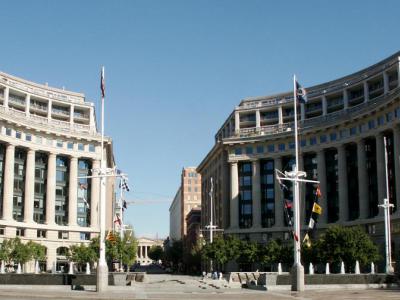
1) U.S. Navy Memorial & Naval Heritage Center
The U.S. Navy Memorial honors those who have served or are currently serving in the U.S. Navy, U.S. Marine Corps, U.S. Coast Guard, and the Merchant Marines. This memorial project, which had been in the planning stages for several years, was ultimately inaugurated in 1987, coinciding with the 212th anniversary of the U.S. Navy.
An interesting historical note is that Pierre L’Enfant, a figure who had served alongside General George Washington, originally conceived the idea for this memorial. However, it was President John Kennedy who revived the plan, leading to its realization. The project's completion required substantial fundraising efforts and received a final push from Admiral Arleigh Burke.
One of the most poignant features of this memorial is "The Lone Sailor," a sculpture crafted by Stanly Bleifeld. The statue incorporates artifacts from eight different U.S. Navy ships and stands overlooking the Granite Sea, a representation of Earth's oceans. Additionally, there are 26 bas-reliefs depicting significant events from various global navies and notable quotes from naval personnel throughout history, making it a must-visit destination.
Inside the Naval Heritage Center, visitors can explore rotating exhibits and watch a film featuring the Blue Angels. The U.S. Navy Memorial is accessible around the clock, while the Naval Heritage Center operates from 9:30 am to 5 pm, Monday through Saturday during the summer. Please note that it is closed on Sundays and Mondays in the winter, as well as on Christmas, Thanksgiving, and New Year's Day.
Tip:
The majority of the Heritage Center is downstairs, underground via an entrance in a building behind the fountain memorial.
It's not a big center but it's well represented. An added bonus is that they have quiet and clean restrooms.
An interesting historical note is that Pierre L’Enfant, a figure who had served alongside General George Washington, originally conceived the idea for this memorial. However, it was President John Kennedy who revived the plan, leading to its realization. The project's completion required substantial fundraising efforts and received a final push from Admiral Arleigh Burke.
One of the most poignant features of this memorial is "The Lone Sailor," a sculpture crafted by Stanly Bleifeld. The statue incorporates artifacts from eight different U.S. Navy ships and stands overlooking the Granite Sea, a representation of Earth's oceans. Additionally, there are 26 bas-reliefs depicting significant events from various global navies and notable quotes from naval personnel throughout history, making it a must-visit destination.
Inside the Naval Heritage Center, visitors can explore rotating exhibits and watch a film featuring the Blue Angels. The U.S. Navy Memorial is accessible around the clock, while the Naval Heritage Center operates from 9:30 am to 5 pm, Monday through Saturday during the summer. Please note that it is closed on Sundays and Mondays in the winter, as well as on Christmas, Thanksgiving, and New Year's Day.
Tip:
The majority of the Heritage Center is downstairs, underground via an entrance in a building behind the fountain memorial.
It's not a big center but it's well represented. An added bonus is that they have quiet and clean restrooms.
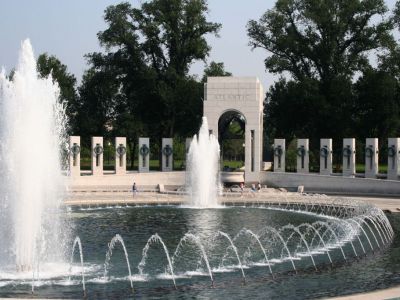
2) World War II Memorial (must see)
The World War II Memorial has a grand design that feels appropriate for a war that spanned the entire globe. Two arches at the ends of it symbolize the Pacific and Atlantic areas of fighting. Between them, 56 pillars form two great semicircles, representing the then 48 U.S. states, the District of Columbia, and the territories of Alaska, Hawaii, Puerto Rico, Guam, the U.S. Virgin Islands, American Samoa, and the Philippines.
Along the walls, bronze bas-relief panels show scenes from the Pacific and European theaters of war. These are not battle-movie explosions, but quieter snapshots of wartime life: soldiers landing, workers building, medics helping, families waiting, and a nation throwing itself into an enormous effort. And then, just when everything feels very solemn and official, up pops “Kilroy Was Here,” the famous wartime doodle that followed American GIs across continents like the world’s most determined graffiti artist.
On the west side is the Freedom Wall, one of the memorial’s most powerful features. It holds 4,048 gold stars, with each star representing 100 American service members who died or remain missing from World War II. In front of it, the Rainbow Pool reflects the stars in the water, creating a scene that is simple, formal, and deeply moving. It is the kind of place where even the most talkative visitor tends to lower their voice without being asked.
The memorial covers a little over seven acres, and nearly two-thirds of the site is made up of water or landscaping. That open space matters. It gives the arches, pillars, reliefs, and stars room to breathe, while giving visitors space to think about the scale of the war and the lives behind the numbers.
Indeed, this is one of Washington’s more formal memorials, and it carries that formality with purpose. Look closely at the relief panels for details of wartime service beyond the battlefield, then take time at the Freedom Wall.
Entry is free, and the site is open 24 hours a day, though rangers are usually on hand from around 10 am to 11 pm. A clear day is best for a visit, because shelter is limited, and comfortable shoes are a wise idea. This memorial was not designed for a quick glance; so give it time, walk the full space, and let its scale do its quiet work.
Along the walls, bronze bas-relief panels show scenes from the Pacific and European theaters of war. These are not battle-movie explosions, but quieter snapshots of wartime life: soldiers landing, workers building, medics helping, families waiting, and a nation throwing itself into an enormous effort. And then, just when everything feels very solemn and official, up pops “Kilroy Was Here,” the famous wartime doodle that followed American GIs across continents like the world’s most determined graffiti artist.
On the west side is the Freedom Wall, one of the memorial’s most powerful features. It holds 4,048 gold stars, with each star representing 100 American service members who died or remain missing from World War II. In front of it, the Rainbow Pool reflects the stars in the water, creating a scene that is simple, formal, and deeply moving. It is the kind of place where even the most talkative visitor tends to lower their voice without being asked.
The memorial covers a little over seven acres, and nearly two-thirds of the site is made up of water or landscaping. That open space matters. It gives the arches, pillars, reliefs, and stars room to breathe, while giving visitors space to think about the scale of the war and the lives behind the numbers.
Indeed, this is one of Washington’s more formal memorials, and it carries that formality with purpose. Look closely at the relief panels for details of wartime service beyond the battlefield, then take time at the Freedom Wall.
Entry is free, and the site is open 24 hours a day, though rangers are usually on hand from around 10 am to 11 pm. A clear day is best for a visit, because shelter is limited, and comfortable shoes are a wise idea. This memorial was not designed for a quick glance; so give it time, walk the full space, and let its scale do its quiet work.
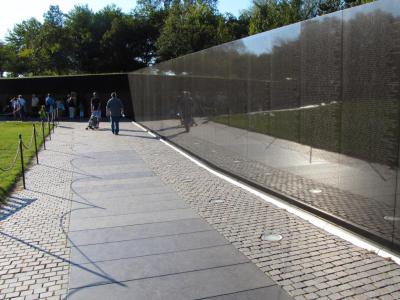
3) Vietnam Veterans Memorial
When people hear “Vietnam Veterans Memorial,” most picture the Wall — that long, polished sweep of black granite where silence does most of the talking. But this memorial has three parts: the Wall, the Vietnam Women’s Memorial, and the Three Soldiers statue, all located in Constitution Gardens on the National Mall.
American involvement in Vietnam lasted through years of conflict, protest, grief, and division at home. That is why one of the memorial’s guiding ideas was so important: whatever people thought about the war, the men and women who served deserved to be honored without the argument drowning them out. Easier said than done, of course. Even the memorial itself caused controversy at first, because apparently, America can debate even the shape of mourning. Over time, though, the focus has returned to where it belongs: the names.
The Wall lists more than 58,000 U.S. service members who were killed or went missing in action. No civilian names are included. As you walk along it, the ground lowers, the Wall rises, and the names keep coming — line after line, year after year. There is no horse, no sword, no heroic arm pointing toward destiny. Just names, reflected faces, and the quiet realization that each inscription once belonged to a life, not a statistic.
Just south of the Wall stands the Vietnam Women’s Memorial. It shows three uniformed women caring for a wounded soldier, representing the nurses and other women who served in support roles during the war. The figures are often identified as Faith, Hope, and Charity — names that sound symbolic until you consider what battlefield care demanded: steadiness, endurance, and compassion under pressure.
Nearby, the Three Soldiers statue offers a more traditional image of service. Added after some critics felt the Wall was too abstract, the bronze soldiers wear Vietnam-era gear and appear to be looking toward the names on the Wall. Sometimes, even the compromise ends up saying something powerful...
The memorial is open 24 hours a day, with rangers on duty available between 9:30 am and 11:30 pm, and directories near the Wall to help visitors find specific names. For a quieter visit and clearer photographs, come early in the morning, just after daybreak. On rainy days, bring an umbrella — the memorial is powerful, but it is not generous with shelter. Stand before the Wall, follow the reflection, and let the memorial make remembrance personal...
American involvement in Vietnam lasted through years of conflict, protest, grief, and division at home. That is why one of the memorial’s guiding ideas was so important: whatever people thought about the war, the men and women who served deserved to be honored without the argument drowning them out. Easier said than done, of course. Even the memorial itself caused controversy at first, because apparently, America can debate even the shape of mourning. Over time, though, the focus has returned to where it belongs: the names.
The Wall lists more than 58,000 U.S. service members who were killed or went missing in action. No civilian names are included. As you walk along it, the ground lowers, the Wall rises, and the names keep coming — line after line, year after year. There is no horse, no sword, no heroic arm pointing toward destiny. Just names, reflected faces, and the quiet realization that each inscription once belonged to a life, not a statistic.
Just south of the Wall stands the Vietnam Women’s Memorial. It shows three uniformed women caring for a wounded soldier, representing the nurses and other women who served in support roles during the war. The figures are often identified as Faith, Hope, and Charity — names that sound symbolic until you consider what battlefield care demanded: steadiness, endurance, and compassion under pressure.
Nearby, the Three Soldiers statue offers a more traditional image of service. Added after some critics felt the Wall was too abstract, the bronze soldiers wear Vietnam-era gear and appear to be looking toward the names on the Wall. Sometimes, even the compromise ends up saying something powerful...
The memorial is open 24 hours a day, with rangers on duty available between 9:30 am and 11:30 pm, and directories near the Wall to help visitors find specific names. For a quieter visit and clearer photographs, come early in the morning, just after daybreak. On rainy days, bring an umbrella — the memorial is powerful, but it is not generous with shelter. Stand before the Wall, follow the reflection, and let the memorial make remembrance personal...
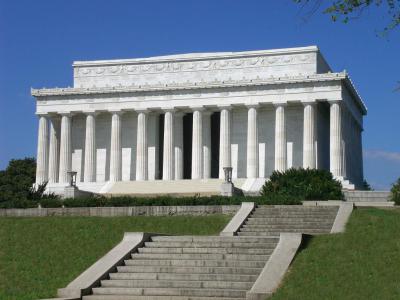
4) Lincoln Memorial (must see)
The Lincoln Memorial is one of those places in Washington, D.C. that needs very little introduction. Built in honor of Abraham Lincoln, the 16th president of the United States, it commemorates the man who led the country through the Civil War and became a lasting symbol of national unity. Architecturally, the memorial goes full ancient Greece, with a grand Doric temple design that speaks in the language of democracy, dignity, and very large columns...
Inside sits the famous statue of Lincoln, calm, massive, and looking as if he is silently judging the nation from his marble chair. Around him are two of his most important speeches: the Gettysburg Address and the Second Inaugural Address. Both are engraved on the walls, proving that powerful writing does not need five warm-up paragraphs and a dramatic title...
The idea for a Lincoln memorial began soon after his assassination, when the Lincoln Monument Association was formed in 1867. Actual planning, however, moved at a pace best described as historically patient. The memorial bill was finally signed by President William Howard Taft in 1911, and the monument was completed for about two million dollars, which in today's prices might just cover the scaffolding, paperwork, and several very serious meetings...
Over time, the Lincoln Memorial became more than a tribute to one president. It turned into a national stage for speeches, gatherings, and protests, most famously Martin Luther King Jr.’s “I Have a Dream” speech in 1963. To find the spot, stand on the steps and look down for the marked stone block. It is a small detail, but a powerful one: the place where one of America’s most famous calls for justice was delivered.
Managed by the National Park Service and listed on the National Register of Historic Places, the memorial is open 24 hours a day. For the best experience, come early in the morning before the crowds arrive, or later in the evening when the lights give the whole place a solemn, cinematic glow. Bring water in summer, and maybe a snack too, because the view is excellent, but the refreshment stands are somewhat overpriced and not exactly the capital’s finest culinary achievement...
Before you leave, turn around. The Reflecting Pool, the Washington Monument, and the long sweep of the National Mall unfold before you — one of those rare postcard views that actually deserves the postcard.
Inside sits the famous statue of Lincoln, calm, massive, and looking as if he is silently judging the nation from his marble chair. Around him are two of his most important speeches: the Gettysburg Address and the Second Inaugural Address. Both are engraved on the walls, proving that powerful writing does not need five warm-up paragraphs and a dramatic title...
The idea for a Lincoln memorial began soon after his assassination, when the Lincoln Monument Association was formed in 1867. Actual planning, however, moved at a pace best described as historically patient. The memorial bill was finally signed by President William Howard Taft in 1911, and the monument was completed for about two million dollars, which in today's prices might just cover the scaffolding, paperwork, and several very serious meetings...
Over time, the Lincoln Memorial became more than a tribute to one president. It turned into a national stage for speeches, gatherings, and protests, most famously Martin Luther King Jr.’s “I Have a Dream” speech in 1963. To find the spot, stand on the steps and look down for the marked stone block. It is a small detail, but a powerful one: the place where one of America’s most famous calls for justice was delivered.
Managed by the National Park Service and listed on the National Register of Historic Places, the memorial is open 24 hours a day. For the best experience, come early in the morning before the crowds arrive, or later in the evening when the lights give the whole place a solemn, cinematic glow. Bring water in summer, and maybe a snack too, because the view is excellent, but the refreshment stands are somewhat overpriced and not exactly the capital’s finest culinary achievement...
Before you leave, turn around. The Reflecting Pool, the Washington Monument, and the long sweep of the National Mall unfold before you — one of those rare postcard views that actually deserves the postcard.
5) Korean War Veterans Memorial (must see)
The Korean War Veterans Memorial stands in West Potomac Park, where Washington, D.C. lowers its voice and lets the statues do most of the talking. It honors all those who served in the Korean War, a conflict that began when North Korea invaded South Korea in 1950. The United States entered the war as part of a United Nations effort to defend South Korea, though back home, the mood was complicated.
Many Americans called it a “conflict” rather than a full-scale war, which must have sounded rather tidy from a warm office. On the ground, it was anything but tidy. At places like the Chosin Reservoir, soldiers fought through brutal cold, with temperatures reportedly dropping to around minus 40 degrees Fahrenheit.
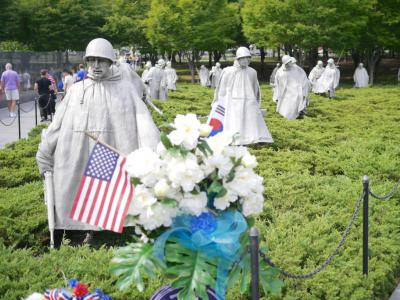
The memorial is laid out in the shape of a triangle, known here as the Field of Service. Juniper plantings and strips of concrete suggest rough battlefield terrain, moving through which are 19 stainless steel soldiers, dressed in full combat gear. Their ponchos seem whipped by the wind, their faces are tense, and their formation gives the feeling that they are still on patrol, still alert, still pushing forward through mud, cold, and uncertainty.
On the south side, a polished black granite wall reflects the statues. Look carefully, and you'll see the 19 soldiers appear to double into 38—a reference to the 38th parallel, the line associated with the division between North and South Korea. The wall also carries etched images of real service members, creating a ghostly crowd of faces behind the patrol. It is subtle by day, but after dark it becomes especially powerful, when the lighting adds drama without needing to overdo it.
At the end of the Field of Service is a triangular reflecting pool, while a low granite wall nearby lists the 22 United Nations member countries that contributed to the war effort. The memorial is open around the clock, and its strongest moments often come in the evening, when the figures seem to emerge from the shadows.
Indeed, this is one of Washington’s most haunting war memorials. Visit after dark, take your time, and use your phone flashlight to study the black granite wall. The longer you look, the more it reveals—and the quieter you may find yourself becoming...
Many Americans called it a “conflict” rather than a full-scale war, which must have sounded rather tidy from a warm office. On the ground, it was anything but tidy. At places like the Chosin Reservoir, soldiers fought through brutal cold, with temperatures reportedly dropping to around minus 40 degrees Fahrenheit.
The memorial is laid out in the shape of a triangle, known here as the Field of Service. Juniper plantings and strips of concrete suggest rough battlefield terrain, moving through which are 19 stainless steel soldiers, dressed in full combat gear. Their ponchos seem whipped by the wind, their faces are tense, and their formation gives the feeling that they are still on patrol, still alert, still pushing forward through mud, cold, and uncertainty.
On the south side, a polished black granite wall reflects the statues. Look carefully, and you'll see the 19 soldiers appear to double into 38—a reference to the 38th parallel, the line associated with the division between North and South Korea. The wall also carries etched images of real service members, creating a ghostly crowd of faces behind the patrol. It is subtle by day, but after dark it becomes especially powerful, when the lighting adds drama without needing to overdo it.
At the end of the Field of Service is a triangular reflecting pool, while a low granite wall nearby lists the 22 United Nations member countries that contributed to the war effort. The memorial is open around the clock, and its strongest moments often come in the evening, when the figures seem to emerge from the shadows.
Indeed, this is one of Washington’s most haunting war memorials. Visit after dark, take your time, and use your phone flashlight to study the black granite wall. The longer you look, the more it reveals—and the quieter you may find yourself becoming...
6) Women in Military Service for America Memorial
Found at the main entrance to Arlington National Cemetery, at the western end of Memorial Avenue, this memorial honors the women who have served with the United States Armed Forces from the American Revolution to the present day.
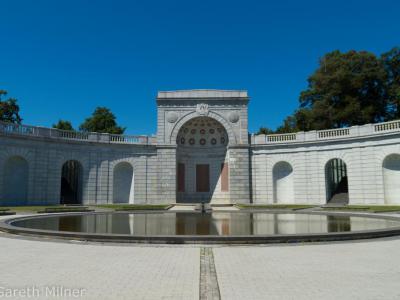
The structure began life in 1932 as the Hemicycle, a grand ceremonial gateway with a very serious name and an equally serious sweep of stone. In 1988, it was chosen as the home for the Women’s Memorial, which officially opened in 1997.
Architecturally, the memorial does a neat balancing act. It keeps the original Neoclassical dignity of the Hemicycle, then adds a modern glass skylight on the terrace above — proof that historic stone and contemporary design can coexist quite gracefully when given enough room. The skylight also brings natural light into the memorial below, creating a quiet link between the visible monument above and the stories preserved inside.
And those stories are the real heart of the place. The memorial recognizes women who served as nurses, pilots, clerks, code breakers, mechanics, officers, enlisted personnel, and in many other roles — sometimes officially, sometimes not quite officially, and often with far less recognition than they deserved. Long before women were fully integrated into the U.S. military, they were already doing the work, carrying the risk, and proving the point.
Inside, the Education Center offers exhibits on women’s military service across American history. Photographs show veterans during their years of service and later in life, which makes the memorial feel less like a distant history lesson and more like a meeting with real people. You see youth, discipline, courage, pride, and the quiet afterlife of service, all in the same frame.
The Women’s Memorial is not loud or showy, and that is part of its strength. It simply asks visitors to remember that the story of American military service was never written by men alone. Here, gratitude finally gets a wider frame...
The structure began life in 1932 as the Hemicycle, a grand ceremonial gateway with a very serious name and an equally serious sweep of stone. In 1988, it was chosen as the home for the Women’s Memorial, which officially opened in 1997.
Architecturally, the memorial does a neat balancing act. It keeps the original Neoclassical dignity of the Hemicycle, then adds a modern glass skylight on the terrace above — proof that historic stone and contemporary design can coexist quite gracefully when given enough room. The skylight also brings natural light into the memorial below, creating a quiet link between the visible monument above and the stories preserved inside.
And those stories are the real heart of the place. The memorial recognizes women who served as nurses, pilots, clerks, code breakers, mechanics, officers, enlisted personnel, and in many other roles — sometimes officially, sometimes not quite officially, and often with far less recognition than they deserved. Long before women were fully integrated into the U.S. military, they were already doing the work, carrying the risk, and proving the point.
Inside, the Education Center offers exhibits on women’s military service across American history. Photographs show veterans during their years of service and later in life, which makes the memorial feel less like a distant history lesson and more like a meeting with real people. You see youth, discipline, courage, pride, and the quiet afterlife of service, all in the same frame.
The Women’s Memorial is not loud or showy, and that is part of its strength. It simply asks visitors to remember that the story of American military service was never written by men alone. Here, gratitude finally gets a wider frame...
