Custom Walk in Philadelphia, Pennsylvania by szilberman_5f988 created on 2025-11-16
Guide Location: USA » Philadelphia
Guide Type: Custom Walk
# of Sights: 8
Tour Duration: 3 Hour(s)
Travel Distance: 7.5 Km or 4.7 Miles
Share Key: J5S6B
Guide Type: Custom Walk
# of Sights: 8
Tour Duration: 3 Hour(s)
Travel Distance: 7.5 Km or 4.7 Miles
Share Key: J5S6B
How It Works
Please retrieve this walk in the GPSmyCity app. Once done, the app will guide you from one tour stop to the next as if you had a personal tour guide. If you created the walk on this website or come to the page via a link, please follow the instructions below to retrieve the walk in the app.
Retrieve This Walk in App
Step 1. Download the app "GPSmyCity: Walks in 1K+ Cities" on Apple App Store or Google Play Store.



Step 2. In the GPSmyCity app, download(or launch) the guide "Philadelphia Map and Walking Tours".
Step 3. Tap the menu button located at upper right corner of the "Walks" screen and select "Retrieve custom walk". Enter the share key: J5S6B
1) Philadelphia City Hall
King Charles II owed a hefty sum of money to Admiral Sir William Penn, to wit 16,000 pounds. To discharge the debt, on 4 March 1681, the King signed a charter granting what is now Pennsylvania to the Admiral's son, William. William the Younger was a radical Quaker filled with democratic ideals. He set out for America.
Center Square was one of the original five squares marked out by Penn as the center of his city. It was simply a public square until the building of City Hall in 1871. By that time, it had come to be called Penn Square.
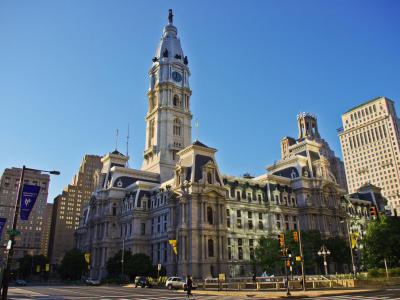
Located at number 1 Penn Square, City Hall was designed by architect John McArthur in the Second Empire style. It was in the process of construction from 1871 until 1901. Upon its completion, the Hall was the world's tallest habitable building.
The City Hall is a masonry building supported by brick and granite walls up to 22 feet thick. The outside walls are mainly limestone, granite, and marble. Sculptor Alexander Milne Calder created over 250 sculptured images of American ideals. With nearly 700 rooms, the Hall is the largest civic building in the country with the tallest clock tower in the world.
The tall clock tower has a clock face on each side. Four bronze eagles are perched above the clocks. A giant bronze statue of William Penn by Calder is at the top of the tower. Beneath the monument is a glass-enclosed observation deck.
Center Square was one of the original five squares marked out by Penn as the center of his city. It was simply a public square until the building of City Hall in 1871. By that time, it had come to be called Penn Square.
Located at number 1 Penn Square, City Hall was designed by architect John McArthur in the Second Empire style. It was in the process of construction from 1871 until 1901. Upon its completion, the Hall was the world's tallest habitable building.
The City Hall is a masonry building supported by brick and granite walls up to 22 feet thick. The outside walls are mainly limestone, granite, and marble. Sculptor Alexander Milne Calder created over 250 sculptured images of American ideals. With nearly 700 rooms, the Hall is the largest civic building in the country with the tallest clock tower in the world.
The tall clock tower has a clock face on each side. Four bronze eagles are perched above the clocks. A giant bronze statue of William Penn by Calder is at the top of the tower. Beneath the monument is a glass-enclosed observation deck.
2) Rittenhouse Square
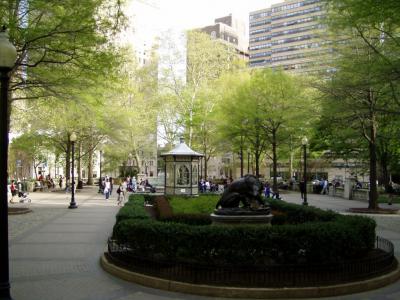
Right in the middle of Philadelphia’s most polished neighborhood—where glass towers loom and fashionably dressed locals pretend not to notice each other—Rittenhouse Square is a slice of greenery that refuses to be outshined. It’s been here since 1825, named after homegrown Revolutionary-era brainiac David Rittenhouse. The layout you see today, with its neat diagonal paths converging toward the center, took shape in 1913, along with many of the bronze statues that quietly observe everything… and judge a little.
But let’s be honest—history aside, a lot of people are here for a different reason: Rocky II. This is where Rocky and Adrian take that soft, slightly awkward stroll along the southeast corner after hearing they’re expecting a baby. It’s one of those rare moments where the Italian Stallion slows down—no punching, just feelings...
From there, they drift south toward 18th and Locust. If you’re feeling cinematic, keep an eye out for the Barclay Condominium—the stone-faced building behind Rocky and Adrian when they stop and face each other. Yes, that’s the one tied to the unforgettable line, “I never use ’em.” Back when the scene was filmed, it had a modest green awning; today, it’s traded that in for a much grander, upscale frontage, self-aware of its status.
And curiously enough, almost too on-the-nose: before the fame, before the running up steps, even before the punches—Sylvester Stallone actually lived right here in the late 1950s, at the Chateau Crillon Apartments. Not only that, in between filming of Rocky II and Rocky III, he stayed at the Barclay Hotel itself. So, yes, when Rocky walks through this square, he’s not just acting—he’s practically coming home...
But let’s be honest—history aside, a lot of people are here for a different reason: Rocky II. This is where Rocky and Adrian take that soft, slightly awkward stroll along the southeast corner after hearing they’re expecting a baby. It’s one of those rare moments where the Italian Stallion slows down—no punching, just feelings...
From there, they drift south toward 18th and Locust. If you’re feeling cinematic, keep an eye out for the Barclay Condominium—the stone-faced building behind Rocky and Adrian when they stop and face each other. Yes, that’s the one tied to the unforgettable line, “I never use ’em.” Back when the scene was filmed, it had a modest green awning; today, it’s traded that in for a much grander, upscale frontage, self-aware of its status.
And curiously enough, almost too on-the-nose: before the fame, before the running up steps, even before the punches—Sylvester Stallone actually lived right here in the late 1950s, at the Chateau Crillon Apartments. Not only that, in between filming of Rocky II and Rocky III, he stayed at the Barclay Hotel itself. So, yes, when Rocky walks through this square, he’s not just acting—he’s practically coming home...
3) South Street
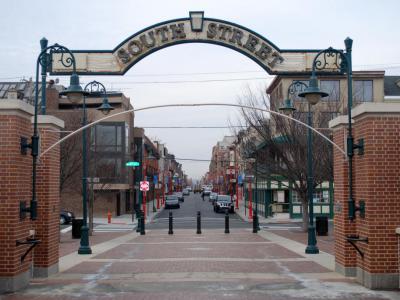
South Street in Philadelphia, a vibrant and historic east-west street, serves as a significant cultural and geographical landmark in the city. Originally called Cedar Street in William Penn's 1682 city plan, it marks the southern limit of Center City and the northern border of South Philadelphia. South Street is renowned for its unique blend of history, culture, and entertainment, making it one of the city's leading tourist attractions.
The area between Front and 7th streets, known as the South Street Headhouse District, is particularly notable for its eclectic and alternative vibe. This neighborhood is characterized by a mix of bohemian, punk, and alternative influences, reflected in its diverse array of shops, bars, and eateries. This distinct atmosphere has been shaped by the street's varied demographic history, which has included Swedish, Dutch, Irish, Jewish, Italian, and African-American communities.
South Street has a rich history in Philadelphia's entertainment scene. It was home to the first permanent theater in the United States due to Quaker opposition to live performances in the city, establishing its entertainment legacy. In the late 1950s and 1960s, South Street became a hotspot for artists, Beat, and counterculture movements like bohemianism and the hippie movement. It also had a vibrant local music scene with many clubs and bars, making it a lively hub for entertainment.
In 1976, Jim's Steaks, a famous cheesesteak restaurant from West Philadelphia, opened its first franchise on South Street, further cementing the street's reputation as a culinary destination.
Today, South Street remains a popular gathering spot, especially for younger crowds including teens, college students, and people in their twenties. The street offers a wide range of attractions, from bars and take-out eateries to unique shops catering to various urban subcultures, including hip hop and punk fashion. This vibrant mix of history, culture, and contemporary urban life continues to define South Street as a quintessential Philadelphia experience.
The area between Front and 7th streets, known as the South Street Headhouse District, is particularly notable for its eclectic and alternative vibe. This neighborhood is characterized by a mix of bohemian, punk, and alternative influences, reflected in its diverse array of shops, bars, and eateries. This distinct atmosphere has been shaped by the street's varied demographic history, which has included Swedish, Dutch, Irish, Jewish, Italian, and African-American communities.
South Street has a rich history in Philadelphia's entertainment scene. It was home to the first permanent theater in the United States due to Quaker opposition to live performances in the city, establishing its entertainment legacy. In the late 1950s and 1960s, South Street became a hotspot for artists, Beat, and counterculture movements like bohemianism and the hippie movement. It also had a vibrant local music scene with many clubs and bars, making it a lively hub for entertainment.
In 1976, Jim's Steaks, a famous cheesesteak restaurant from West Philadelphia, opened its first franchise on South Street, further cementing the street's reputation as a culinary destination.
Today, South Street remains a popular gathering spot, especially for younger crowds including teens, college students, and people in their twenties. The street offers a wide range of attractions, from bars and take-out eateries to unique shops catering to various urban subcultures, including hip hop and punk fashion. This vibrant mix of history, culture, and contemporary urban life continues to define South Street as a quintessential Philadelphia experience.
4) Independence Hall (must see)
By the late 1720s, Philadelphia realized it was running a colony with big decisions to make, but was lacking a proper stage to make them—so, naturally, it decided to build one.
Construction began in 1732 on Chestnut Street, guided by architect Edmund Woolley, and by 1753, the Colonial Government of Pennsylvania moved in without hesitation. For nearly half a century, this was where the business of the province—and later the commonwealth—was handled, until the capital duties packed up and moved on in 1799.
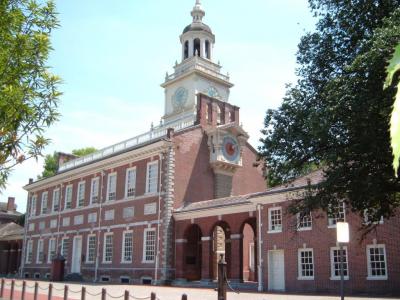
The building itself, now known as Independence Hall, keeps things elegantly symmetrical. Red brick, Georgian style, a central block crowned with a bell tower and a steeple rising 169 feet. Arcaded passageways link the main structure to its side wings, while nearby, Old City Hall, Congress Hall, and Philosophical Hall gather around Independence Square like a well-organized ensemble cast.
Inside, the layout is straightforward but loaded with history. The Assembly Room and Supreme Court Room sit on the ground floor, divided by a vestibule, with the Tower Stair Hall waiting just beyond the entrance. The interiors you see today are the result of careful restorations in the 19th and 20th centuries, all aimed at returning the building to its 18th-century look—because when your past includes founding a nation, you tend to preserve the décor...
And then, of course, came the moments. In June 1775, George Washington was appointed commander-in-chief of the Continental Army right here. A month later, Benjamin Franklin was named the first Postmaster General—arguably launching one of the longest-running institutions in American life. Between 1775 and 1783, this was the meeting place of the Second Continental Congress, where, on July 4, 1776, the Declaration of Independence was approved. Eleven years later, in 1787, the Constitution followed.
Since then, Independence Hall has remained more than just a historic building. It continues to serve as a backdrop for speeches, rallies, and protests—less a frozen monument, more an ongoing conversation about democracy, still very much in progress.
Construction began in 1732 on Chestnut Street, guided by architect Edmund Woolley, and by 1753, the Colonial Government of Pennsylvania moved in without hesitation. For nearly half a century, this was where the business of the province—and later the commonwealth—was handled, until the capital duties packed up and moved on in 1799.
The building itself, now known as Independence Hall, keeps things elegantly symmetrical. Red brick, Georgian style, a central block crowned with a bell tower and a steeple rising 169 feet. Arcaded passageways link the main structure to its side wings, while nearby, Old City Hall, Congress Hall, and Philosophical Hall gather around Independence Square like a well-organized ensemble cast.
Inside, the layout is straightforward but loaded with history. The Assembly Room and Supreme Court Room sit on the ground floor, divided by a vestibule, with the Tower Stair Hall waiting just beyond the entrance. The interiors you see today are the result of careful restorations in the 19th and 20th centuries, all aimed at returning the building to its 18th-century look—because when your past includes founding a nation, you tend to preserve the décor...
And then, of course, came the moments. In June 1775, George Washington was appointed commander-in-chief of the Continental Army right here. A month later, Benjamin Franklin was named the first Postmaster General—arguably launching one of the longest-running institutions in American life. Between 1775 and 1783, this was the meeting place of the Second Continental Congress, where, on July 4, 1776, the Declaration of Independence was approved. Eleven years later, in 1787, the Constitution followed.
Since then, Independence Hall has remained more than just a historic building. It continues to serve as a backdrop for speeches, rallies, and protests—less a frozen monument, more an ongoing conversation about democracy, still very much in progress.
5) Liberty Bell (must see)
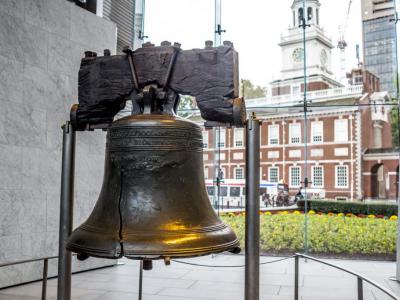
The Liberty Bell, an iconic symbol of American freedom and independence, has a rich and storied history closely tied to Philadelphia, Pennsylvania. Cast in 1752 by the Whitechapel Bell Foundry in London, England, the bell was originally commissioned to mark the 50th anniversary of Pennsylvania's original constitution and to symbolize the ideals of liberty and justice.
Initially hung in the Pennsylvania State House (now known as Independence Hall), the bell gained fame not only for its impressive size and sound but also for its role in important historical events. One popular but apocryphal story links the Liberty Bell to the reading of the Declaration of Independence on July 4, 1776, claiming that it rang out to announce the birth of the new nation. While there is no historical evidence to support this specific event, the bell did gain significance as a symbol of American independence in the ensuing decades.
The bell's inscription, "Proclaim LIBERTY Throughout all the Land unto all the Inhabitants Thereof," from the Bible, became its defining feature and a powerful statement in support of abolitionist movements in the 19th century. Its association with the abolitionist cause led to the bell being dubbed the "Liberty Bell" around the 1830s.
By the mid-19th century, as the bell's structural integrity deteriorated, it was retired from active service. In 1852, it was moved to a pavilion near Independence Hall where it became an object of public veneration. During World War II, the bell's iconic status was further solidified as it was used as a symbol of liberty and freedom, inspiring war bond drives and patriotic sentiment.
Today, the Liberty Bell is housed in the Liberty Bell Center, part of Independence National Historical Park in Philadelphia. It continues to attract millions of visitors each year who come to see and reflect upon its enduring message of liberty, justice, and the ongoing struggle for equality.
Initially hung in the Pennsylvania State House (now known as Independence Hall), the bell gained fame not only for its impressive size and sound but also for its role in important historical events. One popular but apocryphal story links the Liberty Bell to the reading of the Declaration of Independence on July 4, 1776, claiming that it rang out to announce the birth of the new nation. While there is no historical evidence to support this specific event, the bell did gain significance as a symbol of American independence in the ensuing decades.
The bell's inscription, "Proclaim LIBERTY Throughout all the Land unto all the Inhabitants Thereof," from the Bible, became its defining feature and a powerful statement in support of abolitionist movements in the 19th century. Its association with the abolitionist cause led to the bell being dubbed the "Liberty Bell" around the 1830s.
By the mid-19th century, as the bell's structural integrity deteriorated, it was retired from active service. In 1852, it was moved to a pavilion near Independence Hall where it became an object of public veneration. During World War II, the bell's iconic status was further solidified as it was used as a symbol of liberty and freedom, inspiring war bond drives and patriotic sentiment.
Today, the Liberty Bell is housed in the Liberty Bell Center, part of Independence National Historical Park in Philadelphia. It continues to attract millions of visitors each year who come to see and reflect upon its enduring message of liberty, justice, and the ongoing struggle for equality.
6) Christ Church (must see)
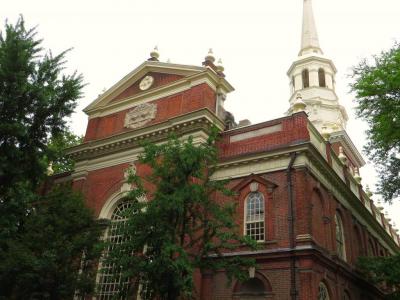
Christ Church in Philadelphia dates back to 1695, when the Church of England set up shop in what was still very much a growing colonial town. Within a year, they had a wooden building up—but clearly, that didn’t hold the crowd for long. By the 1720s, they replaced it with something far more ambitious, creating what was considered one of the most elegant churches in the Thirteen Colonies.
The new parish became known as the “Nation’s Church,” and for good reason. Fifteen signers of the Declaration of Independence were part of this congregation. Names like George Washington, Benjamin Franklin, Robert Morris, and Betsy Ross all passed through these doors. If you’re wondering where they sat, you’re in luck—this place keeps receipts. Brass plaques mark their pews: Washington in #56, Franklin in #70, Betsy Ross in #12. No guessing required.
Architecturally, the church is themed around Georgian style, with a clear nod to Christopher Wren’s London designs—all that symmetry, tall arched windows, and a clean, orderly interior with fluted columns and rows of wooden pews. And instead of dramatic stained glass, you get clear windows—meaning plenty of natural light and a direct connection to the outside world. Revolutionary thinking, in more ways than one...
Construction stretched from 1727 to 1744, with the steeple added in 1754. At that point, it was the tallest building in what would become the United States, holding that title for over fifty years. Not bad for a church... Along the way, it saw changes, including a rebuild in 1777 and interior updates in 1883, but its overall character has held steady.
Step outside into the churchyard, and you’ll find the graves of Robert Morris and James Wilson, both signers of the Declaration of Independence. Today, Christ Church is still an active Episcopal parish and a National Historic Landmark, welcoming more than 250,000 visitors each year—so you won’t be the only one curious about who sat where...
And before you leave, take a moment to look at the artifacts. There’s a 14th-century baptismal font used for William Penn, the founder of Pennsylvania. Add in a rare book collection and communion pieces from the 1790s, and you start to realize: this place doesn’t just tell history—it quietly keeps it on display.
The new parish became known as the “Nation’s Church,” and for good reason. Fifteen signers of the Declaration of Independence were part of this congregation. Names like George Washington, Benjamin Franklin, Robert Morris, and Betsy Ross all passed through these doors. If you’re wondering where they sat, you’re in luck—this place keeps receipts. Brass plaques mark their pews: Washington in #56, Franklin in #70, Betsy Ross in #12. No guessing required.
Architecturally, the church is themed around Georgian style, with a clear nod to Christopher Wren’s London designs—all that symmetry, tall arched windows, and a clean, orderly interior with fluted columns and rows of wooden pews. And instead of dramatic stained glass, you get clear windows—meaning plenty of natural light and a direct connection to the outside world. Revolutionary thinking, in more ways than one...
Construction stretched from 1727 to 1744, with the steeple added in 1754. At that point, it was the tallest building in what would become the United States, holding that title for over fifty years. Not bad for a church... Along the way, it saw changes, including a rebuild in 1777 and interior updates in 1883, but its overall character has held steady.
Step outside into the churchyard, and you’ll find the graves of Robert Morris and James Wilson, both signers of the Declaration of Independence. Today, Christ Church is still an active Episcopal parish and a National Historic Landmark, welcoming more than 250,000 visitors each year—so you won’t be the only one curious about who sat where...
And before you leave, take a moment to look at the artifacts. There’s a 14th-century baptismal font used for William Penn, the founder of Pennsylvania. Add in a rare book collection and communion pieces from the 1790s, and you start to realize: this place doesn’t just tell history—it quietly keeps it on display.
7) Elfreth's Alley (must see)
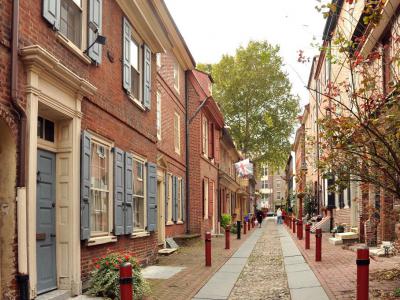
In the 18th century, Philadelphia became a bustling city, overcrowded with artisans, tradesmen, shipwrights, metalsmiths, glassblowers, and furniture makers. As a result, the landowners Arthur Wells and John Gilbert started a cart path from Front Street to Second Street in 1703. The path became Elfreth's Alley, named after Jeremiah Elfreth, an 18th-century blacksmith and a man of property in young Philadelphia.
By the 1770s Georgian and Federal-style houses lined the cobblestone Alley. Many of the structures were uniquely Philadelphian Trinity houses. These were three-story houses, exceptionally narrow, with one room on each floor. The floors were referred to as "Father, Son, and Holy Ghost." And that is how Trinity houses got their name.
In the 19th and 20th centuries, the industry started to close in on the Alley. A stove factory took its place in a row of residential houses. Immigrants, hoping for jobs, came in waves. In 1934 the Elfreth's Alley Association (EAA) was founded by Alley resident Dolly Ottey. Ottey fought to combat the deterioration of the Alley by encroaching industry in the early 20th century.
Elfreth's Alley Museum is located in houses 124 and 126. The museum preserves the home of 18th-century dressmakers. Tour guides discuss other homes and inhabitants of the Alley. On "Fete Day" in early June, which celebrates Alley's diverse ethnic heritage, the residents open their homes. There are historical reenactments with drum and fife bands. The Alley also host events for the 4th of July, Oktoberfestivities, and Halloween.
By the 1770s Georgian and Federal-style houses lined the cobblestone Alley. Many of the structures were uniquely Philadelphian Trinity houses. These were three-story houses, exceptionally narrow, with one room on each floor. The floors were referred to as "Father, Son, and Holy Ghost." And that is how Trinity houses got their name.
In the 19th and 20th centuries, the industry started to close in on the Alley. A stove factory took its place in a row of residential houses. Immigrants, hoping for jobs, came in waves. In 1934 the Elfreth's Alley Association (EAA) was founded by Alley resident Dolly Ottey. Ottey fought to combat the deterioration of the Alley by encroaching industry in the early 20th century.
Elfreth's Alley Museum is located in houses 124 and 126. The museum preserves the home of 18th-century dressmakers. Tour guides discuss other homes and inhabitants of the Alley. On "Fete Day" in early June, which celebrates Alley's diverse ethnic heritage, the residents open their homes. There are historical reenactments with drum and fife bands. The Alley also host events for the 4th of July, Oktoberfestivities, and Halloween.
8) Independence National Historical Park (must see)
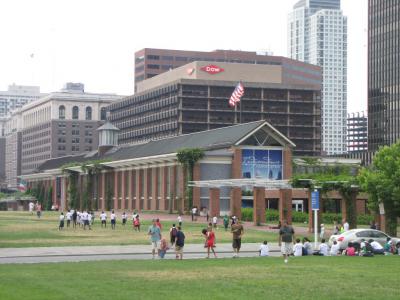
Independence National Historical Park in Philadelphia has been called "America's most historic square mile." Administered by the National Park Service, the 55 landscaped acres hold several often-visited historic sites within the Old City and Society Hill neighborhoods.
The heart of the Park is Independence Hall, the former Old State House of Philadelphia. This is where the Declaration of Independence and the Constitution of the United States were adopted. The first Continental Congress met in 1774 in Carpenters' Hall next door to Independence Hall, the home of the Second Continental Congress.
The Liberty Bell hangs in the Liberty Bell Center across from Independence Hall. The First Bank of the United States is in the Park. The Second Bank of the United States was closed down by President Andrew Jackson. Nearby is the City Tavern, a refuge of delegates and John Adams' favorite hangout.
The Park houses Franklin Court Museum dedicated to Benjamin Franklin. Another park resident is the United States Postal Service Museum. The three blocks immediately north of Independence Hall is Independence Mall. Besides the Liberty Bell Center, the Mall holds the National Constitution Center and George Washington's residence in his second term.
The first proposal for Independence National Historical Park was floated in 1915. Architects Albert Kelsey and David K. Boyd were driven to create a more sylvan locale for Independence Hall. The action was not taken until June 1948, when Congress authorized the creation of the Park. The Park is listed on the National Register of Historic Places.
The heart of the Park is Independence Hall, the former Old State House of Philadelphia. This is where the Declaration of Independence and the Constitution of the United States were adopted. The first Continental Congress met in 1774 in Carpenters' Hall next door to Independence Hall, the home of the Second Continental Congress.
The Liberty Bell hangs in the Liberty Bell Center across from Independence Hall. The First Bank of the United States is in the Park. The Second Bank of the United States was closed down by President Andrew Jackson. Nearby is the City Tavern, a refuge of delegates and John Adams' favorite hangout.
The Park houses Franklin Court Museum dedicated to Benjamin Franklin. Another park resident is the United States Postal Service Museum. The three blocks immediately north of Independence Hall is Independence Mall. Besides the Liberty Bell Center, the Mall holds the National Constitution Center and George Washington's residence in his second term.
The first proposal for Independence National Historical Park was floated in 1915. Architects Albert Kelsey and David K. Boyd were driven to create a more sylvan locale for Independence Hall. The action was not taken until June 1948, when Congress authorized the creation of the Park. The Park is listed on the National Register of Historic Places.
