Custom Walk in Miami, Florida by msmith52002_fe82e created on 2026-01-22
Guide Location: USA » Miami
Guide Type: Custom Walk
# of Sights: 9
Tour Duration: 3 Hour(s)
Travel Distance: 5.3 Km or 3.3 Miles
Share Key: SFMLP
Guide Type: Custom Walk
# of Sights: 9
Tour Duration: 3 Hour(s)
Travel Distance: 5.3 Km or 3.3 Miles
Share Key: SFMLP
How It Works
Please retrieve this walk in the GPSmyCity app. Once done, the app will guide you from one tour stop to the next as if you had a personal tour guide. If you created the walk on this website or come to the page via a link, please follow the instructions below to retrieve the walk in the app.
Retrieve This Walk in App
Step 1. Download the app "GPSmyCity: Walks in 1K+ Cities" on Apple App Store or Google Play Store.



Step 2. In the GPSmyCity app, download(or launch) the guide "Miami Map and Walking Tours".
Step 3. Tap the menu button located at upper right corner of the "Walks" screen and select "Retrieve custom walk". Enter the share key: SFMLP
1) Miami Riverwalk
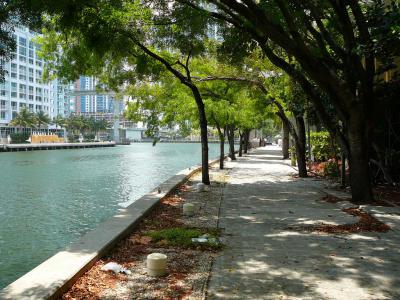
The Miami Riverwalk is where downtown Miami trades its rush for rhythm. Stretching from Bayfront Park to U.S. Highway 41, this waterfront promenade gives you the best of both worlds — the glimmer of Biscayne Bay on the one side and the buzz of the city on the other. Think of it as Miami’s open-air runway, where boats, joggers, and seagulls all share the spotlight...
The view is a never-ending parade of yachts gliding down the river, especially on weekends when everyone seems to be showing off their latest floating toy. But the real charm of the Riverwalk isn’t just on the water — it’s the lively artwork, sculptures, and city scenes that line your path.
As you start from Bayfront Park, look up and you’ll spot the Skyviews Miami Observation Wheel spinning lazily against the skyline. Strolling further, you will pass the Liberty Column and the Seafair Mega Yacht, each demanding its own Instagram moment. During the day, the Riverwalk is calm and sunlit; by night, the reflections of downtown’s lights shimmer on the water like a neon dreamscape.
If you visit in November, don’t miss the Miami Riverwalk Festival — a free, multicultural celebration filled with live music, a children’s fair, food competitions, and a festive boat parade. Whether you’re chasing views, vibes, or vitamin D, the Riverwalk proves there’s no wrong way to walk Miami...
The view is a never-ending parade of yachts gliding down the river, especially on weekends when everyone seems to be showing off their latest floating toy. But the real charm of the Riverwalk isn’t just on the water — it’s the lively artwork, sculptures, and city scenes that line your path.
As you start from Bayfront Park, look up and you’ll spot the Skyviews Miami Observation Wheel spinning lazily against the skyline. Strolling further, you will pass the Liberty Column and the Seafair Mega Yacht, each demanding its own Instagram moment. During the day, the Riverwalk is calm and sunlit; by night, the reflections of downtown’s lights shimmer on the water like a neon dreamscape.
If you visit in November, don’t miss the Miami Riverwalk Festival — a free, multicultural celebration filled with live music, a children’s fair, food competitions, and a festive boat parade. Whether you’re chasing views, vibes, or vitamin D, the Riverwalk proves there’s no wrong way to walk Miami...
2) Bayfront Park (must see)
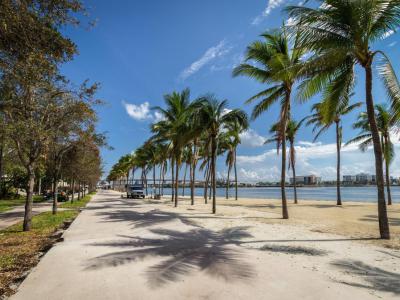
If Downtown Miami had a living room, it would probably be Bayfront Park — 32 acres of breezy, green calm sandwiched between the financial district and the glinting waters of Biscayne Bay. On the one side, you’ve got skyscrapers doing their best to look serious; on the other, the bay, shimmering like it’s posing for postcards.
Its story began in 1925, when the city snagged a stretch of waterfront from the Florida East Coast Railway with a firm intention “to make it pretty.” Landscape architect Warren Henry Manning gave it its first form, which was then enhanced with the artistic glow-up in 1980, thanks to Isamu Noguchi — the Japanese American modernist whose sculptural touch turned ordinary lawns into artful geometry.
But Bayfront isn’t just about sunshine and serenity. It is also the site of one of the most shocking moments in Miami’s history: the 1933 assassination of Chicago Mayor Anton Cermak. The Mayor was shaking hands with the then President-elect Franklin Delano Roosevelt right here when the assassin Giuseppe Zangara fired his shot. Cermak was fatally wounded, and historians still argue over whether Roosevelt was the real target. Dark chapter, bright city...
These days, Bayfront Park has traded gunfire for fireworks. This is where Miami throws some of its biggest parties — from Independence Day celebrations to the city’s official New Year’s Eve bash. Managed by the Bayfront Park Management Trust, the place hums with concerts, yoga classes, festivals, and whatever else Miami decides to celebrate that week.
Indeed, there’s something magnetic about standing at the edge of the bay here, feeling the wind off the water, and watching the skyline glow. Live music from the amphitheater spills through the park, laughter drifts from the crowd, and for a moment, even the financial towers seem to relax.
Oh, and before you go, make sure to check the park’s schedule — there’s always something happening, and it’s almost always worth sticking around for...
Its story began in 1925, when the city snagged a stretch of waterfront from the Florida East Coast Railway with a firm intention “to make it pretty.” Landscape architect Warren Henry Manning gave it its first form, which was then enhanced with the artistic glow-up in 1980, thanks to Isamu Noguchi — the Japanese American modernist whose sculptural touch turned ordinary lawns into artful geometry.
But Bayfront isn’t just about sunshine and serenity. It is also the site of one of the most shocking moments in Miami’s history: the 1933 assassination of Chicago Mayor Anton Cermak. The Mayor was shaking hands with the then President-elect Franklin Delano Roosevelt right here when the assassin Giuseppe Zangara fired his shot. Cermak was fatally wounded, and historians still argue over whether Roosevelt was the real target. Dark chapter, bright city...
These days, Bayfront Park has traded gunfire for fireworks. This is where Miami throws some of its biggest parties — from Independence Day celebrations to the city’s official New Year’s Eve bash. Managed by the Bayfront Park Management Trust, the place hums with concerts, yoga classes, festivals, and whatever else Miami decides to celebrate that week.
Indeed, there’s something magnetic about standing at the edge of the bay here, feeling the wind off the water, and watching the skyline glow. Live music from the amphitheater spills through the park, laughter drifts from the crowd, and for a moment, even the financial towers seem to relax.
Oh, and before you go, make sure to check the park’s schedule — there’s always something happening, and it’s almost always worth sticking around for...
3) Torch of Friendship
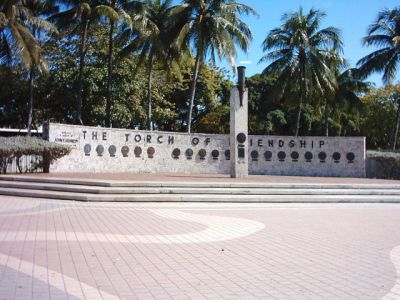
The Torch was installed by the City of Miami to signify the city’s status as the gateway to the Caribbean. The inscription on the monument reads, “The Torch of Friendship dedicated by the City of Miami to the everlasting friendship of our neighboring countries.” It has a gas-fired torch installed at the top of an 18-foot pedestal with an everlasting flame that was meant to be a welcoming beacon for visitors and immigrants.
The Torch of Friendship was rededicated four years after its installation to the memory of the assassinated President John F. Kennedy. The burning candle was regarded as an extension of the candle that burns at Kennedy's gravesite in Arlington.
Today, the candle has stopped burning. Some believe that it was a deliberate act, while others reckon that the gas pipe supplying the fuel must have been damaged. In recent years, the Torch of Friendship Monument has become a venue for gatherings, commemorations, and peaceful protests against national and international injustices.
The Torch of Friendship was rededicated four years after its installation to the memory of the assassinated President John F. Kennedy. The burning candle was regarded as an extension of the candle that burns at Kennedy's gravesite in Arlington.
Today, the candle has stopped burning. Some believe that it was a deliberate act, while others reckon that the gas pipe supplying the fuel must have been damaged. In recent years, the Torch of Friendship Monument has become a venue for gatherings, commemorations, and peaceful protests against national and international injustices.
4) Bayside Marketplace (must see)
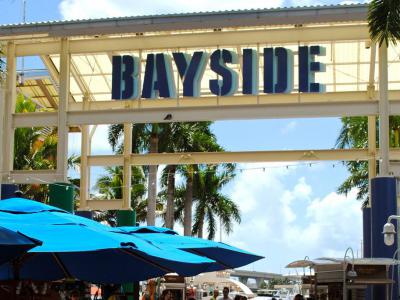
Now that you're acquainted with the Freedom Tower (a former newspaper headquarters turned a lifeline for Cuban refugees fleeing Fidel Castro’s communist rule), slide over to the waterfront and cue the music. You’re at Bayside Marketplace, Miami’s open-air celebration of food, shopping, and rhythm! Sandwiched neatly between Bayfront Park and the Kaseya Center (you might still know it as the American Airlines Arena), Bayside wraps around Biscayne Bay like a tropical bracelet — glittering, colorful, and just a little bit extravagant.
When opened in 1987 (during one of Miami’s real estate booms), Bayside wasn’t designed to fix the city — it was built to amplify it. Think 150 shops — everything from local treasures to big names like Guess and Victoria’s Secret, plus a dozen restaurants that make choosing where to eat a delicious problem. Bubba Gump Shrimp Co., Hard Rock Café, The Knife — all waiting to tempt your taste buds amid the boats gliding past the docks...
If you’re feeling déjà vu, that’s because Bayside has made multiple cameos on Miami Vice (a crime drama TV series, starring Don Johnson) — with pastel suits, fast cars, and all that stuff... And it’s still the city’s most popular attraction, drawing some 15 million visitors per year. Some come for the sunshine, some for their mojitos, and some maybe for the evening with a dance to some live Latino beats...
You, too, are just as welcome to join in, if restaurants with waterfront views, boat cruises chasing sunsets, and street performers who never run out of energy sound like your kind of fun. Day or night, Bayside hums with the kind of spirit that defines Miami — vibrant, spontaneous, and always ready for a party!
When opened in 1987 (during one of Miami’s real estate booms), Bayside wasn’t designed to fix the city — it was built to amplify it. Think 150 shops — everything from local treasures to big names like Guess and Victoria’s Secret, plus a dozen restaurants that make choosing where to eat a delicious problem. Bubba Gump Shrimp Co., Hard Rock Café, The Knife — all waiting to tempt your taste buds amid the boats gliding past the docks...
If you’re feeling déjà vu, that’s because Bayside has made multiple cameos on Miami Vice (a crime drama TV series, starring Don Johnson) — with pastel suits, fast cars, and all that stuff... And it’s still the city’s most popular attraction, drawing some 15 million visitors per year. Some come for the sunshine, some for their mojitos, and some maybe for the evening with a dance to some live Latino beats...
You, too, are just as welcome to join in, if restaurants with waterfront views, boat cruises chasing sunsets, and street performers who never run out of energy sound like your kind of fun. Day or night, Bayside hums with the kind of spirit that defines Miami — vibrant, spontaneous, and always ready for a party!
5) American Airlines Arena
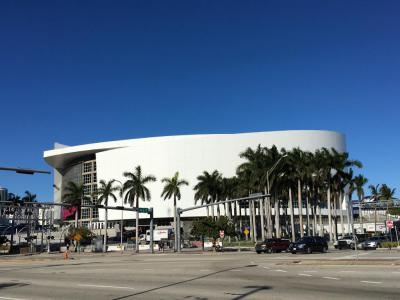
KKnown locally as the "triple-A" or "A³" (A cubed), The American Airlines Arena is a popular sport and entertainment venue located in Downtown Miami alongside Biscayne Bay. The arena was constructed in 1998 and was intended to replace the Miami Arena, serving as a home to the Miami Heat of the National Basketball Association.
The venue can be configured for concerts, family events, musical theater, and other stage performances. Housed within the AAA Waterfront Theater is Florida's largest theater, capable of seating between 3,000 and 5,800 spectators at a time. For concerts in an arena configuration, its end-stage capacity can vary between 12,202 for 180° shows and 18,309 for 360° shows. For center-stage concerts the arena can seat up to more than 19,000 viewers.
Over the years, the AAA has seen the likes of international performers such as Mariah Carey, Cher, Britney Spears, U2, Shakira, Tina Turner, Celine Dion, Lady Gaga, Jennifer Lopez, Madonna, Katy Perry, Janet Jackson, Rihanna, and Adele.
Among many other things, the arena is known for its unusual scoreboard designed by artist Christopher Janney. Drawing on the underwater anemone forms, this scoreboard can change colors depending on the atmosphere.
The venue can be configured for concerts, family events, musical theater, and other stage performances. Housed within the AAA Waterfront Theater is Florida's largest theater, capable of seating between 3,000 and 5,800 spectators at a time. For concerts in an arena configuration, its end-stage capacity can vary between 12,202 for 180° shows and 18,309 for 360° shows. For center-stage concerts the arena can seat up to more than 19,000 viewers.
Over the years, the AAA has seen the likes of international performers such as Mariah Carey, Cher, Britney Spears, U2, Shakira, Tina Turner, Celine Dion, Lady Gaga, Jennifer Lopez, Madonna, Katy Perry, Janet Jackson, Rihanna, and Adele.
Among many other things, the arena is known for its unusual scoreboard designed by artist Christopher Janney. Drawing on the underwater anemone forms, this scoreboard can change colors depending on the atmosphere.
Sight description based on Wikipedia.
6) Freedom Tower
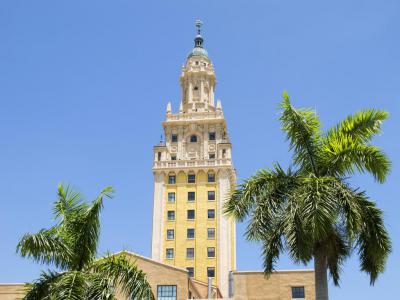
Back in 1925, Miami felt like it needed a little Mediterranean flair. And so, rising proudly over Biscayne Boulevard (just as if Seville’s Giralda Tower took a tropical vacation) appeared the Freedom Tower—full of arches, columns, and drama. At 78 meters tall, with a cupola once crowned by a glowing beacon, it wasn’t just stylish; it was a statement. Inside, this 17-story structure housed The Miami News, a major local newspaper, busy rolling out headlines, ink-stained and unstoppable...
Then came 1957. The presses went quiet, the journalists moved out, and a new story began — one of survival, courage, and hope. During the 1960s, the U.S. government used the building as a processing center for Cuban refugees fleeing Fidel Castro’s regime. Thousands arrived, carrying little more than memories and faith that life on this side of the water might just be freer.
It didn’t take long for people to start calling it the “Ellis Island of the South” (analogy with the Ellis Island in New York, once the busiest immigrant station in the United States). Similarly to the Statue of Liberty, The Freedom Tower stood tall — a golden-yellow lighthouse of second chances and the American Dream, shining for those who had lost almost everything except hope of a new life under the Miami sun.
Decades later, businessman Jorge Mas Canosa bought the building and turned it into a monument to that journey — complete with a museum, library, and convention spaces dedicated to the Cuban exile experience.
Today, its story continues under Miami Dade College’s care. The tower still looks as grand as ever, serving as a cultural and educational hub. Plans are underway for permanent exhibits about The Miami News and its refugee-era history — proof that this tower has always known how to tell a powerful story, no printing press needed...
Then came 1957. The presses went quiet, the journalists moved out, and a new story began — one of survival, courage, and hope. During the 1960s, the U.S. government used the building as a processing center for Cuban refugees fleeing Fidel Castro’s regime. Thousands arrived, carrying little more than memories and faith that life on this side of the water might just be freer.
It didn’t take long for people to start calling it the “Ellis Island of the South” (analogy with the Ellis Island in New York, once the busiest immigrant station in the United States). Similarly to the Statue of Liberty, The Freedom Tower stood tall — a golden-yellow lighthouse of second chances and the American Dream, shining for those who had lost almost everything except hope of a new life under the Miami sun.
Decades later, businessman Jorge Mas Canosa bought the building and turned it into a monument to that journey — complete with a museum, library, and convention spaces dedicated to the Cuban exile experience.
Today, its story continues under Miami Dade College’s care. The tower still looks as grand as ever, serving as a cultural and educational hub. Plans are underway for permanent exhibits about The Miami News and its refugee-era history — proof that this tower has always known how to tell a powerful story, no printing press needed...
7) Gesu Catholic Church
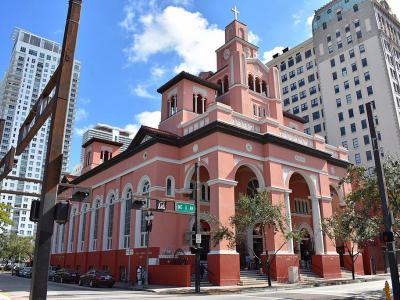
The Gesu Catholic church is the oldest church in Miami. It was first established by a pioneer and landowning couple, William and Evelyn Wagner, in 1872. The full name of the church is The Holy Name of Jesus Catholic Church but it is popularly called “Gesu” which is the Italian name for Jesus.
The Gesu Church relocated to its present site in 1896 on the land donated by Henry Flagler, a Presbyterian landowner. As the congregation outgrew the building, the more spacious structure was erected in 1925. The present church has the capacity of seating 800 parishioners. The altars are made of Italian marble and the temple has polychrome crystal leaded windows brought from Germany, portraying events in the life of Jesus and Mary. In 1974, the building was included in the National Register of Historic Places.
The Gesu Catholic Church has an elementary school run by Jesuits, established in 1961. On the site it has a canteen dining room that serves meals for the elderly through the week. The priests visit and offer their services to the sick in hospitals and convalescent homes. Throughout history, the church has welcomed members of the armed forces and refugees, particularly those who fled the communist regime in Cuba and refugees from Haiti.
The interior of the temple features intricate mosaics depicting the Six Days of Creation, the Hosts of Heaven, and the Stations of the Cross. The stained glass windows portray scenes from the life of Jesus and several scenes from the Old Testament.
The Gesu Church relocated to its present site in 1896 on the land donated by Henry Flagler, a Presbyterian landowner. As the congregation outgrew the building, the more spacious structure was erected in 1925. The present church has the capacity of seating 800 parishioners. The altars are made of Italian marble and the temple has polychrome crystal leaded windows brought from Germany, portraying events in the life of Jesus and Mary. In 1974, the building was included in the National Register of Historic Places.
The Gesu Catholic Church has an elementary school run by Jesuits, established in 1961. On the site it has a canteen dining room that serves meals for the elderly through the week. The priests visit and offer their services to the sick in hospitals and convalescent homes. Throughout history, the church has welcomed members of the armed forces and refugees, particularly those who fled the communist regime in Cuba and refugees from Haiti.
The interior of the temple features intricate mosaics depicting the Six Days of Creation, the Hosts of Heaven, and the Stations of the Cross. The stained glass windows portray scenes from the life of Jesus and several scenes from the Old Testament.
8) Olympia Theater
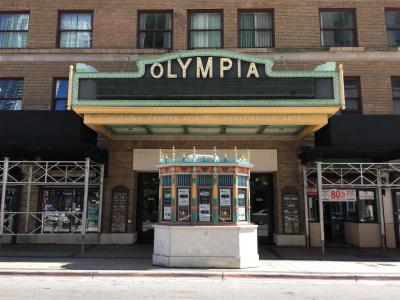
The Olympia Theater began in 1927 as a venue where silent movies were screened. It was designed by well-known theater architect, John Eberson, with Moorish style exteriors and atmospheric interior design featuring red velvet seating, Moorish-inspired hand-painted moldings and arches throughout. The building was also known for its perfect acoustics, simulated night sky ceiling with drifting clouds and twinkling stars, and as the first air-conditioned theater in the South.
Eventually, talking films and Vaudeville shows became major part of the Olympia program, and it was one of the last theaters to stage Vaudeville performances in the U.S.
In the 1970s, the building suffered neglect until the local tycoon, Maurice Gusman, saved it, along with the adjacent office buildings, from deterioration. He gave the renovated complex to the city of Miami which then named it after Gusman in gratitude. The building underwent restoration and structural stabilization work prior to reopening as a modern and structurally safe theater.
In addition to some of the best-known Vaudeville artists, Olympia Theater has hosted some of the world's best-known performers, such as Elvis Presley, Luciano Pavarotti and B.B. King.
Why You Should Visit:
Hidden gem of a theater in the heart of downtown Miami dating back 100 years. Exquisite architecture and elegant decor inside and outside the auditorium. Well worth stopping and catching a concert or movie, if visiting Miami, for a little piece of local history! Highly recommended!
Eventually, talking films and Vaudeville shows became major part of the Olympia program, and it was one of the last theaters to stage Vaudeville performances in the U.S.
In the 1970s, the building suffered neglect until the local tycoon, Maurice Gusman, saved it, along with the adjacent office buildings, from deterioration. He gave the renovated complex to the city of Miami which then named it after Gusman in gratitude. The building underwent restoration and structural stabilization work prior to reopening as a modern and structurally safe theater.
In addition to some of the best-known Vaudeville artists, Olympia Theater has hosted some of the world's best-known performers, such as Elvis Presley, Luciano Pavarotti and B.B. King.
Why You Should Visit:
Hidden gem of a theater in the heart of downtown Miami dating back 100 years. Exquisite architecture and elegant decor inside and outside the auditorium. Well worth stopping and catching a concert or movie, if visiting Miami, for a little piece of local history! Highly recommended!
9) Mary Brickell Village
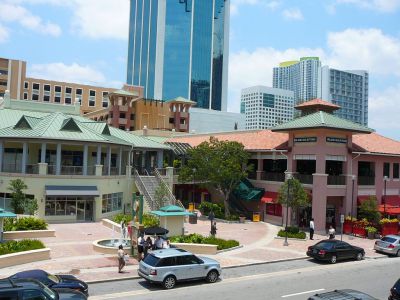
You’re in the middle of downtown Miami, but somehow, it feels like a resort... Welcome to Mary Brickell Village! — Part shopping center, part social playground, and 100% Miami style. Built in 2006, this 200,000-square-foot open-air haven sits at the heart of the Brickell neighborhood, where the locals come to sip, shop, and be seen...
Here, the options are as varied as the crowd. In one stroll, you might pass Face Brow and Beauty Bar, Plump Cosmetics and Injectables, or the fragrant hum of The Village Humidor Cigar Shop. If you need a tune-up for body or mind, Massage Envy and Total Nutrition have you covered. It’s like a self-care festival — just with better lighting and background music...
And then there’s the food scene, which runs from grab-and-go to glam. Craving something classic? Subway’s got your sandwich fix. Coffee addicts will find their happy place at Starbucks, while Shake Shack offers its signature shakes with a side of people-watching. When the sun dips, Blue Martini pours the cocktails, and Toscano Divino turns up the sophistication with fine Italian dining that feels straight out of Florence — if Florence had palm trees and Miami heat...
Open from ten in the morning to nine at night, Mary Brickell Village stays lively but never rushed. Between the bubbling fountains, open-air walkways, and ping-pong tables waiting for a friendly match, it’s the kind of place where you can pause the city’s chaos without ever leaving it.
So, go ahead — play, eat, shop, and repeat. At Mary Brickell Village, the city slows down just enough for you to catch your breath… and maybe another cocktail...
Here, the options are as varied as the crowd. In one stroll, you might pass Face Brow and Beauty Bar, Plump Cosmetics and Injectables, or the fragrant hum of The Village Humidor Cigar Shop. If you need a tune-up for body or mind, Massage Envy and Total Nutrition have you covered. It’s like a self-care festival — just with better lighting and background music...
And then there’s the food scene, which runs from grab-and-go to glam. Craving something classic? Subway’s got your sandwich fix. Coffee addicts will find their happy place at Starbucks, while Shake Shack offers its signature shakes with a side of people-watching. When the sun dips, Blue Martini pours the cocktails, and Toscano Divino turns up the sophistication with fine Italian dining that feels straight out of Florence — if Florence had palm trees and Miami heat...
Open from ten in the morning to nine at night, Mary Brickell Village stays lively but never rushed. Between the bubbling fountains, open-air walkways, and ping-pong tables waiting for a friendly match, it’s the kind of place where you can pause the city’s chaos without ever leaving it.
So, go ahead — play, eat, shop, and repeat. At Mary Brickell Village, the city slows down just enough for you to catch your breath… and maybe another cocktail...
