Custom Walk in Verona, Italy by sarah_james_comms_a47a4a created on 2026-03-02
Guide Location: Italy » Verona
Guide Type: Custom Walk
# of Sights: 13
Tour Duration: 2 Hour(s)
Travel Distance: 2.9 Km or 1.8 Miles
Share Key: 29VF8
Guide Type: Custom Walk
# of Sights: 13
Tour Duration: 2 Hour(s)
Travel Distance: 2.9 Km or 1.8 Miles
Share Key: 29VF8
How It Works
Please retrieve this walk in the GPSmyCity app. Once done, the app will guide you from one tour stop to the next as if you had a personal tour guide. If you created the walk on this website or come to the page via a link, please follow the instructions below to retrieve the walk in the app.
Retrieve This Walk in App
Step 1. Download the app "GPSmyCity: Walks in 1K+ Cities" on Apple App Store or Google Play Store.



Step 2. In the GPSmyCity app, download(or launch) the guide "Verona Map and Walking Tours".
Step 3. Tap the menu button located at upper right corner of the "Walks" screen and select "Retrieve custom walk". Enter the share key: 29VF8
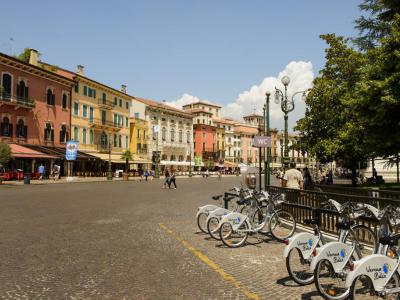
1) Piazza Bra (Bra Square) (must see)
Bra Square, often simply called “La Bra”, is the largest and most prominent square in Verona. Positioned at the edge of the historic center, it acts as a welcoming entrance to the city’s most celebrated landmarks. Its name derives from the Lombard word braida, meaning “wide open space”, a reminder of when this area lay just beyond the Roman city walls, used as an open field for markets and gatherings.
The square began to develop its current shape in the Middle Ages, as Verona expanded outward from the ancient core. Over the centuries, noble families and city authorities commissioned grand residences and civic buildings around the perimeter. By the 17th and 18th centuries, the area had transformed into an elegant public space, reflecting influences from Palladian and later Neoclassical styles. It has hosted everything from military parades to community celebrations and remains one of the busiest civic squares in northern Italy.
The dominant feature of the square is the Verona Arena, a 1st-century Roman amphitheater renowned for its impressive state of preservation and exceptional acoustics. Nearby stands Barbieri Palace, Verona’s neoclassical City Hall, completed in the mid-19th century, and Gran Guardia Palace, a large 17th-century building that now serves as a venue for major exhibitions and cultural events.
Visitors can stroll along the Liston, the marble-paved walkway lined with cafés and restaurants - a popular place to sit outdoors and enjoy the atmosphere. On the southern side, small green gardens provide shaded seating and feature monuments such as the Bersaglieri Monument, dedicated to Italy’s historic light infantry regiment. Traces of the ancient Roman walls and later fortifications remain are also visible.
The square began to develop its current shape in the Middle Ages, as Verona expanded outward from the ancient core. Over the centuries, noble families and city authorities commissioned grand residences and civic buildings around the perimeter. By the 17th and 18th centuries, the area had transformed into an elegant public space, reflecting influences from Palladian and later Neoclassical styles. It has hosted everything from military parades to community celebrations and remains one of the busiest civic squares in northern Italy.
The dominant feature of the square is the Verona Arena, a 1st-century Roman amphitheater renowned for its impressive state of preservation and exceptional acoustics. Nearby stands Barbieri Palace, Verona’s neoclassical City Hall, completed in the mid-19th century, and Gran Guardia Palace, a large 17th-century building that now serves as a venue for major exhibitions and cultural events.
Visitors can stroll along the Liston, the marble-paved walkway lined with cafés and restaurants - a popular place to sit outdoors and enjoy the atmosphere. On the southern side, small green gardens provide shaded seating and feature monuments such as the Bersaglieri Monument, dedicated to Italy’s historic light infantry regiment. Traces of the ancient Roman walls and later fortifications remain are also visible.

2) I Portoni della Bra
The Portoni della Bra is an entryway situated alongside the Verona city walls, originally built to connect the city with what was then the outskirts of the countryside.
In a historical document from 1257, the existence of a Braida gate is first documented. This gate was situated in the same area where the current Portoni della Bra now stands. It featured a small secondary door (known as a "pusterla") on one side and opened up along the town walls, outside of which flowed the Adigetto River. During the period of Visconti rule in Verona (1389-1402), a covered passage was established, beginning at Castelvecchio and extending to connect with the fortified citadel. This passage traversed the road that led out of the city, passing through the arch.
The Portoni della Bra consists of two arches with rounded tops, adorned with battlements that resemble dovetails at the apex. In the space between these arches, a clock was installed in the year 1872. The construction materials employed include Veronese marble for the lower section and brick for the upper part, corresponding to both the covered walkway and the battlement features. Positioned to the right of the gateway is the Pentagona tower, a crenellated defensive tower dating back to the municipal era.
In a historical document from 1257, the existence of a Braida gate is first documented. This gate was situated in the same area where the current Portoni della Bra now stands. It featured a small secondary door (known as a "pusterla") on one side and opened up along the town walls, outside of which flowed the Adigetto River. During the period of Visconti rule in Verona (1389-1402), a covered passage was established, beginning at Castelvecchio and extending to connect with the fortified citadel. This passage traversed the road that led out of the city, passing through the arch.
The Portoni della Bra consists of two arches with rounded tops, adorned with battlements that resemble dovetails at the apex. In the space between these arches, a clock was installed in the year 1872. The construction materials employed include Veronese marble for the lower section and brick for the upper part, corresponding to both the covered walkway and the battlement features. Positioned to the right of the gateway is the Pentagona tower, a crenellated defensive tower dating back to the municipal era.
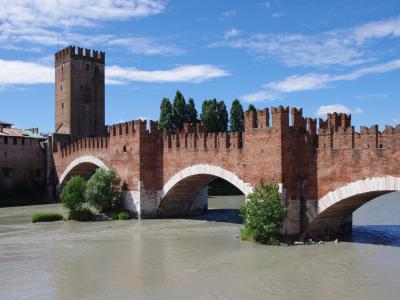
3) Ponte Scaligero (Scaligero Bridge) (must see)
The Scaligero Bridge, also known as the Castelvecchio Bridge, is a remarkable three-arch span crossing the Adige River. Built around 1354 and 1356 by the Scaliger family, it served a vital defensive purpose as a swift escape route from the Old Castle toward the protection of the family’s allies in Tyrol, where ruler Cangrande II’s son-in-law held influence. Today, its elevated walkway provides stunning views of Verona and the river winding through the city.
Stretching roughly 120 meters, the bridge is one of Verona’s most photographed landmarks and remains a popular pedestrian route. The original structure was destroyed in 1945 by retreating German troops during World War II, but a meticulous reconstruction in the 1950s reused a significant portion of the recovered stonework, restoring the bridge closely to its medieval appearance. During reconstruction, archaeologists documented original Roman foundations beneath parts of the structure, highlighting the strategic importance of this river crossing long before the Scaligers’ fortifications.
Its fortified design - red brick battlements above and white stone below - gives the impression of a fortress set across the river. A charming local legend claims that the Lord of Verona rewarded the bridge’s anonymous engineer with Saint Martin’s sword for his success. Because the bridge was designed wide enough for mounted soldiers to cross quickly, it stood out as one of the most innovative defensive bridges of its time.
By day, the bridge’s crenellations appear bold and powerful, while at night, illuminated against the water, it becomes one of Verona’s most atmospheric and romantic sights. The viewpoint from the bridge also frames Saint Peter’s Castle in the distance, another historically significant hilltop fortification.
Stretching roughly 120 meters, the bridge is one of Verona’s most photographed landmarks and remains a popular pedestrian route. The original structure was destroyed in 1945 by retreating German troops during World War II, but a meticulous reconstruction in the 1950s reused a significant portion of the recovered stonework, restoring the bridge closely to its medieval appearance. During reconstruction, archaeologists documented original Roman foundations beneath parts of the structure, highlighting the strategic importance of this river crossing long before the Scaligers’ fortifications.
Its fortified design - red brick battlements above and white stone below - gives the impression of a fortress set across the river. A charming local legend claims that the Lord of Verona rewarded the bridge’s anonymous engineer with Saint Martin’s sword for his success. Because the bridge was designed wide enough for mounted soldiers to cross quickly, it stood out as one of the most innovative defensive bridges of its time.
By day, the bridge’s crenellations appear bold and powerful, while at night, illuminated against the water, it becomes one of Verona’s most atmospheric and romantic sights. The viewpoint from the bridge also frames Saint Peter’s Castle in the distance, another historically significant hilltop fortification.
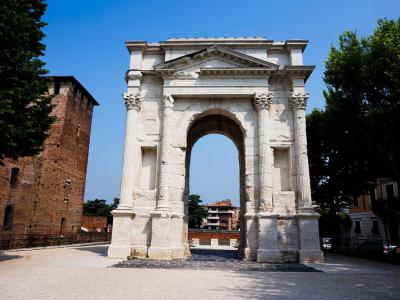
4) Arco dei Gavi
The Arco dei Gavi stands as a splendid triumphal arch made of white limestone, situated at the heart of the Piazza del Castelvecchio. This architectural masterpiece was commissioned by the esteemed Gavi family of ancient Rome. Triumphal arches were a means employed by the Romans to commemorate significant occasions, such as the completion of roads or bridges, or to pay tribute to the passing of notable figures. In the Middle Ages, this arch served as an entryway when the city was enclosed by defensive walls.
The initial design was crafted by Lucio Vitruvio Cerdone. The construction of the arch took place in the first half of the first century CE and demarcates the juncture of Via Postumia that leads towards Verona.
Unfortunately, the arch met its demise in 1805, succumbing to structural issues and being dismantled by the French. However, in 1932, it was meticulously reconstructed and relocated from the Torre degli Orologi del Castelvecchio to its present position. Tourists and graffiti artists alike are drawn to this site, which has become a beloved attraction. Even with the addition of spray paint, the arch's intrinsic beauty remains captivating.
Recommended dining establishments and points of interest in proximity to the arch encompass the Antico Caffe Dante, the Officina dei Sapori, the Osteria Il Bertoldo, the Tosca Cafe Verona, the Al Pompiere, the Villa InCanto Opera Lirica, the Castelvecchio, the Chiesa di San Lorenzo, the Monumento a Aleardo Aleardi, the Ponte Scaligero, and the Museo Storico Naturale.
The initial design was crafted by Lucio Vitruvio Cerdone. The construction of the arch took place in the first half of the first century CE and demarcates the juncture of Via Postumia that leads towards Verona.
Unfortunately, the arch met its demise in 1805, succumbing to structural issues and being dismantled by the French. However, in 1932, it was meticulously reconstructed and relocated from the Torre degli Orologi del Castelvecchio to its present position. Tourists and graffiti artists alike are drawn to this site, which has become a beloved attraction. Even with the addition of spray paint, the arch's intrinsic beauty remains captivating.
Recommended dining establishments and points of interest in proximity to the arch encompass the Antico Caffe Dante, the Officina dei Sapori, the Osteria Il Bertoldo, the Tosca Cafe Verona, the Al Pompiere, the Villa InCanto Opera Lirica, the Castelvecchio, the Chiesa di San Lorenzo, the Monumento a Aleardo Aleardi, the Ponte Scaligero, and the Museo Storico Naturale.
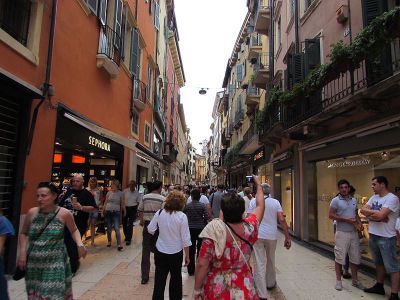
5) Via Mazzini (Mazzini Street) (must see)
Mazzini street is the most popular shopping street, where visitors browse boutique stores and enjoy a coffee or cocktail while watching the lively flow of people around them. Named after Giuseppe Mazzini, a key 19th-century political activist whose ideas helped shape the unification of Italy, the street celebrates one of the nation’s most influential figures.
Connecting the grand Bra Square to the historic Market Square, Mazzini street follows the alignment of a Roman decumanus. Segments near the Verona Arena trace the original Roman alignment, preserving more than two thousand years of city planning. While many of Europe’s ancient streets are paved with cobblestones, Mazzini street features polished marble paving that gives it a sleek, modern look.
Today, Mazzini street is home to a mix of Italy’s top fashion brands and major international labels. One standout is the United Colors of Benetton flagship store, beneath which Roman ruins - including 1st- and 2nd-century AD flooring and walls - were uncovered and are now visible to visitors. Other nearby archaeological findings have revealed fragments of ancient Verona’s residential blocks, suggesting the presence of a lively commercial quarter during Roman times.
Mazzini street became pedestrian-only in the late 20th century, contributing to its pleasant and accessible atmosphere. Its current appearance largely dates to major urban improvements made during the early 1900s, when façades were updated and the street began to develop its reputation as Verona’s fashion district.
Seasonal illuminations and window displays transform the street into a festive promenade, especially during the opera season and winter holidays. Street performers and pop-up markets occasionally add to the atmosphere, creating a lively blend of shopping and entertainment.
Connecting the grand Bra Square to the historic Market Square, Mazzini street follows the alignment of a Roman decumanus. Segments near the Verona Arena trace the original Roman alignment, preserving more than two thousand years of city planning. While many of Europe’s ancient streets are paved with cobblestones, Mazzini street features polished marble paving that gives it a sleek, modern look.
Today, Mazzini street is home to a mix of Italy’s top fashion brands and major international labels. One standout is the United Colors of Benetton flagship store, beneath which Roman ruins - including 1st- and 2nd-century AD flooring and walls - were uncovered and are now visible to visitors. Other nearby archaeological findings have revealed fragments of ancient Verona’s residential blocks, suggesting the presence of a lively commercial quarter during Roman times.
Mazzini street became pedestrian-only in the late 20th century, contributing to its pleasant and accessible atmosphere. Its current appearance largely dates to major urban improvements made during the early 1900s, when façades were updated and the street began to develop its reputation as Verona’s fashion district.
Seasonal illuminations and window displays transform the street into a festive promenade, especially during the opera season and winter holidays. Street performers and pop-up markets occasionally add to the atmosphere, creating a lively blend of shopping and entertainment.
6) Piazza delle Erbe (Market Square) (must see)
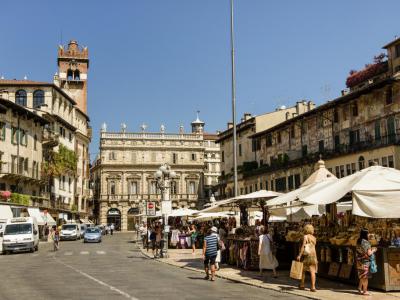
Market Square stands on Verona’s former Roman forum, the center of civic and commercial life in antiquity. Its later name, “Square of Herbs”, recalls the long-running market where spices, produce, and household goods were traded. A weekday market still operates here from Monday to Saturday, continuing that historic role.
At the center of the square stands Madonna Verona, a Roman statue dating to the 4th century AD, set atop a fountain from 1368. Surrounding the piazza is a mix of structures that show how the area evolved after the Roman period. On the north side are the Mazzanti Houses, decorated with 14th-century frescoes, and the base of the Lamberti Tower, which rises behind the buildings and is accessible through a nearby courtyard.
On the northwest edge stands the Maffei Palace, a Baroque residence updated in the 17th century. Its façade is lined with statues of Hercules, Apollo, Minerva, Venus, Mercury, and Jupiter. Shops now occupy the ground floor. Close by are the archaeological remains of the Roman Capitolium, marking the site of Verona’s main Roman temple.
The south side features the House of the Merchants and the Capitello, a 13th-century structure once used for public proclamations. To the west is the Gardello Tower, restored in the 14th century and known for one of Verona’s earliest mechanical clocks. Through the archway at the eastern end, the square connects directly to Signori Square, where the historic Town Hall and the Palace of the Judges are located.
Today, Market Square remains active and walkable, with cafés and market stalls set among some of Verona’s most significant buildings.
At the center of the square stands Madonna Verona, a Roman statue dating to the 4th century AD, set atop a fountain from 1368. Surrounding the piazza is a mix of structures that show how the area evolved after the Roman period. On the north side are the Mazzanti Houses, decorated with 14th-century frescoes, and the base of the Lamberti Tower, which rises behind the buildings and is accessible through a nearby courtyard.
On the northwest edge stands the Maffei Palace, a Baroque residence updated in the 17th century. Its façade is lined with statues of Hercules, Apollo, Minerva, Venus, Mercury, and Jupiter. Shops now occupy the ground floor. Close by are the archaeological remains of the Roman Capitolium, marking the site of Verona’s main Roman temple.
The south side features the House of the Merchants and the Capitello, a 13th-century structure once used for public proclamations. To the west is the Gardello Tower, restored in the 14th century and known for one of Verona’s earliest mechanical clocks. Through the archway at the eastern end, the square connects directly to Signori Square, where the historic Town Hall and the Palace of the Judges are located.
Today, Market Square remains active and walkable, with cafés and market stalls set among some of Verona’s most significant buildings.
7) Arco della Costa
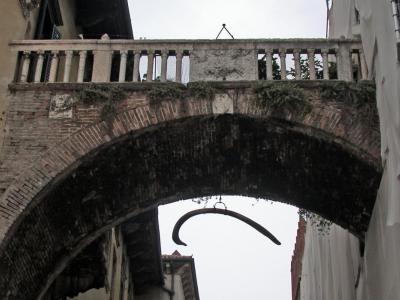
The Arco della Costa (Arch of the Rib) stands as a prominent archway situated between Piazza delle Erbe and Piazza dei Signori. In times when Venice held sway, this passageway served the purpose of enabling magistrates to travel from their abode, the Domus Nova, to the court within the present-day Palazzo della Ragione. This route spared them the need to traverse the city's main thoroughfare, thereby reducing the risk of encountering potential bribe-givers or individuals with malicious intent.
The nomenclature of this arch is intertwined with an object suspended from its pinnacle: a bone, thought to be a whale's rib. Installed during the mid-1700s, as depicted in a contemporary print, this object has given rise to diverse conjectures regarding its true nature. Some speculate that it could be a bone from an ichthyosaur, while others hold beliefs that it might be the "rib of the devil," a relic purportedly obtained from Crusaders during the battle of Lepanto in 1571. This notion finds support in the presence of a similar bone within the Cathedral.
Alternatively, historical accounts propose that the rib might have been affixed by the local apothecary shop as a means of attracting customers. In the medical practices of that era, powdered whale bone was believed to possess potent curative properties.
The legend enveloping this object possesses a distinctive quality: it asserts that the rib will descend when an individual of genuine integrity and a virtuous heart passes beneath it.
The nomenclature of this arch is intertwined with an object suspended from its pinnacle: a bone, thought to be a whale's rib. Installed during the mid-1700s, as depicted in a contemporary print, this object has given rise to diverse conjectures regarding its true nature. Some speculate that it could be a bone from an ichthyosaur, while others hold beliefs that it might be the "rib of the devil," a relic purportedly obtained from Crusaders during the battle of Lepanto in 1571. This notion finds support in the presence of a similar bone within the Cathedral.
Alternatively, historical accounts propose that the rib might have been affixed by the local apothecary shop as a means of attracting customers. In the medical practices of that era, powdered whale bone was believed to possess potent curative properties.
The legend enveloping this object possesses a distinctive quality: it asserts that the rib will descend when an individual of genuine integrity and a virtuous heart passes beneath it.
8) Torre dei Lamberti (Lamberti Tower) (must see)
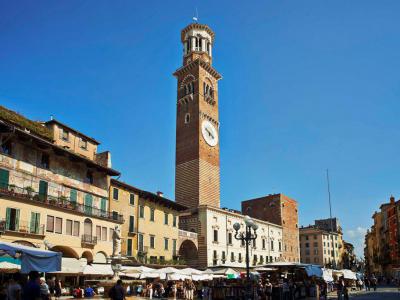
Lamberti Tower is one of Verona’s most recognizable landmarks, built beginning in 1172 by the influential Lamberti family, at a time when prominent Veronese households constructed tall towers to express their wealth and political influence. Over the centuries, the tower has undergone several phases of modification, including a major restoration following a lightning strike in 1403. This reconstruction campaign, which lasted from 1448 to 1464, introduced visible changes in materials and extended the structure to its current height of 84 metres.
The tower features two bells, each with a distinct civic purpose. The Rengo bell once summoned citizens to arms or to public assemblies, while the Marangona signaled work hours, timekeeping, and fire warnings. These bells were central to the daily lives of medieval and Renaissance residents, long before the advent of printed notices or municipal clocks. Their sound was so important that strict laws governed when and how each bell could be rung.
Visitors today can take an elevator partway up and then climb the remaining stairs to reach the main viewing terrace. From the top, the view extends across the historic center - from Market Square directly below to the rooftops and bell towers that define Verona’s skyline - and outward to the Adige River and the surrounding hills. The tower’s clock, a late-18th-century addition, enhanced its civic importance and remains one of the most visible timekeepers in the city.
Today, Lamberti Tower is part of the vast Palace of the Reason complex and is included in Verona’s network of civic museums, hosting temporary exhibitions and occasional special events in its interior spaces. It continues to serve as a key point of orientation for locals and travellers alike.
The tower features two bells, each with a distinct civic purpose. The Rengo bell once summoned citizens to arms or to public assemblies, while the Marangona signaled work hours, timekeeping, and fire warnings. These bells were central to the daily lives of medieval and Renaissance residents, long before the advent of printed notices or municipal clocks. Their sound was so important that strict laws governed when and how each bell could be rung.
Visitors today can take an elevator partway up and then climb the remaining stairs to reach the main viewing terrace. From the top, the view extends across the historic center - from Market Square directly below to the rooftops and bell towers that define Verona’s skyline - and outward to the Adige River and the surrounding hills. The tower’s clock, a late-18th-century addition, enhanced its civic importance and remains one of the most visible timekeepers in the city.
Today, Lamberti Tower is part of the vast Palace of the Reason complex and is included in Verona’s network of civic museums, hosting temporary exhibitions and occasional special events in its interior spaces. It continues to serve as a key point of orientation for locals and travellers alike.
9) Piazza dei Signori (Lords Square) (must see)
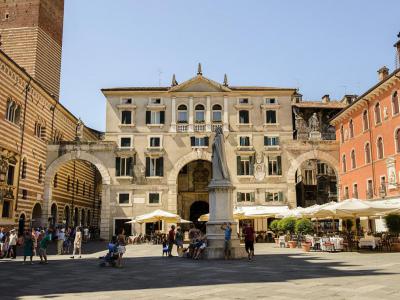
Signori Square has long been one of Verona’s most elegant public spaces, surrounded by grand palaces that once housed the city’s rulers. Also called Lords Square, it reflects the political heart of medieval Verona, where the Scaligeri family governed during the city’s most powerful era. The square is also tied to the legacy of Romeo and Juliet: here stood the seat of government where Bartolomeo della Scala banished the fictional Romeo to Mantua.
At the square’s center rises a statue of Dante Alighieri, installed in 1865 to mark the 600th anniversary of the poet’s birth. Exiled from Florence, Dante found refuge in Verona under the Scaligeri - a key period in which he continued writing the Divine Comedy.
Several important buildings stand along the square. The Ragione Palace, once Verona’s town hall, and the Captain’s Palace, seat of the military governor during Venetian rule, both define the western side.
On the east side is the Portico of the Council, a landmark of Venetian Renaissance architecture where civic leaders once met beneath elegant arches. The Domus Nova Palace, dating to the 13th century, formerly housed the Chief Magistrate’s offices. Nearby stands the Podestà Palace, a former Scaliger residence later adapted for administrative use.
One of the most colorful façades belongs to the House of Charity, now home to Antico Caffè Dante, considered one of Verona’s oldest cafés. Today, Signori Square remains a refined setting for admiring centuries of political, artistic, and literary history - all gathered into one compact civic space.
At the square’s center rises a statue of Dante Alighieri, installed in 1865 to mark the 600th anniversary of the poet’s birth. Exiled from Florence, Dante found refuge in Verona under the Scaligeri - a key period in which he continued writing the Divine Comedy.
Several important buildings stand along the square. The Ragione Palace, once Verona’s town hall, and the Captain’s Palace, seat of the military governor during Venetian rule, both define the western side.
On the east side is the Portico of the Council, a landmark of Venetian Renaissance architecture where civic leaders once met beneath elegant arches. The Domus Nova Palace, dating to the 13th century, formerly housed the Chief Magistrate’s offices. Nearby stands the Podestà Palace, a former Scaliger residence later adapted for administrative use.
One of the most colorful façades belongs to the House of Charity, now home to Antico Caffè Dante, considered one of Verona’s oldest cafés. Today, Signori Square remains a refined setting for admiring centuries of political, artistic, and literary history - all gathered into one compact civic space.
10) Arche Scaligere (Scaligeri Tombs)
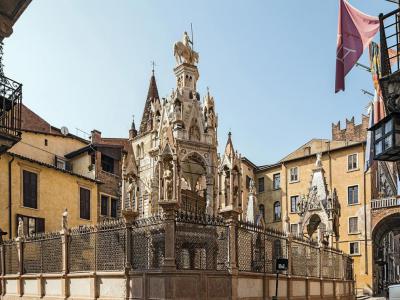
The Scaliger Tombs form one of Verona’s most prominent Gothic ensembles. These five funerary monuments commemorate the Scaligeri family, who ruled Verona during the 13th and 14th centuries. While often associated with Shakespeare’s Romeo and Juliet, the idea that this was the location of Juliet’s staged death belongs to literary tradition rather than documented history.
The tombs stand in a small, gated courtyard beside the Church of Santa Maria Antica, the family’s private chapel. Their design resembles elaborate Gothic tabernacles: each features a highly carved sarcophagus and a canopy, with the deceased depicted on horseback in full armor symbolizing power and leadership.
The rise of these monuments reflects the political ascent of the Scaligeri. Mastino I della Scala secured control over Verona in 1259, earning his family hereditary authority. Yet, as in many medieval dynasties, internal rivalries eventually led to their downfall - an echo of the dramatic themes that later inspired Shakespeare’s storytelling.
Celebrated as some of the finest examples of Gothic funerary architecture in Italy, the Scaliger Tombs remain a powerful reminder of the family who shaped Verona’s medieval history and left a legacy visible in the city’s towers, fortifications, and political memory.
The tombs stand in a small, gated courtyard beside the Church of Santa Maria Antica, the family’s private chapel. Their design resembles elaborate Gothic tabernacles: each features a highly carved sarcophagus and a canopy, with the deceased depicted on horseback in full armor symbolizing power and leadership.
The rise of these monuments reflects the political ascent of the Scaligeri. Mastino I della Scala secured control over Verona in 1259, earning his family hereditary authority. Yet, as in many medieval dynasties, internal rivalries eventually led to their downfall - an echo of the dramatic themes that later inspired Shakespeare’s storytelling.
Celebrated as some of the finest examples of Gothic funerary architecture in Italy, the Scaliger Tombs remain a powerful reminder of the family who shaped Verona’s medieval history and left a legacy visible in the city’s towers, fortifications, and political memory.
11) Antica Salumeria Albertini
Antica Salumeria Albertini stands as a classic yet captivating food market. Within its walls, you'll discover an array of Italian delicacies, ranging from savory cured hams to meticulously crafted handmade pastas, regional cheeses, extra-virgin olive oil, and a diverse selection of local wines. The ethos of Salumeria lies in fostering a robust and wholesome community, evident in its extensive offering of organic and natural foods. Enthusiasts of fine cuisine have the opportunity to indulge in sampling the latest culinary offerings each day.
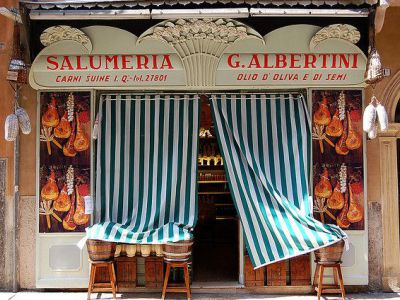
What truly sets this establishment apart is its striking facade. The Art-Nouveau storefront, originating from the 1930s, captures immediate attention. Comprising a triple frame of painted metal, shielded by foldable shutters, it is adorned with an exquisite grey plate sign topped by an ornate scroll design. At the heart of this sign, a fan of stylized flowers takes center stage, drawing focus to the entrance while breaking the flow of the prominent red-lettered inscription. A metal roof with blended, notched edges safeguards the entirety of this architectural gem.
Inside, the interior fixtures are relatively more modern compared to the display, having been replaced with white marble shelves that succeeded the original ones dating back to the early 20th Century. As the years have passed, multiple generations have overseen the shop's operations, leading to Alimentari Salumeria Albertini earning a place in the Botteghe Storiche registry for its enduring quality and long-standing tradition.
What truly sets this establishment apart is its striking facade. The Art-Nouveau storefront, originating from the 1930s, captures immediate attention. Comprising a triple frame of painted metal, shielded by foldable shutters, it is adorned with an exquisite grey plate sign topped by an ornate scroll design. At the heart of this sign, a fan of stylized flowers takes center stage, drawing focus to the entrance while breaking the flow of the prominent red-lettered inscription. A metal roof with blended, notched edges safeguards the entirety of this architectural gem.
Inside, the interior fixtures are relatively more modern compared to the display, having been replaced with white marble shelves that succeeded the original ones dating back to the early 20th Century. As the years have passed, multiple generations have overseen the shop's operations, leading to Alimentari Salumeria Albertini earning a place in the Botteghe Storiche registry for its enduring quality and long-standing tradition.
12) Verona Cathedral (must see)
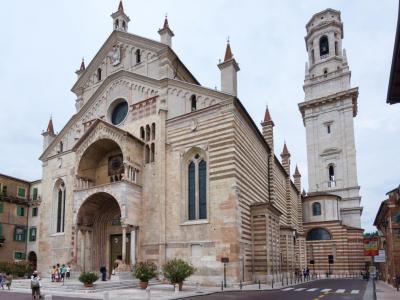
Verona Cathedral is dedicated to the Assumption of the Virgin Mary and stands on the site of earlier churches destroyed in the 1117 earthquake. The present structure, consecrated in 1187, is largely Romanesque, with Gothic elements added during later renovations. It remains the heart of Verona’s historic religious complex.
The west façade features a double porch, Lombard bands, and small pinnacles typical of northern Italian Romanesque. The main portal, sculpted by Maestro Nicolò in 1139, includes reliefs of Saint John the Evangelist and Saint John the Baptist, as well as legendary protectors Roland and Oliver.
Ten prophets flank the doorway, and the tympanum above depicts the Virgin and Child, the Adoration of the Magi, and the Adoration of the Shepherds, forming a complete Nativity cycle. On the south side, a 12th-century portal carved by Peregrinus shows scenes from the story of Jonah. The bell tower, begun in the 16th century and finished only in the 20th, reflects a mix of styles.
Inside, a 15th-century Gothic renovation introduced pointed arches supported by alternating red and white Verona marble columns. The church contains several noteworthy works of art, including Titian’s “Assumption of the Virgin” in the left transept - one of Verona’s finest Renaissance paintings - and a Crucifixion by Giambattista da Verona from 1534. In the western bays, frescoes by Giovanni Maria Falconetto date to 1503.
The Chapter Library, connected to the cathedral, is among Europe’s most important ecclesiastical libraries and holds exceptional manuscripts, including the Leonine Sacramentary, regarded as the oldest surviving text of the Roman Rite. Just steps away, the Canons’ Cloister reveals archaeological remains of earlier cathedral buildings, helping visitors visualize how the site evolved from early Christianity onward.
Tip:
Continue to the Baptistery of Saint Giovanni in Fonte, featuring an impressive octagonal baptismal font richly carved with Biblical scenes. The archaeological areas and audio guide provide helpful explanations of the cathedral’s Roman origins and later transformations.
The west façade features a double porch, Lombard bands, and small pinnacles typical of northern Italian Romanesque. The main portal, sculpted by Maestro Nicolò in 1139, includes reliefs of Saint John the Evangelist and Saint John the Baptist, as well as legendary protectors Roland and Oliver.
Ten prophets flank the doorway, and the tympanum above depicts the Virgin and Child, the Adoration of the Magi, and the Adoration of the Shepherds, forming a complete Nativity cycle. On the south side, a 12th-century portal carved by Peregrinus shows scenes from the story of Jonah. The bell tower, begun in the 16th century and finished only in the 20th, reflects a mix of styles.
Inside, a 15th-century Gothic renovation introduced pointed arches supported by alternating red and white Verona marble columns. The church contains several noteworthy works of art, including Titian’s “Assumption of the Virgin” in the left transept - one of Verona’s finest Renaissance paintings - and a Crucifixion by Giambattista da Verona from 1534. In the western bays, frescoes by Giovanni Maria Falconetto date to 1503.
The Chapter Library, connected to the cathedral, is among Europe’s most important ecclesiastical libraries and holds exceptional manuscripts, including the Leonine Sacramentary, regarded as the oldest surviving text of the Roman Rite. Just steps away, the Canons’ Cloister reveals archaeological remains of earlier cathedral buildings, helping visitors visualize how the site evolved from early Christianity onward.
Tip:
Continue to the Baptistery of Saint Giovanni in Fonte, featuring an impressive octagonal baptismal font richly carved with Biblical scenes. The archaeological areas and audio guide provide helpful explanations of the cathedral’s Roman origins and later transformations.
13) Ponte Pietra (Stone Bridge) (must see)
Stone Bridge is the oldest bridge in Verona and one of the most impressive surviving Roman structures in the city. First built in the 1st century BC, it provided access across the Adige River at a strategic point where the current bends naturally, offering protection to much of the early settlement. Its name derives from the Latin Pons Lapideus, meaning “Stone Bridge”, distinguishing it from the earlier wooden bridges that were often destroyed by seasonal floods.
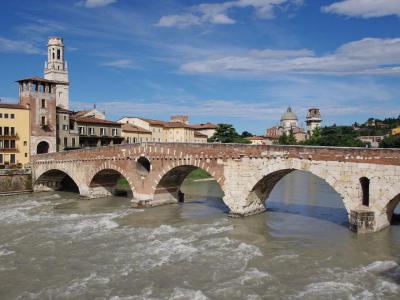
The bridge originally featured five arches constructed from large blocks of white limestone, a typical Roman building material. Over time, floods and warfare led to repeated damage and numerous repairs using different techniques and materials. This explains the striking contrast visible today between the Roman stone arches and the later red brickwork.
Only two arches on the left side remain largely from the Roman period. The two right-side arches were reconstructed in the Scaliger era, while the central arch dates to Venetian times. A defensive watchtower was added during the Middle Ages, controlling movement across the bridge and guarding the northern entrance to the city.
The Roman design included a pronounced central arch, giving the bridge a slightly raised, donkey-back profile that improved resistance to flooding by allowing high water to pass underneath more easily. The structure also included small drainage openings to relieve pressure during periods of high flow from the Adige River.
During World War II, retreating German troops destroyed the bridge in 1945. Fortunately, it was carefully reconstructed in 1957, using as many original stones as possible retrieved from the river. Today, Stone Bridge continues to serve pedestrians and remains one of the most scenic viewpoints in Verona, beautifully linking the historic center with the Roman Theatre and hills of Veronetta across the river.
The bridge originally featured five arches constructed from large blocks of white limestone, a typical Roman building material. Over time, floods and warfare led to repeated damage and numerous repairs using different techniques and materials. This explains the striking contrast visible today between the Roman stone arches and the later red brickwork.
Only two arches on the left side remain largely from the Roman period. The two right-side arches were reconstructed in the Scaliger era, while the central arch dates to Venetian times. A defensive watchtower was added during the Middle Ages, controlling movement across the bridge and guarding the northern entrance to the city.
The Roman design included a pronounced central arch, giving the bridge a slightly raised, donkey-back profile that improved resistance to flooding by allowing high water to pass underneath more easily. The structure also included small drainage openings to relieve pressure during periods of high flow from the Adige River.
During World War II, retreating German troops destroyed the bridge in 1945. Fortunately, it was carefully reconstructed in 1957, using as many original stones as possible retrieved from the river. Today, Stone Bridge continues to serve pedestrians and remains one of the most scenic viewpoints in Verona, beautifully linking the historic center with the Roman Theatre and hills of Veronetta across the river.
