Custom Walk in Annapolis, Maryland by ddragon5_53f7a6 created on 2026-04-17
Guide Location: USA » Annapolis
Guide Type: Custom Walk
# of Sights: 8
Tour Duration: 1 Hour(s)
Travel Distance: 1.7 Km or 1.1 Miles
Share Key: 5FJZA
Guide Type: Custom Walk
# of Sights: 8
Tour Duration: 1 Hour(s)
Travel Distance: 1.7 Km or 1.1 Miles
Share Key: 5FJZA
How It Works
Please retrieve this walk in the GPSmyCity app. Once done, the app will guide you from one tour stop to the next as if you had a personal tour guide. If you created the walk on this website or come to the page via a link, please follow the instructions below to retrieve the walk in the app.
Retrieve This Walk in App
Step 1. Download the app "GPSmyCity: Walks in 1K+ Cities" on Apple App Store or Google Play Store.



Step 2. In the GPSmyCity app, download(or launch) the guide "Annapolis Map and Walking Tours".
Step 3. Tap the menu button located at upper right corner of the "Walks" screen and select "Retrieve custom walk". Enter the share key: 5FJZA
1) Banneker-Douglass-Tubman Museum (must see)
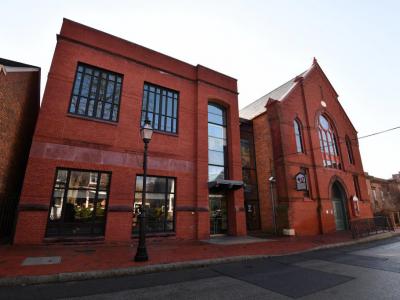
The Banneker-Douglass-Tubman Museum focuses on the history and culture of African Americans in Maryland. Founded in 1984, it serves as the state’s official museum on this subject. It is named after Benjamin Banneker, Frederick Douglass, and Harriet Tubman, three important figures connected to science, abolition, and the fight for freedom. Exhibitions explore stories of struggle, achievement, and community life across several centuries.
The museum is housed in a historic building that once served as the Mount Moriah African Methodist Episcopal Church. The church was built in the 1870s by a congregation formed by formerly enslaved people and free Black residents after the Civil War. For many years the church functioned as a spiritual and social centre for the surrounding community. When the congregation moved to a new building in the late twentieth century, the structure was preserved and later adapted to house the museum.
Inside, the galleries explore many aspects of African American life in Maryland. Exhibits highlight individuals who shaped the state’s history, including educators, artists, soldiers, and civil rights activists. Visitors can see photographs, documents, artworks, and personal objects that reflect everyday life as well as major historical events. Some displays focus on themes such as the fight for freedom, the growth of Black churches and schools, and cultural traditions within African American communities.
The museum also hosts temporary exhibitions, lectures, and community events throughout the year. These programs encourage visitors to explore history from different perspectives and connect past events with the present. Through artifacts and personal stories, the museum shows how African American experiences have shaped Maryland’s cultural and social history.
The museum is housed in a historic building that once served as the Mount Moriah African Methodist Episcopal Church. The church was built in the 1870s by a congregation formed by formerly enslaved people and free Black residents after the Civil War. For many years the church functioned as a spiritual and social centre for the surrounding community. When the congregation moved to a new building in the late twentieth century, the structure was preserved and later adapted to house the museum.
Inside, the galleries explore many aspects of African American life in Maryland. Exhibits highlight individuals who shaped the state’s history, including educators, artists, soldiers, and civil rights activists. Visitors can see photographs, documents, artworks, and personal objects that reflect everyday life as well as major historical events. Some displays focus on themes such as the fight for freedom, the growth of Black churches and schools, and cultural traditions within African American communities.
The museum also hosts temporary exhibitions, lectures, and community events throughout the year. These programs encourage visitors to explore history from different perspectives and connect past events with the present. Through artifacts and personal stories, the museum shows how African American experiences have shaped Maryland’s cultural and social history.
2) Colonial Annapolis Historic District (must see)
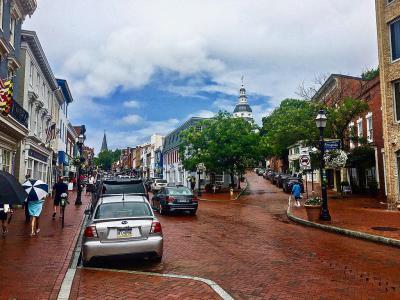
Colonial Annapolis Historic District preserves one of the largest groups of eighteenth-century buildings in the United States. The area grew during the colonial period, when the nearby harbor was an active center for trade. Many buildings from the early and mid-1700s still remain, showing what the town looked like when Maryland was a British colony.
The street layout is unusual compared with most colonial towns. Instead of a grid, the roads spread outward from two circular plazas, a design influenced by Baroque planning used in eighteenth-century Europe. The plan was created in the 1690s by royal governor Francis Nicholson. One circle was intended for government buildings and the other for churches, and this design still shapes the streets today.
One of the most important buildings in the district is the Maryland State House, completed in 1779 and the oldest state capitol still used for legislative work in the United States. In 1783 and 1784 the Continental Congress met here, and in December 1783 George Washington resigned as commander of the Continental Army inside the building. All four Maryland signers of the Declaration of Independence also lived in this community.
The district also includes St. John’s College, founded in 1696 as King William’s School and recognized as the third-oldest college in the United States. A tulip poplar known as the Liberty Tree once stood on the campus where residents discussed ideas about independence. The original tree was damaged by Hurricane Floyd in 1999 and later removed, but descendants have been planted in Maryland and other places.
The street layout is unusual compared with most colonial towns. Instead of a grid, the roads spread outward from two circular plazas, a design influenced by Baroque planning used in eighteenth-century Europe. The plan was created in the 1690s by royal governor Francis Nicholson. One circle was intended for government buildings and the other for churches, and this design still shapes the streets today.
One of the most important buildings in the district is the Maryland State House, completed in 1779 and the oldest state capitol still used for legislative work in the United States. In 1783 and 1784 the Continental Congress met here, and in December 1783 George Washington resigned as commander of the Continental Army inside the building. All four Maryland signers of the Declaration of Independence also lived in this community.
The district also includes St. John’s College, founded in 1696 as King William’s School and recognized as the third-oldest college in the United States. A tulip poplar known as the Liberty Tree once stood on the campus where residents discussed ideas about independence. The original tree was damaged by Hurricane Floyd in 1999 and later removed, but descendants have been planted in Maryland and other places.

3) Annapolis Ice Cream Company
The Annapolis Ice Cream Company is a small ice cream shop known for its homemade flavors and relaxed, old-fashioned atmosphere. It opened in 2004 and has since become a familiar stop for visitors exploring the historic district near the waterfront. The shop focuses on ice cream made in small batches, offering flavors that range from classic favorites to more creative combinations.
Inside, the space feels like a traditional American ice cream parlor. A glass display case shows the day’s flavors, which often include chocolate, vanilla, butter pecan, and cookies and cream, along with seasonal options. Ice cream is scooped by hand into cups, waffle cones, or sugar cones. Visitors can also order sundaes, milkshakes, and floats. The waffle cones are made on site, and their warm smell often drifts toward the entrance.
The list of flavors changes regularly, so there is often something new to try. Some varieties are inspired by familiar desserts, candies, or baked goods. Portions are generous, and many people take their cones outside and continue walking through nearby squares or along the waterfront. For visitors spending time in the historic centre, the shop offers a simple and enjoyable break during a day of sightseeing.
Inside, the space feels like a traditional American ice cream parlor. A glass display case shows the day’s flavors, which often include chocolate, vanilla, butter pecan, and cookies and cream, along with seasonal options. Ice cream is scooped by hand into cups, waffle cones, or sugar cones. Visitors can also order sundaes, milkshakes, and floats. The waffle cones are made on site, and their warm smell often drifts toward the entrance.
The list of flavors changes regularly, so there is often something new to try. Some varieties are inspired by familiar desserts, candies, or baked goods. Portions are generous, and many people take their cones outside and continue walking through nearby squares or along the waterfront. For visitors spending time in the historic centre, the shop offers a simple and enjoyable break during a day of sightseeing.
4) Kunta Kinte - Alex Haley Memorial (must see)
The Kunta Kinte – Alex Haley Memorial honors African heritage and the story shared in Roots by Alex Haley. It marks the harbor where the slave ship Lord Ligonier arrived on September 29, 1767, carrying captives from the Gambia River region, including Kunta Kinte. The memorial, developed in stages beginning with a plaque in 1981, identifies the arrival place of an enslaved African by name.
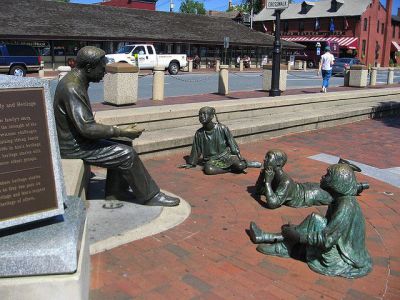
The central sculpture group was dedicated in 1999. It shows Alex Haley seated and reading from a book to three children of different backgrounds. The scene represents the passing of history through storytelling and memory. Around the plaza stands a curved “Story Wall” made of ten bronze plaques. These panels present quotations from Roots and describe the journey from West Africa to North America, helping visitors follow the narrative connected with Kunta Kinte’s capture, transport, and later generations.
Across the nearby plaza is a large compass rose about 14 feet (4.3 meters) in diameter, installed during the final phase of the memorial in 2002. The design is aligned with true north and places the harbor at its center. Its directional markers point toward regions across the Atlantic Ocean that were linked by the slave trade, encouraging visitors to face the direction of ancestral homelands.
The memorial was completed on June 12, 2002, when the Story Wall and compass rose were added. While the site honors the legacy of Roots, Alex Haley described the book as a mixture of historical research and family oral tradition. Today the memorial serves as a place where visitors can read the plaques, reflect on the history of the transatlantic slave trade, and consider the stories that connect past generations with the present.
The central sculpture group was dedicated in 1999. It shows Alex Haley seated and reading from a book to three children of different backgrounds. The scene represents the passing of history through storytelling and memory. Around the plaza stands a curved “Story Wall” made of ten bronze plaques. These panels present quotations from Roots and describe the journey from West Africa to North America, helping visitors follow the narrative connected with Kunta Kinte’s capture, transport, and later generations.
Across the nearby plaza is a large compass rose about 14 feet (4.3 meters) in diameter, installed during the final phase of the memorial in 2002. The design is aligned with true north and places the harbor at its center. Its directional markers point toward regions across the Atlantic Ocean that were linked by the slave trade, encouraging visitors to face the direction of ancestral homelands.
The memorial was completed on June 12, 2002, when the Story Wall and compass rose were added. While the site honors the legacy of Roots, Alex Haley described the book as a mixture of historical research and family oral tradition. Today the memorial serves as a place where visitors can read the plaques, reflect on the history of the transatlantic slave trade, and consider the stories that connect past generations with the present.
5) Maryland State House (must see)
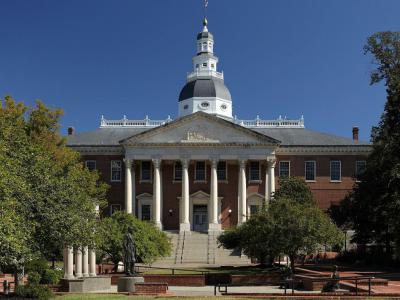
The Maryland State House is the oldest state capitol building in the United States that has been in continuous legislative use. Construction began in 1772, when Maryland leaders decided to build a permanent government center to replace earlier meeting places. The building soon became closely connected with the events of the American Revolution. Between November 1783 and August 1784 the Continental Congress met here, making the city the temporary capital of the United States during that period.
Several important national events took place inside the building. On December 23, 1783, General George Washington resigned his commission as commander-in-chief of the Continental Army in the Old Senate Chamber, returning military authority to civilian government. The Treaty of Paris, which ended the Revolutionary War between the United States and Great Britain, was ratified here in January 1784.
The building is known for its large wooden dome, completed in 1794 and built without nails. It is the largest wooden dome of its kind in the United States. The architecture reflects late colonial and early American design, with brick walls and balanced proportions. Later wings were added in the nineteenth and twentieth centuries to provide more space for offices and meeting rooms.
Visitors can enter several historic rooms that preserve the atmosphere of the late eighteenth century. The Old Senate Chamber, where Washington resigned his command, has been carefully restored with period furnishings and decorations. Nearby rooms display portraits, historical documents, and information about the building’s role in the development of American government. Guided tours help explain how the legislature still meets here today, connecting the historic structure with its continuing role in public life.
Several important national events took place inside the building. On December 23, 1783, General George Washington resigned his commission as commander-in-chief of the Continental Army in the Old Senate Chamber, returning military authority to civilian government. The Treaty of Paris, which ended the Revolutionary War between the United States and Great Britain, was ratified here in January 1784.
The building is known for its large wooden dome, completed in 1794 and built without nails. It is the largest wooden dome of its kind in the United States. The architecture reflects late colonial and early American design, with brick walls and balanced proportions. Later wings were added in the nineteenth and twentieth centuries to provide more space for offices and meeting rooms.
Visitors can enter several historic rooms that preserve the atmosphere of the late eighteenth century. The Old Senate Chamber, where Washington resigned his command, has been carefully restored with period furnishings and decorations. Nearby rooms display portraits, historical documents, and information about the building’s role in the development of American government. Guided tours help explain how the legislature still meets here today, connecting the historic structure with its continuing role in public life.
6) Naval Academy Museum (must see)
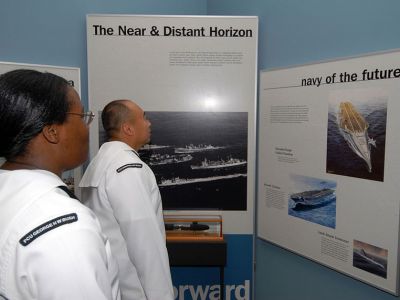
The Naval Academy Museum is located inside Preble Hall at the United States Naval Academy. It was founded in 1845 to help educate midshipmen by collecting objects related to naval history and life at sea. Over time the collection grew and became one of the most important naval history museums in the United States. Today it is open to visitors who want to learn more about ships, naval exploration, and the development of the U.S. Navy.
One of the main highlights is the large collection of ship models. Some models date from the seventeenth and eighteenth centuries and were once used by European navies to study ship design. A well-known part of the museum is the Rogers Collection, which includes about 108 detailed ship models. These models show how ships changed over time, from wooden sailing vessels to modern naval ships.
The museum also has exhibits about important moments in naval history. Displays explain events such as early ocean exploration, the American Revolution, the War of 1812, and the world wars. Visitors can see uniforms, navigation tools, weapons, paintings, and objects connected with sailors and naval missions. Another section focuses on the history of the Naval Academy and how officers have been trained there.
The museum also displays the Beverley R. Robinson Collection of naval prints and paintings, one of the largest collections of its kind. Many artworks show sea battles, voyages, and everyday life on ships. Together with the ship models and historical objects, these exhibits help visitors understand how naval technology and life at sea have changed over the centuries.
One of the main highlights is the large collection of ship models. Some models date from the seventeenth and eighteenth centuries and were once used by European navies to study ship design. A well-known part of the museum is the Rogers Collection, which includes about 108 detailed ship models. These models show how ships changed over time, from wooden sailing vessels to modern naval ships.
The museum also has exhibits about important moments in naval history. Displays explain events such as early ocean exploration, the American Revolution, the War of 1812, and the world wars. Visitors can see uniforms, navigation tools, weapons, paintings, and objects connected with sailors and naval missions. Another section focuses on the history of the Naval Academy and how officers have been trained there.
The museum also displays the Beverley R. Robinson Collection of naval prints and paintings, one of the largest collections of its kind. Many artworks show sea battles, voyages, and everyday life on ships. Together with the ship models and historical objects, these exhibits help visitors understand how naval technology and life at sea have changed over the centuries.
7) Naval Academy Chapel (must see)
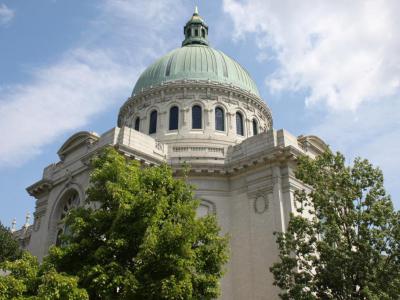
Naval Academy Chapel is the main place of worship at the United States Naval Academy. Completed in 1908 and designed by architect Ernest Flagg, it replaced an earlier mid-nineteenth-century chapel that had become too small for the growing number of midshipmen. Since then, the building has been used for religious services, ceremonies, weddings, and memorial events connected with naval life.
The chapel follows the Beaux-Arts style used for many academy buildings of that time. Its most visible feature is the large dome above the campus. The dome was first covered with decorated terra cotta, but this was removed in 1928 after pieces began falling, and a copper covering was completed in 1929. The original 1908 building seated about 1,200–1,600 people, and an expansion by architect Paul Philippe Cret between 1938 and 1940 increased the capacity to about 2,500.
Beneath the chapel is the crypt of John Paul Jones, a naval officer of the American Revolutionary War often called the “father of the American Navy.” His remains were discovered in Paris in 1905 and placed in the crypt on January 26, 1913. The black-and-white marble tomb, designed by architect Whitney Warren, was inspired by Napoleon’s tomb at Les Invalides in Paris.
Inside the chapel visitors can see stained-glass windows, memorial plaques, and historic naval flags connected with naval service. Among the notable artworks is a stained-glass window created by Tiffany Studios. Protestant and Catholic services are regularly held here for midshipmen and academy staff. The building also continues to host ceremonies, concerts, and guided visits that allow guests to explore both the main hall and the crypt.
The chapel follows the Beaux-Arts style used for many academy buildings of that time. Its most visible feature is the large dome above the campus. The dome was first covered with decorated terra cotta, but this was removed in 1928 after pieces began falling, and a copper covering was completed in 1929. The original 1908 building seated about 1,200–1,600 people, and an expansion by architect Paul Philippe Cret between 1938 and 1940 increased the capacity to about 2,500.
Beneath the chapel is the crypt of John Paul Jones, a naval officer of the American Revolutionary War often called the “father of the American Navy.” His remains were discovered in Paris in 1905 and placed in the crypt on January 26, 1913. The black-and-white marble tomb, designed by architect Whitney Warren, was inspired by Napoleon’s tomb at Les Invalides in Paris.
Inside the chapel visitors can see stained-glass windows, memorial plaques, and historic naval flags connected with naval service. Among the notable artworks is a stained-glass window created by Tiffany Studios. Protestant and Catholic services are regularly held here for midshipmen and academy staff. The building also continues to host ceremonies, concerts, and guided visits that allow guests to explore both the main hall and the crypt.
8) Temple Bell
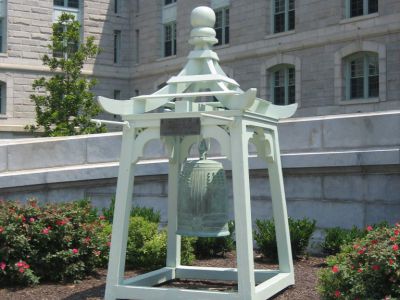
Temple Bell is a large bronze bell displayed on the grounds of the United States Naval Academy. Its history goes back to 1854, when it was presented to Commodore Matthew C. Perry during his mission to open Japan to trade. The bell came from Gokoku-ji Temple in the Ryukyu Kingdom and was originally cast in 1456. After Perry’s death in 1858, his widow Jane Slidell Perry donated it to the Naval Academy in early 1859.
The bell follows the design of traditional Japanese temple bells, with a wide rounded body and decorative bands cast into the bronze. Unlike Western bells that swing inside towers, it stays still and is struck from the outside with a wooden beam. At the academy, it became a tradition to ring the bell after football victories over the Army Black Knights football and during major national events such as the end of the Second World War in 1945.
In 1987 the original bell was returned to Okinawa after officials there asked for its return. Later that year it was sent back to Gokoku-ji Temple. Soon afterward, the people of Okinawa presented the Naval Academy with an exact replica as a gesture of friendship. The bell displayed today is that replacement, placed in the same location where the historic bell once stood.
The bell follows the design of traditional Japanese temple bells, with a wide rounded body and decorative bands cast into the bronze. Unlike Western bells that swing inside towers, it stays still and is struck from the outside with a wooden beam. At the academy, it became a tradition to ring the bell after football victories over the Army Black Knights football and during major national events such as the end of the Second World War in 1945.
In 1987 the original bell was returned to Okinawa after officials there asked for its return. Later that year it was sent back to Gokoku-ji Temple. Soon afterward, the people of Okinawa presented the Naval Academy with an exact replica as a gesture of friendship. The bell displayed today is that replacement, placed in the same location where the historic bell once stood.
