Custom Walk in Baltimore, Maryland by kbharathan_37684b created on 2026-05-18
Guide Location: USA » Baltimore
Guide Type: Custom Walk
# of Sights: 8
Tour Duration: 2 Hour(s)
Travel Distance: 4.3 Km or 2.7 Miles
Share Key: KNDKJ
Guide Type: Custom Walk
# of Sights: 8
Tour Duration: 2 Hour(s)
Travel Distance: 4.3 Km or 2.7 Miles
Share Key: KNDKJ
How It Works
Please retrieve this walk in the GPSmyCity app. Once done, the app will guide you from one tour stop to the next as if you had a personal tour guide. If you created the walk on this website or come to the page via a link, please follow the instructions below to retrieve the walk in the app.
Retrieve This Walk in App
Step 1. Download the app "GPSmyCity: Walks in 1K+ Cities" on Apple App Store or Google Play Store.



Step 2. In the GPSmyCity app, download(or launch) the guide "Baltimore Map and Walking Tours".
Step 3. Tap the menu button located at upper right corner of the "Walks" screen and select "Retrieve custom walk". Enter the share key: KNDKJ
1) Seven Foot Knoll Light
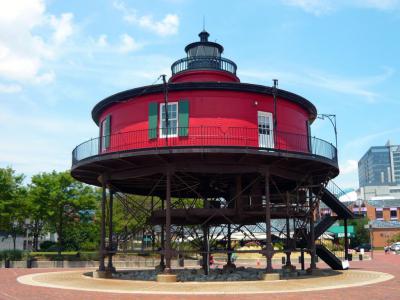
The Seven Foot Knoll Light is a historic lighthouse located in Maryland. It was built in 1855 and is the oldest screw-pile lighthouse in the state. Originally situated atop Seven Foot Knoll in the Chesapeake Bay, the lighthouse was replaced by a modern navigational aid and relocated to Baltimore's Inner Harbor as a museum exhibit.
Constructed of 1-inch rolled iron, the lighthouse is divided into three main sections. The gallery deck, located 9 feet above the average high tide waters, is the first section. The second section is the house where the keeper and his family would live, while the third section is the light beacon, housing a 4th order Fresnel lens visible for 12 nautical miles.
The first requests for a light were made in 1848, and construction began in 1854, with most of the parts fabricated at the Murray and Hazelhurst iron foundry in Baltimore. After being shipped to Seven Foot Knoll, the parts were assembled atop the screw piles. Ice, a perennial threat to screw-pile structures, caused damage in 1884 and 1894, leading to the piling of riprap around the piles.
The light was automated in 1949 and fell into disrepair, eventually being replaced by a skeleton tower. In 1988, the lighthouse was removed from Seven Foot Knoll and placed ashore in Baltimore's Inner Harbor, where it was donated to the city. It was listed on the National Register of Historic Places in 1989 and restored by members of the Steinhice family descendants prior to its re-opening.
The lighthouse is a contributing element in the Baltimore National Heritage Area and part of the Historic American Engineering Record. Thomas Jefferson Steinhise, who served as the keeper from 1930 to 1941, was awarded the Silver Lifesaving Medal for his role in rescuing the crew of the tugboat Point Breeze in 1933. He is buried in Holy Cross Cemetery in Glen Burnie, MD, with a U.S. Lighthouse Service grave-marker.
Constructed of 1-inch rolled iron, the lighthouse is divided into three main sections. The gallery deck, located 9 feet above the average high tide waters, is the first section. The second section is the house where the keeper and his family would live, while the third section is the light beacon, housing a 4th order Fresnel lens visible for 12 nautical miles.
The first requests for a light were made in 1848, and construction began in 1854, with most of the parts fabricated at the Murray and Hazelhurst iron foundry in Baltimore. After being shipped to Seven Foot Knoll, the parts were assembled atop the screw piles. Ice, a perennial threat to screw-pile structures, caused damage in 1884 and 1894, leading to the piling of riprap around the piles.
The light was automated in 1949 and fell into disrepair, eventually being replaced by a skeleton tower. In 1988, the lighthouse was removed from Seven Foot Knoll and placed ashore in Baltimore's Inner Harbor, where it was donated to the city. It was listed on the National Register of Historic Places in 1989 and restored by members of the Steinhice family descendants prior to its re-opening.
The lighthouse is a contributing element in the Baltimore National Heritage Area and part of the Historic American Engineering Record. Thomas Jefferson Steinhise, who served as the keeper from 1930 to 1941, was awarded the Silver Lifesaving Medal for his role in rescuing the crew of the tugboat Point Breeze in 1933. He is buried in Holy Cross Cemetery in Glen Burnie, MD, with a U.S. Lighthouse Service grave-marker.
2) National Aquarium in Baltimore (must see)
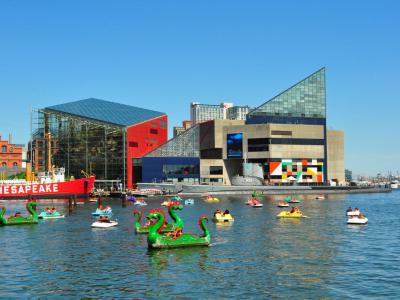
The National Aquarium in Baltimore stands along the Inner Harbor, forming one of the city’s most recognizable waterfront landmarks. Founded in 1978 and opened to the public in 1981, it was designed by architect Peter Chermayeff as part of Baltimore’s harbor revitalization. Today, the 250,000-square-foot complex houses more than 17,000 animals representing over 750 species. The later Glass Pavilion expansion introduced additional exhibition space and helped define the aquarium’s modern architectural profile.
Inside, the aquarium is organized as a sequence of immersive environments that move beyond traditional display tanks. One of the central features is Blacktip Reef, a large, multi-level exhibit built around a 265,000-gallon tank filled with sharks, rays, and tropical fish. Other sections highlight global ecosystems, including an Atlantic coral reef, Australia’s marine habitats, and an open-ocean shark exhibit.
A multi-level tropical rainforest forms one of the most distinctive areas, where elevated pathways wind past dense vegetation, waterfalls, and free-flying birds. Nearby exhibits present species from the Amazon River and Pacific reef systems, alongside animals such as poison dart frogs, parrots, and sloths. Additional galleries focus on regional environments, including Maryland’s native ecosystems, as well as species that illustrate long-term evolutionary adaptation, such as the electric eel. A 4D theater adds another dimension to the visit, offering short films with sensory effects.
Beyond its exhibits, the aquarium places a strong emphasis on conservation and research. The National Aquarium Conservation Center, established in 2009, supports work on coastal ecosystems, aquaculture, and watershed protection, while renewable energy sources, such as a solar farm, help power a significant portion of the facility. Set directly on the waterfront, the aquarium integrates easily into a walk along the Inner Harbor.
Inside, the aquarium is organized as a sequence of immersive environments that move beyond traditional display tanks. One of the central features is Blacktip Reef, a large, multi-level exhibit built around a 265,000-gallon tank filled with sharks, rays, and tropical fish. Other sections highlight global ecosystems, including an Atlantic coral reef, Australia’s marine habitats, and an open-ocean shark exhibit.
A multi-level tropical rainforest forms one of the most distinctive areas, where elevated pathways wind past dense vegetation, waterfalls, and free-flying birds. Nearby exhibits present species from the Amazon River and Pacific reef systems, alongside animals such as poison dart frogs, parrots, and sloths. Additional galleries focus on regional environments, including Maryland’s native ecosystems, as well as species that illustrate long-term evolutionary adaptation, such as the electric eel. A 4D theater adds another dimension to the visit, offering short films with sensory effects.
Beyond its exhibits, the aquarium places a strong emphasis on conservation and research. The National Aquarium Conservation Center, established in 2009, supports work on coastal ecosystems, aquaculture, and watershed protection, while renewable energy sources, such as a solar farm, help power a significant portion of the facility. Set directly on the waterfront, the aquarium integrates easily into a walk along the Inner Harbor.
3) Baltimore Holocaust Memorial
The Baltimore Holocaust Memorial serves as a poignant reminder of the atrocities committed during the Holocaust. The memorial is the result of two decades of hard work by Baltimore residents who raised funds and secured public support for its creation.
The origins of the Baltimore Holocaust Memorial can be traced back to the 1970s, when a ninth grade Baltimore Hebrew class told their teacher that they didn’t believe the Holocaust occurred. This moment marked the beginning of a campaign by Alvin Fisher to have a memorial to Holocaust victims constructed in Baltimore.
By 1976, the Baltimore Jewish Council took up the project and began raising funds, and by 1980, the memorial was designed at a cost of $300,000 by Donald Kann of Kann and Associates and Arthur Valk of Valk Design Associates.
The Baltimore Holocaust Memorial consists of three parts, including a large grassy mound planted with trees, two 80 x 19 feet cantilevered blocks of bleached, gray-white concrete, and a grassy mall behind the blocks. One wall features the memorial's consecration as well as a list of the 32 camps where the victims of the Holocaust died.
In 1988, the flame sculpture on the memorial was dedicated specifically to Kristallnacht, the Night of Broken Glass. Seven years later in 1995, the memorial had severely deteriorated, and the Jewish Council supported a redesigned memorial.
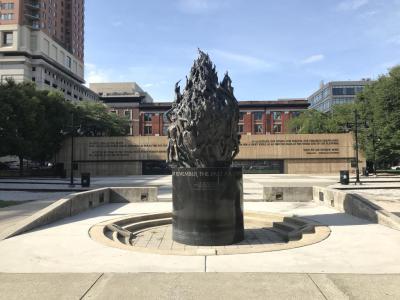
The design of the memorial is both striking and symbolic. It reflects the literal meaning of the word "Holocaust" as destruction by fire, and depicts the emaciated bodies of victims in a ball of flame. Though the design is quite startling, the memorial's supporters hoped that it would help convey their message of remembrance.
The base of the sculpture features the famous words of George Santayana, reminding visitors that those who do not remember the past are destined to repeat it.
In addition to the flame sculpture, the Baltimore Holocaust Memorial features a variety of other symbols and images that communicate the importance of remembrance.
Vintage railroad tracks symbolize the vast railway system that transported millions of victims to their deaths, while a black fence evokes the aura of a concentration camp. The sides of two massive concrete blocks feature quotes by Holocaust survivor and author Primo Levi.
Today, the Baltimore Holocaust Memorial stands as a powerful reminder of the need to remember the past and to prevent such atrocities from happening again in the future.
The origins of the Baltimore Holocaust Memorial can be traced back to the 1970s, when a ninth grade Baltimore Hebrew class told their teacher that they didn’t believe the Holocaust occurred. This moment marked the beginning of a campaign by Alvin Fisher to have a memorial to Holocaust victims constructed in Baltimore.
By 1976, the Baltimore Jewish Council took up the project and began raising funds, and by 1980, the memorial was designed at a cost of $300,000 by Donald Kann of Kann and Associates and Arthur Valk of Valk Design Associates.
The Baltimore Holocaust Memorial consists of three parts, including a large grassy mound planted with trees, two 80 x 19 feet cantilevered blocks of bleached, gray-white concrete, and a grassy mall behind the blocks. One wall features the memorial's consecration as well as a list of the 32 camps where the victims of the Holocaust died.
In 1988, the flame sculpture on the memorial was dedicated specifically to Kristallnacht, the Night of Broken Glass. Seven years later in 1995, the memorial had severely deteriorated, and the Jewish Council supported a redesigned memorial.
The design of the memorial is both striking and symbolic. It reflects the literal meaning of the word "Holocaust" as destruction by fire, and depicts the emaciated bodies of victims in a ball of flame. Though the design is quite startling, the memorial's supporters hoped that it would help convey their message of remembrance.
The base of the sculpture features the famous words of George Santayana, reminding visitors that those who do not remember the past are destined to repeat it.
In addition to the flame sculpture, the Baltimore Holocaust Memorial features a variety of other symbols and images that communicate the importance of remembrance.
Vintage railroad tracks symbolize the vast railway system that transported millions of victims to their deaths, while a black fence evokes the aura of a concentration camp. The sides of two massive concrete blocks feature quotes by Holocaust survivor and author Primo Levi.
Today, the Baltimore Holocaust Memorial stands as a powerful reminder of the need to remember the past and to prevent such atrocities from happening again in the future.
4) Baltimore City Hall
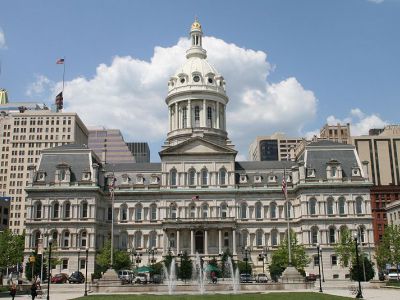
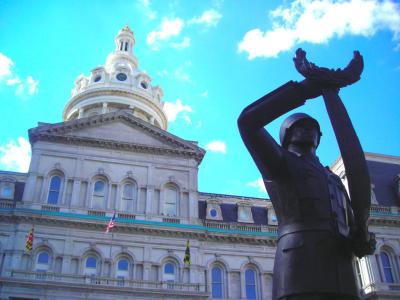
The Baltimore City Hall stands in the center of downtown as both a working government building and a symbol of the city’s post–Civil War growth. Construction began in 1867 and was completed in 1875, based on a design by architect George A. Frederick. Built in the Second Empire style, the six-story structure introduced a purpose-built home for city administration. The dome and cast-iron roof, engineered by Wendel Bollman, added both structural innovation.
The exterior is defined by its formal symmetry, mansard roof, and detailed stone façade. Columns, arched windows, and layered ornamentation give the building a sense of authority, while the central dome rises above the surrounding streets as a clear visual landmark. Inside, the building opens into a central rotunda beneath the dome, where natural light filters down. Corridors extend outward from this core, leading to offices and meeting rooms, including the City Council chamber.
Over time, the structure has undergone changes, particularly after World War II, when deterioration led to a major renovation. Two additional floors were added, significantly increasing the building’s usable space while preserving its historic character. Today, Baltimore City Hall is listed on the National Register of Historic Places and designated as a city landmark. While it continues to serve its administrative role, its exterior and accessible areas remain an integral part of a downtown walking route.
The exterior is defined by its formal symmetry, mansard roof, and detailed stone façade. Columns, arched windows, and layered ornamentation give the building a sense of authority, while the central dome rises above the surrounding streets as a clear visual landmark. Inside, the building opens into a central rotunda beneath the dome, where natural light filters down. Corridors extend outward from this core, leading to offices and meeting rooms, including the City Council chamber.
Over time, the structure has undergone changes, particularly after World War II, when deterioration led to a major renovation. Two additional floors were added, significantly increasing the building’s usable space while preserving its historic character. Today, Baltimore City Hall is listed on the National Register of Historic Places and designated as a city landmark. While it continues to serve its administrative role, its exterior and accessible areas remain an integral part of a downtown walking route.
5) War Memorial Plaza and Negro Heroes of the U.S. Monument
War Memorial Plaza and Negro Heroes of the U.S. Monument are two significant landmarks in Baltimore that commemorate the contributions and sacrifices of the city's residents in times of war. Built in 1927, War Memorial Plaza stands as a reminder of the 1,769 Marylanders who lost their lives in World War I.
Over the years, the plaza has become a cherished civic space in Baltimore, hosting various political events, concerts, and a popular spot for relaxation. Its central location, in front of Baltimore City Hall, makes it a prominent landmark in the city.
One of the most notable monuments on War Memorial Plaza is the Negro Heroes of the U.S. Monument, also known as the Black Soldier Memorial Statue. The statue was commissioned and dedicated by the City of Baltimore with the financial support of an anonymous donor. It was designed by sculptor James E. Lewis and unveiled on May 30th, 1972.
The statue depicts a soldier holding a wreath and sash. The sash bears a chronology of the wars in which African American soldiers served in the United States military. The monument honors the sacrifices and contributions of African American soldiers throughout the history of the United States.
Initially located on the north side of Battle Monument Park, the Negro Heroes of the U.S. Monument was relocated to War Memorial Plaza, in front of Baltimore City Hall, in 2007, where it stands as a reminder of the city's commitment to honoring its past and recognizing the contributions of all its residents.
Over the years, the plaza has become a cherished civic space in Baltimore, hosting various political events, concerts, and a popular spot for relaxation. Its central location, in front of Baltimore City Hall, makes it a prominent landmark in the city.
One of the most notable monuments on War Memorial Plaza is the Negro Heroes of the U.S. Monument, also known as the Black Soldier Memorial Statue. The statue was commissioned and dedicated by the City of Baltimore with the financial support of an anonymous donor. It was designed by sculptor James E. Lewis and unveiled on May 30th, 1972.
The statue depicts a soldier holding a wreath and sash. The sash bears a chronology of the wars in which African American soldiers served in the United States military. The monument honors the sacrifices and contributions of African American soldiers throughout the history of the United States.
Initially located on the north side of Battle Monument Park, the Negro Heroes of the U.S. Monument was relocated to War Memorial Plaza, in front of Baltimore City Hall, in 2007, where it stands as a reminder of the city's commitment to honoring its past and recognizing the contributions of all its residents.
6) U.S.S. Constellation
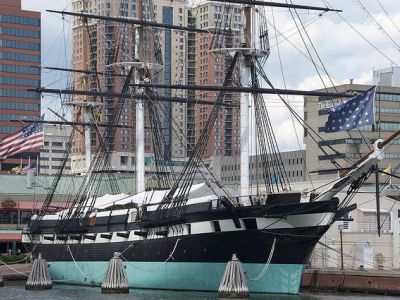
The USS Constellation is a 19th-century naval vessel moored at Constellation Dock in Baltimore’s Inner Harbor. Built between 1853 and 1855, it is the last sail-only warship constructed by the United States Navy and the last intact naval ship from the Civil War era. Parts of its construction incorporated salvaged materials from an earlier frigate of the same name. Over time, the ship served in multiple roles, including as a flagship in the Mediterranean and later as a training vessel.
From the outside, the ship’s tall masts, dense rigging, and wooden hull stand out. Rows of cannons line the gun deck, and the complexity of the rope systems hints at the coordination required to operate the sails. As you step aboard, the scale of the vessel becomes more apparent, with narrow passageways and steep ladders offering insight into the confined conditions sailors experienced.
The interior is arranged across four restored decks, presented to reflect the ship’s appearance during its Civil War service. The gun deck showcases its armament, while lower levels reveal sleeping quarters, storage areas, and officer spaces. Exhibits include thousands of artifacts, primarily documents and photographs, as well as personal items donated by descendants of former crew members.
Today, the USS Constellation operates as part of the Historic Ships in Baltimore, alongside other vessels and maritime structures in the harbor.
From the outside, the ship’s tall masts, dense rigging, and wooden hull stand out. Rows of cannons line the gun deck, and the complexity of the rope systems hints at the coordination required to operate the sails. As you step aboard, the scale of the vessel becomes more apparent, with narrow passageways and steep ladders offering insight into the confined conditions sailors experienced.
The interior is arranged across four restored decks, presented to reflect the ship’s appearance during its Civil War service. The gun deck showcases its armament, while lower levels reveal sleeping quarters, storage areas, and officer spaces. Exhibits include thousands of artifacts, primarily documents and photographs, as well as personal items donated by descendants of former crew members.
Today, the USS Constellation operates as part of the Historic Ships in Baltimore, alongside other vessels and maritime structures in the harbor.
7) Inner Harbor Waterfront Promenade (must see)
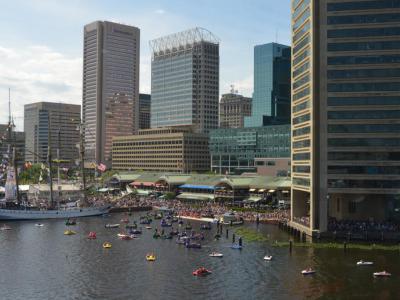
The Inner Harbor Waterfront Promenade forms the central pedestrian route along Baltimore’s revitalized waterfront, tracing an approximately eight-mile path around the harbor. Developed during the late 20th-century renewal of the Inner Harbor, it transformed former industrial docks into a continuous public space for walking, cycling, and gathering. Today, it provides direct access to views of the Patapsco River, while linking shops, restaurants, and cultural venues into a single, easy-to-follow route.
As you move along the promenade, the harbor remains constantly in view, with boats and historic ships. The path connects major attractions, including the National Aquarium in Baltimore, the USS Constellation, and the Top of the World Observation Level and Museum. Additional stops, such as the Maryland Science Center, located on the southwest edge of the Inner Harbor, offers interactive exhibits focused on science, technology, and space. Open plazas and seating areas provide space to pause and take in the surroundings.
The promenade also features several distinctive landmarks. The Mr. Trash Wheel, a solar- and hydro-powered trash interceptor, is positioned near the mouth of the Jones Falls waterway, on the eastern side of the Inner Harbor. A short walk away, the Seven Foot Knoll Lighthouse stands inland on Pier 5, slightly back from the water on your left side; it is a small red screw-pile lighthouse dating to the 19th century, once used to guide ships into the harbor.
Nearby, the Pride of Baltimore Memorial is located along the promenade close to the water’s edge, marking the legacy of Baltimore’s historic clipper ships and commemorating the crew of the Pride of Baltimore that was lost at sea. Throughout the day, the atmosphere shifts from quiet morning walks to busier afternoons and evenings filled with visitors. Street performers, small vendors, and waterfront cafés contribute to the sense of activity, while the wide pathways maintain a comfortable flow.
As you move along the promenade, the harbor remains constantly in view, with boats and historic ships. The path connects major attractions, including the National Aquarium in Baltimore, the USS Constellation, and the Top of the World Observation Level and Museum. Additional stops, such as the Maryland Science Center, located on the southwest edge of the Inner Harbor, offers interactive exhibits focused on science, technology, and space. Open plazas and seating areas provide space to pause and take in the surroundings.
The promenade also features several distinctive landmarks. The Mr. Trash Wheel, a solar- and hydro-powered trash interceptor, is positioned near the mouth of the Jones Falls waterway, on the eastern side of the Inner Harbor. A short walk away, the Seven Foot Knoll Lighthouse stands inland on Pier 5, slightly back from the water on your left side; it is a small red screw-pile lighthouse dating to the 19th century, once used to guide ships into the harbor.
Nearby, the Pride of Baltimore Memorial is located along the promenade close to the water’s edge, marking the legacy of Baltimore’s historic clipper ships and commemorating the crew of the Pride of Baltimore that was lost at sea. Throughout the day, the atmosphere shifts from quiet morning walks to busier afternoons and evenings filled with visitors. Street performers, small vendors, and waterfront cafés contribute to the sense of activity, while the wide pathways maintain a comfortable flow.
8) Federal Hill Park
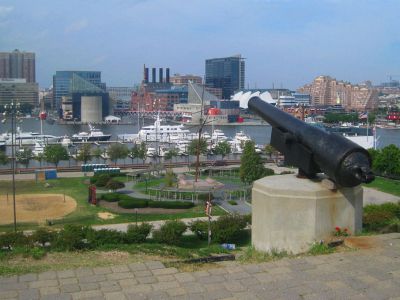
The Federal Hill Park rises just south of the Inner Harbor, offering one of the most recognizable panoramic views of Baltimore’s waterfront and skyline. Covering just over 10 acres, the park takes its name from the hill itself and the surrounding Federal Hill neighborhood. The site has long held strategic importance, including its use as a defensive position during the Civil War, when it served as Fort Federal Hill. It later opened as a public park in 1880, shifting from military use to a civic space for residents and visitors.
The park’s layout is simple and open, with grassy slopes, paved pathways, and a few shaded areas that keep the focus on the landscape and the outlook. Cannons positioned along the ridge recall the hill’s military past. The park has undergone changes over time, including periods of erosion caused by the hill’s red clay composition. Stabilization efforts in the late 20th century helped secure the landscape and preserve its accessibility.
On the north side, the Armistead Monument commemorates Major General Samuel Smith, often associated with Baltimore’s defense, and the broader leadership that helped protect the city during the War of 1812. In addition to its historical elements, the park includes recreational features such as a playground, basketball court, and beach volleyball area. It is used throughout the day for walking and picnics, and in the evening for quieter activities such as watching the skyline at sunset.
The park’s layout is simple and open, with grassy slopes, paved pathways, and a few shaded areas that keep the focus on the landscape and the outlook. Cannons positioned along the ridge recall the hill’s military past. The park has undergone changes over time, including periods of erosion caused by the hill’s red clay composition. Stabilization efforts in the late 20th century helped secure the landscape and preserve its accessibility.
On the north side, the Armistead Monument commemorates Major General Samuel Smith, often associated with Baltimore’s defense, and the broader leadership that helped protect the city during the War of 1812. In addition to its historical elements, the park includes recreational features such as a playground, basketball court, and beach volleyball area. It is used throughout the day for walking and picnics, and in the evening for quieter activities such as watching the skyline at sunset.
