Custom Walk in Lille, France by saveljeva_olga_4ea6ea created on 2026-06-01
Guide Location: France » Lille
Guide Type: Custom Walk
# of Sights: 9
Tour Duration: 2 Hour(s)
Travel Distance: 4.5 Km or 2.8 Miles
Share Key: MEVVK
Guide Type: Custom Walk
# of Sights: 9
Tour Duration: 2 Hour(s)
Travel Distance: 4.5 Km or 2.8 Miles
Share Key: MEVVK
How It Works
Please retrieve this walk in the GPSmyCity app. Once done, the app will guide you from one tour stop to the next as if you had a personal tour guide. If you created the walk on this website or come to the page via a link, please follow the instructions below to retrieve the walk in the app.
Retrieve This Walk in App
Step 1. Download the app "GPSmyCity: Walks in 1K+ Cities" on Apple App Store or Google Play Store.



Step 2. In the GPSmyCity app, download(or launch) the guide "Lille Map and Walking Tours".
Step 3. Tap the menu button located at upper right corner of the "Walks" screen and select "Retrieve custom walk". Enter the share key: MEVVK
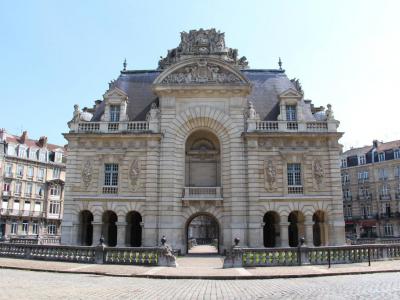
1) Porte de Paris (Paris Gate)
King Louis IV entered the city on August 28, 1667. He passed through the Gate of the Sick and received the keys to the city from Lille’s magistrates. Although Lille’s incorporation into France was not formally confirmed until the Treaty of Aix-la-Chapelle in 1668, Louis IV already had plans for the city and its old southern gateway.
Several years later, Louis IV commissioned engineer and architect Simon Vollant to construct the Paris Gate. Built between 1685 and 1692, it was conceived as a monument celebrating Louis XIV’s conquest of Lille. The triumphal structure was erected opposite a city-side guardhouse. Around 1860, the guardhouse was demolished during the dismantling of Lille’s fortifications, while Vollant’s gate was preserved.
Between 1888 and 1895, the Paris Gate was redeveloped by architect Louis-Marie Cordonnier. He added a new façade on the city side and redesigned the surrounding area as the circular Place Simon-Vollant. Consequently, the monument now has two noticeably different façades: Vollant’s 17th-century ceremonial entrance and Cordonnier’s 19th-century city-facing addition.
As you face the original outer façade and look northwest, toward the city, Mars, the god of war, stands on the left, while Hercules, a symbol of strength, appears on the right. At the summit, two winged figures of Fame sound their trumpets, while Victory raises a crown above a medallion of Louis XIV. At ground level, a former drawbridge leads into a vaulted passage that opens toward the city.
Several years later, Louis IV commissioned engineer and architect Simon Vollant to construct the Paris Gate. Built between 1685 and 1692, it was conceived as a monument celebrating Louis XIV’s conquest of Lille. The triumphal structure was erected opposite a city-side guardhouse. Around 1860, the guardhouse was demolished during the dismantling of Lille’s fortifications, while Vollant’s gate was preserved.
Between 1888 and 1895, the Paris Gate was redeveloped by architect Louis-Marie Cordonnier. He added a new façade on the city side and redesigned the surrounding area as the circular Place Simon-Vollant. Consequently, the monument now has two noticeably different façades: Vollant’s 17th-century ceremonial entrance and Cordonnier’s 19th-century city-facing addition.
As you face the original outer façade and look northwest, toward the city, Mars, the god of war, stands on the left, while Hercules, a symbol of strength, appears on the right. At the summit, two winged figures of Fame sound their trumpets, while Victory raises a crown above a medallion of Louis XIV. At ground level, a former drawbridge leads into a vaulted passage that opens toward the city.
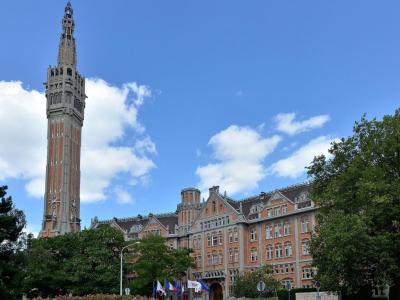
2) Beffroi de l'Hôtel de ville de Lille (Belfry of Lille Town Hall) (must see)
The city’s Town Hall belfry, one of the tallest civic belfries in Europe and the tallest municipal building in France, stands as a architectural and symbolic edifice, recalling the civic towers that traditionally represented municipal freedom and authority.
The belfry was inaugurated on October 16, 1932, as part of a project to replace Lille’s former town hall, which was destroyed by an accidental fire in 1916 during the First World War. It was designed by architect Émile Dubuisson, who drew inspiration from the traditional architecture of Lille, particularly the narrow bays and triangular gables of the city’s old Flemish-style houses.
Built of red brick and reinforced concrete, the belfry is slender and modernist, rising beside the broad, monumental Town Hall. Despite their contrasting forms, the two structures create a balanced architectural ensemble. Lille had used several earlier structures as civic belfries. The tower of the medieval aldermen’s hall was partly dismantled in 1601, after which the tower of Saint-Étienne Church served as the city’s belfry until it was destroyed during the siege of 1792. Lille then remained without a municipal belfry until the present tower was built.
The Town Hall and its belfry combine Art Deco design with regional neo-Flemish elements. Dubuisson used reinforced concrete both for structural strength and as a decorative material, molding and treating it to resemble carved stone. Completed between 1929 and 1932, the belfry rises 341 feet.
Visitors can climb 415 steps or use the historic elevator for part of the ascent. Near the summit, an outdoor belvedere protected by safety netting provides a panoramic view across Lille and the surrounding region. The wind can be strong at this height, but the 360-degree view makes the climb an adventure of its own.
The belfry was inaugurated on October 16, 1932, as part of a project to replace Lille’s former town hall, which was destroyed by an accidental fire in 1916 during the First World War. It was designed by architect Émile Dubuisson, who drew inspiration from the traditional architecture of Lille, particularly the narrow bays and triangular gables of the city’s old Flemish-style houses.
Built of red brick and reinforced concrete, the belfry is slender and modernist, rising beside the broad, monumental Town Hall. Despite their contrasting forms, the two structures create a balanced architectural ensemble. Lille had used several earlier structures as civic belfries. The tower of the medieval aldermen’s hall was partly dismantled in 1601, after which the tower of Saint-Étienne Church served as the city’s belfry until it was destroyed during the siege of 1792. Lille then remained without a municipal belfry until the present tower was built.
The Town Hall and its belfry combine Art Deco design with regional neo-Flemish elements. Dubuisson used reinforced concrete both for structural strength and as a decorative material, molding and treating it to resemble carved stone. Completed between 1929 and 1932, the belfry rises 341 feet.
Visitors can climb 415 steps or use the historic elevator for part of the ascent. Near the summit, an outdoor belvedere protected by safety netting provides a panoramic view across Lille and the surrounding region. The wind can be strong at this height, but the 360-degree view makes the climb an adventure of its own.
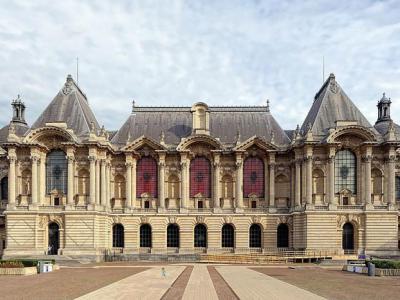
3) Palais des Beaux-Arts (Palace of Fine Arts) (must see)
The Palace of Fine Arts occupies a grand late-19th-century palace designed by Édouard Bérard and Fernand Delmas. Its architecture combines classical and Baroque influences, with touches of the Italian Renaissance. Columns, pediments, balustrades, loggias, elaborate moldings, and a steep French-style roof enrich the monumental façade. Domed pavilions rise at either end of the building, reinforcing its formal symmetry.
The museum was established following a decree signed by Napoleon Bonaparte, then First Consul, in 1801. Lille was among the French cities selected to receive works confiscated during the Revolution and the military campaigns in occupied European territories. The collection opened to the public in 1809. The present building was inaugurated in 1892 and underwent an extensive renovation between 1991 and 1997 under architects Marc Ibos and Myrto Vitart.
On the lower-ground floor, visitors can examine a remarkable collection of large-scale relief models showing fortified towns in northern France and present-day Belgium. Produced for military and strategic purposes, many depict fortifications designed or improved under Sébastien Le Prestre de Vauban, Louis XIV’s celebrated military engineer. The ground floor contains a gallery devoted to 19th-century French sculpture, with collections of ceramics, medieval art, and Renaissance objects.
The first floor houses the principal painting galleries. These include important Flemish and Dutch works, along with French paintings extending from Jacques-Louis David to Henri de Toulouse-Lautrec. Italian and Spanish masters are also represented.
The museum’s holdings comprise tens of thousands of artworks, including paintings, drawings, sculptures, antiquities, ceramics, and decorative arts. Among the artists represented are Raphael, Donatello, Van Dyck, Rembrandt, Goya, El Greco, Delacroix, Rubens, Rodin, Camille Claudel, and Chardin.
The museum was established following a decree signed by Napoleon Bonaparte, then First Consul, in 1801. Lille was among the French cities selected to receive works confiscated during the Revolution and the military campaigns in occupied European territories. The collection opened to the public in 1809. The present building was inaugurated in 1892 and underwent an extensive renovation between 1991 and 1997 under architects Marc Ibos and Myrto Vitart.
On the lower-ground floor, visitors can examine a remarkable collection of large-scale relief models showing fortified towns in northern France and present-day Belgium. Produced for military and strategic purposes, many depict fortifications designed or improved under Sébastien Le Prestre de Vauban, Louis XIV’s celebrated military engineer. The ground floor contains a gallery devoted to 19th-century French sculpture, with collections of ceramics, medieval art, and Renaissance objects.
The first floor houses the principal painting galleries. These include important Flemish and Dutch works, along with French paintings extending from Jacques-Louis David to Henri de Toulouse-Lautrec. Italian and Spanish masters are also represented.
The museum’s holdings comprise tens of thousands of artworks, including paintings, drawings, sculptures, antiquities, ceramics, and decorative arts. Among the artists represented are Raphael, Donatello, Van Dyck, Rembrandt, Goya, El Greco, Delacroix, Rubens, Rodin, Camille Claudel, and Chardin.
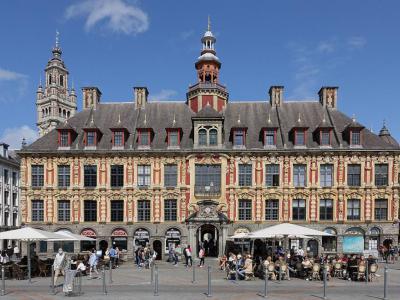
4) Vieille Bourse (Old Stock Exchange) (must see)
In 1651, the city’s magistrates obtained permission from King Philip IV of Spain to build an exchange where local merchants could conduct business. Julien Destrée a municipal architect, was chosen to bring the project to life, creating a commercial monument inspired partly by the celebrated exchanges of Antwerp and Amsterdam.
The king had authorized the construction of “an exchange for the use of merchants,” surrounded by 24 houses. The city sold 24 plots around the market square to traders, while the municipal authorities financed the galleries, the paving of the courtyard, and the four entrances. Construction proceeded under Destrée’s direction from the spring of 1652 until the autumn of 1653.
The building is a fine example of 17th-century Flemish Mannerist architecture. Its pilasters, window frames, and columns are richly decorated with garlands of fruit, scrolls, and cornucopias. Above the courtyard rises a small campanile crowned by a gilded figure of Mercury, the Roman god of trade. The elaborate ornamentation reflected Lille’s commercial ambitions at a time when it competed with Flemish cities such as Antwerp, Ghent, and Bruges.
In 1861, a modern securities exchange began operating inside the building. Trading remained limited, however, with only about 3.4 percent of the listed capital changing hands each year. The exchange later moved into the new Chamber of Commerce building, constructed between 1910 and 1921. The older complex consequently became known as the Old Stock Exchange.
The king had authorized the construction of “an exchange for the use of merchants,” surrounded by 24 houses. The city sold 24 plots around the market square to traders, while the municipal authorities financed the galleries, the paving of the courtyard, and the four entrances. Construction proceeded under Destrée’s direction from the spring of 1652 until the autumn of 1653.
The building is a fine example of 17th-century Flemish Mannerist architecture. Its pilasters, window frames, and columns are richly decorated with garlands of fruit, scrolls, and cornucopias. Above the courtyard rises a small campanile crowned by a gilded figure of Mercury, the Roman god of trade. The elaborate ornamentation reflected Lille’s commercial ambitions at a time when it competed with Flemish cities such as Antwerp, Ghent, and Bruges.
In 1861, a modern securities exchange began operating inside the building. Trading remained limited, however, with only about 3.4 percent of the listed capital changing hands each year. The exchange later moved into the new Chamber of Commerce building, constructed between 1910 and 1921. The older complex consequently became known as the Old Stock Exchange.
5) Grande Place (Main Square) (must see)
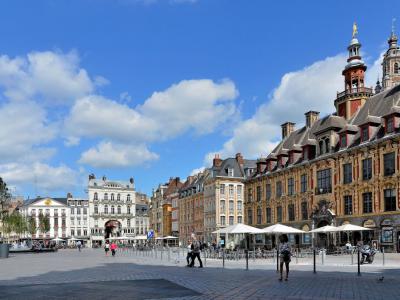
Lille’s Main Square forms the historic and social center of the city. The square developed on marshy ground that was gradually drained and prepared for use as a grain market during the Middle Ages. It acquired its present official name in 1944 in honor of statesman Charles de Gaulle, who was born in Lille.
The square is framed by an varied collection of Flemish and French façades, with stepped gables, warm brickwork, carved stone details, and steep slate roofs. Its best-known building is the Old Stock Exchange on the north side of the square. At the center of the square stands the Column of the Goddess, inaugurated in 1845 to commemorate Lille’s resistance during the Austrian siege of 1792. The female figure, sculpted by Théophile Bra, holds a firing linstock and symbolizes the city’s determination to defend itself.
Other prominent landmarks include the North Theater, housed in the former Grand Guard building on the southeastern side of the square, and the adjoining “The Voice of the North” building, immediately to the theater’s left as you face them. The newspaper building’s monumental stepped gable is crowned by three gilded female figures representing Flanders, Artois, and Hainaut. Created by sculptor Raymond Couvègnes, the figures are collectively known as the Three Graces.
Today, the Main Square remains one of Lille’s principal meeting places. Café terraces, shops, and restaurants line its edges, while seasonal decorations and public events regularly transform the open space. Visitors should also pass through one of the entrances of the Old Stock Exchange to see its quieter courtyard, whose elaborate façades provide a close-up view of the ornamentation associated with Lille’s 17th-century commercial prosperity.
The square is framed by an varied collection of Flemish and French façades, with stepped gables, warm brickwork, carved stone details, and steep slate roofs. Its best-known building is the Old Stock Exchange on the north side of the square. At the center of the square stands the Column of the Goddess, inaugurated in 1845 to commemorate Lille’s resistance during the Austrian siege of 1792. The female figure, sculpted by Théophile Bra, holds a firing linstock and symbolizes the city’s determination to defend itself.
Other prominent landmarks include the North Theater, housed in the former Grand Guard building on the southeastern side of the square, and the adjoining “The Voice of the North” building, immediately to the theater’s left as you face them. The newspaper building’s monumental stepped gable is crowned by three gilded female figures representing Flanders, Artois, and Hainaut. Created by sculptor Raymond Couvègnes, the figures are collectively known as the Three Graces.
Today, the Main Square remains one of Lille’s principal meeting places. Café terraces, shops, and restaurants line its edges, while seasonal decorations and public events regularly transform the open space. Visitors should also pass through one of the entrances of the Old Stock Exchange to see its quieter courtyard, whose elaborate façades provide a close-up view of the ornamentation associated with Lille’s 17th-century commercial prosperity.
6) Lille Cathedral (must see)
The venerated statue of Our Lady of the Treille, traditionally associated with miraculous events, was housed in Lille’s Collegiate Church of Saint Peter from the beginning of the 13th century until the French Revolution. Its name has traditionally been linked to the gilded iron trellis surrounding it. When the church was destroyed, the statue was saved, and eventually given to Saint Catherine’s Church.
In 1853, politician and businessman Charles Kolb-Bernard and his cousin, Abbé Charles Bernard, established a commission to build a magnificent new church in honor of Our Lady of the Treille. An international architectural competition launched in 1854 required designs inspired by the early-13th-century Gothic architecture of cathedrals such as Reims, Amiens, and Chartres.
The original scheme was extremely ambitious, calling for a building approximately 433 feet, long, with spires rising more than 377 feet. Financial difficulties, wars, and repeated interruptions prevented the project from being completed as originally envisioned. Construction continued in stages for 145 years, and the cathedral’s modern western façade was finally inaugurated in 1999.
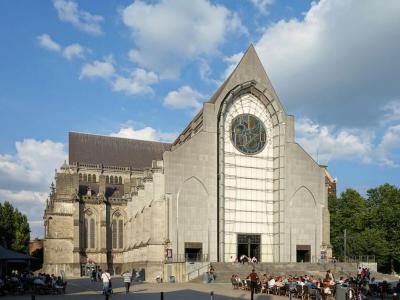
The façade’s central section forms a 98-foot, pointed arch filled with 110 thin panels of translucent white marble. The façade was conceived by architect Pierre-Louis Carlier, with structural engineering by Peter Rice. Its circular window, represents the Resurrection, while the monumental bronze entrance portal was created by sculptor Georges Jeanclos.
The result is a vast neo-Gothic cathedral with a distinctly contemporary façade. In addition to religious services, it hosts concerts, exhibitions, and other cultural events. The modern crypt contains the Sacred Art Center, which displays contemporary works from the Delaine Collection devoted largely to the Passion of Christ.
In 1853, politician and businessman Charles Kolb-Bernard and his cousin, Abbé Charles Bernard, established a commission to build a magnificent new church in honor of Our Lady of the Treille. An international architectural competition launched in 1854 required designs inspired by the early-13th-century Gothic architecture of cathedrals such as Reims, Amiens, and Chartres.
The original scheme was extremely ambitious, calling for a building approximately 433 feet, long, with spires rising more than 377 feet. Financial difficulties, wars, and repeated interruptions prevented the project from being completed as originally envisioned. Construction continued in stages for 145 years, and the cathedral’s modern western façade was finally inaugurated in 1999.
The façade’s central section forms a 98-foot, pointed arch filled with 110 thin panels of translucent white marble. The façade was conceived by architect Pierre-Louis Carlier, with structural engineering by Peter Rice. Its circular window, represents the Resurrection, while the monumental bronze entrance portal was created by sculptor Georges Jeanclos.
The result is a vast neo-Gothic cathedral with a distinctly contemporary façade. In addition to religious services, it hosts concerts, exhibitions, and other cultural events. The modern crypt contains the Sacred Art Center, which displays contemporary works from the Delaine Collection devoted largely to the Passion of Christ.
7) Charles de Gaulle Birthplace Museum
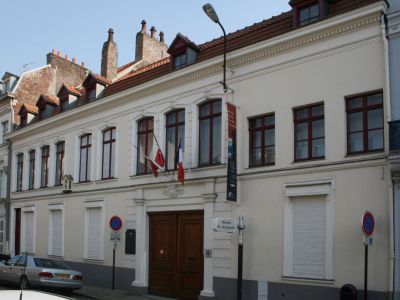
The Charles de Gaulle Birthplace Museum, located on Princesse Street in the historical district of Old Lille, is a cultural and historical site dedicated to the early life of one of France's most esteemed figures. Originally the residence of Charles de Gaulle's maternal grandparents, this 19th-century mansion witnessed the birth of the future general and president in 1890. Since its opening to the public in 1983, the museum has attracted thousands of visitors annually, numbering between 19,000 and 20,000.
Managed by the Departmental Council of Nord and under the ownership of the Charles-de-Gaulle Foundation, the museum is recognized as a monument historique and has been bestowed the Houses of the Illustrious (Maisons des Illustres) label, affirming its significance in French heritage. The museum complex, known as the History Factory (Fabrique d'Histoire), is a blend of personal and historical exploration, displaying an array of family mementos, personal items, and documents that provide a glimpse into de Gaulle's formative years.
Rehabilitated in the early 2000s, the museum now offers visitors a comprehensive view of the family home's various rooms and a cultural center located in what was once the tulle factory run by de Gaulle's grandfather. This area has been transformed into a vibrant educational space featuring a chronological fresco of de Gaulle's life, a multimedia center, and activities tailored for younger audiences.
Visitors to the museum can immerse themselves in the historical ambiance of the period through its preserved architecture, period furnishings, and an extensive collection of artifacts that narrate the life of one of France's most celebrated figures. The Charles de Gaulle Birthplace Museum is not only a testament to the personal history of de Gaulle but also serves as an educational site where tourists and locals alike can delve into the rich tapestry of French history.
Managed by the Departmental Council of Nord and under the ownership of the Charles-de-Gaulle Foundation, the museum is recognized as a monument historique and has been bestowed the Houses of the Illustrious (Maisons des Illustres) label, affirming its significance in French heritage. The museum complex, known as the History Factory (Fabrique d'Histoire), is a blend of personal and historical exploration, displaying an array of family mementos, personal items, and documents that provide a glimpse into de Gaulle's formative years.
Rehabilitated in the early 2000s, the museum now offers visitors a comprehensive view of the family home's various rooms and a cultural center located in what was once the tulle factory run by de Gaulle's grandfather. This area has been transformed into a vibrant educational space featuring a chronological fresco of de Gaulle's life, a multimedia center, and activities tailored for younger audiences.
Visitors to the museum can immerse themselves in the historical ambiance of the period through its preserved architecture, period furnishings, and an extensive collection of artifacts that narrate the life of one of France's most celebrated figures. The Charles de Gaulle Birthplace Museum is not only a testament to the personal history of de Gaulle but also serves as an educational site where tourists and locals alike can delve into the rich tapestry of French history.
8) Column of the Goddess
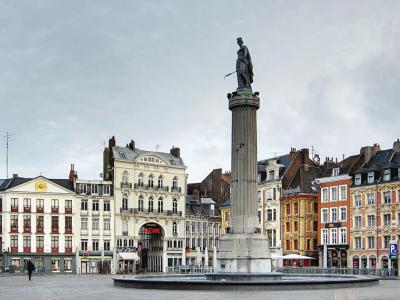
The Column of the Goddess stands as a poignant memorial in the heart of the city's Grand Place, or General de Gaulle Square (Place du Général de Gaulle). This memorial commemorates the Siege of Lille in September 1792, during the French Revolutionary Wars, a pivotal moment in local history marked by the relentless and heroic resistance of Lille's citizens against Austrian forces. Despite its limited strategic importance in the broader scope of the wars, the siege remains a significant event for Lille's residents.
For nine continuous days and nights, the Austrians bombarded Lille, resulting in substantial destruction, including the demolition of many houses and the main church, Saint-Etienne, located on the Grand Place. This church was never rebuilt, leaving the Grand Place notably devoid of a church or belfry, which is unusual compared to other central squares in similar cities like Bruges and Brussels.
The absence of a physical monument to remember the siege was felt until the mid-19th century. In response, local authorities decided to erect a memorial in time for the siege's 50th anniversary. The foundation stone was laid in September 1842, and the memorial was completed three years later in 1845.
Designed by architect Charles Benvignat, the memorial features a column topped by a statue crafted by sculptor Théophile Bra. The statue, an allegorical representation of the besieged city adorned with a mural crown, quickly earned the moniker "The Goddess" from locals. This nickname was reinforced by references in contemporary poetry. Since around 1990, the column has also been encircled by a fountain, enhancing its presence as a central and cherished landmark in Lille.
For nine continuous days and nights, the Austrians bombarded Lille, resulting in substantial destruction, including the demolition of many houses and the main church, Saint-Etienne, located on the Grand Place. This church was never rebuilt, leaving the Grand Place notably devoid of a church or belfry, which is unusual compared to other central squares in similar cities like Bruges and Brussels.
The absence of a physical monument to remember the siege was felt until the mid-19th century. In response, local authorities decided to erect a memorial in time for the siege's 50th anniversary. The foundation stone was laid in September 1842, and the memorial was completed three years later in 1845.
Designed by architect Charles Benvignat, the memorial features a column topped by a statue crafted by sculptor Théophile Bra. The statue, an allegorical representation of the besieged city adorned with a mural crown, quickly earned the moniker "The Goddess" from locals. This nickname was reinforced by references in contemporary poetry. Since around 1990, the column has also been encircled by a fountain, enhancing its presence as a central and cherished landmark in Lille.
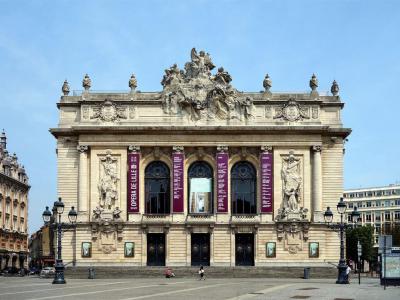
9) Opéra de Lille (Lille Opera)
The Lille Opera (Opéra de Lille) is an example of Neoclassical architecture, seamlessly integrated with the adjacent Chamber of Commerce and Old Stock Exchange. The current structure was erected from 1907 to 1913 after its predecessor, dating back to 1785, was destroyed by fire in 1903.
The design of the new opera house was the vision of architect Louis Marie Cordonnier, selected through a competitive process. His Belle Époque style is evident in the building's grand façade, which features an elaborate pediment relief crafted by Hippolyte Lefèbvre. This is complemented by two bas-relief panels on either side, created by Alphonse-Amédée Cordonnier and Hector Lemaire. The interior of the opera house is equally striking, showcasing the artistic contributions of the prominent sculptor Edgar-Henri Boutry.
However, the building's completion was marred by the events of World War I. In July 1914, German forces occupying Lille requisitioned the still unfinished opera house, stripping it of its furniture and equipment to outfit the local Sebastopol Theatre. It wasn't until after the war that the opera house was fully restored, reopening in 1923 as the Grand Theatre. This reopening was celebrated with a French premiere (première française), marking a new chapter in its history.
The theatre again faced challenges in 1998 when it was forced to close mid-season due to deteriorating physical conditions. This closure led to an extensive renovation project aimed not only at restoring the building but also at enhancing its functional capacities. The renovation was completed in 2004, coinciding with Lille's designation as the European Capital of Culture, thus affirming the Opéra de Lille's status as a cultural and architectural landmark in the region.
The design of the new opera house was the vision of architect Louis Marie Cordonnier, selected through a competitive process. His Belle Époque style is evident in the building's grand façade, which features an elaborate pediment relief crafted by Hippolyte Lefèbvre. This is complemented by two bas-relief panels on either side, created by Alphonse-Amédée Cordonnier and Hector Lemaire. The interior of the opera house is equally striking, showcasing the artistic contributions of the prominent sculptor Edgar-Henri Boutry.
However, the building's completion was marred by the events of World War I. In July 1914, German forces occupying Lille requisitioned the still unfinished opera house, stripping it of its furniture and equipment to outfit the local Sebastopol Theatre. It wasn't until after the war that the opera house was fully restored, reopening in 1923 as the Grand Theatre. This reopening was celebrated with a French premiere (première française), marking a new chapter in its history.
The theatre again faced challenges in 1998 when it was forced to close mid-season due to deteriorating physical conditions. This closure led to an extensive renovation project aimed not only at restoring the building but also at enhancing its functional capacities. The renovation was completed in 2004, coinciding with Lille's designation as the European Capital of Culture, thus affirming the Opéra de Lille's status as a cultural and architectural landmark in the region.
