Custom Walk in Liverpool, England by vanessa_doyle_aff4c7 created on 2026-06-04
Guide Location: England » Liverpool
Guide Type: Custom Walk
# of Sights: 10
Tour Duration: 2 Hour(s)
Travel Distance: 3.5 Km or 2.2 Miles
Share Key: ZNZQF
Guide Type: Custom Walk
# of Sights: 10
Tour Duration: 2 Hour(s)
Travel Distance: 3.5 Km or 2.2 Miles
Share Key: ZNZQF
How It Works
Please retrieve this walk in the GPSmyCity app. Once done, the app will guide you from one tour stop to the next as if you had a personal tour guide. If you created the walk on this website or come to the page via a link, please follow the instructions below to retrieve the walk in the app.
Retrieve This Walk in App
Step 1. Download the app "GPSmyCity: Walks in 1K+ Cities" on Apple App Store or Google Play Store.



Step 2. In the GPSmyCity app, download(or launch) the guide "Liverpool Map and Walking Tours".
Step 3. Tap the menu button located at upper right corner of the "Walks" screen and select "Retrieve custom walk". Enter the share key: ZNZQF
1) Hargreaves Building
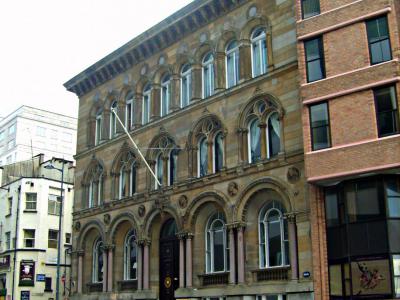
The Hargreaves Building, located in Chapel Street, close to Liverpool’s docklands, was built in 1859 as a head office for Brown Shipley Bank. The bank was founded by local finance magnate and philanthropist Sir William Brown. Designed by architect and renowned local figure Sir James Picton, the building was a collaboration between two of the city’s most famous sons. Designed in the Venetian style with rounded window frames, Hargreaves Building also bears symbols of the city’s rich maritime heritage. Images relating to history’s great explorers – Columbus, Vespucci and Pizarro, amongst others – are engraved above the windows. The building is actually four stories in total, as it has a large basement level below ground.
When the Brown Shipley Bank moved to London in 1888, the building was converted to house offices. It was then taken over by the city’s Racquet Club, who turned it into a brand new premises, comprising squash courts, a swimming pool and a billiard room. This followed a grim chapter in Liverpudlian history, when the club’s previous building was destroyed during the Toxteth Riots of 1981. The Hargreaves Building is now a hotel and restaurant, still bearing the Racquet Club name. The building was awarded Grade II listed status by English Heritage in 1966.
When the Brown Shipley Bank moved to London in 1888, the building was converted to house offices. It was then taken over by the city’s Racquet Club, who turned it into a brand new premises, comprising squash courts, a swimming pool and a billiard room. This followed a grim chapter in Liverpudlian history, when the club’s previous building was destroyed during the Toxteth Riots of 1981. The Hargreaves Building is now a hotel and restaurant, still bearing the Racquet Club name. The building was awarded Grade II listed status by English Heritage in 1966.
2) Oriel Chambers
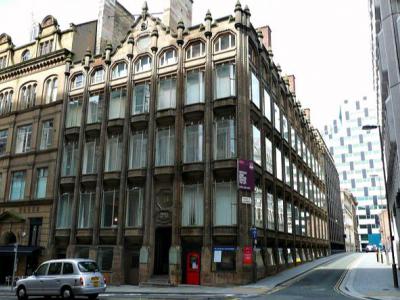
Oriel Chambers, located on Water Street near Liverpool's town hall, is a pioneering architectural landmark. Built in 1864, it was the first building in the world to feature a metal-framed glass curtain wall, a design element that has since become a hallmark of modern skyscrapers. Designed by the innovative architect Peter Ellis, the five-story Grade I listed building comprises 43,000 square feet (4,000 square meters) of floor space. Its striking grid of oriel windows maximizes natural light, giving the structure its iconic appearance.
When first completed, Oriel Chambers received mixed reviews, with some critics dismissing its unconventional design. However, its forward-thinking elements caught the attention of figures like John Wellborn Root, a young student in Liverpool during the American Civil War. Root later became a prominent architect in the Chicago School of Architecture, incorporating lessons from Ellis’s designs into American skyscrapers.
Oriel Chambers and Ellis’s nearby building at 16 Cook Street are considered early precursors of modernist architecture. Both structures utilize metal-framed glass curtain walls and H-section iron columns at their perimeters, which support the floors and cladding. This approach prefigured modern construction techniques, though Ellis's specific cladding method was not widely adopted.
The structure underwent changes over the years, including the addition of a 1950s extension to repair damage caused by German bombing during the Second World War. Refurbished by Bruntwood after being purchased in 2006, it was sold in 2019 to Yakel Property Investment, which planned further updates. Today, its primary tenant is a barristers' chamber, which has occupied various spaces within the building since 1965.
Oriel Chambers has also garnered media attention, featuring in the first episode of Grundy's Northern Pride, a television series highlighting notable northern English architecture. This enduring icon stands as a testament to Peter Ellis's vision and its profound influence on architectural history.
When first completed, Oriel Chambers received mixed reviews, with some critics dismissing its unconventional design. However, its forward-thinking elements caught the attention of figures like John Wellborn Root, a young student in Liverpool during the American Civil War. Root later became a prominent architect in the Chicago School of Architecture, incorporating lessons from Ellis’s designs into American skyscrapers.
Oriel Chambers and Ellis’s nearby building at 16 Cook Street are considered early precursors of modernist architecture. Both structures utilize metal-framed glass curtain walls and H-section iron columns at their perimeters, which support the floors and cladding. This approach prefigured modern construction techniques, though Ellis's specific cladding method was not widely adopted.
The structure underwent changes over the years, including the addition of a 1950s extension to repair damage caused by German bombing during the Second World War. Refurbished by Bruntwood after being purchased in 2006, it was sold in 2019 to Yakel Property Investment, which planned further updates. Today, its primary tenant is a barristers' chamber, which has occupied various spaces within the building since 1965.
Oriel Chambers has also garnered media attention, featuring in the first episode of Grundy's Northern Pride, a television series highlighting notable northern English architecture. This enduring icon stands as a testament to Peter Ellis's vision and its profound influence on architectural history.

3) Nelson Monument
The Nelson Monument is a tribute to Lord Horatio Nelson, the renowned British Admiral who died whilst defeating the French Navy at the Battle of Trafalgar in 1805. It was designed by Matthew Coates Wyatt and sculpted by Sir Richard Westmacott. Unveiled in 1813, the monument was the first major public sculpture to appear in the city of Liverpool. It is situated at Exchange Flags Square, behind Liverpool’s town hall. Whilst Lord Nelson had no great association with the city, his navy’s victory was of great local significance. The war with France had greatly restricted maritime trade, and the victory at Trafalgar allowed Liverpool to build a reputation as a global shipping centre.
The Nelson Monument is circular and carved from stone, and holds a bronze statue of Nelson sitting astride a cannon. The other bronze figures surrounding the Admiral are a sailor, the goddess Britannia, a skeleton, and an angelic body representing Victory. At the base of the monument are four prisoners of war in shackles, and panels showing four of Nelson’s greatest naval victories. The inscription around the circumference of the monument reads “England expects that every man will do his duty” – words uttered by Nelson himself during the fateful battle of Trafalgar.
The Nelson Monument is circular and carved from stone, and holds a bronze statue of Nelson sitting astride a cannon. The other bronze figures surrounding the Admiral are a sailor, the goddess Britannia, a skeleton, and an angelic body representing Victory. At the base of the monument are four prisoners of war in shackles, and panels showing four of Nelson’s greatest naval victories. The inscription around the circumference of the monument reads “England expects that every man will do his duty” – words uttered by Nelson himself during the fateful battle of Trafalgar.
4) Town Hall
The Liverpool Town Hall, an architectural jewel of 18th-century England, is situated at the crossroads of High Street, Dale Street, Castle Street, and Water Street in Liverpool, Merseyside. Recognized as a Grade I listed building in the National Heritage List for England, it is celebrated as "one of the finest surviving 18th-century town halls."
Constructed between 1749 and 1754, the Town Hall was designed by John Wood the Elder to replace an earlier building nearby. An extension by James Wyatt in 1785 added grandeur, but a fire in 1795 led to extensive rebuilding, including Wyatt's distinctive dome. Over time, minor alterations have been made, and the surrounding streets were restructured, notably removing obstructing buildings to reveal the hall’s southern façade from Castle Street.
Unlike administrative buildings such as the nearby Cunard Building, Liverpool Town Hall serves as a civic suite. It houses the Lord Mayor's parlor, Council Chamber, and a Hall of Remembrance dedicated to Liverpool servicemen who perished in World War I. The opulent upper floor hosts events, functions, and weddings, with public tours offering a glimpse into its historical and decorative splendor.
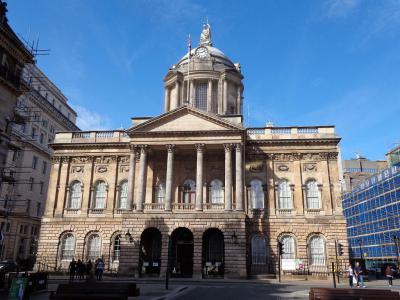
The Town Hall, made of stone with a slate roof and lead dome, features a rectangular plan with a southern portico and Wyatt’s narrower northern extension. It has two stories, a rusticated basement, and façades with classical details. The south side has nine bays, a portico with rounded arches, and an upper balcony with Corinthian columns. The east and west façades have nine bays, plus three in Wyatt's extension, while the north includes five bays, a portico, and statues by Richard Westmacott from the Irish Houses of Parliament. Carvings above windows reflect Liverpool's trade history, and the dome, encircled by clock faces with lions and unicorns, is crowned by Minerva, a 10-foot statue symbolizing wisdom.
Liverpool Town Hall remains an enduring testament to the city's civic pride and Georgian architectural heritage, offering both a functional space and a visual marvel for visitors and locals alike.
Why You Should Visit:
Inside, visitors will find the grandest suite of civic rooms in the UK and a magnificent example of late Georgian decoration.
You also might want to go onto the balcony where the Beatles stood when returned to Liverpool.
Tip:
Guided tours inside are available, but check the opening times prior to the visit or just take photos from Castle Street.
Once the main business district, the area is now replete with bars and restaurants, so refreshments are only minutes away/opposite.
Constructed between 1749 and 1754, the Town Hall was designed by John Wood the Elder to replace an earlier building nearby. An extension by James Wyatt in 1785 added grandeur, but a fire in 1795 led to extensive rebuilding, including Wyatt's distinctive dome. Over time, minor alterations have been made, and the surrounding streets were restructured, notably removing obstructing buildings to reveal the hall’s southern façade from Castle Street.
Unlike administrative buildings such as the nearby Cunard Building, Liverpool Town Hall serves as a civic suite. It houses the Lord Mayor's parlor, Council Chamber, and a Hall of Remembrance dedicated to Liverpool servicemen who perished in World War I. The opulent upper floor hosts events, functions, and weddings, with public tours offering a glimpse into its historical and decorative splendor.
The Town Hall, made of stone with a slate roof and lead dome, features a rectangular plan with a southern portico and Wyatt’s narrower northern extension. It has two stories, a rusticated basement, and façades with classical details. The south side has nine bays, a portico with rounded arches, and an upper balcony with Corinthian columns. The east and west façades have nine bays, plus three in Wyatt's extension, while the north includes five bays, a portico, and statues by Richard Westmacott from the Irish Houses of Parliament. Carvings above windows reflect Liverpool's trade history, and the dome, encircled by clock faces with lions and unicorns, is crowned by Minerva, a 10-foot statue symbolizing wisdom.
Liverpool Town Hall remains an enduring testament to the city's civic pride and Georgian architectural heritage, offering both a functional space and a visual marvel for visitors and locals alike.
Why You Should Visit:
Inside, visitors will find the grandest suite of civic rooms in the UK and a magnificent example of late Georgian decoration.
You also might want to go onto the balcony where the Beatles stood when returned to Liverpool.
Tip:
Guided tours inside are available, but check the opening times prior to the visit or just take photos from Castle Street.
Once the main business district, the area is now replete with bars and restaurants, so refreshments are only minutes away/opposite.
5) Mathew Street (must see)
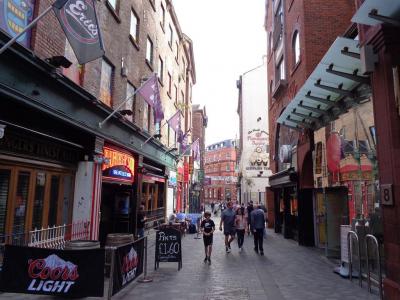
Mathew Street is an unassuming side road in Liverpool city centre that houses a world famous musical attraction – the Cavern Club, the city’s most famous music venue and a place forever associated with the Beatles. The Liverpudlian four piece, considered by many to be the world’s greatest ever band, played at the venue several times in their early years. As a result, the street is visited by thousands of tourists each year, and is the centre of the Cavern Quarter, a bohemian area of arcades filled with must see attractions for Beatles fans.
In addition to the Cavern Club, which is still a hugely popular night-time venue, the street hosts a music festival each August. The largest free festival in Europe, the Mathew Street Festival plays host to dozens of tribute bands – with a Beatles act usually headlining. The street is also notable for the Grapes pub, often frequented by the Fab Four, and an unusual statue by Arthur Dooley, depicting the four band members in a religious pose. The statue, built into the wall on Mathew Street, bears the inscription ‘Four Lads who Shook the World’. The street was also believed to be visited by renowned philosopher Carl Jung; a plaster statue of the great Swiss thinker also stands on the street.
In addition to the Cavern Club, which is still a hugely popular night-time venue, the street hosts a music festival each August. The largest free festival in Europe, the Mathew Street Festival plays host to dozens of tribute bands – with a Beatles act usually headlining. The street is also notable for the Grapes pub, often frequented by the Fab Four, and an unusual statue by Arthur Dooley, depicting the four band members in a religious pose. The statue, built into the wall on Mathew Street, bears the inscription ‘Four Lads who Shook the World’. The street was also believed to be visited by renowned philosopher Carl Jung; a plaster statue of the great Swiss thinker also stands on the street.

6) Victoria Monument
The Victoria Monument stands in the centre of Derby Square, a secluded section of the docklands area, close to Saint James rail station. Built in 1906 as a memorial to Queen Victoria, it contains her statue at its centre, surrounded by pillars and topped with a domed roof. Around the monument, there are four groups of statues representing areas where Liverpool and the UK as a whole have excelled – Agriculture, Commerce, Industry and Education. The four dark figures on the domed roof represent Justice, Knowledge, Medicine and Sciences. At the monument’s summit stands a cherubic statue, representing Victory, and bringing the height of this imposing creation to 18 feet in total.
The monument was designed by C.J. Allen, an artist and architect with a fondness for mystical and allegorical statues. It has stood in Derby Square for over a century, although the landscape around it has changed remarkably in that time. Much of the square and nearby Castle Street were destroyed by German bombs in World War 2, yet the monument somehow survived virtually intact. Iconic photographs show the statue of Victory atop the monument, surveying the rubble. The statue, and the monument as a whole, became a symbol for the city’s post war recovery as a result.
The monument was designed by C.J. Allen, an artist and architect with a fondness for mystical and allegorical statues. It has stood in Derby Square for over a century, although the landscape around it has changed remarkably in that time. Much of the square and nearby Castle Street were destroyed by German bombs in World War 2, yet the monument somehow survived virtually intact. Iconic photographs show the statue of Victory atop the monument, surveying the rubble. The statue, and the monument as a whole, became a symbol for the city’s post war recovery as a result.
7) Albion House
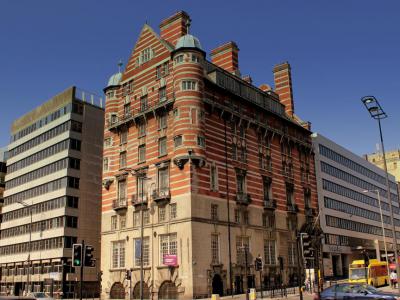
Albion House is situated in Liverpool’s historic docklands, on the corner of the Strand and James Street. Located next to the Pier Head and ferry terminals, Albion House was built in 1898 to house the headquarters of the city’s famous White Star Line shipping company. After relocating to the new building, White Star Line grew to become one of the world’s most famous shipping companies. It is however best remembered for the sinking of its ship, The Titanic, in 1912. Following the disaster, crowds gathered at Albion House as employees read the names of casualties from the balcony, too afraid to face the angry mob gathering below.
Albion House was designed by architects Richard Norman Shaw and J. Francis Doyle and closely resembles their first project, the Scotland Yard building in London. A grade II listed building, Albion House has a distinctive red and white striped façade, comprised of Portland stone and red brick – earning it the local nickname of the ‘streaky bacon’ building. The entrance hall features a mosaic of South America, a continent regularly visited by White Star Line ships. The shipping company merged with rivals Cunard Line in 1927 and relocated – Albion House is now a private office building.
Albion House was designed by architects Richard Norman Shaw and J. Francis Doyle and closely resembles their first project, the Scotland Yard building in London. A grade II listed building, Albion House has a distinctive red and white striped façade, comprised of Portland stone and red brick – earning it the local nickname of the ‘streaky bacon’ building. The entrance hall features a mosaic of South America, a continent regularly visited by White Star Line ships. The shipping company merged with rivals Cunard Line in 1927 and relocated – Albion House is now a private office building.
8) Royal Albert Dock & the Waterfront (must see)
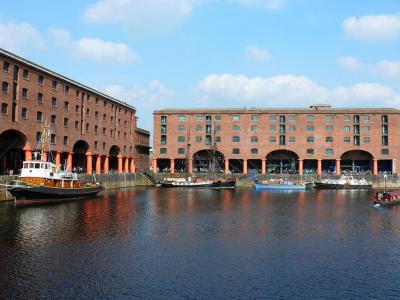
Albert Dock, a historic complex of docks and warehouses on the banks of the Mersey river, is Liverpool’s biggest tourist draw, attracting over 4 million visitors each year. It was built in the 1840s and designed by local architects Jesse Hartley and Philip Hardwick. The new dock was ground-breaking in two ways – one of the first dock complexes to allow direct unloading of cargo into warehouses, it was also the first UK development not to use wood in its construction. The complex was crucial to Liverpool’s rapid development as a global trade port, with ivory, sugar, silk and tobacco stored in its five vast warehouses.
The dock ceased to function for trade purposes after the outbreak of WWII, instead becoming a base for Royal Navy ships. In the post-war era, Albert Dock fell into disuse, before a redevelopment plan was drawn up in the 1980s. The dock itself was regenerated and hosted the Tall Ships Race in 1983, bringing a million tourists into the city. Gradually, the historic warehouses around the water were renovated and used for a wide range of new attractions. They now host a Maritime Museum, the world’s only dedicated Beatles museum, and Liverpool’s Tate Gallery.
Albert Dock houses the largest collection of Grade I listed buildings in the UK and is the jewel of Liverpool’s historic waterfront area. Immediately west of the dock, you will find the Pier Head, a peninsula jutting into the river which houses the Three Graces – three of Liverpool’s most famous buildings, including the Royal Liver building. The ornamental birds on the Liver building have become a symbol for the city’s university, council, and eponymous football team, Liverpool FC.
Why You Should Visit:
Industrial heritage, museums (some are free entry), art galleries, countless shops, bars & restaurants – a focal point of Liverpool.
The only problem with this place is, it is too big to discover in a single day.
The dock ceased to function for trade purposes after the outbreak of WWII, instead becoming a base for Royal Navy ships. In the post-war era, Albert Dock fell into disuse, before a redevelopment plan was drawn up in the 1980s. The dock itself was regenerated and hosted the Tall Ships Race in 1983, bringing a million tourists into the city. Gradually, the historic warehouses around the water were renovated and used for a wide range of new attractions. They now host a Maritime Museum, the world’s only dedicated Beatles museum, and Liverpool’s Tate Gallery.
Albert Dock houses the largest collection of Grade I listed buildings in the UK and is the jewel of Liverpool’s historic waterfront area. Immediately west of the dock, you will find the Pier Head, a peninsula jutting into the river which houses the Three Graces – three of Liverpool’s most famous buildings, including the Royal Liver building. The ornamental birds on the Liver building have become a symbol for the city’s university, council, and eponymous football team, Liverpool FC.
Why You Should Visit:
Industrial heritage, museums (some are free entry), art galleries, countless shops, bars & restaurants – a focal point of Liverpool.
The only problem with this place is, it is too big to discover in a single day.
9) Pier Head (must see)
The Pier Head, officially known as George’s Pier Head, is a prominent riverside location in Liverpool’s city center. Formerly part of the Liverpool Maritime Mercantile City UNESCO World Heritage Site (2004–2021), the Pier Head is celebrated for its iconic architecture, public spaces, and historical significance as a landing site for passenger ships.
Originally the site of George’s Dock, constructed in 1771, the area became obsolete by the 1890s due to its inadequate size for modern commercial vessels. After prolonged negotiations between the Mersey Docks and Harbour Board and Liverpool Corporation, the dock was purchased in 1898 for redevelopment. This paved the way for the construction of landmark buildings and new public spaces, transforming the area into the architectural centerpiece it is today.
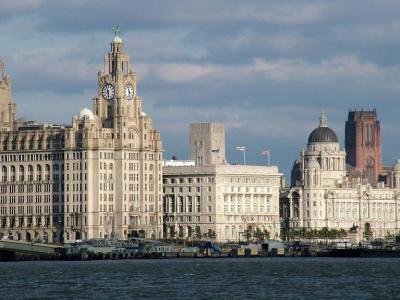
The Pier Head features the iconic "Three Graces": the Royal Liver Building (1911), England’s first skyscraper; the Cunard Building (1917), inspired by Italian palaces; and the Port of Liverpool Building (1907), a neo-baroque symbol of the city’s maritime legacy.
In 2002, the Pier Head was the focus of the controversial "Fourth Grace" project, which aimed to add a bold architectural statement to the waterfront. The winning design, “The Cloud” by Will Alsop, was abandoned in 2004 but plans for redevelopment continued.
In 2011, the Museum of Liverpool opened at the Pier Head, housing a rich collection that celebrates the city’s history and culture. Additionally, a canal link connecting the Leeds and Liverpool Canal to the South Docks was completed in 2009, enhancing the area’s accessibility and recreational appeal.
Although the Pier Head lost its UNESCO World Heritage status in 2021 due to modern developments that altered its historic landscape, it remains a testament to Liverpool’s evolution as a maritime and cultural hub. With its blend of historic grandeur and contemporary vibrancy, the Pier Head continues to draw locals and visitors alike to its storied waterfront.
Originally the site of George’s Dock, constructed in 1771, the area became obsolete by the 1890s due to its inadequate size for modern commercial vessels. After prolonged negotiations between the Mersey Docks and Harbour Board and Liverpool Corporation, the dock was purchased in 1898 for redevelopment. This paved the way for the construction of landmark buildings and new public spaces, transforming the area into the architectural centerpiece it is today.
The Pier Head features the iconic "Three Graces": the Royal Liver Building (1911), England’s first skyscraper; the Cunard Building (1917), inspired by Italian palaces; and the Port of Liverpool Building (1907), a neo-baroque symbol of the city’s maritime legacy.
In 2002, the Pier Head was the focus of the controversial "Fourth Grace" project, which aimed to add a bold architectural statement to the waterfront. The winning design, “The Cloud” by Will Alsop, was abandoned in 2004 but plans for redevelopment continued.
In 2011, the Museum of Liverpool opened at the Pier Head, housing a rich collection that celebrates the city’s history and culture. Additionally, a canal link connecting the Leeds and Liverpool Canal to the South Docks was completed in 2009, enhancing the area’s accessibility and recreational appeal.
Although the Pier Head lost its UNESCO World Heritage status in 2021 due to modern developments that altered its historic landscape, it remains a testament to Liverpool’s evolution as a maritime and cultural hub. With its blend of historic grandeur and contemporary vibrancy, the Pier Head continues to draw locals and visitors alike to its storied waterfront.
10) Tower Building
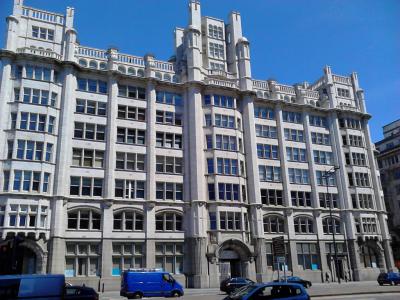
Tower Buildings stand close to the waterfront in Liverpool city centre, directly opposite the ‘Three Graces’ – three grand old buildings which face out across the River Mersey from the waterfront. Tower Buildings has a rich history of its own, with the current structure bearing hallmarks of the first to stand here – a sandstone mansion, built in 1256. This was replaced by the Tower of Liverpool, a fortified house built in 1406. Throughout the 18th century, the building was used as a civic hall and even a prison. Liverpool Corporation bought the site in 1774, but it wasn’t until 1846 that a new structure, the first to be known as Tower Buildings, was built by Sir James Picton.
The current building was completed in 1910, and designed by Walter Aubrey Thomas, a local architect who also created the Royal Liver Building. True to its roots, the building maintained a sandstone effect frontage, and is heavily fortified – it was one of the first buildings in England to be constructed around a steel frame. An office building for much of the 20th century, Tower Buildings were renovated in 2006, and are now a mixture of retail units and private residential accommodation. The original structure, composed of granite laid over its steel frame, with white terracotta tiling, is Grade II listed.
The current building was completed in 1910, and designed by Walter Aubrey Thomas, a local architect who also created the Royal Liver Building. True to its roots, the building maintained a sandstone effect frontage, and is heavily fortified – it was one of the first buildings in England to be constructed around a steel frame. An office building for much of the 20th century, Tower Buildings were renovated in 2006, and are now a mixture of retail units and private residential accommodation. The original structure, composed of granite laid over its steel frame, with white terracotta tiling, is Grade II listed.
