Custom Walk in Hamburg, Germany by amkrellwitz_9927c2 created on 2026-06-11
Guide Location: Germany » Hamburg
Guide Type: Custom Walk
# of Sights: 8
Tour Duration: 2 Hour(s)
Travel Distance: 4.8 Km or 3 Miles
Share Key: Q9V9G
Guide Type: Custom Walk
# of Sights: 8
Tour Duration: 2 Hour(s)
Travel Distance: 4.8 Km or 3 Miles
Share Key: Q9V9G
How It Works
Please retrieve this walk in the GPSmyCity app. Once done, the app will guide you from one tour stop to the next as if you had a personal tour guide. If you created the walk on this website or come to the page via a link, please follow the instructions below to retrieve the walk in the app.
Retrieve This Walk in App
Step 1. Download the app "GPSmyCity: Walks in 1K+ Cities" on Apple App Store or Google Play Store.



Step 2. In the GPSmyCity app, download(or launch) the guide "Hamburg Map and Walking Tours".
Step 3. Tap the menu button located at upper right corner of the "Walks" screen and select "Retrieve custom walk". Enter the share key: Q9V9G
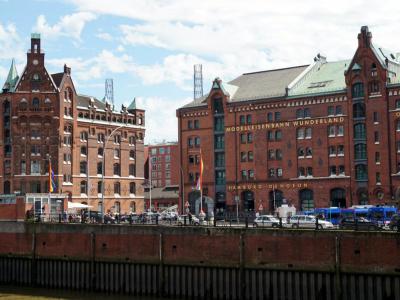
1) Miniature Wonderland (must see)
Miniature Wonderland is home to the world’s largest model railway. The layout includes 16,491 meters of track operated by more than 1,230 digitally controlled trains. A sophisticated lighting system creates realistic day-and-night cycles across the entire model world. Visitors move through a sequence of interconnected rooms, each dedicated to a different region or theme.
The fictional town of Knuffingen, known for its fully functioning road system with moving cars, forms a playful centerpiece. Surrounding it are detailed landscapes representing Germany, including the Harz Mountains and parts of central and southern Germany, as well as Austria and the Alps, Switzerland, Italy, Scandinavia, the United States, South America, Hamburg, and Hamburg Airport. The Austrian Alps feature dramatic mountain scenery and a multi-level helix, while the Swiss Alps rise several meters high.
In the Scandinavian section, ships navigate real water basins, with tidal changes that shift regularly to recreate coastal conditions. The Hamburg section is the largest city model in the exhibition, recreating the harbor, bridges, and major landmarks in dense detail, with hundreds of trains moving through the miniature city each day. Nearby, Knuffingen Airport showcases one of Miniature Wonderland’s most complex technical achievements, with aircraft taxiing, taking off, and landing under automated control.
The United States section includes Las Vegas, illuminated by tens of thousands of lights, alongside scenes inspired by Cape Canaveral, the Florida Keys, the Grand Canyon, Mount Rushmore, and Yosemite National Park. Italy features Rome and Tuscany, with Mount Vesuvius periodically erupting, and an especially elaborate Venice, where gondolas glide beneath dozens of bridges through finely recreated canals. The recently completed Monaco & Provence section introduces a highly complex Formula 1 Grand Prix circuit. The exhibition continues to expand, with new large-scale landscapes and environments regularly added.
Tips: Backstage tours offer insight into the technology behind the scenes. Visiting on weekdays is recommended to avoid the largest crowds.
The fictional town of Knuffingen, known for its fully functioning road system with moving cars, forms a playful centerpiece. Surrounding it are detailed landscapes representing Germany, including the Harz Mountains and parts of central and southern Germany, as well as Austria and the Alps, Switzerland, Italy, Scandinavia, the United States, South America, Hamburg, and Hamburg Airport. The Austrian Alps feature dramatic mountain scenery and a multi-level helix, while the Swiss Alps rise several meters high.
In the Scandinavian section, ships navigate real water basins, with tidal changes that shift regularly to recreate coastal conditions. The Hamburg section is the largest city model in the exhibition, recreating the harbor, bridges, and major landmarks in dense detail, with hundreds of trains moving through the miniature city each day. Nearby, Knuffingen Airport showcases one of Miniature Wonderland’s most complex technical achievements, with aircraft taxiing, taking off, and landing under automated control.
The United States section includes Las Vegas, illuminated by tens of thousands of lights, alongside scenes inspired by Cape Canaveral, the Florida Keys, the Grand Canyon, Mount Rushmore, and Yosemite National Park. Italy features Rome and Tuscany, with Mount Vesuvius periodically erupting, and an especially elaborate Venice, where gondolas glide beneath dozens of bridges through finely recreated canals. The recently completed Monaco & Provence section introduces a highly complex Formula 1 Grand Prix circuit. The exhibition continues to expand, with new large-scale landscapes and environments regularly added.
Tips: Backstage tours offer insight into the technology behind the scenes. Visiting on weekdays is recommended to avoid the largest crowds.
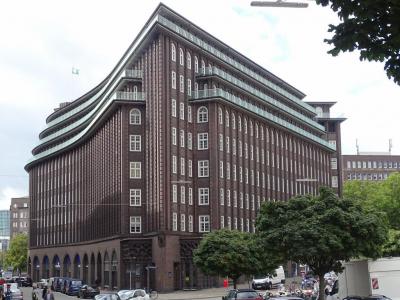
2) Chilehaus (Chile House)
Chile House (Chilehaus) is a prominent architectural landmark located in Hamburg. This ten-story office building stands as a stunning example of Brick Expressionism, a popular architectural style in the 1920s. It was designed by the German architect Fritz Höger and completed in 1924 for the shipping magnate Henry B. Sloman, who earned his wealth through saltpeter trade with Chile, thus inspiring the building's name.
Covering an area of approximately 6,000 square meters (1.5 acres), Chile House is strategically placed in the Kontorhaus District. The building is renowned for its distinctive top resembling a ship's prow and its sharp-cornered façades. These features, combined with the vertical emphasis and recessed upper stories, impart a sense of lightness despite its substantial size.
The structure of Chile House is supported by reinforced concrete and constructed using about 4.8 million dark Oldenburg bricks. Given its proximity to the Elbe River and challenging terrain, the building is anchored on 16-meter-deep reinforced concrete pilings to ensure stability. It also features a specially sealed cellar and heating equipment housed in a floating caisson to prevent flood damage.
Artistic elements enhance the building's aesthetic, with sculptural details by Richard Kuöhl adorning the staircases and façade. Initially, Chilehaus featured paternoster lifts, which were modernized in 1991.
As part of the broader Kontorhaus District, Chile House was declared a UNESCO World Heritage Site in 2015, underscoring its cultural and historical significance. Today, it is owned by Union Investment Real Estate AG and hosts various tenants, including the Hamburg site of the Cervantes Institute.
Covering an area of approximately 6,000 square meters (1.5 acres), Chile House is strategically placed in the Kontorhaus District. The building is renowned for its distinctive top resembling a ship's prow and its sharp-cornered façades. These features, combined with the vertical emphasis and recessed upper stories, impart a sense of lightness despite its substantial size.
The structure of Chile House is supported by reinforced concrete and constructed using about 4.8 million dark Oldenburg bricks. Given its proximity to the Elbe River and challenging terrain, the building is anchored on 16-meter-deep reinforced concrete pilings to ensure stability. It also features a specially sealed cellar and heating equipment housed in a floating caisson to prevent flood damage.
Artistic elements enhance the building's aesthetic, with sculptural details by Richard Kuöhl adorning the staircases and façade. Initially, Chilehaus featured paternoster lifts, which were modernized in 1991.
As part of the broader Kontorhaus District, Chile House was declared a UNESCO World Heritage Site in 2015, underscoring its cultural and historical significance. Today, it is owned by Union Investment Real Estate AG and hosts various tenants, including the Hamburg site of the Cervantes Institute.
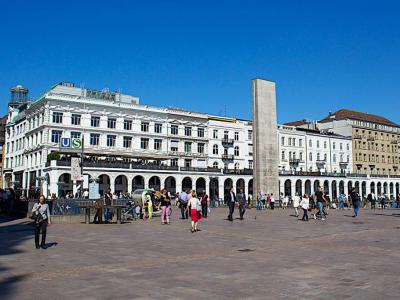
3) Rathausmarkt (City Hall Marketplace)
The City Hall Marketplace is Hamburg’s central civic square. It stretches out directly in front of the Neo-Renaissance City Hall, whose richly ornamented facade, tower, and imperial statues dominate the view. The square took shape after the Great Fire of 1842, when large parts of the old city were destroyed, and was conceived to express Hamburg’s identity as a confident, self-governing city-state.
For much of its history, the City Hall Marketplace functioned as a crossroads of everyday urban life. In the 20th century, it served as a major hub for Hamburg’s tram network, with tracks and stops crisscrossing the space. After tram services ended in the 1970s, the area was redesigned and pedestrianized, transforming it from a transport junction into a ceremonial and social gathering place.
In summer, the square often becomes an open-air cinema or hosts a seasonal wine village, drawing crowds in the evenings. During the winter months, it fills with one of the city’s most popular Christmas markets, complete with festive lighting, decorated stalls, mulled wine, hot chocolate, and traditional street food. Within the open space, visitors can find the monument to Heinrich Heine, the influential poet born in Düsseldorf, located on the left side of the square, as you face the City Hall.
For much of its history, the City Hall Marketplace functioned as a crossroads of everyday urban life. In the 20th century, it served as a major hub for Hamburg’s tram network, with tracks and stops crisscrossing the space. After tram services ended in the 1970s, the area was redesigned and pedestrianized, transforming it from a transport junction into a ceremonial and social gathering place.
In summer, the square often becomes an open-air cinema or hosts a seasonal wine village, drawing crowds in the evenings. During the winter months, it fills with one of the city’s most popular Christmas markets, complete with festive lighting, decorated stalls, mulled wine, hot chocolate, and traditional street food. Within the open space, visitors can find the monument to Heinrich Heine, the influential poet born in Düsseldorf, located on the left side of the square, as you face the City Hall.
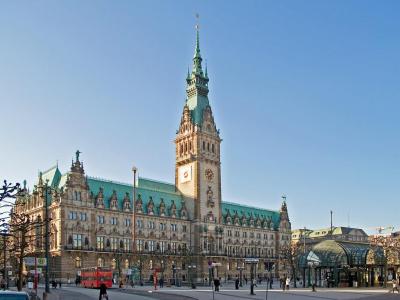
4) Hamburger Rathaus (Hamburg City Hall) (must see)
After the old city hall was destroyed in the Great Fire of 1842, it took 55 years for a new one to be completed, with construction of the present Hamburg City Hall concluding in 1897. Its richly decorated exterior follows a Neo-Renaissance style, and the building occupies some 17,000 m², with a tower rising to 112 meters. Hamburg City Hall contains over 647 rooms, a number chosen to surpass those of the British Parliament and underline the city’s confidence and prosperity. Today, the building serves as the seat of Hamburg’s parliament, mayor, and senate.
The elaborate facade includes 20 statues of emperors, and the main entrance’s wrought-iron gate leads into a hall supported by 16 sandstone pillars bearing 68 portraits of notable citizens. On a guided tour, visitors can see the grand staircase of Sardinian marble, symbolizing the journey of life, as well as the Kaisersaal and other state rooms, which contain paintings and decorative elements celebrating Hamburg’s history. The Grand Ballroom features large paintings depicting the city’s past, complemented by impressive chandeliers. While not visible to visitors, the Senate chamber’s glass roof evokes the ancient tradition of open-air council meetings.
The lobby is used for exhibitions and concerts, while the balcony mosaic displays Hamburg’s coat of arms and motto alongside Hammonia, the female personification of the city. In the inner courtyard stands the Hygieia Fountain, a tribute to health and hygiene installed after the cholera epidemic of 1892. The building rests on thousands of oak piles driven deep into the marshy ground of the Alster basin.
The elaborate facade includes 20 statues of emperors, and the main entrance’s wrought-iron gate leads into a hall supported by 16 sandstone pillars bearing 68 portraits of notable citizens. On a guided tour, visitors can see the grand staircase of Sardinian marble, symbolizing the journey of life, as well as the Kaisersaal and other state rooms, which contain paintings and decorative elements celebrating Hamburg’s history. The Grand Ballroom features large paintings depicting the city’s past, complemented by impressive chandeliers. While not visible to visitors, the Senate chamber’s glass roof evokes the ancient tradition of open-air council meetings.
The lobby is used for exhibitions and concerts, while the balcony mosaic displays Hamburg’s coat of arms and motto alongside Hammonia, the female personification of the city. In the inner courtyard stands the Hygieia Fountain, a tribute to health and hygiene installed after the cholera epidemic of 1892. The building rests on thousands of oak piles driven deep into the marshy ground of the Alster basin.
5) Jungfernstieg (Alster Lake Promenade)
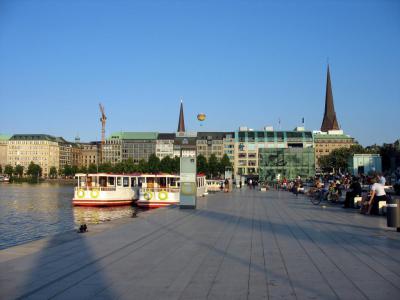
The Alster Lake Promenade is one of Hamburg’s most prominent urban waterfronts. Stretching for roughly 600 meters, it follows the southern edge of the Inner Alster. From here, pedestrian routes connect easily with areas such as Gänsemarkt Market.
The origins of the area date back to 1235, when Count Adolf IV of Holstein ordered the construction of a mill dam on the Alster River, creating the lake that still defines the city center today. Over the following centuries, the shoreline evolved from a functional zone into a prestigious promenade. By the 17th and 18th centuries, the promenade had become a place for public gatherings and informal social encounters among the city’s merchant elite.
In 1838, it became the site of Germany’s first asphalt-paved street, and it later accommodated horse-drawn trams, followed by electric tram services. Today, the promenade functions as both a public terrace and a transit hub. Its broad lakeside platform offers views across the Inner Alster and its central fountain. Two notable structures mark the waterfront: on the southern edge stands the Alster Pavilion, now used as a cafe and restaurant, while a smaller pavilion on the northern edge provides access to the rapid transit station below. Nearby landing stages also serve as departure points for Alster ferry services.
While the Alster Lake Promenade itself is not primarily a shopping street, it provides direct access to major retail areas such as New Wall Street and Great Bleaching Street if you head west from the Alster Pavilion, as well as to nearby shopping centers, galleries, and cultural venues.
The origins of the area date back to 1235, when Count Adolf IV of Holstein ordered the construction of a mill dam on the Alster River, creating the lake that still defines the city center today. Over the following centuries, the shoreline evolved from a functional zone into a prestigious promenade. By the 17th and 18th centuries, the promenade had become a place for public gatherings and informal social encounters among the city’s merchant elite.
In 1838, it became the site of Germany’s first asphalt-paved street, and it later accommodated horse-drawn trams, followed by electric tram services. Today, the promenade functions as both a public terrace and a transit hub. Its broad lakeside platform offers views across the Inner Alster and its central fountain. Two notable structures mark the waterfront: on the southern edge stands the Alster Pavilion, now used as a cafe and restaurant, while a smaller pavilion on the northern edge provides access to the rapid transit station below. Nearby landing stages also serve as departure points for Alster ferry services.
While the Alster Lake Promenade itself is not primarily a shopping street, it provides direct access to major retail areas such as New Wall Street and Great Bleaching Street if you head west from the Alster Pavilion, as well as to nearby shopping centers, galleries, and cultural venues.
6) St. Michaelis Church (must see)
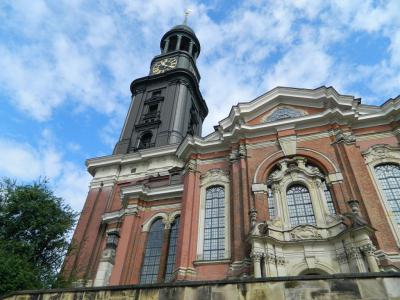
Saint Michaelis Church is one of Hamburg's five main Lutheran churches. This important landmark church is a gorgeous example of baroque architecture. Most of Hamburg's churches were built as Roman Catholic Churches and then converted to Protestant churches; however, Saint Michaelis is one of Hamburg's few purpose-built Protestant churches.
The church is dedicated to the Archangel Michael, and a large bronze statue representing Saint Michael stands above the church's portal. The impressive baroque clock tower is 132 meters tall (433 feet). The clock tower is covered in copper and serves as a landmark for ships entering the Elbe River.
A church has stood on this site since 1647. The current Saint Michaelis Church was built in 1786. Saint Michaelis underwent reconstruction after a 1906 fire, and after WWII bombs damaged it.
Johannes Brahms, the famous composer and pianist, was baptized in Saint Michaelis in 1833.
Saint Michaelis is the largest church in Hamburg and can seat 2.500. The marble pulpit features an impressive staircase. The white marble baptismal font represents a seashell. The marble altar is 20 meters (65 feet) tall and features three scenes from the life of Jesus.
The large crypt has over 2,000 grave chambers. The crypt was used as a shelter during WWII and is now used for concerts and church services.
Visitors can access the 106-meter-tall (348 foot) observational platform using the elevator or stairs. The view from the top is spectacular.
The church is dedicated to the Archangel Michael, and a large bronze statue representing Saint Michael stands above the church's portal. The impressive baroque clock tower is 132 meters tall (433 feet). The clock tower is covered in copper and serves as a landmark for ships entering the Elbe River.
A church has stood on this site since 1647. The current Saint Michaelis Church was built in 1786. Saint Michaelis underwent reconstruction after a 1906 fire, and after WWII bombs damaged it.
Johannes Brahms, the famous composer and pianist, was baptized in Saint Michaelis in 1833.
Saint Michaelis is the largest church in Hamburg and can seat 2.500. The marble pulpit features an impressive staircase. The white marble baptismal font represents a seashell. The marble altar is 20 meters (65 feet) tall and features three scenes from the life of Jesus.
The large crypt has over 2,000 grave chambers. The crypt was used as a shelter during WWII and is now used for concerts and church services.
Visitors can access the 106-meter-tall (348 foot) observational platform using the elevator or stairs. The view from the top is spectacular.
7) St. Pauli Piers (must see)
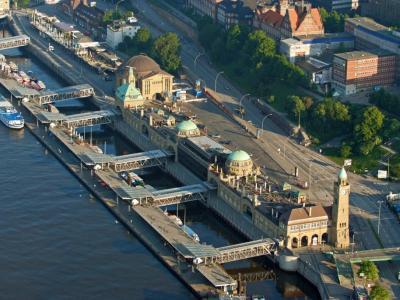
Saint Pauli Piers offers historic waterfront buildings and stunning views. The first pier was built in 1839 and served as a steamship terminal. The piers now connect more modern transportation options. The current floating piers were originally built in 1907 and rebuilt in the 1950s after World War II bombs damaged them.
The floating jetty is 700 meters (2297 feet) long. This vibrant waterfront area draws visitors to see the busy harbor upfront, take pictures, and enjoy the scenery. The piers are connected to the city by ten movable bridges. Hop on a ferry or catamaran and take a tour of the harbor. If you have tickets to The Lion King, you can get ferry transport to the production's musical island.
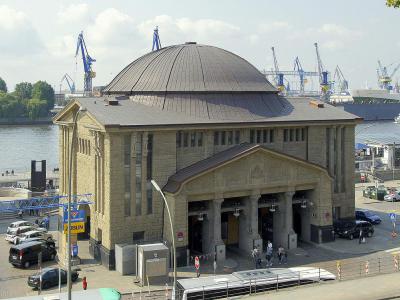
The 205-meter-long (672-foot) terminal building features two distinct green domes. On the attractive Saint Pauli Piers promenade, visitors can find restaurants, cafes, and bars along the piers. Visitors can also enter the Old Elbe tunnel from the piers.
The floating jetty is 700 meters (2297 feet) long. This vibrant waterfront area draws visitors to see the busy harbor upfront, take pictures, and enjoy the scenery. The piers are connected to the city by ten movable bridges. Hop on a ferry or catamaran and take a tour of the harbor. If you have tickets to The Lion King, you can get ferry transport to the production's musical island.
The 205-meter-long (672-foot) terminal building features two distinct green domes. On the attractive Saint Pauli Piers promenade, visitors can find restaurants, cafes, and bars along the piers. Visitors can also enter the Old Elbe tunnel from the piers.
8) Old Elb Tunnel (must see)
The Old Elb Tunnel first opened in 1911. The 426-meter-long (1,398 foot) tunnel runs 24 meters (80 feet) underneath the river's surface. It was the first river tunnel on the continent.
The Old Elb Tunnel is open to vehicle traffic and pedestrians and connects central Hamburg with the docks and shipyards on the River Elbe's south side.
When the tunnel opened in 1911, it was a scientific marvel. Moreover, it considerably improved daily life for the tens of thousands of workers who could cross the river and reach their workplaces much more efficiently.
The tunnel is under the water table of the Elbe River, and work was completed under pressure to keep water from flooding the construction.
The tunnel is open 24/7 for pedestrians and bicycles and is open during the day for vehicle traffic. Six lifts carry pedestrians and vehicles to the tunnel.
The tunnel hosts an art exhibition. In addition, the Elbtunnel-Marathon takes place on the tunnel. Visitors can admire the original walls, which are decorated and display river themes such as fish and crabs.
Why You Should Visit:
The Old Elbe Tunnel represents a feat of engineering. It's free to pedestrians and provides an exciting look at the tunnel's architecture.
Tips:
After crossing the tunnel, visitors can enjoy views of the Elbe River and the harbor.
The Old Elb Tunnel is open to vehicle traffic and pedestrians and connects central Hamburg with the docks and shipyards on the River Elbe's south side.
When the tunnel opened in 1911, it was a scientific marvel. Moreover, it considerably improved daily life for the tens of thousands of workers who could cross the river and reach their workplaces much more efficiently.
The tunnel is under the water table of the Elbe River, and work was completed under pressure to keep water from flooding the construction.
The tunnel is open 24/7 for pedestrians and bicycles and is open during the day for vehicle traffic. Six lifts carry pedestrians and vehicles to the tunnel.
The tunnel hosts an art exhibition. In addition, the Elbtunnel-Marathon takes place on the tunnel. Visitors can admire the original walls, which are decorated and display river themes such as fish and crabs.
Why You Should Visit:
The Old Elbe Tunnel represents a feat of engineering. It's free to pedestrians and provides an exciting look at the tunnel's architecture.
Tips:
After crossing the tunnel, visitors can enjoy views of the Elbe River and the harbor.
