Custom Walk in Tallinn, Estonia by ssyskin639 created on 2026-06-28
Guide Location: Estonia » Tallinn
Guide Type: Custom Walk
# of Sights: 11
Tour Duration: 3 Hour(s)
Travel Distance: 5.4 Km or 3.4 Miles
Share Key: 5K73G
Guide Type: Custom Walk
# of Sights: 11
Tour Duration: 3 Hour(s)
Travel Distance: 5.4 Km or 3.4 Miles
Share Key: 5K73G
How It Works
Please retrieve this walk in the GPSmyCity app. Once done, the app will guide you from one tour stop to the next as if you had a personal tour guide. If you created the walk on this website or come to the page via a link, please follow the instructions below to retrieve the walk in the app.
Retrieve This Walk in App
Step 1. Download the app "GPSmyCity: Walks in 1K+ Cities" on Apple App Store or Google Play Store.



Step 2. In the GPSmyCity app, download(or launch) the guide "Tallinn Map and Walking Tours".
Step 3. Tap the menu button located at upper right corner of the "Walks" screen and select "Retrieve custom walk". Enter the share key: 5K73G
1) Ukrainian Greek-Catholic Church
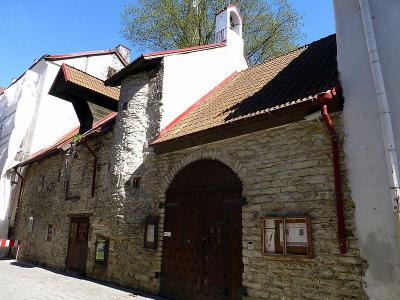
The Ukrainian Greek Catholic Church is part of the so-called Eastern Rite Catholic Church Union. It also happens to be the largest such institution still affiliated with the Roman Catholic Church. It is a very old worshipping community, dating all the way back to 988, when it was one of the successor churches during the time of Grand Prince Vladimir the Great.
This local group is housed in an old medieval house that dates back to the 1300s. The local church has been an active part of Tallinn since the 17th Century. The iconic art of the walls of the sanctuary are the real draw here though. They are some of the finest examples of such art to be found anywhere. The MaDonna and child are quite striking indeed, as well as the figures of Saints Matthew, Mark, Luke and John. The iconostasis is the handy work of the famous artist Pyotr Gumenyuk.
Besides being a church, the building also acts as a cultural gathering place for the Ukrainian community of the area. Periodically, there are celebrations held here that the local public can visit. The congregation worships on Sundays at 10:00 a.m. Otherwise, you must call ahead to be able to visit the inside of the church, but it is worth the call.
This local group is housed in an old medieval house that dates back to the 1300s. The local church has been an active part of Tallinn since the 17th Century. The iconic art of the walls of the sanctuary are the real draw here though. They are some of the finest examples of such art to be found anywhere. The MaDonna and child are quite striking indeed, as well as the figures of Saints Matthew, Mark, Luke and John. The iconostasis is the handy work of the famous artist Pyotr Gumenyuk.
Besides being a church, the building also acts as a cultural gathering place for the Ukrainian community of the area. Periodically, there are celebrations held here that the local public can visit. The congregation worships on Sundays at 10:00 a.m. Otherwise, you must call ahead to be able to visit the inside of the church, but it is worth the call.
2) Tallinn Old Town
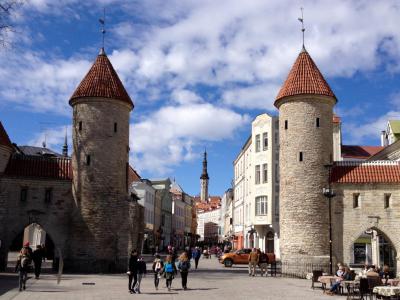
Tallinn Old Town, known as "Tallinna vanalinn" in Estonian, is the historical heart of Tallinn. Renowned for its well-preserved medieval and Hanseatic architecture, this area is a living testimony to the city's rich history. Spanning 113 hectares with a buffer zone of 2,253 hectares, the Old Town is characterized by its 13th-century city plan, which remains remarkably intact.
The Old Town has a history of prosperity and turmoil. Most buildings date back to the 13th-16th centuries, reflecting its medieval importance. However, WWII caused significant damage. Between 1941-1944, Soviet air raids, during the German occupation of Estonia, destroyed about 10% of Old Town buildings, leaving 20,000 homeless and many casualties.
Despite this turbulent history, Tallinn Old Town stands today as Northern Europe's best-preserved medieval city. Its Gothic spires, winding cobblestone streets, and enchanting architecture attract visitors worldwide. The area was once a hub for wealthy merchants from Germany, Denmark, and other regions. Now, it is a vibrant center with restaurants, bars, museums, and galleries, offering a blend of historical ambiance and modern vitality.
The Old Town's unique charm lies in its ability to maintain its medieval and Hanseatic structure completely. Recognized for its historical value and well-preserved state, it was inscribed as a UNESCO World Heritage Site in 1997. The city's layout includes original cobblestone streets lined with medieval churches, grand merchant houses, barns, and warehouses, many dating back to the Middle Ages.
Visitors to Tallinn Old Town often describe it as mystical, mesmerizing, and addictive. Spending a day wandering through its streets offers an immersive experience in an authentic medieval milieu, revealing why it holds such a special place in the annals of world heritage sites.
The Old Town has a history of prosperity and turmoil. Most buildings date back to the 13th-16th centuries, reflecting its medieval importance. However, WWII caused significant damage. Between 1941-1944, Soviet air raids, during the German occupation of Estonia, destroyed about 10% of Old Town buildings, leaving 20,000 homeless and many casualties.
Despite this turbulent history, Tallinn Old Town stands today as Northern Europe's best-preserved medieval city. Its Gothic spires, winding cobblestone streets, and enchanting architecture attract visitors worldwide. The area was once a hub for wealthy merchants from Germany, Denmark, and other regions. Now, it is a vibrant center with restaurants, bars, museums, and galleries, offering a blend of historical ambiance and modern vitality.
The Old Town's unique charm lies in its ability to maintain its medieval and Hanseatic structure completely. Recognized for its historical value and well-preserved state, it was inscribed as a UNESCO World Heritage Site in 1997. The city's layout includes original cobblestone streets lined with medieval churches, grand merchant houses, barns, and warehouses, many dating back to the Middle Ages.
Visitors to Tallinn Old Town often describe it as mystical, mesmerizing, and addictive. Spending a day wandering through its streets offers an immersive experience in an authentic medieval milieu, revealing why it holds such a special place in the annals of world heritage sites.
3) Toompea Hill (must see)
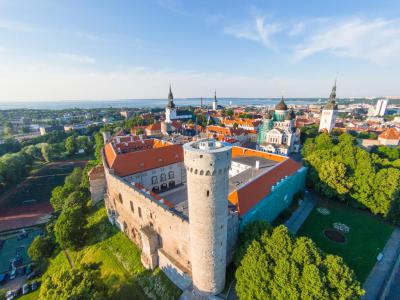
Rising about 20 to 30 meters above the surrounding city, Toompea Hill has long been the political and symbolic center of Tallinn. This limestone plateau has served as a defensive stronghold since medieval times, its elevated position offering both protection and wide views over the harbor and surrounding lands. In Estonian mythology, the hill is said to be the burial mound of the legendary king Kalev, raised by his wife Linda, whose tears are believed to have formed nearby Lake Ülemiste.
At the heart of the hill stands Toompea Castle, now home to Estonia’s parliament. The castle incorporates medieval foundations with later Baroque additions, including its distinctive pink façade completed in the 18th century. Rising above it is the Tall Hermann Tower, first built in the 14th century and still used for the daily raising and lowering of the Estonian flag. Nearby, the ornate Alexander Nevsky Cathedral adds a contrasting architectural presence with its 19th-century Russian Orthodox design.
Walking through Toompea, the setting feels more formal and contained than the lower town. Streets are lined with government buildings, embassies, and historic residences. Saint Mary's Cathedral, dating back to the 13th century and one of the oldest churches in Estonia, survived a major fire in 1684 that reshaped much of the hill. Inside, medieval coats of arms and memorials reflect centuries of noble influence and religious life.
Along the edges of the hill, several viewpoints open out across the city. These vantage points highlight the historic divide between the upper town and the merchant quarters below, while also offering one of the most complete views of Tallinn’s layout.
At the heart of the hill stands Toompea Castle, now home to Estonia’s parliament. The castle incorporates medieval foundations with later Baroque additions, including its distinctive pink façade completed in the 18th century. Rising above it is the Tall Hermann Tower, first built in the 14th century and still used for the daily raising and lowering of the Estonian flag. Nearby, the ornate Alexander Nevsky Cathedral adds a contrasting architectural presence with its 19th-century Russian Orthodox design.
Walking through Toompea, the setting feels more formal and contained than the lower town. Streets are lined with government buildings, embassies, and historic residences. Saint Mary's Cathedral, dating back to the 13th century and one of the oldest churches in Estonia, survived a major fire in 1684 that reshaped much of the hill. Inside, medieval coats of arms and memorials reflect centuries of noble influence and religious life.
Along the edges of the hill, several viewpoints open out across the city. These vantage points highlight the historic divide between the upper town and the merchant quarters below, while also offering one of the most complete views of Tallinn’s layout.
4) Alexander Nevsky Cathedral (must see)
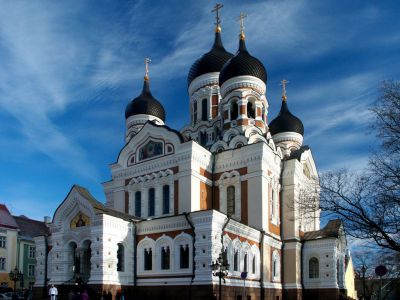
Built between 1894 and 1900 to a design by Mikhail Preobrazhensky, Alexander Nevsky Cathedral reflects the period when Estonia was part of the Russian Empire. It is dedicated to Saint Alexander Nevsky, the Russian prince who secured victory at the Battle of the Ice in 1242 on nearby Lake Peipus.
Its architecture stands in clear contrast to the surrounding medieval cityscape. Designed in the Russian Revival style, the cathedral features onion-shaped domes, richly ornamented façades, and layered decorative details that distinguish it from the Gothic and Baroque buildings nearby. As Tallinn’s largest Orthodox cathedral, its scale and elevated location make it visible from many points across the city.
Inside, the cathedral presents a richly decorated interior typical of Orthodox tradition. Gilded icons, mosaics, and painted surfaces create a dense visual environment, centered around the iconostasis that separates the altar from the nave. The interplay of light and gold surfaces gives the space a distinct atmosphere, differing markedly from the more restrained interiors of Lutheran churches in Estonia. The cathedral’s bells, among the largest in Tallinn, add another defining feature with their deep, resonant sound.
The cathedral’s history has not been without controversy. Built during a period of Russification, it was at times viewed as a symbol of imperial authority, and plans for its demolition were even considered in the 1920s, though never carried out. During the Soviet era, when religious practice declined, the building fell into disrepair. Since Estonia regained independence in 1991, the cathedral has been carefully restored and continues to function as an active place of worship, while also welcoming visitors interested in this distinct chapter of Tallinn’s past.
Its architecture stands in clear contrast to the surrounding medieval cityscape. Designed in the Russian Revival style, the cathedral features onion-shaped domes, richly ornamented façades, and layered decorative details that distinguish it from the Gothic and Baroque buildings nearby. As Tallinn’s largest Orthodox cathedral, its scale and elevated location make it visible from many points across the city.
Inside, the cathedral presents a richly decorated interior typical of Orthodox tradition. Gilded icons, mosaics, and painted surfaces create a dense visual environment, centered around the iconostasis that separates the altar from the nave. The interplay of light and gold surfaces gives the space a distinct atmosphere, differing markedly from the more restrained interiors of Lutheran churches in Estonia. The cathedral’s bells, among the largest in Tallinn, add another defining feature with their deep, resonant sound.
The cathedral’s history has not been without controversy. Built during a period of Russification, it was at times viewed as a symbol of imperial authority, and plans for its demolition were even considered in the 1920s, though never carried out. During the Soviet era, when religious practice declined, the building fell into disrepair. Since Estonia regained independence in 1991, the cathedral has been carefully restored and continues to function as an active place of worship, while also welcoming visitors interested in this distinct chapter of Tallinn’s past.
5) Kohtuotsa Viewing Point (must see)
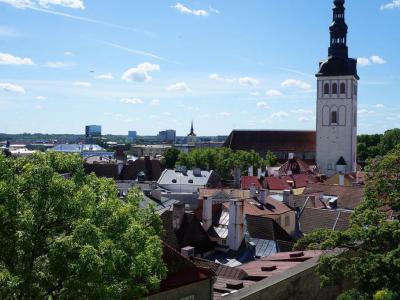
Perched along the edge of Toompea Hill, the Kohtuotsa Viewing Platform is one of the most popular vantage points in Tallinn, offering a wide and uninterrupted panorama over the city. Easily reached on foot from the Old Town, the platform sits in a slightly more open and informal setting compared to other viewpoints, allowing visitors to take in the view without the visual interruption of nearby walls or towers.
From here, Tallinn unfolds in a broad sweep. The red rooftops of the Old Town stretch out below, punctuated by church spires such as Saint Olav’s Church. Beyond the medieval core, the view extends toward the modern city, the harbor, and the Gulf of Finland. The perspective offers a clear sense of how the historic center fits within the wider urban landscape.
Kohtuotsa is also known for small contemporary details that contrast with the historic setting. A section of the wall near the platform often features changing graffiti, including the well-known phrase “The Times We Had”, which has become a recognizable visual element for visitors. This blend of historic panorama and modern expression gives the viewpoint a slightly different character from other spots on Toompea.
The platform itself is simple, with a raised area and safety railings that make it a comfortable place to pause. It is particularly popular for photography, especially at sunrise and sunset when the light softens across the rooftops and the sea. Free to access and open year-round, Kohtuotsa Viewing Platform offers one of the most expansive and memorable views of Tallinn.
From here, Tallinn unfolds in a broad sweep. The red rooftops of the Old Town stretch out below, punctuated by church spires such as Saint Olav’s Church. Beyond the medieval core, the view extends toward the modern city, the harbor, and the Gulf of Finland. The perspective offers a clear sense of how the historic center fits within the wider urban landscape.
Kohtuotsa is also known for small contemporary details that contrast with the historic setting. A section of the wall near the platform often features changing graffiti, including the well-known phrase “The Times We Had”, which has become a recognizable visual element for visitors. This blend of historic panorama and modern expression gives the viewpoint a slightly different character from other spots on Toompea.
The platform itself is simple, with a raised area and safety railings that make it a comfortable place to pause. It is particularly popular for photography, especially at sunrise and sunset when the light softens across the rooftops and the sea. Free to access and open year-round, Kohtuotsa Viewing Platform offers one of the most expansive and memorable views of Tallinn.
6) Tallinna Raekoda (Tallinn Town Hall) (must see)
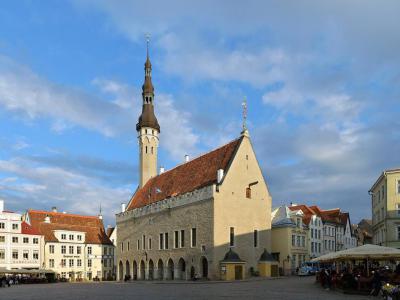
The Tallinn Town Hall stands as one of the best-preserved Gothic town halls in Northern Europe, and the only one of its kind still standing in the region. First mentioned in 1322 and completed in its current form in 1404, it reflects the wealth and independence of a medieval trading city at the height of its Hanseatic influence. Until 1970, it served as the center of civic life, where the town council governed, trade was regulated, and public ceremonies were held.
From the outside, the building is defined by its limestone construction, clay-tiled roof, and a slender spire rising about 64 meters above Town Hall Square. The tower is crowned by “Old Thomas”, a weather vane figure first installed in 1530, symbolizing the city’s watchful guardian. Along the façade, a series of arches supported by pillars form a sheltered arcade, where merchants once gathered during poor weather. In earlier times, this space also served as a place of public display, where offenders could be chained to a pillar as a form of punishment.
Inside, the Town Hall reveals a series of spaces designed for both governance and representation. The main room, known as the Citizens’ Hall, could accommodate around 100 people and continues to host concerts and events today. Elsewhere, the Council Chamber features carved wooden details dating back to the 14th century, while benches, arches, and decorative elements reflect the craftsmanship of the period. Copies of historic tapestries line the walls, with the originals preserved in the Tallinn City Museum.
Today, the Town Hall remains an active cultural venue, open to visitors during the warmer months. You can explore its interior, attend an event, or climb the tower for views across the red rooftops of the Old Town.
From the outside, the building is defined by its limestone construction, clay-tiled roof, and a slender spire rising about 64 meters above Town Hall Square. The tower is crowned by “Old Thomas”, a weather vane figure first installed in 1530, symbolizing the city’s watchful guardian. Along the façade, a series of arches supported by pillars form a sheltered arcade, where merchants once gathered during poor weather. In earlier times, this space also served as a place of public display, where offenders could be chained to a pillar as a form of punishment.
Inside, the Town Hall reveals a series of spaces designed for both governance and representation. The main room, known as the Citizens’ Hall, could accommodate around 100 people and continues to host concerts and events today. Elsewhere, the Council Chamber features carved wooden details dating back to the 14th century, while benches, arches, and decorative elements reflect the craftsmanship of the period. Copies of historic tapestries line the walls, with the originals preserved in the Tallinn City Museum.
Today, the Town Hall remains an active cultural venue, open to visitors during the warmer months. You can explore its interior, attend an event, or climb the tower for views across the red rooftops of the Old Town.
7) Raekoja Plats (Town Hall Square) (must see)
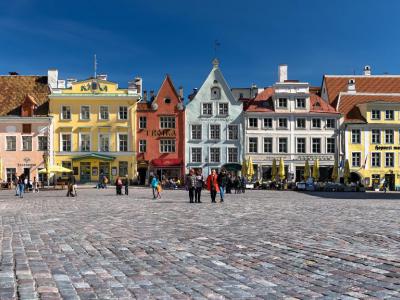
At the center of Tallinn’s Old Town, Town Hall Square has functioned as the city’s main gathering place since at least the medieval period, with market activity recorded here as early as the 11th century. The square is framed by pastel-toned merchant houses and dominated by the Gothic Town Hall, completed in 1404, widely regarded as the oldest surviving town hall in Northern Europe. Look toward the southern side of the square to take in its full façade and tower.
The surrounding buildings, dating mainly from the 15th to 17th centuries, illustrate the prosperity of the city during its time within the Hanseatic network. Among them is the historic Raeapteek, located on the northeastern edge of the square. Established in the early 15th century, it is often cited as one of Europe’s oldest continuously operating pharmacies. Inside, a small exhibition presents early medical tools and remedies, offering a glimpse into centuries-old practices.
As you cross the cobbled square, smaller details begin to stand out. Near the center lies a circular stone marked with a compass rose. Stand directly on this stone and look around. You can align your view to spot five of Tallinn’s historic church spires rising above the rooftops, including those of Saint Olaf’s Church, Saint Nicholas’ Church, Saint Mary’s Cathedral, Church of the Holy Spirit, and Saint Michael’s Church. A short distance from this marker, slightly off-center toward the Town Hall side, lies an L-shaped stone linked to a local legend: it is said to mark the spot where a priest was executed after a violent dispute. In summer, cafés extend their seating into the square, and depending on their layout, the temporary flooring may partially or completely cover this subtle piece.
In warmer months, café terraces fill the edges of the square, while markets and open-air events bring a steady flow of activity. The annual Tallinn Old Town Days festival transforms the area into a stage for performances and exhibitions. In winter, the square is centered around a large decorated Christmas tree, linked to a tradition often associated with the Brotherhood of the Blackheads, who are said to have erected one of the earliest public Christmas trees here in the 15th century.
The surrounding buildings, dating mainly from the 15th to 17th centuries, illustrate the prosperity of the city during its time within the Hanseatic network. Among them is the historic Raeapteek, located on the northeastern edge of the square. Established in the early 15th century, it is often cited as one of Europe’s oldest continuously operating pharmacies. Inside, a small exhibition presents early medical tools and remedies, offering a glimpse into centuries-old practices.
As you cross the cobbled square, smaller details begin to stand out. Near the center lies a circular stone marked with a compass rose. Stand directly on this stone and look around. You can align your view to spot five of Tallinn’s historic church spires rising above the rooftops, including those of Saint Olaf’s Church, Saint Nicholas’ Church, Saint Mary’s Cathedral, Church of the Holy Spirit, and Saint Michael’s Church. A short distance from this marker, slightly off-center toward the Town Hall side, lies an L-shaped stone linked to a local legend: it is said to mark the spot where a priest was executed after a violent dispute. In summer, cafés extend their seating into the square, and depending on their layout, the temporary flooring may partially or completely cover this subtle piece.
In warmer months, café terraces fill the edges of the square, while markets and open-air events bring a steady flow of activity. The annual Tallinn Old Town Days festival transforms the area into a stage for performances and exhibitions. In winter, the square is centered around a large decorated Christmas tree, linked to a tradition often associated with the Brotherhood of the Blackheads, who are said to have erected one of the earliest public Christmas trees here in the 15th century.
8) Katariina Käik (St. Catherine’s Passage) (must see)
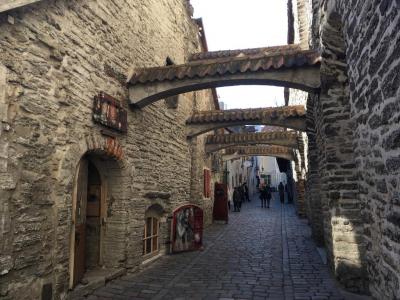
Saint Catherine’s Passage is a narrow medieval lane connecting Vene Street with Müürivahe Street, following the outer wall of the former Dominican monastery. Dating back to the 13th century, the passage developed alongside the monastery complex and preserves sections of its original stonework. Overhead arches linking the buildings were added later to reinforce the structures and remain one of the passage’s defining features.
The passage takes its name from Saint Catherine and the adjacent Dominican monastery, founded in 1246. Along the northern section, you can see the remains of the monastery church, one of the oldest surviving ecclesiastical structures in Tallinn. Several tombstones are set directly into the walls. These belonged to burials associated with the monastery and date mainly from the 14th to 16th centuries.
Toward the southern end, the passage becomes a center for traditional crafts. A group of working studios, often referred to as Saint Catherine’s Guild, continues long-established artisanal practices. Here, visitors can observe glass-blowing, ceramics, leatherwork, and textile production, with many workshops maintaining techniques rooted in historical craftsmanship rather than modern mass production.
The passage is short and can be walked in minutes, but it is best explored slowly. Entry points are easy to miss, and the northern section near the monastery remains the most historically intact, while the southern end is more active with workshops. Unlike larger streets in the Old Town, this lane functions more as a preserved corridor than a thoroughfare.
The passage takes its name from Saint Catherine and the adjacent Dominican monastery, founded in 1246. Along the northern section, you can see the remains of the monastery church, one of the oldest surviving ecclesiastical structures in Tallinn. Several tombstones are set directly into the walls. These belonged to burials associated with the monastery and date mainly from the 14th to 16th centuries.
Toward the southern end, the passage becomes a center for traditional crafts. A group of working studios, often referred to as Saint Catherine’s Guild, continues long-established artisanal practices. Here, visitors can observe glass-blowing, ceramics, leatherwork, and textile production, with many workshops maintaining techniques rooted in historical craftsmanship rather than modern mass production.
The passage is short and can be walked in minutes, but it is best explored slowly. Entry points are easy to miss, and the northern section near the monastery remains the most historically intact, while the southern end is more active with workshops. Unlike larger streets in the Old Town, this lane functions more as a preserved corridor than a thoroughfare.
9) St. Nicholas' Orthodox Church
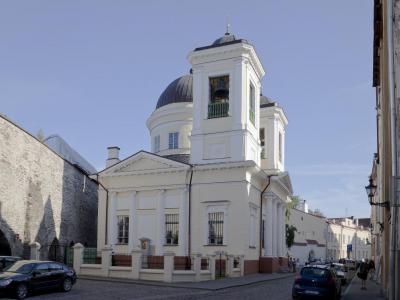
The Saint Nicholas’ Church stands as a key example of the city’s medieval religious and cultural life. Originally built between the 13th and 15th centuries by merchants from Westphalia, the church was dedicated to Saint Nicholas, the patron saint of sailors and fishermen. At a time when Tallinn lacked full defensive walls, the church also served a protective function, with reinforced entrances and spaces designed to shelter people during times of unrest.
As the city’s fortifications were completed in the early 14th century, the church shifted into a more typical parish role. Its structure was expanded and refined over time, particularly in the early 15th century, when it took on the form of a basilica with a raised central nave. The tower, later heightened and modified, now rises prominently above the surrounding rooftops, reaching approximately 105 meters. Despite the upheaval of the Protestant Reformation in 1523, the church avoided major damage.
The building suffered significant destruction during the Bombing of Tallinn in World War II, after which it was carefully restored. Rather than returning to regular parish use, it was adapted as a museum space. Today, it houses the Niguliste Museum, part of the Art Museum of Estonia, focusing on ecclesiastical art from the Middle Ages onward. Inside, visitors will find a collection of altarpieces, religious sculptures, and paintings displayed within the restored Gothic interior.
As the city’s fortifications were completed in the early 14th century, the church shifted into a more typical parish role. Its structure was expanded and refined over time, particularly in the early 15th century, when it took on the form of a basilica with a raised central nave. The tower, later heightened and modified, now rises prominently above the surrounding rooftops, reaching approximately 105 meters. Despite the upheaval of the Protestant Reformation in 1523, the church avoided major damage.
The building suffered significant destruction during the Bombing of Tallinn in World War II, after which it was carefully restored. Rather than returning to regular parish use, it was adapted as a museum space. Today, it houses the Niguliste Museum, part of the Art Museum of Estonia, focusing on ecclesiastical art from the Middle Ages onward. Inside, visitors will find a collection of altarpieces, religious sculptures, and paintings displayed within the restored Gothic interior.
10) Viru Värav (Viru Gate)
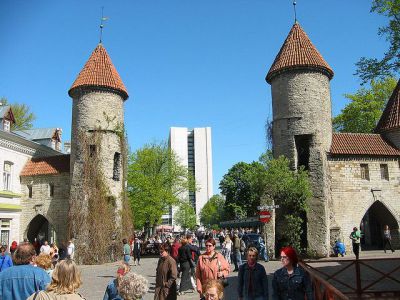
The Viru Gate forms one of the most recognizable entrances into Tallinn’s Medieval Old Town. Dating to the 14th century, these twin stone towers are the surviving outer section of a much larger gate complex that once guarded the city. At its height, Tallinn’s fortifications included around 45 towers, of which roughly half still remain today. The Viru towers originally stood as the foregate, with a second, more heavily fortified inner gate positioned further along the passage.
Approaching the gate, the symmetry of the towers stands out, with their conical roofs and narrow openings reflecting their original military purpose. Over time, however, their appearance has softened. Ivy often climbs their surfaces, and during warmer months, flower stalls gather at their base. Passing through the towers, the transition is immediate. The wider modern streets give way to narrower, cobbled lanes, where merchant houses, small shops, and cafés line the route into the Lower Town.
Much of the original gate complex was dismantled in the late 19th century, around 1880, to ease growing traffic demands. What remains today are the two round towers. While no longer part of an active defense system, they continue to define the city’s edge, offering a clear starting point for exploring one of the most intact medieval urban landscapes in Europe.
Approaching the gate, the symmetry of the towers stands out, with their conical roofs and narrow openings reflecting their original military purpose. Over time, however, their appearance has softened. Ivy often climbs their surfaces, and during warmer months, flower stalls gather at their base. Passing through the towers, the transition is immediate. The wider modern streets give way to narrower, cobbled lanes, where merchant houses, small shops, and cafés line the route into the Lower Town.
Much of the original gate complex was dismantled in the late 19th century, around 1880, to ease growing traffic demands. What remains today are the two round towers. While no longer part of an active defense system, they continue to define the city’s edge, offering a clear starting point for exploring one of the most intact medieval urban landscapes in Europe.
11) Kadriorg Palace and Park (must see)
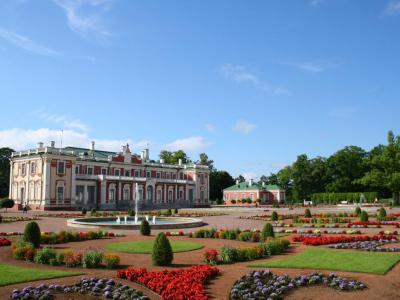
Kadriog Palace and Park has a long history in Tallinn. It was commissioned by Peter the Great after he successfully brought Estonia under his domain. The Palace was to be a sea-side home for himself and his wife, Catherine I of Russia. Building of the Palace was started in July of 1718. Niccolo Michetti, the Italian architect, designed this beautiful Baroque Palace.
Although only two stories tall, it is a very grand building. Unfortunately, Peter died before the building was completed. Catherine lost all interest in the palace after the death of her husband, and never visited it, even after the palace was completed. Parts of the palace were left to fall into disrepair; however, the great hall has been lovingly preserved and restored.
The Palace has had several tenants and uses over the centuries. Almost all of the Russian ruling class has been to the palace over the years. Estonia’s President, Konstantin Päts, undertook an extensive renovation in the 1930s. It was also home to the Art Museum of Estonia until just recently. In 2000, the palace was reopened after extensive renovations and it now houses a branch of the museum. Now that the building has been restored, work is ongoing in the gardens and surrounding structures on the property.
The gardens, that have been redone, are fabulous. Kadrioru Park is a beautiful open space with a picturesque natural landscape, as well as fields and forest groves. Visitors may traverse the park through a collection of twisting paths. Kadrioru Park is also home to the symmetrical Swan Lake, one of the most popular destinations inside the open space.
There is an admission fee for the museum portion of the palace and guided tours are available in several languages for the palace. Please call at least one week ahead to schedule a tour.
Although only two stories tall, it is a very grand building. Unfortunately, Peter died before the building was completed. Catherine lost all interest in the palace after the death of her husband, and never visited it, even after the palace was completed. Parts of the palace were left to fall into disrepair; however, the great hall has been lovingly preserved and restored.
The Palace has had several tenants and uses over the centuries. Almost all of the Russian ruling class has been to the palace over the years. Estonia’s President, Konstantin Päts, undertook an extensive renovation in the 1930s. It was also home to the Art Museum of Estonia until just recently. In 2000, the palace was reopened after extensive renovations and it now houses a branch of the museum. Now that the building has been restored, work is ongoing in the gardens and surrounding structures on the property.
The gardens, that have been redone, are fabulous. Kadrioru Park is a beautiful open space with a picturesque natural landscape, as well as fields and forest groves. Visitors may traverse the park through a collection of twisting paths. Kadrioru Park is also home to the symmetrical Swan Lake, one of the most popular destinations inside the open space.
There is an admission fee for the museum portion of the palace and guided tours are available in several languages for the palace. Please call at least one week ahead to schedule a tour.
