Custom Walk in Bangkok, Thailand by victoriarmillar_7a4e7d created on 2026-07-09
Guide Location: Thailand » Bangkok
Guide Type: Custom Walk
# of Sights: 7
Tour Duration: 2 Hour(s)
Travel Distance: 3 Km or 1.9 Miles
Share Key: LAESK
Guide Type: Custom Walk
# of Sights: 7
Tour Duration: 2 Hour(s)
Travel Distance: 3 Km or 1.9 Miles
Share Key: LAESK
How It Works
Please retrieve this walk in the GPSmyCity app. Once done, the app will guide you from one tour stop to the next as if you had a personal tour guide. If you created the walk on this website or come to the page via a link, please follow the instructions below to retrieve the walk in the app.
Retrieve This Walk in App
Step 1. Download the app "GPSmyCity: Walks in 1K+ Cities" on Apple App Store or Google Play Store.



Step 2. In the GPSmyCity app, download(or launch) the guide "Bangkok Map and Walking Tours".
Step 3. Tap the menu button located at upper right corner of the "Walks" screen and select "Retrieve custom walk". Enter the share key: LAESK
1) Khaosan Road
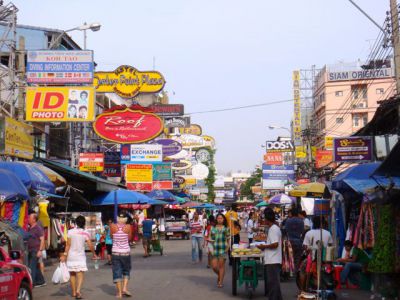
Clocking in at just 410 meters, Khaosan Road somehow manages to feel like a whole universe squeezed into a single stretch of asphalt. Built in 1892 during the reign of King Rama V, it started life as a rice market—khaosan literally means “milled rice.” Not exactly the kind of origin story that hints at neon lights, bass drops, and bucket cocktails… but here we are.
Over the past four decades, this short street has turned into a global rite of passage. Budget travelers arrive in waves—40,000 to 50,000 a day in peak season—hunting for cheap beds, cheaper food, and stories they may or may not remember later. Accommodation ranges from “just enough to sleep” to surprisingly decent mid-range hotels, depending on how adventurous—or sleep-deprived—you’re willing to be.
As for the crowd, it's a rotating cast of characters. Gap-year explorers, post-exam escapees, backpackers mapping out Southeast Asia one hostel at a time, and travelers who came for a few days and somehow never quite left. Indeed, this street feels like a temporary society, held together by shared curiosity, jet lag, and the occasional questionable life decision...
By day, stalls line the road, selling everything from handmade crafts and loose, elephant-print trousers to second-hand books and items that definitely didn’t come with a warranty. But once the sun goes down, the whole place shifts gears. Music spills out from bars, street vendors fire up grills—yes, including insects—and the air fills with equal parts excitement and chaos. If you happen to be here during Songkran festival (which is the Thai New Year), expect the entire street to turn into one giant water fight, where staying dry is simply not an option.
Just across the way, the calm presence of Wat Chana Songkram offers a quiet counterpoint, while nearby lanes reveal small mosques and a longstanding Muslim community—reminders that even here, amid the noise, Bangkok’s layered identity never really disappears...
Over the past four decades, this short street has turned into a global rite of passage. Budget travelers arrive in waves—40,000 to 50,000 a day in peak season—hunting for cheap beds, cheaper food, and stories they may or may not remember later. Accommodation ranges from “just enough to sleep” to surprisingly decent mid-range hotels, depending on how adventurous—or sleep-deprived—you’re willing to be.
As for the crowd, it's a rotating cast of characters. Gap-year explorers, post-exam escapees, backpackers mapping out Southeast Asia one hostel at a time, and travelers who came for a few days and somehow never quite left. Indeed, this street feels like a temporary society, held together by shared curiosity, jet lag, and the occasional questionable life decision...
By day, stalls line the road, selling everything from handmade crafts and loose, elephant-print trousers to second-hand books and items that definitely didn’t come with a warranty. But once the sun goes down, the whole place shifts gears. Music spills out from bars, street vendors fire up grills—yes, including insects—and the air fills with equal parts excitement and chaos. If you happen to be here during Songkran festival (which is the Thai New Year), expect the entire street to turn into one giant water fight, where staying dry is simply not an option.
Just across the way, the calm presence of Wat Chana Songkram offers a quiet counterpoint, while nearby lanes reveal small mosques and a longstanding Muslim community—reminders that even here, amid the noise, Bangkok’s layered identity never really disappears...
2) Sanam Luang Square
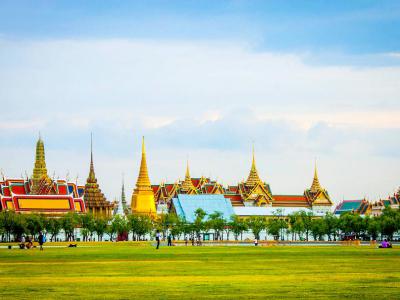
Sanam Luang—a wide, open field stretching right in front of Wat Phra Kaew and the Grand Palace—has quietly witnessed some of the most solemn and symbolic moments in Thai history. It didn’t always carry such a neutral name, though. Originally called Thung Phra Men, this was the royal cremation ground, where kings, queens, and princes were bid farewell in elaborate ceremonies starting from the reign of Rama I in the 1780s. So, yes—this peaceful-looking lawn comes with a rather weighty past.
Then, in a surprising change of pace, the field briefly turned agricultural. During the reign of Rama III in the first half of the 19th century, amid tensions with Vietnam over Cambodia, the land was transformed into a rice field. Not for harvest, but for show—a living statement that the kingdom was fertile, stable, and doing just fine, thank you very much...
By 1855, Rama IV stepped in, gave the place its current name, and reshaped its purpose yet again. Sanam Luang became a ceremonial stage, complete with pavilions, a hall for sacred images, and even a platform for rituals meant to keep the gods on good terms. It was less “open field” and more “open-air royal theater.”
Later, Rama V cleared out the earlier structures and expanded the grounds for Bangkok’s centennial in 1897. Inspired by palace gardens he had seen in Java, he added the rows of tamarind trees that still frame the field today—because if you’re going to redesign a ceremonial space, you might as well make it elegant...
Over time, Sanam Luang has worn many hats. It has hosted kite festivals, horse races, and even functioned as a golf course. Major national events—from the Royal Ploughing Ceremony to grand celebrations like Bangkok’s bicentennial—have unfolded here. And yet, it has never fully let go of its original role. Royal cremations have continued into modern times, reminding visitors that beneath the open sky lies a space shaped as much by remembrance as by celebration...
Then, in a surprising change of pace, the field briefly turned agricultural. During the reign of Rama III in the first half of the 19th century, amid tensions with Vietnam over Cambodia, the land was transformed into a rice field. Not for harvest, but for show—a living statement that the kingdom was fertile, stable, and doing just fine, thank you very much...
By 1855, Rama IV stepped in, gave the place its current name, and reshaped its purpose yet again. Sanam Luang became a ceremonial stage, complete with pavilions, a hall for sacred images, and even a platform for rituals meant to keep the gods on good terms. It was less “open field” and more “open-air royal theater.”
Later, Rama V cleared out the earlier structures and expanded the grounds for Bangkok’s centennial in 1897. Inspired by palace gardens he had seen in Java, he added the rows of tamarind trees that still frame the field today—because if you’re going to redesign a ceremonial space, you might as well make it elegant...
Over time, Sanam Luang has worn many hats. It has hosted kite festivals, horse races, and even functioned as a golf course. Major national events—from the Royal Ploughing Ceremony to grand celebrations like Bangkok’s bicentennial—have unfolded here. And yet, it has never fully let go of its original role. Royal cremations have continued into modern times, reminding visitors that beneath the open sky lies a space shaped as much by remembrance as by celebration...
3) The Royal Grand Palace (must see)
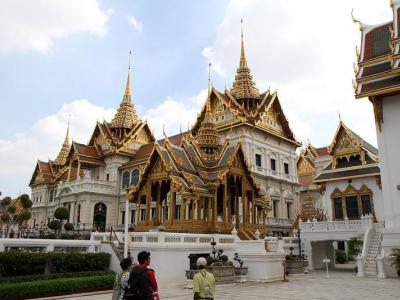
If Bangkok had a crown, it would look suspiciously like the Grand Palace—ornate, dazzling, and absolutely not trying to keep a low profile. Commissioned in 1782 by King Rama I, this sprawling complex marked the moment the capital officially moved from Thonburi to Bangkok. The chosen site already had Chinese merchants in place, who, when asked politely to relocate, did so without delay—because when a king needs a palace, negotiations tend to be short...
At the beginning, the palace was a fortified cluster of wooden buildings wrapped in a defensive wall stretching nearly two kilometers. Over time, it grew into something far more elaborate, with layers of halls, courtyards, and ceremonial spaces unfolding like a carefully staged performance. On the eastern side, you’ll find the revered Wat Phra Kaew, built as the king’s personal place of worship and still considered the most sacred temple in Thailand. The layout follows a strict order: river to the west, temple to the east, and everything aligned with purpose.
Inside, the palace is divided into three zones. The Outer Court handled administration, treasury, and military affairs—the kingdom’s working machinery. The Central Court housed the king’s residence and state halls. Beyond that lay the Inner Court, a secluded world occupied only by royal consorts, daughters, and young boys, functioning as a self-contained community.
By the early 20th century, Thai kings had moved out, but the palace didn’t retire and stayed very much in use. Today, it hosts royal ceremonies, state events, and occasions that call for maximum grandeur. And grandeur is something this place delivers effortlessly. Gold surfaces shimmer in the sun, intricate details reward every glance, and the entire complex feels like a masterclass in craftsmanship.
A quick note before entering: this is Thailand’s most sacred site, so dress accordingly—covered shoulders, no bare feet, nothing see-through.
And, of course, timing matters. Arrive early to avoid midday crowds. Free English tours run at 10 and 10:30 am, as well as at 1 and 1:30 pm, and audio guides are available if you prefer to explore at your own pace. The entry ticket also includes access to a traditional theater performance, adding a final touch of spectacle.
Skip this, and you’ve essentially missed Bangkok’s main act.
At the beginning, the palace was a fortified cluster of wooden buildings wrapped in a defensive wall stretching nearly two kilometers. Over time, it grew into something far more elaborate, with layers of halls, courtyards, and ceremonial spaces unfolding like a carefully staged performance. On the eastern side, you’ll find the revered Wat Phra Kaew, built as the king’s personal place of worship and still considered the most sacred temple in Thailand. The layout follows a strict order: river to the west, temple to the east, and everything aligned with purpose.
Inside, the palace is divided into three zones. The Outer Court handled administration, treasury, and military affairs—the kingdom’s working machinery. The Central Court housed the king’s residence and state halls. Beyond that lay the Inner Court, a secluded world occupied only by royal consorts, daughters, and young boys, functioning as a self-contained community.
By the early 20th century, Thai kings had moved out, but the palace didn’t retire and stayed very much in use. Today, it hosts royal ceremonies, state events, and occasions that call for maximum grandeur. And grandeur is something this place delivers effortlessly. Gold surfaces shimmer in the sun, intricate details reward every glance, and the entire complex feels like a masterclass in craftsmanship.
A quick note before entering: this is Thailand’s most sacred site, so dress accordingly—covered shoulders, no bare feet, nothing see-through.
And, of course, timing matters. Arrive early to avoid midday crowds. Free English tours run at 10 and 10:30 am, as well as at 1 and 1:30 pm, and audio guides are available if you prefer to explore at your own pace. The entry ticket also includes access to a traditional theater performance, adding a final touch of spectacle.
Skip this, and you’ve essentially missed Bangkok’s main act.
4) Wat Phra Kaew (Temple of the Emerald Buddha) (must see)
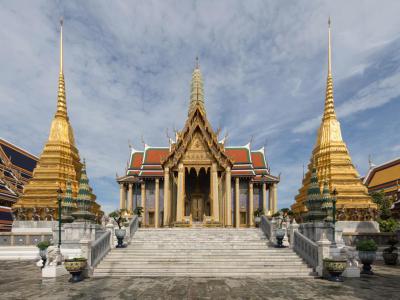
Set within the grounds of the Grand Palace, Wat Phra Kaew—or the Temple of the Emerald Buddha—is a place where reverence meets spectacle. It’s the most sacred Buddhist site in the country, and all that prestige revolves around a statue that stands just about two feet tall. Small in size, enormous in significance—the Emerald Buddha, carved from dark green stone, commands the kind of attention most monuments can only dream of.
Now, where did this statue actually come from? That depends on who you ask. Some historians point toward Sri Lanka, others insist it was crafted locally in the 14th century. But the more cinematic version involves a lightning strike in Chiang Rai in 1434, cracking open a plaster-covered monument to reveal the green figure hidden inside. Not exactly subtle, but then again, subtlety wasn’t really the point.
Over the centuries, this statue has sparked rivalries, relocations, and more than a few military campaigns. Eventually, it arrived in Bangkok in 1782, where it has remained ever since, regarded as a powerful symbol of protection and legitimacy for the Thai kingdom. Paired with the Grand Palace next door, Wat Phra Kaew forms one of the most compelling sights in the city—less a single attraction, more a full cultural statement.
So, yes, the Grand Palace already delivers the grandeur. But Wat Phra Kaew adds that final, almost theatrical flourish—the detail that pulls everything together. Call it the finishing touch, the quiet center of gravity, or simply the reason everyone ends up here sooner or later.
If you want to experience it without the shoulder-to-shoulder shuffle, aim to arrive right when the gates open, around 8 a.m. Dress with a bit of respect—covered shoulders, no bare knees—and give yourself time to wander. This isn’t a place you rush; it’s one you take in, piece by piece, until the scale of it all starts to make sense.
Now, where did this statue actually come from? That depends on who you ask. Some historians point toward Sri Lanka, others insist it was crafted locally in the 14th century. But the more cinematic version involves a lightning strike in Chiang Rai in 1434, cracking open a plaster-covered monument to reveal the green figure hidden inside. Not exactly subtle, but then again, subtlety wasn’t really the point.
Over the centuries, this statue has sparked rivalries, relocations, and more than a few military campaigns. Eventually, it arrived in Bangkok in 1782, where it has remained ever since, regarded as a powerful symbol of protection and legitimacy for the Thai kingdom. Paired with the Grand Palace next door, Wat Phra Kaew forms one of the most compelling sights in the city—less a single attraction, more a full cultural statement.
So, yes, the Grand Palace already delivers the grandeur. But Wat Phra Kaew adds that final, almost theatrical flourish—the detail that pulls everything together. Call it the finishing touch, the quiet center of gravity, or simply the reason everyone ends up here sooner or later.
If you want to experience it without the shoulder-to-shoulder shuffle, aim to arrive right when the gates open, around 8 a.m. Dress with a bit of respect—covered shoulders, no bare knees—and give yourself time to wander. This isn’t a place you rush; it’s one you take in, piece by piece, until the scale of it all starts to make sense.
5) Lak Mueang (City Pillar Shrine)
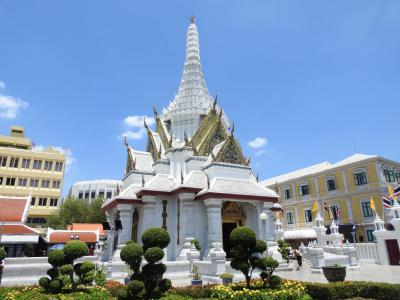
In Thailand, cities don’t just get a founding date—they get a guardian. These are the Lak Mueang, or city pillars, and each one houses a protective spirit known as Chao Pho Lak Mueang. Before a single wall went up, a Brahman ritual would plant a lone acacia trunk—called Chaiyaphreuk, or the “tree of victory”—right at the city’s core.
Think of it as laying the spiritual foundation first, and the bricks later. From that moment on, the pillar wasn’t just wood in the ground—it was the city’s anchor for luck, protection, and a bit of cosmic reassurance.
Bangkok’s own pillar was set in place by King Rama I on April 21, 1782, right as the capital made its move across the river from Thonburi. In fact, this shrine came before the Grand Palace, which tells you exactly where priorities stood: first secure the spirits, then build the kingdom. That original pillar stood nearly five meters tall, with a horoscope tucked inside—because naturally, even cities need their stars checked...
By the mid-19th century, the shrine was rebuilt, the pillar refreshed with an updated horoscope, and in 1852, a second pillar joined the first, slightly taller and just as symbolic. The whole structure was crowned with a prang-style spire, inspired by the Ayutthaya shrine, giving it the kind of architectural flourish that says, “yes, this is important.”
Now, as with many old foundations, there’s a darker legend lurking in the background. One tale claims that during construction, people who answered a mysterious call—“in–chan–mun–kong,” supposedly marking the cardinal directions—were sacrificed and buried beneath the pillar to protect the city. It’s a gripping story, though historians will quickly point out there’s no real evidence to support it. Still, it adds a certain dramatic edge to what might otherwise seem like a very polite piece of infrastructure.
Today, the ritual is far less intense. Worshipers arrive with offerings: three incense sticks, a candle, gold leaf, two lotus flowers, a pair of garlands, and a strip of colorful cloth. No sacrifices required—just a quiet moment, a bit of smoke curling into the air, and a centuries-old tradition still doing its job in the background...
Think of it as laying the spiritual foundation first, and the bricks later. From that moment on, the pillar wasn’t just wood in the ground—it was the city’s anchor for luck, protection, and a bit of cosmic reassurance.
Bangkok’s own pillar was set in place by King Rama I on April 21, 1782, right as the capital made its move across the river from Thonburi. In fact, this shrine came before the Grand Palace, which tells you exactly where priorities stood: first secure the spirits, then build the kingdom. That original pillar stood nearly five meters tall, with a horoscope tucked inside—because naturally, even cities need their stars checked...
By the mid-19th century, the shrine was rebuilt, the pillar refreshed with an updated horoscope, and in 1852, a second pillar joined the first, slightly taller and just as symbolic. The whole structure was crowned with a prang-style spire, inspired by the Ayutthaya shrine, giving it the kind of architectural flourish that says, “yes, this is important.”
Now, as with many old foundations, there’s a darker legend lurking in the background. One tale claims that during construction, people who answered a mysterious call—“in–chan–mun–kong,” supposedly marking the cardinal directions—were sacrificed and buried beneath the pillar to protect the city. It’s a gripping story, though historians will quickly point out there’s no real evidence to support it. Still, it adds a certain dramatic edge to what might otherwise seem like a very polite piece of infrastructure.
Today, the ritual is far less intense. Worshipers arrive with offerings: three incense sticks, a candle, gold leaf, two lotus flowers, a pair of garlands, and a strip of colorful cloth. No sacrifices required—just a quiet moment, a bit of smoke curling into the air, and a centuries-old tradition still doing its job in the background...
6) Wat Pho (Temple of the Reclining Buddha) (must see)
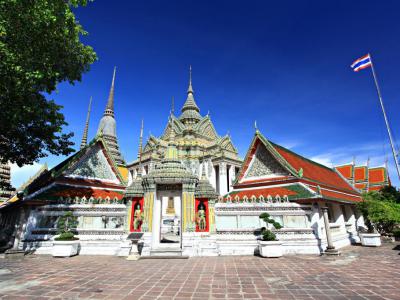
If there's one place in Bangkok that does “relaxed grandeur” properly, this is Wat Pho. Officially known as the Temple of the Reclining Buddha, it’s the city’s oldest Buddhist temple, whose origins reach back well before Bangkok became the capital. Sitting just behind Wat Phra Kaew, it might sound secondary—but once inside, that idea disappears quickly.
The temple's main attraction is impossible to miss. The Reclining Buddha stretches 46 meters long and 15 meters high, covered in gold and representing the Buddha’s passage into nirvana. In essence, this statue feels more like an experience in scale. As you move along its length, the details begin to stand out—especially the feet, inlaid with mother-of-pearl and decorated with 108 auspicious symbols drawn from both Chinese and Indian traditions. It’s the kind of detail that rewards slowing down.
The complex expands gradually as you walk through it. Divided into two walled sections, most visitors focus on the northern compound, where the Reclining Buddha sits inside a large hall surrounded by nearly 400 bronze Buddha images.
Step outside, and the grounds open up to rows of Buddhist structures called “chedis”—91 in total—each adding color and variation to the skyline. Nearby, a richly decorated library stands out with porcelain ornamentation, while across the complex, you’ll find over a thousand Buddha images, many brought here from the ruins of earlier capitals like Ayutthaya and Sukhothai.
Apart from being a place to pray and look at, Wat Pho is also a teaching institution. Recognized as Thailand’s first public university, it remains closely tied to the traditional Thai massage. This isn’t the gentle spa version, no; it’s more structured, involving stretching and pressure techniques designed to improve circulation and flexibility. If you’re curious, this is one of the most authentic places to try it.
Practicalities are straightforward but worth noting. Bring exact change for your ticket, as change is rarely given. Plan at least two hours, though it’s easy to stay longer. The ticket includes a bottle of water, and refill stations are available inside. Dress modestly—covering knees and shoulders—and be prepared to remove your shoes before entering the main hall. It’s a small adjustment that fits the rhythm of the place: slow down, take your time, and let the details do the work.
The temple's main attraction is impossible to miss. The Reclining Buddha stretches 46 meters long and 15 meters high, covered in gold and representing the Buddha’s passage into nirvana. In essence, this statue feels more like an experience in scale. As you move along its length, the details begin to stand out—especially the feet, inlaid with mother-of-pearl and decorated with 108 auspicious symbols drawn from both Chinese and Indian traditions. It’s the kind of detail that rewards slowing down.
The complex expands gradually as you walk through it. Divided into two walled sections, most visitors focus on the northern compound, where the Reclining Buddha sits inside a large hall surrounded by nearly 400 bronze Buddha images.
Step outside, and the grounds open up to rows of Buddhist structures called “chedis”—91 in total—each adding color and variation to the skyline. Nearby, a richly decorated library stands out with porcelain ornamentation, while across the complex, you’ll find over a thousand Buddha images, many brought here from the ruins of earlier capitals like Ayutthaya and Sukhothai.
Apart from being a place to pray and look at, Wat Pho is also a teaching institution. Recognized as Thailand’s first public university, it remains closely tied to the traditional Thai massage. This isn’t the gentle spa version, no; it’s more structured, involving stretching and pressure techniques designed to improve circulation and flexibility. If you’re curious, this is one of the most authentic places to try it.
Practicalities are straightforward but worth noting. Bring exact change for your ticket, as change is rarely given. Plan at least two hours, though it’s easy to stay longer. The ticket includes a bottle of water, and refill stations are available inside. Dress modestly—covering knees and shoulders—and be prepared to remove your shoes before entering the main hall. It’s a small adjustment that fits the rhythm of the place: slow down, take your time, and let the details do the work.
7) Museum Siam
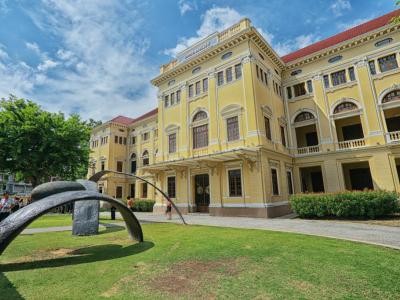
Museum Siam, established in 2007 within the former Ministry of Commerce building, serves as a discovery museum. Its primary mission is to educate visitors about the national identity, history, and cultural connections of the Thai people, including their interactions with neighboring societies. The museum achieves this through a collection of interactive exhibits that chronicle Thailand's historical development from the past to the present.
The museum's building originally served as the offices for the Ministry of Commerce during the reign of King Vajiravudh (Rama VI, 1910–1925). The land it occupies was previously part of a palace that housed several of King Rama III's sons. The architectural design of the building, featuring classical revival elements, was a collaborative effort involving Italian architect Mario Tamagno, engineer E.G. Gollo, architect Guadrelli, and decorative contributions from Vittorio Novi. Construction of the building took place between 1921 and 1922, and it is now a registered historical monument.
The museum's interior is divided into various thematic rooms, each with its own focus. These themes encompass aspects such as 'Typically Thai,' 'Bangkok,' 'New Ayutthaya,' 'Village Life,' 'Change,' 'Politics and Communications,' 'Thailand and the World,' 'Thailand Today,' 'Thailand Tomorrow,' 'Introduction to Suvarnabhumi,' 'Suvarnabhumi,' 'Buddhism,' 'Founding of Ayutthaya,' 'Siam,' and the 'War Room.' Additionally, the museum includes a map room, an immersive theater with a panoramic screen for historical movies. The museum's initial permanent exhibit was titled 'Essays,' which provided insights into Thailand's history from various angles.
It's worth noting that the Sanam Chai MRT station, inaugurated in 2020, is conveniently located directly in front of the museum, facilitating easy access for visitors.
The museum's building originally served as the offices for the Ministry of Commerce during the reign of King Vajiravudh (Rama VI, 1910–1925). The land it occupies was previously part of a palace that housed several of King Rama III's sons. The architectural design of the building, featuring classical revival elements, was a collaborative effort involving Italian architect Mario Tamagno, engineer E.G. Gollo, architect Guadrelli, and decorative contributions from Vittorio Novi. Construction of the building took place between 1921 and 1922, and it is now a registered historical monument.
The museum's interior is divided into various thematic rooms, each with its own focus. These themes encompass aspects such as 'Typically Thai,' 'Bangkok,' 'New Ayutthaya,' 'Village Life,' 'Change,' 'Politics and Communications,' 'Thailand and the World,' 'Thailand Today,' 'Thailand Tomorrow,' 'Introduction to Suvarnabhumi,' 'Suvarnabhumi,' 'Buddhism,' 'Founding of Ayutthaya,' 'Siam,' and the 'War Room.' Additionally, the museum includes a map room, an immersive theater with a panoramic screen for historical movies. The museum's initial permanent exhibit was titled 'Essays,' which provided insights into Thailand's history from various angles.
It's worth noting that the Sanam Chai MRT station, inaugurated in 2020, is conveniently located directly in front of the museum, facilitating easy access for visitors.
