

Audio Guide: Walk Through Pula's Beautiful Old Town (Self Guided), Pula
According to Greek mythology, Pula was founded by a group of people from the ancient land of Colchis, on the eastern shore of the Black Sea. Their story is connected to Jason and the Golden Fleece. After Jason stole the Fleece and fled with Medea, a powerful sorceress from Colchis, her people pursued the couple across the seas. When they lost their trail and could not find their way home, they settled here on the Adriatic. According to the legend, they called their new home a “Place of Refuge.”
The Romans arrived in 177 BC. During the civil war of 42 BC between the alliance of Brutus and Cassius and that of Antony, Octavian, and Lepidus, Pula had to choose a side. It supported Brutus and Cassius-a poor decision, as they were defeated. In retaliation, Octavian ordered Pula to be demolished.
Odoacer, the Ostrogoths, the Byzantines, the Franks, and the Venetians took turns conquering Pula. Genoa and Venice struggled for control of the city until 1331, when Venice prevailed. The Venetians ruled Pula until 1797. Following the collapse of the Venetian Republic, the city became part of the Austrian Empire and later Austria-Hungary, remaining under Habsburg rule until the end of World War I.
Today, Pula is part of the Republic of Croatia. The city is officially bilingual, with both Croatian and Italian in use. It lies beneath seven hills on the Istrian Peninsula, overlooking the Adriatic Sea. Pula has a distinctly urban and international atmosphere. Its architecture combines Roman, Venetian, Austro-Hungarian, and Socialist-era influences.
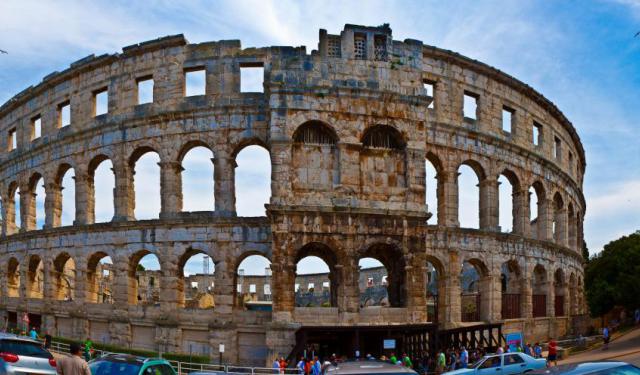
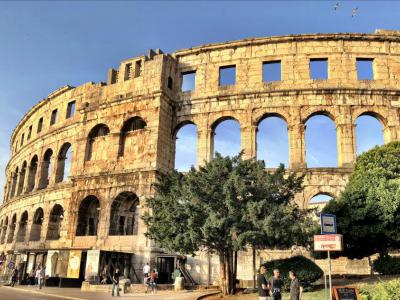
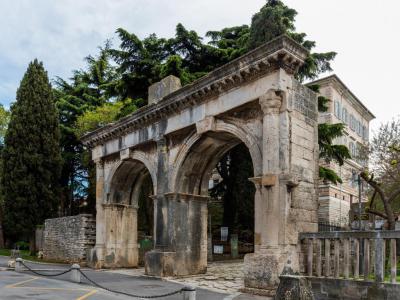
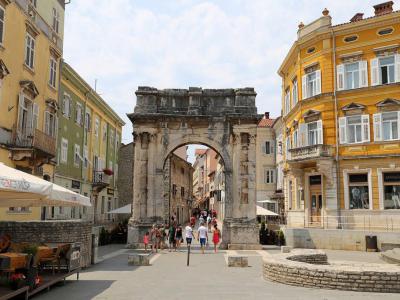
Its best-known attraction is the Roman amphitheater, commonly called the Pula Arena. Remarkably well preserved, it dates mainly from the 1st century AD. The 1st-century-BC Arch of the Sergii, once connected to the city walls, now stands alone. The Roman Forum also preserves traces of several ancient temples.
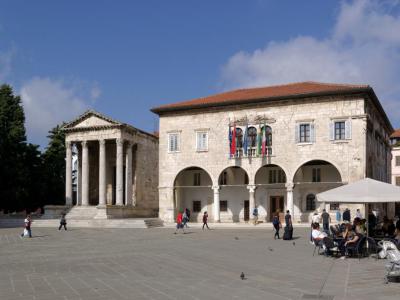
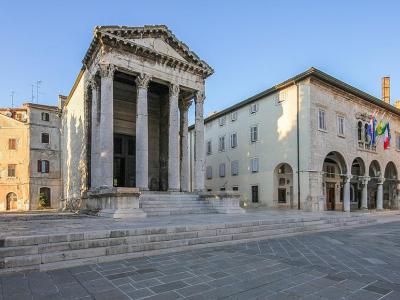
The area contains 26 Austro-Hungarian forts and artillery batteries and brings together landmarks from several periods of its history. Forum Square is framed by the medieval Communal Palace and the remarkably preserved Temple of Augustus. Above the old town, Pula Castle overlooks the harbor from its hilltop position and houses the Historical and Maritime Museum of Istria. Nearby, the richly decorated Triumphal Arch of the Sergii recalls the city’s Roman past through its Corinthian columns, carved victories, garlands, and ancient inscriptions today.
From a legendary refuge for strangers far from home to a Roman city, Venetian possession, Habsburg military center, and modern Croatian city, Pula has accumulated layer upon layer of history. Follow this walk through its streets and discover how the ancient “Place of Refuge” became a city where the worlds of mythology, Rome, Venice, and Austria-Hungary still meet beside the Adriatic.
The Romans arrived in 177 BC. During the civil war of 42 BC between the alliance of Brutus and Cassius and that of Antony, Octavian, and Lepidus, Pula had to choose a side. It supported Brutus and Cassius-a poor decision, as they were defeated. In retaliation, Octavian ordered Pula to be demolished.
Odoacer, the Ostrogoths, the Byzantines, the Franks, and the Venetians took turns conquering Pula. Genoa and Venice struggled for control of the city until 1331, when Venice prevailed. The Venetians ruled Pula until 1797. Following the collapse of the Venetian Republic, the city became part of the Austrian Empire and later Austria-Hungary, remaining under Habsburg rule until the end of World War I.
Today, Pula is part of the Republic of Croatia. The city is officially bilingual, with both Croatian and Italian in use. It lies beneath seven hills on the Istrian Peninsula, overlooking the Adriatic Sea. Pula has a distinctly urban and international atmosphere. Its architecture combines Roman, Venetian, Austro-Hungarian, and Socialist-era influences.
Its best-known attraction is the Roman amphitheater, commonly called the Pula Arena. Remarkably well preserved, it dates mainly from the 1st century AD. The 1st-century-BC Arch of the Sergii, once connected to the city walls, now stands alone. The Roman Forum also preserves traces of several ancient temples.
The area contains 26 Austro-Hungarian forts and artillery batteries and brings together landmarks from several periods of its history. Forum Square is framed by the medieval Communal Palace and the remarkably preserved Temple of Augustus. Above the old town, Pula Castle overlooks the harbor from its hilltop position and houses the Historical and Maritime Museum of Istria. Nearby, the richly decorated Triumphal Arch of the Sergii recalls the city’s Roman past through its Corinthian columns, carved victories, garlands, and ancient inscriptions today.
From a legendary refuge for strangers far from home to a Roman city, Venetian possession, Habsburg military center, and modern Croatian city, Pula has accumulated layer upon layer of history. Follow this walk through its streets and discover how the ancient “Place of Refuge” became a city where the worlds of mythology, Rome, Venice, and Austria-Hungary still meet beside the Adriatic.
How it works: Download the app "GPSmyCity: Walks in 1K+ Cities" from Apple App Store or Google Play Store to your mobile phone or tablet. The app turns your mobile device into a personal tour guide and its built-in GPS navigation functions guide you from one tour stop to next. The app works offline, so no data plan is needed when traveling abroad.
Download The GPSmyCity App



Walk Through Pula's Beautiful Old Town Map
Guide Name: Walk Through Pula's Beautiful Old Town
Guide Location: Croatia » Pula (See other walking tours in Pula)
Guide Type: Self-guided Walking Tour (Sightseeing)
Tour Duration: 2 Hours
Travel Distance: 2.7 Km or 1.7 Miles
Tour Best Suited For: First-time visit
Guide Location: Croatia » Pula (See other walking tours in Pula)
Guide Type: Self-guided Walking Tour (Sightseeing)
Tour Duration: 2 Hours
Travel Distance: 2.7 Km or 1.7 Miles
Tour Best Suited For: First-time visit
Sights Featured in This Walk
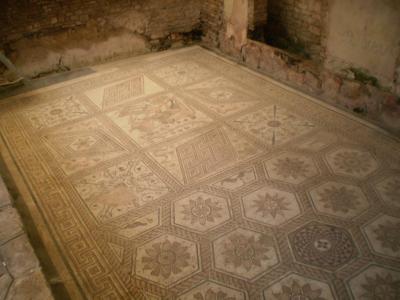
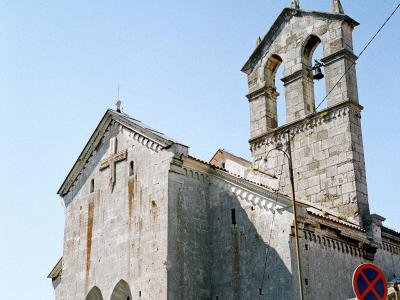
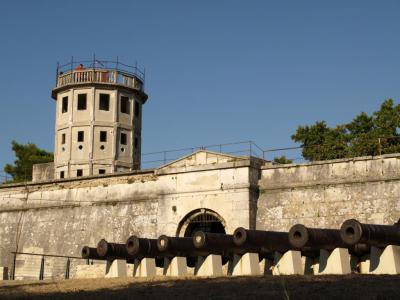
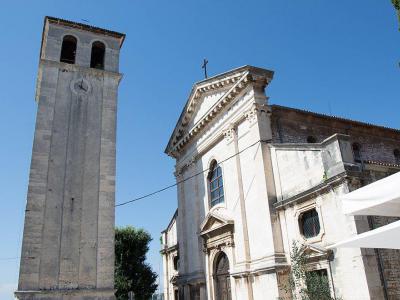
Walking Tours in Pula, Croatia

Create Your Own Walk in Pula
Creating your own self-guided walk in Pula is easy and fun. Choose the city attractions that you want to see and a walk route map will be created just for you. You can even set your hotel as the start point of the walk.
Pula's Seaside Walking Tour
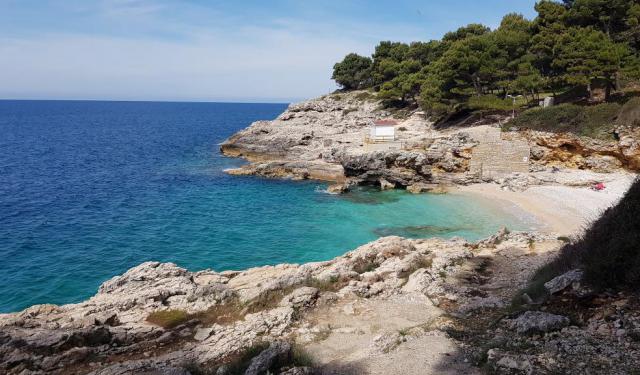
If you crave for holidays by the sea, the Croatian coast is a good choice for family vacation, especially so if it includes the town of Pula. This charming port city is rich in tourist attractions, the most famous of which, undoubtedly, are the local beaches and bays.
Indeed, the dreamlike beaches of Pula are widely regarded among the most picturesque in Istria. Incredibly spectacular, these... view more
Tour Duration: 2 Hours
Travel Distance: 4.7 Km or 2.9 Miles
Indeed, the dreamlike beaches of Pula are widely regarded among the most picturesque in Istria. Incredibly spectacular, these... view more
Tour Duration: 2 Hours
Travel Distance: 4.7 Km or 2.9 Miles
The Most Popular Cities
/ view all