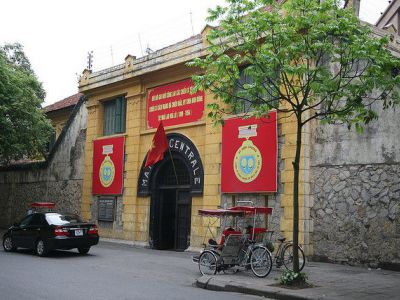


Hoa Lo Prison, Hanoi (must see)
Hoa Lo Prison is one of Hanoi’s most thought-provoking historical sites, preserving the remains of a notorious prison that witnessed both French colonial rule and the Vietnam War. Built by the French colonial authorities between 1896 and 1901, it was originally known as the Central House and was intended primarily for Vietnamese political prisoners and opponents of colonial rule. Its Vietnamese name, Hoa Lo, can be translated as “fiery furnace” or “stove,” referring to the pottery kilns that once operated in the area.
Originally designed to accommodate around 450 inmates, the prison became severely overcrowded as opposition to French rule intensified, at times holding more than 2,000 prisoners. Conditions were notoriously harsh, with overcrowded cells, poor sanitation, disease and severe punishment. Many inmates were restrained with iron shackles, while a French guillotine, now preserved in the museum, was once used to execute condemned prisoners. To find it, proceed into the southern wing of the museum, where the guillotine is displayed near the death-row cells, alongside shackles dating from the colonial era.
Following the end of French colonial rule in 1954, the prison came under North Vietnamese control. During the Vietnam War, it became a major detention centre for captured American servicemen, particularly pilots whose aircraft had been shot down. American prisoners sarcastically nicknamed it the “Hanoi Hilton.” Among its best-known inmates were future US senator and presidential candidate John McCain and Pete Peterson, who later became the first US ambassador to Vietnam following the restoration of diplomatic relations.
Much of the original complex was demolished during redevelopment in the 1990s, with only a portion preserved as a museum. Visitors can explore communal cells, narrow corridors, sections of the original walls and reconstructed detention areas, alongside photographs, personal objects and other historical artefacts. Particularly striking are the dark communal cells, where life-sized figures illustrate how prisoners were once shackled together on raised platforms. The concrete platforms were sloped, adding to the discomfort of prisoners who were chained by their ankles and forced to remain in restrictive positions for extended periods. The men’s section can be reached by passing through a series of rooms in the northern wing.
Beyond the communal cells, visitors reach the dark solitary-confinement cells, known as the dungeon, where prisoners who violated prison rules were isolated in darkness and subjected to extremely poor living conditions and inadequate food.
Originally designed to accommodate around 450 inmates, the prison became severely overcrowded as opposition to French rule intensified, at times holding more than 2,000 prisoners. Conditions were notoriously harsh, with overcrowded cells, poor sanitation, disease and severe punishment. Many inmates were restrained with iron shackles, while a French guillotine, now preserved in the museum, was once used to execute condemned prisoners. To find it, proceed into the southern wing of the museum, where the guillotine is displayed near the death-row cells, alongside shackles dating from the colonial era.
Following the end of French colonial rule in 1954, the prison came under North Vietnamese control. During the Vietnam War, it became a major detention centre for captured American servicemen, particularly pilots whose aircraft had been shot down. American prisoners sarcastically nicknamed it the “Hanoi Hilton.” Among its best-known inmates were future US senator and presidential candidate John McCain and Pete Peterson, who later became the first US ambassador to Vietnam following the restoration of diplomatic relations.
Much of the original complex was demolished during redevelopment in the 1990s, with only a portion preserved as a museum. Visitors can explore communal cells, narrow corridors, sections of the original walls and reconstructed detention areas, alongside photographs, personal objects and other historical artefacts. Particularly striking are the dark communal cells, where life-sized figures illustrate how prisoners were once shackled together on raised platforms. The concrete platforms were sloped, adding to the discomfort of prisoners who were chained by their ankles and forced to remain in restrictive positions for extended periods. The men’s section can be reached by passing through a series of rooms in the northern wing.
Beyond the communal cells, visitors reach the dark solitary-confinement cells, known as the dungeon, where prisoners who violated prison rules were isolated in darkness and subjected to extremely poor living conditions and inadequate food.
Want to visit this sight? Check out these Self-Guided Walking Tours in Hanoi. Alternatively, you can download the mobile app "GPSmyCity: Walks in 1K+ Cities" from Apple App Store or Google Play Store. The app turns your mobile device to a personal tour guide and it works offline, so no data plan is needed when traveling abroad.
Download The GPSmyCity App



Hoa Lo Prison on Map
Sight Name: Hoa Lo Prison
Sight Location: Hanoi, Vietnam (See walking tours in Hanoi)
Sight Type: Museum/Gallery
Guide(s) Containing This Sight:
Sight Location: Hanoi, Vietnam (See walking tours in Hanoi)
Sight Type: Museum/Gallery
Guide(s) Containing This Sight:
Nearby Sights




Walking Tours in Hanoi, Vietnam

Create Your Own Walk in Hanoi
Creating your own self-guided walk in Hanoi is easy and fun. Choose the city attractions that you want to see and a walk route map will be created just for you. You can even set your hotel as the start point of the walk.

Explore Hanoi's Modern City Center on Foot
Known for its centuries-old architecture and rich culture with Southeast Asian, Chinese and French influences, the capital of Vietnam, Hanoi, traces its origin back to the third century BC. Originally, a portion of modern-day Hanoi served as the capital of the historic Vietnamese nation Âu Lạc. Following the collapse of Âu Lạc, the city was made part of Han China (111 BC-40 AD).
... view more
Tour Duration: 2 Hours
Travel Distance: 4 Km or 2.5 Miles
... view more
Tour Duration: 2 Hours
Travel Distance: 4 Km or 2.5 Miles
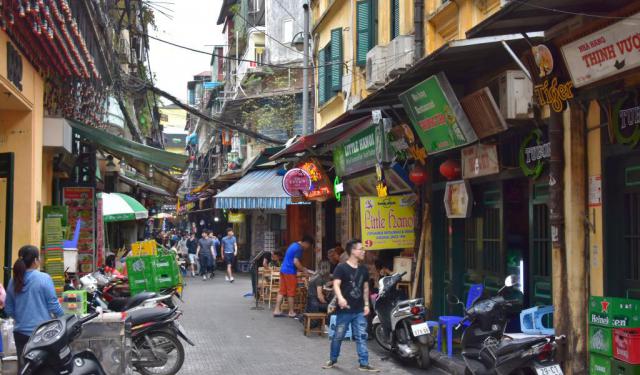
Hanoi's Old Quarter Walking Tour
Vietnamese writer Thach Lam’s book Hanoi’s Thirty-Six Streets celebrates the streets, food and everyday character of the old city. In one memorable passage, he wrote: “We too have Hanoi, a city of many beauties.”
Hanoi, the capital of Vietnam, has a history stretching back more than a thousand years, although settlements existed in the area long before the city became an imperial... view more
Tour Duration: 2 Hours
Travel Distance: 4 Km or 2.5 Miles
Hanoi, the capital of Vietnam, has a history stretching back more than a thousand years, although settlements existed in the area long before the city became an imperial... view more
Tour Duration: 2 Hours
Travel Distance: 4 Km or 2.5 Miles