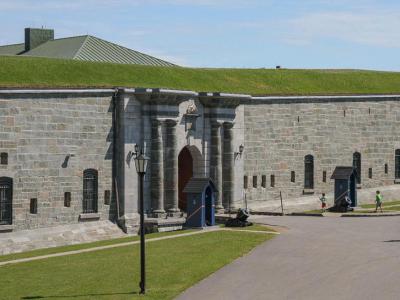


La Citadelle de Quebec (Quebec Citadel), Quebec City (must see)
As you approach the Quebec Citadel, follow the road up Cape Diamond, the high point overlooking Old Quebec. The massive star-shaped stone walls ahead mark one of North America’s largest and best-preserved fortresses. Built by the British between 1820 and 1831 against a feared American attack that never came, the Citadel is often called “The Gibraltar of the Americas.” Today, it remains an active military base and home of the Royal 22nd Regiment, the Canadian Army’s only French-speaking regular infantry unit.
Before entering, pause by the ramparts to notice the fortress layout: thick curtain walls linking four projecting bastions. From this elevated position, look down toward Château Frontenac and across the broad Saint Lawrence River for some of the best views in the city.
Once through the main entrance, orient yourself by the central parade ground, the wide open space inside the walls. Around it, look for the long, low barracks, identifiable by their plain stone façades, regular rows of windows, and practical rectangular shape. As your self-guided route continues, notice the more functional buildings set slightly back from the parade ground. The former hangars and service buildings are recognizable by their broad doors and utilitarian appearance. Among them is the armory once used for the storage and maintenance of military equipment, showing how the Citadel functioned as a self-contained defensive post.
When the route turns toward the ramparts, look for the older French-period structures. The powder magazine, dating from 1750, is a compact, thick-walled stone building designed to protect gunpowder. Nearby, the Cap-aux-Diamants Redoubt, built in 1693, is a smaller fortified work incorporated into the later British fortress.
The Governor General’s residence stands apart from the plainer military buildings; identify it by its more refined, residence-like appearance within the grounds. The visitor-focused highlight is the Royal 22nd Regiment Museum, where uniforms, weapons, medals, and wartime memorabilia tell the story of the famous “Van Doos” and Quebec’s military past.
From June 24 to Labour Day, arrive before 10:00 a.m. for the Changing of the Guard, with soldiers in scarlet tunics and bearskin hats, often joined by Batisse, the regiment’s goat mascot. As the Citadel is an active military base, visits are allowed by guided tour only.
Before entering, pause by the ramparts to notice the fortress layout: thick curtain walls linking four projecting bastions. From this elevated position, look down toward Château Frontenac and across the broad Saint Lawrence River for some of the best views in the city.
Once through the main entrance, orient yourself by the central parade ground, the wide open space inside the walls. Around it, look for the long, low barracks, identifiable by their plain stone façades, regular rows of windows, and practical rectangular shape. As your self-guided route continues, notice the more functional buildings set slightly back from the parade ground. The former hangars and service buildings are recognizable by their broad doors and utilitarian appearance. Among them is the armory once used for the storage and maintenance of military equipment, showing how the Citadel functioned as a self-contained defensive post.
When the route turns toward the ramparts, look for the older French-period structures. The powder magazine, dating from 1750, is a compact, thick-walled stone building designed to protect gunpowder. Nearby, the Cap-aux-Diamants Redoubt, built in 1693, is a smaller fortified work incorporated into the later British fortress.
The Governor General’s residence stands apart from the plainer military buildings; identify it by its more refined, residence-like appearance within the grounds. The visitor-focused highlight is the Royal 22nd Regiment Museum, where uniforms, weapons, medals, and wartime memorabilia tell the story of the famous “Van Doos” and Quebec’s military past.
From June 24 to Labour Day, arrive before 10:00 a.m. for the Changing of the Guard, with soldiers in scarlet tunics and bearskin hats, often joined by Batisse, the regiment’s goat mascot. As the Citadel is an active military base, visits are allowed by guided tour only.
Want to visit this sight? Check out these Self-Guided Walking Tours in Quebec City. Alternatively, you can download the mobile app "GPSmyCity: Walks in 1K+ Cities" from Apple App Store or Google Play Store. The app turns your mobile device to a personal tour guide and it works offline, so no data plan is needed when traveling abroad.
Download The GPSmyCity App



La Citadelle de Quebec (Quebec Citadel) on Map
Sight Name: La Citadelle de Quebec (Quebec Citadel)
Sight Location: Quebec City, Canada (See walking tours in Quebec City)
Sight Type: Attraction/Landmark
Guide(s) Containing This Sight:
Sight Location: Quebec City, Canada (See walking tours in Quebec City)
Sight Type: Attraction/Landmark
Guide(s) Containing This Sight:
Nearby Sights

Walking Tours in Quebec City, Quebec

Create Your Own Walk in Quebec City
Creating your own self-guided walk in Quebec City is easy and fun. Choose the city attractions that you want to see and a walk route map will be created just for you. You can even set your hotel as the start point of the walk.
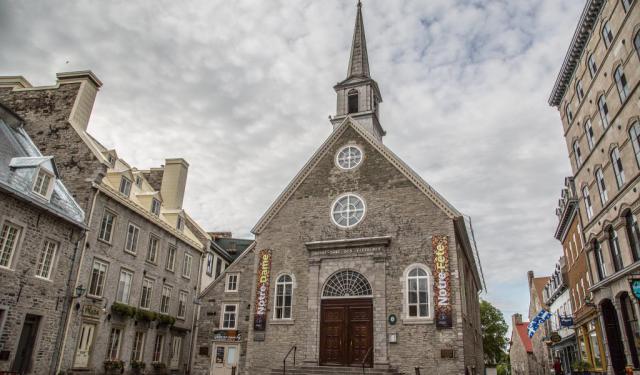
Qucbec City's Historical Churches Walking Tour
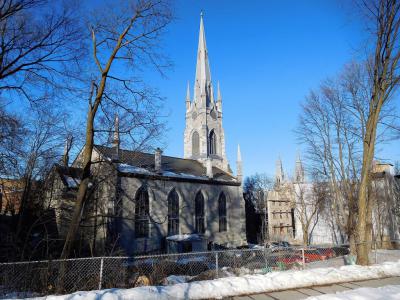
The first religious buildings in Canada were established by the Récollets and Jesuits, in 1615 and 1625, respectively, when they first arrived in New France. Later on, the French colonists brought along their culture and architectural traditions, and the establishment of British and evangelical society triggered further major developments in Quebec City.
Over the course of the 17th and 18th... view more
Tour Duration: 1 Hour(s)
Travel Distance: 2.9 Km or 1.8 Miles
Over the course of the 17th and 18th... view more
Tour Duration: 1 Hour(s)
Travel Distance: 2.9 Km or 1.8 Miles
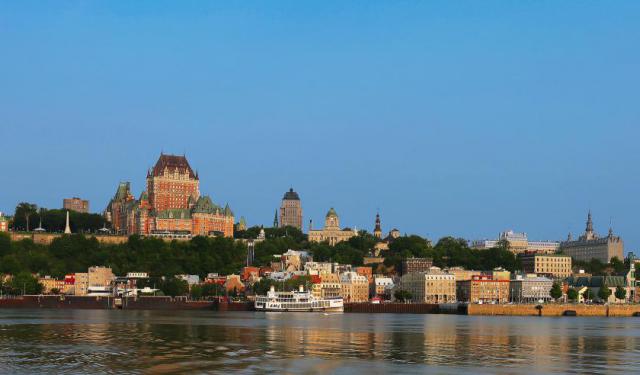
Quebec City Introduction Walking Tour
Cresting a cliff above the St. Lawrence River, Quebec City is the soul of the province of Quebec – a place all its own; a country within a country with its own traditions, architecture, and French-speaking population.
The Algonquian people had originally named this area Kébec, which means "where the river narrows", because the Saint Lawrence River indeed narrows proximate to the... view more
Tour Duration: 2 Hour(s)
Travel Distance: 3.2 Km or 2 Miles
The Algonquian people had originally named this area Kébec, which means "where the river narrows", because the Saint Lawrence River indeed narrows proximate to the... view more
Tour Duration: 2 Hour(s)
Travel Distance: 3.2 Km or 2 Miles
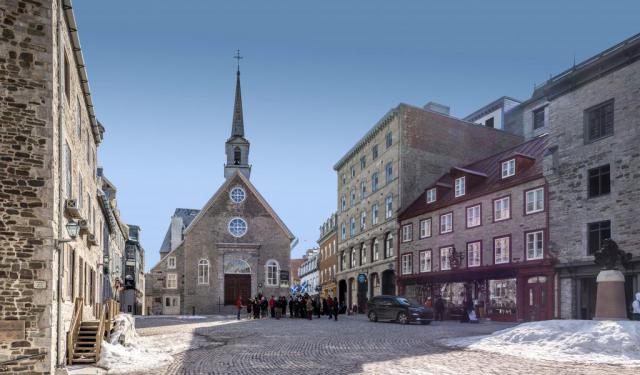
Old Quebec Walk
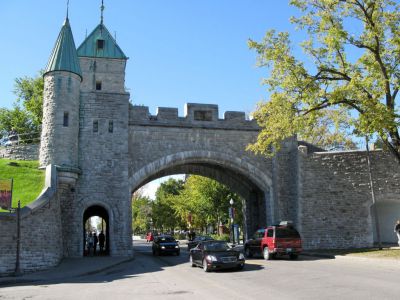
The historic part of Quebec City known as Old Quebec (French: Vieux-Québec), sometimes also referred to as the Latin Quarter (Quartier Latin), is the neighborhood centered around Cape Diamond (Cap Diamant), located on the eastern edge of Quebec hill promontory. The area comprises Upper Town (Haute-Ville) and Lower Town (Basse-Ville) and is currently listed among UNESCO’s World Heritage Sites.
... view more
Tour Duration: 2 Hour(s)
Travel Distance: 2.6 Km or 1.6 Miles
... view more
Tour Duration: 2 Hour(s)
Travel Distance: 2.6 Km or 1.6 Miles
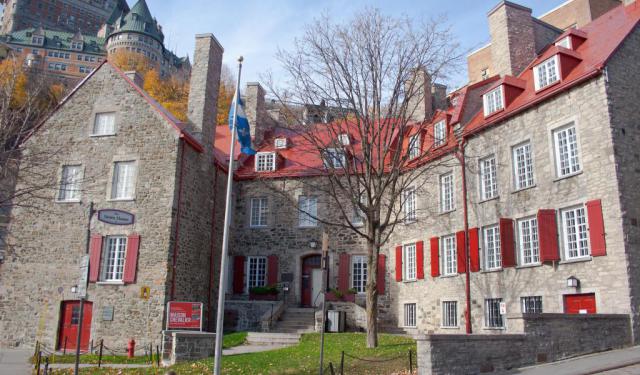
Historical Houses Walking Tour
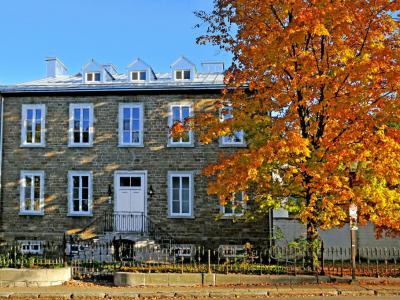
Quebec City, particularly evocative of Europe in its atmosphere, is often referred to as the cradle of New France. The city boasts one of the richest architectural heritages in North America, though most of its buildings had to be adapted to harsh winters and the lack of specialized workers and materials in the colony. As such, the majority of local houses were designed as simple and efficient... view more
Tour Duration: 2 Hour(s)
Travel Distance: 2.5 Km or 1.6 Miles
Tour Duration: 2 Hour(s)
Travel Distance: 2.5 Km or 1.6 Miles