

Presernov spomenik (Preseren Monument), Ljubljana
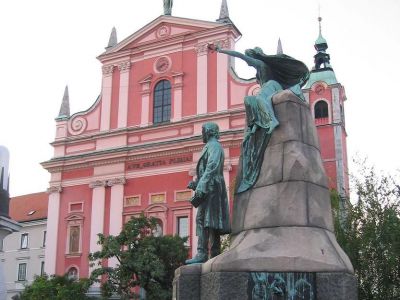
Prešernov spomenik (Prešeren Monument) honours France Prešeren, Slovenia’s national poet and a major figure in Slovenian literature. Unveiled in 1905, it was created by sculptor Ivan Zajec, while architect Maks Fabiani designed the pedestal and surrounding setting. The figure of Prešeren is 3.5 metres high, and the complete monument reaches 9.6 metres. Inside the pedestal, an official document about the monument’s creation and a collection of period coins were sealed as a time capsule.
Above Prešeren, a topless Muse raises a laurel wreath. Its position opposite the Franciscan church caused protests from Bishop Anton Bonaventura Jeglič. The pedestal includes a stylised lime-tree motif, a traditional symbol of the Slovenian homeland. Its bronze reliefs, completed in 1901, are titled Farewell, showing Črtomir and Bogomila from The Baptism on the Savica, and Fisherman, based on The Fisher.
Prešeren’s gaze is aligned with a terracotta relief of Julija Primic on the building where she once lived, creating a lasting visual connection with his unrequited love and literary muse. Fabiani also placed three birch trees behind the monument as a symbolic and natural backdrop. During the Second World War, the site became associated with cultural resistance, and red carnations were placed around the pedestal on Culture Day in 1942.
Above Prešeren, a topless Muse raises a laurel wreath. Its position opposite the Franciscan church caused protests from Bishop Anton Bonaventura Jeglič. The pedestal includes a stylised lime-tree motif, a traditional symbol of the Slovenian homeland. Its bronze reliefs, completed in 1901, are titled Farewell, showing Črtomir and Bogomila from The Baptism on the Savica, and Fisherman, based on The Fisher.
Prešeren’s gaze is aligned with a terracotta relief of Julija Primic on the building where she once lived, creating a lasting visual connection with his unrequited love and literary muse. Fabiani also placed three birch trees behind the monument as a symbolic and natural backdrop. During the Second World War, the site became associated with cultural resistance, and red carnations were placed around the pedestal on Culture Day in 1942.
Want to visit this sight? Check out these Self-Guided Walking Tours in Ljubljana. Alternatively, you can download the mobile app "GPSmyCity: Walks in 1K+ Cities" from Apple App Store or Google Play Store. The app turns your mobile device to a personal tour guide and it works offline, so no data plan is needed when traveling abroad.
Download The GPSmyCity App



Presernov spomenik (Preseren Monument) on Map
Sight Name: Presernov spomenik (Preseren Monument)
Sight Location: Ljubljana, Slovenia (See walking tours in Ljubljana)
Sight Type: Attraction/Landmark
Sight Location: Ljubljana, Slovenia (See walking tours in Ljubljana)
Sight Type: Attraction/Landmark
Nearby Sights

Walking Tours in Ljubljana, Slovenia

Create Your Own Walk in Ljubljana
Creating your own self-guided walk in Ljubljana is easy and fun. Choose the city attractions that you want to see and a walk route map will be created just for you. You can even set your hotel as the start point of the walk.
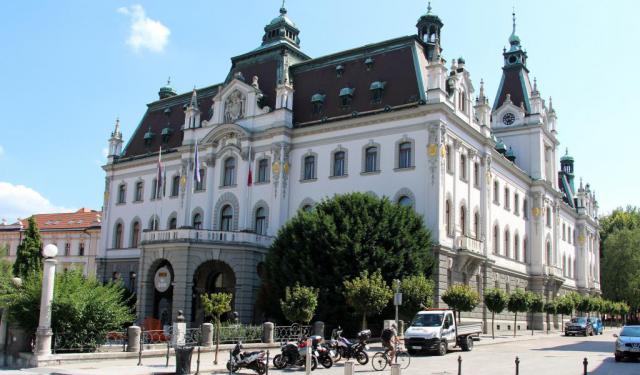
Historic Buildings Walking Tour
The Slovenian capital has no shortage of historical buildings. The architectural wealth of Ljubljana accumulated over the years received a significant boost in the early 20th century thanks to the famous Slovenian architect, Joze Plecnik, a classicist, who tried to model the city on ancient Athens.
Among the notable local landmarks is the Ljubljana Central Pharmacy, a testament to the... view more
Tour Duration: 2 Hour(s)
Travel Distance: 2.8 Km or 1.7 Miles
Among the notable local landmarks is the Ljubljana Central Pharmacy, a testament to the... view more
Tour Duration: 2 Hour(s)
Travel Distance: 2.8 Km or 1.7 Miles
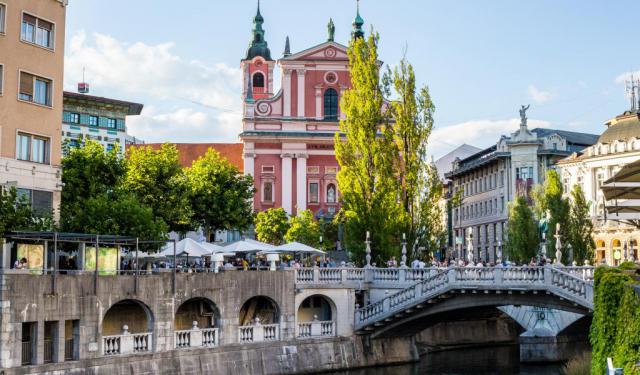
Explore Ljubljana Old Town on Foot
Ljubljana, Slovenia’s capital and largest city, developed at a natural crossroads between Central Europe, the Adriatic, and the Balkans, beside the navigable Ljubljanica River. People lived in the surrounding marshes in prehistoric times, leaving behind pile-dwelling settlements and a wooden wheel with an axle dating back about 5,200 years. By the early first century AD, the Romans had... view more
Tour Duration: 2 Hour(s)
Travel Distance: 2.0 Km or 1.2 Miles
Tour Duration: 2 Hour(s)
Travel Distance: 2.0 Km or 1.2 Miles