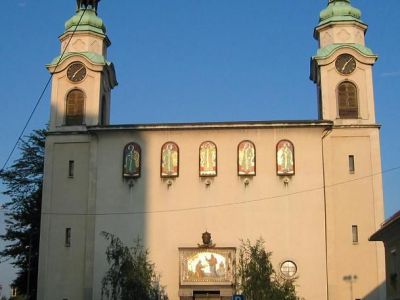


Sentpetrska cerkev (St. Peter's Church), Ljubljana
Šentpetrska cerkev (St. Peter's Church) is one of the oldest parish churches in the area, with origins reaching back to the early Middle Ages. Once the main parish church of the Ljubljana basin, it was rebuilt between 1729 and 1733. Its Italian Baroque design is linked to Carlo Martinuzzi and Giovanni Fusconi and was inspired by San Giorgio Maggiore in Venice.
The interior preserves much of its Late Baroque character, including a cupola, detailed stucco decoration, marble altars, and frescoes painted by Franc Jelovšek in 1731. The high altar is dedicated to Saint Peter, while several side altars feature paintings by Valentin Metzinger, one of Slovenia's earliest important Baroque painters, together with sculptures and decorative works by 18th-century artists. Large arched windows illuminate the nave, highlighting its balanced proportions and rich interior decoration.
The exterior changed significantly after the 1895 earthquake. An early restoration proved unpopular, leading architect Ivan Vurnik to redesign the front façade between 1938 and 1940 with distinctive mosaics created by his wife, Helena Vurnik. The church also gave its name to several nearby landmarks as the surrounding settlement expanded beyond the medieval walls. Its peaceful interior offers a quiet setting for exploring Baroque art and the long religious history of the parish.
The interior preserves much of its Late Baroque character, including a cupola, detailed stucco decoration, marble altars, and frescoes painted by Franc Jelovšek in 1731. The high altar is dedicated to Saint Peter, while several side altars feature paintings by Valentin Metzinger, one of Slovenia's earliest important Baroque painters, together with sculptures and decorative works by 18th-century artists. Large arched windows illuminate the nave, highlighting its balanced proportions and rich interior decoration.
The exterior changed significantly after the 1895 earthquake. An early restoration proved unpopular, leading architect Ivan Vurnik to redesign the front façade between 1938 and 1940 with distinctive mosaics created by his wife, Helena Vurnik. The church also gave its name to several nearby landmarks as the surrounding settlement expanded beyond the medieval walls. Its peaceful interior offers a quiet setting for exploring Baroque art and the long religious history of the parish.
Want to visit this sight? Check out these Self-Guided Walking Tours in Ljubljana. Alternatively, you can download the mobile app "GPSmyCity: Walks in 1K+ Cities" from Apple App Store or Google Play Store. The app turns your mobile device to a personal tour guide and it works offline, so no data plan is needed when traveling abroad.
Download The GPSmyCity App



Sentpetrska cerkev (St. Peter's Church) on Map
Sight Name: Sentpetrska cerkev (St. Peter's Church)
Sight Location: Ljubljana, Slovenia (See walking tours in Ljubljana)
Sight Type: Religious
Sight Location: Ljubljana, Slovenia (See walking tours in Ljubljana)
Sight Type: Religious
Nearby Sights
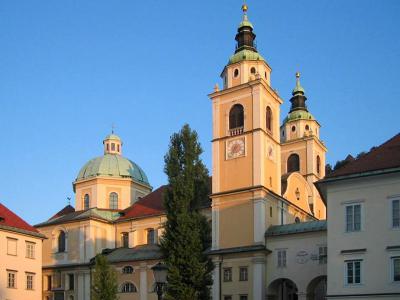
Walking Tours in Ljubljana, Slovenia

Create Your Own Walk in Ljubljana
Creating your own self-guided walk in Ljubljana is easy and fun. Choose the city attractions that you want to see and a walk route map will be created just for you. You can even set your hotel as the start point of the walk.
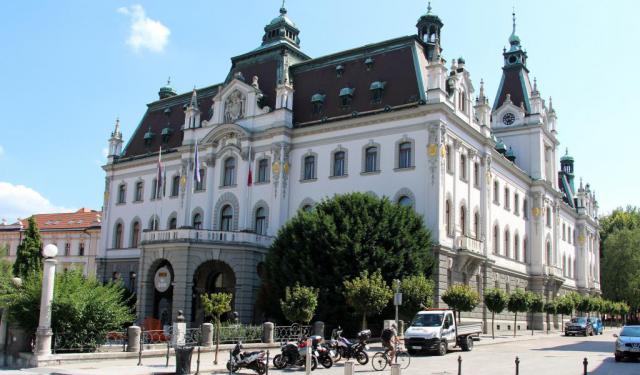
Historic Buildings Walking Tour
The Slovenian capital has no shortage of historical buildings. The architectural wealth of Ljubljana accumulated over the years received a significant boost in the early 20th century thanks to the famous Slovenian architect, Joze Plecnik, a classicist, who tried to model the city on ancient Athens.
Among the notable local landmarks is the Ljubljana Central Pharmacy, a testament to the... view more
Tour Duration: 2 Hours
Travel Distance: 2.8 Km or 1.7 Miles
Among the notable local landmarks is the Ljubljana Central Pharmacy, a testament to the... view more
Tour Duration: 2 Hours
Travel Distance: 2.8 Km or 1.7 Miles
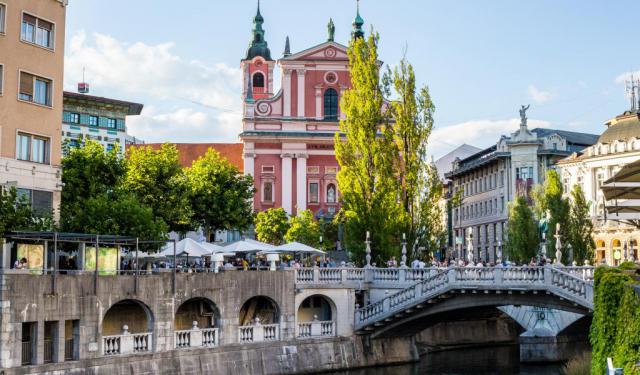
Explore Ljubljana Old Town on Foot
Ljubljana, Slovenia’s capital and largest city, developed at a natural crossroads between Central Europe, the Adriatic, and the Balkans, beside the navigable Ljubljanica River. People lived in the surrounding marshes in prehistoric times, leaving behind pile-dwelling settlements and a wooden wheel with an axle dating back about 5,200 years. By the early first century AD, the Romans had... view more
Tour Duration: 2 Hours
Travel Distance: 2 Km or 1.2 Miles
Tour Duration: 2 Hours
Travel Distance: 2 Km or 1.2 Miles
City Walks Overview
