

Margate and the Highs and Lows of an English Seaside Town, Margate, England
TS Eliot wrote this while convalescing in Margate in Thanet on the coast of Kent. He had suffered a mental breakdown. Every day he would sit in the open timber structure that overlooks Margate Sands and Nayland Rock. It seems he was soothed and stimulated by the sea and this helped him to overcome writer’s block. This excerpt is from Part III of The Wasteland which many regard as the most important English poem of the twentieth century. The shelter is still there and is now a listed building.
Eliot is not the only person to have benefitted from a sojourn in the little seaside town. At the end of the eighteenth century the Royal Sea Bathing Hospital was created in Margate. It was the first hospital to pioneer the open-air treatment for tuberculosis. Initially the hospital was only open during the summer months when patients would sleep on the verandas (the wards were only used in bad weather) and bathe in the sea from a bathing machine. In 1858 an indoor bath was added and the hospital remained open throughout the year. In the early 1950s the hospital became redundant as tuberculosis was no longer a common disease. The hospital building has since been converted into flats
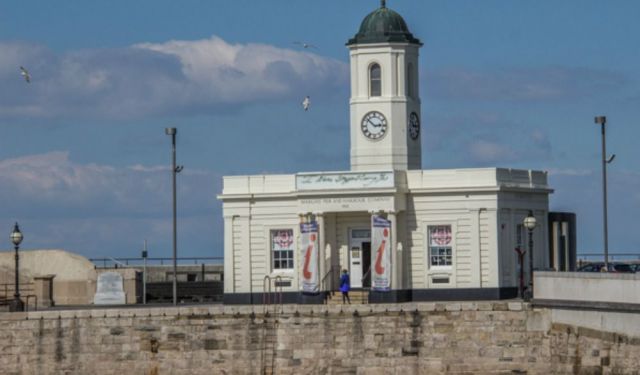
Bathing was not only popular for medicinal benefits and during the early eighteenth century bathing in the sea became popular with the upper classes. At this time Margate was a small fishing village. It had a church on the hill with a track leading to a cluster of houses around the harbour. Sailing ships, then steamships and finally trains brought a stream of visitors to the town. Margate quickly became a fashionable resort, one of the first. As the number of visitors increased so the town grew with the addition of lovely Georgian and Victorian buildings to accommodate and entertain the holiday makers. Elegant squares, fashionable hotels, and crescents with sea-views, many of which can still be seen today, made Margate an architectural treasure. In 1815 a new harbour was built for Margate by John Rennie and became known as the Harbour Arm. Steamers could now come into Margate and it became a busy commercial port. Today the small buildings along the Harbour Arm are occupied by small restaurants, cafés and bars. ...... (follow the instructions below for accessing the rest of this article).
How it works: The full article is featured in the app "GPSmyCity: Walks in 1K+ Cities" on Apple App Store and Google Play Store.
Download the app to your mobile device to read the article offline and create a self-guided walking tour to visit the sights featured in this article. The app's navigation functions guide you from one sight to the next. The app works offline, so no data plan is needed when traveling abroad.
Download The GPSmyCity App



Sights Featured in This Article
Guide Name: Margate and the Highs and Lows of an English Seaside Town
Guide Location: England » Margate
Guide Type: Self-guided Walking Tour (Insider Tips)
Author: Valery Collins
Read it on Author's Website: https://experiencedtraveller.com/journal/2017-05-21-margate-and-the-highs-and-lows-of-an-english-seaside-town
Sight(s) Featured in This Guide:
Guide Location: England » Margate
Guide Type: Self-guided Walking Tour (Insider Tips)
Author: Valery Collins
Read it on Author's Website: https://experiencedtraveller.com/journal/2017-05-21-margate-and-the-highs-and-lows-of-an-english-seaside-town
Sight(s) Featured in This Guide:
- Royal Sea Bathing Hospital
- Harbour Arm
- Droit House
- Dreamland
- Tudor House
- Shell Grotto
- Turner Contemporary
- Mrs Booth
Insider Tips Overview
