


Promenading in Split, Croatia, Split, Croatia
Split is the second largest city in Croatia An unusual characteristic, the wide promenade known as Riva stretches along the sea front reminiscent of some elegant French resorts. The original Riva was established two centuries earlier when this area was ruled by the French under Napoleon.
Cafés and restaurants line the land side of Riva against the dramatic backdrop of an imposing wall. This is the south section of the wall that surrounded Diocletian’s Palace
This palace was built in 295 AD by the Emperor Diocletian. He ordered it to be built as a residence for himself when he retired. It took ten years to build and he lived there until he died in 313 AD. Roman rulers used the palace as a retreat but by the end of the sixth century it was becoming dilapidated. Since then very little of the original palace remains as it became incorporated in in the medieval town of Split. When Diocletian lived there the sea lapped around the south wall as he had a vision - he would sail his boat into the palace. It was so close to the sea the windows were set high in the walls in case the sea level should rise.
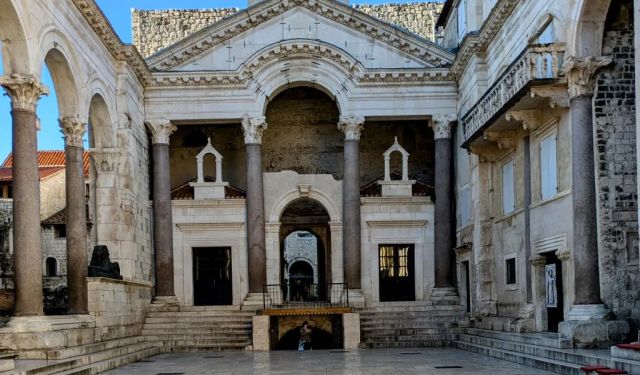
I entered the palace through the south entrance (fee payable). After exploring the empty rooms on the south side of the palace I made my way into the centre of the palace now the centre of the old town. Known as the peristyle or peristil it was the main open space in the palace and originally a temple. I entered the square through the archway in the middle of the fourteenth century Pjaca (town hall) that now houses the archaeological museum. The Cathedral of St Domnius stretches along the eastern side of square. It was built when the palace was built as a mausoleum for Diocletian but was later turned into a cathedral to house the bones of the Bishop Domnius. The colonnaded square has steps on both sides. Visitors can sit here to appreciate the amazing mixture of old and new. The square illustrates the way in which the palace and the town have merged together and evolved into the present day city. ...... (follow the instructions below for accessing the rest of this article).
How it works: The full article is featured in the app "GPSmyCity: Walks in 1K+ Cities" on Apple App Store and Google Play Store.
Download the app to your mobile device to read the article offline and create a self-guided walking tour to visit the sights featured in this article. The app's navigation functions guide you from one sight to the next. The app works offline, so no data plan is needed when traveling abroad.
Download The GPSmyCity App



Sights Featured in This Article
Guide Name: Promenading in Split, Croatia
Guide Location: Croatia » Split
Guide Type: Self-guided Walking Tour (Insider Tips)
Author: Valery Collins
Read it on Author's Website: https://experiencedtraveller.com/journal/2017-05-28-promenading-in-split-croatia
Sight(s) Featured in This Guide:
Guide Location: Croatia » Split
Guide Type: Self-guided Walking Tour (Insider Tips)
Author: Valery Collins
Read it on Author's Website: https://experiencedtraveller.com/journal/2017-05-28-promenading-in-split-croatia
Sight(s) Featured in This Guide:
- Diocletian’s Palace
- archaeological museum
- Cathedral of St Domnius
- golden gate
- Strossmayer’s Park
- pazar
- Peškarija
- Hotel Adriana
- Church and Monastery of St Francis
- Church of Saint Nicholas
- Republic Square
- Bellevue Hotel
Insider Tips for Split, Croatia

Okrug Gornji to Split, 10 Days in Croatia
Okrug Gornji is situated on the beautiful island of Ciovo and is surrounded by pebbled beaches and clear waters. Okrug Gornji is quiet and peaceful There are a number of lovely restaurants dotted around and a few small grocers and market stalls selling food. There isn’t much of a nightlife.

25 Hours in Split, Croatia
We arrived in Split, Croatia whilst we were on our way to Medjugorje. Being just next door, it seemed like a good idea to spend at least a bit of time checking the place out.

Eat & Drink in Split, Croatia: My Favorite Bites & Sips
Split, Croatia contains culinary multitudes. I spent a month in Split, eating and drinking my way through the city, and here are my favorite bites and sips. Includes plenty of budget options!

The Top 10 Activities to Do in Split, Croatia
Split is a bustling port city, the second largest in Croatia, with majestic mountain and sea views. Because of its Mediterranean climate, it has hot and moderately dry summers and mild to cold, wet winters. The warm summers make it the ideal destination to visit. Moreover, from 1 January 2023, Croatia became a member of the Schengen states and the euro currency was adopted.
Split is known for its... view more
Split is known for its... view more

Explore Split in Croatia: a Complete Travel Guide
Split is a coastal jewel in Croatia. The city is located along the Adriatic Sea. Split attracts tourists with its stunning Roman architecture, lively waterfront, and Mediterranean charm. Wander through ancient streets, sip coffee on the lively Riva promenade, or soak up the sun on nearby beaches. Split has a great combination of culture, relaxation, and adventure that makes it an unforgettable... view more
Split’s Best (and Worst) Attractions You Should Know
In any given metropolis, there is a list of Best Things to See and Do, an optimistic and misleading phrase that suggests these activities will be entirely delightful and without peril. Such a list, however, is merely a catalog of places where one can witness something curious, or perhaps even perform a curious deed oneself. One should approach this list with caution and a healthy dose of... view more
Insider Tips Overview
