Custom Walk in Lyon, France by macaronichannel_6b249 created on 2025-03-28
Guide Location: France » Lyon
Guide Type: Custom Walk
# of Sights: 16
Tour Duration: 4 Hour(s)
Travel Distance: 7.4 Km or 4.6 Miles
Share Key: 6TBQE
Guide Type: Custom Walk
# of Sights: 16
Tour Duration: 4 Hour(s)
Travel Distance: 7.4 Km or 4.6 Miles
Share Key: 6TBQE
How It Works
Please retrieve this walk in the GPSmyCity app. Once done, the app will guide you from one tour stop to the next as if you had a personal tour guide. If you created the walk on this website or come to the page via a link, please follow the instructions below to retrieve the walk in the app.
Retrieve This Walk in App
Step 1. Download the app "GPSmyCity: Walks in 1K+ Cities" on Apple App Store or Google Play Store.



Step 2. In the GPSmyCity app, download(or launch) the guide "Lyon Map and Walking Tours".
Step 3. Tap the menu button located at upper right corner of the "Walks" screen and select "Retrieve custom walk". Enter the share key: 6TBQE
1) Place Bellecour (Bellecour Square)
If Lyon had a front porch, it would definitely be Bellecour Square - big, open, and impossible to ignore. It’s the third largest square in France, the largest fully pedestrian square in Europe, and the beating heart of the city. But it didn’t start out this polished.
Roll back to Gallo-Roman times, and this grand square was not a square at all. It was an island - basically a sandy leftover from river floods - used for military drills and trade.
By the 12th century, the Archbishop of Lyon had planted a vineyard here. Officially, it was for “medicinal purposes,” but you may draw your own conclusions... Later, the vines disappeared, the land was abandoned, and the whole place turned into a swamp. Not exactly postcard material.
In 1562, Baron des Adrets parked his troops here during an attack on Lyon. After the drama settled, the land dried out and became pasture. Then, in 1604, King Henry III had a bright idea: let’s build a proper public square. Simple? Not at all. The archbishop objected, lawyers got involved, and the argument between the crown and clergy dragged on for more than a century. Urban planning, 17th-century style...
Finally, in 1708, King Louis XIV settled the matter. The square opened in 1715 under the name Louis-le-Grand. A few decades later, during the French Revolution, it witnessed a much darker chapter - a guillotine stood here, reminding everyone that public squares can host both celebrations and upheaval.
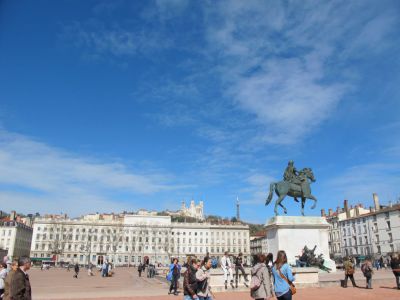
Today, at the centre, you’ll find the equestrian statue of Louis XIV, installed in 1825 to replace the earlier version destroyed in revolutionary enthusiasm. At its base, two allegorical figures represent the Saône and Rhône rivers, as if quietly supporting the king. At the western end, there’s a gentler presence: statues of author Antoine de Saint-Exupéry and his Little Prince, watching over the square with poetic calm.
Around the edges, life continues. Two pavilions sit here - one houses the Tourist Office, the other an art gallery. There’s a small play area, a fountain, a couple of bars, and from time to time, a giant Ferris wheel rises above it all, giving visitors a slow spin above Lyon’s rooftops.
From sandy island to swamp, from royal ambition to revolutionary drama, Bellecour Square has seen it all - and it’s still the place where Lyon gathers, pauses, and looks around.
Roll back to Gallo-Roman times, and this grand square was not a square at all. It was an island - basically a sandy leftover from river floods - used for military drills and trade.
By the 12th century, the Archbishop of Lyon had planted a vineyard here. Officially, it was for “medicinal purposes,” but you may draw your own conclusions... Later, the vines disappeared, the land was abandoned, and the whole place turned into a swamp. Not exactly postcard material.
In 1562, Baron des Adrets parked his troops here during an attack on Lyon. After the drama settled, the land dried out and became pasture. Then, in 1604, King Henry III had a bright idea: let’s build a proper public square. Simple? Not at all. The archbishop objected, lawyers got involved, and the argument between the crown and clergy dragged on for more than a century. Urban planning, 17th-century style...
Finally, in 1708, King Louis XIV settled the matter. The square opened in 1715 under the name Louis-le-Grand. A few decades later, during the French Revolution, it witnessed a much darker chapter - a guillotine stood here, reminding everyone that public squares can host both celebrations and upheaval.
Today, at the centre, you’ll find the equestrian statue of Louis XIV, installed in 1825 to replace the earlier version destroyed in revolutionary enthusiasm. At its base, two allegorical figures represent the Saône and Rhône rivers, as if quietly supporting the king. At the western end, there’s a gentler presence: statues of author Antoine de Saint-Exupéry and his Little Prince, watching over the square with poetic calm.
Around the edges, life continues. Two pavilions sit here - one houses the Tourist Office, the other an art gallery. There’s a small play area, a fountain, a couple of bars, and from time to time, a giant Ferris wheel rises above it all, giving visitors a slow spin above Lyon’s rooftops.
From sandy island to swamp, from royal ambition to revolutionary drama, Bellecour Square has seen it all - and it’s still the place where Lyon gathers, pauses, and looks around.
2) Lyon Cathedral (must see)
In 450 AD, on or about, Bishop Patiens of Lyon - later sainted, so clearly doing something right - decided the city needed a proper cathedral. He dedicated it to Saint Stephen. A baptistry followed in the 7th century, because what’s a cathedral without a place for dramatic spiritual beginnings? Nearby stood the Church of Saint Croix. All of this activity took place right here in Old Lyon, close to the Saône River - the very ground where Lyon Cathedral would rise 800 years later.
Now, here’s where the story gets ambitious. The new cathedral was built over the ruins of Saint Stephen’s and is traditionally linked to Saints Pothinus and Irenaeus, early Christian figures in Lyon. Construction began in 1180 and, in true medieval fashion, took nearly three centuries to wrap up in 1476.
And yet, somehow, the style holds together beautifully. Romanesque solidity meets Gothic height in a surprisingly calm architectural handshake - no dramatic identity crisis despite the long build...
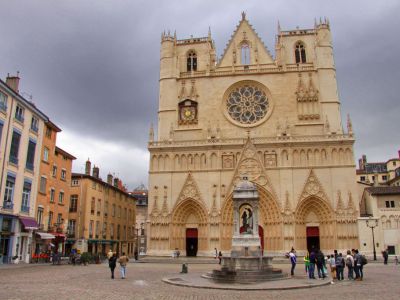
The numbers are impressive. The cathedral stretches 263 feet in length, with the nave soaring 107 feet high. The façade leans Gothic, with pointed arches and vertical lines drawing your eyes upward. Move toward the apse and choir, and you feel the heavier, rounded strength of Romanesque design. Above you, the ribbed vault of the nave lifts in full Gothic confidence, as if the building is taking a deep, stone-carved breath.
Inside, you’ll see one of the cathedral's greatest stars: a 30-foot-high astronomical clock. Installed in 1383, it didn’t just tell time - it mapped the heavens. Its astrolabe charts the positions of the Sun, Moon, stars, and Earth. Quite advanced for the Middle Ages...
The clock was smashed in 1562, during the Wars of Religion, by François de Beaumont, Baron of Adrets - clearly not a fan of delicate mechanics - and later rebuilt in 1661 by master clockmaker Guillaume Norrisson. Second life, same cosmic ambition...
Each year, in December, candles glow in windows across Lyon to honor the Virgin Mary. It is then that the cathedral façade transforms into a canvas of light during the Festival of Lights, marking the city’s gratitude for the end of the plague in 1643. Stone, history, astronomy, and light are all layered into one remarkable building.
Now, here’s where the story gets ambitious. The new cathedral was built over the ruins of Saint Stephen’s and is traditionally linked to Saints Pothinus and Irenaeus, early Christian figures in Lyon. Construction began in 1180 and, in true medieval fashion, took nearly three centuries to wrap up in 1476.
And yet, somehow, the style holds together beautifully. Romanesque solidity meets Gothic height in a surprisingly calm architectural handshake - no dramatic identity crisis despite the long build...
The numbers are impressive. The cathedral stretches 263 feet in length, with the nave soaring 107 feet high. The façade leans Gothic, with pointed arches and vertical lines drawing your eyes upward. Move toward the apse and choir, and you feel the heavier, rounded strength of Romanesque design. Above you, the ribbed vault of the nave lifts in full Gothic confidence, as if the building is taking a deep, stone-carved breath.
Inside, you’ll see one of the cathedral's greatest stars: a 30-foot-high astronomical clock. Installed in 1383, it didn’t just tell time - it mapped the heavens. Its astrolabe charts the positions of the Sun, Moon, stars, and Earth. Quite advanced for the Middle Ages...
The clock was smashed in 1562, during the Wars of Religion, by François de Beaumont, Baron of Adrets - clearly not a fan of delicate mechanics - and later rebuilt in 1661 by master clockmaker Guillaume Norrisson. Second life, same cosmic ambition...
Each year, in December, candles glow in windows across Lyon to honor the Virgin Mary. It is then that the cathedral façade transforms into a canvas of light during the Festival of Lights, marking the city’s gratitude for the end of the plague in 1643. Stone, history, astronomy, and light are all layered into one remarkable building.
3) Ancient Theatre of Fourvière (Amphitheatre Gallo-Romain) (must see)
There are a lot of interesting vestiges of ancient Lyon to behold and one of the best of them, undoubtedly, is the Amphitheatre Gallo-Romain, at the foot of the Croix-Rousse Hill.
This theatre, first built under the reign of Roman Emperor Tiberius, around 19AD, was also known as the Amphitheatre des Trois Gaules. Its main purpose was to serve as the Sanctuary of the Three Gauls – an administrative institution set to federalize and romanize Gallia as an Imperial province.
Other than that, the theatre was used, as were all such places in Roman times, as a place for entertainment. Theatrical plays were put on here along with gladiator fights and other public events. The theatre was also used for public executions.
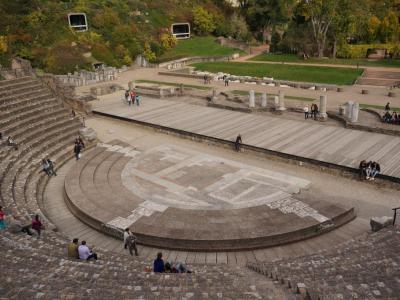
The original amphitheatre wasn’t very large; it had room for just about 1,800 spectators. The basement was made up of three elliptical walls joined by cross-walls and a channel around the oval central space.
Around 230 AD the theatre was enlarged, added with two new galleries, which brought the seating space up to 20,000. At the end of the Gallo-Roman era the theatre was abandoned and fell into ruin, with parts of it being built on.
Archaeological digs between 1956 and 1976 uncovered the remains of what you can see today in the Jardin des Plantes.
This theatre, first built under the reign of Roman Emperor Tiberius, around 19AD, was also known as the Amphitheatre des Trois Gaules. Its main purpose was to serve as the Sanctuary of the Three Gauls – an administrative institution set to federalize and romanize Gallia as an Imperial province.
Other than that, the theatre was used, as were all such places in Roman times, as a place for entertainment. Theatrical plays were put on here along with gladiator fights and other public events. The theatre was also used for public executions.
The original amphitheatre wasn’t very large; it had room for just about 1,800 spectators. The basement was made up of three elliptical walls joined by cross-walls and a channel around the oval central space.
Around 230 AD the theatre was enlarged, added with two new galleries, which brought the seating space up to 20,000. At the end of the Gallo-Roman era the theatre was abandoned and fell into ruin, with parts of it being built on.
Archaeological digs between 1956 and 1976 uncovered the remains of what you can see today in the Jardin des Plantes.
4) Basilica of Notre-Dame de Fourvière (must see)
"Fourviere" is a corruption of the French version of the Latin name, "forum vetus," meaning "Old Forum." Old Forum in French becomes "Vieux-Forum." Reverse it and say it fast and voila! We have "Fourviere." The Basilica of Notre-Dame de Fourviere of Lyon is sitting on the remains the Roman forum built by Trajan. Nothing more need be said.
The basilica was built in the years 1872 to 1896 using private funds. The church is dedicated to the Virgin Mary. She is credited with saving the city from the Black Plague in 1643. Each December 8th, the Festival of Lights is held in her honor. Lighted candles are placed outside every window, and Light Shows play over building facades.
The Virgin has not been neglectful. It is said she also saved the city from the Cholera epidemic in 1832 and the Prussian invasion of 1871. Like the Sacred Heart of Montmartre (Sacré Coeur de Montmartre), the Basilica of Notre-Dame de Fourviere perches on a high hill, a votive offering and a victory memorial.
The basilica has a Museum of Sacred Art and sees over two million visitors and pilgrims every year. The church was designed by historicist architect Pierre Bossan. He foreswore Gothic influences, embracing Romanesque and Byzantine styles.
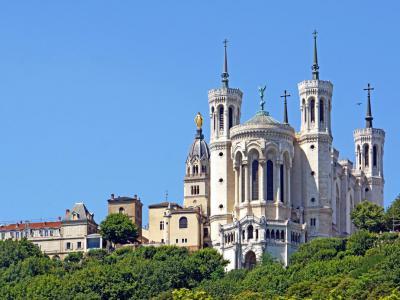
The basilica has four towers and a bell tower with a gilded statue of the Virgin. There is a wealth of mosaics, stained glass and a crypt to Saint Joseph. There are actually two sanctuaries. The upper one is lush and ornate. The lower sanctuary is simple. The building, with its four towers, is said to look like an elephant upside-down.
The basilica is not the first shrine at Fourviere. The earliest chapel on the site dedicated to Mary dates from 1170. The most recent reconstruction was in 1852 when the tower bearing the golden statue by sculptor Joseph Fabisch was installed. The city committed to build the basilica after the Franco-Prussian War of 1871.
The basilica was built in the years 1872 to 1896 using private funds. The church is dedicated to the Virgin Mary. She is credited with saving the city from the Black Plague in 1643. Each December 8th, the Festival of Lights is held in her honor. Lighted candles are placed outside every window, and Light Shows play over building facades.
The Virgin has not been neglectful. It is said she also saved the city from the Cholera epidemic in 1832 and the Prussian invasion of 1871. Like the Sacred Heart of Montmartre (Sacré Coeur de Montmartre), the Basilica of Notre-Dame de Fourviere perches on a high hill, a votive offering and a victory memorial.
The basilica has a Museum of Sacred Art and sees over two million visitors and pilgrims every year. The church was designed by historicist architect Pierre Bossan. He foreswore Gothic influences, embracing Romanesque and Byzantine styles.
The basilica has four towers and a bell tower with a gilded statue of the Virgin. There is a wealth of mosaics, stained glass and a crypt to Saint Joseph. There are actually two sanctuaries. The upper one is lush and ornate. The lower sanctuary is simple. The building, with its four towers, is said to look like an elephant upside-down.
The basilica is not the first shrine at Fourviere. The earliest chapel on the site dedicated to Mary dates from 1170. The most recent reconstruction was in 1852 when the tower bearing the golden statue by sculptor Joseph Fabisch was installed. The city committed to build the basilica after the Franco-Prussian War of 1871.
5) La Tour Rose Traboule (The Pink Tower Passageway)
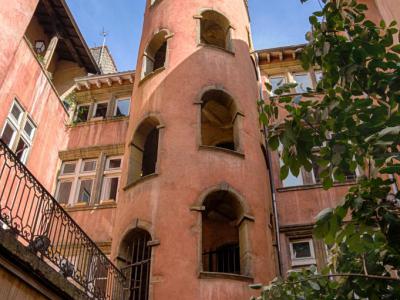
In the heart of Lyon’s Saint-Jean district stands a building with two names and plenty of personality: the House of the Sieve - or, more memorably, The Pink Tower. Built in the 16th century and attributed to the Italian architect Sebastiano Serlio of Bologna, it carries the elegance of the Renaissance with quiet confidence. The courtyard was refreshed in the 17th century, but the spirit of the place remains unmistakably Renaissance.
As for the curious name “House of the Sieve,” no one can say for certain. One popular theory links it to Martin de Troyes, a 16th-century tax collector whose coat of arms may have featured a sieve - perhaps a subtle reminder that taxes, like flour, must pass through fine filters.
From the street, you might walk past without suspecting anything dramatic. The façade is reserved, almost discreet. But step through the gate, and the building changes character completely. Suddenly, rising before you, is a monumental circular tower washed in soft pink plaster - a bold architectural statement hidden in plain sight.
Inside that tower curls a grand spiral staircase-belvedere, climbing upward in elegant curves. Semicircular bay windows open onto terraces and gardens that unfold across several levels, while a historic well stands quietly at the courtyard’s edge, as if keeping watch over centuries of stories.
The Pink Tower has also hosted its share of distinguished guests. In 1600, King Henri IV of France stayed here briefly during his marriage celebrations with Marie de Medici. Imagine the courtyard filled with royal footsteps and whispered courtly conversations. Its significance was officially recognized in 1937, when it was listed as a historic monument. Still, like many grand old residences, it experienced periods of neglect before careful restoration efforts revived its former glory.
Today, known as the tallest building in the Saint-Jean area, the Pink Tower remains one of Old Lyon’s most captivating sights. It stands not just as an architectural curiosity, but as a symbol of the neighborhood’s hidden wonders - especially the famous traboules that weave through the district. So, whenever you wander these medieval streets, don’t be fooled by modest façades. Sometimes the real spectacle is waiting just behind the door.
As for the curious name “House of the Sieve,” no one can say for certain. One popular theory links it to Martin de Troyes, a 16th-century tax collector whose coat of arms may have featured a sieve - perhaps a subtle reminder that taxes, like flour, must pass through fine filters.
From the street, you might walk past without suspecting anything dramatic. The façade is reserved, almost discreet. But step through the gate, and the building changes character completely. Suddenly, rising before you, is a monumental circular tower washed in soft pink plaster - a bold architectural statement hidden in plain sight.
Inside that tower curls a grand spiral staircase-belvedere, climbing upward in elegant curves. Semicircular bay windows open onto terraces and gardens that unfold across several levels, while a historic well stands quietly at the courtyard’s edge, as if keeping watch over centuries of stories.
The Pink Tower has also hosted its share of distinguished guests. In 1600, King Henri IV of France stayed here briefly during his marriage celebrations with Marie de Medici. Imagine the courtyard filled with royal footsteps and whispered courtly conversations. Its significance was officially recognized in 1937, when it was listed as a historic monument. Still, like many grand old residences, it experienced periods of neglect before careful restoration efforts revived its former glory.
Today, known as the tallest building in the Saint-Jean area, the Pink Tower remains one of Old Lyon’s most captivating sights. It stands not just as an architectural curiosity, but as a symbol of the neighborhood’s hidden wonders - especially the famous traboules that weave through the district. So, whenever you wander these medieval streets, don’t be fooled by modest façades. Sometimes the real spectacle is waiting just behind the door.
6) Rue Saint-Jean - Old Lyon Traboules (must see)
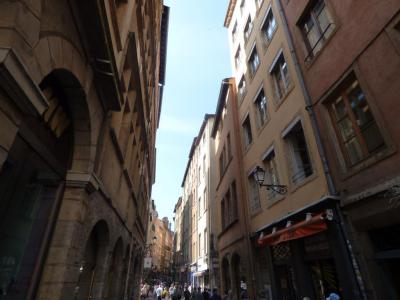
Back in 1954, Lyon’s Old Town made history. It became the first city in France to receive protection under the Malraux Law, long before “heritage preservation” became fashionable dinner conversation. The law shielded three Renaissance neighbourhoods wrapped around Fourvière Hill, namely: Saint Jean, Saint Paul, and Saint Georges.
In the Middle Ages, Saint Jean was the place to be - politically, religiously, and strategically. Power lived here. Right at the heart of it stands Lyon Cathedral, alongside the Romanesque Manecanterie, the former choir school.
But the real local secret isn’t just above ground - it’s hidden in the walls. The first traboule, or foot tunnel, linked Saint-Jean Street to Government Square. Why? Because medieval streets were few, the hill was steep, and everyone needed quicker access to the Saône River for fresh water. When streets failed, ingenuity stepped in...
So, Lyon built passageways - traboules - hidden corridors threading through buildings, across courtyards, quietly connecting one street to another. In the 19th century, more were added. The silk workers - the famous Canuts - used them to carry delicate rolls of silk down to the river without exposing them to rain.
When those same workers rebelled in the 1830s against wealthy silk merchants, the traboules turned into strategic hideouts. Fast forward to World War II, and the tunnels once again proved useful - this time sheltering members of the French Resistance. Indeed, these walls have seen more secrets than a confessional.
Now, if you’re curious, head to 54 Rue Saint-Jean. Look for a modest green door with a small engraved sign reading “The Long Traboule.” It doesn’t shout for attention - it doesn’t need to. This is the longest traboule in Old Lyon. Cross the threshold, and you’ll pass through five courtyards and four different buildings, emerging on Beef Street, if you’re translating literally. It feels less like walking through a corridor and more like slipping through time.
Around 50 traboules are open to the public today. But many more remain hidden, known mostly to residents. And that’s the charm of Lyon - a city where history doesn’t just sit in monuments. It runs behind walls, under your feet, and occasionally behind an unassuming green door...
In the Middle Ages, Saint Jean was the place to be - politically, religiously, and strategically. Power lived here. Right at the heart of it stands Lyon Cathedral, alongside the Romanesque Manecanterie, the former choir school.
But the real local secret isn’t just above ground - it’s hidden in the walls. The first traboule, or foot tunnel, linked Saint-Jean Street to Government Square. Why? Because medieval streets were few, the hill was steep, and everyone needed quicker access to the Saône River for fresh water. When streets failed, ingenuity stepped in...
So, Lyon built passageways - traboules - hidden corridors threading through buildings, across courtyards, quietly connecting one street to another. In the 19th century, more were added. The silk workers - the famous Canuts - used them to carry delicate rolls of silk down to the river without exposing them to rain.
When those same workers rebelled in the 1830s against wealthy silk merchants, the traboules turned into strategic hideouts. Fast forward to World War II, and the tunnels once again proved useful - this time sheltering members of the French Resistance. Indeed, these walls have seen more secrets than a confessional.
Now, if you’re curious, head to 54 Rue Saint-Jean. Look for a modest green door with a small engraved sign reading “The Long Traboule.” It doesn’t shout for attention - it doesn’t need to. This is the longest traboule in Old Lyon. Cross the threshold, and you’ll pass through five courtyards and four different buildings, emerging on Beef Street, if you’re translating literally. It feels less like walking through a corridor and more like slipping through time.
Around 50 traboules are open to the public today. But many more remain hidden, known mostly to residents. And that’s the charm of Lyon - a city where history doesn’t just sit in monuments. It runs behind walls, under your feet, and occasionally behind an unassuming green door...
7) Ancien Palais de Justice (The Former Palace of Justice)
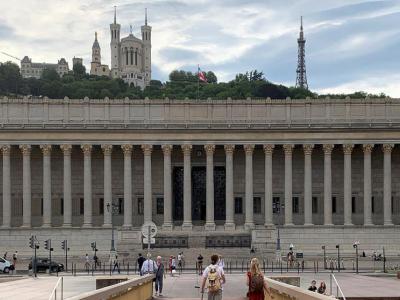
If buildings could clear their throats before speaking, the Former Palace of Justice would not need to - it already makes its point the moment you see those 24 Corinthian columns lined up like a very disciplined jury.
Commanding and symmetrical, it stands on the ground that has dealt with legal matters since the 14th century. The structure you see today was completed in 1842 by architect Victor Baltard, who clearly believed that justice should look solid, orderly, and just a little intimidating. Rectangular in form and arranged around a central courtyard, it remains one of France’s finest Neo-classical statements.
Step inside, and you enter the grand “Hall of Lost Steps,” though nothing feels exactly lost about it. This was the waiting area where lawyers paced, witnesses rehearsed their testimonies, and tension quietly built before a judge called a name. Tall marble columns rise toward vaulted ceilings, stucco details frame the space, and three cupolas allow light to filter down with appropriate drama. The red-carpeted grand staircase sweeps upward to the upper chambers and visitors’ gallery, while a smaller set of marble steps leads to the Assize Court.
Today, only this court and the Court of Appeal still operate here. In earlier decades, the palace witnessed trials that shaped modern French history. The most famous took place in 1987, when Klaus Barbie - the Nazi officer known as the “Butcher of Lyon” - was tried and sentenced to life imprisonment for crimes against humanity. Thus, the courtroom became not just a legal setting, but a place of national reckoning.
Even if legal procedure is not your usual travel interest, this building offers something more than courtrooms. It represents centuries of civic authority layered onto one site - medieval courts replaced by 19th-century grandeur, all facing the river with quiet confidence. Take a moment to stand before those columns, imagine the footsteps echoing across the marble floors, and consider how architecture can turn law into theatre, where justice arrives with classical proportions...
Commanding and symmetrical, it stands on the ground that has dealt with legal matters since the 14th century. The structure you see today was completed in 1842 by architect Victor Baltard, who clearly believed that justice should look solid, orderly, and just a little intimidating. Rectangular in form and arranged around a central courtyard, it remains one of France’s finest Neo-classical statements.
Step inside, and you enter the grand “Hall of Lost Steps,” though nothing feels exactly lost about it. This was the waiting area where lawyers paced, witnesses rehearsed their testimonies, and tension quietly built before a judge called a name. Tall marble columns rise toward vaulted ceilings, stucco details frame the space, and three cupolas allow light to filter down with appropriate drama. The red-carpeted grand staircase sweeps upward to the upper chambers and visitors’ gallery, while a smaller set of marble steps leads to the Assize Court.
Today, only this court and the Court of Appeal still operate here. In earlier decades, the palace witnessed trials that shaped modern French history. The most famous took place in 1987, when Klaus Barbie - the Nazi officer known as the “Butcher of Lyon” - was tried and sentenced to life imprisonment for crimes against humanity. Thus, the courtroom became not just a legal setting, but a place of national reckoning.
Even if legal procedure is not your usual travel interest, this building offers something more than courtrooms. It represents centuries of civic authority layered onto one site - medieval courts replaced by 19th-century grandeur, all facing the river with quiet confidence. Take a moment to stand before those columns, imagine the footsteps echoing across the marble floors, and consider how architecture can turn law into theatre, where justice arrives with classical proportions...
8) Place des Jacobins (Jacobins' Square)
If you’re standing in the middle of traffic coming from twelve different directions, engines humming, pedestrians weaving past - and somehow, this busy crossroads still manages to be one of Lyon’s most elegant squares. Rest assured - you're in Jacobins' Square.
In the late 13th century, Jacobin monks settled here, building a convent and a church. Over time, the open space nearby turned into a walled market. Then, in 1556, the walls came down, and a triangular public square took shape.
A few years later, in 1562, some surrounding buildings were demolished to create Rue Saint Dominique, opening the area even further. A modest fountain appeared, and the square became the local social network - the place where people gathered to exchange news, rumors, and probably a fair bit of harmless gossip. It was even renamed Comfort Square. Sadly, the fountain wasn’t very comforting; it was too small for the growing population and was eventually removed.
In 1609, things became more ambitious. A pyramidal obelisk was installed, crowned with a cross. Around its base, the name of God was engraved in 24 languages - quite an international statement for its time. But history had other plans.
The French Revolution swept it away, along with many religious symbols. The church was rebuilt in 1689, the convent restored in 1714, only for the church to be demolished again in 1818. The convent survived a little longer, serving as the Préfecture until 1852. Indeed, if buildings could sigh, this block would have done so more than once...
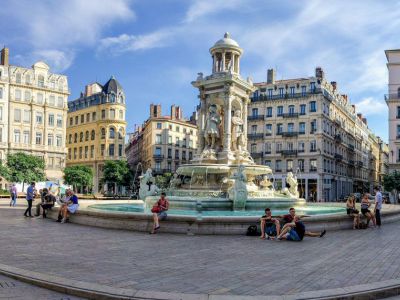
Now shift to the 19th century. The fountain you see today dates from 1878 and was designed by architect Gaspard André. The four statues added in 1885 - representing the engraver Benoît Audran, celebrated sculptor Guillaume Coustou, Renaissance architect Philibert de l’Orme, and 19th-century painter Hippolyte Flandrin - were sculpted by Charles Degeorges, turning the square into an open-air tribute to Lyon’s artistic heritage. And in 2004, a plaque was installed nearby to remind visitors of the square’s layered past.
So yes, traffic may swirl around it. But at its centre, Jacobins' Square stands calmly - a small stage where monks, merchants, revolutionaries, artists, and modern commuters have all played their part.
In the late 13th century, Jacobin monks settled here, building a convent and a church. Over time, the open space nearby turned into a walled market. Then, in 1556, the walls came down, and a triangular public square took shape.
A few years later, in 1562, some surrounding buildings were demolished to create Rue Saint Dominique, opening the area even further. A modest fountain appeared, and the square became the local social network - the place where people gathered to exchange news, rumors, and probably a fair bit of harmless gossip. It was even renamed Comfort Square. Sadly, the fountain wasn’t very comforting; it was too small for the growing population and was eventually removed.
In 1609, things became more ambitious. A pyramidal obelisk was installed, crowned with a cross. Around its base, the name of God was engraved in 24 languages - quite an international statement for its time. But history had other plans.
The French Revolution swept it away, along with many religious symbols. The church was rebuilt in 1689, the convent restored in 1714, only for the church to be demolished again in 1818. The convent survived a little longer, serving as the Préfecture until 1852. Indeed, if buildings could sigh, this block would have done so more than once...
Now shift to the 19th century. The fountain you see today dates from 1878 and was designed by architect Gaspard André. The four statues added in 1885 - representing the engraver Benoît Audran, celebrated sculptor Guillaume Coustou, Renaissance architect Philibert de l’Orme, and 19th-century painter Hippolyte Flandrin - were sculpted by Charles Degeorges, turning the square into an open-air tribute to Lyon’s artistic heritage. And in 2004, a plaque was installed nearby to remind visitors of the square’s layered past.
So yes, traffic may swirl around it. But at its centre, Jacobins' Square stands calmly - a small stage where monks, merchants, revolutionaries, artists, and modern commuters have all played their part.

9) The Grand Temple de Lyon
The Grand Temple de Lyon, a prominent Protestant church in Lyon, holds significant historical and cultural value. Classified as a Historic Site in 2011, this church was constructed in 1879 under the architectural vision of Gaspard André. Its aesthetic appeal is heightened by the facade, renovated in 1885, which features intricate patterns forming arcs, adding to its historic charm.
Inside, the church is both functional and artistic. The furniture, installed concurrently with the facade renovation, complements the church's interior design. A notable feature is the pipe organ, crafted by Merklin in 1884. This instrument underwent restoration in 1923 following partial damage caused by a fire, preserving its historical integrity.
The Grand Temple de Lyon is not just a place of worship but also a cultural hub. It can accommodate up to 900 worshippers in its main hall. Beyond its religious function, the church is renowned for housing the Bibliothèque Populaire, a large Protestant library. This library, maintained in its original 19th-century style, echoes the rich heritage of the site.
Originally established in 1830 at the Temple du Change, it was relocated to its current location in 1859. With a collection of over 4500 books, the library covers a wide range of subjects including Protestant History, Philosophy, Theology, children's books, adult novels, and travel guides. However, access to this trove of knowledge is limited, with the library opening its doors to the public only on Heritage Day.
Furthermore, for over a decade, the Grand Temple de Lyon has been an active cultural center. It hosts various events such as concerts and exhibitions, which often focus on religious themes, showcasing paintings and sculptures. These events highlight the church's commitment to not only being a place of religious significance but also a center for cultural enrichment and community engagement.
Inside, the church is both functional and artistic. The furniture, installed concurrently with the facade renovation, complements the church's interior design. A notable feature is the pipe organ, crafted by Merklin in 1884. This instrument underwent restoration in 1923 following partial damage caused by a fire, preserving its historical integrity.
The Grand Temple de Lyon is not just a place of worship but also a cultural hub. It can accommodate up to 900 worshippers in its main hall. Beyond its religious function, the church is renowned for housing the Bibliothèque Populaire, a large Protestant library. This library, maintained in its original 19th-century style, echoes the rich heritage of the site.
Originally established in 1830 at the Temple du Change, it was relocated to its current location in 1859. With a collection of over 4500 books, the library covers a wide range of subjects including Protestant History, Philosophy, Theology, children's books, adult novels, and travel guides. However, access to this trove of knowledge is limited, with the library opening its doors to the public only on Heritage Day.
Furthermore, for over a decade, the Grand Temple de Lyon has been an active cultural center. It hosts various events such as concerts and exhibitions, which often focus on religious themes, showcasing paintings and sculptures. These events highlight the church's commitment to not only being a place of religious significance but also a center for cultural enrichment and community engagement.
10) Palais du Commerce (Chamber of Commerce)
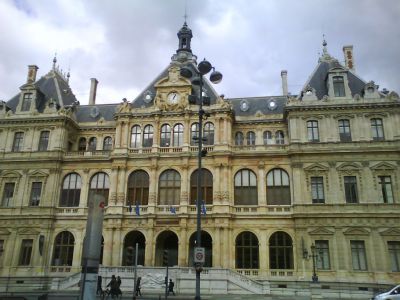
The headquarters of Lyon's Chamber of Commerce and Industry, Palais de Commerce was initially intended to house a museum of art and industry together with shops and offices for silk trade, as well as the Chamber of Commerce and Tribunal.
The decision to build the palace was taken by the City Council in 1853. The project was finished in 1860, designed by architect René Dardel, featuring four pavilions around a central glass-roofed main hall, called the “Salle de la Corbeille”, with both the north and south façades richly decorated with ornate coping and columns supporting elegant balconies.
The statues representing Agriculture, Industry, Justice, Temperance and Trade reflect the purpose of the work carried out inside the building. The ceiling paintings done by Lyonnais artists, such as Ponthus-Cinier and Beuchot, continue the themes of the statues.
At the foot of the steps giving onto Place des Cordeliers there are two more, allegorical statues depicting the Rivers Saône and Rhône with their arms entwined. On the north side of the building, the former Place de la Bourse has been turned into a small, rather charming public garden.
In 1894, President of the Third Republic, Sadi Carnot, was assassinated while leaving the building. In memory of the late president, there is a plaque installed on the wall near the main entrance.
Parts of the palace are open to the public for guided tours only.
The decision to build the palace was taken by the City Council in 1853. The project was finished in 1860, designed by architect René Dardel, featuring four pavilions around a central glass-roofed main hall, called the “Salle de la Corbeille”, with both the north and south façades richly decorated with ornate coping and columns supporting elegant balconies.
The statues representing Agriculture, Industry, Justice, Temperance and Trade reflect the purpose of the work carried out inside the building. The ceiling paintings done by Lyonnais artists, such as Ponthus-Cinier and Beuchot, continue the themes of the statues.
At the foot of the steps giving onto Place des Cordeliers there are two more, allegorical statues depicting the Rivers Saône and Rhône with their arms entwined. On the north side of the building, the former Place de la Bourse has been turned into a small, rather charming public garden.
In 1894, President of the Third Republic, Sadi Carnot, was assassinated while leaving the building. In memory of the late president, there is a plaque installed on the wall near the main entrance.
Parts of the palace are open to the public for guided tours only.
11) Fine Arts Museum (must see)
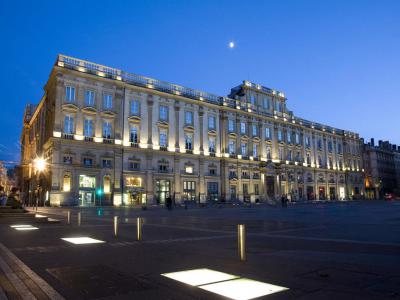
The Fine Arts Museum in Lion is situated within the former Abbey of Les Dames de Saint Pierre, known as the Saint Peter's Palace (Palais de Saint Pierre). This abbey has its origins dating back to the 7th century and underwent significant renovations in the 17th century. It faced upheaval during the French Revolution when the nuns were expelled. Subsequently, the palace saw further restoration and expansion efforts carried out between 1988 and 1998.
Established in 1801, the museum encompasses a wide span of art history, ranging from Ancient Egypt to the Modern Art era. Its collection is comprehensive, covering various artistic disciplines, and it stands as one of France's foremost fine arts museums.
The museum's exhibitions, both temporary and permanent, are spread across 70 rooms. Among these, 35 rooms are dedicated to paintings from the 14th to the mid-20th century, organized chronologically based on major art schools. You can admire works from French, German, Flemish, Dutch, and Spanish artists.
In the museum's garden, 19th-century statues can be found, while additional statues are divided into two sections: Medieval and Renaissance pieces on the ground floor and 19th- and 20th-century sculptures in the former refectory.
Nine rooms are specifically allocated to Ancient Egyptian artifacts, displaying 600 items in chronological order by theme. Other rooms showcase items from Assyria, Babylon, Cyprus, Samaria, and Syria. There are also three rooms dedicated to Greek artifacts and Roman sculptures.
The museum boasts a notable collection of coins and medals from the 19th century, as well as objets d’art spanning from the Middle Ages to the 20th century. Additionally, there is a selection of Graphic Art from the 19th and 20th centuries on display.
Established in 1801, the museum encompasses a wide span of art history, ranging from Ancient Egypt to the Modern Art era. Its collection is comprehensive, covering various artistic disciplines, and it stands as one of France's foremost fine arts museums.
The museum's exhibitions, both temporary and permanent, are spread across 70 rooms. Among these, 35 rooms are dedicated to paintings from the 14th to the mid-20th century, organized chronologically based on major art schools. You can admire works from French, German, Flemish, Dutch, and Spanish artists.
In the museum's garden, 19th-century statues can be found, while additional statues are divided into two sections: Medieval and Renaissance pieces on the ground floor and 19th- and 20th-century sculptures in the former refectory.
Nine rooms are specifically allocated to Ancient Egyptian artifacts, displaying 600 items in chronological order by theme. Other rooms showcase items from Assyria, Babylon, Cyprus, Samaria, and Syria. There are also three rooms dedicated to Greek artifacts and Roman sculptures.
The museum boasts a notable collection of coins and medals from the 19th century, as well as objets d’art spanning from the Middle Ages to the 20th century. Additionally, there is a selection of Graphic Art from the 19th and 20th centuries on display.
12) Bartholdi Fountain
While every town or city in France is proud of its fountains, Lyon justifiably takes pride in its most famous one – Bartholdi Fountain – on Place des Terreaux.
The fountain was designed by Frédéric Auguste Bartholdi in 1889 and manufactured by Gaget and Gautier. It was originally intended for the city of Bordeaux when first exhibited at the Exposition Universelle of 1889. After the show, however, the mayor of Bordeaux perceived it too expensive for his city, and so the fountain was bought by the mayor of Lyon in 1890.
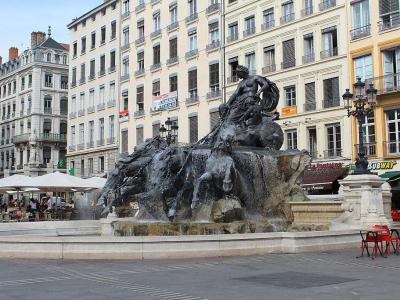
The centerpiece of the fountain is an allegorical sculpture of the River Garonne, called the “Char triumphant de la Garonne”, featuring a woman with a small child in a chariot drawn by four water horses. The statue is made of lead on an iron frame; it weighs 21 tons and is 4.85 meters high.
The woman figure represents the Garonne and the four horses with their bridles of water weeds represent its four main tributaries, namely: the Tarn, Ariège, Lot and Gers. The horses are leaping and plunging, thus symbolizing these tributaries jumping into the sea. However, since placed in Lyon, the woman figure is believed to be representing the River Saône instead.
Architect Bartholdi is best known for his other major works, like the Lion of Belfort created in 1879 and the Statue of Liberty in 1886.
The fountain was designed by Frédéric Auguste Bartholdi in 1889 and manufactured by Gaget and Gautier. It was originally intended for the city of Bordeaux when first exhibited at the Exposition Universelle of 1889. After the show, however, the mayor of Bordeaux perceived it too expensive for his city, and so the fountain was bought by the mayor of Lyon in 1890.
The centerpiece of the fountain is an allegorical sculpture of the River Garonne, called the “Char triumphant de la Garonne”, featuring a woman with a small child in a chariot drawn by four water horses. The statue is made of lead on an iron frame; it weighs 21 tons and is 4.85 meters high.
The woman figure represents the Garonne and the four horses with their bridles of water weeds represent its four main tributaries, namely: the Tarn, Ariège, Lot and Gers. The horses are leaping and plunging, thus symbolizing these tributaries jumping into the sea. However, since placed in Lyon, the woman figure is believed to be representing the River Saône instead.
Architect Bartholdi is best known for his other major works, like the Lion of Belfort created in 1879 and the Statue of Liberty in 1886.
13) Place des Terreaux (Terreaux Square)
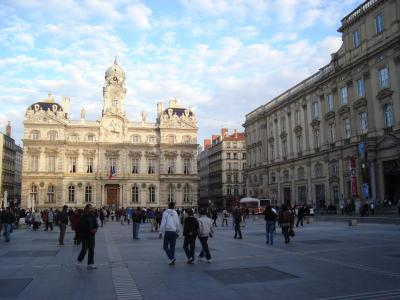
If Lyon had a living room, this would be it. Perfectly rectangular, grand, and confidently grey, Terreaux Square stretches across the Presqu’île between the Rhône and the Saône, right at the foot of Croix-Rousse hill. It sits in the 1st district like a stone stage set - symmetrical, open, and always ready for action. No surprise it’s part of Lyon’s UNESCO-listed historic centre.
By day, the square works as a social magnet. You can claim a café table and let time pass slowly with a drink, settle on the steps of the Museum of Fine Arts, or admire the dramatic fountain at the centre. On the eastern side rises the elegant City Hall of Lyon, built in the mid-17th century, rebuilt after a fire, and still serving its purpose. Across from it stands the former 17th-century nunnery of Saint-Pierre, which has housed the Fine Arts Museum since 1803 - proof that even convent walls can reinvent themselves.
The symmetry of lines may look calm, but they hide a rather dramatic past. Terreaux has seen far more than just casual espresso moments.
In 1642, Henri Coiffier de Ruzé, Marquis of Cinq-Mars, lost his head here after plotting against Cardinal Richelieu. During the French Revolution, the guillotine returned with alarming efficiency. And after the siege of Lyon, dozens more were executed on this very ground. Yes, this peaceful square once echoed with the sharp logic of political justice - 18th-century style.
Now look at the centrepiece. The powerful fountain was created by Frédéric Auguste Bartholdi - the same sculptor who later gave the world the Statue of Liberty. Inaugurated in 1891, the dramatic group shows a woman driving a quadriga, representing the Garonne River and its four tributaries charging toward the sea. Muscles tense, horses rear, water surges - it’s stone theatre at full volume.
Today, Terreaux Square balances beauty and memory. It’s a meeting point, a museum forecourt, a civic address, and a former revolutionary stage all in one. Stand still for a moment. Listen past the café chatter and splashing fountain. History hasn’t left here - it’s just learned to share the space...
By day, the square works as a social magnet. You can claim a café table and let time pass slowly with a drink, settle on the steps of the Museum of Fine Arts, or admire the dramatic fountain at the centre. On the eastern side rises the elegant City Hall of Lyon, built in the mid-17th century, rebuilt after a fire, and still serving its purpose. Across from it stands the former 17th-century nunnery of Saint-Pierre, which has housed the Fine Arts Museum since 1803 - proof that even convent walls can reinvent themselves.
The symmetry of lines may look calm, but they hide a rather dramatic past. Terreaux has seen far more than just casual espresso moments.
In 1642, Henri Coiffier de Ruzé, Marquis of Cinq-Mars, lost his head here after plotting against Cardinal Richelieu. During the French Revolution, the guillotine returned with alarming efficiency. And after the siege of Lyon, dozens more were executed on this very ground. Yes, this peaceful square once echoed with the sharp logic of political justice - 18th-century style.
Now look at the centrepiece. The powerful fountain was created by Frédéric Auguste Bartholdi - the same sculptor who later gave the world the Statue of Liberty. Inaugurated in 1891, the dramatic group shows a woman driving a quadriga, representing the Garonne River and its four tributaries charging toward the sea. Muscles tense, horses rear, water surges - it’s stone theatre at full volume.
Today, Terreaux Square balances beauty and memory. It’s a meeting point, a museum forecourt, a civic address, and a former revolutionary stage all in one. Stand still for a moment. Listen past the café chatter and splashing fountain. History hasn’t left here - it’s just learned to share the space...

14) Hotel de Ville (City Hall)
The Lyon's City Hall (Hôtel de Ville) stands as a testament to the city's rich architectural and historical legacy. Situated opposite the Nouvel Opera House and commanding a prominent position overlooking Place des Terreaux, this Town Hall has endured and risen from the ashes of multiple fires to become one of Lyon's most distinguished monuments.
Construction of the building spanned from 1646 to 1672, under the direction of Simon Maupin, the city architect at the time. The completion of the City Hall marked the transformation of Place des Terreaux into the administrative heart of Lyon. Architecturally, the building is structured around two courtyards, one elevated, and features four corner pavilions with a belfry encircling the main courtyard. The interior is celebrated for its opulent decoration, setting a standard in ornate design.
However, the City Hall's history is marked by adversity. In 1674, a devastating fire partially destroyed the building. In response, King Louis XIV commissioned Jules Hardouin-Mansart, a renowned architect, to design the new Town Hall. This reconstruction phase introduced new elements to its already rich design.
The building also played a significant role during the French Revolution. The consulate hall was repurposed as a revolutionary tribunal, and in 1792, the new municipality destroyed paintings of the aldermen and merchant provosts in an attempt to obliterate the vestiges of the old consulate.
Tragedy struck again on July 14, 1803, when a second fire ravaged the Hôtel de Ville. The building underwent extensive renovations during the Second Empire, restoring and enhancing its grandeur.
In contemporary times, the Lyon's City Hall continues to serve an important civic function, hosting the municipal council meetings ten times annually. This enduring edifice not only encapsulates the tumultuous history of Lyon but also stands as a symbol of resilience and architectural magnificence.
Construction of the building spanned from 1646 to 1672, under the direction of Simon Maupin, the city architect at the time. The completion of the City Hall marked the transformation of Place des Terreaux into the administrative heart of Lyon. Architecturally, the building is structured around two courtyards, one elevated, and features four corner pavilions with a belfry encircling the main courtyard. The interior is celebrated for its opulent decoration, setting a standard in ornate design.
However, the City Hall's history is marked by adversity. In 1674, a devastating fire partially destroyed the building. In response, King Louis XIV commissioned Jules Hardouin-Mansart, a renowned architect, to design the new Town Hall. This reconstruction phase introduced new elements to its already rich design.
The building also played a significant role during the French Revolution. The consulate hall was repurposed as a revolutionary tribunal, and in 1792, the new municipality destroyed paintings of the aldermen and merchant provosts in an attempt to obliterate the vestiges of the old consulate.
Tragedy struck again on July 14, 1803, when a second fire ravaged the Hôtel de Ville. The building underwent extensive renovations during the Second Empire, restoring and enhancing its grandeur.
In contemporary times, the Lyon's City Hall continues to serve an important civic function, hosting the municipal council meetings ten times annually. This enduring edifice not only encapsulates the tumultuous history of Lyon but also stands as a symbol of resilience and architectural magnificence.
15) Fresque des Lyonnais (The Lyon Fresco) (must see)
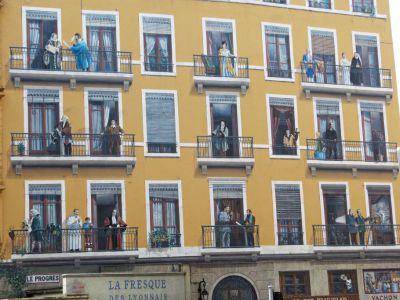
On the Saône side of Lyon’s first district, at the corner of Quai Saint Vincent and Martinière Street, a seven-storey building pulls off one of the city’s cleverest illusions. Two of its walls - one about 800 square metres, the other 200 - are covered with a gigantic “trick of the eye” mural.
And it really does trick you. Windows that don’t exist suddenly open. Balconies appear where there are none. You may even find yourself waving at someone who’s technically made of paint.
Stretching roughly 200 metres along the Saint Vincent side and 600 along Martinière, this mural has become a landmark in its own right. It presents 30 figures linked to Lyon - 24 from the past and six more modern personalities - arranged as if they all live together in one very distinguished apartment block. The contemporary characters stand at street level, casually “interacting” with passersby, as if they’ve just stepped out for coffee.
This painted façade tells 2,000 years of Lyon’s story. Emperor Claudius represents the Roman chapter. Abbé Pierre, founder of the Emmaus movement and member of the French Resistance, appears as a reminder of 20th-century social activism. Football legend Bernard Lacombe joins the line-up, while culinary icon Paul Bocuse seems to wait in the doorway of an imaginary café, ready to comment on the menu.
Look up, and you’ll spot explorer Giovanni da Verrazzano, who sailed for Francis I and reached what would later become New York. Antoine de Saint-Exupéry leans out with his Little Prince, quietly observing the world below. Long-serving mayor Édouard Herriot puffs thoughtfully on his pipe. Nearby, Auguste and Louis Lumière present their first motion-picture camera, the device that launched cinema and secured Lyon’s place in film history.
More faces peer from windows and balconies, creating the impression that the entire building is alive with conversation. The mural was created in 1995 by the artist cooperative CitéCréation, as part of a project to revitalize this busy waterfront district. The idea proved so successful that similar “balcony” murals later appeared elsewhere, including Barcelona.
If you want the full effect, come in the morning. Between 10 and 11 a.m., when the sun hits the wall just right, the illusion sharpens, and the figures seem almost ready to step out. Indeed, this neighbourhood is rich in wall art - but none quite match the scale and storytelling power of The Lyon Fresco.
And it really does trick you. Windows that don’t exist suddenly open. Balconies appear where there are none. You may even find yourself waving at someone who’s technically made of paint.
Stretching roughly 200 metres along the Saint Vincent side and 600 along Martinière, this mural has become a landmark in its own right. It presents 30 figures linked to Lyon - 24 from the past and six more modern personalities - arranged as if they all live together in one very distinguished apartment block. The contemporary characters stand at street level, casually “interacting” with passersby, as if they’ve just stepped out for coffee.
This painted façade tells 2,000 years of Lyon’s story. Emperor Claudius represents the Roman chapter. Abbé Pierre, founder of the Emmaus movement and member of the French Resistance, appears as a reminder of 20th-century social activism. Football legend Bernard Lacombe joins the line-up, while culinary icon Paul Bocuse seems to wait in the doorway of an imaginary café, ready to comment on the menu.
Look up, and you’ll spot explorer Giovanni da Verrazzano, who sailed for Francis I and reached what would later become New York. Antoine de Saint-Exupéry leans out with his Little Prince, quietly observing the world below. Long-serving mayor Édouard Herriot puffs thoughtfully on his pipe. Nearby, Auguste and Louis Lumière present their first motion-picture camera, the device that launched cinema and secured Lyon’s place in film history.
More faces peer from windows and balconies, creating the impression that the entire building is alive with conversation. The mural was created in 1995 by the artist cooperative CitéCréation, as part of a project to revitalize this busy waterfront district. The idea proved so successful that similar “balcony” murals later appeared elsewhere, including Barcelona.
If you want the full effect, come in the morning. Between 10 and 11 a.m., when the sun hits the wall just right, the illusion sharpens, and the figures seem almost ready to step out. Indeed, this neighbourhood is rich in wall art - but none quite match the scale and storytelling power of The Lyon Fresco.
16) Le Mur Des Canuts (The Canuts Mural) (must see)
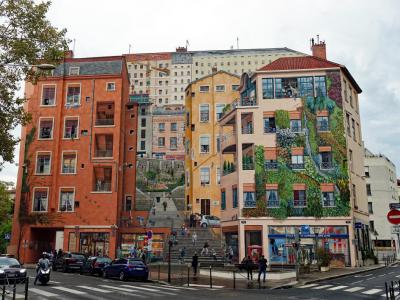
The Wall of the Silkworkers (Le Mur des Canuts) is a mural in the Croix-Rouge ("Red-Cross") district of Lyon. It is the largest "trick of the eye" (trompe-l'oeil) mural in the city, covering an area of 12,917 square feet. It is located at the corner of the Canuts Boulevard (Boulevard des Canuts) and Denfert Rochereau Street.
This mural is unlike any other. It represents ordinary day-to-day life in the neighborhood of Croix-Rouge, but with a twist. It is updated. The first update was in 1997. The second, in 2013. The aim is to keep up with the transformations of the district, including changes in the people. The mural is a "living" history.
Pastel colored buildings with tall windows, a steep stairway of stone, a theatre, a silk shop, a bank; all appear in a near surrealistic display. It is another work of CiteCreation. The mural painting organization created the mural in 1987 to honor the history of Croix-Rouge neighborhood.
The profound three-dimensional effects give a sense of action to the display. A black dog lies in front of a shop. Customers wait for the bank to open. Children play at parkour on the stone steps. Tenants peer from windows at passersby. It is a show of life on the "Hill that works." The spirit of the silk weavers of Lyon lives on.
This mural is unlike any other. It represents ordinary day-to-day life in the neighborhood of Croix-Rouge, but with a twist. It is updated. The first update was in 1997. The second, in 2013. The aim is to keep up with the transformations of the district, including changes in the people. The mural is a "living" history.
Pastel colored buildings with tall windows, a steep stairway of stone, a theatre, a silk shop, a bank; all appear in a near surrealistic display. It is another work of CiteCreation. The mural painting organization created the mural in 1987 to honor the history of Croix-Rouge neighborhood.
The profound three-dimensional effects give a sense of action to the display. A black dog lies in front of a shop. Customers wait for the bank to open. Children play at parkour on the stone steps. Tenants peer from windows at passersby. It is a show of life on the "Hill that works." The spirit of the silk weavers of Lyon lives on.
