Custom Walk in San Juan, Puerto Rico by cornice-kisser6v_c4c7f created on 2025-04-09
Guide Location: Puerto Rico » San Juan
Guide Type: Custom Walk
# of Sights: 14
Tour Duration: 6 Hour(s)
Travel Distance: 15 Km or 9.3 Miles
Share Key: L26FG
Guide Type: Custom Walk
# of Sights: 14
Tour Duration: 6 Hour(s)
Travel Distance: 15 Km or 9.3 Miles
Share Key: L26FG
How It Works
Please retrieve this walk in the GPSmyCity app. Once done, the app will guide you from one tour stop to the next as if you had a personal tour guide. If you created the walk on this website or come to the page via a link, please follow the instructions below to retrieve the walk in the app.
Retrieve This Walk in App
Step 1. Download the app "GPSmyCity: Walks in 1K+ Cities" on Apple App Store or Google Play Store.



Step 2. In the GPSmyCity app, download(or launch) the guide "San Juan Map and Walking Tours".
Step 3. Tap the menu button located at upper right corner of the "Walks" screen and select "Retrieve custom walk". Enter the share key: L26FG
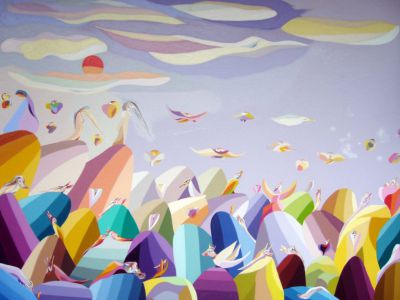
1) Museo de Arte de Puerto Rico (Museum of Art of Puerto Rico) (must see)
The Museum of Art of Puerto Rico (MAPR) is one of the most prestigious art museums in Puerto Rico. MAPR is a 130,000-square-foot neoclassical building from the 1920s formerly known as the San Juan Municipal Hospital. It is one of the biggest museums in the Caribbean and a local house for collections from the 17th century. The new east wing, which is dominated by a five-story-tall stained-glass window, is the work of local artist Eric Tabales.
The museum is located in the heart of Santurce, steps away from the Luis A. Ferré Performing Arts Center and the Puerto Rico Museum of Contemporary Art. The historical building that houses part of the MAPR was built during the 1920s by architect William Shimmelphening. A new wing, designed by architects Otto Reyes and Luis Gutierrez in 1996, was added to the existing building to create what is now the complete structure. Museum's facilities are: top-floor gallery inspired by Oller, beautiful garden filled with a variety of native flora, 400-seat theater, massive atrium, restaurant, gift and book store, and much more.
The museum is located in the heart of Santurce, steps away from the Luis A. Ferré Performing Arts Center and the Puerto Rico Museum of Contemporary Art. The historical building that houses part of the MAPR was built during the 1920s by architect William Shimmelphening. A new wing, designed by architects Otto Reyes and Luis Gutierrez in 1996, was added to the existing building to create what is now the complete structure. Museum's facilities are: top-floor gallery inspired by Oller, beautiful garden filled with a variety of native flora, 400-seat theater, massive atrium, restaurant, gift and book store, and much more.
Sight description based on Wikipedia.
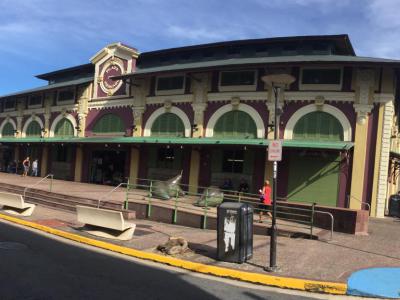
2) La Placita del Mercado de Santurce (Santurce's Market Square)
The market square was established in 1910 when the area was selected by Puerto Rico's government to build a marketplace. The marketplace building had two levels, the first one for kiosks, food and produce stalls and other service businesses, while the second level had the butcher and the meat market. The building originally also had business spaces, including medical offices.
The market square building has been renovated and modified on numerous occasions throughout the 20th century, and at some point the second level was demolished to increase the area of the main marketplace. The marketplace lost its importance in the later second half of the 20th century which left the area in various stages of disrepair. The building and the neighborhood were revitalized in the 1990s and 2000s when numerous restaurant and entertainment businesses opened.
La Placita historic district is located in and around the historical Santurce Market building. The area is now one of the liveliest social districts in San Juan and it is famous for its nightlife and gastronomy with its numerous restaurants, cafés, bars and dance clubs.
The market square building has been renovated and modified on numerous occasions throughout the 20th century, and at some point the second level was demolished to increase the area of the main marketplace. The marketplace lost its importance in the later second half of the 20th century which left the area in various stages of disrepair. The building and the neighborhood were revitalized in the 1990s and 2000s when numerous restaurant and entertainment businesses opened.
La Placita historic district is located in and around the historical Santurce Market building. The area is now one of the liveliest social districts in San Juan and it is famous for its nightlife and gastronomy with its numerous restaurants, cafés, bars and dance clubs.
Sight description based on Wikipedia.
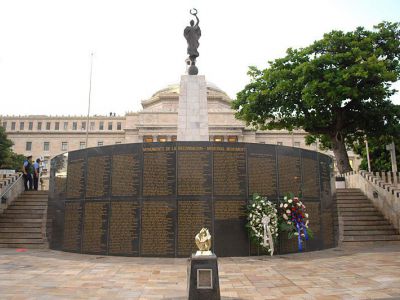
3) Monumento de la Recordación
In front of the beautiful El Capitolio you will see Monumento de la Recordación. El Monumento de la Recordación is a memorial monument and monolith erected in San Juan, Puerto Rico that honors Puerto Ricans who have fallen in combat in service of the United States armed forces. The monument was unveiled on May 19, 1996 as a granite wall in semicircular shape engraved with the names of those Puerto Rican soldiers that have fallen in war. As of today the monument is etched with the names of more than 2,000 service members
Sight description based on Wikipedia.
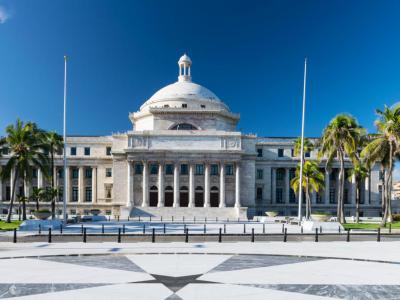
4) El Capitolio (The Capitol)
El Capitolio is the home of the Legislative Assembly of Puerto Rico and is located in San Juan, the capital of Puerto Rico. The building is an important landmark in the city, and has a fascinating history that spans more than a century.
The idea for the construction of a capitol building in Puerto Rico was first proposed in the late 19th century, during the island's transition from Spanish to American colonial rule. However, it wasn't until the 1920s that the project gained momentum, as the island's political leaders sought to create a building that would reflect Puerto Rico's cultural and political identity.
Construction of El Capitolio began in 1925 and was completed in 1929. The building was designed by Rafael Carmoega and was heavily influenced by the Spanish Revival style of architecture. The structure is built of concrete and is topped by a large dome, which is decorated with a bronze sculpture by Italian artist Angelo Lanzarotti.
El Capitolio was inaugurated on February 11, 1929, and since then it has served as the seat of government for the Legislative Assembly of Puerto Rico. Visitors to the building can take guided tours of the interior, which includes an impressive collection of artwork and historical artifacts. The building is also the site of many important political and cultural events, including exhibitions, concerts, and official ceremonies.
The idea for the construction of a capitol building in Puerto Rico was first proposed in the late 19th century, during the island's transition from Spanish to American colonial rule. However, it wasn't until the 1920s that the project gained momentum, as the island's political leaders sought to create a building that would reflect Puerto Rico's cultural and political identity.
Construction of El Capitolio began in 1925 and was completed in 1929. The building was designed by Rafael Carmoega and was heavily influenced by the Spanish Revival style of architecture. The structure is built of concrete and is topped by a large dome, which is decorated with a bronze sculpture by Italian artist Angelo Lanzarotti.
El Capitolio was inaugurated on February 11, 1929, and since then it has served as the seat of government for the Legislative Assembly of Puerto Rico. Visitors to the building can take guided tours of the interior, which includes an impressive collection of artwork and historical artifacts. The building is also the site of many important political and cultural events, including exhibitions, concerts, and official ceremonies.
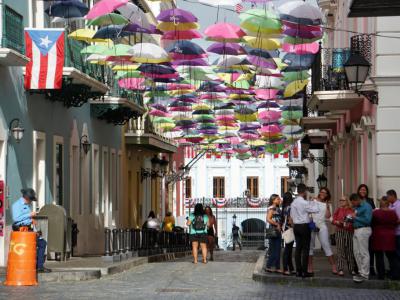
5) Calle de la Fortaleza (Fortaleza Street) (must see)
Proudly presiding over the bay of San Juan is the imposing La Fortaleza (Fortress), formally known as the Palace of Santa Catalina, the official residence of the Governor of Puerto Rico. The narrow road leading to the building, called Fortaleza Street, is the main artery of San Juan's historic quarter, cutting through most of it, and is also the oldest street in the area. It starts from Columbus Square and for the whole of its duration is lined with governmental buildings, hotels, perfumeries, craft shops, jewelry stores, and restaurants, gradually transforming into Avenue Juan Ponce de León in the east.
Just like many other colorful cobblestone streets in Old San Juan, each one more photogenic than the other, this thoroughfare is an important tourist attraction, in large part due to its historical and cultural significance. Visiting Fortaleza Street should be an integral part of every Old San Juan itinerary.
While the walled-in Old City has no shortage of vibrant photo spots, Fortaleza Street stands out above the rest due to the display of umbrellas – at the end of the street, near La Fortaleza itself – creating an overhead canopy that makes it particularly recognizable. These umbrellas tend to change colors during the year, from rainbow to all pink. Before the umbrellas, La Fortaleza Street was adorned with colorful kites.
Just like many other colorful cobblestone streets in Old San Juan, each one more photogenic than the other, this thoroughfare is an important tourist attraction, in large part due to its historical and cultural significance. Visiting Fortaleza Street should be an integral part of every Old San Juan itinerary.
While the walled-in Old City has no shortage of vibrant photo spots, Fortaleza Street stands out above the rest due to the display of umbrellas – at the end of the street, near La Fortaleza itself – creating an overhead canopy that makes it particularly recognizable. These umbrellas tend to change colors during the year, from rainbow to all pink. Before the umbrellas, La Fortaleza Street was adorned with colorful kites.
Sight description based on Wikipedia.
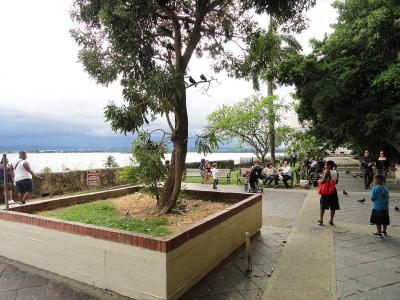
6) Parque de las Palomas (Pigeon Park)
Pigeon Park offers a unique experience for visitors. A small kiosk sells pigeon feed, but these friendly birds are so accustomed to human presence that they may land on you even if you don't have food. The park is adorned with bird toys and decorations, lovingly put up and maintained by the adjacent Café del Niño. Adding to its charm, the park boasts a gorgeous overlook of San Juan and the San Juan Bay.
In the 18th century, the heavily fortified city of San Juan erected a wall for cannon placement, overlooking the southeastern coast of Puerto Rico. When the cannons were eventually removed or ceased to be used, pigeons found a new home in the sockets left behind. Over the years, families have delighted in bringing their children to feed the bustling pigeon population that settled in these historic remnants
In the 18th century, the heavily fortified city of San Juan erected a wall for cannon placement, overlooking the southeastern coast of Puerto Rico. When the cannons were eventually removed or ceased to be used, pigeons found a new home in the sockets left behind. Over the years, families have delighted in bringing their children to feed the bustling pigeon population that settled in these historic remnants
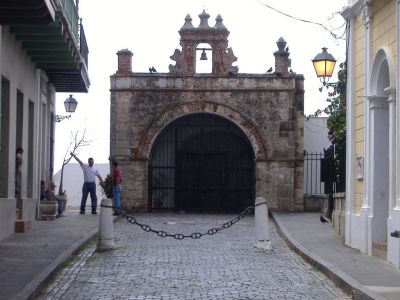
7) Capilla del Cristo (Chapel of Christ) (must see)
Capilla del Cristo (Chapel of Christ), is a small chapel located in the Old San Juan Historic District of Puerto Rico. Built in the 18th century, the structure has become a cultural icon of Puerto Rico and was saved from demolition in the 20th century. Most of the articles located at its altar are from 1753.
The chapel with its belfry is located in the Old San Juan Historic District in the western section of San Juan Islet, at the end of Cristo Street, now a pedestrian walkway. It sits on top of the old city walk. The chapel is a major tourist attraction in San Juan. Inside the chapel there is a famous painting called El Milagro ("The Miracle").
According to the legend, during a horse race that was taking place on the street where the chapel is located, a young rider and his horse took a bad fall and the rider went over the city wall but was miraculously saved. In a famous book about Puerto Rican legends, it says that the horse was killed but the rider lived. Afterwards, permission was granted to build the Catholic chapel and many festivals have been held, over the years, at the location to celebrate the miracle.
The chapel is open to publish on Saturday and Sunday from 12:00 to 18:00.
The chapel with its belfry is located in the Old San Juan Historic District in the western section of San Juan Islet, at the end of Cristo Street, now a pedestrian walkway. It sits on top of the old city walk. The chapel is a major tourist attraction in San Juan. Inside the chapel there is a famous painting called El Milagro ("The Miracle").
According to the legend, during a horse race that was taking place on the street where the chapel is located, a young rider and his horse took a bad fall and the rider went over the city wall but was miraculously saved. In a famous book about Puerto Rican legends, it says that the horse was killed but the rider lived. Afterwards, permission was granted to build the Catholic chapel and many festivals have been held, over the years, at the location to celebrate the miracle.
The chapel is open to publish on Saturday and Sunday from 12:00 to 18:00.
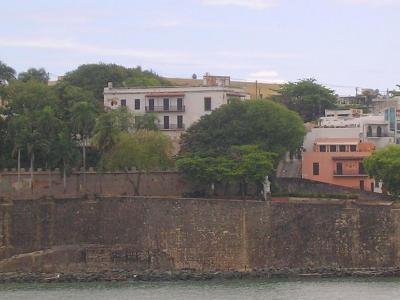
8) Casa Blanca Museum (White House Museum)
Casa Blanca is a house museum located in Old San Juan. This lovely white adobe building is one of the oldest buildings in San Juan. Built in 1521 it served as the first fortification of the San Juan islet and residence for Juan Ponce de Leon, the first governor of Puerto Rico, and his family. Juan Ponce de Leon unfortunately died in an expedition to Florida without ever lived in the house. It was later used as the residence of his descendants, until the mid-18th century. As a fortification it served mostly as a refuge in times of attack from Taino rebels.
The house was built in wood but the original structure was destroyed by fire and rebuilt in stone and masonry. It subsequently was occupied by members of the Spanish army and later by American army commanders. The surrounding gardens were planted by the first American governor of the island in the 19th century. In 1967 the complex was transferred to the government of Puerto Rico and declared a historical monument. In 1981, it was recorded in the Historic American Buildings Survey. The house is a museum of 16th and 17th century artifacts managed by the Institute of Puerto Rican Culture.
The building, walls and gardens are in excellent condition. The plaques on the walls explain the history of each room. The museum charges a small fee ($5) to enter while one can visit the gardens for free.
The house was built in wood but the original structure was destroyed by fire and rebuilt in stone and masonry. It subsequently was occupied by members of the Spanish army and later by American army commanders. The surrounding gardens were planted by the first American governor of the island in the 19th century. In 1967 the complex was transferred to the government of Puerto Rico and declared a historical monument. In 1981, it was recorded in the Historic American Buildings Survey. The house is a museum of 16th and 17th century artifacts managed by the Institute of Puerto Rican Culture.
The building, walls and gardens are in excellent condition. The plaques on the walls explain the history of each room. The museum charges a small fee ($5) to enter while one can visit the gardens for free.
Sight description based on Wikipedia.
9) Plaza de Beneficencia (Charity Square)
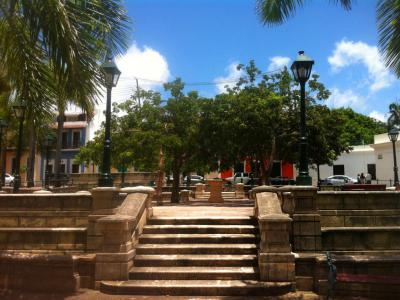
Plaza de Beneficencia (Charity Square) is located near the prominent Cuartel de Ballajá. The main attraction of the plaza is a statue in honor of Eugenio Maria de Hostos a famous Puerto Rican intellectual, teacher, lawyer, philosopher and advocate. The sculpture was created by the renowned sculptor José Buscaglia Guillermety. The monument features Eugenio Maria de Hostos with children dancing on him.
10) La Ballajá Sculpture
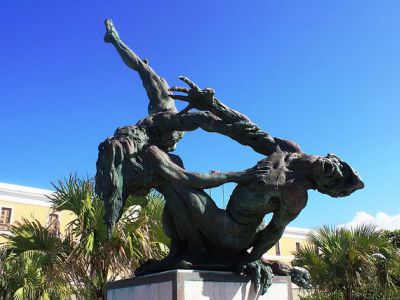
Near Instituto de Cultura Puertorriquena, Museo de las Américas and historic Cuartel de Ballajá, you will find the fascinating sculpture, La Ballajá. It consists of three figures, beautifully united in the overall composition.
11) Iglesia de San José (San José Church)
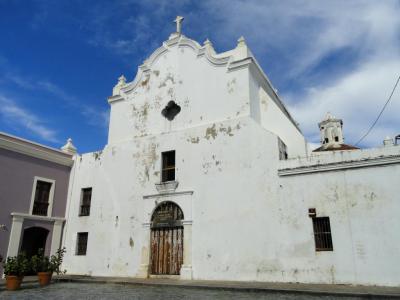
San Jose Church (Iglesia de San Jose), located in Old San Juan, is one of the first significant works of architecture on the island. The church was first opened in 1532 and is one of the earliest surviving examples of 16th-century Spanish Gothic architecture in the Western hemisphere.
Juan Ponce de León, the first governor of Puerto Rico, was buried in the crypt of the church from 1559 to 1836, when his remains were exhumed and later transferred to the Cathedral of San Juan Bautista. However, his coat of arms is still located near the main altar. His grandson, Juan Ponce de Leon II is buried in the crypt beneath the Sanctuary's floor. Puerto Rican painter José Campeche is also buried in the church.
In 2002, a restoration project on the structure began and several painted murals were discovered including a mid-19th century depiction of the Battle of Lepanto. In 2004, the church was listed on the 2004 World Monuments Watch by the World Monuments Fund, which helped the conservation effort.
The Church of Saint Joseph is closed to visitors due to the restoration work that has been going on. It is expected to re-open in 2020.
Juan Ponce de León, the first governor of Puerto Rico, was buried in the crypt of the church from 1559 to 1836, when his remains were exhumed and later transferred to the Cathedral of San Juan Bautista. However, his coat of arms is still located near the main altar. His grandson, Juan Ponce de Leon II is buried in the crypt beneath the Sanctuary's floor. Puerto Rican painter José Campeche is also buried in the church.
In 2002, a restoration project on the structure began and several painted murals were discovered including a mid-19th century depiction of the Battle of Lepanto. In 2004, the church was listed on the 2004 World Monuments Watch by the World Monuments Fund, which helped the conservation effort.
The Church of Saint Joseph is closed to visitors due to the restoration work that has been going on. It is expected to re-open in 2020.
Sight description based on Wikipedia.
12) Plaza de Armas (Arms Square) (must see)
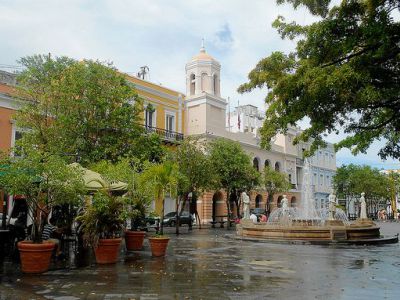
Arms Square is the de-facto central square of San Juan. Over the years, it has changed several names relative to the functions it served. Initially, in 1521, it was called Vegetables Square. Then, during the 17th-19th centuries, it was known as Arms Square, for being the grounds for military drills. After that, in the early 20th century, it turned back to being called Vegetables Square once again, serving as a marketplace, before it finally re-assumed the Arms Square title.
The plaza is modeled on the classic squares of Madrid and Mexico City. Although it factually existed for centuries, it was not until 1840 that the city council approved its proper development, which started in 1851. It was at that time that the four bronze statues, oil-coated to simulate marble, representing Commerce, Industry, Science, and the Arts, arrived here (there were a total of eight statues to be installed, but the other four were lost). In 1872, the original statues were replaced with the new marble ones, representing the Four Seasons, put in the four corners of the square.
In 1955, two circular fountains and two lampposts in the center were added. The four statues were then configured in a circular fountain outside the Palacio de la Real Intendencia, which is the seat of the Department of State of Puerto Rico, on the western side of the square.
A highlight of the northern side is the Casa Alcaldía – home of the San Juan City Hall. Built in 1789, this Spanish colonial-style edifice with twin turrets resembles its sister building in Madrid. The tinkling of the fountain, the comfortable seating in the shade of the trees, and the presence of several old-style coffee booths selling snacks have long attracted tourists as a good spot for a sightseeing break when you can stretch out your feet and soak up some of the everyday comings and goings.
The laid-back atmosphere of the place also made it a popular gathering venue with locals, offering a chance to buy kids some traditional treats (like sesame-seed lollipops or coconut candies), watch shows, play dominoes, or chit-chat with friends.
The plaza is modeled on the classic squares of Madrid and Mexico City. Although it factually existed for centuries, it was not until 1840 that the city council approved its proper development, which started in 1851. It was at that time that the four bronze statues, oil-coated to simulate marble, representing Commerce, Industry, Science, and the Arts, arrived here (there were a total of eight statues to be installed, but the other four were lost). In 1872, the original statues were replaced with the new marble ones, representing the Four Seasons, put in the four corners of the square.
In 1955, two circular fountains and two lampposts in the center were added. The four statues were then configured in a circular fountain outside the Palacio de la Real Intendencia, which is the seat of the Department of State of Puerto Rico, on the western side of the square.
A highlight of the northern side is the Casa Alcaldía – home of the San Juan City Hall. Built in 1789, this Spanish colonial-style edifice with twin turrets resembles its sister building in Madrid. The tinkling of the fountain, the comfortable seating in the shade of the trees, and the presence of several old-style coffee booths selling snacks have long attracted tourists as a good spot for a sightseeing break when you can stretch out your feet and soak up some of the everyday comings and goings.
The laid-back atmosphere of the place also made it a popular gathering venue with locals, offering a chance to buy kids some traditional treats (like sesame-seed lollipops or coconut candies), watch shows, play dominoes, or chit-chat with friends.
13) Castillo San Cristóbal (Fort San Cristobal) (must see)
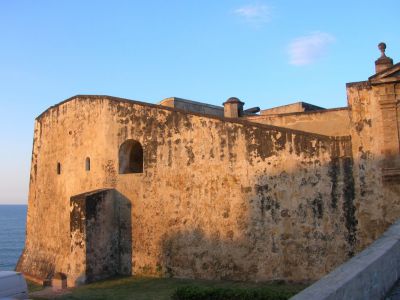
Standing guard at the eastern gate, north of Columbus Square, is an imposing 18th-century fortress, called San Cristóbal. Contrary to her sister, El Morro, which was designed to protect from attacks by sea, the San Cristóbal Fort guarded the city against the enemy approaching by land, for which purpose it created a crossfire with El Morro over the bay. The citadel construction began in 1634 and was meant to strengthen the Spanish position in the face of imminent English and Dutch invasion.
The fort was named San Cristóbal in celebration of the Spanish victories which enabled ejecting of the English and Dutch interlopers from the island of the same name in the Lesser Antilles, which was then part of the insular territorial glacis of Puerto Rico.
When finished in 1783, the Fort San Cristóbal covered nearly 27 acres of land and practically wrapped around the whole of San Juan, with the entry to the city sealed by the San Cristóbal's double gates. After almost 100 years of relative peace, about a third of the fortification was demolished, in 1897, to help ease the flow of traffic in and out of the walled city.
The Fort San Cristóbal is now a listed National Historic Site. It is particularly worth visiting as the largest fortification ever built by the Spanish in the New World, where the first shots of the Spanish-American War were fired. If you're a keen photographer, San Cristobal is a goldmine of panoramic views of the coast, from Old San Juan to Condado and beyond.
Tip:
Guided tours by local rangers visit the extensive tunnel system connecting various sections of the fort. There is an exhibition of military clothing. Be sure to visit the overlook for the Devil's Sentry Box ("Garita del Diablo"), from which, according to legends, soldiers mysteriously disappeared. Tickets to San Cristobal or El Morro can be used to enter either of the forts.
The fort was named San Cristóbal in celebration of the Spanish victories which enabled ejecting of the English and Dutch interlopers from the island of the same name in the Lesser Antilles, which was then part of the insular territorial glacis of Puerto Rico.
When finished in 1783, the Fort San Cristóbal covered nearly 27 acres of land and practically wrapped around the whole of San Juan, with the entry to the city sealed by the San Cristóbal's double gates. After almost 100 years of relative peace, about a third of the fortification was demolished, in 1897, to help ease the flow of traffic in and out of the walled city.
The Fort San Cristóbal is now a listed National Historic Site. It is particularly worth visiting as the largest fortification ever built by the Spanish in the New World, where the first shots of the Spanish-American War were fired. If you're a keen photographer, San Cristobal is a goldmine of panoramic views of the coast, from Old San Juan to Condado and beyond.
Tip:
Guided tours by local rangers visit the extensive tunnel system connecting various sections of the fort. There is an exhibition of military clothing. Be sure to visit the overlook for the Devil's Sentry Box ("Garita del Diablo"), from which, according to legends, soldiers mysteriously disappeared. Tickets to San Cristobal or El Morro can be used to enter either of the forts.
Sight description based on Wikipedia.
14) San Gerónimo Fort
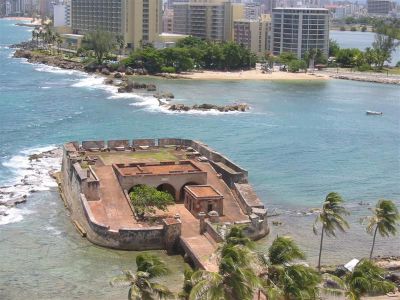
Fortín de San Gerónimo del Boquerón is a small fort located at the entrance of what is known today as Condado Lagoon. It was built during the 17th century to replace the smaller El Boquerón, which stood at the easternmost end of San Juan. The original Boquerón battery defended San Juan from attacks by Sir Francis Drake in 1595 and Sir George Clifford, 3rd Earl of Cumberland in 1598, who destroyed it after his attack.
San Gerónimo became part of San Juan's line of defense, along with San Antonio Fort/Bridge and Escambrón Fort and Castillo de San Cristóbal. It was listed in the National Register of Historic Places on October 11, 1983.
Unlike similar forts near Old San Juan, it is not part of San Juan National Historic Site. San Gerónimo is owned by the Institute of Puerto Rican Culture, but is managed by the Hilton. The hotel occasionally used it for private gatherings, but during recent times it has fallen into such disrepair that visitors are no longer allowed.
San Gerónimo became part of San Juan's line of defense, along with San Antonio Fort/Bridge and Escambrón Fort and Castillo de San Cristóbal. It was listed in the National Register of Historic Places on October 11, 1983.
Unlike similar forts near Old San Juan, it is not part of San Juan National Historic Site. San Gerónimo is owned by the Institute of Puerto Rican Culture, but is managed by the Hilton. The hotel occasionally used it for private gatherings, but during recent times it has fallen into such disrepair that visitors are no longer allowed.
Sight description based on Wikipedia.
