Custom Walk in Strasbourg, France by abbmedsyg_aed86 created on 2025-06-04
Guide Location: France » Strasbourg
Guide Type: Custom Walk
# of Sights: 14
Tour Duration: 4 Hours
Travel Distance: 9.6 Km or 6 Miles
Share Key: STED9
Guide Type: Custom Walk
# of Sights: 14
Tour Duration: 4 Hours
Travel Distance: 9.6 Km or 6 Miles
Share Key: STED9
How It Works
Please retrieve this walk in the GPSmyCity app. Once done, the app will guide you from one tour stop to the next as if you had a personal tour guide. If you created the walk on this website or come to the page via a link, please follow the instructions below to retrieve the walk in the app.
Retrieve This Walk in App
Step 1. Download the app "GPSmyCity: Walks in 1K+ Cities" on Apple App Store or Google Play Store.



Step 2. In the GPSmyCity app, download(or launch) the guide "Strasbourg Map and Walking Tours".
Step 3. Tap the menu button located at upper right corner of the "Walks" screen and select "Retrieve custom walk". Enter the share key: STED9
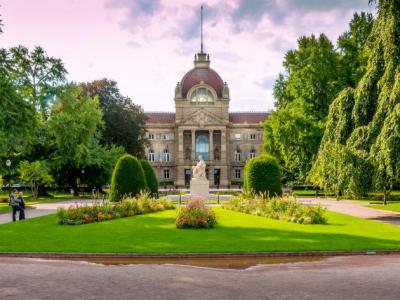
1) Place de la République (Republic Square)
Republic Square (Place de la République) stands as one of the principal plazas within Strasbourg's "German quarter." This square is encompassed on three sides by a collection of five edifices, each void of residential occupancy. These notable structures include the Palais du Rhin, the National and University Library, the Théâtre national de Strasbourg, the Préfecture of Grand Est and Bas-Rhin, and the Hôtel des Impôts, which serves as the tax center. Notably, all of these architectural marvels are classified as Historical Monuments.
The mastermind behind the design of Republic Square was the architect Jean-Geoffroy Conrath (1824-1892), who envisioned this space during the period of Reichsland. It was intended to serve as a grand and impressive gateway to the Neustadt, situated across the Ill River from the historic heart of the city, Grande Île. The square's design and construction began in 1880, initially named "Imperial Square." Notably, a group of Ginkgo biloba trees, also known as Maidenhair trees, were brought from Japan by Emperor Meiji and were planted in the central garden during the 1880s. These trees, a testament to history, still grace the square with their presence today.
At the heart of Republic Square, an impactful War memorial sculpture created by Léon-Ernest Drivier commands attention. Unveiled in 1936, this statue portrays a mother cradling two fallen sons, symbolizing the intricate historical narrative of Strasbourg, oscillating between the influences of Germany and France. This poignant memorial took the place of an equestrian statue of Emperor Wilhelm I, which had been commissioned in 1897 and previously held its stance on the square from 1911 until 1918.
Why You Should Visit:
To see one, if not the only, remaining example of fabulous German architecture in the world since all the stunning examples in Germany were destroyed in WWII.
The mastermind behind the design of Republic Square was the architect Jean-Geoffroy Conrath (1824-1892), who envisioned this space during the period of Reichsland. It was intended to serve as a grand and impressive gateway to the Neustadt, situated across the Ill River from the historic heart of the city, Grande Île. The square's design and construction began in 1880, initially named "Imperial Square." Notably, a group of Ginkgo biloba trees, also known as Maidenhair trees, were brought from Japan by Emperor Meiji and were planted in the central garden during the 1880s. These trees, a testament to history, still grace the square with their presence today.
At the heart of Republic Square, an impactful War memorial sculpture created by Léon-Ernest Drivier commands attention. Unveiled in 1936, this statue portrays a mother cradling two fallen sons, symbolizing the intricate historical narrative of Strasbourg, oscillating between the influences of Germany and France. This poignant memorial took the place of an equestrian statue of Emperor Wilhelm I, which had been commissioned in 1897 and previously held its stance on the square from 1911 until 1918.
Why You Should Visit:
To see one, if not the only, remaining example of fabulous German architecture in the world since all the stunning examples in Germany were destroyed in WWII.
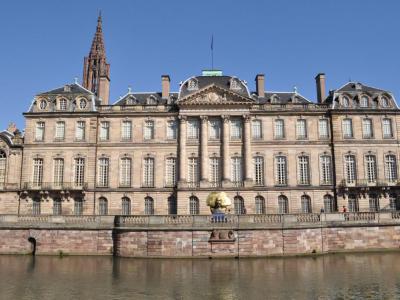
2) Palais Rohan (Rohan Palace) (must see)
Rohan Palace was built between 1732 and 1742 and was commissioned by Cardinal Gaston de Rohan, prince-bishop of Strasbourg, as a prestigious residence reflecting his close ties to the French royal court. The palace was conceived in an elegant French Baroque style, deliberately echoing the grandeur of Parisian aristocratic residences. Its location beside the River Ill, adjacent to Strasbourg Cathedral, placed it at the symbolic heart of the city.
Over time, the palace hosted a remarkable list of historical figures. King Louis XV, Marie Antoinette, and Napoleon Bonaparte all stayed here, reinforcing its status as a setting for high diplomacy and ceremonial life. Following the French Revolution, the building was gradually repurposed for civic and cultural use.
Today, the Rohan Palace is especially appealing because it houses three major museums under one roof. As you step onto the palace’s grounds and face it, you will see the entrance to the museums on the far left side of the palace’s main courtyard. The entrance is easy to recognise, as it is framed by beige Ionic columns and preceded by a small staircase. The Museum of Decorative Arts occupies the palace’s former state apartments on the ground floor, allowing visitors to experience furnished interiors that evoke aristocratic life in the 18th century. Porcelain, furniture, clocks, and silverware are displayed in richly decorated rooms.
The upper two floors of the palace host the Museum of Fine Arts, which presents a strong collection of European paintings from the Renaissance to the 19th century. Highlights of the gallery include works by artists such as Giotto, Botticelli, Rubens, and Goya. The collection is arranged roughly chronologically; early Renaissance works appear at the beginning of the route, followed by late Renaissance and Baroque paintings in the central galleries, and later periods toward the end.
Last but not least, the Archaeological Museum traces human settlement in Alsace from prehistory through the early Middle Ages, with a special focus on Argentoratum, the Roman name for Strasbourg. It is located at basement level.
Beyond the collections themselves, the palace’s formal façades, inner courtyard, and riverside terraces add to its charm. So notable is its setting, in fact, that it has been chosen for multiple diplomatic meetings. Among them, U.S. President Ronald Reagan dined here in 1985, while President Barack Obama met French President Nicolas Sarkozy on the palace grounds in 2009.
Over time, the palace hosted a remarkable list of historical figures. King Louis XV, Marie Antoinette, and Napoleon Bonaparte all stayed here, reinforcing its status as a setting for high diplomacy and ceremonial life. Following the French Revolution, the building was gradually repurposed for civic and cultural use.
Today, the Rohan Palace is especially appealing because it houses three major museums under one roof. As you step onto the palace’s grounds and face it, you will see the entrance to the museums on the far left side of the palace’s main courtyard. The entrance is easy to recognise, as it is framed by beige Ionic columns and preceded by a small staircase. The Museum of Decorative Arts occupies the palace’s former state apartments on the ground floor, allowing visitors to experience furnished interiors that evoke aristocratic life in the 18th century. Porcelain, furniture, clocks, and silverware are displayed in richly decorated rooms.
The upper two floors of the palace host the Museum of Fine Arts, which presents a strong collection of European paintings from the Renaissance to the 19th century. Highlights of the gallery include works by artists such as Giotto, Botticelli, Rubens, and Goya. The collection is arranged roughly chronologically; early Renaissance works appear at the beginning of the route, followed by late Renaissance and Baroque paintings in the central galleries, and later periods toward the end.
Last but not least, the Archaeological Museum traces human settlement in Alsace from prehistory through the early Middle Ages, with a special focus on Argentoratum, the Roman name for Strasbourg. It is located at basement level.
Beyond the collections themselves, the palace’s formal façades, inner courtyard, and riverside terraces add to its charm. So notable is its setting, in fact, that it has been chosen for multiple diplomatic meetings. Among them, U.S. President Ronald Reagan dined here in 1985, while President Barack Obama met French President Nicolas Sarkozy on the palace grounds in 2009.
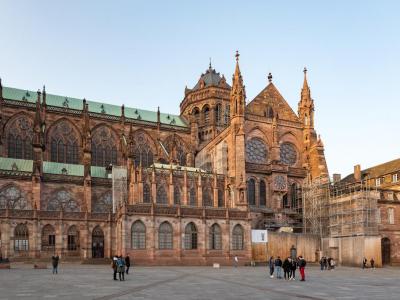
3) Cathédrale Notre-Dame de Strasbourg (Strasbourg Cathedral) (must see)
Victor Hugo described the Strasbourg Cathedral as a “gigantic and delicate marvel”, while Goethe praised it as “sublimely towering, a wide-spreading tree of God”. Its construction began in 1015 on the site of earlier religious buildings, including a Roman sanctuary. After a devastating fire in the 12th century, it was rebuilt in the emerging Gothic style, with work continuing until its completion in 1439. The result is a cathedral that blends Romanesque foundations with soaring Gothic forms, all built from the distinctive pink sandstone quarried in the nearby Vosges Mountains.
For centuries, Strasbourg Cathedral dominated not just the city but the world: its single spire reaches 142 metres, making it the tallest building on Earth from 1647 to 1874, and today still the tallest structure built entirely in the Middle Ages, as well as one of the tallest churches in the world. The cathedral’s western façade is a marvel of medieval sculpture; hundreds of intricately carved figures, biblical scenes, and allegorical motifs animate the stone, turning the exterior into a “book” of stories. The western façade is impossible to miss, as it is from here that the spire rises, and it also serves as the cathedral’s main entrance.
As you step inside, the interior proves just as rich. Stained-glass windows line the cathedral’s interior along both the north and south transepts. Many date from the 12th to the 14th centuries, filling the space with coloured light and depicting biblical narratives and saints. The cathedral also houses one of Europe’s most celebrated horological masterpieces, the Astronomical Clock. Moving forward from the entrance toward the main altar, a broad beige staircase marks the turning point; from here, the Astronomical Clock stands in the south transept. Its elaborate mechanisms and animated figures perform a remarkably intricate show each day at 12:30 pm.
Other interior highlights include the ornate stone pulpit, notable for its small sculpted dog, the sculptural Pillar of Angels, Baroque altars, and the monumental organ.
There is much to appreciate beyond simply admiring the cathedral’s beauty. Climbing the tower via its internal stairway rewards visitors with panoramic views over Strasbourg’s rooftops and the surrounding Alsatian plains.
Around the cathedral, Cathedral Square buzzes with life and is flanked by landmarks such as the Kammerzell House and the Rohan Palace museums, making the area a focal point of Strasbourg’s historic city centre.
For centuries, Strasbourg Cathedral dominated not just the city but the world: its single spire reaches 142 metres, making it the tallest building on Earth from 1647 to 1874, and today still the tallest structure built entirely in the Middle Ages, as well as one of the tallest churches in the world. The cathedral’s western façade is a marvel of medieval sculpture; hundreds of intricately carved figures, biblical scenes, and allegorical motifs animate the stone, turning the exterior into a “book” of stories. The western façade is impossible to miss, as it is from here that the spire rises, and it also serves as the cathedral’s main entrance.
As you step inside, the interior proves just as rich. Stained-glass windows line the cathedral’s interior along both the north and south transepts. Many date from the 12th to the 14th centuries, filling the space with coloured light and depicting biblical narratives and saints. The cathedral also houses one of Europe’s most celebrated horological masterpieces, the Astronomical Clock. Moving forward from the entrance toward the main altar, a broad beige staircase marks the turning point; from here, the Astronomical Clock stands in the south transept. Its elaborate mechanisms and animated figures perform a remarkably intricate show each day at 12:30 pm.
Other interior highlights include the ornate stone pulpit, notable for its small sculpted dog, the sculptural Pillar of Angels, Baroque altars, and the monumental organ.
There is much to appreciate beyond simply admiring the cathedral’s beauty. Climbing the tower via its internal stairway rewards visitors with panoramic views over Strasbourg’s rooftops and the surrounding Alsatian plains.
Around the cathedral, Cathedral Square buzzes with life and is flanked by landmarks such as the Kammerzell House and the Rohan Palace museums, making the area a focal point of Strasbourg’s historic city centre.
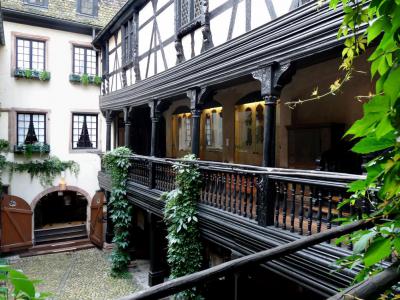
4) Musée Alsacien (Alsatian Museum) (must see)
The Alsatian Museum offers a close and grounded introduction to everyday life in Alsace from the 18th to the early 20th century. It was founded in 1907, at a time when rapid industrialization and political change threatened to erase regional traditions. The aim was not to create a grand national museum, but to preserve the material culture of rural and small-town Alsace-its homes, crafts, customs, and beliefs-before they disappeared.
The museum is housed in a group of historic houses along the River Ill. Once you step inside, you'll be met by an interior courtyard framed by traditional Strasbourg half-timbered houses. The houses are arranged in a rectangular, interconnected layout, which helps maintain the intimate atmosphere of the space. The three floors of the houses can be accessed by climbing a black wooden staircase located on the far south eastern side of the courtyard. A special detail is provided by the vines on the balconies to the right of the staircase, which add variation to the color palette of the exterior complex. As you enter the interior courtyard, you'll find a metal statue of a man on the south-western balcony. The statue is placed on the wooden railing of the balcony and the man depicted rings a bell by using a hammer.
The museum’s main appeal lies in its immersive, room-by-room presentation. In other words, its layout differs from traditional museums, as it is not divided on a floor-by-floor basis. Instead, you will have to move up and down stairs and walk through chronologically arranged adjoining rooms.
Interiors are arranged to resemble traditional Alsatian homes, with furnished kitchens, bedrooms, workshops, and ceremonial rooms reconstructed using original objects. Painted furniture, pottery, textiles, carved wooden cupboards, and everyday tools reveal how people lived, worked, cooked, and celebrated across different social settings. Traditional costumes and accessories illustrate regional identity and social distinction, while displays dedicated to religious practices, seasonal festivals, and folk beliefs provide insight into the rhythms that shaped daily life.
What sets the Alsatian Museum apart is its focus on lived experience rather than monumental history. Courtyards, staircases, and uneven floor levels reinforce the sense of moving through historic dwellings rather than a conventional gallery.
Editor's note: the museum is currently closed due to renovation works and is expected to reopen in 2027.
The museum is housed in a group of historic houses along the River Ill. Once you step inside, you'll be met by an interior courtyard framed by traditional Strasbourg half-timbered houses. The houses are arranged in a rectangular, interconnected layout, which helps maintain the intimate atmosphere of the space. The three floors of the houses can be accessed by climbing a black wooden staircase located on the far south eastern side of the courtyard. A special detail is provided by the vines on the balconies to the right of the staircase, which add variation to the color palette of the exterior complex. As you enter the interior courtyard, you'll find a metal statue of a man on the south-western balcony. The statue is placed on the wooden railing of the balcony and the man depicted rings a bell by using a hammer.
The museum’s main appeal lies in its immersive, room-by-room presentation. In other words, its layout differs from traditional museums, as it is not divided on a floor-by-floor basis. Instead, you will have to move up and down stairs and walk through chronologically arranged adjoining rooms.
Interiors are arranged to resemble traditional Alsatian homes, with furnished kitchens, bedrooms, workshops, and ceremonial rooms reconstructed using original objects. Painted furniture, pottery, textiles, carved wooden cupboards, and everyday tools reveal how people lived, worked, cooked, and celebrated across different social settings. Traditional costumes and accessories illustrate regional identity and social distinction, while displays dedicated to religious practices, seasonal festivals, and folk beliefs provide insight into the rhythms that shaped daily life.
What sets the Alsatian Museum apart is its focus on lived experience rather than monumental history. Courtyards, staircases, and uneven floor levels reinforce the sense of moving through historic dwellings rather than a conventional gallery.
Editor's note: the museum is currently closed due to renovation works and is expected to reopen in 2027.
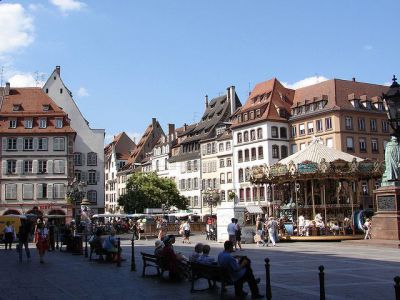
5) Place Gutenberg (Gutenberg Square) (must see)
Gutenberg Square is named after Johannes Gutenberg, the inventor of movable type, who lived and worked in Strasbourg during the 1430s, a formative period in the development of his printing techniques. Although Gutenberg’s most famous work would later emerge in Mainz, Strasbourg played an important role in shaping his ideas, and the square reflects the city’s pride in that intellectual legacy. The bronze statue of Gutenberg, erected in 1840, stands at the centre of the square and remains one of its most recognisable features.
Historically, the area developed as a commercial hub close to the cathedral, where merchants, craftsmen, and traders gathered in the late Middle Ages and the early modern period. Surrounding buildings reflect this mercantile past, with elegant façades dating mainly from the 18th and 19th centuries, blending classical proportions with Alsatian details. Among them is the former Chamber of Commerce building, recognisable for its Renaissance style and sloping Alsatian roof.
Gutenberg Square’s open layout provides clear views toward the cathedral spire, making it a natural pause while exploring the old town. Cafés and terraces line the edges of the square, creating an inviting place to sit and observe daily life in the historic centre. Seasonal events and small markets occasionally animate the space, but even on quieter days it remains a pleasant spot to absorb Strasbourg’s atmosphere.
Historically, the area developed as a commercial hub close to the cathedral, where merchants, craftsmen, and traders gathered in the late Middle Ages and the early modern period. Surrounding buildings reflect this mercantile past, with elegant façades dating mainly from the 18th and 19th centuries, blending classical proportions with Alsatian details. Among them is the former Chamber of Commerce building, recognisable for its Renaissance style and sloping Alsatian roof.
Gutenberg Square’s open layout provides clear views toward the cathedral spire, making it a natural pause while exploring the old town. Cafés and terraces line the edges of the square, creating an inviting place to sit and observe daily life in the historic centre. Seasonal events and small markets occasionally animate the space, but even on quieter days it remains a pleasant spot to absorb Strasbourg’s atmosphere.
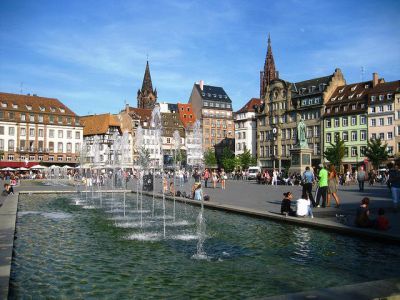
6) Place Kléber (Kleber Square) (must see)
Kléber Square is the largest and most prominent square in Strasbourg, serving as the civic heart of the city for more than three centuries. Its history dates back to the late 17th and early 18th centuries, when Strasbourg-newly annexed by France under Louis XIV-began reshaping its urban fabric with grand public spaces. Originally named Weapons Square, the square hosted military drills and civic gatherings. It was renamed in 1840 in honour of General Jean-Baptiste Kléber, a Strasbourg-born military leader who rose to prominence during the French Revolutionary Wars as part of Napoleon's campaigns in 1798 and 1799. Kléber's ashes rest beneath the pyramid-shaped monument at the centre of the square, making it both a public plaza and a discreet memorial.
The buildings surrounding the square reflect layers of Strasbourg’s architectural past. Among them is the Aubette on the north side, built in the 18th century as a guardhouse and later transformed into a cultural venue. Its most intriguing feature today is the restored 1928 avant-garde interior-a masterpiece of the European modernist movement. This work of art is often called the "Sistine Chapel of Abstract Art" for its artistic beauty.
The square is also framed by elegant façades, wide pedestrian walkways, and the large Galeries Lafayette department store, which contributes to the area’s lively commercial character.
Visiting Kléber Square is one of the best ways to feel Strasbourg’s pulse. Outdoor cafés and seasonal markets occupy the square throughout the year, but it becomes especially atmospheric during the Strasbourg Christmas Market, when an immense Christmas tree and festive stalls transform it into a glowing winter scene. The square also functions as a central meeting point, with easy access to the historic district, Little France neighborhood, and nearby shopping streets.
The buildings surrounding the square reflect layers of Strasbourg’s architectural past. Among them is the Aubette on the north side, built in the 18th century as a guardhouse and later transformed into a cultural venue. Its most intriguing feature today is the restored 1928 avant-garde interior-a masterpiece of the European modernist movement. This work of art is often called the "Sistine Chapel of Abstract Art" for its artistic beauty.
The square is also framed by elegant façades, wide pedestrian walkways, and the large Galeries Lafayette department store, which contributes to the area’s lively commercial character.
Visiting Kléber Square is one of the best ways to feel Strasbourg’s pulse. Outdoor cafés and seasonal markets occupy the square throughout the year, but it becomes especially atmospheric during the Strasbourg Christmas Market, when an immense Christmas tree and festive stalls transform it into a glowing winter scene. The square also functions as a central meeting point, with easy access to the historic district, Little France neighborhood, and nearby shopping streets.
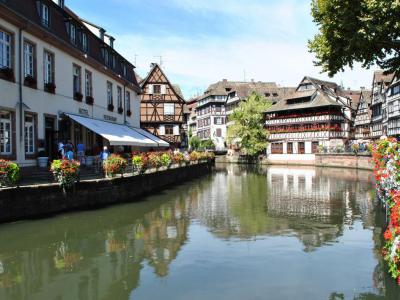
7) Petite France (Little France) (must see)
Little France is one of Strasbourg’s most picturesque and historically rich districts, known for its canals, half-timbered houses, and medieval atmosphere. Despite its romantic name, the quarter was not originally French in character. In the Middle Ages, this area lay just outside the main city centre and was home to tanners, millers, and fishermen whose trades depended on direct access to water. The canals of the Ill River powered mills and helped wash animal hides, making the district an important-if pungent-centre of craft production.
The name of the district emerged much later, in the 17th century, and has a darker origin. It refers to a hospice that treated soldiers suffering from syphilis, then known as the “French disease.” Over time, the name lost its grim association and came to describe the entire neighbourhood. While many industrial activities faded, the district’s architecture survived remarkably intact, preserving rows of timber-framed houses from the 16th and 17th centuries with steep roofs, wooden galleries, and colourful façades.
Today, Little France is one of Strasbourg’s most popular areas to explore on foot. Narrow lanes wind between canals and locks, while flower-lined bridges offer postcard views in every direction. Highlights include the Tanners’ House, once a guild house for tanners and now a restaurant, as well as the Covered Bridges and the Vauban Dam at the western edge of the district.
The appeal lies in both atmosphere and accessibility. Cafés and traditional winstubs serve Alsatian specialties such as sauerkraut, while riverside terraces invite lingering pauses. Boat tours glide through the canals, offering a different perspective on the historic buildings. In every season-but especially in spring and during the Christmas markets-Little France captures Strasbourg’s blend of Germanic and French heritage, combining history, architecture, and everyday city life into one of the city’s most memorable quarters.
The name of the district emerged much later, in the 17th century, and has a darker origin. It refers to a hospice that treated soldiers suffering from syphilis, then known as the “French disease.” Over time, the name lost its grim association and came to describe the entire neighbourhood. While many industrial activities faded, the district’s architecture survived remarkably intact, preserving rows of timber-framed houses from the 16th and 17th centuries with steep roofs, wooden galleries, and colourful façades.
Today, Little France is one of Strasbourg’s most popular areas to explore on foot. Narrow lanes wind between canals and locks, while flower-lined bridges offer postcard views in every direction. Highlights include the Tanners’ House, once a guild house for tanners and now a restaurant, as well as the Covered Bridges and the Vauban Dam at the western edge of the district.
The appeal lies in both atmosphere and accessibility. Cafés and traditional winstubs serve Alsatian specialties such as sauerkraut, while riverside terraces invite lingering pauses. Boat tours glide through the canals, offering a different perspective on the historic buildings. In every season-but especially in spring and during the Christmas markets-Little France captures Strasbourg’s blend of Germanic and French heritage, combining history, architecture, and everyday city life into one of the city’s most memorable quarters.
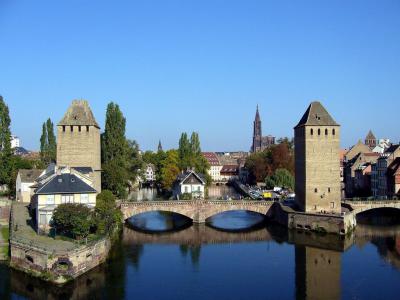
8) Pont Couverts (Covered Bridges) (must see)
The Covered Bridges of Strasbourg mark the western edge of the historic centre, where the Ill River divides into a network of canals. Despite their name, the bridges themselves are no longer covered; instead, it was the three square defensive towers beside them that once supported wooden roofs. Built in the 13th century, the bridges formed part of Strasbourg’s medieval fortifications, guarding a key approach to the city and controlling river traffic entering the old town.
Originally, the complex consisted of several towers connected by wooden bridges that spanned the canals. These structures played a crucial defensive role, allowing soldiers to monitor trade routes and protect the city during periods of conflict. By the 17th century, advances in artillery made the medieval defenses obsolete, leading to the construction of the Vauban Dam just behind the bridges as part of a more modern fortification system.
Today, the Covered Bridges are valued less for defense and more for their atmosphere and views. Walking across them offers striking perspectives of the Little France district, with its half-timbered houses, canals, and locks, as well as distant views of Strasbourg Cathedral rising above the rooftops. Each tower can be closely observed from the outside, revealing details such as arrow slits and stonework shaped by centuries of wear.
The bridges are a natural stopping point when exploring the historic center. They connect easily with riverside paths and nearby landmarks, making them ideal for photography and leisurely walks. In the evening, subtle lighting highlights the towers and water below, creating one of Strasbourg’s most evocative scenes.
Originally, the complex consisted of several towers connected by wooden bridges that spanned the canals. These structures played a crucial defensive role, allowing soldiers to monitor trade routes and protect the city during periods of conflict. By the 17th century, advances in artillery made the medieval defenses obsolete, leading to the construction of the Vauban Dam just behind the bridges as part of a more modern fortification system.
Today, the Covered Bridges are valued less for defense and more for their atmosphere and views. Walking across them offers striking perspectives of the Little France district, with its half-timbered houses, canals, and locks, as well as distant views of Strasbourg Cathedral rising above the rooftops. Each tower can be closely observed from the outside, revealing details such as arrow slits and stonework shaped by centuries of wear.
The bridges are a natural stopping point when exploring the historic center. They connect easily with riverside paths and nearby landmarks, making them ideal for photography and leisurely walks. In the evening, subtle lighting highlights the towers and water below, creating one of Strasbourg’s most evocative scenes.
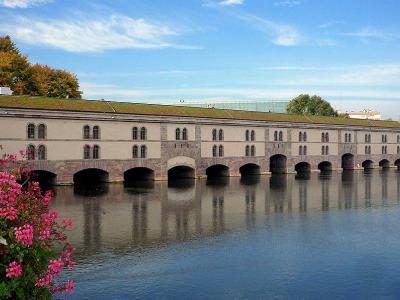
9) Barrage Vauban (Vauban Dam) (must see)
The Vauban Dam was built between 1681 and 1688, shortly after Strasbourg was annexed by France under Louis XIV. The dam was designed by the city’s military engineers following the principles of Sébastien de Vauban, France’s most influential fortress architect. Its primary purpose was strategic: in the event of an attack, the dam could be used to flood the southern approaches to the city by controlling the flow of the Ill River, creating a water barrier that made invasion far more difficult.
Architecturally, the Vauban Dam is a long, covered stone structure spanning the river just behind the medieval Covered Bridges. Inside, a vaulted gallery runs the length of the dam, pierced by large arches that allow water to pass through. These openings once held wooden gates that could be raised or lowered to regulate water levels.
Today, the Vauban Dam is valued less as a military installation and more as a viewpoint and cultural landmark. The interior gallery is open to visitors and often hosts temporary art installations and exhibitions. The gallery is easily accessible via an arched gateway on the side of the dam.
Two staircases and an elevator inside the dam lead to a rooftop terrace that offers one of the best panoramic views in Strasbourg. The staircases can be identified by signs reading “terrasse panoramique,” meaning “panoramic terrace.” From here, you can look out over the canals and half-timbered houses of the Little France district on one side, and toward the towers of Strasbourg Cathedral and the historic city center on the other. The contrast between medieval neighborhoods, waterways, and later fortifications is especially striking from this elevated position.
Architecturally, the Vauban Dam is a long, covered stone structure spanning the river just behind the medieval Covered Bridges. Inside, a vaulted gallery runs the length of the dam, pierced by large arches that allow water to pass through. These openings once held wooden gates that could be raised or lowered to regulate water levels.
Today, the Vauban Dam is valued less as a military installation and more as a viewpoint and cultural landmark. The interior gallery is open to visitors and often hosts temporary art installations and exhibitions. The gallery is easily accessible via an arched gateway on the side of the dam.
Two staircases and an elevator inside the dam lead to a rooftop terrace that offers one of the best panoramic views in Strasbourg. The staircases can be identified by signs reading “terrasse panoramique,” meaning “panoramic terrace.” From here, you can look out over the canals and half-timbered houses of the Little France district on one side, and toward the towers of Strasbourg Cathedral and the historic city center on the other. The contrast between medieval neighborhoods, waterways, and later fortifications is especially striking from this elevated position.
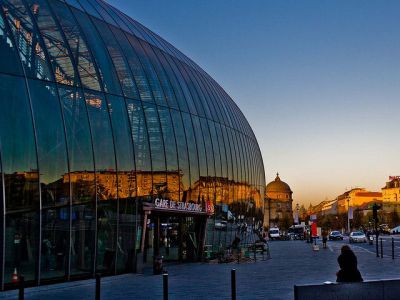
10) Strasbourg-Ville Train Station
The Strasbourg-Ville Train Station stands as the second largest in France and likely holds a position as one of the most distinctive in Europe. This station was opened in 1883, where the Basle-Cologne and Paris-Vienna routes intersected. It was designed by German architect Johann Eduard Jocobsthal to replace a smaller station that was in a dead-end location.
The station is 120 meters long and has two floors. The ground floor is on the same level as the square in front of it, while the upper floor is a bit higher than the train tracks. The front of the building, done in a Neo-Renaissance style, served both travelers and goods, and there was also a yard for marshaling.
In 1901, a post office was added on a single facet of the structure, and later, a police station was constructed on the opposite side of the building. Initially, the station had nine tracks, but in 2007, during a renovation, they added four more tracks, mostly for the TGV arrivals.
The 120-meter-long dome made of steel and glass that stretches across the old building was designed by Jean-Marie Duthilleul, an architect from the French railroad company (SNCF). There's a 25-meter space between the dome and the station's front. Here, you'll find the entrance to the subway, a reception area, the Tourist Office, and a cafe/snack bar.
From this station, you can catch trains to Switzerland, the Netherlands, Belgium, and Germany, as well as to most towns in France. If you're interested in a day trip to Paris, the TGV will get you there in a little over two hours.
The station is 120 meters long and has two floors. The ground floor is on the same level as the square in front of it, while the upper floor is a bit higher than the train tracks. The front of the building, done in a Neo-Renaissance style, served both travelers and goods, and there was also a yard for marshaling.
In 1901, a post office was added on a single facet of the structure, and later, a police station was constructed on the opposite side of the building. Initially, the station had nine tracks, but in 2007, during a renovation, they added four more tracks, mostly for the TGV arrivals.
The 120-meter-long dome made of steel and glass that stretches across the old building was designed by Jean-Marie Duthilleul, an architect from the French railroad company (SNCF). There's a 25-meter space between the dome and the station's front. Here, you'll find the entrance to the subway, a reception area, the Tourist Office, and a cafe/snack bar.
From this station, you can catch trains to Switzerland, the Netherlands, Belgium, and Germany, as well as to most towns in France. If you're interested in a day trip to Paris, the TGV will get you there in a little over two hours.
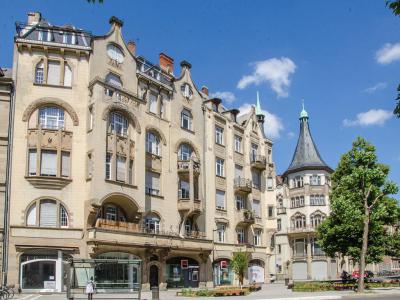
11) Palais Des Fetes (Festival Palace)
The Festival Palace (Palais des Fêtes) stands as a significant music arena within the Neustadt area of Strasbourg. Initially constructed for the Strasbourg male choral society, this venue held a pivotal role as the primary concert hall in the city and the residence of the Strasbourg Philharmonic Orchestra until 1975. Its historical importance was acknowledged in 2007 when it gained the status of Monument historique.
Renowned conductors such as Gustav Mahler, Richard Strauss, Charles Munch, Bruno Walter, Wilhelm Furtwängler, Herbert von Karajan, Karel Ančerl, Pierre Boulez, and Lorin Maazel, among others, have graced the Palais with their presence, conducting guest performances.
The construction of the Festival Palace took place between 1901 and 1903, a period during which Strasbourg was under German rule and served as the capital of Alsace-Lorraine. Notably, this building was an early adopter of reinforced concrete within Strasbourg. Despite the architectural style chosen by Joseph Müller and Richard Kuder being Art Nouveau, the main auditorium featured opulent Neo-Baroque decorations.
In 1933, a significant interior overhaul was carried out in the main auditorium, aligning with the principles of New Objectivity. The stucco work and chandeliers were removed, resulting in a simplified appearance for the organ case. Other sections of the building largely retained their Art Nouveau embellishments, including stained glass and door handles.
After the Philharmonic Orchestra moved to the Strasbourg Convention Centre in 1975, the Palais des Fêtes still held fewer concerts. It's now home to La Philharmonie, a medium-sized orchestra founded in 1900, with three annual performances. The venue also hosts jazz, rock, gospel, and other music genres. The Marseillaise wing of the building is used for the municipal ballet school.
Renowned conductors such as Gustav Mahler, Richard Strauss, Charles Munch, Bruno Walter, Wilhelm Furtwängler, Herbert von Karajan, Karel Ančerl, Pierre Boulez, and Lorin Maazel, among others, have graced the Palais with their presence, conducting guest performances.
The construction of the Festival Palace took place between 1901 and 1903, a period during which Strasbourg was under German rule and served as the capital of Alsace-Lorraine. Notably, this building was an early adopter of reinforced concrete within Strasbourg. Despite the architectural style chosen by Joseph Müller and Richard Kuder being Art Nouveau, the main auditorium featured opulent Neo-Baroque decorations.
In 1933, a significant interior overhaul was carried out in the main auditorium, aligning with the principles of New Objectivity. The stucco work and chandeliers were removed, resulting in a simplified appearance for the organ case. Other sections of the building largely retained their Art Nouveau embellishments, including stained glass and door handles.
After the Philharmonic Orchestra moved to the Strasbourg Convention Centre in 1975, the Palais des Fêtes still held fewer concerts. It's now home to La Philharmonie, a medium-sized orchestra founded in 1900, with three annual performances. The venue also hosts jazz, rock, gospel, and other music genres. The Marseillaise wing of the building is used for the municipal ballet school.
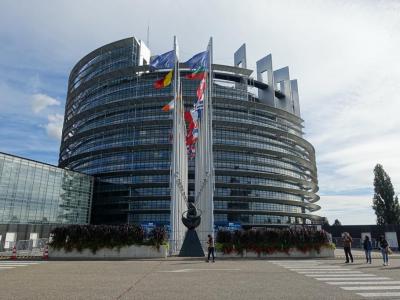
12) European Parliament (must see)
The Louise Weiss Building in the Wacken district of Strasbourg serves as the home of the European Parliament. Visitors have the opportunity to secure tickets for a seat in the public gallery of this significant institution.
The building is named after Louise Weiss, a former Member of the European Parliament. Inaugurated in 1999, it stands as a tribute to her legacy. The architectural design was crafted by the Architect Studio, resulting in a sprawling structure spanning 220,000 square meters. This expansive size ranks it among Europe's largest buildings.
Comprising of 18 assembly rooms, 1133 offices, and the renowned Hemicycle, which resembles a Roman amphitheater, the Louise Weiss Building offers a comprehensive space for parliamentary activities. The Hemicycle, hosting 785 seats for European Parliament Members, boasts interpretive booths with glass fronts encircling the walls. Above, there are galleries reserved for the press and the public.
The tower of the building stands tall at 60 meters. Its unique appearance intentionally mimics an unfinished state with an open western side, symbolizing Europe's ongoing journey toward unity. Folklore suggests that the tower draws inspiration from Bruegel's depiction of the Tower of Babel.
An inner courtyard named the "Bronislaw Geremek Agora," paying homage to the recently deceased Polish Member of the European Parliament, forms a part of the building's layout. Additionally, a covered footbridge establishes a connection between the Parliament building and the Winston Churchill Building, located on the opposite side of the River Ill.
Tip:
Prior booking is not required; just head for the middle of the atrium of the building, entrance 2. Security checks etc. and bring your passport or other ID.
Plenary sessions:
Monday: 5−6 pm; Tuesday, Wednesday: 9 am−12 pm / 3−6 pm; Thursday: 9 am−12 pm.
The building is named after Louise Weiss, a former Member of the European Parliament. Inaugurated in 1999, it stands as a tribute to her legacy. The architectural design was crafted by the Architect Studio, resulting in a sprawling structure spanning 220,000 square meters. This expansive size ranks it among Europe's largest buildings.
Comprising of 18 assembly rooms, 1133 offices, and the renowned Hemicycle, which resembles a Roman amphitheater, the Louise Weiss Building offers a comprehensive space for parliamentary activities. The Hemicycle, hosting 785 seats for European Parliament Members, boasts interpretive booths with glass fronts encircling the walls. Above, there are galleries reserved for the press and the public.
The tower of the building stands tall at 60 meters. Its unique appearance intentionally mimics an unfinished state with an open western side, symbolizing Europe's ongoing journey toward unity. Folklore suggests that the tower draws inspiration from Bruegel's depiction of the Tower of Babel.
An inner courtyard named the "Bronislaw Geremek Agora," paying homage to the recently deceased Polish Member of the European Parliament, forms a part of the building's layout. Additionally, a covered footbridge establishes a connection between the Parliament building and the Winston Churchill Building, located on the opposite side of the River Ill.
Tip:
Prior booking is not required; just head for the middle of the atrium of the building, entrance 2. Security checks etc. and bring your passport or other ID.
Plenary sessions:
Monday: 5−6 pm; Tuesday, Wednesday: 9 am−12 pm / 3−6 pm; Thursday: 9 am−12 pm.
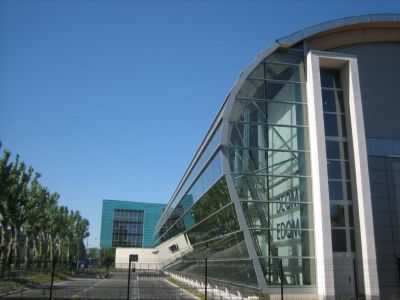
13) European Pharmacopoeia
A Pharmacopoeia serves as a guide detailing the specifications for approved drugs. The European Pharmacopoeia is situated within a building on Allée Kastner. If desired, you can peruse the volumes that outline the components and compounds sanctioned for use in the authorized medications you may be taking to treat a particular condition.
Developed by the European Directorate for the Quality of Medicines (EDQM), an entity under the Council of Europe, this Pharmacopoeia draws its foundation from the 1964 Convention for the Creation of a European Pharmacopoeia.
The EDQM conducts assessments and quality checks on all medications, regardless of whether they are intended for human or animal consumption. Only after these medications receive certification and authorization are they permitted to enter the public market. Contained within the various volumes of the Pharmacopoeia are comprehensive listings of the active ingredients and organic compounds found in antibiotics and vaccines that your family doctor is allowed to prescribe for your treatment.
Comprising 36 member countries, which encompass Iceland, Switzerland, Turkey, and the European Union, the EDQM enforces adherence to the standards outlined in the Pharmacopoeia through legal obligations.
Observers hailing from 20 non-member nations of the EDQM, including Tunisia, Algeria, Morocco, the Russian Federation, and the United States of America, along with organizations like the World Health Organization, participate in meetings convened by the EDQM. While these observers aren't obligated to comply with the European Pharmacopoeia, they leverage these meetings to enhance the quality of prescribed medications in their own countries as well as in developing nations.
Developed by the European Directorate for the Quality of Medicines (EDQM), an entity under the Council of Europe, this Pharmacopoeia draws its foundation from the 1964 Convention for the Creation of a European Pharmacopoeia.
The EDQM conducts assessments and quality checks on all medications, regardless of whether they are intended for human or animal consumption. Only after these medications receive certification and authorization are they permitted to enter the public market. Contained within the various volumes of the Pharmacopoeia are comprehensive listings of the active ingredients and organic compounds found in antibiotics and vaccines that your family doctor is allowed to prescribe for your treatment.
Comprising 36 member countries, which encompass Iceland, Switzerland, Turkey, and the European Union, the EDQM enforces adherence to the standards outlined in the Pharmacopoeia through legal obligations.
Observers hailing from 20 non-member nations of the EDQM, including Tunisia, Algeria, Morocco, the Russian Federation, and the United States of America, along with organizations like the World Health Organization, participate in meetings convened by the EDQM. While these observers aren't obligated to comply with the European Pharmacopoeia, they leverage these meetings to enhance the quality of prescribed medications in their own countries as well as in developing nations.
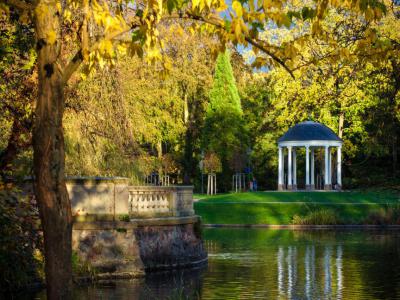
14) Parc de l'Orangerie (must see)
The Parc de l'Orangerie is a public park situated in Strasbourg. Positioned across from the Palais de l'Europe and in proximity to the other European establishments within the Orangerie district, part of the Neustadt area, it spans an expanse of 26 hectares.
Historical accounts differ regarding the origins of Parc de l'Orangerie. Some assert that it was planted in 1801 following designs by André Le Nôtre, while others argue that in 1735, the plan titled "Plan de Strasbourg" was conceived by the captain engineer Antoine du Chaffat.
During the period of the French Revolution, the city of Strasbourg came into possession of a hundred and forty orange trees seized from the Château de Bouxwiller by the Republicans. In 1804, the current Joséphine pavilion, named in honor of Joséphine de Beauharnais (Empress of the French and Napoleon Bonaparte's wife), was erected by Pierre-Valentin Boudhors to house these trees.
The Parc de l'Orangerie underwent significant expansion during the German era, coinciding with the industrial and artisanal exhibition in Strasbourg in 1895. This was when the artificial lake and its accompanying waterfall were created. The park became an integral part of the Neustadt. In 1929, the Joséphine pavilion was officially recognized as a historical monument, while the entire park received this designation in 1993.
A fire in 1968 ravaged the Joséphine pavilion, which was then meticulously reconstructed to mirror its original form and repurposed for cultural activities. In 2013, both the main thoroughfare of the park, Allée de l'Orangerie Joséphine, and the Allée des Platanes underwent redesign, accompanied by new lighting installations.
At present, merely three orange trees remain, sheltered within the park's accessible greenhouses on specific dates for public viewing. The Orangerie stands as a cherished locale for Strasbourg locals, offering a mini-farm, a stork reintroduction center, a bowling alley, a children's car circuit named "L'École de Conduite," multiple play areas, sports facilities, and petanque courts. Furthermore, visitors can rent boats for lake navigation. Numerous fountains, statues, and kiosks adorn the park's pathways, and a number of ice cream parlors have set up stands in the vicinity.
Tip:
Check out the flamingos in the mini zoo - a beautiful splash of color!
Historical accounts differ regarding the origins of Parc de l'Orangerie. Some assert that it was planted in 1801 following designs by André Le Nôtre, while others argue that in 1735, the plan titled "Plan de Strasbourg" was conceived by the captain engineer Antoine du Chaffat.
During the period of the French Revolution, the city of Strasbourg came into possession of a hundred and forty orange trees seized from the Château de Bouxwiller by the Republicans. In 1804, the current Joséphine pavilion, named in honor of Joséphine de Beauharnais (Empress of the French and Napoleon Bonaparte's wife), was erected by Pierre-Valentin Boudhors to house these trees.
The Parc de l'Orangerie underwent significant expansion during the German era, coinciding with the industrial and artisanal exhibition in Strasbourg in 1895. This was when the artificial lake and its accompanying waterfall were created. The park became an integral part of the Neustadt. In 1929, the Joséphine pavilion was officially recognized as a historical monument, while the entire park received this designation in 1993.
A fire in 1968 ravaged the Joséphine pavilion, which was then meticulously reconstructed to mirror its original form and repurposed for cultural activities. In 2013, both the main thoroughfare of the park, Allée de l'Orangerie Joséphine, and the Allée des Platanes underwent redesign, accompanied by new lighting installations.
At present, merely three orange trees remain, sheltered within the park's accessible greenhouses on specific dates for public viewing. The Orangerie stands as a cherished locale for Strasbourg locals, offering a mini-farm, a stork reintroduction center, a bowling alley, a children's car circuit named "L'École de Conduite," multiple play areas, sports facilities, and petanque courts. Furthermore, visitors can rent boats for lake navigation. Numerous fountains, statues, and kiosks adorn the park's pathways, and a number of ice cream parlors have set up stands in the vicinity.
Tip:
Check out the flamingos in the mini zoo - a beautiful splash of color!
