Custom Walk in Pompei, Italy by ronmolson17_d965e created on 2026-04-08
Guide Location: Italy » Pompei
Guide Type: Custom Walk
# of Sights: 13
Tour Duration: 2 Hour(s)
Travel Distance: 2.4 Km or 1.5 Miles
Share Key: 89EYE
Guide Type: Custom Walk
# of Sights: 13
Tour Duration: 2 Hour(s)
Travel Distance: 2.4 Km or 1.5 Miles
Share Key: 89EYE
How It Works
Please retrieve this walk in the GPSmyCity app. Once done, the app will guide you from one tour stop to the next as if you had a personal tour guide. If you created the walk on this website or come to the page via a link, please follow the instructions below to retrieve the walk in the app.
Retrieve This Walk in App
Step 1. Download the app "GPSmyCity: Walks in 1K+ Cities" on Apple App Store or Google Play Store.



Step 2. In the GPSmyCity app, download(or launch) the guide "Pompei Map and Walking Tours".
Step 3. Tap the menu button located at upper right corner of the "Walks" screen and select "Retrieve custom walk". Enter the share key: 89EYE
1) Amphitheater
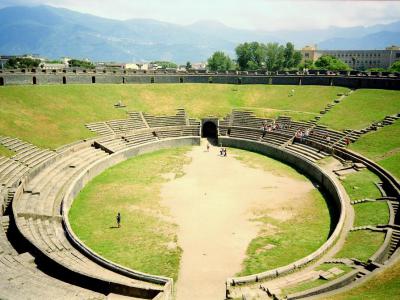
The Pompei Amphitheatre is the oldest building of its kind to have survived from the Roman era. Pompei houses many of the best preserved examples of Roman architecture, after the city was buried under volcanic ash for almost 2000 years. The Amphitheatre, one of Pompei’s most well known attractions, predates the Coliseum in Rome by over a century. It is believed that the success of the Pompei Amphitheatre, the first stone arena built within the Roman Empire, was the inspiration for a larger stone-built arena in Rome itself.
A circular structure with arches and stairways creating several entrance points, the Amphitheatre is still considered by crowd control analysts to be a near perfectly designed venue. Built around 70 BC, it was initially known as the Spectacula. Paid for by wealthy local statesmen Quinctius Valgus and Marcius Porcius, it was primarily used to host gladiatorial games and ceremonies. Twenty years before the eruption that destroyed Pompei, games were banned at the Amphitheatre, following a brawl between locals and residents of nearby Nuceria. In recent years, UK progressive rock band Pink Floyd became the first people for almost two thousand years to perform at the arena, filming a live concert here.
A circular structure with arches and stairways creating several entrance points, the Amphitheatre is still considered by crowd control analysts to be a near perfectly designed venue. Built around 70 BC, it was initially known as the Spectacula. Paid for by wealthy local statesmen Quinctius Valgus and Marcius Porcius, it was primarily used to host gladiatorial games and ceremonies. Twenty years before the eruption that destroyed Pompei, games were banned at the Amphitheatre, following a brawl between locals and residents of nearby Nuceria. In recent years, UK progressive rock band Pink Floyd became the first people for almost two thousand years to perform at the arena, filming a live concert here.
2) Via dell'Abbondanza (Street of Abundance)
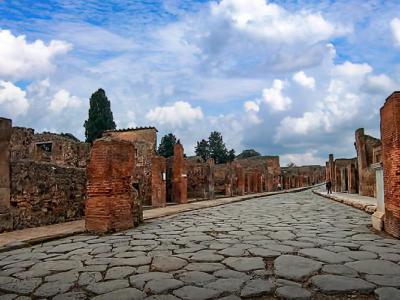
Via dell'Abbondanza is the main artery of ancient Pompeii. Almost every modern-day visitor to the city has a chance to stroll along at least some part of it now. Stretching for almost 900 meters, via dell’Abbondanza is the longest street in the city and 2,000 years ago was also its liveliest.
Translated as the “Street of Abundance”, this bustling thoroughfare did live up to its name, lined with grand public buildings and shrines, numerous elite residences, shops and workshops run by representatives of all strata of Pompeii’s society. Leading all the way up to the Forum, the connecting crossroads of via dell’Abbondanza led to the Triangular Forum, Palaestra, Amphitheater and other prominent locations.
The two public properties, standing at the intersection with the Forum, are the Eumachia Building and the Comitium. Also, there is a large public bath complex, known as the Stabian Baths. Furthermore, this street is a home to one of the earliest sites excavated in Pompeii, the Praedia di Iulia Felix (House of Julia Felix).
It is fair to say that no place in Pompeii, other than via dell'Abbondanza, can provide a better illustration of the diversity of life once enjoyed in this ancient city.
Translated as the “Street of Abundance”, this bustling thoroughfare did live up to its name, lined with grand public buildings and shrines, numerous elite residences, shops and workshops run by representatives of all strata of Pompeii’s society. Leading all the way up to the Forum, the connecting crossroads of via dell’Abbondanza led to the Triangular Forum, Palaestra, Amphitheater and other prominent locations.
The two public properties, standing at the intersection with the Forum, are the Eumachia Building and the Comitium. Also, there is a large public bath complex, known as the Stabian Baths. Furthermore, this street is a home to one of the earliest sites excavated in Pompeii, the Praedia di Iulia Felix (House of Julia Felix).
It is fair to say that no place in Pompeii, other than via dell'Abbondanza, can provide a better illustration of the diversity of life once enjoyed in this ancient city.
3) Stabian Baths (must see)
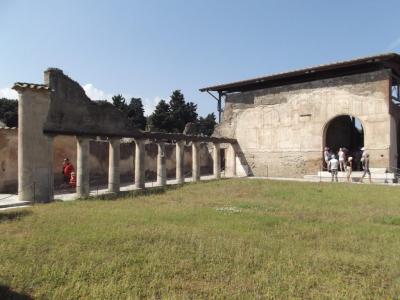
The Stabian Baths are the oldest bath complex discovered in Pompei. Covering 3500 square metres, they are also the largest in the city. Located on Via Stabiana, like the nearby Forum Baths, they are divided into men’s and women’s facilities. The two newer baths in Pompei, the Central and Suburban Baths, both had one large changing facility.
At the entrance to the baths, there is a courtyard, which would have been used as a gymnasium. The yard is surrounded on three sides by colonnades, with a 1.5 metre deep swimming pool on the other side. A door in the right hand corner of the longest colonnade leads to the men’s bath house. The frigidarium, a room for cold bathing, is round, with four corner niches and the bath in the centre. This is the only room for which there is not an equivalent in the women’s section.
Both sides of the bath house feature a whitewashed apodyterium, a tepidarium for warm baths and a caldarium, furthest from the entrance, which was used for hot baths. The baths are richly decorated, with many statues discovered in the ruins. The building has vaulted, ornately decorated ceilings throughout. It was believed to have been built as a symbol of the wealth of Pompei’s ruling classes.
At the entrance to the baths, there is a courtyard, which would have been used as a gymnasium. The yard is surrounded on three sides by colonnades, with a 1.5 metre deep swimming pool on the other side. A door in the right hand corner of the longest colonnade leads to the men’s bath house. The frigidarium, a room for cold bathing, is round, with four corner niches and the bath in the centre. This is the only room for which there is not an equivalent in the women’s section.
Both sides of the bath house feature a whitewashed apodyterium, a tepidarium for warm baths and a caldarium, furthest from the entrance, which was used for hot baths. The baths are richly decorated, with many statues discovered in the ruins. The building has vaulted, ornately decorated ceilings throughout. It was believed to have been built as a symbol of the wealth of Pompei’s ruling classes.
4) Lupanar (Brothel) (must see)
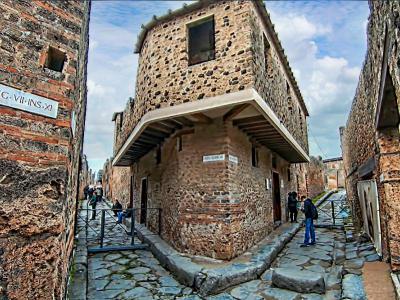
The Lupanar is the largest brothel within Pompei. It is located close to the Forum, on via del Lupanare, a street which bears its name. Whilst it has been established that prostitution was in existence during the Roman era, there has been some debate over the prevalence of brothels in a settlement like Pompei. A number of homes and bath houses in the city featured erotic artworks on their walls. Early excavators initially believed any building with erotic frescoes to have been a brothel.
When thirty five buildings with erotic artworks were discovered, it became apparent this couldn’t be the case. Further investigation has led experts to suggest that the Lupanar was the largest of ten brothels in the city, with many of the others single room establishments. The Lupanar has ten rooms, all plainly decorated, with brick platforms serving as beds. It is thought that brothels were mainly frequented by ordinary townspeople, rather than rich or well known figures. Graffiti found on the walls gives an insight into the activities that went on here. The term ‘lupanar’ is derogatory towards prostitutes – it means ‘house of the she-wolves’, a nickname given to prostitutes, who were considered predatory in Roman times.
When thirty five buildings with erotic artworks were discovered, it became apparent this couldn’t be the case. Further investigation has led experts to suggest that the Lupanar was the largest of ten brothels in the city, with many of the others single room establishments. The Lupanar has ten rooms, all plainly decorated, with brick platforms serving as beds. It is thought that brothels were mainly frequented by ordinary townspeople, rather than rich or well known figures. Graffiti found on the walls gives an insight into the activities that went on here. The term ‘lupanar’ is derogatory towards prostitutes – it means ‘house of the she-wolves’, a nickname given to prostitutes, who were considered predatory in Roman times.
5) Bakery and Vicolo Storto
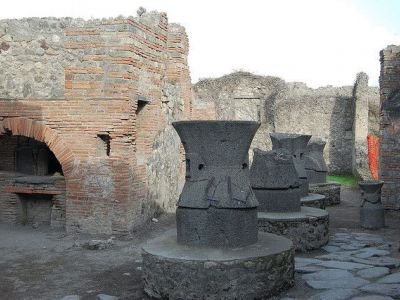
Pompei’s largest bakery is located in the Vicolo Storto area, a market place area similar to the Forum, which is also known for housing the only known brothel in the city. The building is one of a remarkable thirty five mills and bakeries discovered in the ruins of Pompei; by contrast, no other sufficiently preserved Roman bakeries have been recovered anywhere else in the world. The bakeries of Pompei therefore give us a unique insight into the advanced milling industry possessed by the Roman Empire. It is thought that the majority of citizens would have travelled to bakeries to collect bread, as there was no facility to bake it at home.
The machinery used to produce bread here consists of millstones, formed from igneous rock, which were turned by mules or donkeys, grinding grains that fell through an hourglass-shaped funnel and through the millstones. It has been suggested that whilst this appears a fairly primitive method, there may been improved techniques in operation within larger cities such as Rome and Naples. The mills of Rome were hard places to work – Apuleius, a Roman author, recorded the hardships of the women, slaves and animals that were put to work in bakeries. The playwright Plautus himself worked in a bakery at one time, and wrote about the struggles of life in the mill.
The machinery used to produce bread here consists of millstones, formed from igneous rock, which were turned by mules or donkeys, grinding grains that fell through an hourglass-shaped funnel and through the millstones. It has been suggested that whilst this appears a fairly primitive method, there may been improved techniques in operation within larger cities such as Rome and Naples. The mills of Rome were hard places to work – Apuleius, a Roman author, recorded the hardships of the women, slaves and animals that were put to work in bakeries. The playwright Plautus himself worked in a bakery at one time, and wrote about the struggles of life in the mill.
6) House of the Golden Cupids
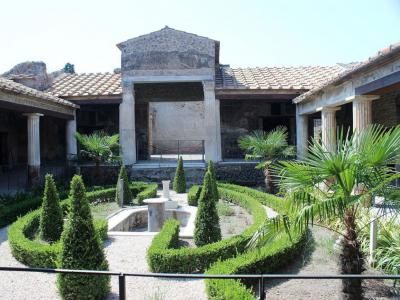
The House of the Golden Cupids was first excavated between 1903 and 1905. It is situated on the via del Vesuvio, and is believed to have been owned by Gnaeus Poppaeus Habitus, a wealthy local figure. Hidden behind an unremarkable façade, the house is renowned for several ornate third style artworks discovered on its walls. Dating from the end of the reign of Augustus Caesar, the third style is defined by delicate, colourful frescoes, influenced by Egyptian art.
The walls of the house feature a number of red and yellow panels with elaborate paintings at their centre. Whilst many of the artworks have faded, there are a number of surviving artworks depicting mythical scenes. In the atrium, the only surviving panel is a fresco of Helen and Paris meeting at Sparta. The exedra, an alcove off to one side of the atrium, features a number of large panels depicting scenes from Roman life. Both the exedra and tablinum, or main living room, have fine mosaics on their floors.
The building gained its name from two glass discs, found in a cubiculum, with cherubs etched onto them. The room also features a remarkable fourth style decoration – a symmetrical pattern of painted red and yellow patterned hexagons, which almost resembles modern wallpaper. Many of the rooms also feature frescoes on their ceilings, making the house one of the most heavily decorated in the city.
The walls of the house feature a number of red and yellow panels with elaborate paintings at their centre. Whilst many of the artworks have faded, there are a number of surviving artworks depicting mythical scenes. In the atrium, the only surviving panel is a fresco of Helen and Paris meeting at Sparta. The exedra, an alcove off to one side of the atrium, features a number of large panels depicting scenes from Roman life. Both the exedra and tablinum, or main living room, have fine mosaics on their floors.
The building gained its name from two glass discs, found in a cubiculum, with cherubs etched onto them. The room also features a remarkable fourth style decoration – a symmetrical pattern of painted red and yellow patterned hexagons, which almost resembles modern wallpaper. Many of the rooms also feature frescoes on their ceilings, making the house one of the most heavily decorated in the city.
7) House of the Vettii
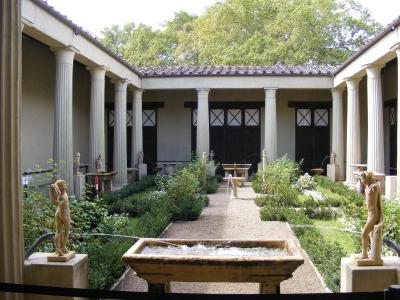
The House of the Vettii is a mansion built around a central open space, and was once one of Pompei’s most luxurious residences. It is particularly well preserved, featuring many exceptional wall frescoes. This suggests that it was constructed and decorated between the earthquake of 62 AD, which damaged many of the Roman city’s buildings, and the 79 AD volcanic eruption that buried it altogether. It is named after its owners – Aulus Vettius Conviva and Aulus Vettius Restitutus. Both are believed to have been freed slaves that subsequently amassed a large fortune.
Visitors will enter the mansion through a darkened atrium. You can see the servants’ quarters off to one side, built around a smaller atrium. In the entrance foyer, there is an almost life size image of Priapus, the Roman god of fertility. Priapus features heavily in frescoes all over Pompei – often appearing in graphic images which have led to repeated attempts to censor the original artwork. At the centre of the complex stands a peristyle, an open air garden space flanked by Doric columns. Symmetrical in design, it once contained several marble fountains and sculptures of mythological figures. The walls, as with many of the rooms, are lined with several ornate frescoes, framed in red and yellow paint, as is common throughout the buildings of Pompei.
Visitors will enter the mansion through a darkened atrium. You can see the servants’ quarters off to one side, built around a smaller atrium. In the entrance foyer, there is an almost life size image of Priapus, the Roman god of fertility. Priapus features heavily in frescoes all over Pompei – often appearing in graphic images which have led to repeated attempts to censor the original artwork. At the centre of the complex stands a peristyle, an open air garden space flanked by Doric columns. Symmetrical in design, it once contained several marble fountains and sculptures of mythological figures. The walls, as with many of the rooms, are lined with several ornate frescoes, framed in red and yellow paint, as is common throughout the buildings of Pompei.
8) House of the Faun
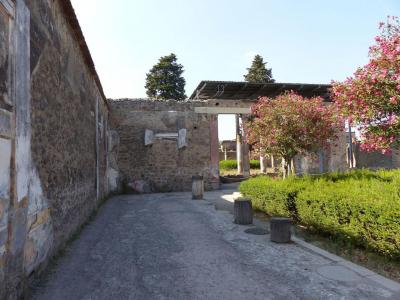
Casa del Fauno, or the House of the Faun, was built in the Samnite period, at least 100 years before the volcanic eruption which consumed Pompei. Largely ruined by the two earthquakes, which preceded the eruption, it has been preserved to represent the scale and layout of a Roman mansion.
It is known as the House of the Faun due to the discovery of a bronze statue on the edge of an impluvium – a basin used to collect rainwater for drinking and bathing. The statue depicts a dancing faun – a small, mythical creature believed to roam the wild woodlands that were once common across southern Europe. The original sculpture is housed in Naples’ National Archaeological Museum, but the exact replica of it is now found in the centre of the basin.
The house covers three thousand square metres, occupying an entire block of the ancient city. It is divided into five sections – four built around atriums and peristyles, and a network of service rooms. Look out for two other notable artworks in the complex. Firstly, the mosaic spelling out ‘HAVE’ (a popular Roman greeting) at the entrance, and, secondly, a replica of a detailed mosaic inside the house, that depicts Alexander the Great’s victory at the Battle of Issus in 333 BC.
It is known as the House of the Faun due to the discovery of a bronze statue on the edge of an impluvium – a basin used to collect rainwater for drinking and bathing. The statue depicts a dancing faun – a small, mythical creature believed to roam the wild woodlands that were once common across southern Europe. The original sculpture is housed in Naples’ National Archaeological Museum, but the exact replica of it is now found in the centre of the basin.
The house covers three thousand square metres, occupying an entire block of the ancient city. It is divided into five sections – four built around atriums and peristyles, and a network of service rooms. Look out for two other notable artworks in the complex. Firstly, the mosaic spelling out ‘HAVE’ (a popular Roman greeting) at the entrance, and, secondly, a replica of a detailed mosaic inside the house, that depicts Alexander the Great’s victory at the Battle of Issus in 333 BC.
9) House of the Tragic Poet
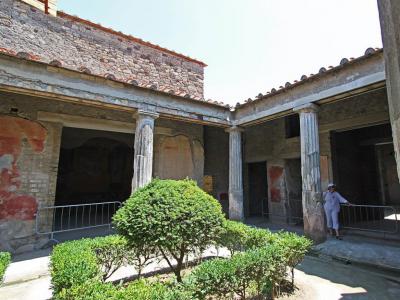
The House of the Tragic Poet is also known as the Homeric or Iliadic House. It is a fairly typical Roman era residential building, built in the 2nd century BC. It is famous for a series of elaborate mosaics and frescoes which depict scenes from Greek mythology. It has attracted interest from writers and academics ever since it was unearthed in November 1824. The artworks discovered are among the finest ever found in Pompei. This is unusual, given that the house itself is unremarkable compared to some of the city’s larger villas. Little is known of the family that owned the house, except that they were most likely killed in the 79 AD eruption of Vesuvius.
There are frescoes and mosaics throughout the House of the Tragic Poet. A mosaic found in the entrance hall shows a chained dog, with the words ‘Cave Canem’ – beware of the dog – written underneath. The house’s atrium and peristyle feature frescoes depicting several Greek Gods, including Zeus, Aphrodite, Achilles and Poseidon, amongst others. Many literary figures have been based upon this mysterious building, including Vladimir Janovic, whose epic poem House of the Tragic Poet gave the house its name. Janovic’s work is based around the myths and stories told in the house’s many frescoes and mosaics.
There are frescoes and mosaics throughout the House of the Tragic Poet. A mosaic found in the entrance hall shows a chained dog, with the words ‘Cave Canem’ – beware of the dog – written underneath. The house’s atrium and peristyle feature frescoes depicting several Greek Gods, including Zeus, Aphrodite, Achilles and Poseidon, amongst others. Many literary figures have been based upon this mysterious building, including Vladimir Janovic, whose epic poem House of the Tragic Poet gave the house its name. Janovic’s work is based around the myths and stories told in the house’s many frescoes and mosaics.
10) House of the Small Fountain
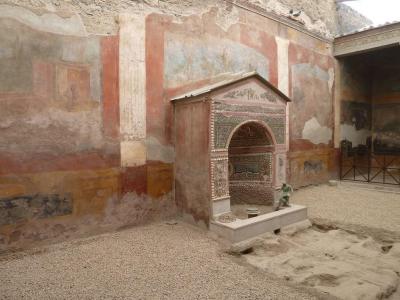
The House of the Small Fountain is found in the western end of Pompei, close to the ancient city walls. It was built in the 1st century BC, and combines architectural features which span the history of Pompei. Almost all of the rooms open onto a central atrium. The entrance of the house is heavily decorated, demonstrating the owner’s wealth and social status to all who visited the building. The roof sloped inwards, allowing rainwater to collect in the central impluvium. A cistern built below the basin gathered the water, which was then recovered and used in the production of food and wine.
The peristyle, located in the garden, is richly decorated with frescoes of landscapes and maritime buildings. Whilst many features of the house are consistent with BC-era Roman buildings, the key feature is a more modern addition. The fountain-nymphaeum, which gives the house its name, is believed to have become a fashionable feature in the 1st century AD. Like much of the house, it is heavily decorated with mosaics and sculptures. The fountain takes the form of a miniature arch with a triangular roof. The water springs into a hollow underneath the arch, with bronze statuettes on either side.
The peristyle, located in the garden, is richly decorated with frescoes of landscapes and maritime buildings. Whilst many features of the house are consistent with BC-era Roman buildings, the key feature is a more modern addition. The fountain-nymphaeum, which gives the house its name, is believed to have become a fashionable feature in the 1st century AD. Like much of the house, it is heavily decorated with mosaics and sculptures. The fountain takes the form of a miniature arch with a triangular roof. The water springs into a hollow underneath the arch, with bronze statuettes on either side.
11) House of Dioscuri
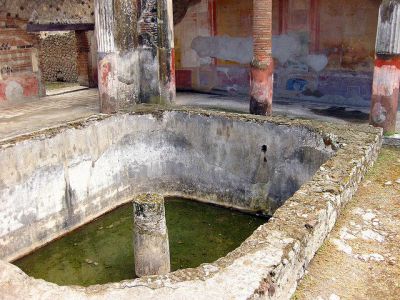
The House of the Dioscuri is named after Castor and Pollux, the sons of Jupiter and Leda, who were collectively known as the Dioscuri. The house, an expansive villa complex in keeping with many in Pompei, does have an unusual feature at its centre. The atrium is in the Corinthian style, and is surrounded by twelve tufa columns. Other houses in Pompei tend to be built around either Tuscan atriums without surrounding columns, or tetrastyle atriums, which have four columns. The atrium has a central impluvium and tablinum, whilst the walls were once richly decorated with frescoes. Many of these have been transferred to museums, to protect them from the elements and bring them to a wider audience.
There are still a number of frescoes visible within the house, many depicting elaborate carpets and architecture, as well as a number of fine still life ‘fourth style’ artworks. Behind the atrium, there is a porticoed courtyard flanked with Doric columns, and a peristyle, complete with a large basin in the centre. There are several wall paintings around the peristyle, which are in the same style as those found in the House of the Vettii. This has led to the theory that these works were created by the same artist, whose services were paid for by the wealthy home owners.
There are still a number of frescoes visible within the house, many depicting elaborate carpets and architecture, as well as a number of fine still life ‘fourth style’ artworks. Behind the atrium, there is a porticoed courtyard flanked with Doric columns, and a peristyle, complete with a large basin in the centre. There are several wall paintings around the peristyle, which are in the same style as those found in the House of the Vettii. This has led to the theory that these works were created by the same artist, whose services were paid for by the wealthy home owners.
12) House of the Baker
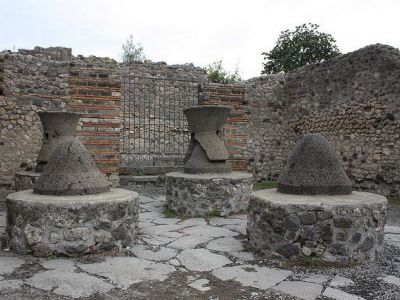
The House of the Baker dates from the 2nd century BC, but like many buildings in Pompei, was badly damaged by the 62 AD earthquake. It is believed that the house was being extensively renovated when it was destroyed by the eruption of Vesuvius. The ground floor of the house had been converted into work rooms, with the living quarters moved to the top floor. The renovation was incomplete at the time of the eruption in 79 AD. One of thirty-five bakeries discovered in the city, the House of the Baker gives an insight into the impressive food manufacturing techniques used in Roman times.
The hortus, or garden, located behind the building, contains machinery used for grinding wheat. The vaulted oven was heated by millstones carved from lava rock. There are also tables where bread was rested before and after baking. Between the garden and the main building there lies a row of stalls. It is believed that the bakery owners would have used the stalls to sell bread to the citizens of Pompei. Many residential buildings did not have their own ovens, so the bakeries played a huge part in feeding the city’s population. It was here that the skeleton of a harnessed mule was discovered during excavations.
The hortus, or garden, located behind the building, contains machinery used for grinding wheat. The vaulted oven was heated by millstones carved from lava rock. There are also tables where bread was rested before and after baking. Between the garden and the main building there lies a row of stalls. It is believed that the bakery owners would have used the stalls to sell bread to the citizens of Pompei. Many residential buildings did not have their own ovens, so the bakeries played a huge part in feeding the city’s population. It was here that the skeleton of a harnessed mule was discovered during excavations.
13) Villa of the Mysteries (must see)
The Villa of the Mysteries is one of the most well known buildings in the historic area around Mount Vesuvius. It is not situated within Pompei itself, lying around 500 metres northwest of the main city. Believed to be a suburban villa, which were commonplace in Roman times, it can easily be reached on foot from the centre of Pompei. Admission into the city centre will usually allow access to the villa, as well as the nearby settlement of Herculaneum.
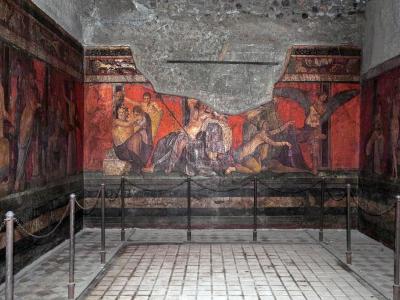
The villa is one of the best preserved buildings in the Pompei area, as it suffered little damage during either the 62 AD earthquake or the tremors prior to the eruption of Vesuvius seventeen years later. The walls of the building are lined with some of the best kept and most detailed frescoes surviving from the Roman era. The Villa of the Mysteries earned its name from the unusual paintings on the walls of the triclinium, a formal dining hall found in most Roman villas.
The frescoes in the dining hall appear to show some form of ritual, although nobody is certain of its purpose. One theory suggests the woman pictured in the frescoes is being inducted into the cult of Dionysus. An alternative idea put forward is that the paintings show an ancient marriage ritual. The dining hall also features well preserved serving areas, which may have been used to make wine and olive oil.
The villa is one of the best preserved buildings in the Pompei area, as it suffered little damage during either the 62 AD earthquake or the tremors prior to the eruption of Vesuvius seventeen years later. The walls of the building are lined with some of the best kept and most detailed frescoes surviving from the Roman era. The Villa of the Mysteries earned its name from the unusual paintings on the walls of the triclinium, a formal dining hall found in most Roman villas.
The frescoes in the dining hall appear to show some form of ritual, although nobody is certain of its purpose. One theory suggests the woman pictured in the frescoes is being inducted into the cult of Dionysus. An alternative idea put forward is that the paintings show an ancient marriage ritual. The dining hall also features well preserved serving areas, which may have been used to make wine and olive oil.
