Custom Walk in Pompei, Italy by ronmolson17_d965e created on 2026-06-24
Guide Location: Italy » Pompei
Guide Type: Custom Walk
# of Sights: 15
Tour Duration: 3 Hour(s)
Travel Distance: 4.3 Km or 2.7 Miles
Share Key: S69JN
Guide Type: Custom Walk
# of Sights: 15
Tour Duration: 3 Hour(s)
Travel Distance: 4.3 Km or 2.7 Miles
Share Key: S69JN
How It Works
Please retrieve this walk in the GPSmyCity app. Once done, the app will guide you from one tour stop to the next as if you had a personal tour guide. If you created the walk on this website or come to the page via a link, please follow the instructions below to retrieve the walk in the app.
Retrieve This Walk in App
Step 1. Download the app "GPSmyCity: Walks in 1K+ Cities" on Apple App Store or Google Play Store.



Step 2. In the GPSmyCity app, download(or launch) the guide "Pompei Map and Walking Tours".
Step 3. Tap the menu button located at upper right corner of the "Walks" screen and select "Retrieve custom walk". Enter the share key: S69JN
1) Villa of the Mysteries (must see)
The Villa of the Mysteries is one of the most well-known buildings in the historic area around Mount Vesuvius. It is not situated within the city walls of Pompeii itself, but lies around 500 meters northwest of the main city boundaries. Believed to be a suburban villa, of a type that was commonplace in Roman times, it can easily be reached on foot from the archaeological centre of Pompeii.
Although it suffered extensive structural damage during the major earthquake of 62 AD, the villa was subsequently rebuilt and converted from a purely luxury estate into a working farmhouse prior to the catastrophic eruption of Vesuvius seventeen years later.
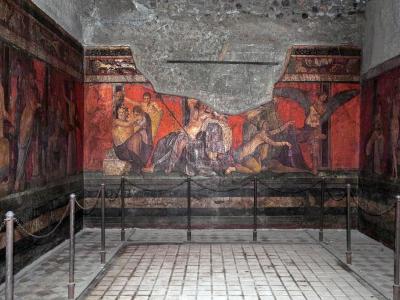
The walls of the building are lined with some of the best-kept and most detailed frescoes surviving from the Roman era. The Villa of the Mysteries earned its name from these unusual paintings, found on the walls of the triclinium, a formal dining hall central to the estate. Getting to the triclinium is done by entering the main atrium and turning immediately toward the left-hand corner of the residential quarters.
The frescoes in this dining hall appear to show some form of ritual, although nobody is completely certain of its true purpose. One leading theory suggests that the woman pictured in the frescoes is being inducted into the mystery cult of Dionysus, the Greek god of wine. An alternative idea put forward by scholars is that the paintings illustrate a traditional ancient marriage ritual.
Exit the elite dining quarters and walk around the building to the rustic service wing located on the southern side of the property. Set inside these spaces is the rustic wine press room. It features a massive, reconstructed wooden lever and a heavy stone base designed to crush grapes for the estate's private vineyards.
As a final highlight stands the grand outdoor platform housed on the seaward side of the property. Finding this elevated panoramic terrace is done by navigating the villa towards the western front and then passing out of the living rooms through a series of wide doorways. The sight was a masterstroke of late Republican engineering, built as a sprawling, semi-circular veranda to give the wealthy owners sweeping views over the ancient coastline.
Although it suffered extensive structural damage during the major earthquake of 62 AD, the villa was subsequently rebuilt and converted from a purely luxury estate into a working farmhouse prior to the catastrophic eruption of Vesuvius seventeen years later.
The walls of the building are lined with some of the best-kept and most detailed frescoes surviving from the Roman era. The Villa of the Mysteries earned its name from these unusual paintings, found on the walls of the triclinium, a formal dining hall central to the estate. Getting to the triclinium is done by entering the main atrium and turning immediately toward the left-hand corner of the residential quarters.
The frescoes in this dining hall appear to show some form of ritual, although nobody is completely certain of its true purpose. One leading theory suggests that the woman pictured in the frescoes is being inducted into the mystery cult of Dionysus, the Greek god of wine. An alternative idea put forward by scholars is that the paintings illustrate a traditional ancient marriage ritual.
Exit the elite dining quarters and walk around the building to the rustic service wing located on the southern side of the property. Set inside these spaces is the rustic wine press room. It features a massive, reconstructed wooden lever and a heavy stone base designed to crush grapes for the estate's private vineyards.
As a final highlight stands the grand outdoor platform housed on the seaward side of the property. Finding this elevated panoramic terrace is done by navigating the villa towards the western front and then passing out of the living rooms through a series of wide doorways. The sight was a masterstroke of late Republican engineering, built as a sprawling, semi-circular veranda to give the wealthy owners sweeping views over the ancient coastline.
2) Forum Baths
The Forum Baths are one of four bathhouses discovered in the ruined city of Pompeii. Along with the Central, Stabian, and Suburban Baths, they have provided fascinating insight into the importance of public baths in Roman life. With little in the way of bathing facilities found inside private dwellings, it appears that bathing in these buildings would have been a daily ritual for many citizens. The Forum Baths were not the largest or most decorated in the city, but they survived the earthquake of 62 AD relatively unscathed and, as a result, were the only public baths fully back in use when the city was destroyed.
The Forum Baths are located opposite the Temple of Fortuna Augusta in the centre of Pompeii. Divided into men’s and women’s sections, this compact bathhouse contained all of the features found in larger public baths, including a frigidarium, where customers could take a cold bath.
To witness how visitors prepared for this routine, step directly through the main street entrance corridor into the open-air palaestra courtyard. Here, a compact exercise yard opens up, framed by a classic stone colonnade where ancient bathers would lift weights, wrestle, or play ball games before entering the heated chambers.
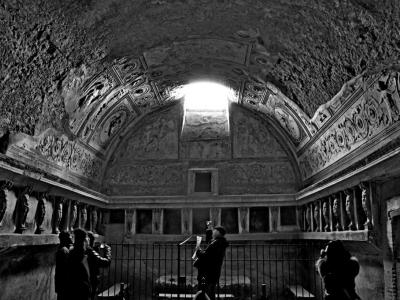
The adjoining warm room, or tepidarium, is notable for its high barrel-vaulted roof, complete with beautiful, intact stucco decorations. Reaching the room requires passing through the vaulted threshold of the ancient changing room leading off the courtyard. Inside, the massive plaster ceiling remains completely covered in elaborate, intact stucco reliefs of mythological figures, visually held up by a row of muscular, terracotta male statues called atlantes projecting from the walls.
The caldarium, which contained the hot baths, was heated by warm air circulated within cavities in the walls. This room is accessed by stepping through the low, narrow thermal doorway located at the far side of the warm room. As you cross this threshold into the steaming zone, look directly up at the main barrel-vaulted ceiling to see a pattern of parallel fluted grooves running down the plaster — an ingenious design feature that forced condensation to roll cleanly down the walls rather than dripping onto the heads of bathers.
Move deeper into the hall and turn your attention toward the semicircular, domed alcove at the far western end. This recessed area features a large, elevated marble basin known as a labrum, which provided refreshing cold water for bathers to splash on themselves and cool off after bathing.
The Forum Baths are located opposite the Temple of Fortuna Augusta in the centre of Pompeii. Divided into men’s and women’s sections, this compact bathhouse contained all of the features found in larger public baths, including a frigidarium, where customers could take a cold bath.
To witness how visitors prepared for this routine, step directly through the main street entrance corridor into the open-air palaestra courtyard. Here, a compact exercise yard opens up, framed by a classic stone colonnade where ancient bathers would lift weights, wrestle, or play ball games before entering the heated chambers.
The adjoining warm room, or tepidarium, is notable for its high barrel-vaulted roof, complete with beautiful, intact stucco decorations. Reaching the room requires passing through the vaulted threshold of the ancient changing room leading off the courtyard. Inside, the massive plaster ceiling remains completely covered in elaborate, intact stucco reliefs of mythological figures, visually held up by a row of muscular, terracotta male statues called atlantes projecting from the walls.
The caldarium, which contained the hot baths, was heated by warm air circulated within cavities in the walls. This room is accessed by stepping through the low, narrow thermal doorway located at the far side of the warm room. As you cross this threshold into the steaming zone, look directly up at the main barrel-vaulted ceiling to see a pattern of parallel fluted grooves running down the plaster — an ingenious design feature that forced condensation to roll cleanly down the walls rather than dripping onto the heads of bathers.
Move deeper into the hall and turn your attention toward the semicircular, domed alcove at the far western end. This recessed area features a large, elevated marble basin known as a labrum, which provided refreshing cold water for bathers to splash on themselves and cool off after bathing.
3) Macellum (Provision Market)
The Provision Market of Pompeii was built alongside the Forum to provide further space for the city’s growing central market. The existing building was constructed in approximately 130 BC, replacing the original market building. Built around a central courtyard, the complex features various specialized units for the sale of foodstuffs, including a row of twelve internal shops lining its southern side.
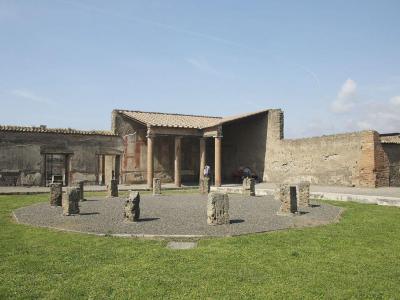
Upon discovering the large, columned building, archaeologists at first believed it to be a pantheon — a central temple for the worship of many gods. It was only after the discovery of fish bones and jarred fruits underneath the ash that it became clear this building had been used as a market. It is believed that permanent stalls were set up on the north side, opening outward to the street, where they were shaded from the sun for much of the day. These shops sold fruit, nuts, and bread, among other things. At the southeast corner of the complex, a specialized hall was used by local traders to sell meat and fish on marble counters. In the centre of the courtyard stood a circular arrangement of columns around a shallow pool and drain, which vendors used to clean and gut fish.
The market had three entrances. The southern entrance is notable for the checkerboard-patterned wall adjacent to it, considered one of the finest-quality walls constructed during the Roman era of Pompeii. At the back of the market, there is a mysterious room that was used as a shrine. There has been much debate over the paintings and statues found there. The latest and most widely accepted theory is that they depict Emperor Augustus Caesar, as well as local figures who commanded respect within the town.
Upon discovering the large, columned building, archaeologists at first believed it to be a pantheon — a central temple for the worship of many gods. It was only after the discovery of fish bones and jarred fruits underneath the ash that it became clear this building had been used as a market. It is believed that permanent stalls were set up on the north side, opening outward to the street, where they were shaded from the sun for much of the day. These shops sold fruit, nuts, and bread, among other things. At the southeast corner of the complex, a specialized hall was used by local traders to sell meat and fish on marble counters. In the centre of the courtyard stood a circular arrangement of columns around a shallow pool and drain, which vendors used to clean and gut fish.
The market had three entrances. The southern entrance is notable for the checkerboard-patterned wall adjacent to it, considered one of the finest-quality walls constructed during the Roman era of Pompeii. At the back of the market, there is a mysterious room that was used as a shrine. There has been much debate over the paintings and statues found there. The latest and most widely accepted theory is that they depict Emperor Augustus Caesar, as well as local figures who commanded respect within the town.
4) Temple of Jupiter
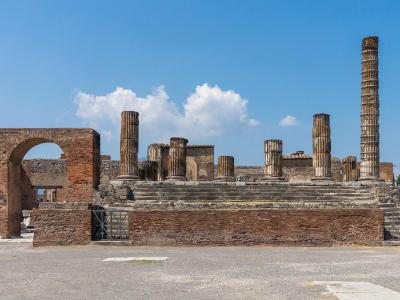
The Temple of Jupiter sits at the northern end of the Forum, a large open space once used as a marketplace. Also known as the Capitolium, it was a place of worship for Jupiter, the Roman ruler of the Gods and protector of Rome. Temples dedicated to Jupiter were considered the centres of Roman religion. This temple, built in the mid-2nd century BC, marked the passing of Pompeii into the Roman sphere of influence. Pompeii was originally founded by the indigenous Oscan people, and was later ruled by the Samnites. Even after forming an alliance with Rome in 310 BC, it maintained a high degree of autonomy, with Hellenistic culture and Greek gods worshipped more fervently than those followed in Rome.
A failed revolt in 89 BC led to a more forceful implementation of Roman language, culture, and law in Pompeii. This saw Jupiter become the town’s highest God, and his temple the centre of Pompeian worship. It later also became a place of worship for Juno and Minerva, who together with Jupiter formed the Capitoline Triad of Gods. The temple dominates one side of the forum, and is built in traditional Italic style, with an inner sanctuary at the centre housing statues of the Capitoline Triad. A colossal marble head of Jupiter can be seen at the northern end of the temple. A chamber below the temple housed sacrificial offerings and the city’s treasury.
A failed revolt in 89 BC led to a more forceful implementation of Roman language, culture, and law in Pompeii. This saw Jupiter become the town’s highest God, and his temple the centre of Pompeian worship. It later also became a place of worship for Juno and Minerva, who together with Jupiter formed the Capitoline Triad of Gods. The temple dominates one side of the forum, and is built in traditional Italic style, with an inner sanctuary at the centre housing statues of the Capitoline Triad. A colossal marble head of Jupiter can be seen at the northern end of the temple. A chamber below the temple housed sacrificial offerings and the city’s treasury.
5) Forum (must see)
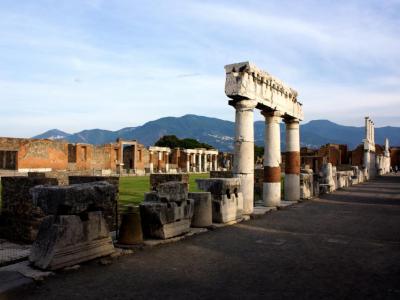
The Forum, a feature present in many Roman settlements, was a public space found at the heart of Pompeii. It forms a large, elongated rectangular plaza, surrounded by several of the town’s most significant buildings. From the southern end of the Forum, moving counterclockwise along its perimeter, you encounter the municipal offices and the Comitium, followed by the grand Building of Eumachia, the Temple of Vespasian, and the Sanctuary of the Public Lares on the eastern side. Continuing past the grain and food markets at the northeast corner and the northern Temple of Jupiter, you find the Temple of Apollo before finishing at the massive Basilica on the western side.
It is accurate to state that the Forum was the permanent centre of public life in Pompeii. It stood near the junction of major urban roads, linking Pompeii with Naples and the nearby settlement of Stabiae. Within the preserved ruins of the city, the Forum remains firmly integrated into the southwestern quadrant of the urban grid. This is due to large-scale development in the 2nd century BC, which permanently formalised, paved, and expanded the square, cementing it as the city’s civic, commercial, and religious core right up until the eruption.
Now an open, hard-packed archaeological plaza, the Forum area appears to have undergone many changes during the history of Pompeii. Prior to the earthquake of 62 AD, the floor was receiving an extensive upgrade, and it is still partially paved with fine white travertine stone. It is thought that a vibrant daily market was held in the middle of the open space. There are also a number of marble and tuff bases where statues once stood, as well as a half-finished suggestum — the Roman equivalent of a soapbox for public speaking.
It is accurate to state that the Forum was the permanent centre of public life in Pompeii. It stood near the junction of major urban roads, linking Pompeii with Naples and the nearby settlement of Stabiae. Within the preserved ruins of the city, the Forum remains firmly integrated into the southwestern quadrant of the urban grid. This is due to large-scale development in the 2nd century BC, which permanently formalised, paved, and expanded the square, cementing it as the city’s civic, commercial, and religious core right up until the eruption.
Now an open, hard-packed archaeological plaza, the Forum area appears to have undergone many changes during the history of Pompeii. Prior to the earthquake of 62 AD, the floor was receiving an extensive upgrade, and it is still partially paved with fine white travertine stone. It is thought that a vibrant daily market was held in the middle of the open space. There are also a number of marble and tuff bases where statues once stood, as well as a half-finished suggestum — the Roman equivalent of a soapbox for public speaking.

6) Forum Granary (storage of artifacts)
The Forum Granary in Pompeii stands as a pivotal archaeological repository, adjacent to the Forum and the Temple of Jupiter. Originally serving as a marketplace for grain and various products, this site has transitioned into a crucial storage facility for artifacts unearthed from the ruins of Pompeii. Its proximity to significant landmarks underscores its historical and cultural significance within the ancient city.
Dating back to a period after the earthquake of 62 AD, the Forum Granary's construction hints at an ambitious project possibly halted by the devastating eruption that buried Pompeii. The building's architectural features, including eight entrances flanked by brick pillars, indicate its original use for commerce, specifically the fruit and vegetable trade known as the Forum Holitorium. However, the eruption's catastrophic impact left the building's completion in doubt, adding a layer of mystery to its historical narrative.
Today, the Forum Granary encapsulates over 9,000 artifacts, making it the largest archaeological collection related to Pompeii and its environs since excavation efforts commenced in the late 19th century. The collection extends to everyday items used by the citizens of Pompeii, such as terracotta crockery, pots, pans, jugs, and bottles, which illustrate the culinary practices of the time. Amphorae, essential for transporting staples like oil, wine, and fish sauce across the Mediterranean, highlight Pompeii's role in ancient trade networks. Additionally, marble tables and baths intended for fountains that once graced the entrances of homes are displayed, alongside casts of victims and natural elements like a tree, capturing the last moments of life in the city.
Dating back to a period after the earthquake of 62 AD, the Forum Granary's construction hints at an ambitious project possibly halted by the devastating eruption that buried Pompeii. The building's architectural features, including eight entrances flanked by brick pillars, indicate its original use for commerce, specifically the fruit and vegetable trade known as the Forum Holitorium. However, the eruption's catastrophic impact left the building's completion in doubt, adding a layer of mystery to its historical narrative.
Today, the Forum Granary encapsulates over 9,000 artifacts, making it the largest archaeological collection related to Pompeii and its environs since excavation efforts commenced in the late 19th century. The collection extends to everyday items used by the citizens of Pompeii, such as terracotta crockery, pots, pans, jugs, and bottles, which illustrate the culinary practices of the time. Amphorae, essential for transporting staples like oil, wine, and fish sauce across the Mediterranean, highlight Pompeii's role in ancient trade networks. Additionally, marble tables and baths intended for fountains that once graced the entrances of homes are displayed, alongside casts of victims and natural elements like a tree, capturing the last moments of life in the city.
7) Basilica
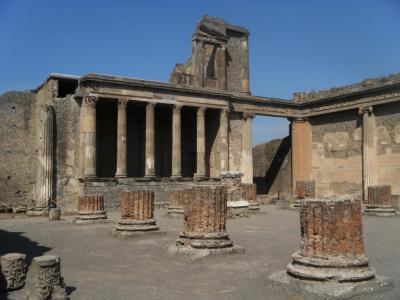
The Basilica stands on the western side of a large square, with the Forum at its centre. It is the oldest Roman basilica ever discovered and has stood here since the 2nd century BC. This was one of Pompeii’s most important buildings, housing the town’s law courts, as well as halls for commercial and financial transactions.
The main entrance was located on one of the building’s two short sides, behind a vestibule. Walk forward from the eastern vestibule through the main entrance into the body of the structure to find the centre of the central colonnaded hall. Here, the vast floor layout contains 28 massive columns made of specially cut tiles. The columns stand as broken stumps today, lacking their upper sections. There is some debate over whether these thick columns supported a complete roof or whether the centre of the building was open to the elements.
Next, direct your gaze straight across the length of the hall to the far short side opposite the entrance. There, standing prominently, is the tribunal, or law court. It consists of a two-metre-high podium originally topped with six Corinthian columns. There are no permanent stairs leading up to the podium, suggesting that temporary steps were used for judges to access it, while also preventing members of the public from reaching the judges during proceedings.
As a final highlight, the walls of the Basilica are decorated with painted stucco, much of which was preserved by the falling ash that buried the city in 79 AD. As you walk along the side aisles of the basilica, look closely at how the decorative plasterwork mimics luxurious marble blocks.
The main entrance was located on one of the building’s two short sides, behind a vestibule. Walk forward from the eastern vestibule through the main entrance into the body of the structure to find the centre of the central colonnaded hall. Here, the vast floor layout contains 28 massive columns made of specially cut tiles. The columns stand as broken stumps today, lacking their upper sections. There is some debate over whether these thick columns supported a complete roof or whether the centre of the building was open to the elements.
Next, direct your gaze straight across the length of the hall to the far short side opposite the entrance. There, standing prominently, is the tribunal, or law court. It consists of a two-metre-high podium originally topped with six Corinthian columns. There are no permanent stairs leading up to the podium, suggesting that temporary steps were used for judges to access it, while also preventing members of the public from reaching the judges during proceedings.
As a final highlight, the walls of the Basilica are decorated with painted stucco, much of which was preserved by the falling ash that buried the city in 79 AD. As you walk along the side aisles of the basilica, look closely at how the decorative plasterwork mimics luxurious marble blocks.

8) Temple of Apollo
The Temple of Apollo stands next to the Forum in the historic heart of Pompeii. It is thought to have been the most important religious building in the city for much of its history, especially during Greek and Samnite rule. The cult of Apollo, centred on the worship of Apollo, son of Zeus and god of light, knowledge, and the sun, drew many followers in Campania from the 6th century BC onwards.
The temple gained its present form in the 2nd century BC and was a central part of Pompeian life — so much so that a table of weights is set into a niche on its outer perimeter wall facing the Forum. This stone table served as the town’s guide to official measurements, used by traders in the market. Damaged extensively by the earthquake of 62 AD, the temple was never fully rebuilt. Its elevated podium still allows visitors a clear view northwest toward Mount Vesuvius.
The Temple of Apollo was built in the form of a peripteral temple — a raised platform surrounded on all sides by columns. This creates an arcade running around the outside of the temple. This area was redecorated under Roman rule, but the changes have almost completely disappeared over time. In the centre of the temple, you can see a white marble altar and a set-back inner sanctuary, which contains statues of Apollo and Diana.
The temple gained its present form in the 2nd century BC and was a central part of Pompeian life — so much so that a table of weights is set into a niche on its outer perimeter wall facing the Forum. This stone table served as the town’s guide to official measurements, used by traders in the market. Damaged extensively by the earthquake of 62 AD, the temple was never fully rebuilt. Its elevated podium still allows visitors a clear view northwest toward Mount Vesuvius.
The Temple of Apollo was built in the form of a peripteral temple — a raised platform surrounded on all sides by columns. This creates an arcade running around the outside of the temple. This area was redecorated under Roman rule, but the changes have almost completely disappeared over time. In the centre of the temple, you can see a white marble altar and a set-back inner sanctuary, which contains statues of Apollo and Diana.
9) Temple of Isis
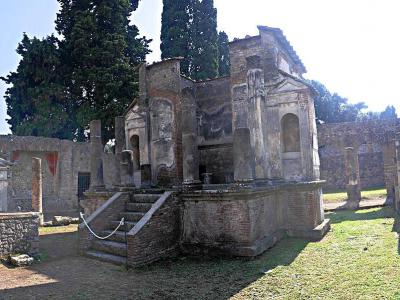
The Temple of Isis is a small Roman temple, though unusually, it is a place of worship for an Egyptian goddess. Isis was worshipped in Ancient Egypt as a form of universal mother goddess, benevolent to all in Egyptian society. She became worshipped by many Roman communities, particularly those, like Pompei, which had strong trade links with Egypt. One of the first buildings discovered in the excavation of 1764, its origins were revealed upon the discovery of an inscription one year later.
The Temple of Isis is located behind the Large Theatre. Originally built in the late 2nd century BC, it was destroyed by the earthquake in 62 AD, and was in the process of being rebuilt. This work was funded from the personal fortune of a freed slave. The temple was thought to have been particularly popular with slaves, servants and the working classes of Pompei.
Like many temples in the city, the Temple of Isis is built in the Hellenic style, and features a cella where sacred statues of the goddess were kept. The temple also features a columned podium, accessed from a stairway, in its centre. Excavation works at the site also unearthed a number of unusual treasures, including a marble hand, bronze candlesticks and a human skull, believed to have been used in cult rituals.
The Temple of Isis is located behind the Large Theatre. Originally built in the late 2nd century BC, it was destroyed by the earthquake in 62 AD, and was in the process of being rebuilt. This work was funded from the personal fortune of a freed slave. The temple was thought to have been particularly popular with slaves, servants and the working classes of Pompei.
Like many temples in the city, the Temple of Isis is built in the Hellenic style, and features a cella where sacred statues of the goddess were kept. The temple also features a columned podium, accessed from a stairway, in its centre. Excavation works at the site also unearthed a number of unusual treasures, including a marble hand, bronze candlesticks and a human skull, believed to have been used in cult rituals.
10) Odeon - Teatro Piccolo (Small Theater)
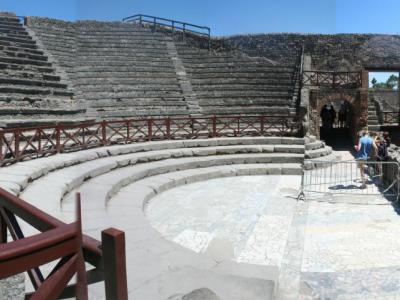
The Odeon theater in Pompeii is also known as Teatro Piccolo. Back in the Roman times, it was colloquially referred to by locals as theatrum tectum (“roofed theater”), for its four-pitched tiled roof.
The theater was built during the early years of the Roman colony, around 80-75 BC, and had a seating capacity of about 1,500. The construction was commissioned by the two local magistrates (duumvirs), Marcus Porcius and Caius Quinctius Valgus, who also facilitated the construction of the Amphitheater.
The venue was well designed for poetry recitals, operas and other musical performances, allowing every sound uttered on the stage to be heard in each part of the building. Largely adding to the acoustics was the roof. The Odeon is also said to have been used for mime shows, the most popular theatrical genre of the time.
This perfectly-balanced, Greek-style structure used to have four lower rows separated from the upper 17 rows by a high parapet, of which now only the left part (relative to the stage) has remained. It was richly decorated with multicolored marbles, whereas large male tuff figures (telamones) supported the steps. Remarkably, the plaster of the external masonry retains many graffiti left by the ancient spectators. Some of the people are believed to have traveled many miles from distant parts of the country to see the shows here.
The site was excavated in two phases, starting from 1769 and then in 1792-1795.
The theater was built during the early years of the Roman colony, around 80-75 BC, and had a seating capacity of about 1,500. The construction was commissioned by the two local magistrates (duumvirs), Marcus Porcius and Caius Quinctius Valgus, who also facilitated the construction of the Amphitheater.
The venue was well designed for poetry recitals, operas and other musical performances, allowing every sound uttered on the stage to be heard in each part of the building. Largely adding to the acoustics was the roof. The Odeon is also said to have been used for mime shows, the most popular theatrical genre of the time.
This perfectly-balanced, Greek-style structure used to have four lower rows separated from the upper 17 rows by a high parapet, of which now only the left part (relative to the stage) has remained. It was richly decorated with multicolored marbles, whereas large male tuff figures (telamones) supported the steps. Remarkably, the plaster of the external masonry retains many graffiti left by the ancient spectators. Some of the people are believed to have traveled many miles from distant parts of the country to see the shows here.
The site was excavated in two phases, starting from 1769 and then in 1792-1795.
11) Antiquarium of Pompeii
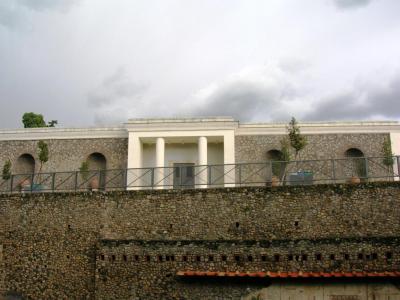
The Pompeian Antiquarium serves as an archaeological museum housing artefacts recovered from Pompeii’s excavations. The museum's layout follows a sequential, chronological journey that guides visitors through the life, growth, and sudden death of the city.
The introductory galleries explore the pre-Roman eras, charting the city’s indigenous Oscan and Samnite roots from the 7th to the 4th centuries BC. Here, the displays feature ancient Sarno Valley tomb remains, fragments of Attic and Corinthian pottery, and archaic architectural terracottas recovered from the Doric Temple and the Temple of Apollo.
As you advance into the city’s golden Roman era, the exhibition expands. To see the crown jewel of this classical section, walk straight ahead from the early pottery rooms into the centre of the luxury exhibition gallery to find the Moregine Silver Treasure display. This collection features a complete, highly decorated Roman silver table-service set used for elite dinner parties, with no major modern blemishes despite being buried under volcanic debris.
The subsequent galleries look more deeply into everyday life, highlighting a rich variety of Roman tools, standard measuring scales, medical instruments, fish hooks, and household furniture. Step to the centre of this commercial hall to examine the display table featuring carbonized food and shop artefacts. Here, you can view organic food remnants — such as bread and fruit — completely carbonized by the volcano's heat, set directly alongside an original painted stone sign from the Inn of Euxinus.
The chronological path culminates in a gallery dedicated to the tragedy of the 79 AD eruption. Enter this climate-controlled space through the heavy interior glass doors and look directly to your right to find plaster casts of the eruption's victims. These fragile original moulds capture the final, agonizing moments of the men, women, children, and animals who failed to escape the cloud of ash.
The introductory galleries explore the pre-Roman eras, charting the city’s indigenous Oscan and Samnite roots from the 7th to the 4th centuries BC. Here, the displays feature ancient Sarno Valley tomb remains, fragments of Attic and Corinthian pottery, and archaic architectural terracottas recovered from the Doric Temple and the Temple of Apollo.
As you advance into the city’s golden Roman era, the exhibition expands. To see the crown jewel of this classical section, walk straight ahead from the early pottery rooms into the centre of the luxury exhibition gallery to find the Moregine Silver Treasure display. This collection features a complete, highly decorated Roman silver table-service set used for elite dinner parties, with no major modern blemishes despite being buried under volcanic debris.
The subsequent galleries look more deeply into everyday life, highlighting a rich variety of Roman tools, standard measuring scales, medical instruments, fish hooks, and household furniture. Step to the centre of this commercial hall to examine the display table featuring carbonized food and shop artefacts. Here, you can view organic food remnants — such as bread and fruit — completely carbonized by the volcano's heat, set directly alongside an original painted stone sign from the Inn of Euxinus.
The chronological path culminates in a gallery dedicated to the tragedy of the 79 AD eruption. Enter this climate-controlled space through the heavy interior glass doors and look directly to your right to find plaster casts of the eruption's victims. These fragile original moulds capture the final, agonizing moments of the men, women, children, and animals who failed to escape the cloud of ash.
12) Great Theater and Quadroporticus (must see)
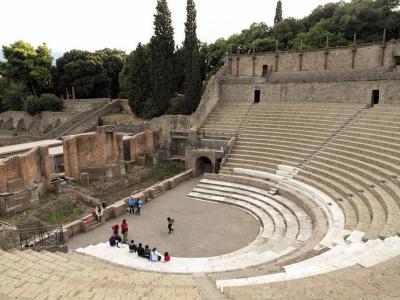
In contrast to the nearby Odeon, this venue was known as the Large Theater. It was built in the 2nd century BC, in the style of ancient Greek amphitheaters. Set in a natural indentation of the land, it features tiered stone seating on sloping sides, leading to a central horseshoe-shaped performance area.
The theater reached its peak under the reign of Augustus Caesar, being refurbished and extended by the Holconius brothers, rich wine growers from the region, who fitted the rows of seating with marble tops. Following the earthquake of 62 AD, however, the theater was damaged and the marble was removed. Simultaneously, the stage was rebuilt and a grand façade added, complete with columns and statues.
The Holconius brothers also added an upper circle and two side boxes for guests of honor. The Large Theater could hold up to 5,000 spectators within segregated seating areas. The eldest Holconius brother had his own reserved seat here, inscribed with bronze lettering. Back then, the theater was covered by a large canopy, protecting the audience from the sun. The opposite side of the amphitheater housed dressing rooms and access to the outer courtyard.
The Quadriporticus, a large four-sided courtyard, is flanked by colonnaded buildings, typical for most Roman dwellings. While there is some uncertainty over its function, it is known that portions of the complex were used as barracks for the town’s gladiators. The courtyard itself was used for their exercises, being ideally located next to the theater where gladiatorial games were held regularly. It is depicted in the ancient painting, now housed in Naples’ National Archaeological Museum, featuring a swimming pool in the center. The pool might have been covered after the site was damaged in the earthquake of 62 AD.
Graffiti carved by the gladiators in the columns of the Quadriporticus hint at public opposition to, and even condemnation of the violent games. A large quantity of gladiatorial armor found at the site, including helmets, belts and shoulder protectors, all marked with the letters NER, suggest that the gladiators came from the Neroniam, Nero’s imperial school, in nearby Capua.
The theater reached its peak under the reign of Augustus Caesar, being refurbished and extended by the Holconius brothers, rich wine growers from the region, who fitted the rows of seating with marble tops. Following the earthquake of 62 AD, however, the theater was damaged and the marble was removed. Simultaneously, the stage was rebuilt and a grand façade added, complete with columns and statues.
The Holconius brothers also added an upper circle and two side boxes for guests of honor. The Large Theater could hold up to 5,000 spectators within segregated seating areas. The eldest Holconius brother had his own reserved seat here, inscribed with bronze lettering. Back then, the theater was covered by a large canopy, protecting the audience from the sun. The opposite side of the amphitheater housed dressing rooms and access to the outer courtyard.
The Quadriporticus, a large four-sided courtyard, is flanked by colonnaded buildings, typical for most Roman dwellings. While there is some uncertainty over its function, it is known that portions of the complex were used as barracks for the town’s gladiators. The courtyard itself was used for their exercises, being ideally located next to the theater where gladiatorial games were held regularly. It is depicted in the ancient painting, now housed in Naples’ National Archaeological Museum, featuring a swimming pool in the center. The pool might have been covered after the site was damaged in the earthquake of 62 AD.
Graffiti carved by the gladiators in the columns of the Quadriporticus hint at public opposition to, and even condemnation of the violent games. A large quantity of gladiatorial armor found at the site, including helmets, belts and shoulder protectors, all marked with the letters NER, suggest that the gladiators came from the Neroniam, Nero’s imperial school, in nearby Capua.
13) House of the Theatrical Paintings
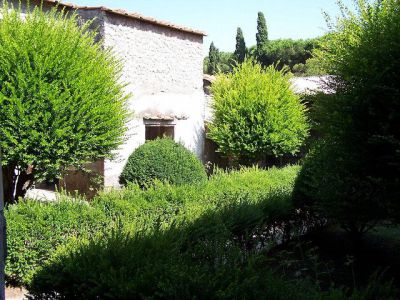
The House of the Theatrical Paintings, also known by the name of its purported original owner, P. Casca Longus, stands as a significant archaeological and historical site in Pompeii. Located along the bustling Via d'Abbondanza, this complex is a striking example of Pompeian domestic architecture and artistry, showcasing a rich array of paintings alongside a collection of personal and household items that paint a vivid picture of life before the catastrophic eruption of Mount Vesuvius in 79 AD.
The house's architectural layout is emblematic of traditional Pompeian homes, featuring a central atrium surrounded by various rooms. This space served as the heart of the household, bathing the interior in natural light and collecting rainwater through an elegantly designed compluvium and impluvium system. The impluvium, notably adorned with colored marble, reflects the opulence that characterizes the entire premises.
Among the treasures unearthed within this dwelling are pieces of silverware, bronze tableware, and a remarkable marble table tripod, highlighting the luxurious lifestyle of its occupants. These finds, along with a silver plate and a bronze statue discovered in the atrium cabinets, underscore the wealth and refined taste of the house's owner, believed to be Publius Servilius Casca Longus.
The complex, a blend of two ancient houses from the 2nd century BC, underwent renovations to add a main and secondary atrium. Notably, the house boasts high-quality Augustan-era paintings depicting scenes from Menander's tragedies, echoing its theatrical name. These artworks, alongside natural motifs, reflect the residents' artistic tastes and cultural interests, showcasing the house's elegance.
The house's architectural layout is emblematic of traditional Pompeian homes, featuring a central atrium surrounded by various rooms. This space served as the heart of the household, bathing the interior in natural light and collecting rainwater through an elegantly designed compluvium and impluvium system. The impluvium, notably adorned with colored marble, reflects the opulence that characterizes the entire premises.
Among the treasures unearthed within this dwelling are pieces of silverware, bronze tableware, and a remarkable marble table tripod, highlighting the luxurious lifestyle of its occupants. These finds, along with a silver plate and a bronze statue discovered in the atrium cabinets, underscore the wealth and refined taste of the house's owner, believed to be Publius Servilius Casca Longus.
The complex, a blend of two ancient houses from the 2nd century BC, underwent renovations to add a main and secondary atrium. Notably, the house boasts high-quality Augustan-era paintings depicting scenes from Menander's tragedies, echoing its theatrical name. These artworks, alongside natural motifs, reflect the residents' artistic tastes and cultural interests, showcasing the house's elegance.
14) Garden of Fugitives
The many historical wonders of Pompei tell us much about how people lived in this ancient city. One quiet corner amongst its maze of buildings gives a poignant insight into the disaster that destroyed this city overnight. The eruption of Mount Vesuvius in 79 AD is believed to have been one of the most catastrophic volcanic events of all time. It threw a deadly cloud of ash and stone up to 20 miles into the air, and ultimately released enough thermal energy to make a hundred thousand atomic bombs. Those unable to flee Pompei, just a few miles from the volcano, were killed by lava flows that swept through the city. When the ash cloud fell to earth, it buried Pompei, and an estimated 16,000 victims of the deadly eruption.
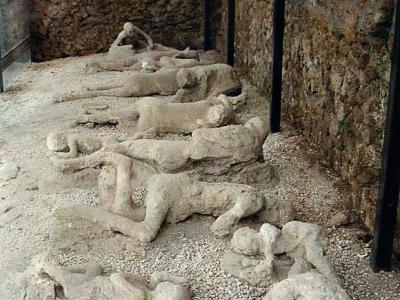
When they began excavating Pompei in the 19th century, archaeologists began finding decomposed bodies of people and animals. By pouring plaster into air pockets left in the rubble, they were able to create casts of many victims. At the Garden of the Fugitives, an area thought to have been a small orchard, thirteen bodies were found, and their casts have been laid out as they were discovered. It is a poignant memorial to those that perished in the eruption that preserved the city for modern visitors. A woman can be seen holding her child, whilst others were clearly trying to protect themselves, in vain, from the deadly lava flow.
When they began excavating Pompei in the 19th century, archaeologists began finding decomposed bodies of people and animals. By pouring plaster into air pockets left in the rubble, they were able to create casts of many victims. At the Garden of the Fugitives, an area thought to have been a small orchard, thirteen bodies were found, and their casts have been laid out as they were discovered. It is a poignant memorial to those that perished in the eruption that preserved the city for modern visitors. A woman can be seen holding her child, whilst others were clearly trying to protect themselves, in vain, from the deadly lava flow.
15) Amphitheater
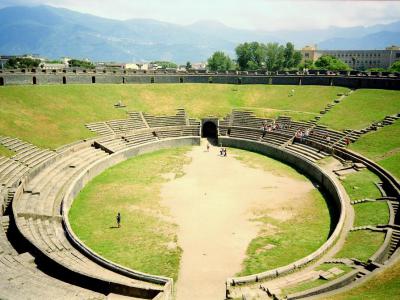
The Pompei Amphitheatre is the oldest building of its kind to have survived from the Roman era. Pompei houses many of the best preserved examples of Roman architecture, after the city was buried under volcanic ash for almost 2000 years. The Amphitheatre, one of Pompei’s most well known attractions, predates the Coliseum in Rome by over a century. It is believed that the success of the Pompei Amphitheatre, the first stone arena built within the Roman Empire, was the inspiration for a larger stone-built arena in Rome itself.
A circular structure with arches and stairways creating several entrance points, the Amphitheatre is still considered by crowd control analysts to be a near perfectly designed venue. Built around 70 BC, it was initially known as the Spectacula. Paid for by wealthy local statesmen Quinctius Valgus and Marcius Porcius, it was primarily used to host gladiatorial games and ceremonies. Twenty years before the eruption that destroyed Pompei, games were banned at the Amphitheatre, following a brawl between locals and residents of nearby Nuceria. In recent years, UK progressive rock band Pink Floyd became the first people for almost two thousand years to perform at the arena, filming a live concert here.
A circular structure with arches and stairways creating several entrance points, the Amphitheatre is still considered by crowd control analysts to be a near perfectly designed venue. Built around 70 BC, it was initially known as the Spectacula. Paid for by wealthy local statesmen Quinctius Valgus and Marcius Porcius, it was primarily used to host gladiatorial games and ceremonies. Twenty years before the eruption that destroyed Pompei, games were banned at the Amphitheatre, following a brawl between locals and residents of nearby Nuceria. In recent years, UK progressive rock band Pink Floyd became the first people for almost two thousand years to perform at the arena, filming a live concert here.
