Custom Walk in Dresden, Germany by sarahcollins747_a2478e created on 2026-03-07
Guide Location: Germany » Dresden
Guide Type: Custom Walk
# of Sights: 12
Tour Duration: 2 Hour(s)
Travel Distance: 2 Km or 1.2 Miles
Share Key: NCETM
Guide Type: Custom Walk
# of Sights: 12
Tour Duration: 2 Hour(s)
Travel Distance: 2 Km or 1.2 Miles
Share Key: NCETM
How It Works
Please retrieve this walk in the GPSmyCity app. Once done, the app will guide you from one tour stop to the next as if you had a personal tour guide. If you created the walk on this website or come to the page via a link, please follow the instructions below to retrieve the walk in the app.
Retrieve This Walk in App
Step 1. Download the app "GPSmyCity: Walks in 1K+ Cities" on Apple App Store or Google Play Store.



Step 2. In the GPSmyCity app, download(or launch) the guide "Dresden Map and Walking Tours".
Step 3. Tap the menu button located at upper right corner of the "Walks" screen and select "Retrieve custom walk". Enter the share key: NCETM
1) Zwinger (Palatial Complex) (must see)
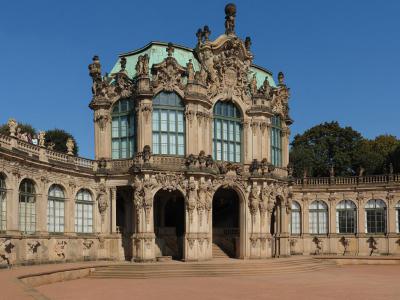
The Zwinger is one of Germany's most impressive Baroque buildings. August the Strong commissioned the complex after visiting Louis XIV's Versailles Palace. The palace was designed as an orangery, garden, and festival area. Architect Matthäus Daniel Pöppelmann designed the palace, which was built between 1710 and 1728.
The Zwinger name refers to an area between defensive walls. In the 15th century, Dresden had a Zwinger garden in between the city walls that supplied the royal court with fresh produce. The present-day Zwinger is in a different location, but the new palace kept the old garden's name.
The Zwinger was primarily a royal entertainment venue and features ornate portals and extravagant fountains. Sculptor Balthasar Permoser’s Nymph's Bath is one fine example of the Zwinger's fabulous Baroque fountains.
Other attractions include an Atlas sculpture on top of the western pavilion. In addition, a carillon with 40 porcelain bells plays every 15 minutes. The chimes change every season and feature melodies by Vivaldi, Mozart, Bach, Wagner, and Weber.
The Zwinger hosted a royal wedding in 1719 when Augustus the Strong’s son Frederick August married Maria Josepha, the daughter of Habsburg emperor Joseph I.
The courtyard garden and pond were added in the 1820s. The gallery wing that now houses the Old Masters Gallery was built in 1855.
The Zwinger was heavily damaged during World War II bombs. It was reconstructed during the 1950s. The Zwinger houses three museums, including the Old Masters Gallery, the Porcelain Collection, and the Mathematical and Physical Instruments collection. The Zwinger and its gardens are open to the public.
The Zwinger name refers to an area between defensive walls. In the 15th century, Dresden had a Zwinger garden in between the city walls that supplied the royal court with fresh produce. The present-day Zwinger is in a different location, but the new palace kept the old garden's name.
The Zwinger was primarily a royal entertainment venue and features ornate portals and extravagant fountains. Sculptor Balthasar Permoser’s Nymph's Bath is one fine example of the Zwinger's fabulous Baroque fountains.
Other attractions include an Atlas sculpture on top of the western pavilion. In addition, a carillon with 40 porcelain bells plays every 15 minutes. The chimes change every season and feature melodies by Vivaldi, Mozart, Bach, Wagner, and Weber.
The Zwinger hosted a royal wedding in 1719 when Augustus the Strong’s son Frederick August married Maria Josepha, the daughter of Habsburg emperor Joseph I.
The courtyard garden and pond were added in the 1820s. The gallery wing that now houses the Old Masters Gallery was built in 1855.
The Zwinger was heavily damaged during World War II bombs. It was reconstructed during the 1950s. The Zwinger houses three museums, including the Old Masters Gallery, the Porcelain Collection, and the Mathematical and Physical Instruments collection. The Zwinger and its gardens are open to the public.
2) Theaterplatz (Theatre Square)
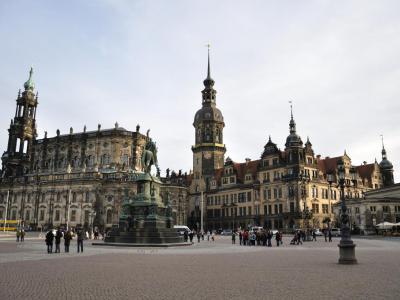
The Theatre Square (Theaterplatz) in Dresden is a significant and historic square located west of the city's inner old town. The square is famously positioned in front of the Dresden Semperoper (Semper Opera House), the esteemed former court theater from which it derives its name. Theatre Square stretches between the Post Office (Postplatz) and the Augustus Bridge, directly bordering the elevated banks of the Elbe River. This prime location offers a sweeping view across the Elbe and into the lush expanse of the Dresdner Heath, especially notable from the approach to the Augustus Bridge.
Architecturally, the Theatre Square is surrounded by significant buildings, each with its historical and cultural importance. To the north, the Italian Village, designed by Hans Erlwein, marks one of the newer additions to the square. From here, visitors can also view the Erlwein Storage (Erlweinspeicher), a noted technical structure. The southeast side of the square features the only fully baroque building in the area, the Dresden Cathedral, separated from the expansive Dresden Castle by a small alley. The castle itself has undergone extensive expansions and redesigns over time.
The south-southwest side of the square showcases the Semper Gallery, adorned with a Neorenaissance façade, while the northwest side is dominated by the most celebrated structure in the square, the Semper Opera House. This opera house, designed by Gottfried Semper, stands as the third iteration of the building at this location, cementing its historical and cultural significance.
Architecturally, the Theatre Square is surrounded by significant buildings, each with its historical and cultural importance. To the north, the Italian Village, designed by Hans Erlwein, marks one of the newer additions to the square. From here, visitors can also view the Erlwein Storage (Erlweinspeicher), a noted technical structure. The southeast side of the square features the only fully baroque building in the area, the Dresden Cathedral, separated from the expansive Dresden Castle by a small alley. The castle itself has undergone extensive expansions and redesigns over time.
The south-southwest side of the square showcases the Semper Gallery, adorned with a Neorenaissance façade, while the northwest side is dominated by the most celebrated structure in the square, the Semper Opera House. This opera house, designed by Gottfried Semper, stands as the third iteration of the building at this location, cementing its historical and cultural significance.
3) Dresden Castle (must see)
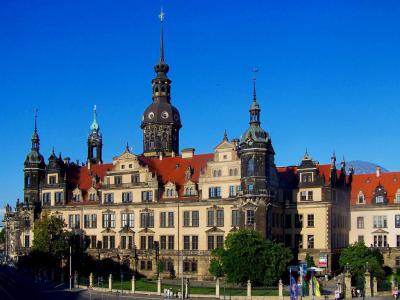
Dresden Castle is one of Dresden's oldest buildings. It served as a royal residence for almost 400 years and housed Saxony electors and Saxony and Polish kings. The castle features different architectural styles, such as Baroque and Neo-renaissance.
The castle was originally built in the 13th century as a Romanesque keep. The keep was extended in the 15th century and again in the 16th century. A fire damaged the castle in 1701, and Augustus the Strong rebuilt the castle and added the western wing collection rooms. The castle was rebuilt in the ornate Baroque style.
The House of Wettin celebrated its 800th anniversary with further renovations and additions between 1889 and 1901. The Stall Courtyard was painted with the famous "Procession of Princes ." In 1914, additional renovations modernized the castle with heating and electric lights.
World War II bombs heavily damaged Dresden Castle. Restoration work started in the 1960s and continues today.
The castle is now home to a collection of museums that are housed in Augustus the Strong's collection rooms. The museums include the Historic Green Vault, the New Green Vault, the Numismatic Cabinet, the Collection of Prints, Drawings, and Photographs, and the Dresden Armory. Guests can also visit an art library with 260,000 titles related to art history.
The Hausmann Tower offers a beautiful view of Dresden's Old Town. In addition, the English Stairway was reconstructed using the original Baroque design.
The castle was originally built in the 13th century as a Romanesque keep. The keep was extended in the 15th century and again in the 16th century. A fire damaged the castle in 1701, and Augustus the Strong rebuilt the castle and added the western wing collection rooms. The castle was rebuilt in the ornate Baroque style.
The House of Wettin celebrated its 800th anniversary with further renovations and additions between 1889 and 1901. The Stall Courtyard was painted with the famous "Procession of Princes ." In 1914, additional renovations modernized the castle with heating and electric lights.
World War II bombs heavily damaged Dresden Castle. Restoration work started in the 1960s and continues today.
The castle is now home to a collection of museums that are housed in Augustus the Strong's collection rooms. The museums include the Historic Green Vault, the New Green Vault, the Numismatic Cabinet, the Collection of Prints, Drawings, and Photographs, and the Dresden Armory. Guests can also visit an art library with 260,000 titles related to art history.
The Hausmann Tower offers a beautiful view of Dresden's Old Town. In addition, the English Stairway was reconstructed using the original Baroque design.
4) Semperoper (Opera House)
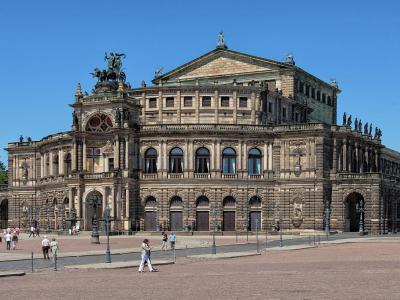
The Opera House (Semperoper) in Dresden is a monumental structure with deep historical and cultural significance. Serving as the home to the Saxon State Opera (Sächsische Staatsoper Dresden), the Saxon State Orchestra (Staatskapelle Dresden), and the Semperoper Ballett, this iconic opera house is not only a venue for world-class performances but also an architectural treasure.
Designed by the renowned architect Gottfried Semper, the Opera House was first constructed in 1841. However, it faced destruction by fire in 1869 and underwent a significant rebuilding process, led once more by Semper. Although Semper was in exile due to political involvement, his son, Manfred Semper, used his father's plans to complete the reconstruction in 1878. This second opera house emerged in the Neo-Renaissance style and exemplified what is known as "Dresden Baroque," marking it as one of the most beautiful opera houses in Europe.
The building displays an eclectic architectural style, combining early Renaissance, Baroque, and Greek classical revival elements, including Corinthian pillars. Located on Theatre Square beside the Elbe River, the Semperoper features a facade decorated with a Panther quadriga and a Dionysos statue. Internally, it showcases works from architects like Johannes Schilling and sculptors such as Ernst Rietschel. Monuments of figures like Goethe, Schiller, and Shakespeare enhance its cultural significance.
The Opera House's history is marked by numerous premieres of significant works by composers like Richard Wagner and Richard Strauss, playing a pivotal role in shaping the musical landscape. Tragically, the opera house was largely destroyed during the bombing of Dresden in World War II in 1945, which left only its external shell.
Reconstruction efforts mirrored the original designs, and the opera house was ceremoniously reopened on February 13, 1985, exactly 40 years after its destruction. The reopening performance featured Carl Maria von Weber's "Der Freischütz," the same opera staged before the building was destroyed in 1945. Today, the Opera House continues to enchant audiences with its historical legacy, architectural beauty, and rich program of operatic and ballet performances.
Designed by the renowned architect Gottfried Semper, the Opera House was first constructed in 1841. However, it faced destruction by fire in 1869 and underwent a significant rebuilding process, led once more by Semper. Although Semper was in exile due to political involvement, his son, Manfred Semper, used his father's plans to complete the reconstruction in 1878. This second opera house emerged in the Neo-Renaissance style and exemplified what is known as "Dresden Baroque," marking it as one of the most beautiful opera houses in Europe.
The building displays an eclectic architectural style, combining early Renaissance, Baroque, and Greek classical revival elements, including Corinthian pillars. Located on Theatre Square beside the Elbe River, the Semperoper features a facade decorated with a Panther quadriga and a Dionysos statue. Internally, it showcases works from architects like Johannes Schilling and sculptors such as Ernst Rietschel. Monuments of figures like Goethe, Schiller, and Shakespeare enhance its cultural significance.
The Opera House's history is marked by numerous premieres of significant works by composers like Richard Wagner and Richard Strauss, playing a pivotal role in shaping the musical landscape. Tragically, the opera house was largely destroyed during the bombing of Dresden in World War II in 1945, which left only its external shell.
Reconstruction efforts mirrored the original designs, and the opera house was ceremoniously reopened on February 13, 1985, exactly 40 years after its destruction. The reopening performance featured Carl Maria von Weber's "Der Freischütz," the same opera staged before the building was destroyed in 1945. Today, the Opera House continues to enchant audiences with its historical legacy, architectural beauty, and rich program of operatic and ballet performances.
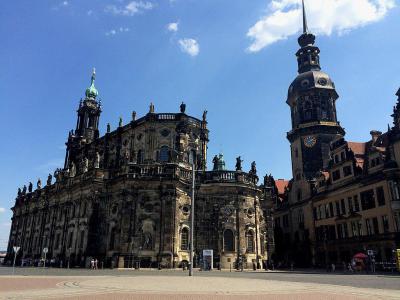
5) Katholische Hofkirche (Catholic Church) (must see)
Dresden Cathedral is Dresden's most important Catholic church. Architect Gaetano Chiavari designed the Baroque church, which was completed in 1751. It was commissioned by Augustus II, Elector of Saxony and King of Poland. Dresden Cathedral was built at the same time as the Lutheran Church of Our Lady.
Dresden's population was Protestant, but its rulers were Catholic. Augustus II built the church for his own use and connected it to Dresden Castle with a decorative walkway. It was originally known as the Court Church of the Most Holy Trinity. It became a cathedral in 1964.
The cathedral's balustrades feature 78 statues of saints. A procession ambulatory was integrated into the interior because outdoor Catholic worship was forbidden.
The baptismal font features a gilded metal lid and was designed in 1721. In addition, the cathedral has an organ built by famed organist Gottfried Silbermann.
Many of Saxon's rulers are buried in the cathedral's crypts. The Founder's Crypt holds the remains of Polish King Augustus III. King Augustus the Strong is buried here, as is the last King of Saxony.
Dresden Cathedral was damaged during World War II bombing raids and was restored in 1962.
Dresden's population was Protestant, but its rulers were Catholic. Augustus II built the church for his own use and connected it to Dresden Castle with a decorative walkway. It was originally known as the Court Church of the Most Holy Trinity. It became a cathedral in 1964.
The cathedral's balustrades feature 78 statues of saints. A procession ambulatory was integrated into the interior because outdoor Catholic worship was forbidden.
The baptismal font features a gilded metal lid and was designed in 1721. In addition, the cathedral has an organ built by famed organist Gottfried Silbermann.
Many of Saxon's rulers are buried in the cathedral's crypts. The Founder's Crypt holds the remains of Polish King Augustus III. King Augustus the Strong is buried here, as is the last King of Saxony.
Dresden Cathedral was damaged during World War II bombing raids and was restored in 1962.
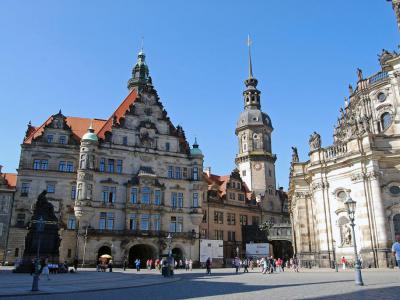
6) Schlossplatz (Castle Square)
Castle Square (Schlossplatz) is a city square in the heart of Dresden. Named after the Dresden Castle-once the royal residence of the Electors and Kings of Saxony-the square is a historical and architectural focal point of the city. It is flanked by several significant buildings including the Catholic Court Church (Katholische Hofkirche), the Saxon House of Estates (Sächsische Ständehaus), the Georgentor, and the Augustus Bridge, which spans the River Elbe.
The square's history extends back to the 15th century, but it suffered extensive damage during the bombing of Dresden in World War II. In recent years, extensive restoration efforts have revived its historic ambiance, reinstating its original grandeur.
A notable feature of the square was a bronze statue of Albert of Saxony by Max Baumbach, inaugurated in 1906 but destroyed in 1945. In its place now stands a sculpture by Ernst Rietschel of Frederick Augustus I "The Righteous", initially unveiled in 1843 and moved to Castle Square in 2008. This relocation was celebrated with a special performance of Richard Wagner's Weih-Hymne, composed for the sculpture's original unveiling.
Additionally, the square holds a historical significance marked by a paving stone with the letter 'N' outside the main entrance of the Catholic Court Church (Katholische Hofkirche), denoting where Napoleon Bonaparte rallied his troops for the Battle of Dresden in 1813.
While Castle Square is a site for political events, its compact stone architecture creates significant reverberation, making nearby Theaterplatz, with better acoustics, a preferred venue for concerts. This integration of history, art, and cultural activities makes Schlossplatz a vital and vibrant part of Dresden's urban landscape.
The square's history extends back to the 15th century, but it suffered extensive damage during the bombing of Dresden in World War II. In recent years, extensive restoration efforts have revived its historic ambiance, reinstating its original grandeur.
A notable feature of the square was a bronze statue of Albert of Saxony by Max Baumbach, inaugurated in 1906 but destroyed in 1945. In its place now stands a sculpture by Ernst Rietschel of Frederick Augustus I "The Righteous", initially unveiled in 1843 and moved to Castle Square in 2008. This relocation was celebrated with a special performance of Richard Wagner's Weih-Hymne, composed for the sculpture's original unveiling.
Additionally, the square holds a historical significance marked by a paving stone with the letter 'N' outside the main entrance of the Catholic Court Church (Katholische Hofkirche), denoting where Napoleon Bonaparte rallied his troops for the Battle of Dresden in 1813.
While Castle Square is a site for political events, its compact stone architecture creates significant reverberation, making nearby Theaterplatz, with better acoustics, a preferred venue for concerts. This integration of history, art, and cultural activities makes Schlossplatz a vital and vibrant part of Dresden's urban landscape.
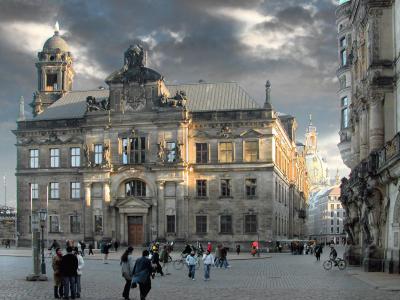
7) Sächsisches Ständehaus (Saxon State House)
The Sachsisches Standehaus, otherwise known as the Saxon House of Estates or Saxon State House, is an early 20th century house built by Paul Wallot. Located in Dresden's Old Town, Saxon State House was formerly the parliament building. It now serves as the seat of the Dresden Higher Regional Court and the State Office for the Preservation of Monuments in Saxony.
The original Saxon State House was built on a site once occupied by the Bruhlsche Palace, the Furstenburgsche House and the Charonsche House. These were all demolished to make room for the large palace. It was built with three stories in a trapezoidal shape.
Saxon State House contains an impressive collection of statues and artwork. Most of these works of art were created from 1905 through 1907. Artists who contributed to the Saxon State House include John Schilling, Heinrich Wedemeyer, Heinrich Epler, Ernest Paul, Peter Poeppelmann, Semlar Werner and many others.
The house was badly damaged during the World War II air raids. Reconstruction began almost immediately. However, it was thoroughly renovated between 1996 and 2001. It now holds seven courtrooms and a number of representative rooms for the state parliament.
The original Saxon State House was built on a site once occupied by the Bruhlsche Palace, the Furstenburgsche House and the Charonsche House. These were all demolished to make room for the large palace. It was built with three stories in a trapezoidal shape.
Saxon State House contains an impressive collection of statues and artwork. Most of these works of art were created from 1905 through 1907. Artists who contributed to the Saxon State House include John Schilling, Heinrich Wedemeyer, Heinrich Epler, Ernest Paul, Peter Poeppelmann, Semlar Werner and many others.
The house was badly damaged during the World War II air raids. Reconstruction began almost immediately. However, it was thoroughly renovated between 1996 and 2001. It now holds seven courtrooms and a number of representative rooms for the state parliament.
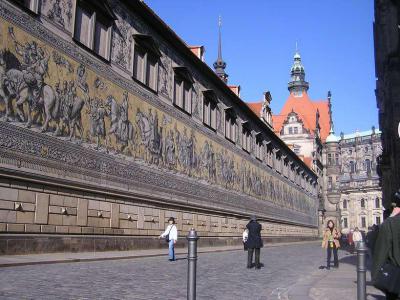
8) Fürstenzug (Procession of Princes) (must see)
The Procession of Princes is an impressive mural that shows Saxony's rulers. The painting was commissioned to celebrate the Wettin Dynasty's 800th anniversary in 1889.
Wilhelm Walther painted the original painting. It took Walther five years to complete the painting, which was finished in 1876. When the artwork began to fade, a preservation plan was implemented. Between 1904 and 1907, the painting was replaced by 23,000 porcelain tiles to make the artwork weatherproof.
The artwork is 102 meters (335 feet) long and is the world's largest porcelain artwork. The mural shows the portraits of the House of Wettin's 35 margraves, electors, dukes, and kings from 1127 to 1904. The rulers are shown on horses with their names written underneath them.
The first ruler in the procession mural is 12th-century ruler Conrad, Margrave of Meissen. The last king of Saxony, Frederick Augustus III, who ruled from 1904 to 1918, is not shown.
The mural also shows 59 farmers, craftsmen, scientists, artists, and children. A girl in the children's group is the only female shown in the procession. The last person shown in the procession is the mural's original creator, Wilhelm Walther.
The Procession of Princes was designed to look like a giant tapestry. The top edge features depictions of 38 individual hanging knobs to make the mural look like a tapestry hung on a wall. The mural also features ornamental frames with plants, butterflies, and birds.
Wilhelm Walther painted the original painting. It took Walther five years to complete the painting, which was finished in 1876. When the artwork began to fade, a preservation plan was implemented. Between 1904 and 1907, the painting was replaced by 23,000 porcelain tiles to make the artwork weatherproof.
The artwork is 102 meters (335 feet) long and is the world's largest porcelain artwork. The mural shows the portraits of the House of Wettin's 35 margraves, electors, dukes, and kings from 1127 to 1904. The rulers are shown on horses with their names written underneath them.
The first ruler in the procession mural is 12th-century ruler Conrad, Margrave of Meissen. The last king of Saxony, Frederick Augustus III, who ruled from 1904 to 1918, is not shown.
The mural also shows 59 farmers, craftsmen, scientists, artists, and children. A girl in the children's group is the only female shown in the procession. The last person shown in the procession is the mural's original creator, Wilhelm Walther.
The Procession of Princes was designed to look like a giant tapestry. The top edge features depictions of 38 individual hanging knobs to make the mural look like a tapestry hung on a wall. The mural also features ornamental frames with plants, butterflies, and birds.
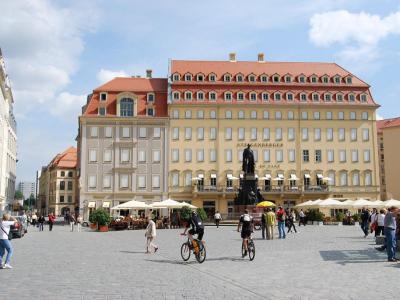
9) Neumarkt (New Market Square)
New Market Square (Neumarkt), located in the heart of Dresden, is a historically significant square that has experienced extensive transformations over the centuries. Originally established on a slight elevation above the flood-prone Elbe River, this area began as a small village surrounding the Frauenkirche. It became part of the fortified city in 1530 when Dresden expanded its walls, distinguishing itself from the Altmarkt, which was centered around the Kreuzkirche.
The New Market flourished during the reign of August II the Strong, a period marked by the adoption of the Baroque architectural style. This era saw the construction of the current Frauenkirche and numerous surrounding structures. The square further evolved in the 18th century following damage from the Seven Years' War, with many buildings being restored or reconstructed in the Rococo/Late Baroque style.
By the 19th and early 20th centuries, the New Market Square underwent few changes, with significant renovations such as the completion of the Johanneum in 1873 and the construction of the Albertinum and the Academy of Fine Arts by the late 1800s. However, the area was nearly obliterated during the Allied bombing in World War II.
Following the war, Dresden fell under Soviet control and later became part of the German Democratic Republic. During this time, parts of the square were reconstructed in a Socialist Realist style, and some historic buildings were partially rebuilt. However, many plots remained undeveloped.
The Neumarkt is now divided into eight "quarters," each considered a separate project in terms of reconstruction. The approach is to rebuild buildings either entirely as they were or at least to replicate the original facades. As of 2020, most quarters are complete, with only Quarter III and Quarter VII still under construction, signaling a near-complete revival of this storied square.
The New Market flourished during the reign of August II the Strong, a period marked by the adoption of the Baroque architectural style. This era saw the construction of the current Frauenkirche and numerous surrounding structures. The square further evolved in the 18th century following damage from the Seven Years' War, with many buildings being restored or reconstructed in the Rococo/Late Baroque style.
By the 19th and early 20th centuries, the New Market Square underwent few changes, with significant renovations such as the completion of the Johanneum in 1873 and the construction of the Albertinum and the Academy of Fine Arts by the late 1800s. However, the area was nearly obliterated during the Allied bombing in World War II.
Following the war, Dresden fell under Soviet control and later became part of the German Democratic Republic. During this time, parts of the square were reconstructed in a Socialist Realist style, and some historic buildings were partially rebuilt. However, many plots remained undeveloped.
The Neumarkt is now divided into eight "quarters," each considered a separate project in terms of reconstruction. The approach is to rebuild buildings either entirely as they were or at least to replicate the original facades. As of 2020, most quarters are complete, with only Quarter III and Quarter VII still under construction, signaling a near-complete revival of this storied square.
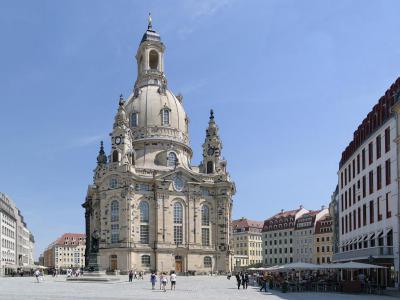
10) Frauenkirche (Church of Our Lady) (must see)
The current Church of Our Lady is a Lutheran church built between 1726 and 1743. It features Baroque architecture and has one of Europe's largest domes.
The first Church of Our Lady was a Catholic church built in the 11th century. It became a Protestant church during the Reformation. The original church was torn down and replaced by the new Luthern church.
In 1736, Gottfried Silbermann built an exceptional 43-stop organ for the church. Johann Sebastian Bach played a recital on the organ on December 1, 1736.
The church's iconic dome is 96 meters (315 feet) tall. The dome is known as Stone Bell ("die Steinerne Glocke" in German). The dome is often compared to Michelangelo's Saint Peter's Basilica dome. Stone Bell weighed 12,000 tons and was originally held up by eight supports.
In 1945, Allied forces bombed Dresden. The church survived two days of attacks before collapsing. While most of the church was destroyed, the original altar and chancel were salvaged.
Residents salvaged and numbered stone fragments, hoping to use them in a future reconstruction. In 1994, Gunter Blobel won the Nobel Prize for medicine and donated his prize money to restore the Church of Our Lady. In addition, England's Prince Edward supported the Dresden Trust which contributed funds for the reconstruction project.
Rebuilding the Church of Our Lady cost 180 million Euros. The rebuilding effort began in 1992 and was completed in 2005. The church was rebuilt using the original plans from the 1720s and salvaged materials. About 3,800 original stones were used in the reconstruction. One can see the original stones in the building as they appear darker due to age and fire damage.
Rebuilding the church was a community-wide effort. Builders relied on photographs and memories to reconstruct the details. For example, old wedding albums helped builders reconstruct the church's carved oak doors.
A new orb and cross were forged and placed on top of the dome. The original damaged cross stands inside by the church's altar. The original organ was replaced with a 68-stop organ.
The rebuilt Church of Our Lady is a popular attraction. US President Barack Obama visited the church in 2009.
The first Church of Our Lady was a Catholic church built in the 11th century. It became a Protestant church during the Reformation. The original church was torn down and replaced by the new Luthern church.
In 1736, Gottfried Silbermann built an exceptional 43-stop organ for the church. Johann Sebastian Bach played a recital on the organ on December 1, 1736.
The church's iconic dome is 96 meters (315 feet) tall. The dome is known as Stone Bell ("die Steinerne Glocke" in German). The dome is often compared to Michelangelo's Saint Peter's Basilica dome. Stone Bell weighed 12,000 tons and was originally held up by eight supports.
In 1945, Allied forces bombed Dresden. The church survived two days of attacks before collapsing. While most of the church was destroyed, the original altar and chancel were salvaged.
Residents salvaged and numbered stone fragments, hoping to use them in a future reconstruction. In 1994, Gunter Blobel won the Nobel Prize for medicine and donated his prize money to restore the Church of Our Lady. In addition, England's Prince Edward supported the Dresden Trust which contributed funds for the reconstruction project.
Rebuilding the Church of Our Lady cost 180 million Euros. The rebuilding effort began in 1992 and was completed in 2005. The church was rebuilt using the original plans from the 1720s and salvaged materials. About 3,800 original stones were used in the reconstruction. One can see the original stones in the building as they appear darker due to age and fire damage.
Rebuilding the church was a community-wide effort. Builders relied on photographs and memories to reconstruct the details. For example, old wedding albums helped builders reconstruct the church's carved oak doors.
A new orb and cross were forged and placed on top of the dome. The original damaged cross stands inside by the church's altar. The original organ was replaced with a 68-stop organ.
The rebuilt Church of Our Lady is a popular attraction. US President Barack Obama visited the church in 2009.
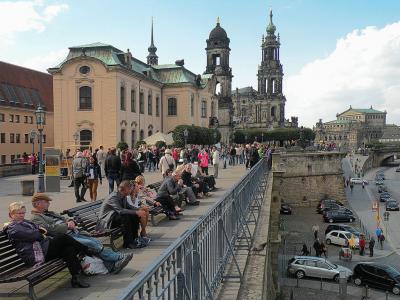
11) Brühl's Terrace (must see)
Brühl's Terrace is often called "The Balcony of Europe." This high terrace overlooks the river Elbe and is a popular place to walk, admire the architecture, and enjoy an outdoor cafe.
Brühl's Terrace was built on the city's fortifications that were rebuilt in 1547. The terrace is named after Count Heinrich von Brühl, who had a Dresden city palace. In 1747 the Saxon elector gave Brühl the terrace to thank him for introducing a betterment tax.
When Russian troops occupied Dresden in 1814, Prince Nikolai Grigorjevich Repnin-Wolkonski ordered the terrace to open to the public. At that time, architect Gottlob Friedrich Thormeyer built stairs at the terrace's western end to be accessible from Castle Square and Augustus Bridge.
The terrace's original buildings were destroyed during World War II bombing attacks. The terrace has since been rebuilt and is one of Dresden's main attractions.
The terrace features a monument for Johann Friedrich Böttger, an alchemist who invented European porcelain. Visitors can see a fingerprint near the monument in one of the garden's guard rails. This fingerprint is said to have been left by legendary Augustus the Strong.
Today's terrace buildings include Saxony's Supreme Court, the Sächsisches Ständehaus, the Academy of Fine Arts, and the Albertinum.
As you stroll the terrace, you may find many artists painting and selling artworks.
Brühl's Terrace was built on the city's fortifications that were rebuilt in 1547. The terrace is named after Count Heinrich von Brühl, who had a Dresden city palace. In 1747 the Saxon elector gave Brühl the terrace to thank him for introducing a betterment tax.
When Russian troops occupied Dresden in 1814, Prince Nikolai Grigorjevich Repnin-Wolkonski ordered the terrace to open to the public. At that time, architect Gottlob Friedrich Thormeyer built stairs at the terrace's western end to be accessible from Castle Square and Augustus Bridge.
The terrace's original buildings were destroyed during World War II bombing attacks. The terrace has since been rebuilt and is one of Dresden's main attractions.
The terrace features a monument for Johann Friedrich Böttger, an alchemist who invented European porcelain. Visitors can see a fingerprint near the monument in one of the garden's guard rails. This fingerprint is said to have been left by legendary Augustus the Strong.
Today's terrace buildings include Saxony's Supreme Court, the Sächsisches Ständehaus, the Academy of Fine Arts, and the Albertinum.
As you stroll the terrace, you may find many artists painting and selling artworks.
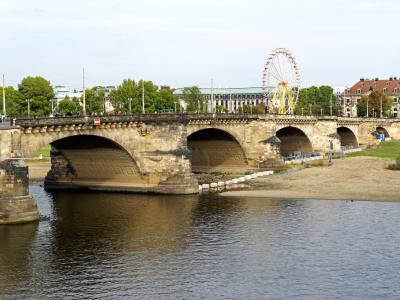
12) Augustusbrücke (Augustus Bridge)
One of the most famous bridges north of the Alps, the Augustbrucke crosses the River Elbe to connect Dresden Neustadt on the right bank of the River to the historic part of Dresden on the left bank. The bridge was named after Elector Augustus the Strong and renamed Georgi Dimitrov Bridge when Dresden formed part of the German Democratic Republic.
The earliest record of a bridge that later became the Augustusbrucke was a wooden bridge in 1275. Later a stone bridge was constructed with 25 stone pillars in 1287. It was one of the longest bridges in Germany and connected major trade routes. The tolls collected at the customs house near the bridge was a major source of revenue for the Saxon Wettin rulers.
Augustus the Strong, who reigned during the golden age of Dresden, commissioned a new bridge because the old structure was unable to sustain the increased traffic that crossed the Elbe. The bridge was constructed by Council master mason, Johann Gottfried Fehre between 1727 and 1731. Architect Mathew Daniel Popplemann designed a curved structure, 402 meters long with 18 pillars. In 1845, the bridge collapsed because of the flooding of the Elbe and was constructed again by Wilhelm Kreis and Hermann Burdock.
Augustusbrucke suffered extensive damage during the 1945 Dresden bombings and was later lovingly restored to its former glory. Visitors can get a spectacular view of the River Elbe and both sides of Dresden while taking a stroll across the bridge.
The earliest record of a bridge that later became the Augustusbrucke was a wooden bridge in 1275. Later a stone bridge was constructed with 25 stone pillars in 1287. It was one of the longest bridges in Germany and connected major trade routes. The tolls collected at the customs house near the bridge was a major source of revenue for the Saxon Wettin rulers.
Augustus the Strong, who reigned during the golden age of Dresden, commissioned a new bridge because the old structure was unable to sustain the increased traffic that crossed the Elbe. The bridge was constructed by Council master mason, Johann Gottfried Fehre between 1727 and 1731. Architect Mathew Daniel Popplemann designed a curved structure, 402 meters long with 18 pillars. In 1845, the bridge collapsed because of the flooding of the Elbe and was constructed again by Wilhelm Kreis and Hermann Burdock.
Augustusbrucke suffered extensive damage during the 1945 Dresden bombings and was later lovingly restored to its former glory. Visitors can get a spectacular view of the River Elbe and both sides of Dresden while taking a stroll across the bridge.
