Custom Walk in Palermo, Italy by gmarkasyan_ab43d created on 2026-03-19
Guide Location: Italy » Palermo
Guide Type: Custom Walk
# of Sights: 8
Tour Duration: 2 Hour(s)
Travel Distance: 2.9 Km or 1.8 Miles
Share Key: LDNYN
Guide Type: Custom Walk
# of Sights: 8
Tour Duration: 2 Hour(s)
Travel Distance: 2.9 Km or 1.8 Miles
Share Key: LDNYN
How It Works
Please retrieve this walk in the GPSmyCity app. Once done, the app will guide you from one tour stop to the next as if you had a personal tour guide. If you created the walk on this website or come to the page via a link, please follow the instructions below to retrieve the walk in the app.
Retrieve This Walk in App
Step 1. Download the app "GPSmyCity: Walks in 1K+ Cities" on Apple App Store or Google Play Store.



Step 2. In the GPSmyCity app, download(or launch) the guide "Palermo Map and Walking Tours".
Step 3. Tap the menu button located at upper right corner of the "Walks" screen and select "Retrieve custom walk". Enter the share key: LDNYN
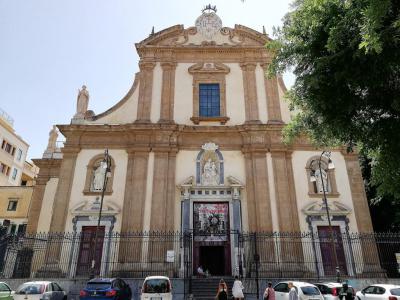
1) Chiesa del Gesù (Church of Jesus) (must see)
The Church of Jesus, often called Professed House, is one of the most spectacular examples of Sicilian Baroque anywhere in Italy. While its exterior is relatively restrained, the interior is overwhelmingly rich and theatrical.
Approaching the church, the facade presents three portals at ground level. Above them, niches contain statues of Saint Ignatius of Loyola, the Madonna and Child, and Saint Francis Xavier. Inside, the visual impact is immediate. The rebuilt interior is defined by its extensive marble inlay decoration, which covers nearly every structural surface. Walls, pillars, arches, and balustrades are faced with panels of white, red, yellow, and green marble arranged in geometric patterns, floral motifs, and sculptural compositions.
Moving along the nave, the pillars themselves become part of the decorative program. Their marble surfaces are carved with dense reliefs and allegorical figures, interwoven with scrollwork and symbolic motifs typical of Jesuit Baroque decoration. Behind the high altar, in the apse, are some of the most important surviving sculptural works. Here are the large marble reliefs of the Adoration of the Shepherds and the Adoration of the Magi, conceived within the artistic circle of Giacomo Serpotta and executed by Gioacchino Vitagliano.
Much of what visitors see today is the result of careful reconstruction. In 1943, an Allied bombing raid caused the collapse of the dome and destroyed large sections of the church, along with many frescoes and decorative elements. The survival of the marble decoration and apse reliefs is therefore especially significant, preserving key elements of the original program within a reconstructed architectural shell.
As the space opens at the crossing, attention shifts upward toward the dome, which today reflects a postwar reconstruction of the original decorative scheme. The original Baroque dome frescoes were destroyed. However, original frescoes by Filippo Tancredi survive in the upper vaults of the nave, depicting Marian triumphal themes with angels and allegorical figures.
Approaching the church, the facade presents three portals at ground level. Above them, niches contain statues of Saint Ignatius of Loyola, the Madonna and Child, and Saint Francis Xavier. Inside, the visual impact is immediate. The rebuilt interior is defined by its extensive marble inlay decoration, which covers nearly every structural surface. Walls, pillars, arches, and balustrades are faced with panels of white, red, yellow, and green marble arranged in geometric patterns, floral motifs, and sculptural compositions.
Moving along the nave, the pillars themselves become part of the decorative program. Their marble surfaces are carved with dense reliefs and allegorical figures, interwoven with scrollwork and symbolic motifs typical of Jesuit Baroque decoration. Behind the high altar, in the apse, are some of the most important surviving sculptural works. Here are the large marble reliefs of the Adoration of the Shepherds and the Adoration of the Magi, conceived within the artistic circle of Giacomo Serpotta and executed by Gioacchino Vitagliano.
Much of what visitors see today is the result of careful reconstruction. In 1943, an Allied bombing raid caused the collapse of the dome and destroyed large sections of the church, along with many frescoes and decorative elements. The survival of the marble decoration and apse reliefs is therefore especially significant, preserving key elements of the original program within a reconstructed architectural shell.
As the space opens at the crossing, attention shifts upward toward the dome, which today reflects a postwar reconstruction of the original decorative scheme. The original Baroque dome frescoes were destroyed. However, original frescoes by Filippo Tancredi survive in the upper vaults of the nave, depicting Marian triumphal themes with angels and allegorical figures.
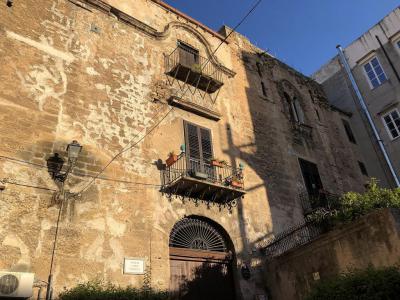
2) Palazzo Conte Federico (Count Federico Palace) (must see)
Curious to see how Palermo’s aristocracy has lived for centuries? Count Federico Palace offers a rare glimpse inside a privately owned noble residence that is still inhabited today. It is built directly over stretches of the ancient Punic and Roman city walls, and its most distinctive feature is the 12th-century Arab-Norman Busuemi Tower, which incorporates part of an earlier Islamic gateway. This layered structure makes the palace one of the clearest examples of Palermo’s continuous urban history.
The property passed into the hands of the Federico family in the 17th century, when they acquired it from the Olivetan monks of Santa Maria dello Spasimo, who had previously used parts of the complex as a hospice. Over time, the palace evolved into a noble residence organized around an internal courtyard. A marble staircase leads to the piano nobile, the palace’s main reception floor, opening onto a sequence of halls decorated in different historical styles.
Inside, the rooms preserve original furnishings and decorative elements from several periods. These include 15th-century wooden coffered ceilings, 18th-century frescoes attributed to Vito d’Anna, and collections of ceramics, weapons, and family heirlooms. One of the most memorable spaces is the ballroom, traditionally highlighted during visits. The palace also contains a historic piano associated with Richard Wagner, who stayed in Palermo in the early 1880s while working on Parsifal.
Visits are by guided tour only and are often led by a member of the Federico family, offering a personal perspective on the building’s history. The experience focuses on architecture, family heritage, and Palermo’s past.
The property passed into the hands of the Federico family in the 17th century, when they acquired it from the Olivetan monks of Santa Maria dello Spasimo, who had previously used parts of the complex as a hospice. Over time, the palace evolved into a noble residence organized around an internal courtyard. A marble staircase leads to the piano nobile, the palace’s main reception floor, opening onto a sequence of halls decorated in different historical styles.
Inside, the rooms preserve original furnishings and decorative elements from several periods. These include 15th-century wooden coffered ceilings, 18th-century frescoes attributed to Vito d’Anna, and collections of ceramics, weapons, and family heirlooms. One of the most memorable spaces is the ballroom, traditionally highlighted during visits. The palace also contains a historic piano associated with Richard Wagner, who stayed in Palermo in the early 1880s while working on Parsifal.
Visits are by guided tour only and are often led by a member of the Federico family, offering a personal perspective on the building’s history. The experience focuses on architecture, family heritage, and Palermo’s past.
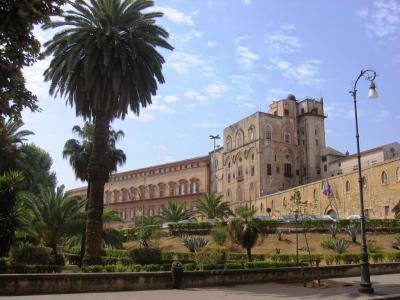
3) Palazzo dei Normanni (Norman Palace) (must see)
Sicily has long been a reef of survival amid the tsunamis of war and invasion that have swept across the island since antiquity. In the 9th century, on one of the highest points of the old city and above earlier Punic remains, the Arab rulers of Palermo established a fortified residence. When Palermo became the capital of Islamic Sicily, this complex formed the core of the emir’s seat of power. Archaeological traces of both the Punic settlement and the Arab fortress can still be found beneath the foundations of what later became the Norman Palace.
When the Normans conquered Palermo in 1072, they established the County of Sicily, later elevated to a kingdom, with Palermo as its capital. Rather than demolishing the existing structure, the Normans transformed the former Arab stronghold into a royal residence. The palace evolved into a complex of interconnected buildings linked by arcades, combining residential, administrative, and ceremonial functions, and surrounded by gardens.
Under King Roger II, the palace reached its most celebrated form. Inside the Norman Palace between 1130 and 1140, he commissioned the Palatine Chapel, intended as a private royal chapel and consecrated in 1140. Dedicated to Saint Peter, it stands as one of the finest expressions of Arab-Norman-Byzantine art in 12th-century Sicily. Its dome, apse, and upper walls are covered in luminous Byzantine mosaics depicting Christ Pantocrator, the Evangelists, and scenes from the Bible.
Over the centuries, the palace passed through many hands. During the Bourbon period, several ceremonial rooms were redesigned, including the Red Room, Yellow Room, and Green Room, and the Hall of Hercules, famous for its fresco cycle depicting the hero. Other notable spaces include the Hall of the Viceroy, the Hall of the Winds, and the Hall of Pompeii.
Within the complex, the Maqueda Courtyard and the Courtyard of the Fountain feature multi-level Renaissance loggias and staircases. Of the original four defensive towers, only two survive today: the Pisan Tower at the south-eastern corner and the Treasure Tower at the south-western corner of the palace.
When the Normans conquered Palermo in 1072, they established the County of Sicily, later elevated to a kingdom, with Palermo as its capital. Rather than demolishing the existing structure, the Normans transformed the former Arab stronghold into a royal residence. The palace evolved into a complex of interconnected buildings linked by arcades, combining residential, administrative, and ceremonial functions, and surrounded by gardens.
Under King Roger II, the palace reached its most celebrated form. Inside the Norman Palace between 1130 and 1140, he commissioned the Palatine Chapel, intended as a private royal chapel and consecrated in 1140. Dedicated to Saint Peter, it stands as one of the finest expressions of Arab-Norman-Byzantine art in 12th-century Sicily. Its dome, apse, and upper walls are covered in luminous Byzantine mosaics depicting Christ Pantocrator, the Evangelists, and scenes from the Bible.
Over the centuries, the palace passed through many hands. During the Bourbon period, several ceremonial rooms were redesigned, including the Red Room, Yellow Room, and Green Room, and the Hall of Hercules, famous for its fresco cycle depicting the hero. Other notable spaces include the Hall of the Viceroy, the Hall of the Winds, and the Hall of Pompeii.
Within the complex, the Maqueda Courtyard and the Courtyard of the Fountain feature multi-level Renaissance loggias and staircases. Of the original four defensive towers, only two survive today: the Pisan Tower at the south-eastern corner and the Treasure Tower at the south-western corner of the palace.
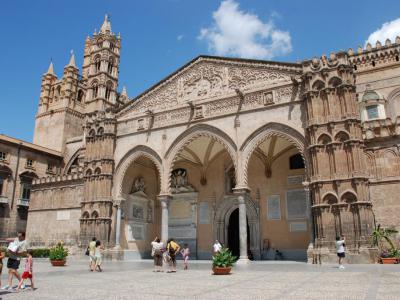
4) Palermo Cathedral (must see)
In 831, Arab conquerors recorded the presence of a major Christian church on the site of today’s Palermo Cathedral, referring to it as a large “infidel temple”. They converted this structure into the Great Mosque of Palermo, which became the city’s principal place of worship during the Islamic period. In 1072, when the Normans conquered Palermo, the mosque was reconsecrated as a Christian church. This early cathedral played a ceremonial role in Norman rule, and Roger II, the first king of Sicily, was crowned here in 1130.
The present Palermo Cathedral reflects centuries of rebuilding, expansion, and restoration, resulting in an unusual mixture of architectural styles. The current structure was begun in 1185 under Walter Ophamil, the Anglo-Norman Archbishop of Palermo and a close advisor to King William II. Walter intended the new cathedral both as a statement of Norman authority and as a rival to the nearby Norman Palace. His remains are today preserved in the cathedral’s crypt.
One of the cathedral’s main entrances is located on Matteo Bonello Street, the western side of the cathedral, marked by a Gothic portal flanked by two towers. Above the portal is a niche containing a 15th-century statue of the Madonna. The most prominent entrance, however, is on the south side, where a broad Gothic-Catalan portico was added in 1465. This portico features three large arcades, decorative turrets, and rich sculptural detail.
The interior follows a Latin cross plan, with a central nave and two aisles divided by pilasters. Along the right side are chapels housing the royal tombs, including those of Roger II, Henry VI, Constance of Hauteville, and Frederick II. The cathedral’s sacred vestments, illuminated manuscripts, and the gold tiara of Constance of Aragon are preserved today in the Cathedral Treasury, located on the south side of the building, separate from the royal tombs inside the nave.
For those wishing to continue upward, access to the rooftop is located on the south-west tower, within the cathedral’s Monumental Area. A medieval stairway leads onto the roof, offering panoramic views across Palermo’s historic center.
The present Palermo Cathedral reflects centuries of rebuilding, expansion, and restoration, resulting in an unusual mixture of architectural styles. The current structure was begun in 1185 under Walter Ophamil, the Anglo-Norman Archbishop of Palermo and a close advisor to King William II. Walter intended the new cathedral both as a statement of Norman authority and as a rival to the nearby Norman Palace. His remains are today preserved in the cathedral’s crypt.
One of the cathedral’s main entrances is located on Matteo Bonello Street, the western side of the cathedral, marked by a Gothic portal flanked by two towers. Above the portal is a niche containing a 15th-century statue of the Madonna. The most prominent entrance, however, is on the south side, where a broad Gothic-Catalan portico was added in 1465. This portico features three large arcades, decorative turrets, and rich sculptural detail.
The interior follows a Latin cross plan, with a central nave and two aisles divided by pilasters. Along the right side are chapels housing the royal tombs, including those of Roger II, Henry VI, Constance of Hauteville, and Frederick II. The cathedral’s sacred vestments, illuminated manuscripts, and the gold tiara of Constance of Aragon are preserved today in the Cathedral Treasury, located on the south side of the building, separate from the royal tombs inside the nave.
For those wishing to continue upward, access to the rooftop is located on the south-west tower, within the cathedral’s Monumental Area. A medieval stairway leads onto the roof, offering panoramic views across Palermo’s historic center.
5) Quattro Canti (Four Corners Square) (must see)
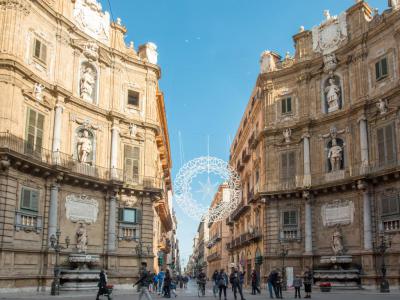
Although it is commonly called Four Corners, the square’s formal name is Vigliena Square. It is named after the Spanish viceroy Juan Fernández Pacheco, Duke of Escalona, who governed Sicily at the time of its construction. Four Corners Square was laid out between 1608 and 1620 by order of the Spanish viceroys as part of Palermo’s urban renewal. The project was overseen by architects Giulio Lasso and Mariano Smiriglio, who conceived the ensemble as a carefully staged urban crossroads.
While usually described as a square, it was historically known as the “Octagon of the Sun”, since its plan is in fact eight-sided. This octagonal form is created by four streets intersecting at right angles and four concave Baroque facades closing off the corners. All four facades are uniform in height, deliberately symmetrical, and treated as a single architectural composition. Each one incorporates a fountain at ground level, above which a tiered sculptural program unfolds.
At the lowest level, the fountains are animated by allegorical figures of the Four Seasons, grounding the square in the rhythms of nature. Above them stand statues of the four Spanish kings of Sicily: Charles V, Philip II, Philip III, and Philip IV. The highest tier is reserved for Palermo’s four female patron saints: Saint Christina, Saint Ninfa, Saint Olivia, and Saint Agatha.
This sculptural hierarchy is also carefully oriented. On the south-facing facade, Spring, Charles V, and Saint Christina are aligned one above the other. Turning west, the facade presents Summer, Philip II, and Saint Ninfa. The north-facing facade carries Autumn, Philip III, and Saint Olivia, while the east-facing facade completes the cycle with Winter, Philip IV, and Saint Agatha.
While usually described as a square, it was historically known as the “Octagon of the Sun”, since its plan is in fact eight-sided. This octagonal form is created by four streets intersecting at right angles and four concave Baroque facades closing off the corners. All four facades are uniform in height, deliberately symmetrical, and treated as a single architectural composition. Each one incorporates a fountain at ground level, above which a tiered sculptural program unfolds.
At the lowest level, the fountains are animated by allegorical figures of the Four Seasons, grounding the square in the rhythms of nature. Above them stand statues of the four Spanish kings of Sicily: Charles V, Philip II, Philip III, and Philip IV. The highest tier is reserved for Palermo’s four female patron saints: Saint Christina, Saint Ninfa, Saint Olivia, and Saint Agatha.
This sculptural hierarchy is also carefully oriented. On the south-facing facade, Spring, Charles V, and Saint Christina are aligned one above the other. Turning west, the facade presents Summer, Philip II, and Saint Ninfa. The north-facing facade carries Autumn, Philip III, and Saint Olivia, while the east-facing facade completes the cycle with Winter, Philip IV, and Saint Agatha.
6) Fontanna della Vergogna (Fountain of Shame) (must see)
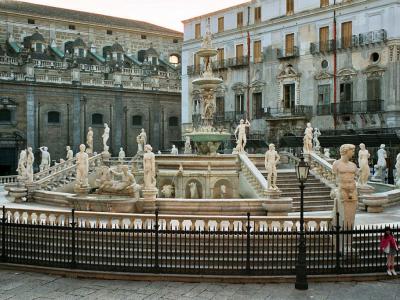
The monumental fountain, crowded with nude figures, gods, animals, and mythological creatures, was originally designed as a garden fountain in Florence. It was commissioned around 1554 by Luigi de Toledo, a Florentine nobleman. When Luigi later ran into serious financial trouble, he was forced to sell the fountain.
The work was designed by the Florentine sculptor Francesco Camilliani and originally consisted of dozens of statues arranged around concentric basins, connected by an elaborate hydraulic system. Because of its size and complexity, the fountain had to be dismantled, shipped by sea, and reassembled. Despite the challenges, the Senate of Palermo purchased the fountain in 1573, convinced it would lend prestige to the city.
An outer stone ring encloses a water-filled basin, separated from the central area by a shallow moat. Stone steps bridge the water, allowing visitors to enter the inner circle. Here, classical deities preside over the scene, while animals and fantastical figures populate the lower levels, many of them designed as water spouts, with open mouths spraying jets of water.
In Palermo, however, the fountain’s reception was mixed. During the 18th and 19th centuries, its abundance of nude figures clashed with local sensibilities. Popular tradition claims that nearby nuns damaged some statues by breaking off anatomically explicit details. A more convincing explanation links the nickname to the Praetorian Palace itself, which by that time had become a symbol of municipal corruption and misrule. The naked statues were seen as a satirical mirror of shameless civic life.
In the end, both interpretations stuck. The square became known as Pretoria Square, while the fountain earned its enduring nickname: the Fountain of Shame.
The work was designed by the Florentine sculptor Francesco Camilliani and originally consisted of dozens of statues arranged around concentric basins, connected by an elaborate hydraulic system. Because of its size and complexity, the fountain had to be dismantled, shipped by sea, and reassembled. Despite the challenges, the Senate of Palermo purchased the fountain in 1573, convinced it would lend prestige to the city.
An outer stone ring encloses a water-filled basin, separated from the central area by a shallow moat. Stone steps bridge the water, allowing visitors to enter the inner circle. Here, classical deities preside over the scene, while animals and fantastical figures populate the lower levels, many of them designed as water spouts, with open mouths spraying jets of water.
In Palermo, however, the fountain’s reception was mixed. During the 18th and 19th centuries, its abundance of nude figures clashed with local sensibilities. Popular tradition claims that nearby nuns damaged some statues by breaking off anatomically explicit details. A more convincing explanation links the nickname to the Praetorian Palace itself, which by that time had become a symbol of municipal corruption and misrule. The naked statues were seen as a satirical mirror of shameless civic life.
In the end, both interpretations stuck. The square became known as Pretoria Square, while the fountain earned its enduring nickname: the Fountain of Shame.
7) La Martorana (Martorana Church) (must see)
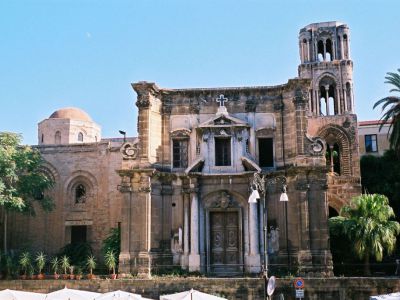
Martorana church, also known as the Church of Saint Mary of the Admiral, was founded by George of Antioch, a Syrian Christian who served as the principal minister and admiral of King Roger II of Sicily. One of the most powerful figures at the Norman court, George commissioned the church as his personal foundation, originally following the Byzantine rite, though it was not formally Eastern Orthodox in the modern sense.
The foundation charter dates to 1143 and was written in Greek and Arabic. Construction may have begun slightly earlier, but the church was certainly completed by 1151, the year of George’s death. Tradition holds that George of Antioch was buried in the church, likely in the narthex area.
Around 1194, Eloisa Martorana, a noblewoman, established a Benedictine convent adjacent to the church. Over time, the convent absorbed the church, which then became commonly known as La Martorana. The nuns gained fame for creating marzipan sweets shaped like fruit, known as “Martorana fruit”. Although the convent community eventually left, the name and the confection remain closely associated with the site.
Over time, the church underwent several architectural changes. The narthex, added later, now forms part of the entrance area. The bell tower, with its layered arches and loggias, survives from the medieval structure and today serves as the main point of entry.
The church is especially renowned for its interior mosaics, among the finest Byzantine mosaics in Sicily. One of the most wonderful images shows Roger II being crowned directly by Christ, positioned to the left as you face the altar. Above, the dome features Christ Pantokrator, surrounded by angels, prophets, and evangelists, forming a luminous theological and artistic centerpiece.
The foundation charter dates to 1143 and was written in Greek and Arabic. Construction may have begun slightly earlier, but the church was certainly completed by 1151, the year of George’s death. Tradition holds that George of Antioch was buried in the church, likely in the narthex area.
Around 1194, Eloisa Martorana, a noblewoman, established a Benedictine convent adjacent to the church. Over time, the convent absorbed the church, which then became commonly known as La Martorana. The nuns gained fame for creating marzipan sweets shaped like fruit, known as “Martorana fruit”. Although the convent community eventually left, the name and the confection remain closely associated with the site.
Over time, the church underwent several architectural changes. The narthex, added later, now forms part of the entrance area. The bell tower, with its layered arches and loggias, survives from the medieval structure and today serves as the main point of entry.
The church is especially renowned for its interior mosaics, among the finest Byzantine mosaics in Sicily. One of the most wonderful images shows Roger II being crowned directly by Christ, positioned to the left as you face the altar. Above, the dome features Christ Pantokrator, surrounded by angels, prophets, and evangelists, forming a luminous theological and artistic centerpiece.
8) Teatro Massimo (Massimo Theater) (must see)
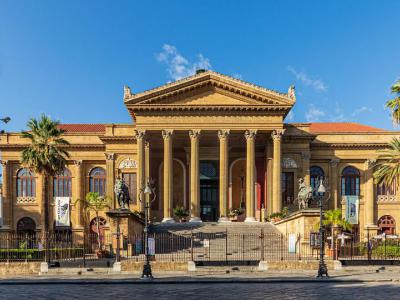
The Massimo Theater is the largest opera house in Italy, often cited as the third largest after the Paris Opera and Vienna State Opera. In 1864, the Palermo City Council launched an international competition to design a new opera house, intended to express the cultural ambitions of newly unified Italy. The winning design was by architect Giovanni Battista Filippo Basile, a leading figure in Sicilian historicist architecture. After his death in 1891, construction was continued and completed by his son, Ernesto Basile. The theater officially opened in 1897.
Basile drew inspiration from classical Sicilian architecture, particularly the monumental forms of the ancient Greek temples of Agrigento, combined with elements of Neoclassicism and late Renaissance revival. The massive portico, broad steps, and temple-like massing give the building a solemn, ceremonial presence.
Inside, the auditorium seats approximately 1,300 spectators and is arranged in the traditional horseshoe shape, designed for optimal acoustics. It features seven levels, including stalls, boxes, and galleries. The stage is slightly inclined, while the seating rises steadily away from it, enhancing sightlines and sound projection.
In 1974, the theater closed for restoration and modernization. What was initially planned as a relatively short renovation became a 23-year closure. It finally reopened in 1997, regaining its role as Palermo’s principal cultural venue. Since reopening, the theater has resumed an active international program of opera, ballet, and concerts. While administrative and financial challenges have periodically affected its management, the Massimo remains a central symbol of Palermo’s cultural life and ambitions.
Basile drew inspiration from classical Sicilian architecture, particularly the monumental forms of the ancient Greek temples of Agrigento, combined with elements of Neoclassicism and late Renaissance revival. The massive portico, broad steps, and temple-like massing give the building a solemn, ceremonial presence.
Inside, the auditorium seats approximately 1,300 spectators and is arranged in the traditional horseshoe shape, designed for optimal acoustics. It features seven levels, including stalls, boxes, and galleries. The stage is slightly inclined, while the seating rises steadily away from it, enhancing sightlines and sound projection.
In 1974, the theater closed for restoration and modernization. What was initially planned as a relatively short renovation became a 23-year closure. It finally reopened in 1997, regaining its role as Palermo’s principal cultural venue. Since reopening, the theater has resumed an active international program of opera, ballet, and concerts. While administrative and financial challenges have periodically affected its management, the Massimo remains a central symbol of Palermo’s cultural life and ambitions.
