Custom Walk in Dubrovnik, Croatia by rogerfor_c247ba created on 2026-03-27
Guide Location: Croatia » Dubrovnik
Guide Type: Custom Walk
# of Sights: 10
Tour Duration: 2 Hour(s)
Travel Distance: 1.9 Km or 1.2 Miles
Share Key: 5ZH2K
Guide Type: Custom Walk
# of Sights: 10
Tour Duration: 2 Hour(s)
Travel Distance: 1.9 Km or 1.2 Miles
Share Key: 5ZH2K
How It Works
Please retrieve this walk in the GPSmyCity app. Once done, the app will guide you from one tour stop to the next as if you had a personal tour guide. If you created the walk on this website or come to the page via a link, please follow the instructions below to retrieve the walk in the app.
Retrieve This Walk in App
Step 1. Download the app "GPSmyCity: Walks in 1K+ Cities" on Apple App Store or Google Play Store.



Step 2. In the GPSmyCity app, download(or launch) the guide "Dubrovnik Map and Walking Tours".
Step 3. Tap the menu button located at upper right corner of the "Walks" screen and select "Retrieve custom walk". Enter the share key: 5ZH2K
1) Pile Gate (must see)
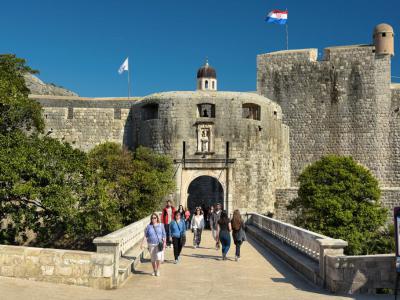
"Kill them, kill them all!" King Joffrey is under attack by an angry mob when he returns to Red Keep. Dramatic scene, plenty of shouting… except there's a thing or two missing. There's no King Joffrey here, and definitely no Red Keep. What you’re seeing is Pile Gate. Television magic simply turned this Croatian gateway into one of the most famous locations in “Game of Thrones,” particularly in Season 2, Episode 6, when Joffrey discovers that ruling a kingdom does not always guarantee popularity.
The name Pile comes from the Greek word pylaj, meaning “gate,” which is quite fitting for what has been Dubrovnik’s main doorway for centuries. Most visitors begin their walk through the Old City right here. The gate sits on the western side of the city walls and leads directly onto Stradun Street, Dubrovnik’s main promenade.
But Pile Gate is not just one gate—it is actually two. The inner gate was built in 1460, while the outer gate was added in 1537. Together, they formed part of a carefully designed defensive system. Protecting the approach was the cylindrical Fort Bokar, along with a deep moat that once surrounded the outer wall. Today, the moat is dry and has been transformed into a green strip of landscaped parkland between the walls.
To reach the gate, visitors cross a stone bridge with elegant Gothic arches. Designed in 1471, this bridge connected to a wooden drawbridge over the moat. Each night, the drawbridge was raised, sealing the entrance and keeping the city secure.
Above the gateway arch stands a statue of Saint Blaise, the patron saint of Dubrovnik. He holds a small model of the city in his hand, as if quietly keeping watch over the place he protects.
Beyond the gate lies one of the most impressive defensive systems in Europe. Dubrovnik’s city walls stretch for nearly two kilometers and in some sections rise as high as 82 feet. The land-facing side is reinforced with ten circular bastions and a powerful fortress. The two main entrances to the city are Pile Gate in the west and Ploče Gate in the east.
So, as you walk through Pile Gate, remember: you’re not entering King’s Landing, but stepping into one of the best-preserved medieval cities in the world. And thankfully, today the only crowds waiting here are tourists—not angry mobs...
The name Pile comes from the Greek word pylaj, meaning “gate,” which is quite fitting for what has been Dubrovnik’s main doorway for centuries. Most visitors begin their walk through the Old City right here. The gate sits on the western side of the city walls and leads directly onto Stradun Street, Dubrovnik’s main promenade.
But Pile Gate is not just one gate—it is actually two. The inner gate was built in 1460, while the outer gate was added in 1537. Together, they formed part of a carefully designed defensive system. Protecting the approach was the cylindrical Fort Bokar, along with a deep moat that once surrounded the outer wall. Today, the moat is dry and has been transformed into a green strip of landscaped parkland between the walls.
To reach the gate, visitors cross a stone bridge with elegant Gothic arches. Designed in 1471, this bridge connected to a wooden drawbridge over the moat. Each night, the drawbridge was raised, sealing the entrance and keeping the city secure.
Above the gateway arch stands a statue of Saint Blaise, the patron saint of Dubrovnik. He holds a small model of the city in his hand, as if quietly keeping watch over the place he protects.
Beyond the gate lies one of the most impressive defensive systems in Europe. Dubrovnik’s city walls stretch for nearly two kilometers and in some sections rise as high as 82 feet. The land-facing side is reinforced with ten circular bastions and a powerful fortress. The two main entrances to the city are Pile Gate in the west and Ploče Gate in the east.
So, as you walk through Pile Gate, remember: you’re not entering King’s Landing, but stepping into one of the best-preserved medieval cities in the world. And thankfully, today the only crowds waiting here are tourists—not angry mobs...
2) Saint Ignatius Church (must see)
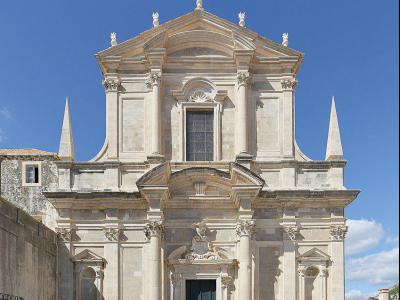
Climb the broad staircase in Ruđer Bošković Square, and you might feel a sudden sense of déjà vu. That's no accident. The steps leading up to the Church of Saint Ignatius were clearly inspired by Rome’s famous Spanish Steps. At the top, waits a church that would look perfectly at home in the heart of Italy. Built for the Jesuit order in 1725, this church follows the Roman Baroque style and was designed by the Jesuit architect Ignazio Pozzo as a single-nave space meant to impress rather than whisper.
Once inside, the ceiling quickly steals the show. Baroque frescoes painted by Gaetano Garcia unfold above, illustrating scenes from the life of Saint Ignatius. Later additions brought in more layers to the interior. In 1885, a small grotto dedicated to Our Lady of Lourdes was painted by Jesuit artist Antonio Moscheni. Balconies and small gallery boxes line the sides, while daylight gently filters through the stained-glass roof, filling the church with a soft glow that highlights every painted surface.
Outside, the façade delivers full Baroque drama. Free-standing columns frame the central section, while sculpted angels gather around an ornate portal designed by architect Marino Groppelli. The result feels theatrical, as if the building itself is making a grand entrance.
Right next door stands the Jesuit Collegium. Its first version appeared in 1662, though the great earthquake of 1667 prompted its major reconstruction between 1669 and 1725. One of the institution's most famous teachers was the celebrated scientist and philosopher Ruđer Bošković, whose ideas traveled far beyond Dubrovnik’s walls. Today, the building still serves education, housing the Classical Gymnasium High School of Dubrovnik—a vivid proof that even centuries-old Jesuit classrooms can continue shaping new generations...
Once inside, the ceiling quickly steals the show. Baroque frescoes painted by Gaetano Garcia unfold above, illustrating scenes from the life of Saint Ignatius. Later additions brought in more layers to the interior. In 1885, a small grotto dedicated to Our Lady of Lourdes was painted by Jesuit artist Antonio Moscheni. Balconies and small gallery boxes line the sides, while daylight gently filters through the stained-glass roof, filling the church with a soft glow that highlights every painted surface.
Outside, the façade delivers full Baroque drama. Free-standing columns frame the central section, while sculpted angels gather around an ornate portal designed by architect Marino Groppelli. The result feels theatrical, as if the building itself is making a grand entrance.
Right next door stands the Jesuit Collegium. Its first version appeared in 1662, though the great earthquake of 1667 prompted its major reconstruction between 1669 and 1725. One of the institution's most famous teachers was the celebrated scientist and philosopher Ruđer Bošković, whose ideas traveled far beyond Dubrovnik’s walls. Today, the building still serves education, housing the Classical Gymnasium High School of Dubrovnik—a vivid proof that even centuries-old Jesuit classrooms can continue shaping new generations...
3) Rector's Palace (must see)
Located just south of Luža Square, the Rector’s Palace—formerly the political nerve center of the Republic of Ragusa—was once a government office, official residence, and a very controlled living arrangement rolled into one.
Built in the 13th century, it served initially as the accommodation for Dubrovnik’s Rector, the city’s highest official. His term in office lasted only one month, during which the Rector abided by strict rules. In particular, he might leave the palace only for official duties, while his family resided elsewhere. One of his key responsibilities—quite literally—was safeguarding the keys to Dubrovnik’s city gates.
Still, the palace was far more than just an official dwelling. It also housed the Republic’s Major and Minor Councils, the city’s main arsenal, and even the prison. Courtrooms and government chambers operated here too, making the building the core of Dubrovnik’s political life. Personal comfort was not the priority; governance was.
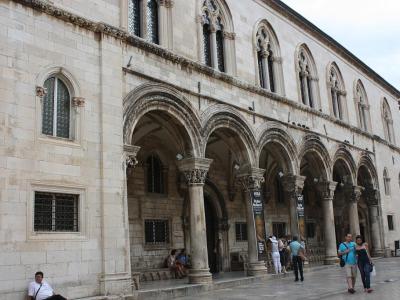
Over the centuries, the palace has survived numerous earthquakes, fires, wars, and sieges, and its architecture duly reflects that turbulent history. The original structure was Gothic, but later reconstructions introduced Renaissance and Baroque elements. After a gunpowder explosion in 1463, the building was rebuilt with the elegant atrium and portico that define its appearance today.
The western entrance features a graceful portico with carved columns and capitals. Inside, the courtyard is framed by Corinthian columns and a Baroque staircase that leads to the upper gallery. Beneath the staircase stands a small 15th-century fountain and a statue created in 1638 by sculptor Piero Paolo Giacometti. It honors Miho Pracat, a wealthy Dubrovnik merchant, who donated his entire fortune to the Republic.
The palace courtyard is known for its excellent acoustics. During the Dubrovnik Summer Festival, concerts are often held here, transforming the historic government atrium into a lively cultural stage.
Today, the building houses the Museum of Dubrovnik, which has managed the palace since 1872. Its exhibitions display artifacts from the city’s past, including furniture, portraits, coins, seals, and coats of arms. Visitors can also see the keys to the city gates and records from meetings of the Republic’s councils, along with objects connected to the 15th-century charitable hospital known as Domus Christi, the House of Christ.
Walking through the Rector’s Palace offers a glimpse into the disciplined and carefully organized world of Dubrovnik’s former republic, where power changed hands every month, but the city’s traditions remained firmly in place...
Built in the 13th century, it served initially as the accommodation for Dubrovnik’s Rector, the city’s highest official. His term in office lasted only one month, during which the Rector abided by strict rules. In particular, he might leave the palace only for official duties, while his family resided elsewhere. One of his key responsibilities—quite literally—was safeguarding the keys to Dubrovnik’s city gates.
Still, the palace was far more than just an official dwelling. It also housed the Republic’s Major and Minor Councils, the city’s main arsenal, and even the prison. Courtrooms and government chambers operated here too, making the building the core of Dubrovnik’s political life. Personal comfort was not the priority; governance was.
Over the centuries, the palace has survived numerous earthquakes, fires, wars, and sieges, and its architecture duly reflects that turbulent history. The original structure was Gothic, but later reconstructions introduced Renaissance and Baroque elements. After a gunpowder explosion in 1463, the building was rebuilt with the elegant atrium and portico that define its appearance today.
The western entrance features a graceful portico with carved columns and capitals. Inside, the courtyard is framed by Corinthian columns and a Baroque staircase that leads to the upper gallery. Beneath the staircase stands a small 15th-century fountain and a statue created in 1638 by sculptor Piero Paolo Giacometti. It honors Miho Pracat, a wealthy Dubrovnik merchant, who donated his entire fortune to the Republic.
The palace courtyard is known for its excellent acoustics. During the Dubrovnik Summer Festival, concerts are often held here, transforming the historic government atrium into a lively cultural stage.
Today, the building houses the Museum of Dubrovnik, which has managed the palace since 1872. Its exhibitions display artifacts from the city’s past, including furniture, portraits, coins, seals, and coats of arms. Visitors can also see the keys to the city gates and records from meetings of the Republic’s councils, along with objects connected to the 15th-century charitable hospital known as Domus Christi, the House of Christ.
Walking through the Rector’s Palace offers a glimpse into the disciplined and carefully organized world of Dubrovnik’s former republic, where power changed hands every month, but the city’s traditions remained firmly in place...
4) Luža Square
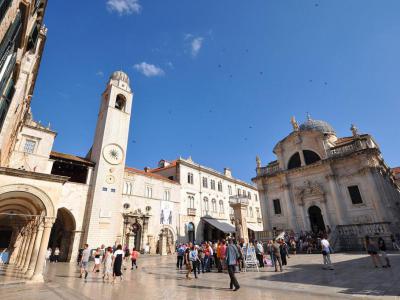
Luža Square may not be large, but it certainly makes efficient use of space. Packed into this compact corner are several of Dubrovnik’s most recognizable landmarks, such as Sponza Palace, the Clock Tower, Saint Blaise’s Church, Orlando’s Column, and Onofrio’s Small Fountain.
Look around, and you’ll notice even more familiar faces. There’s the elegant City Café (known locally as Gradska Kavana), the Marin Držić Theater, the Rector’s Palace, and just a short walk away, the Dubrovnik Cathedral.
Today, the square buzzes with tourists snapping photos and café tables filling up with espresso drinkers. But in earlier times, this same square hosted public announcements, legal trials, punishments, and the occasional execution. In other words, Dubrovnik’s version of a town hall meeting was a bit more dramatic.
Architecturally, the square fits together like a carefully arranged puzzle. Sponza Palace sits beside the Bell Tower, which leads toward a gateway opening to the harbor. Nearby stands the City Guard building, keeping watch beside Onofrio’s Small Fountain.
Just across the way, you’ll find the bronze statue of Marin Držić, Dubrovnik’s celebrated Renaissance playwright—often nicknamed the “Shakespeare of Dubrovnik.” He sits thoughtfully outside the theater that bears his name, conveniently close to the Rector’s Palace, which now serves as a museum.
A few steps further brings you to the Dubrovnik Cathedral and its treasury. Just beyond it lies Gundulić Square, home to a lively morning market. For centuries, Luža Square has also served as the stage for major events such as the Dubrovnik Summer Festival and the Feast of Saint Blaise, the city’s patron saint.
If you’d like to experience the square without quite so many fellow explorers, try arriving early in the summer—or later in the quieter winter months, when the stones echo more with history than with footsteps...
Look around, and you’ll notice even more familiar faces. There’s the elegant City Café (known locally as Gradska Kavana), the Marin Držić Theater, the Rector’s Palace, and just a short walk away, the Dubrovnik Cathedral.
Today, the square buzzes with tourists snapping photos and café tables filling up with espresso drinkers. But in earlier times, this same square hosted public announcements, legal trials, punishments, and the occasional execution. In other words, Dubrovnik’s version of a town hall meeting was a bit more dramatic.
Architecturally, the square fits together like a carefully arranged puzzle. Sponza Palace sits beside the Bell Tower, which leads toward a gateway opening to the harbor. Nearby stands the City Guard building, keeping watch beside Onofrio’s Small Fountain.
Just across the way, you’ll find the bronze statue of Marin Držić, Dubrovnik’s celebrated Renaissance playwright—often nicknamed the “Shakespeare of Dubrovnik.” He sits thoughtfully outside the theater that bears his name, conveniently close to the Rector’s Palace, which now serves as a museum.
A few steps further brings you to the Dubrovnik Cathedral and its treasury. Just beyond it lies Gundulić Square, home to a lively morning market. For centuries, Luža Square has also served as the stage for major events such as the Dubrovnik Summer Festival and the Feast of Saint Blaise, the city’s patron saint.
If you’d like to experience the square without quite so many fellow explorers, try arriving early in the summer—or later in the quieter winter months, when the stones echo more with history than with footsteps...
5) Saint Blaise's Church (must see)
In Dubrovnik, one name appears everywhere—from statues to festivals to flags fluttering above the old streets. Saint Blaise, or Sveti Vlaho, if you want to make it sound Croatian, was a bishop, martyr, healer of animals, and—according to local legend—the city’s personal guardian.
Back in the year 971, he reportedly appeared in a vision to a priest named Stojko and warned him that the Venetians were planning a surprise attack. This warning ultimately saved the city, and Dubrovnik, in gratitude, has been honoring Saint Blaise ever since. His church stands proudly in Luža Square, right in the ceremonial heart of the Old Town.
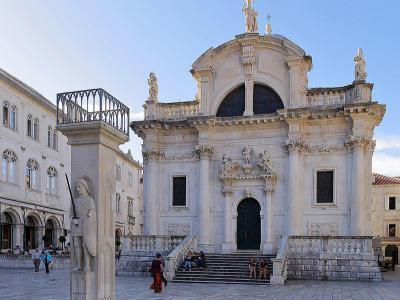
The present Saint Blaise’s Church was completed in 1715, designed by Venetian architect Marino Groppelli. It rose on the site of an earlier Romanesque church that had stood here for centuries before that. The new building follows a Greek-cross plan, meaning that all four arms of the cross are the same length. The single nave leads toward the apse, which is framed by two sacristies, while an oval dome sits above the center like a crown placed carefully on the structure.
The exterior announces itself in confident Baroque fashion. Four Corinthian columns frame the lower façade—two beside the main entrance and two marking the outer edges. Above them rises a curved gable and balustrade, a kind of stone balcony for the sky. At the top stands Saint Blaise himself, calmly watching over the city. On either side are symbolic companions—Faith and Hope—quiet reminders that Dubrovnik has needed both more than once...
Inside, the church feels richly theatrical, as Baroque interiors often do. The barrel-vaulted ceiling draws the eye upward, while marble surfaces reflect soft light across the space. At the main altar, made from white and multicolored marble, stands a particularly important figure: a 15th-century statue of Saint Blaise. In his hand, he holds a small model of the older Romanesque church that once stood here—destroyed by fire during the great earthquake of 1667.
It’s a subtle detail, but a meaningful one: the city’s protector calmly holding a reminder of what was lost—much as of what Dubrovnik has managed to rebuild...
Back in the year 971, he reportedly appeared in a vision to a priest named Stojko and warned him that the Venetians were planning a surprise attack. This warning ultimately saved the city, and Dubrovnik, in gratitude, has been honoring Saint Blaise ever since. His church stands proudly in Luža Square, right in the ceremonial heart of the Old Town.
The present Saint Blaise’s Church was completed in 1715, designed by Venetian architect Marino Groppelli. It rose on the site of an earlier Romanesque church that had stood here for centuries before that. The new building follows a Greek-cross plan, meaning that all four arms of the cross are the same length. The single nave leads toward the apse, which is framed by two sacristies, while an oval dome sits above the center like a crown placed carefully on the structure.
The exterior announces itself in confident Baroque fashion. Four Corinthian columns frame the lower façade—two beside the main entrance and two marking the outer edges. Above them rises a curved gable and balustrade, a kind of stone balcony for the sky. At the top stands Saint Blaise himself, calmly watching over the city. On either side are symbolic companions—Faith and Hope—quiet reminders that Dubrovnik has needed both more than once...
Inside, the church feels richly theatrical, as Baroque interiors often do. The barrel-vaulted ceiling draws the eye upward, while marble surfaces reflect soft light across the space. At the main altar, made from white and multicolored marble, stands a particularly important figure: a 15th-century statue of Saint Blaise. In his hand, he holds a small model of the older Romanesque church that once stood here—destroyed by fire during the great earthquake of 1667.
It’s a subtle detail, but a meaningful one: the city’s protector calmly holding a reminder of what was lost—much as of what Dubrovnik has managed to rebuild...
6) Dubrovnik Synagogue
The Dubrovnik Synagogue, located within the city’s historic Old Town, holds a special place in both Croatian and European Jewish heritage. Established in the mid-14th century, it is recognized as the second-oldest synagogue still in use in Europe and the oldest Sephardic synagogue on the continent. Its foundation coincided with the settlement of Jews in Dubrovnik after their expulsion from Spain and Portugal, when the Republic of Ragusa welcomed them as merchants, physicians, and diplomats. Tucked along a narrow lane off the bustling Stradun, the synagogue reflects the centuries-long presence of a once-thriving Jewish community in the city.
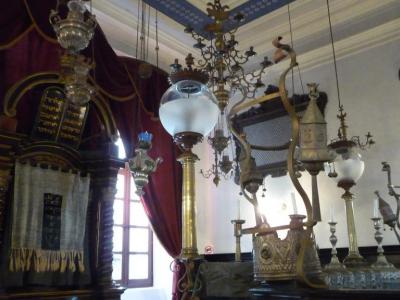
Architecturally, the synagogue blends Gothic and Baroque elements, mirroring Dubrovnik’s layered history. While its unassuming exterior blends into the surrounding stone buildings, the interior reveals a richly decorated sanctuary. Wooden furnishings, brass chandeliers, and an ornate Ark holding centuries-old Torah scrolls give the space a warm and reverent atmosphere. The synagogue has undergone restorations over time, particularly after damage during the 1667 earthquake and, more recently, during the Croatian War of Independence in the 1990s. Despite hardships, it has remained a symbol of resilience and continuity for Dubrovnik’s Jewish community.
Today, the synagogue also houses a small museum that offers visitors insight into Jewish life in Dubrovnik over the centuries. Exhibits include religious artifacts, archival documents, and personal items that trace the community’s story from the Middle Ages to modern times. For travelers, a visit provides not only a spiritual and historical experience but also a deeper understanding of the multicultural layers that shaped Dubrovnik.
Architecturally, the synagogue blends Gothic and Baroque elements, mirroring Dubrovnik’s layered history. While its unassuming exterior blends into the surrounding stone buildings, the interior reveals a richly decorated sanctuary. Wooden furnishings, brass chandeliers, and an ornate Ark holding centuries-old Torah scrolls give the space a warm and reverent atmosphere. The synagogue has undergone restorations over time, particularly after damage during the 1667 earthquake and, more recently, during the Croatian War of Independence in the 1990s. Despite hardships, it has remained a symbol of resilience and continuity for Dubrovnik’s Jewish community.
Today, the synagogue also houses a small museum that offers visitors insight into Jewish life in Dubrovnik over the centuries. Exhibits include religious artifacts, archival documents, and personal items that trace the community’s story from the Middle Ages to modern times. For travelers, a visit provides not only a spiritual and historical experience but also a deeper understanding of the multicultural layers that shaped Dubrovnik.

7) War Photo Limited (must see)
Just a short step away from Stradun, tucked inside Dubrovnik’s Old Town, is the War Photo Limited, a museum that trades medieval romance for a much harsher view of history. It operates seasonally—from April through October—and spreads its exhibitions across two floors. Instead of paintings or artifacts, the walls are covered with powerful photojournalism from modern conflicts around the globe. The images are compelling and often deeply moving, though some visitors may find them difficult to look at.
The museum’s purpose is simple but direct: to show war exactly as it appears through the camera lens. There is little attempt to soften the reality. Many of the photographs are raw, immediate, and sometimes unsettling. Conflicts from places such as Afghanistan, Sierra Leone, Iraq, and Croatia appear here in stark detail. Against the dark gallery walls, the brightly lit images range from scenes of violence to moments of strange, almost surreal absurdity that war sometimes produces.
The second floor focuses on a conflict that left a lasting mark on this very city. Here, a permanent exhibition documents the siege of Dubrovnik and the wider war in Croatia following the breakup of Yugoslavia in the early 1990s. The photographs show damaged streets, civilians under threat, and the everyday reality of a city caught in war.
War Photo Limited presents these images without commentary, slogans, or political messaging. Its mission is to collect and display photographs of modern conflicts, allowing visitors to see the human consequences of war through the eyes of those who documented it.
The museum’s purpose is simple but direct: to show war exactly as it appears through the camera lens. There is little attempt to soften the reality. Many of the photographs are raw, immediate, and sometimes unsettling. Conflicts from places such as Afghanistan, Sierra Leone, Iraq, and Croatia appear here in stark detail. Against the dark gallery walls, the brightly lit images range from scenes of violence to moments of strange, almost surreal absurdity that war sometimes produces.
The second floor focuses on a conflict that left a lasting mark on this very city. Here, a permanent exhibition documents the siege of Dubrovnik and the wider war in Croatia following the breakup of Yugoslavia in the early 1990s. The photographs show damaged streets, civilians under threat, and the everyday reality of a city caught in war.
War Photo Limited presents these images without commentary, slogans, or political messaging. Its mission is to collect and display photographs of modern conflicts, allowing visitors to see the human consequences of war through the eyes of those who documented it.
8) Stradun Street (must see)
Imagine a street that has been the city’s living room for centuries. That is Stradun, also known as Placa, an elegant promenade and the heart of Dubrovnik’s historic center.
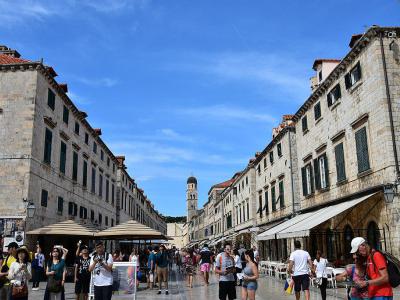
Running about 1,000 feet through the Old Town, it stretches neatly from the Pile Gate in the west to Luža Square in the east and further beyond the Ploče Gate. Near the Pile Gate stand the Large Onofrio’s Fountain and the Franciscan Monastery. At the opposite end, near Ploče Gate, you will find the Small Onofrio’s Fountain and the Dubrovnik Bell Tower, close to lively Luža Square.
Today, this polished limestone boulevard forms the central axis of Dubrovnik, but its origin was far less glamorous. Back in the 13th century, it was nothing more than a swampy channel. The street’s current appearance dates mostly after the devastating 1667 earthquake, which ruined much of the city and forced Dubrovnik to rebuild.
The rebuilding came with strict rules. After the disaster, the Republic introduced regulations for construction along Stradun, which explains the remarkable uniformity of local buildings. Before the quake, houses had arcades and elaborate decoration, most of which was lost to the fire that followed.
The new buildings were designed with shop spaces on the ground floor beneath semicircular arches. The first floor served as the main living area, while the upper floors contained extra rooms and a small kitchen loft.
Since then, Stradun has also become Dubrovnik’s favorite stage. Festivals, celebrations, and processions pass through here regularly. These include the Feast of Saint Blaise, Dubrovnik’s patron saint, on February 3rd.
The best way to experience Stradun is an unhurried stroll. Stop at a café, have a drink, and watch the steady flow of people. The steps of Saint Blaise’s Church offer a great viewpoint.
Nearby stands Orlando’s Column, erected in 1418, showing the knight Orlando with a sword and shield. Legend claims that he once defeated Saracen pirates along this very coast. True or not, Orlando has long stood as a symbol of Dubrovnik’s freedom—and he still watches over the city’s most famous street.
Running about 1,000 feet through the Old Town, it stretches neatly from the Pile Gate in the west to Luža Square in the east and further beyond the Ploče Gate. Near the Pile Gate stand the Large Onofrio’s Fountain and the Franciscan Monastery. At the opposite end, near Ploče Gate, you will find the Small Onofrio’s Fountain and the Dubrovnik Bell Tower, close to lively Luža Square.
Today, this polished limestone boulevard forms the central axis of Dubrovnik, but its origin was far less glamorous. Back in the 13th century, it was nothing more than a swampy channel. The street’s current appearance dates mostly after the devastating 1667 earthquake, which ruined much of the city and forced Dubrovnik to rebuild.
The rebuilding came with strict rules. After the disaster, the Republic introduced regulations for construction along Stradun, which explains the remarkable uniformity of local buildings. Before the quake, houses had arcades and elaborate decoration, most of which was lost to the fire that followed.
The new buildings were designed with shop spaces on the ground floor beneath semicircular arches. The first floor served as the main living area, while the upper floors contained extra rooms and a small kitchen loft.
Since then, Stradun has also become Dubrovnik’s favorite stage. Festivals, celebrations, and processions pass through here regularly. These include the Feast of Saint Blaise, Dubrovnik’s patron saint, on February 3rd.
The best way to experience Stradun is an unhurried stroll. Stop at a café, have a drink, and watch the steady flow of people. The steps of Saint Blaise’s Church offer a great viewpoint.
Nearby stands Orlando’s Column, erected in 1418, showing the knight Orlando with a sword and shield. Legend claims that he once defeated Saracen pirates along this very coast. True or not, Orlando has long stood as a symbol of Dubrovnik’s freedom—and he still watches over the city’s most famous street.
9) Franciscan Monastery & Museum (must see)
Dubrovnik’s Franciscan Monastery is a quiet complex that carries nearly eight centuries of history. A document from 1235 mentions a Franciscan monastery dedicated to Saint Thomas in the suburb of Pile, outside the city walls. Amid growing tensions with King Uroš II of Serbia, the friars decided it would be safer to move inside Dubrovnik’s defenses, and thus, in 1317, they rebuilt the monastery within the city walls. The destructive earthquake of 1667 damaged much of the complex, and the church was restored in the Baroque style seen today.
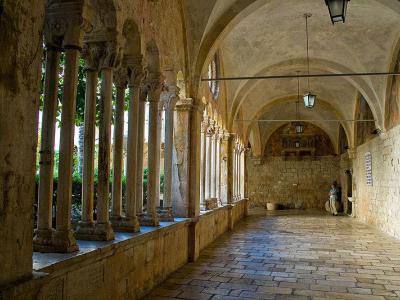
The monastery unfolds around two elegant cloisters. The upper cloister reflects Renaissance design, with graceful arches and semicircular vaults. The lower cloister is older and combines Romanesque and Gothic elements. Its courtyard is surrounded by galleries supported by double columns, while the carved capitals above them show detailed decorations of plants, animals, and geometric patterns.
This lower cloister was in the early 13th century and remains one of the monastery’s most admired features. It contains 120 columns and twelve large pilasters arranged around the courtyard. At the center stands a fountain and a statue of Saint Francis, creating a calm focal point where monks once gathered.
One of the monastery’s greatest treasures is the Minor Friars Pharmacy. Operational since 1317, it is considered one of the oldest pharmacies in Europe. Inside, visitors can see original cabinets and furnishings crafted in Siena and Florence during the 15th and 16th centuries. Glass jars, instruments, and handwritten prescriptions reveal how medicines were prepared long before modern laboratories.
The monastery museum displays presses, mortars, scales, and even a 14th-century distillation still used to produce medicine. The onsite library preserves copies of medieval manuscripts and chorales, along with paintings by lesser-known masters.
Among the most unusual relics are a 14th-century head of Saint Ursula and a collection of ex-voto jewelry—devotional offerings created from antique elements. Together, these objects show that the monastery served not only as a place of worship, but also as a center of healing, learning, and daily life in medieval Dubrovnik.
The monastery unfolds around two elegant cloisters. The upper cloister reflects Renaissance design, with graceful arches and semicircular vaults. The lower cloister is older and combines Romanesque and Gothic elements. Its courtyard is surrounded by galleries supported by double columns, while the carved capitals above them show detailed decorations of plants, animals, and geometric patterns.
This lower cloister was in the early 13th century and remains one of the monastery’s most admired features. It contains 120 columns and twelve large pilasters arranged around the courtyard. At the center stands a fountain and a statue of Saint Francis, creating a calm focal point where monks once gathered.
One of the monastery’s greatest treasures is the Minor Friars Pharmacy. Operational since 1317, it is considered one of the oldest pharmacies in Europe. Inside, visitors can see original cabinets and furnishings crafted in Siena and Florence during the 15th and 16th centuries. Glass jars, instruments, and handwritten prescriptions reveal how medicines were prepared long before modern laboratories.
The monastery museum displays presses, mortars, scales, and even a 14th-century distillation still used to produce medicine. The onsite library preserves copies of medieval manuscripts and chorales, along with paintings by lesser-known masters.
Among the most unusual relics are a 14th-century head of Saint Ursula and a collection of ex-voto jewelry—devotional offerings created from antique elements. Together, these objects show that the monastery served not only as a place of worship, but also as a center of healing, learning, and daily life in medieval Dubrovnik.
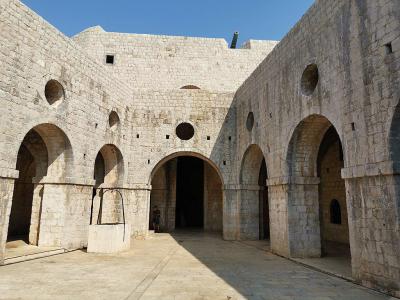
10) Fort Lovrijenac (must see)
Fort Lovrijenac—often nicknamed the “Gibraltar of Dubrovnik”—rises boldly from a 37-meter cliff just outside the city’s western walls, looking as though it was placed there specifically to intimidate anyone arriving by sea. The fortress dates back to the early 11th century and was built to keep a watchful eye on Venice, Dubrovnik’s powerful maritime rival.
According to local legend, the Venetians once intended to build their own fort on this exact rock. Dubrovnik’s citizens, not exactly thrilled with that idea, reportedly rushed to construct Lovrijenac first—and finished it so quickly that Venice never had the chance. Since then, the fortress has stood as a proud symbol of the city’s independence and determination to remain its own master.
The structure itself reflects pure strategic thinking. Lovrijenac is triangular in shape, with walls reaching an impressive 12 meters thick on the seaward side, while the landward walls are just 60 centimeters thick—thin enough that defenders inside could deal with trouble approaching from the city, if needed. Its position allowed guards to control both land and sea routes into Dubrovnik, making the fortress a crucial piece of the city’s defenses.
Above the entrance, you’ll notice a Latin inscription: Non Bene Pro Toto Libertas Venditur Auro, which means, quite simply, “Freedom is not sold for all the gold in the world.” It’s a motto that perfectly sums up Dubrovnik’s long-standing reputation for independence.
These days, Fort Lovrijenac has traded cannon smoke for theater lights. During the Dubrovnik Summer Festival, the fortress regularly becomes the dramatic stage for Shakespeare’s Hamlet, where the stone walls and open sea create a setting no theater designer could hope to improve.
And if the place looks familiar, that’s because it also played a starring role in the HBO series Game of Thrones. In the show, Lovrijenac served as the Red Keep of King’s Landing. Several memorable scenes were filmed here, including King Joffrey’s tournament celebration in Season 2, Episode 1, “The North Remembers.” In that same episode, the fortress setting hosted a tense exchange between Cersei and Littlefinger—when the famous line “Knowledge is power” is swiftly corrected with Cersei’s reply: “Power is power.”
Indeed, this fortress is one of those rare spots where the city’s long military history, dramatic setting, and television fantasy all come together on the same dramatic cliff.
According to local legend, the Venetians once intended to build their own fort on this exact rock. Dubrovnik’s citizens, not exactly thrilled with that idea, reportedly rushed to construct Lovrijenac first—and finished it so quickly that Venice never had the chance. Since then, the fortress has stood as a proud symbol of the city’s independence and determination to remain its own master.
The structure itself reflects pure strategic thinking. Lovrijenac is triangular in shape, with walls reaching an impressive 12 meters thick on the seaward side, while the landward walls are just 60 centimeters thick—thin enough that defenders inside could deal with trouble approaching from the city, if needed. Its position allowed guards to control both land and sea routes into Dubrovnik, making the fortress a crucial piece of the city’s defenses.
Above the entrance, you’ll notice a Latin inscription: Non Bene Pro Toto Libertas Venditur Auro, which means, quite simply, “Freedom is not sold for all the gold in the world.” It’s a motto that perfectly sums up Dubrovnik’s long-standing reputation for independence.
These days, Fort Lovrijenac has traded cannon smoke for theater lights. During the Dubrovnik Summer Festival, the fortress regularly becomes the dramatic stage for Shakespeare’s Hamlet, where the stone walls and open sea create a setting no theater designer could hope to improve.
And if the place looks familiar, that’s because it also played a starring role in the HBO series Game of Thrones. In the show, Lovrijenac served as the Red Keep of King’s Landing. Several memorable scenes were filmed here, including King Joffrey’s tournament celebration in Season 2, Episode 1, “The North Remembers.” In that same episode, the fortress setting hosted a tense exchange between Cersei and Littlefinger—when the famous line “Knowledge is power” is swiftly corrected with Cersei’s reply: “Power is power.”
Indeed, this fortress is one of those rare spots where the city’s long military history, dramatic setting, and television fantasy all come together on the same dramatic cliff.
