Custom Walk in Oxford, England by willy49_727c7 created on 2026-04-16
Guide Location: England » Oxford
Guide Type: Custom Walk
# of Sights: 9
Tour Duration: 1 Hour(s)
Travel Distance: 1.7 Km or 1.1 Miles
Share Key: JDYH8
Guide Type: Custom Walk
# of Sights: 9
Tour Duration: 1 Hour(s)
Travel Distance: 1.7 Km or 1.1 Miles
Share Key: JDYH8
How It Works
Please retrieve this walk in the GPSmyCity app. Once done, the app will guide you from one tour stop to the next as if you had a personal tour guide. If you created the walk on this website or come to the page via a link, please follow the instructions below to retrieve the walk in the app.
Retrieve This Walk in App
Step 1. Download the app "GPSmyCity: Walks in 1K+ Cities" on Apple App Store or Google Play Store.



Step 2. In the GPSmyCity app, download(or launch) the guide "Oxford Map and Walking Tours".
Step 3. Tap the menu button located at upper right corner of the "Walks" screen and select "Retrieve custom walk". Enter the share key: JDYH8
1) Sheldonian Theatre (must see)
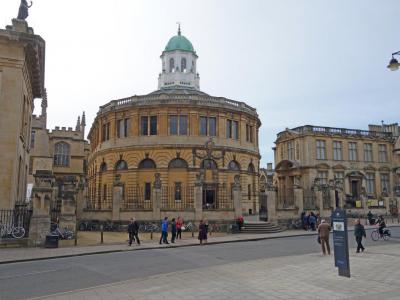
While Oxford University was initially established by clergy members with a primary focus on theology education, it quickly evolved to serve various purposes beyond academic study. One such multifunctional building is the Sheldonian Theatre.
For numerous centuries, graduation ceremonies were conducted at Saint Mary the Virgin on High Church. These events often transformed into lively celebrations, a stark contrast to the solemn religious setting. This displeased the church's clergy to the extent that in 1660, they sought assistance from Gilbert Sheldon, who served as the University's Chancellor. Sheldon, who later became the Archbishop of Canterbury, not only embraced the idea but also personally financed the construction of a dedicated venue for these ceremonies.
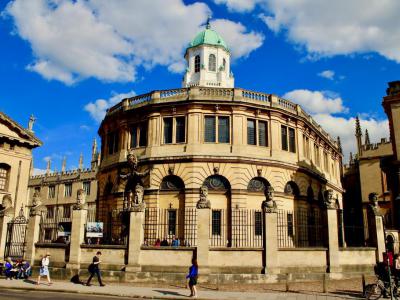
The theater's design was entrusted to Sir Christopher Wren, who departed from the prevalent Gothic architectural style. Instead, he drew inspiration from the 1st-century BC Theatre of Marcellus in Rome. However, a challenge arose due to the D-shaped structure being too wide for the roof beams to support. To overcome this issue, Wren employed a geometric grid pattern, originally devised by John Wallis in 1648. This pattern featured a lattice framework of timber trusses and crossbeams, eliminating the need for additional supporting pillars. In 1802, George Saunders oversaw the reconstruction of the roof.
Adorning the ceiling are 32 oil-on-canvas panels, forming a captivating fresco that narrates the story of Truth, Arts, and Sciences triumphing over Ignorance within the University. Today, in addition to graduation ceremonies, the theater serves as a venue for various events such as conferences, lectures, and music recitals.
A remarkable feature of the theater is its octagonal lantern situated at the center of the roof, with windows on all sides. This offers splendid panoramic views of the city and is accessible to the general public.
For numerous centuries, graduation ceremonies were conducted at Saint Mary the Virgin on High Church. These events often transformed into lively celebrations, a stark contrast to the solemn religious setting. This displeased the church's clergy to the extent that in 1660, they sought assistance from Gilbert Sheldon, who served as the University's Chancellor. Sheldon, who later became the Archbishop of Canterbury, not only embraced the idea but also personally financed the construction of a dedicated venue for these ceremonies.
The theater's design was entrusted to Sir Christopher Wren, who departed from the prevalent Gothic architectural style. Instead, he drew inspiration from the 1st-century BC Theatre of Marcellus in Rome. However, a challenge arose due to the D-shaped structure being too wide for the roof beams to support. To overcome this issue, Wren employed a geometric grid pattern, originally devised by John Wallis in 1648. This pattern featured a lattice framework of timber trusses and crossbeams, eliminating the need for additional supporting pillars. In 1802, George Saunders oversaw the reconstruction of the roof.
Adorning the ceiling are 32 oil-on-canvas panels, forming a captivating fresco that narrates the story of Truth, Arts, and Sciences triumphing over Ignorance within the University. Today, in addition to graduation ceremonies, the theater serves as a venue for various events such as conferences, lectures, and music recitals.
A remarkable feature of the theater is its octagonal lantern situated at the center of the roof, with windows on all sides. This offers splendid panoramic views of the city and is accessible to the general public.
2) Bridge of Sighs (must see)
Unfortunately, if you are not a student of Hertford College, you won’t be able to cross the Bridge of Sighs, but you can certainly admire it from street level and add a photo of it to your collection of Oxford’s marvellous structures.
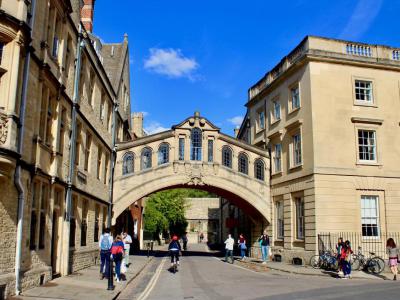
The real name of the bridge is the Hertford Bridge and it was built in 1914 by Sir Thomas Jackson. It took its popular name from the fact that it is supposed to look just like the bridge of the same name in Venice. Actually, it resembles the Rialto Bridge more than anything else, but the Bridge of Sighs sounds more romantic.
The bridge is a fine example of the Quadrature of the Parabola, developed by Archimedes in the 3rd century BC – a rather difficult geometrical concept in that the area of a parabolic segment is 4/3 of a certain inscribed triangle. It all comes down to the triangle (top) of the bridge being supported by the arch (parabola) because they are of the same base length and height.
Leaving the Maths lesson behind, the bridge is covered and glass panelled and links the college’s Old Quad with the New Quad. According to popular legend, the college once closed the bridge to overweight students, forcing them to get some exercise by taking the long route from one building to another.
***Harry Potter Walk***
Conveniently easy to spot behind Oxford’s very own Bridge of Sighs, the ancient (almost 200-year-old) giant Oak Tree, featured during a duel between Harry Potter and Draco Malfoy in Harry Potter and the Goblet of Fire, can be seen in New College Cloisters. And while the cloisters themselves are closed to the public, a photo of the tree can still be snapped from the roadside!
The real name of the bridge is the Hertford Bridge and it was built in 1914 by Sir Thomas Jackson. It took its popular name from the fact that it is supposed to look just like the bridge of the same name in Venice. Actually, it resembles the Rialto Bridge more than anything else, but the Bridge of Sighs sounds more romantic.
The bridge is a fine example of the Quadrature of the Parabola, developed by Archimedes in the 3rd century BC – a rather difficult geometrical concept in that the area of a parabolic segment is 4/3 of a certain inscribed triangle. It all comes down to the triangle (top) of the bridge being supported by the arch (parabola) because they are of the same base length and height.
Leaving the Maths lesson behind, the bridge is covered and glass panelled and links the college’s Old Quad with the New Quad. According to popular legend, the college once closed the bridge to overweight students, forcing them to get some exercise by taking the long route from one building to another.
***Harry Potter Walk***
Conveniently easy to spot behind Oxford’s very own Bridge of Sighs, the ancient (almost 200-year-old) giant Oak Tree, featured during a duel between Harry Potter and Draco Malfoy in Harry Potter and the Goblet of Fire, can be seen in New College Cloisters. And while the cloisters themselves are closed to the public, a photo of the tree can still be snapped from the roadside!
3) Bodleian Library (must see)
Bodleian Library is the main research library of Oxford University, and if you are not a student, you can visit it on a guided tour which should be booked in advance.
The Bodleian is one of the oldest reference libraries in Europe and one of the six legal deposit libraries in the United Kingdom, which means that a copy of every book published in the UK and Ireland is required by law to be deposited here.
The 1st library was founded by Thomas Cobham, the Bishop of Worcester, in the 14th century. It was a chained library – the books were chained to the shelves to stop people pinching them. In 1437, after the Duke of Gloucester donated a vast number of manuscripts, the building proved too small, so Duke Humphrey’s Library was built at Divinity School.
Over the years, the library fell into disuse until 1598 when a Fellow of Merton College, Thomas Bodley, had the place renovated and enlarged to receive his collection of books. It reopened in 1602 and took its present-day name. It was also Bodley who made an agreement with the Stationer’s Company in 1610 to put a copy of each of their books in the library. This agreement became the Deposit Law in the 19th century.
The library expanded in 1612 and 1637 and grew popular with Fellows to donate or bequeath their collections. The New Library was built in 1937 and today a tunnel under Broad Street connects the Old and the New Bodleian.
The library holds a staggering 11 million books and other reading matter, 117 miles of shelves and 400 staff members. Among the ancient manuscripts here is a copy of the Magna Charta and the Song of Roland. It also houses one of the last copies of the Guttenberg Bible.
***Harry Potter Tour***
Hidden away in the Bodleian Library, the Duke Humfrey’s reading room revels in a magical atmosphere. Boasting imposing high walls and an intricately painted ceiling, even the smallest of Harry Potter fans will fail to ignore this eye-catching beauty. Presented as the main Hogwarts Library in the film series, it is most memorable for the scene in The Philosopher’s Stone, when Harry uses his Cloak of Invisibility to sneak into the restricted section of the library. We see Harry creeping around here before he is given away by a screaming book.
The Bodleian is one of the oldest reference libraries in Europe and one of the six legal deposit libraries in the United Kingdom, which means that a copy of every book published in the UK and Ireland is required by law to be deposited here.
The 1st library was founded by Thomas Cobham, the Bishop of Worcester, in the 14th century. It was a chained library – the books were chained to the shelves to stop people pinching them. In 1437, after the Duke of Gloucester donated a vast number of manuscripts, the building proved too small, so Duke Humphrey’s Library was built at Divinity School.
Over the years, the library fell into disuse until 1598 when a Fellow of Merton College, Thomas Bodley, had the place renovated and enlarged to receive his collection of books. It reopened in 1602 and took its present-day name. It was also Bodley who made an agreement with the Stationer’s Company in 1610 to put a copy of each of their books in the library. This agreement became the Deposit Law in the 19th century.
The library expanded in 1612 and 1637 and grew popular with Fellows to donate or bequeath their collections. The New Library was built in 1937 and today a tunnel under Broad Street connects the Old and the New Bodleian.
The library holds a staggering 11 million books and other reading matter, 117 miles of shelves and 400 staff members. Among the ancient manuscripts here is a copy of the Magna Charta and the Song of Roland. It also houses one of the last copies of the Guttenberg Bible.
***Harry Potter Tour***
Hidden away in the Bodleian Library, the Duke Humfrey’s reading room revels in a magical atmosphere. Boasting imposing high walls and an intricately painted ceiling, even the smallest of Harry Potter fans will fail to ignore this eye-catching beauty. Presented as the main Hogwarts Library in the film series, it is most memorable for the scene in The Philosopher’s Stone, when Harry uses his Cloak of Invisibility to sneak into the restricted section of the library. We see Harry creeping around here before he is given away by a screaming book.
4) Radcliffe Camera (must see)
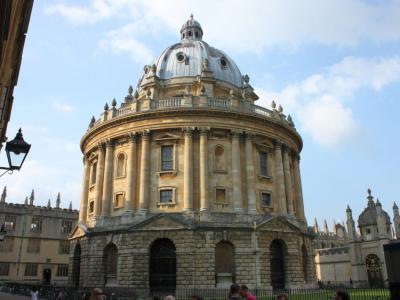
The Radcliffe Camera, despite its name, isn't a camera in the technical sense; rather, it is the first circular library ever constructed in the United Kingdom. In this context, "camera" is synonymous with "chamber."
John Radcliffe, a royal physician, expressed his desire to build a library at the University to house his collection of scientific materials. This led to a debate among several colleges over which of them should have the honor of hosting the library. Ultimately, none of the colleges were chosen.
To make room for the library, several terraced houses on Cattle Street, the Black Hall, and some outbuildings from Brasenose College were demolished. Constructed in 1749 by James Gibbes in the English Palladian architectural style, the exterior of the Radcliffe Camera appears to have three stories. The ground floor is rusticated, while the first floor is divided into sections by ten pairs of Corinthian columns. Above this section is a lantern and a dome covered in lead.
Inside the building, the first floor serves as an open gallery that runs along the walls. There is a 2-meter-high statue of John Radcliffe, sculpted by John Rysbrack. In 1912, an underground archives room was established, connected to the Bodleian Library through a passage.
The Radcliffe Camera houses an impressive collection of over 600,000 books and now functions as a reading room affiliated with the Bodleian Library. Unfortunately, it is not accessible to the general public.
John Radcliffe, a royal physician, expressed his desire to build a library at the University to house his collection of scientific materials. This led to a debate among several colleges over which of them should have the honor of hosting the library. Ultimately, none of the colleges were chosen.
To make room for the library, several terraced houses on Cattle Street, the Black Hall, and some outbuildings from Brasenose College were demolished. Constructed in 1749 by James Gibbes in the English Palladian architectural style, the exterior of the Radcliffe Camera appears to have three stories. The ground floor is rusticated, while the first floor is divided into sections by ten pairs of Corinthian columns. Above this section is a lantern and a dome covered in lead.
Inside the building, the first floor serves as an open gallery that runs along the walls. There is a 2-meter-high statue of John Radcliffe, sculpted by John Rysbrack. In 1912, an underground archives room was established, connected to the Bodleian Library through a passage.
The Radcliffe Camera houses an impressive collection of over 600,000 books and now functions as a reading room affiliated with the Bodleian Library. Unfortunately, it is not accessible to the general public.
5) University Church of Saint Mary the Virgin (must see)
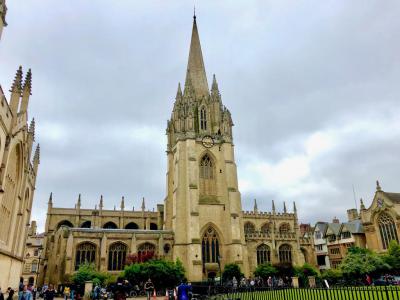
The University Church of Saint Mary the Virgin is the largest parish church in Oxford. It stands on High Street and is surrounded by colleges, which is why it is so popular with the students and professors.
The first church on this site was built in 1086 and when the university was founded in the 13th century, it was considered to be its first building. In 1320, a two-storey edifice was constructed on the north side of the chancel; the ground floor was the university’s Convocation House and today it houses Vault Café. The upper floor became the university’s first library, with books donated by Thomas Cobham.
The church’s Baroque porch was designed by Nicholas Stone. Its 13th century tower affords excellent views, and is open to the public. The steeple is reputed to be the most beautiful in England.
In 1555, the Oxford Martyrs were tried and condemned inside this church. You will notice that a section of the pillar opposite the pulpit is missing. This was cut out to support a small platform where the former Archbishop of Canterbury, Thomas Cranmer, stood while withdrawing his recantation of his Protestant faith, before being taken out and burnt at the stake.
At the end of the 15th and the early 16th centuries, most of the church was rebuilt in the Perpendicular style, only the tower and the spire remained untouched. Out of the 12 statues, 11 were replaced in 1894 by George Frampton.
Into the 17th century, the church was used for graduation ceremonies, until the church officials got fed up with the very un-Christian parties held afterwards, and therefore they had the Sheldonian Theatre built to host the ceremonies instead.
The first church on this site was built in 1086 and when the university was founded in the 13th century, it was considered to be its first building. In 1320, a two-storey edifice was constructed on the north side of the chancel; the ground floor was the university’s Convocation House and today it houses Vault Café. The upper floor became the university’s first library, with books donated by Thomas Cobham.
The church’s Baroque porch was designed by Nicholas Stone. Its 13th century tower affords excellent views, and is open to the public. The steeple is reputed to be the most beautiful in England.
In 1555, the Oxford Martyrs were tried and condemned inside this church. You will notice that a section of the pillar opposite the pulpit is missing. This was cut out to support a small platform where the former Archbishop of Canterbury, Thomas Cranmer, stood while withdrawing his recantation of his Protestant faith, before being taken out and burnt at the stake.
At the end of the 15th and the early 16th centuries, most of the church was rebuilt in the Perpendicular style, only the tower and the spire remained untouched. Out of the 12 statues, 11 were replaced in 1894 by George Frampton.
Into the 17th century, the church was used for graduation ceremonies, until the church officials got fed up with the very un-Christian parties held afterwards, and therefore they had the Sheldonian Theatre built to host the ceremonies instead.
6) Cornmarket Street
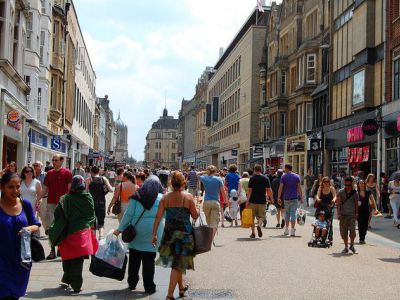
Cornmarket Street, commonly referred to as Cornmarket or simply The Corn, is a significant pedestrian pathway in Oxford. It stretches between Carfax Tower in the northern direction and Magdalen Street in the southern direction. In the year 1999, the street underwent a transformation and became a pedestrian-only zone.
To the east of Cornmarket Street, you'll find the charming Golden Cross arcade. This arcade houses a collection of small jewelry and craft shops within a historical courtyard, leading visitors to the Covered Market. On the western side of the street, there's the Clarendon Shopping Centre, an indoor shopping complex that extends in an L-shape and connects to Queen Street.
One notable historical structure on Cornmarket is the building located at 26–28 Cornmarket. This timber-framed building dates back to the 14th century and is a remnant of the New Inn, which was completed in 1386. This building is now owned by Jesus College and underwent an investigative and restorative process in 1983.
One of the most prominent retail establishments on Cornmarket Street is the largest department store in Oxford, situated at number 50. Boswells of Oxford founded this store in 1738. In 1928, the store introduced a new main entrance on Broad Street, while still maintaining an entrance on Cornmarket.
The tower of the Church of England parish church of Saint Michael at the Northgate holds the distinction of being the oldest structure in Oxford. It originates from the Saxon era and can be traced back to around the years 1000–1050. The church derives its name from the medieval gate that once existed at the northern terminus of Cornmarket, known as Oxford's city walls.
To the east of Cornmarket Street, you'll find the charming Golden Cross arcade. This arcade houses a collection of small jewelry and craft shops within a historical courtyard, leading visitors to the Covered Market. On the western side of the street, there's the Clarendon Shopping Centre, an indoor shopping complex that extends in an L-shape and connects to Queen Street.
One notable historical structure on Cornmarket is the building located at 26–28 Cornmarket. This timber-framed building dates back to the 14th century and is a remnant of the New Inn, which was completed in 1386. This building is now owned by Jesus College and underwent an investigative and restorative process in 1983.
One of the most prominent retail establishments on Cornmarket Street is the largest department store in Oxford, situated at number 50. Boswells of Oxford founded this store in 1738. In 1928, the store introduced a new main entrance on Broad Street, while still maintaining an entrance on Cornmarket.
The tower of the Church of England parish church of Saint Michael at the Northgate holds the distinction of being the oldest structure in Oxford. It originates from the Saxon era and can be traced back to around the years 1000–1050. The church derives its name from the medieval gate that once existed at the northern terminus of Cornmarket, known as Oxford's city walls.
7) Christ Church College (must see)
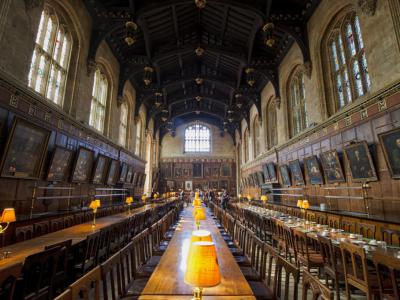
Founded in 1546 by King Henry VIII, Christ Church stands as one of the University of Oxford's largest and most affluent colleges. Noteworthy for its distinctive architecture, the college boasts several significant structures, including Tom Tower, designed by Sir Christopher Wren, Tom Quad, Oxford's largest quadrangle, and the Great Dining Hall, which also served as the gathering place for King Charles I's parliament during the English Civil War.
Christ Church boasts an impressive list of alumni, counting thirteen British prime ministers, more than any other Oxbridge college, as well as King Edward VII, King William II of the Netherlands, seventeen Archbishops, and the renowned author Lewis Carroll, known for penning "Alice in Wonderland."
Christ Church houses one of the UK's most significant private collections of drawings, featuring artworks by renowned artists such as Leonardo da Vinci, Raphael, and Michelangelo. This collection consists of approximately 300 paintings and 2,000 drawings, and a curated selection of these pieces is accessible to the general public at the specially designed Christ Church Picture Gallery. Most of these artworks were generously donated by a former college member, General John Guise (16823-1765), which paved the way for the establishment of the first-ever public art gallery in Britain.
The college's buildings and grounds have featured prominently in literary works such as Evelyn Waugh's "Brideshead Revisited" and in a minor capacity in Lewis Carroll's "Alice's Adventures in Wonderland." More recently, it has served as a backdrop for the film adaptations of J. K. Rowling's "Harry Potter" series and Philip Pullman's novel "Northern Lights" (released in the United States as "The Golden Compass"). These appearances have catapulted Christ Church to its status as the most frequented Oxford college by tourists, attracting nearly half a million visitors each year.
***Harry Potter Walk***
Christ Church Dining Hall
Contrary to belief, no filming actually took place inside the famous Christ Church Dining Hall. Still, it did provide an immense inspiration for Hogwart’s very own Great Hall. Founded in the time of King Henry VII and being alma mater to thirteen British Prime Ministers, it's no wonder that the filmmakers opted to replicate this historical location at their own Warner Bros. studios. Matchingly magnificent, both the Christ Church Dining Hall and its studio copy are worth visiting, even if only to compare, all the same.
Bodley Tower Staircase
Probably one of the most famous filming spots, the grand stone staircase, located inside Bodley Tower at Christ Church College, is a prominent feature in the first two Harry Potter movies. Among the several memorable scenes filmed here are Harry’s first day at Hogwarts; a flashback sequence between Tom Riddle and Dumbledore; and a scene near the end of the first film where Harry is reunited with Ron and Hermione after being released from Hogwarts Infirmary – the one many Potterheads, no doubt, hold dear to their hearts.
Christ Church Cloisters
The Cloisters played a starring role in Harry Potter and the Philosopher’s Stone, as Hogwarts Hallways.
Another notable scene associated with the hallways is that when Harry has just been made seeker for the Gryffindor quidditch team. In it, Hermione tells him that being a seeker is “in his blood,” upon which she goes on to show him a display case containing a quidditch trophy with his father’s name inscription.
Christ Church boasts an impressive list of alumni, counting thirteen British prime ministers, more than any other Oxbridge college, as well as King Edward VII, King William II of the Netherlands, seventeen Archbishops, and the renowned author Lewis Carroll, known for penning "Alice in Wonderland."
Christ Church houses one of the UK's most significant private collections of drawings, featuring artworks by renowned artists such as Leonardo da Vinci, Raphael, and Michelangelo. This collection consists of approximately 300 paintings and 2,000 drawings, and a curated selection of these pieces is accessible to the general public at the specially designed Christ Church Picture Gallery. Most of these artworks were generously donated by a former college member, General John Guise (16823-1765), which paved the way for the establishment of the first-ever public art gallery in Britain.
The college's buildings and grounds have featured prominently in literary works such as Evelyn Waugh's "Brideshead Revisited" and in a minor capacity in Lewis Carroll's "Alice's Adventures in Wonderland." More recently, it has served as a backdrop for the film adaptations of J. K. Rowling's "Harry Potter" series and Philip Pullman's novel "Northern Lights" (released in the United States as "The Golden Compass"). These appearances have catapulted Christ Church to its status as the most frequented Oxford college by tourists, attracting nearly half a million visitors each year.
***Harry Potter Walk***
Christ Church Dining Hall
Contrary to belief, no filming actually took place inside the famous Christ Church Dining Hall. Still, it did provide an immense inspiration for Hogwart’s very own Great Hall. Founded in the time of King Henry VII and being alma mater to thirteen British Prime Ministers, it's no wonder that the filmmakers opted to replicate this historical location at their own Warner Bros. studios. Matchingly magnificent, both the Christ Church Dining Hall and its studio copy are worth visiting, even if only to compare, all the same.
Bodley Tower Staircase
Probably one of the most famous filming spots, the grand stone staircase, located inside Bodley Tower at Christ Church College, is a prominent feature in the first two Harry Potter movies. Among the several memorable scenes filmed here are Harry’s first day at Hogwarts; a flashback sequence between Tom Riddle and Dumbledore; and a scene near the end of the first film where Harry is reunited with Ron and Hermione after being released from Hogwarts Infirmary – the one many Potterheads, no doubt, hold dear to their hearts.
Christ Church Cloisters
The Cloisters played a starring role in Harry Potter and the Philosopher’s Stone, as Hogwarts Hallways.
Another notable scene associated with the hallways is that when Harry has just been made seeker for the Gryffindor quidditch team. In it, Hermione tells him that being a seeker is “in his blood,” upon which she goes on to show him a display case containing a quidditch trophy with his father’s name inscription.
8) Christ Church Cathedral (must see)
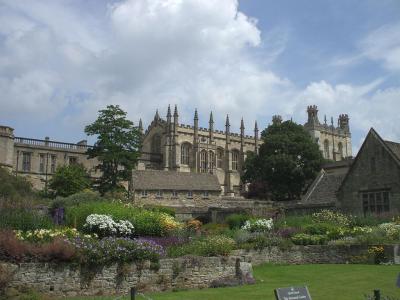
Christ Church Cathedral holds a unique position as both a college chapel and the cathedral of the Diocese of Oxford. Prior to the 20th century, it was also the smallest cathedral in the United Kingdom.
Its historical roots trace back to before the Norman Conquest when a shrine was constructed on the site in memory of Saint Frideswide, a 7th-century priestess who faced persecution and sought to protect her chastity from King Algar, one of the rulers of the Seven Kingdoms of Saxony.
By 1122, the cathedral became a part of Saint Frideswide Priory. However, in 1520, Cardinal Wolsey seized the buildings and lands to establish Cardinal College. To make room for what is now Tom Quad, five bays in the western part of the nave were demolished. Eventually, King Henry VIII took over and had Christ Church College constructed upon the foundation.
The remainder of the cathedral was built in the Perpendicular or English Gothic style. The eastern part of the nave, the choir, and the tower retained the original Norman appearance.
Notable features include the exquisite rose window in the Botanical style with ten petals around the central glass. Other noteworthy windows are the Becket Window from 1320, which survived the Reformation, and the Jonah Window, depicting the City of Nineveh, created in 1632.
The shrine of Saint Frideswide has been restored and stands before a stunning stained glass window with 16 panels recounting her life. An interesting detail is the 16th panel, which includes a water-closet, a clear indication of its Victorian origin, certainly not present in the 8th century.
The Cathedral Shop, where visitors can purchase souvenirs, books, CDs, and other gift items, is located in the 12th-century Chapter House. While perusing the shelves, be sure to admire the vaulted ceiling adorned with 13th-century medallions depicting the Saints.
Its historical roots trace back to before the Norman Conquest when a shrine was constructed on the site in memory of Saint Frideswide, a 7th-century priestess who faced persecution and sought to protect her chastity from King Algar, one of the rulers of the Seven Kingdoms of Saxony.
By 1122, the cathedral became a part of Saint Frideswide Priory. However, in 1520, Cardinal Wolsey seized the buildings and lands to establish Cardinal College. To make room for what is now Tom Quad, five bays in the western part of the nave were demolished. Eventually, King Henry VIII took over and had Christ Church College constructed upon the foundation.
The remainder of the cathedral was built in the Perpendicular or English Gothic style. The eastern part of the nave, the choir, and the tower retained the original Norman appearance.
Notable features include the exquisite rose window in the Botanical style with ten petals around the central glass. Other noteworthy windows are the Becket Window from 1320, which survived the Reformation, and the Jonah Window, depicting the City of Nineveh, created in 1632.
The shrine of Saint Frideswide has been restored and stands before a stunning stained glass window with 16 panels recounting her life. An interesting detail is the 16th panel, which includes a water-closet, a clear indication of its Victorian origin, certainly not present in the 8th century.
The Cathedral Shop, where visitors can purchase souvenirs, books, CDs, and other gift items, is located in the 12th-century Chapter House. While perusing the shelves, be sure to admire the vaulted ceiling adorned with 13th-century medallions depicting the Saints.
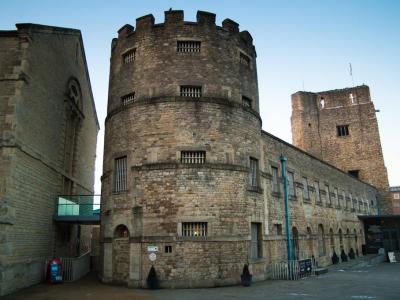
9) Oxford Castle (must see)
Oxford takes great pride in its rich history and dedicates significant resources to maintaining its ancient structures, as evidenced by the preservation efforts at Oxford Castle. This partially ruined Norman castle stands on the western outskirts of the town, just off New Road. Initially, it consisted of a wooden motte and bailey castle, which was later replaced by stone buildings in the 11th century.
During the conflict between England and Normandy from 1135 to 1153, the castle served as a strategic base for Empress Matilda, the daughter of King Henry I, in her quest to claim the English throne from her cousin, King Stephen. King Stephen besieged the castle with siege engines, but Matilda managed to escape, leading to the surrender of the castle's occupants before a full-scale battle could commence.
In the 13th century, further fortifications were added, including the construction of the Round Tower and the restoration of the chapel. King Henry III utilized the castle as a prison. However, during the English Civil War, the castle suffered significant damage and continued to function as a prison after the war's conclusion.
In 1888, the prison underwent expansion and operated as HM Prison Oxford until its closure in 1996. Today, only the motte and Saint George's Tower remain as remnants of the original castle.
The former prison buildings have been repurposed into a luxury hotel, office spaces, a shopping center, and a heritage complex. The castle's courtyard now hosts an open market and frequently features theater performances.
Additionally, Oxford Castle offers guided tours led by guides dressed in period costumes, providing insights into the castle's history. Visitors can explore Saint George's Tower, visit the crypt, and access the motte with its vaulted Well Chamber as part of the tour experience.
During the conflict between England and Normandy from 1135 to 1153, the castle served as a strategic base for Empress Matilda, the daughter of King Henry I, in her quest to claim the English throne from her cousin, King Stephen. King Stephen besieged the castle with siege engines, but Matilda managed to escape, leading to the surrender of the castle's occupants before a full-scale battle could commence.
In the 13th century, further fortifications were added, including the construction of the Round Tower and the restoration of the chapel. King Henry III utilized the castle as a prison. However, during the English Civil War, the castle suffered significant damage and continued to function as a prison after the war's conclusion.
In 1888, the prison underwent expansion and operated as HM Prison Oxford until its closure in 1996. Today, only the motte and Saint George's Tower remain as remnants of the original castle.
The former prison buildings have been repurposed into a luxury hotel, office spaces, a shopping center, and a heritage complex. The castle's courtyard now hosts an open market and frequently features theater performances.
Additionally, Oxford Castle offers guided tours led by guides dressed in period costumes, providing insights into the castle's history. Visitors can explore Saint George's Tower, visit the crypt, and access the motte with its vaulted Well Chamber as part of the tour experience.
