Custom Walk in Porto, Portugal by nbtokarz_3a656 created on 2026-06-04
Guide Location: Portugal » Porto
Guide Type: Custom Walk
# of Sights: 9
Tour Duration: 2 Hour(s)
Travel Distance: 3.9 Km or 2.4 Miles
Share Key: BN8VD
Guide Type: Custom Walk
# of Sights: 9
Tour Duration: 2 Hour(s)
Travel Distance: 3.9 Km or 2.4 Miles
Share Key: BN8VD
How It Works
Please retrieve this walk in the GPSmyCity app. Once done, the app will guide you from one tour stop to the next as if you had a personal tour guide. If you created the walk on this website or come to the page via a link, please follow the instructions below to retrieve the walk in the app.
Retrieve This Walk in App
Step 1. Download the app "GPSmyCity: Walks in 1K+ Cities" on Apple App Store or Google Play Store.



Step 2. In the GPSmyCity app, download(or launch) the guide "Porto Map and Walking Tours".
Step 3. Tap the menu button located at upper right corner of the "Walks" screen and select "Retrieve custom walk". Enter the share key: BN8VD
1) Rua das Flores (Flowers Street)
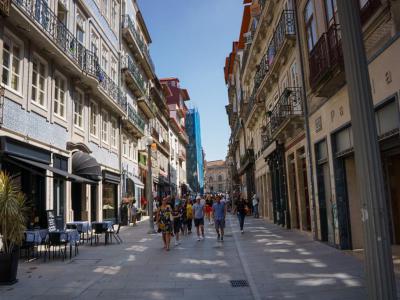
Flowers Street didn’t earn its name by accident. Back in the early 16th century, this stretch of land was quite literally a garden—belonging to Pedro Álvares da Costa, the Bishop of Porto, a man with both green fingers and a devotion to Saint Catherine of Mount Sinai. When the street was laid out in 1525, during the reign of Manuel I of Portugal, it was called “Saint Catherine Flowers Street”—a name that sounded as formal as the era itself.
But the real story here isn’t just botanical—it’s social. The creation of the street coincided with a quiet shake-up of Porto’s hierarchy. Restrictions that once kept the nobility at a distance were lifted, and suddenly, the city opened up. In moved a rising bourgeois class, bringing with them new money, new ambitions, and a need for proper urban order. Regulations followed. Facades were aligned, proportions controlled, and the street took on a uniform look—less medieval maze, more carefully composed stage set...
Still, this wasn’t a boulevard of powdered wigs and aristocratic airs. Most residents were working hands rather than titled names. Cobblers, blacksmiths, metalworkers, bricklayers—people who built, repaired, and kept the city running—filled these houses. If Porto was expanding, this was the street where it was done.
Today, the tools have changed, but the rhythm hasn’t entirely disappeared. Flowers Street is now pedestrian-friendly, lined with cafés, small shops, and restored buildings that hint at their past lives. It’s a place for slow wandering rather than urgent errands—though if you listen closely, you might still hear the echo of hammer on metal beneath the hum of conversation...
But the real story here isn’t just botanical—it’s social. The creation of the street coincided with a quiet shake-up of Porto’s hierarchy. Restrictions that once kept the nobility at a distance were lifted, and suddenly, the city opened up. In moved a rising bourgeois class, bringing with them new money, new ambitions, and a need for proper urban order. Regulations followed. Facades were aligned, proportions controlled, and the street took on a uniform look—less medieval maze, more carefully composed stage set...
Still, this wasn’t a boulevard of powdered wigs and aristocratic airs. Most residents were working hands rather than titled names. Cobblers, blacksmiths, metalworkers, bricklayers—people who built, repaired, and kept the city running—filled these houses. If Porto was expanding, this was the street where it was done.
Today, the tools have changed, but the rhythm hasn’t entirely disappeared. Flowers Street is now pedestrian-friendly, lined with cafés, small shops, and restored buildings that hint at their past lives. It’s a place for slow wandering rather than urgent errands—though if you listen closely, you might still hear the echo of hammer on metal beneath the hum of conversation...
2) Livraria Lello (Lello Bookstore)
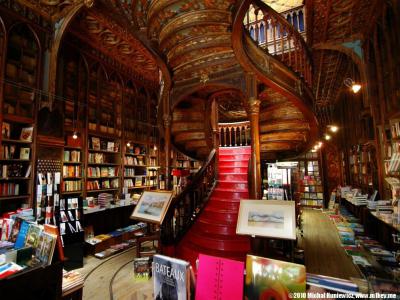
Right in the heart of Porto, along the historic Rua dos Clérigos, stands Livraria Lello—a bookstore that regularly earns the title of one of the most beautiful in the world… and for once, the hype holds up.
Opened in 1906 and still managed by the same company, the shop feels more like a carefully staged piece of theater than a retail space. The design leans into Art Deco’s love of symmetry and clean lines—an aesthetic that quietly borrows from ancient Egyptian motifs—while the façade mixes in touches of Art Nouveau and Gothic Revival, just to keep things interesting. The result is a building that doesn’t quite sit still stylistically, but somehow makes perfect sense once you step inside.
And stepping inside is the real moment. The shelves climb from floor to ceiling, wrapped in richly carved wood that seems to have been shaped with more patience than urgency. At the center, a sweeping wooden staircase curves upward like it knows it’s being watched—and it usually is. Above it all, a stained-glass ceiling filters the daylight into a soft, amber glow, giving the space a slightly unreal, almost cinematic quality.
Designed by architect and engineer Xavier Esteves, the structure was built to endure, but it’s the details that keep people lingering. Every surface invites a second look, every angle seems composed rather than accidental. It’s the kind of place where you might come in for a quick visit… and leave wondering how long you’ve actually been standing there.
Opened in 1906 and still managed by the same company, the shop feels more like a carefully staged piece of theater than a retail space. The design leans into Art Deco’s love of symmetry and clean lines—an aesthetic that quietly borrows from ancient Egyptian motifs—while the façade mixes in touches of Art Nouveau and Gothic Revival, just to keep things interesting. The result is a building that doesn’t quite sit still stylistically, but somehow makes perfect sense once you step inside.
And stepping inside is the real moment. The shelves climb from floor to ceiling, wrapped in richly carved wood that seems to have been shaped with more patience than urgency. At the center, a sweeping wooden staircase curves upward like it knows it’s being watched—and it usually is. Above it all, a stained-glass ceiling filters the daylight into a soft, amber glow, giving the space a slightly unreal, almost cinematic quality.
Designed by architect and engineer Xavier Esteves, the structure was built to endure, but it’s the details that keep people lingering. Every surface invites a second look, every angle seems composed rather than accidental. It’s the kind of place where you might come in for a quick visit… and leave wondering how long you’ve actually been standing there.
3) São Bento Railway Station
The São Bento Railway Station is a place where catching a train comes with a side of history, art, and just a hint of architectural drama.
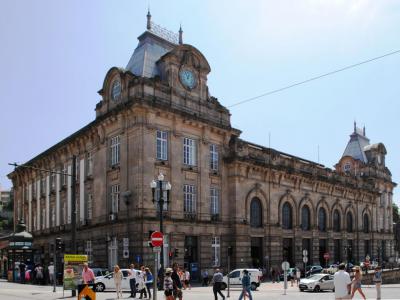
Opened in the early 20th century, this grand station takes its name from Saint Benedict, because long before trains rolled in, this was the site of a Benedictine convent. The convent was cleared in 1892, making way for something a bit louder and considerably more punctual. The idea for a central station had been floating around since 1864, but like many good plans, it took a while to get moving.
Construction began in earnest in the 1890s, with the first train arriving in 1896—though not without setbacks, including a landslide that slowed things down. Eventually, architect José Marques da Silva stepped in, bringing with him a refined Beaux-Arts vision, and by the early 1900s, São Bento began to take the form you see today.
From the outside, the station keeps things composed: a symmetrical, U-shaped granite structure with three levels, clean lines, and just enough decorative detail to remind you it has standards. It’s elegant, balanced, and quietly confident—like it knows it doesn’t need to shout.
But step inside, and that restraint disappears entirely.
The entrance hall is wrapped in over 20,000 azulejo tiles, covering more than 500 square meters, all created by artist Jorge Colaço. These blue-and-white panels don’t just decorate the space—they narrate it. Scenes from Portugal’s history unfold across the walls, from royal ceremonies to rural life, while friezes trace the evolution of transportation. It’s part gallery, part waiting room, and entirely unforgettable.
Declared a national monument in 1988, São Bento has been carefully preserved, with parts of the building even adapted for modern use, including a small hostel tucked within its historic walls.
So, before you rush off to your next destination, pause for a moment here—because at São Bento, the journey doesn’t begin on the tracks, it begins on the walls...
Opened in the early 20th century, this grand station takes its name from Saint Benedict, because long before trains rolled in, this was the site of a Benedictine convent. The convent was cleared in 1892, making way for something a bit louder and considerably more punctual. The idea for a central station had been floating around since 1864, but like many good plans, it took a while to get moving.
Construction began in earnest in the 1890s, with the first train arriving in 1896—though not without setbacks, including a landslide that slowed things down. Eventually, architect José Marques da Silva stepped in, bringing with him a refined Beaux-Arts vision, and by the early 1900s, São Bento began to take the form you see today.
From the outside, the station keeps things composed: a symmetrical, U-shaped granite structure with three levels, clean lines, and just enough decorative detail to remind you it has standards. It’s elegant, balanced, and quietly confident—like it knows it doesn’t need to shout.
But step inside, and that restraint disappears entirely.
The entrance hall is wrapped in over 20,000 azulejo tiles, covering more than 500 square meters, all created by artist Jorge Colaço. These blue-and-white panels don’t just decorate the space—they narrate it. Scenes from Portugal’s history unfold across the walls, from royal ceremonies to rural life, while friezes trace the evolution of transportation. It’s part gallery, part waiting room, and entirely unforgettable.
Declared a national monument in 1988, São Bento has been carefully preserved, with parts of the building even adapted for modern use, including a small hostel tucked within its historic walls.
So, before you rush off to your next destination, pause for a moment here—because at São Bento, the journey doesn’t begin on the tracks, it begins on the walls...
4) Capela das Almas (Chapel of Souls) (must see)
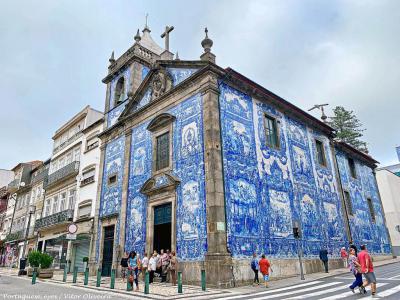
Just when you think Santa Catarina Street has shown you all its cards, you arrive at the Chapel of Souls, standing quietly at the corner of Fernandes Tomás Street.
By the end of the 18th century, things were getting a bit crowded, so the Brotherhood of Souls packed up and moved here from the Monastery of Santa Clara. The addition of the Brotherhood swelled the size of the Santa Catarina faction of devotees to the point where a new building was needed. So, in 1801, the chapel was expanded and restored, giving the growing community a space that could finally keep up.
Now, take a moment to look at the façade. It’s neat, balanced, and very much in line with neoclassical taste. There’s a framed doorway topped by a circular pediment, and just above it, a coat of arms featuring Saint Francis of Assisi and Saint Catherine—your clue about who this place is dedicated to. The bell tower rises in two levels: a door and window below, then four windows and a balcony above, all crowned by a dome with a simple iron cross. Elegant, but not overly dramatic—at least at first glance...
And then the tiles take over.
The entire exterior is wrapped in around 16,000 blue-and-white azulejo tiles, produced by the Viuva Lamego workshop in Lisbon. And these aren’t just decorative patterns—they tell stories. Scenes from the lives of Saint Catherine and Saint Francis unfold across the walls like a giant ceramic narrative. It’s the kind of façade that stops people mid-step, whether they planned to visit or not.
Once inside, the tone shifts. The stained glass windows by Amandio Silva cast a softer light, illustrating souls in Purgatory being redeemed. There’s an 18th-century image of the Virgin of Souls, and on the main altar, a large painting of “The Ascension of the Lord” by Joaquin Rafael, a Fine Arts professor from Lisbon. It’s quieter, more reflective—less spectacle, more atmosphere...
And yes, people often say this is the most beautiful church in Porto. That’s a bold claim in a city full of churches—but once you’ve seen it, it’s hard to argue.
By the end of the 18th century, things were getting a bit crowded, so the Brotherhood of Souls packed up and moved here from the Monastery of Santa Clara. The addition of the Brotherhood swelled the size of the Santa Catarina faction of devotees to the point where a new building was needed. So, in 1801, the chapel was expanded and restored, giving the growing community a space that could finally keep up.
Now, take a moment to look at the façade. It’s neat, balanced, and very much in line with neoclassical taste. There’s a framed doorway topped by a circular pediment, and just above it, a coat of arms featuring Saint Francis of Assisi and Saint Catherine—your clue about who this place is dedicated to. The bell tower rises in two levels: a door and window below, then four windows and a balcony above, all crowned by a dome with a simple iron cross. Elegant, but not overly dramatic—at least at first glance...
And then the tiles take over.
The entire exterior is wrapped in around 16,000 blue-and-white azulejo tiles, produced by the Viuva Lamego workshop in Lisbon. And these aren’t just decorative patterns—they tell stories. Scenes from the lives of Saint Catherine and Saint Francis unfold across the walls like a giant ceramic narrative. It’s the kind of façade that stops people mid-step, whether they planned to visit or not.
Once inside, the tone shifts. The stained glass windows by Amandio Silva cast a softer light, illustrating souls in Purgatory being redeemed. There’s an 18th-century image of the Virgin of Souls, and on the main altar, a large painting of “The Ascension of the Lord” by Joaquin Rafael, a Fine Arts professor from Lisbon. It’s quieter, more reflective—less spectacle, more atmosphere...
And yes, people often say this is the most beautiful church in Porto. That’s a bold claim in a city full of churches—but once you’ve seen it, it’s hard to argue.
5) Rua Santa Catarina (St. Catherine Street) (must see)
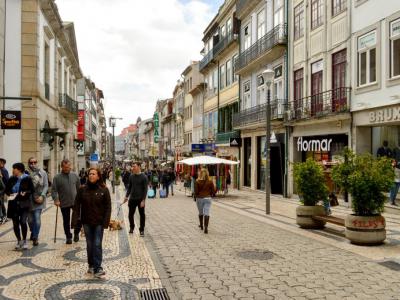
If Porto had a main stage for everyday life, this would be Santa Catarina Street—the city’s busiest thoroughfare, where strolling isn't just optional but practically a sport. The street takes its name from Saint Catherine of Alexandria. Fully pedestrianized, it stretches from Marquês de Pombal park in the north down to Batalha park in the south, lined with buildings that quietly show off their Art Deco details, if you remember to look up between shop windows...
Indeed, as you move along, you can't help noticing a steady lineup of clothing stores, shoe shops, and old-school haberdashery mingling with modern retail. The Via Catarina shopping center adds a more polished, indoor option, while street vendors appear at just the right moments, and cafés seem strategically placed for when your energy—or your shopping budget—needs a pause.
Near Batalha, the Latina New Art Bookstore invites a slower pace, whereas the Palladium Gallery, at the intersection with Passos Manuel Street, brings a touch of early 20th-century elegance. Then comes one of Porto’s most famous addresses: Café Majestic. Open since 1921, it has long been a meeting place for writers, thinkers, and anyone who enjoys their coffee with a side of history. Right next door, the Imperiale Tea Room continues the vintage atmosphere, as if time agreed to slow down just for this stretch of street.
A little further on, the Grande Hotel do Porto, welcoming guests since 1880, carries its own share of stories. Over the years, it has hosted notable figures, witnessed political upheaval (notably when Prime Minister Afonso Costa was held prisoner here in 1917 during a coup d'etat), and even served as the final stop in the life of Teresa Cristina, Empress of Brazil. Not quite an average hotel résumé, really...
Walk Santa Catarina end to end, or just dip in and out—either way, this street has a way of making you linger longer than planned.
Indeed, as you move along, you can't help noticing a steady lineup of clothing stores, shoe shops, and old-school haberdashery mingling with modern retail. The Via Catarina shopping center adds a more polished, indoor option, while street vendors appear at just the right moments, and cafés seem strategically placed for when your energy—or your shopping budget—needs a pause.
Near Batalha, the Latina New Art Bookstore invites a slower pace, whereas the Palladium Gallery, at the intersection with Passos Manuel Street, brings a touch of early 20th-century elegance. Then comes one of Porto’s most famous addresses: Café Majestic. Open since 1921, it has long been a meeting place for writers, thinkers, and anyone who enjoys their coffee with a side of history. Right next door, the Imperiale Tea Room continues the vintage atmosphere, as if time agreed to slow down just for this stretch of street.
A little further on, the Grande Hotel do Porto, welcoming guests since 1880, carries its own share of stories. Over the years, it has hosted notable figures, witnessed political upheaval (notably when Prime Minister Afonso Costa was held prisoner here in 1917 during a coup d'etat), and even served as the final stop in the life of Teresa Cristina, Empress of Brazil. Not quite an average hotel résumé, really...
Walk Santa Catarina end to end, or just dip in and out—either way, this street has a way of making you linger longer than planned.
6) Café Majestic
In 1921, Porto was feeling just a little more glamorous than usual. Fresh off a flight from Madeira, aviator Gago Coutinho did what any reasonable pioneer of the skies would do—he landed and went for a drink. His destination was a brand-new Art Nouveau café called “Elite.” Not a bad choice...
Inside, the scene was already in full swing. Artists, celebrities, and well-dressed onlookers gathered for the grand opening, all eyes drifting between each other and the décor. And the décor… well, it didn't whisper—it performed. Gago, who had just crossed the skies, now found himself equally captivated on the ground, surrounded by polished wood, mirrors, and a kind of elegance that suggests this place fully intends to be noticed.
Before long, “Elite” decided the name wasn’t quite grand enough, and thus emerged “Café Majestic”—a title that fitted like a tailored suit. And with that, the café settled into its role as one of Porto’s cultural stages. Students and professors from the Porto School of Fine Arts started claiming tables, turning coffee into conversation and conversation into ideas. Among the regulars, there were sculptor José Rodrigues, philosopher Leonardo Coimbra, and painters like Armando Alves, Ângelo de Sousa, and Jorge Pinheiro—casually shaping Portuguese culture between sips...
Time moved on, but the guest list kept its shine. The café’s book of honor got filled with names like those of Portuguese presidents Mário Soares, Jorge Sampaio, and Aníbal Cavaco Silva, as well as French President Jacques Chirac. And then there’s the story—half fact, half legend—that J. K. Rowling spent afternoons here working on “Harry Potter and the Philosopher’s Stone.” Whether you believe it or not, it certainly sounds like something this place would inspire.
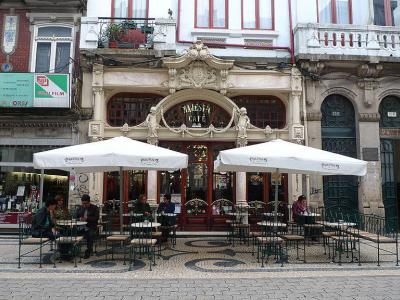
Stay outside for a moment, and the façade sets the tone before you even enter—marble, curved lines, floral details, and three elegant columns, all gently insisting you come closer. Inside, it’s a continuation of that same theatrical charm: carved wood, sweeping frames, and decorative touches that lean unapologetically toward the sensual.
So, if you’re wondering where Porto keeps a piece of its golden age—this is it. And yes, stopping for a coffee here still counts as cultural research...
Inside, the scene was already in full swing. Artists, celebrities, and well-dressed onlookers gathered for the grand opening, all eyes drifting between each other and the décor. And the décor… well, it didn't whisper—it performed. Gago, who had just crossed the skies, now found himself equally captivated on the ground, surrounded by polished wood, mirrors, and a kind of elegance that suggests this place fully intends to be noticed.
Before long, “Elite” decided the name wasn’t quite grand enough, and thus emerged “Café Majestic”—a title that fitted like a tailored suit. And with that, the café settled into its role as one of Porto’s cultural stages. Students and professors from the Porto School of Fine Arts started claiming tables, turning coffee into conversation and conversation into ideas. Among the regulars, there were sculptor José Rodrigues, philosopher Leonardo Coimbra, and painters like Armando Alves, Ângelo de Sousa, and Jorge Pinheiro—casually shaping Portuguese culture between sips...
Time moved on, but the guest list kept its shine. The café’s book of honor got filled with names like those of Portuguese presidents Mário Soares, Jorge Sampaio, and Aníbal Cavaco Silva, as well as French President Jacques Chirac. And then there’s the story—half fact, half legend—that J. K. Rowling spent afternoons here working on “Harry Potter and the Philosopher’s Stone.” Whether you believe it or not, it certainly sounds like something this place would inspire.
Stay outside for a moment, and the façade sets the tone before you even enter—marble, curved lines, floral details, and three elegant columns, all gently insisting you come closer. Inside, it’s a continuation of that same theatrical charm: carved wood, sweeping frames, and decorative touches that lean unapologetically toward the sensual.
So, if you’re wondering where Porto keeps a piece of its golden age—this is it. And yes, stopping for a coffee here still counts as cultural research...
7) Batalha Square
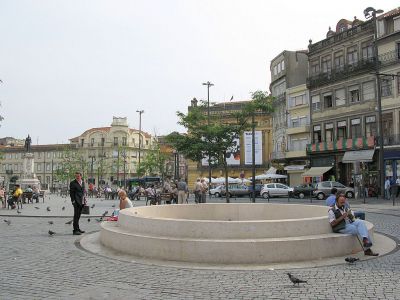
Batalha Square (Praça da Batalha) is a historical and cultural landmark located in Porto. The square's name, which translates to "battle," is rooted in local tradition, commemorating a 10th-century conflict between the Moorish forces of Al-Mansur Ibn Abi Aamir and the inhabitants of Porto, leading to the city's defeat and destruction.
One of the key monuments in Batalha Square is the Batalha Palace, a notable example of a late 18th-century urban palace in Porto. Its main façade, a blend of Baroque and Neoclassical styles, prominently displays the coat-of-arms of its former owners-the Silvas, Guedes, Melos, and Pereiras families. During the Siege of Porto in 1832, the building's owners abandoned it, and it served various functions, including as a blood hospital. By the 19th century, the palace’s interior had been stripped of its original decoration, and today, it functions as a post office.
The square was urbanized in 1861, marked by the addition of a statue of King Pedro V of Portugal, sculpted by Teixeira Lopes (father), which was unveiled in 1866. This statue stands prominently in front of the Batalha Palace, adding to the square’s historic charm.
Batalha Square has long been a vibrant cultural hub. In 1794, it saw the establishment of Porto's opera house, the Royal Theatre of São João. Although the original building was replaced in 1908 following a fire, the theatre remains a key cultural venue in the area. Another architectural highlight is the Cinema Batalha, an iconic example of Portuguese Art Deco architecture from 1947.
Once a bustling traffic hub, Batalha Square has been largely pedestrianized since the 1980s, enhancing its appeal as a tourist destination. Today, visitors can enjoy the square’s rich history, its monuments, and its lively atmosphere, with numerous cafés and hotels lining the area, making it a must-visit spot in Porto.
One of the key monuments in Batalha Square is the Batalha Palace, a notable example of a late 18th-century urban palace in Porto. Its main façade, a blend of Baroque and Neoclassical styles, prominently displays the coat-of-arms of its former owners-the Silvas, Guedes, Melos, and Pereiras families. During the Siege of Porto in 1832, the building's owners abandoned it, and it served various functions, including as a blood hospital. By the 19th century, the palace’s interior had been stripped of its original decoration, and today, it functions as a post office.
The square was urbanized in 1861, marked by the addition of a statue of King Pedro V of Portugal, sculpted by Teixeira Lopes (father), which was unveiled in 1866. This statue stands prominently in front of the Batalha Palace, adding to the square’s historic charm.
Batalha Square has long been a vibrant cultural hub. In 1794, it saw the establishment of Porto's opera house, the Royal Theatre of São João. Although the original building was replaced in 1908 following a fire, the theatre remains a key cultural venue in the area. Another architectural highlight is the Cinema Batalha, an iconic example of Portuguese Art Deco architecture from 1947.
Once a bustling traffic hub, Batalha Square has been largely pedestrianized since the 1980s, enhancing its appeal as a tourist destination. Today, visitors can enjoy the square’s rich history, its monuments, and its lively atmosphere, with numerous cafés and hotels lining the area, making it a must-visit spot in Porto.
8) Sé Catedral do Porto (Porto Cathedral) (must see)
Back in the year 868, a nobleman from Asturias, Vímara Peres, arrived in the north of what is now Portugal and began reclaiming land from Moorish control. Among the places he took was a settlement called Portus Cale. The name eventually shifted to Portucale for the county he went on to rule, and gave rise to both Porto and Portugal. At the top of this early settlement was Penaventosa Hill—the highest point—where the city’s cathedral would later rise.
Before the cathedral, this hill had already held religious importance as a home to a Suebian church. Construction of the Porto Cathedral began in the 12th century and, like many long-lived projects, moved forward in stages. By 1737, it was finally considered complete. What stands today is a solid, fortress-like structure—less delicate ornament, more defensive confidence—looking out over the city below.
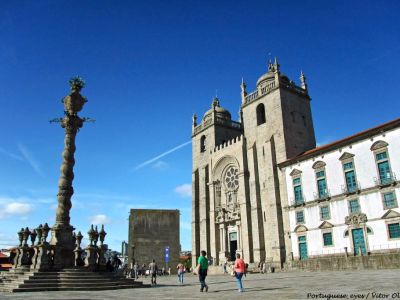
Take your time to observe the exterior. Two square towers frame the façade, sturdy and slightly severe, each topped with a cupola. Gothic details from the 15th century soften the front just enough, while the cloister—added in 1736 by the Italian architect Nicolau Nasoni—brings a more refined, decorative touch. Walk around to the northern side, and you’ll notice a mix of styles: a Baroque porch, a Romanesque rose window, and crenellated walls that make the whole place feel like it could withstand a siege, if needed.
Enter the building, and the mood shifts again. The nave is relatively narrow, covered by a barrel vault that draws your eyes forward. The Baroque apse is richly decorated with paintings by Nasoni, while the altarpiece, designed by Santos Pacheco, adds another layer of artistic detail. In the south transept, blue azulejo tiles introduce a familiar Portuguese element, telling stories through pattern and color.
Mass is still held here daily at 11 am, a quiet reminder that this is not only a historic monument but a living place of worship. Entry to the cathedral itself is free, while a small fee grants access to the Gothic cloisters and the Sacred Art Museum. If you have the energy, the tower climb is demanding but rewarding, offering views not only over Porto, but also of architectural details you simply can’t see from below.
Before the cathedral, this hill had already held religious importance as a home to a Suebian church. Construction of the Porto Cathedral began in the 12th century and, like many long-lived projects, moved forward in stages. By 1737, it was finally considered complete. What stands today is a solid, fortress-like structure—less delicate ornament, more defensive confidence—looking out over the city below.
Take your time to observe the exterior. Two square towers frame the façade, sturdy and slightly severe, each topped with a cupola. Gothic details from the 15th century soften the front just enough, while the cloister—added in 1736 by the Italian architect Nicolau Nasoni—brings a more refined, decorative touch. Walk around to the northern side, and you’ll notice a mix of styles: a Baroque porch, a Romanesque rose window, and crenellated walls that make the whole place feel like it could withstand a siege, if needed.
Enter the building, and the mood shifts again. The nave is relatively narrow, covered by a barrel vault that draws your eyes forward. The Baroque apse is richly decorated with paintings by Nasoni, while the altarpiece, designed by Santos Pacheco, adds another layer of artistic detail. In the south transept, blue azulejo tiles introduce a familiar Portuguese element, telling stories through pattern and color.
Mass is still held here daily at 11 am, a quiet reminder that this is not only a historic monument but a living place of worship. Entry to the cathedral itself is free, while a small fee grants access to the Gothic cloisters and the Sacred Art Museum. If you have the energy, the tower climb is demanding but rewarding, offering views not only over Porto, but also of architectural details you simply can’t see from below.
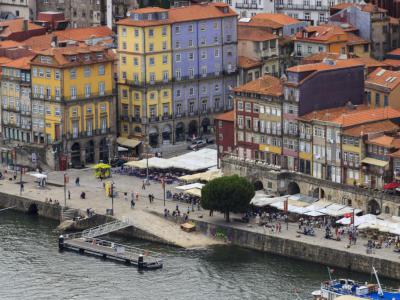
9) Cais da Ribeira (Ribeira Waterfront) (must see)
The exact beginnings of the Ribeira are a bit hazy—history here prefers suggestion over certainty. What we do know is that a riverside settlement took shape where the Vila River meets the Douro, the kind of spot traders tend to notice early. Roman mosaics dating back to the fourth century quietly confirm that people have been settling, building, and leaving traces here for a very long time. By the 13th century, as Porto expanded, Ribeira grew with it—spilling across the slopes below Penaventosa Hill and clustering along the river’s edge.
At one point, there were essentially two worlds: one above, gathered around the cathedral on the heights, and another below, pressed against the Douro. Connecting them was a bit of a puzzle—a tight web of narrow, winding streets that made moving around an exercise in patience. Eventually, they felt a drastic solution was needed.
So, King John I of Portugal decided to pierce the labyrinth with a street carved right through it. With admirable simplicity, it was named Rua Nova or “New Street.” And, indeed, new it was: straight, unusually wide for its time, and refreshingly easy to navigate. It quickly became the address of choice for Porto’s well-to-do—merchants, clergy, and anyone keen to swap medieval maze for a bit of urban order.
Down by the river, though, Ribeira kept its personality. And it still does. The district draws you in with its layered streets and uneven alleys that eventually spill into the lively Ribeira Square. Along the waterfront, fragments of the 14th-century walls remain, while just beyond, the steep, twisting lanes of the Barredo neighborhood remind you that Porto never fully gave up its labyrinthine instincts.
By day, the square hums with cafés and small shops, anchored by a large fountain at its northern edge. The Ribeira Wharf stretches out beside the river, beginning near the Dom Luís I Bridge and following the curve of the Douro. There’s also an upper walkway—once part of the old defensive walls—where medieval guards kept watch. Today, the only thing under surveillance is the view.
By evening, the riverside shifts gears. Lights flicker on, music drifts out from bars, and the whole area settles into a relaxed but lively rhythm. So, find yourself a seat, order something local, and watch the river slide past—because in Ribeira, time doesn’t rush. It drifts...
At one point, there were essentially two worlds: one above, gathered around the cathedral on the heights, and another below, pressed against the Douro. Connecting them was a bit of a puzzle—a tight web of narrow, winding streets that made moving around an exercise in patience. Eventually, they felt a drastic solution was needed.
So, King John I of Portugal decided to pierce the labyrinth with a street carved right through it. With admirable simplicity, it was named Rua Nova or “New Street.” And, indeed, new it was: straight, unusually wide for its time, and refreshingly easy to navigate. It quickly became the address of choice for Porto’s well-to-do—merchants, clergy, and anyone keen to swap medieval maze for a bit of urban order.
Down by the river, though, Ribeira kept its personality. And it still does. The district draws you in with its layered streets and uneven alleys that eventually spill into the lively Ribeira Square. Along the waterfront, fragments of the 14th-century walls remain, while just beyond, the steep, twisting lanes of the Barredo neighborhood remind you that Porto never fully gave up its labyrinthine instincts.
By day, the square hums with cafés and small shops, anchored by a large fountain at its northern edge. The Ribeira Wharf stretches out beside the river, beginning near the Dom Luís I Bridge and following the curve of the Douro. There’s also an upper walkway—once part of the old defensive walls—where medieval guards kept watch. Today, the only thing under surveillance is the view.
By evening, the riverside shifts gears. Lights flicker on, music drifts out from bars, and the whole area settles into a relaxed but lively rhythm. So, find yourself a seat, order something local, and watch the river slide past—because in Ribeira, time doesn’t rush. It drifts...
