Custom Walk in Porto, Portugal by gdrmaq_57c4a created on 2026-06-25
Guide Location: Portugal » Porto
Guide Type: Custom Walk
# of Sights: 9
Tour Duration: 1 Hour(s)
Travel Distance: 0.7 Km or 0.4 Miles
Share Key: EH2CE
Guide Type: Custom Walk
# of Sights: 9
Tour Duration: 1 Hour(s)
Travel Distance: 0.7 Km or 0.4 Miles
Share Key: EH2CE
How It Works
Please retrieve this walk in the GPSmyCity app. Once done, the app will guide you from one tour stop to the next as if you had a personal tour guide. If you created the walk on this website or come to the page via a link, please follow the instructions below to retrieve the walk in the app.
Retrieve This Walk in App
Step 1. Download the app "GPSmyCity: Walks in 1K+ Cities" on Apple App Store or Google Play Store.



Step 2. In the GPSmyCity app, download(or launch) the guide "Porto Map and Walking Tours".
Step 3. Tap the menu button located at upper right corner of the "Walks" screen and select "Retrieve custom walk". Enter the share key: EH2CE
1) Saint Anthony Church of the Gatherers
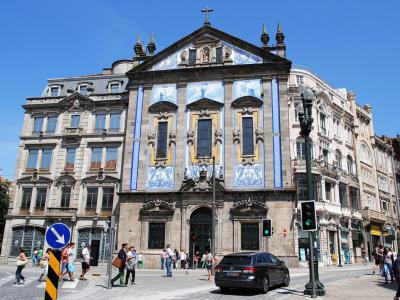
Located in Porto, Portugal, the Igreja de Santo Antonio Congregados, also known as the Saint Anthony Church of the Gatherers, is dedicated to Saint Anthony of Padua. This Portuguese born saint, Saint Anthony was born in the 12th century and became a Franciscan priest. The Franciscans were the largest member of the Order of the Friars Minor and were founded by Saint Francis Assisi. As a missionary, he eventually found his calling in Padua, Italy.
The building was constructed during the late part of the 17th century. The church replaced the original church which stood on this land for several hundred years. Designed by the very popular and world renowned architect of the time, Joaquim Jaime B. Ferreira-Alves, it is elegant and elaborate with Baroque features including the fabulous tile work which was created by the famed artisans, Jorge Colaço and João Baptista Ribeiro.
The tile work tells the story of Saint Anthony and the Assumption of the Blessed Virgin Mary. Baroque style is characterized by sharp details and larger-than-life motion which, it its architectural constructions often appear as if they are seamlessly reaching for the sky. Many of the Roman Catholic Churches throughout Europe have some style elements of the Baroque period of art and architecture.
The building was constructed during the late part of the 17th century. The church replaced the original church which stood on this land for several hundred years. Designed by the very popular and world renowned architect of the time, Joaquim Jaime B. Ferreira-Alves, it is elegant and elaborate with Baroque features including the fabulous tile work which was created by the famed artisans, Jorge Colaço and João Baptista Ribeiro.
The tile work tells the story of Saint Anthony and the Assumption of the Blessed Virgin Mary. Baroque style is characterized by sharp details and larger-than-life motion which, it its architectural constructions often appear as if they are seamlessly reaching for the sky. Many of the Roman Catholic Churches throughout Europe have some style elements of the Baroque period of art and architecture.
2) Newspaper Vendor Statue
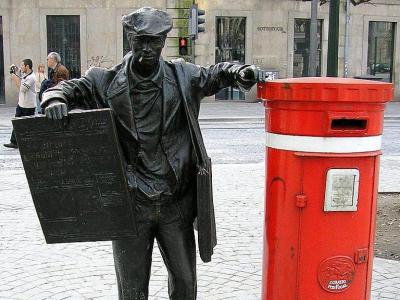
The Newspaper Vendor Statue (Estátua do Ardina) is a charming bronze sculpture located at the bottom of Freedom Square (Praça da Liberdade), on the corner near Saint Benedict (São Bento) station in Porto. Created by Manuel Dias in 1990, this life-size statue honors the "ardina," a traditional newspaper seller who once roamed the streets of Porto, bringing the latest news to locals before the advent of the internet and television. The newspaper vendor is depicted in a classic pose-leaning casually against a red post box, with a newspaper in one hand and a bag slung over his shoulder-a nostalgic nod to a time when news traveled in print, not pixels.
A popular spot for tourists and locals alike, this statue is a beloved reminder of Porto’s past, capturing the old-world charm of the city. While it might be easy to overlook, nestled just around the corner from the bustling railway station, the statue’s quaint and unassuming presence makes it one of the most photographed in Porto. It stands as a tribute to the everyday workers of the past, particularly the low-paid newspaper vendors who once gathered near the former headquarters of the Porto Commerce newspaper.
Despite the mass trend of statues honoring everyday professions across Europe, the Newspaper Vendor Statue remains special to Porto. It has endured its fair share of challenges, including numerous collisions by careless drivers, which led to a significant repair in 2004. As print media continues to decline, this statue serves as a poignant reminder of the ardinas' role in Porto’s history, making it a must-see for those exploring the city’s cultural landmarks.
A popular spot for tourists and locals alike, this statue is a beloved reminder of Porto’s past, capturing the old-world charm of the city. While it might be easy to overlook, nestled just around the corner from the bustling railway station, the statue’s quaint and unassuming presence makes it one of the most photographed in Porto. It stands as a tribute to the everyday workers of the past, particularly the low-paid newspaper vendors who once gathered near the former headquarters of the Porto Commerce newspaper.
Despite the mass trend of statues honoring everyday professions across Europe, the Newspaper Vendor Statue remains special to Porto. It has endured its fair share of challenges, including numerous collisions by careless drivers, which led to a significant repair in 2004. As print media continues to decline, this statue serves as a poignant reminder of the ardinas' role in Porto’s history, making it a must-see for those exploring the city’s cultural landmarks.
3) Praça da Liberdade (Liberty Square) (must see)
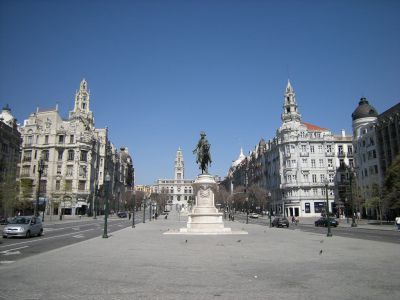
Down in Porto’s Baixa district, just off the south side of the grand Avenue of the Allies, you arrive at Liberty Square—a wide, open space that feels like the city decided to take a deep breath and hold it. Today it’s a central meeting point, but back in 1718, this was a bold piece of urban planning, then known simply as New Square.
Not long after, in 1788, things took a more monastic turn. The religious order of Saint Eligius—patron saint of, among others, veterinarians, horses, and metalworkers—built a convent right here on the southern edge. To make room, they removed part of the old medieval city wall. In its place rose a solid neoclassical structure, which still stands today as the Cardosas Palace—a solid reminder that even defensive walls can give way to more refined ambitions.
Then, in 1866, the square gained its central figure: a monument to Peter IV of Portugal. And he was not a man for small titles, no. In Portugal, he ruled as Peter IV; in Brazil, he was Emperor Peter I. Two crowns, one person—and a strong commitment to liberal ideals on both sides of the Atlantic... Perched on horseback at the center of the square, the monarch holds the constitution he fought to defend during the Liberal Wars, as if to remind everyone passing by that freedom, in his case, came with paperwork.
The square took on its present form in 1916, when the elegant Avenue of the Allies was extended northward, reshaping the space and giving it a more modern, ceremonial feel. Today, the surroundings are a mix of banks, hotels, offices, and restaurants, creating a steady rhythm of daily life. Yet, despite the movement, the statue of Peter IV remains the focal point—calm, elevated, and impossible to ignore.
Take a moment here. Look around. This is where Porto balances its past and present—one eye on history, the other on whatever comes next...
Not long after, in 1788, things took a more monastic turn. The religious order of Saint Eligius—patron saint of, among others, veterinarians, horses, and metalworkers—built a convent right here on the southern edge. To make room, they removed part of the old medieval city wall. In its place rose a solid neoclassical structure, which still stands today as the Cardosas Palace—a solid reminder that even defensive walls can give way to more refined ambitions.
Then, in 1866, the square gained its central figure: a monument to Peter IV of Portugal. And he was not a man for small titles, no. In Portugal, he ruled as Peter IV; in Brazil, he was Emperor Peter I. Two crowns, one person—and a strong commitment to liberal ideals on both sides of the Atlantic... Perched on horseback at the center of the square, the monarch holds the constitution he fought to defend during the Liberal Wars, as if to remind everyone passing by that freedom, in his case, came with paperwork.
The square took on its present form in 1916, when the elegant Avenue of the Allies was extended northward, reshaping the space and giving it a more modern, ceremonial feel. Today, the surroundings are a mix of banks, hotels, offices, and restaurants, creating a steady rhythm of daily life. Yet, despite the movement, the statue of Peter IV remains the focal point—calm, elevated, and impossible to ignore.
Take a moment here. Look around. This is where Porto balances its past and present—one eye on history, the other on whatever comes next...
4) Estátua Equestre de D. Pedro IV (King Peter IV Monument)
The King Peter IV Monument, located in Freedom Square (Praça da Liberdade) in Porto, is a prominent tribute to one of Portugal's most significant monarchs, King Pedro IV, also known as Dom Pedro I of Brazil. Inaugurated in October 1866, this monument has been recognized as a Property of Public Interest since 1982, reflecting its cultural and historical significance.
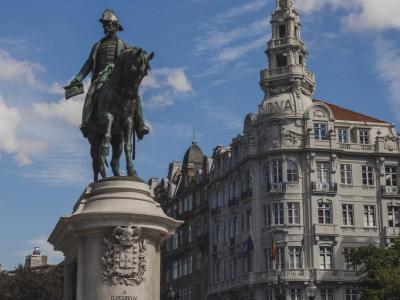
The centerpiece of the monument is a striking bronze statue crafted by French sculptor Célestin Anatole Calmels, set atop a towering 10-meter column of Lioz stone designed by architect Joaquim da Costa Lima. The statue, fused in Belgium, depicts King Pedro IV in military uniform on horseback, proudly holding the constitutional charter in his right hand-a symbol of his dedication to the liberal cause and the constitutional values he upheld during the Liberal Wars.
The monument’s column features intricate details, including two-sided pedestals with low reliefs originally made of Carrara marble, now replaced with bronze duplicates for preservation. These reliefs portray significant moments from Pedro IV's life: the delivery of his heart to Porto's representatives and his landing at Mindelo, where he handed the flag to Tomás de Melo Breyner. Additionally, the coats of arms of Bragança and Porto adorn the front and back of the column, framed by oak and bay leaves, adding to the monument's regal and symbolic presence.
King Pedro IV was born on October 12, 1798, in Queluz. He was the fourth child of King Dom João VI of Portugal and Infanta Charlotte of Spain. As the founder of the Brazilian branch of the House of Braganza and a figure deeply intertwined with the histories of both Portugal and Brazil, Pedro IV’s legacy is commemorated through this grand monument, forever linking him to the city of Porto, which he cherished and defended.
The centerpiece of the monument is a striking bronze statue crafted by French sculptor Célestin Anatole Calmels, set atop a towering 10-meter column of Lioz stone designed by architect Joaquim da Costa Lima. The statue, fused in Belgium, depicts King Pedro IV in military uniform on horseback, proudly holding the constitutional charter in his right hand-a symbol of his dedication to the liberal cause and the constitutional values he upheld during the Liberal Wars.
The monument’s column features intricate details, including two-sided pedestals with low reliefs originally made of Carrara marble, now replaced with bronze duplicates for preservation. These reliefs portray significant moments from Pedro IV's life: the delivery of his heart to Porto's representatives and his landing at Mindelo, where he handed the flag to Tomás de Melo Breyner. Additionally, the coats of arms of Bragança and Porto adorn the front and back of the column, framed by oak and bay leaves, adding to the monument's regal and symbolic presence.
King Pedro IV was born on October 12, 1798, in Queluz. He was the fourth child of King Dom João VI of Portugal and Infanta Charlotte of Spain. As the founder of the Brazilian branch of the House of Braganza and a figure deeply intertwined with the histories of both Portugal and Brazil, Pedro IV’s legacy is commemorated through this grand monument, forever linking him to the city of Porto, which he cherished and defended.

5) Vista Alegre
Vista Alegre, established in 1824 by José Ferreira Pinto Basto, has been a symbol of excellence in Portuguese craftsmanship for two centuries. Originally located near Ílhavo in the north of Portugal, the factory was built on the site of the old Chapel of Vista Alegre. Just five years after its founding, Vista Alegre was recognized for its success by King D. João VI, earning the prestigious title of Royal Factory. Initially producing both glass and ceramic items, the company shifted its focus to porcelain exclusively in 1880.
The brand's growth over the years is a testament to its ability to adapt to changing social and aesthetic trends. By the 20th century, Vista Alegre had solidified its position as a key player in the European market. Today, Vista Alegre pieces are highly sought after, gracing the tables of world leaders, including the President of the Portuguese Republic, the White House, and royal families globally. Its porcelain treasures are not confined to private collections but are also featured in prestigious museums such as the Metropolitan Museum of Art in New York.
For those looking to bring a piece of this renowned brand into their home, the Vista Alegre Outlet shop in Vila do Conde Porto Fashion Outlet offers a selection of high-quality porcelain at competitive prices.
The brand's growth over the years is a testament to its ability to adapt to changing social and aesthetic trends. By the 20th century, Vista Alegre had solidified its position as a key player in the European market. Today, Vista Alegre pieces are highly sought after, gracing the tables of world leaders, including the President of the Portuguese Republic, the White House, and royal families globally. Its porcelain treasures are not confined to private collections but are also featured in prestigious museums such as the Metropolitan Museum of Art in New York.
For those looking to bring a piece of this renowned brand into their home, the Vista Alegre Outlet shop in Vila do Conde Porto Fashion Outlet offers a selection of high-quality porcelain at competitive prices.
6) Church and Tower of the Clergymen (must see)
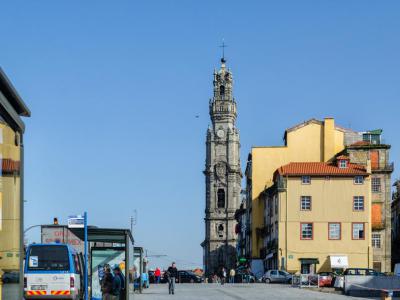
In Porto, one name keeps rising above the skyline—Nicolau Nasoni. This 18th-century Italian architect and painter left his mark all over Portugal, but nowhere more clearly than at the Church and Tower of the Clergymen—his most recognizable creation. And he didn’t stop there. Around the city, his work also shaped places like the Misericórdia Church, the Archbishop’s Palace, and even parts of Porto Cathedral.
The church itself reached completion in 1750, though Nasoni clearly wasn’t in a hurry to wrap things up. The bell tower and the dramatic split staircase out front only followed in 1763.
Pause for a second and take in the façade—it plays out like a Baroque stage set. Garlands, shells, curved lines, and that slightly theatrical pediment all come together in a design that feels both detailed and deliberate. Above the windows, you’ll spot carved symbols with spiritual meaning, while the sides reveal something unusual for the time: an elliptical nave, gently curving instead of following the typical straight layout.
In fact, this was one of the early Baroque churches to experiment with an elliptical floor plan, giving the interior a more dynamic, flowing space. Inside, the main chapel draws attention with a richly colored marble altarpiece, crafted by Manuel dos Santos Porto. It adds both weight and elegance to the otherwise balanced interior.
Then there’s the tower—the part everyone remembers. Built in a Roman Baroque style, inspired by Tuscan bell towers, it rises to about 75 meters, or 245 feet. If you’re feeling energetic, 240 steps will take you to the top. The climb is narrow, the turns are tight, but the reward is a sweeping view across Porto’s rooftops and the Douro River beyond. It’s no surprise the tower became one of the city’s defining symbols.
And Nasoni didn’t just design the place—he became part of it. During his lifetime, he joined the Clerigos Brotherhood, and when he died, he was buried inside the crypt of the very church he created. Not a bad way to stay permanently connected to your best work...
The church itself reached completion in 1750, though Nasoni clearly wasn’t in a hurry to wrap things up. The bell tower and the dramatic split staircase out front only followed in 1763.
Pause for a second and take in the façade—it plays out like a Baroque stage set. Garlands, shells, curved lines, and that slightly theatrical pediment all come together in a design that feels both detailed and deliberate. Above the windows, you’ll spot carved symbols with spiritual meaning, while the sides reveal something unusual for the time: an elliptical nave, gently curving instead of following the typical straight layout.
In fact, this was one of the early Baroque churches to experiment with an elliptical floor plan, giving the interior a more dynamic, flowing space. Inside, the main chapel draws attention with a richly colored marble altarpiece, crafted by Manuel dos Santos Porto. It adds both weight and elegance to the otherwise balanced interior.
Then there’s the tower—the part everyone remembers. Built in a Roman Baroque style, inspired by Tuscan bell towers, it rises to about 75 meters, or 245 feet. If you’re feeling energetic, 240 steps will take you to the top. The climb is narrow, the turns are tight, but the reward is a sweeping view across Porto’s rooftops and the Douro River beyond. It’s no surprise the tower became one of the city’s defining symbols.
And Nasoni didn’t just design the place—he became part of it. During his lifetime, he joined the Clerigos Brotherhood, and when he died, he was buried inside the crypt of the very church he created. Not a bad way to stay permanently connected to your best work...
7) António Ferreira Gomes Statue
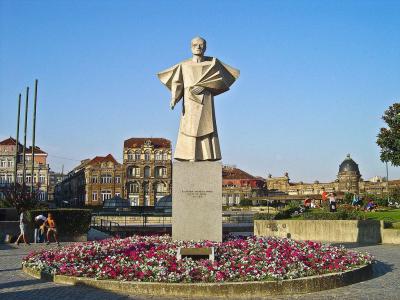
The António Ferreira Gomes Statue in Porto stands as a tribute to a fearless advocate for social justice and freedom of expression. Located in front of Cordoaria Garden (Jardim da Cordoaria), just steps from the iconic Clérigos Tower, this statue captures the spirit of Dom António Ferreira Gomes, who served as the Bishop of Porto from 1952 to 1982. Crafted by Porto sculptor Arlindo Rocha in 1979, the statue depicts Gomes, noted for his distinctive glasses and unyielding stance against the Estado Novo dictatorship.
Gomes was not just a religious leader; he was a vocal critic of the regime, famously confronting António de Oliveira Salazar with a critical letter that ultimately led to his exile from 1959 to 1969. This tenacity and courage have made his statue a subtle yet powerful landmark in Porto, symbolizing his unwavering commitment to social causes.
The statue's placement near the Clérigos Tower is deliberate, ensuring that Gomes' legacy is not overlooked by passersby. While the statue itself stands 4 meters tall against the 75-meter height of the tower, the illusion of grandeur is enhanced by the perspective from pavement level, making Gomes appear almost as monumental as the causes he championed.
Gomes was not just a religious leader; he was a vocal critic of the regime, famously confronting António de Oliveira Salazar with a critical letter that ultimately led to his exile from 1959 to 1969. This tenacity and courage have made his statue a subtle yet powerful landmark in Porto, symbolizing his unwavering commitment to social causes.
The statue's placement near the Clérigos Tower is deliberate, ensuring that Gomes' legacy is not overlooked by passersby. While the statue itself stands 4 meters tall against the 75-meter height of the tower, the illusion of grandeur is enhanced by the perspective from pavement level, making Gomes appear almost as monumental as the causes he championed.
8) Estatua de Ramalho Ortigão (Ramalho Ortigão Statue)
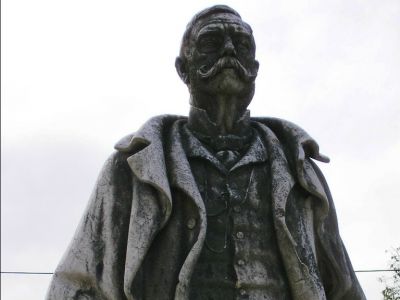
The Ramalho Ortigão Statue in Porto is a tribute to José Duarte Ramalho Ortigão, a prominent 19th-century Portuguese journalist and writer. This marble statue stands proudly at one of the entrances to the Cordoaria Garden (Jardim da Cordoaria), directly across from the Carmelite Church (Igreja do Carmo), marking a prominent spot in the city's historic landscape.
Born in Porto in 1836, Ramalho Ortigão became a significant figure in Portuguese journalism and literature. Starting his career in 1862 as a literary critic for the Porto Diary (Diário do Porto), Ortigão was deeply immersed in the Romanticism movement, a dominant trend at the time, influenced by key literary figures like Camilo Castelo Branco and Soares de Passos. Beyond journalism, he contributed to various literary magazines, worked as a translator, and made a notable mark with his 1874 Portuguese translation of Edward Jenkins' satirical novel, Ginx's Baby. Throughout his life, Ortigão was known for his lively and sharp writing style, penning numerous books that cemented his place in Portuguese literature. He passed away in Lisbon in 1915.
The statue, crafted by sculptor Leopoldo de Almeida, was inaugurated in 1954. It features Ortigão atop a granite pedestal, honoring his legacy and contribution to Portuguese culture. The monument not only celebrates Ortigão's literary achievements but also serves as a historical landmark, reflecting the cultural fabric of Porto.
Born in Porto in 1836, Ramalho Ortigão became a significant figure in Portuguese journalism and literature. Starting his career in 1862 as a literary critic for the Porto Diary (Diário do Porto), Ortigão was deeply immersed in the Romanticism movement, a dominant trend at the time, influenced by key literary figures like Camilo Castelo Branco and Soares de Passos. Beyond journalism, he contributed to various literary magazines, worked as a translator, and made a notable mark with his 1874 Portuguese translation of Edward Jenkins' satirical novel, Ginx's Baby. Throughout his life, Ortigão was known for his lively and sharp writing style, penning numerous books that cemented his place in Portuguese literature. He passed away in Lisbon in 1915.
The statue, crafted by sculptor Leopoldo de Almeida, was inaugurated in 1954. It features Ortigão atop a granite pedestal, honoring his legacy and contribution to Portuguese culture. The monument not only celebrates Ortigão's literary achievements but also serves as a historical landmark, reflecting the cultural fabric of Porto.
9) Centro Português de Fotografia (Portuguese Centre of Photography)
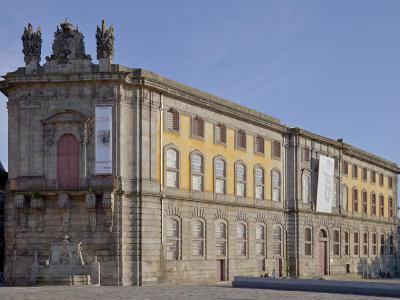
The Portuguese Centre of Photography (Centro Português de Fotografia) was established in 1997, with the first exhibitions taking place later that year on the building’s ground floor. However, it wasn’t until 2001, after an extensive renovation by architects Eduardo Souto Moura and Humberto Vieira, that the Centre of Photography fully occupied its current location.
This location is the historic Cadeia da Relação, a building that dates back to 1767, originally designed by Eugénio dos Santos e Carvalho, an architect known for his work in Pombaline Lisbon. Its construction took nearly three decades, and it served both as a Court of Appeal and a jail. The building’s design, with a distinctive trapezoidal layout, divided space equally between the courtrooms and the jail cells. The careful attention to detail in the court areas remains evident even today in the intricate finishes and architectural flourishes.
The establishment of the Portuguese Centre of Photography came as part of a broader revival of photographic culture in Portugal during the 1990s, supported by photography schools, festivals, and galleries. This movement also drew back photographers who had been exiled during the Salazar regime, allowing them to once again produce and exhibit internationally significant works.
Today, the Portuguese Centre of Photography serves as a cultural hub for historical and contemporary photography, housing a significant part of the country's photographic heritage. During your visit, you can explore old national and international cameras, including instant and still models that are over 100 years old. The center features a permanent exhibition along with rotating temporary exhibits, each highlighting various themes and aspects of Portuguese and international photography history.
Why You Should Visit:
To see interesting photo exhibits while walking through the caverns of an old prison, including the upper levels that used to be reserved for high-paying criminals.
Even a casual photographer should find some of the vintage cameras on display to be interesting. From the last floor, you can also get a good view of Porto and there is a lift.
This location is the historic Cadeia da Relação, a building that dates back to 1767, originally designed by Eugénio dos Santos e Carvalho, an architect known for his work in Pombaline Lisbon. Its construction took nearly three decades, and it served both as a Court of Appeal and a jail. The building’s design, with a distinctive trapezoidal layout, divided space equally between the courtrooms and the jail cells. The careful attention to detail in the court areas remains evident even today in the intricate finishes and architectural flourishes.
The establishment of the Portuguese Centre of Photography came as part of a broader revival of photographic culture in Portugal during the 1990s, supported by photography schools, festivals, and galleries. This movement also drew back photographers who had been exiled during the Salazar regime, allowing them to once again produce and exhibit internationally significant works.
Today, the Portuguese Centre of Photography serves as a cultural hub for historical and contemporary photography, housing a significant part of the country's photographic heritage. During your visit, you can explore old national and international cameras, including instant and still models that are over 100 years old. The center features a permanent exhibition along with rotating temporary exhibits, each highlighting various themes and aspects of Portuguese and international photography history.
Why You Should Visit:
To see interesting photo exhibits while walking through the caverns of an old prison, including the upper levels that used to be reserved for high-paying criminals.
Even a casual photographer should find some of the vintage cameras on display to be interesting. From the last floor, you can also get a good view of Porto and there is a lift.
