Custom Walk in Prague, Czech Republic by mindy_62d6fc created on 2026-07-14
Guide Location: Czech Republic » Prague
Guide Type: Custom Walk
# of Sights: 11
Tour Duration: 2 Hour(s)
Travel Distance: 2.3 Km or 1.4 Miles
Share Key: H8CRG
Guide Type: Custom Walk
# of Sights: 11
Tour Duration: 2 Hour(s)
Travel Distance: 2.3 Km or 1.4 Miles
Share Key: H8CRG
How It Works
Please retrieve this walk in the GPSmyCity app. Once done, the app will guide you from one tour stop to the next as if you had a personal tour guide. If you created the walk on this website or come to the page via a link, please follow the instructions below to retrieve the walk in the app.
Retrieve This Walk in App
Step 1. Download the app "GPSmyCity: Walks in 1K+ Cities" on Apple App Store or Google Play Store.



Step 2. In the GPSmyCity app, download(or launch) the guide "Prague Map and Walking Tours".
Step 3. Tap the menu button located at upper right corner of the "Walks" screen and select "Retrieve custom walk". Enter the share key: H8CRG
1) Jewish Museum
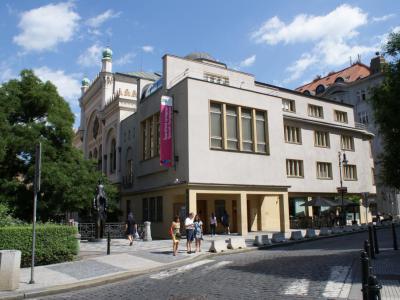
This museum in Prague offers a journey through centuries of Jewish life, resilience, and cultural richness. Founded in 1906, it’s one of the oldest institutions of its kind in Europe, home to a remarkable collection of over 40,000 artifacts and 100,000 books. But what truly sets it apart is its unique layout: instead of being confined to a single building, it is spread across several sites within Prague’s historic Jewish Quarter, each telling a different chapter of the Jewish experience in Bohemia.
At the Maisel Synagogue, exhibitions trace the history of Jewish life in the Bohemian lands from the 10th to the 18th century. Meanwhile, the Pinkas Synagogue is one of Prague’s most haunting sites: inside, the walls are inscribed with the names of nearly 80,000 Czech Jews murdered during the Holocaust. Upstairs, drawings made by children imprisoned in the Terezín Ghetto speak louder than words, offering a glimpse into wartime innocence lost.
Just beyond the Pinkas Synagogue lies the Old Jewish Cemetery, dating back to the 1400s. With over 12,000 tightly packed gravestones rising in layers, it tells a silent yet powerful tale of centuries lived, mourned, and remembered.
The Klausen Synagogue and the neighboring Ceremonial Hall take you deeper into the daily rhythms of Jewish life-birth, coming of age, marriage, and mourning-all explored through displays of ritual objects, customs, and traditions.
A shift in tone and style awaits at the Spanish Synagogue, which houses exhibits on more recent Jewish contributions to Czech society-from the world of science and politics to literature and the arts. And don’t miss the Robert Guttmann Gallery, which offers rotating exhibitions on Jewish identity and contemporary art, drawing connections between past and present.
To take it all in at a comfortable pace, plan to visit either early in the morning or later in the day. And if you find yourself unable to absorb everything in one go, it’s well worth coming back for a second visit-there’s always more to uncover in this deeply meaningful collection of spaces.
At the Maisel Synagogue, exhibitions trace the history of Jewish life in the Bohemian lands from the 10th to the 18th century. Meanwhile, the Pinkas Synagogue is one of Prague’s most haunting sites: inside, the walls are inscribed with the names of nearly 80,000 Czech Jews murdered during the Holocaust. Upstairs, drawings made by children imprisoned in the Terezín Ghetto speak louder than words, offering a glimpse into wartime innocence lost.
Just beyond the Pinkas Synagogue lies the Old Jewish Cemetery, dating back to the 1400s. With over 12,000 tightly packed gravestones rising in layers, it tells a silent yet powerful tale of centuries lived, mourned, and remembered.
The Klausen Synagogue and the neighboring Ceremonial Hall take you deeper into the daily rhythms of Jewish life-birth, coming of age, marriage, and mourning-all explored through displays of ritual objects, customs, and traditions.
A shift in tone and style awaits at the Spanish Synagogue, which houses exhibits on more recent Jewish contributions to Czech society-from the world of science and politics to literature and the arts. And don’t miss the Robert Guttmann Gallery, which offers rotating exhibitions on Jewish identity and contemporary art, drawing connections between past and present.
To take it all in at a comfortable pace, plan to visit either early in the morning or later in the day. And if you find yourself unable to absorb everything in one go, it’s well worth coming back for a second visit-there’s always more to uncover in this deeply meaningful collection of spaces.
2) Spanish Synagogue (must see)
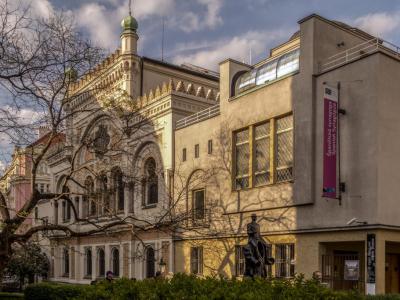
The Spanish Synagogue is one of the most striking sights in Prague’s Jewish Quarter and a natural place to begin exploring the area. Completed in 1868, it stands on the site of the city's oldest synagogue. Despite its name, the synagogue was never used by a Spanish or Sephardic community; the name likely refers to its richly decorative Moorish Revival style, inspired by the architecture of Islamic Spain.
Before entering, pause outside and face the main façade. You can identify it by its three-part design: a taller central section framed by two smaller domed turrets. The rounded domes, arched windows, and balanced symmetry make it stand out from the nearby Gothic and Baroque buildings. The design was partly inspired by Vienna’s Leopoldstadt Temple, though the Prague synagogue has a more compact elegance.
Once inside, step into the main prayer hall and look around from the center. Almost every surface here, except the floor, is covered with delicate arabesques, geometric patterns, gilded details, and painted ornament. The effect is dazzling, like standing inside a jewel box.
From the same central position, look up to the richly decorated dome. Hanging beneath it is a striking Magen David chandelier, easily recognized by its Star of David form. This is one of the best places to appreciate the harmony of light, color, and ornament.
Next, face the front of the hall. Here you will find the ark, the sacred cabinet traditionally used to hold Torah scrolls. You'll identify it by its prominent position and richly decorated form. Nearby is the bimah, the platform used for reading the Torah. Together, they form the ceremonial focus of the synagogue.
Then turn toward the rear of the hall to spot the restored organ, an unusual feature in a synagogue. It reflects the reform-minded Jewish community that worshiped here in the 19th century.
After exploring the main hall, look for the museum displays inside, managed by the Jewish Museum in Prague. The synagogue also serves as an atmospheric concert venue. Just next door is the Robert Guttmann Gallery, a separate exhibition space hosting temporary shows on Jewish art and culture.
Neglected during the Nazi and Communist periods, the Spanish Synagogue was restored in the late 1990s and reopened to the public. Today, it remains one of Prague’s most beautiful interiors and a memorable highlight of the Jewish Quarter.
Before entering, pause outside and face the main façade. You can identify it by its three-part design: a taller central section framed by two smaller domed turrets. The rounded domes, arched windows, and balanced symmetry make it stand out from the nearby Gothic and Baroque buildings. The design was partly inspired by Vienna’s Leopoldstadt Temple, though the Prague synagogue has a more compact elegance.
Once inside, step into the main prayer hall and look around from the center. Almost every surface here, except the floor, is covered with delicate arabesques, geometric patterns, gilded details, and painted ornament. The effect is dazzling, like standing inside a jewel box.
From the same central position, look up to the richly decorated dome. Hanging beneath it is a striking Magen David chandelier, easily recognized by its Star of David form. This is one of the best places to appreciate the harmony of light, color, and ornament.
Next, face the front of the hall. Here you will find the ark, the sacred cabinet traditionally used to hold Torah scrolls. You'll identify it by its prominent position and richly decorated form. Nearby is the bimah, the platform used for reading the Torah. Together, they form the ceremonial focus of the synagogue.
Then turn toward the rear of the hall to spot the restored organ, an unusual feature in a synagogue. It reflects the reform-minded Jewish community that worshiped here in the 19th century.
After exploring the main hall, look for the museum displays inside, managed by the Jewish Museum in Prague. The synagogue also serves as an atmospheric concert venue. Just next door is the Robert Guttmann Gallery, a separate exhibition space hosting temporary shows on Jewish art and culture.
Neglected during the Nazi and Communist periods, the Spanish Synagogue was restored in the late 1990s and reopened to the public. Today, it remains one of Prague’s most beautiful interiors and a memorable highlight of the Jewish Quarter.
3) Ceremonial Hall
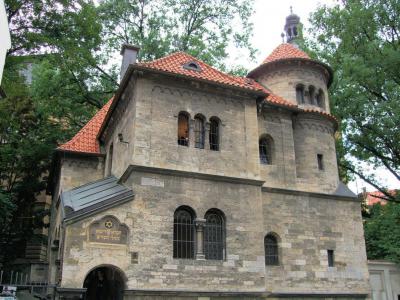
As you step out of the Old Jewish Cemetery and glance to your left, you’ll notice a building that looks like a small fortress or perhaps a nobleman’s residence from another era. That’s the Ceremonial Hall, and while it may not come with a dramatic backstory, its purpose was deeply rooted in the rituals of Jewish life and death.
Built in the early 20th century in a bold Neo-Romanesque style, the hall was commissioned by the Prague Jewish Burial Society. This was no ordinary society-it was made up of respected members entrusted with the sacred task of caring for the dead. Inside, the building was arranged with purpose: the basement was used as a morgue, the ground floor held a space for ritual purification, and the upper floor served as a meeting hall-where the Burial Society conducted business, held ceremonies, and even hosted annual banquets.
Until its closure for renovations in July 2024, the Ceremonial Hall was home to a fascinating exhibit titled “Jewish Customs and Traditions”. The display explored the full spectrum of Jewish life-from birth to death-with special focus on religious rites and communal practices. One of the highlights was an evocative 18th-century painting series illustrating burial customs, along with ceremonial objects and archival materials related to the Burial Society’s history.
The hall is currently undergoing extensive restoration, with plans to reopen by the end of 2026. When it returns, visitors can look forward to an updated core exhibition, once again dedicated to the rituals and traditions that have shaped Jewish identity for centuries. For the latest announcements, keep an eye on the official website of the Jewish Museum in Prague.
Built in the early 20th century in a bold Neo-Romanesque style, the hall was commissioned by the Prague Jewish Burial Society. This was no ordinary society-it was made up of respected members entrusted with the sacred task of caring for the dead. Inside, the building was arranged with purpose: the basement was used as a morgue, the ground floor held a space for ritual purification, and the upper floor served as a meeting hall-where the Burial Society conducted business, held ceremonies, and even hosted annual banquets.
Until its closure for renovations in July 2024, the Ceremonial Hall was home to a fascinating exhibit titled “Jewish Customs and Traditions”. The display explored the full spectrum of Jewish life-from birth to death-with special focus on religious rites and communal practices. One of the highlights was an evocative 18th-century painting series illustrating burial customs, along with ceremonial objects and archival materials related to the Burial Society’s history.
The hall is currently undergoing extensive restoration, with plans to reopen by the end of 2026. When it returns, visitors can look forward to an updated core exhibition, once again dedicated to the rituals and traditions that have shaped Jewish identity for centuries. For the latest announcements, keep an eye on the official website of the Jewish Museum in Prague.
4) Old Jewish Cemetery
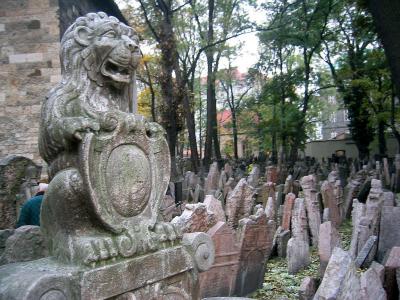
The Old Jewish Cemetery in Prague is one of the city’s most hauntingly beautiful places, and one of the most important Jewish burial grounds in Europe. The cemetery served Prague’s Jewish community from the early 15th century until 1787. Because burial space inside the walled Jewish Quarter was so limited, graves were placed in layers, in some areas many deep. The roughly 12,000 visible headstones are only a fraction of those actually buried here.
Because the cemetery is dense, visitors usually follow a controlled route rather than wandering freely into an uneven forest of tombstones—some leaning forward, others crowded together shoulder to shoulder, creating the almost chaotic landscape. Along this path, the most important graves are often identified by their form, symbols, or the attention they attract.
The oldest markers are simple, while later ones, especially from the 17th century onward, become more ornate, with carved frames, scroll-like volutes, false doorways, and Hebrew inscriptions. Symbols offer clues: hands may indicate priestly descent, scissors may suggest a tailor, and animals or objects may refer to a name, trade, or family.
Among the most important figures associated with the cemetery is Avigdor Kara, a 15th-century rabbi and poet whose burial is traditionally regarded as the oldest marked grave here. His original headstone is preserved in the Maisel Synagogue, so think of him as the cemetery’s first clearly identified voice from the past.
Another best-known grave belongs to Rabbi Judah Loew ben Bezalel, also called Rabbi Löw or the Maharal of Prague. His tomb is usually one of the easiest to recognize, because visitors often stop there to leave small slips of paper with prayers or wishes tucked into the stone. Historically, Rabbi Löw was a major scholar and religious teacher; in legend, he is forever associated with the Golem of Prague.
Among other notable graves appearing along the route is the substantial tomb of Mordecai Maisel, the wealthy benefactor who helped shape Prague’s Jewish Town. The grave of David Gans, a historian, astronomer, mathematician, and geographer, can be identified by a goose symbol, which is a play on his surname, translating as “goose.” Also, David Oppenheim, a respected rabbi and scholar, is marked here by a tumba, with a hexagram referring to the name David.
Because the cemetery is dense, visitors usually follow a controlled route rather than wandering freely into an uneven forest of tombstones—some leaning forward, others crowded together shoulder to shoulder, creating the almost chaotic landscape. Along this path, the most important graves are often identified by their form, symbols, or the attention they attract.
The oldest markers are simple, while later ones, especially from the 17th century onward, become more ornate, with carved frames, scroll-like volutes, false doorways, and Hebrew inscriptions. Symbols offer clues: hands may indicate priestly descent, scissors may suggest a tailor, and animals or objects may refer to a name, trade, or family.
Among the most important figures associated with the cemetery is Avigdor Kara, a 15th-century rabbi and poet whose burial is traditionally regarded as the oldest marked grave here. His original headstone is preserved in the Maisel Synagogue, so think of him as the cemetery’s first clearly identified voice from the past.
Another best-known grave belongs to Rabbi Judah Loew ben Bezalel, also called Rabbi Löw or the Maharal of Prague. His tomb is usually one of the easiest to recognize, because visitors often stop there to leave small slips of paper with prayers or wishes tucked into the stone. Historically, Rabbi Löw was a major scholar and religious teacher; in legend, he is forever associated with the Golem of Prague.
Among other notable graves appearing along the route is the substantial tomb of Mordecai Maisel, the wealthy benefactor who helped shape Prague’s Jewish Town. The grave of David Gans, a historian, astronomer, mathematician, and geographer, can be identified by a goose symbol, which is a play on his surname, translating as “goose.” Also, David Oppenheim, a respected rabbi and scholar, is marked here by a tumba, with a hexagram referring to the name David.
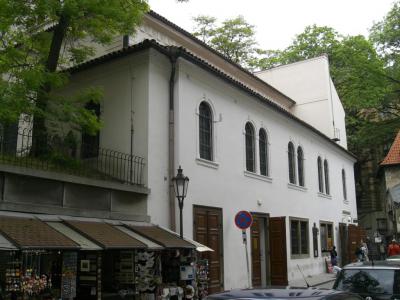
5) Klausen Synagogue
Conveniently located right at the entrance to the Old Jewish Cemetery, the Klausen Synagogue is the largest in Prague’s historic Jewish Quarter. Built at the end of the 17th century, its foundations rest on the site of three earlier structures-a small synagogue, a school, and a ritual bath-all consumed by the devastating fire that swept through the ghetto in 1689. The new building, shaped by early Baroque design, quickly became a central part of the community’s spiritual and social life.
During the Second World War, the synagogue was seized by the Nazis and used as a storage space, a grim chapter that led to the loss of much of its interior detail. In the years following the war, it became part of the Jewish Museum in Prague and has since offered visitors a meaningful window into Jewish life and ritual. The permanent exhibitions focused on everyday customs and the major Jewish holidays have long been a favorite among those interested in the cultural fabric of Czech Jewry.
Inside, visitors would normally find a spacious nave beneath a barrel-vaulted ceiling, adorned with Baroque stucco work-acanthus leaves, cascading fruit garlands, and intricate detailing that adds a sense of movement and warmth. Sunlight pours through tall arched windows, casting a golden glow across the space. One of the most cherished elements is the Torah Ark, carved from wood in 1696. Positioned at the front of the hall, it showcases the artistry and devotion that defined the period.
As of July 2024, the Klausen Synagogue is temporarily closed for major renovations, with a planned reopening set for 2028. When it reopens, a new core exhibition focused on Jewish customs and daily practices will take center stage, continuing the synagogue’s role as a bridge between past and present. For the latest updates and announcements, be sure to check the official website of the Jewish Museum in Prague.
During the Second World War, the synagogue was seized by the Nazis and used as a storage space, a grim chapter that led to the loss of much of its interior detail. In the years following the war, it became part of the Jewish Museum in Prague and has since offered visitors a meaningful window into Jewish life and ritual. The permanent exhibitions focused on everyday customs and the major Jewish holidays have long been a favorite among those interested in the cultural fabric of Czech Jewry.
Inside, visitors would normally find a spacious nave beneath a barrel-vaulted ceiling, adorned with Baroque stucco work-acanthus leaves, cascading fruit garlands, and intricate detailing that adds a sense of movement and warmth. Sunlight pours through tall arched windows, casting a golden glow across the space. One of the most cherished elements is the Torah Ark, carved from wood in 1696. Positioned at the front of the hall, it showcases the artistry and devotion that defined the period.
As of July 2024, the Klausen Synagogue is temporarily closed for major renovations, with a planned reopening set for 2028. When it reopens, a new core exhibition focused on Jewish customs and daily practices will take center stage, continuing the synagogue’s role as a bridge between past and present. For the latest updates and announcements, be sure to check the official website of the Jewish Museum in Prague.
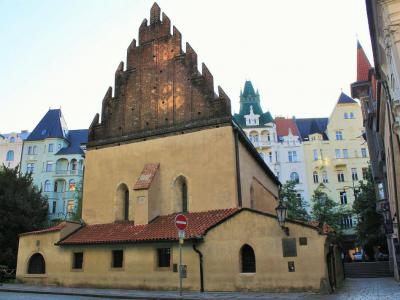
6) Old-New Synagogue
The Old-New Synagogue stands as one the most historically significant landmarks-Europe’s oldest synagogue still in regular use. When first completed in the 13th century, it was known simply as the “New” or “Great” Synagogue. The slightly ironic name “Old-New” came later, after additional synagogues were built nearby during the 16th century.
Unlike the richly adorned buildings that surround it, this synagogue embraces a striking simplicity. The high vaulted ceilings, Gothic arched windows, and unembellished ironwork create a solemn atmosphere that feels both ancient and enduring. One of the most distinctive features is the rare twin-nave layout, thought to be inspired by Christian monasteries of the same era-an architectural crossover not often seen in Jewish houses of worship.
Beyond the stone and mortar lies legend. According to local lore, the attic once housed a clay guardian-the Golem-brought to life by Rabbi Judah Löw in the late 1500s. Created to protect the Jewish community from harm, the Golem was said to obey its creator faithfully-until, like a tale out of folklore, it began to spiral out of control. To prevent further danger, the Rabbi deactivated the creature and sealed it away in the attic, where it supposedly still rests. The area remains closed to visitors, ensuring their “safety”. Other stories claim that the synagogue's survival through centuries of conflict and disaster is thanks to a divine presence-angelic wings that turned into doves to shield the building from harm.
Although the Old-New Synagogue operates independently of the Jewish Museum, visitors can still explore it using the Prague Jewish Town ticket, which provides access to several nearby historic sites. Advance booking is recommended, and tickets are available online for those hoping to secure a guaranteed visit.
Unlike the richly adorned buildings that surround it, this synagogue embraces a striking simplicity. The high vaulted ceilings, Gothic arched windows, and unembellished ironwork create a solemn atmosphere that feels both ancient and enduring. One of the most distinctive features is the rare twin-nave layout, thought to be inspired by Christian monasteries of the same era-an architectural crossover not often seen in Jewish houses of worship.
Beyond the stone and mortar lies legend. According to local lore, the attic once housed a clay guardian-the Golem-brought to life by Rabbi Judah Löw in the late 1500s. Created to protect the Jewish community from harm, the Golem was said to obey its creator faithfully-until, like a tale out of folklore, it began to spiral out of control. To prevent further danger, the Rabbi deactivated the creature and sealed it away in the attic, where it supposedly still rests. The area remains closed to visitors, ensuring their “safety”. Other stories claim that the synagogue's survival through centuries of conflict and disaster is thanks to a divine presence-angelic wings that turned into doves to shield the building from harm.
Although the Old-New Synagogue operates independently of the Jewish Museum, visitors can still explore it using the Prague Jewish Town ticket, which provides access to several nearby historic sites. Advance booking is recommended, and tickets are available online for those hoping to secure a guaranteed visit.
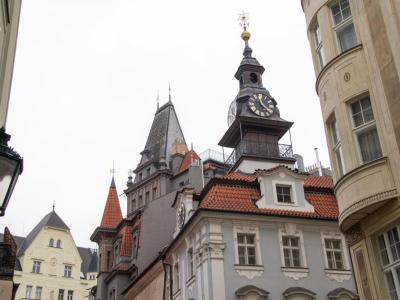
7) High Synagogue
The High Synagogue is easy to spot by its more restrained Renaissance-style appearance. The modest exterior can be misleading, though, as the most important space was deliberately placed upstairs: the elevated prayer hall that gave the synagogue its name.
The High Synagogue was funded by Mordechai Maisel, one of the wealthiest and most influential Jewish figures in 16th-century Prague, and was completed in 1568. It originally served not only as a house of worship but also as a meeting place for the Jewish council and the seat of the Rabbinic Court.
As you stand outside, first notice the synagogue’s relationship to the Jewish Town Hall next door. The two buildings once formed an important civic and religious center for Prague’s Jewish community. The Town Hall is the more immediately recognizable landmark, especially because of its famous clocks, including the Hebrew clock whose hands move counterclockwise. The High Synagogue, by contrast, is quieter and more reserved.
If you can enter the building, head upward to the main prayer hall. This is the key feature of the synagogue and the reason for the word “High” in its name. Once inside, look up: the ribbed vaulted ceiling is one of the most important surviving original elements. Its eight-pointed star motif is especially striking and offers a glimpse of the building’s Renaissance character, even though the synagogue was later damaged and restored after the Great Fire of 1689.
Also worth noticing inside are the Torah scrolls and richly embroidered mantles, which can be seen by those attending services or granted access. These ritual objects represent the continuity of Jewish worship in a space that has survived fire, political upheaval, Nazi occupation, and Communist rule.
During much of the 20th century, the High Synagogue was no longer used primarily for worship. Under the Jewish Museum, it functioned as an exhibition space displaying Torah textiles, ceremonial silverwork, and rare Hebrew manuscripts. After the Velvet Revolution, a bookshop specializing in Holocaust literature and Jewish studies opened on the premises. Since 1997, however, the synagogue has once again been consecrated for religious use.
Although the High Synagogue is not generally open to casual visitors, its location, history, and surviving interior features make it an important stop for understanding how religious, legal, and communal life once overlapped in Jewish Prague.
The High Synagogue was funded by Mordechai Maisel, one of the wealthiest and most influential Jewish figures in 16th-century Prague, and was completed in 1568. It originally served not only as a house of worship but also as a meeting place for the Jewish council and the seat of the Rabbinic Court.
As you stand outside, first notice the synagogue’s relationship to the Jewish Town Hall next door. The two buildings once formed an important civic and religious center for Prague’s Jewish community. The Town Hall is the more immediately recognizable landmark, especially because of its famous clocks, including the Hebrew clock whose hands move counterclockwise. The High Synagogue, by contrast, is quieter and more reserved.
If you can enter the building, head upward to the main prayer hall. This is the key feature of the synagogue and the reason for the word “High” in its name. Once inside, look up: the ribbed vaulted ceiling is one of the most important surviving original elements. Its eight-pointed star motif is especially striking and offers a glimpse of the building’s Renaissance character, even though the synagogue was later damaged and restored after the Great Fire of 1689.
Also worth noticing inside are the Torah scrolls and richly embroidered mantles, which can be seen by those attending services or granted access. These ritual objects represent the continuity of Jewish worship in a space that has survived fire, political upheaval, Nazi occupation, and Communist rule.
During much of the 20th century, the High Synagogue was no longer used primarily for worship. Under the Jewish Museum, it functioned as an exhibition space displaying Torah textiles, ceremonial silverwork, and rare Hebrew manuscripts. After the Velvet Revolution, a bookshop specializing in Holocaust literature and Jewish studies opened on the premises. Since 1997, however, the synagogue has once again been consecrated for religious use.
Although the High Synagogue is not generally open to casual visitors, its location, history, and surviving interior features make it an important stop for understanding how religious, legal, and communal life once overlapped in Jewish Prague.
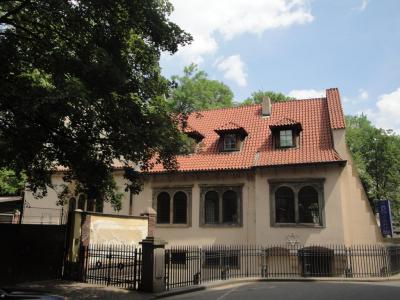
8) Pinkas Synagogue - Holocaust Memorial
Built in 1535, Prague’s second-oldest synagogue has borne witness to centuries of change. Today, it serves as a solemn tribute to over 77,000 Czech Jews who perished during the Holocaust. Though the building has been restored multiple times, its most profound transformation came in the 1990s, when the interior walls were carefully inscribed with the names of the victims, each one listed alongside their hometown in Bohemia or Moravia. Stepping inside feels less like entering a historic monument and more like walking into a vast, silent book of remembrance-every wall a page, every name a life once lived.
As visitors continue through the space, they enter a deeply emotional exhibit that features artwork created by children held in the Terezín ghetto during the war. These drawings were made during secret art classes led by a courageous teacher interned at the camp from 1942 to 1944. Despite the ever-present threat of deportation, she encouraged the children to express their inner worlds through art. Knowing the danger, she hid their work in two suitcases, which remarkably survived the war and today offer a rare glimpse into the lives of those young souls, many of whom would never return home.
Visitors can also witness “Faces of the Victims of the Shoah”, an evening video projection that casts photographs of Holocaust victims onto the synagogue’s exterior-clearly visible from the nearby street. The display's duration changes with the seasons, lasting up to two and a half hours during the longer winter nights.
As visitors continue through the space, they enter a deeply emotional exhibit that features artwork created by children held in the Terezín ghetto during the war. These drawings were made during secret art classes led by a courageous teacher interned at the camp from 1942 to 1944. Despite the ever-present threat of deportation, she encouraged the children to express their inner worlds through art. Knowing the danger, she hid their work in two suitcases, which remarkably survived the war and today offer a rare glimpse into the lives of those young souls, many of whom would never return home.
Visitors can also witness “Faces of the Victims of the Shoah”, an evening video projection that casts photographs of Holocaust victims onto the synagogue’s exterior-clearly visible from the nearby street. The display's duration changes with the seasons, lasting up to two and a half hours during the longer winter nights.
9) Jan Palach Square
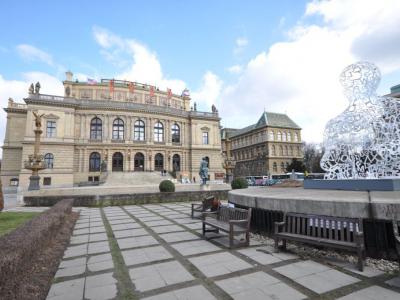
Jan Palach Square is among the most quietly powerful public spaces in the Czech capital. Standing near the open western side of it, with the Vltava River in front of you, you’ll immediately understand why the setting matters. To your left, the elegant Mánes Bridge leads across the water toward the Lesser Town. Straight ahead, beyond the river, you can catch postcard views of Charles Bridge and the rising silhouette of Prague Castle.
The place was originally called Red Army Square, in honor of Soviet soldiers who died during the liberation of Prague in 1945. In 1970, however, it became informally associated with Jan Palach, the philosophy student who set himself on fire in 1969 to protest the Soviet-led invasion of Czechoslovakia. His sacrifice turned the square into a place of memory and moral resistance. The name Jan Palach Square was officially adopted in 1989, as Communist rule was collapsing.
Now turn north, toward the grand Neo-Renaissance building with arched windows, sculpted decoration, and a formal concert-hall presence. This is the Rudolfinum, home of the Czech Philharmonic and one of Prague’s major cultural landmarks. In front of it, look for the standing statue of Antonín Dvořák, the great Czech composer; it is easy to identify by its placement in the open space before the building.
Next, face east, away from the river. The large academic building here belongs to the Faculty of Arts of Charles University, long connected with Prague’s intellectual life. Near this side of the square, look for two stark, dark sculptural forms resembling small, severe houses. These are John Hejduk’s memorials to Jan Palach, titled The House of the Suicide and The House of the Mother of the Suicide. Installed in 2016, they are intentionally unsettling: less decorative monuments than an emotional wound made visible that became a national wake-up call.
Now look south, toward the Academy of Arts, Architecture, and Design, another reminder that this square is not only about politics and memory, but also about culture and creativity. Finally, nearer the river, find the statue of Josef Mánes, the 19th-century painter best known for creating the beloved calendar medallions on Prague’s Astronomical Clock. Together, all these landmarks make the square feel like a meeting point of Czech music, art, scholarship, grief, and national conscience...
The place was originally called Red Army Square, in honor of Soviet soldiers who died during the liberation of Prague in 1945. In 1970, however, it became informally associated with Jan Palach, the philosophy student who set himself on fire in 1969 to protest the Soviet-led invasion of Czechoslovakia. His sacrifice turned the square into a place of memory and moral resistance. The name Jan Palach Square was officially adopted in 1989, as Communist rule was collapsing.
Now turn north, toward the grand Neo-Renaissance building with arched windows, sculpted decoration, and a formal concert-hall presence. This is the Rudolfinum, home of the Czech Philharmonic and one of Prague’s major cultural landmarks. In front of it, look for the standing statue of Antonín Dvořák, the great Czech composer; it is easy to identify by its placement in the open space before the building.
Next, face east, away from the river. The large academic building here belongs to the Faculty of Arts of Charles University, long connected with Prague’s intellectual life. Near this side of the square, look for two stark, dark sculptural forms resembling small, severe houses. These are John Hejduk’s memorials to Jan Palach, titled The House of the Suicide and The House of the Mother of the Suicide. Installed in 2016, they are intentionally unsettling: less decorative monuments than an emotional wound made visible that became a national wake-up call.
Now look south, toward the Academy of Arts, Architecture, and Design, another reminder that this square is not only about politics and memory, but also about culture and creativity. Finally, nearer the river, find the statue of Josef Mánes, the 19th-century painter best known for creating the beloved calendar medallions on Prague’s Astronomical Clock. Together, all these landmarks make the square feel like a meeting point of Czech music, art, scholarship, grief, and national conscience...
10) Maisel Synagogue
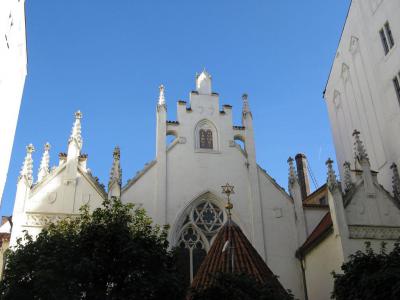
Like the Jewish Town Hall and the Klausen and High Synagogues, the Maisel Synagogue owes its existence to the generosity of Mordecai Maisel-a wealthy philanthropist, influential mayor of Prague’s Jewish Town, and key figure at the court of Emperor Rudolf II. Constructed in the late 16th century, it was not only one of the most splendid synagogues of its time but also the first in Prague to welcome women into its services. The original structure was built in the Renaissance style; however, the Great Fire of 1689 devastated much of the building. A Baroque redesign followed, only to be replaced in the late 19th century by the neo-Gothic façade you see today.
Inside, the synagogue now serves as a museum space dedicated to the history of Jewish life in the Czech lands, with a focus on the period leading up to the late 18th century. The whitewashed walls create a quiet, contemplative setting for the exhibition. Displayed in glass cases are finely crafted ritual objects: gold and silver Hanukkah lamps, Torah scrolls adorned with embroidered mantles, and delicately worked ceremonial items. Some pieces offer curious insights into social customs, such as the starched ruffs once worn by unmarried Jewish boys from the age of twelve.
Many of the most exquisite artifacts come from the golden age of the 16th and early 17th centuries-a time when Prague’s Jewish community flourished culturally and economically. There is a certain tragic irony, however: a large number of these items were brought to Prague during the Nazi occupation, seized from synagogues across Bohemia and Moravia with the intent of showcasing them in a planned “museum of an extinct race.”
Adding a modern layer to the experience, interactive displays allow to explore historical maps and biographies of notable figures. A highlight is the immersive video installation “Flight Over the Prague Jewish Town”, projected on a large screen and based on Antonín Langweil’s 19th-century paper model of the city-a rare bird’s-eye view into the vanished world of the former ghetto.
Inside, the synagogue now serves as a museum space dedicated to the history of Jewish life in the Czech lands, with a focus on the period leading up to the late 18th century. The whitewashed walls create a quiet, contemplative setting for the exhibition. Displayed in glass cases are finely crafted ritual objects: gold and silver Hanukkah lamps, Torah scrolls adorned with embroidered mantles, and delicately worked ceremonial items. Some pieces offer curious insights into social customs, such as the starched ruffs once worn by unmarried Jewish boys from the age of twelve.
Many of the most exquisite artifacts come from the golden age of the 16th and early 17th centuries-a time when Prague’s Jewish community flourished culturally and economically. There is a certain tragic irony, however: a large number of these items were brought to Prague during the Nazi occupation, seized from synagogues across Bohemia and Moravia with the intent of showcasing them in a planned “museum of an extinct race.”
Adding a modern layer to the experience, interactive displays allow to explore historical maps and biographies of notable figures. A highlight is the immersive video installation “Flight Over the Prague Jewish Town”, projected on a large screen and based on Antonín Langweil’s 19th-century paper model of the city-a rare bird’s-eye view into the vanished world of the former ghetto.
11) Jubilee Synagogue
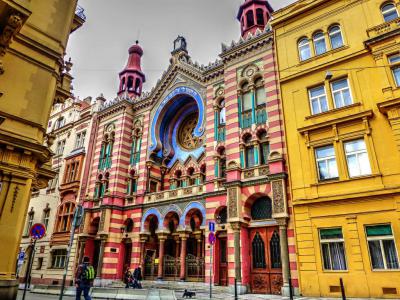
Also referred to as the Jerusalem Synagogue for its location on Jerusalem Street, the Jubilee Synagogue was named in honor of Emperor Franz-Josef I of Austria's sixtieth year of reign in 1908. As the latest and largest addition to Prague's Jewish community, its construction showcases a vibrant Moorish style reminiscent of the Spanish Synagogue in Josefov, embellished with touches of Art Nouveau, particularly evident within its interiors. The Mudéjar red-and-white stone facade adds to its visual allure, striking observers with its distinctiveness. Despite recent renovations, the synagogue remains dedicated to its religious purpose.
After nearly a century of serving as a place of worship, the Jubilee Synagogue began welcoming tourists and enthusiasts of historic architecture regularly starting April 1, 2008. Now transformed into a cultural and exhibition venue, it hosts concerts where visitors can experience the uniquely preserved original organ. The facade bears a meaningful Hebrew inscription from Malachi, promoting a message of unity and optimism: "Do we not have one father? Were we not created by the same God?"
After nearly a century of serving as a place of worship, the Jubilee Synagogue began welcoming tourists and enthusiasts of historic architecture regularly starting April 1, 2008. Now transformed into a cultural and exhibition venue, it hosts concerts where visitors can experience the uniquely preserved original organ. The facade bears a meaningful Hebrew inscription from Malachi, promoting a message of unity and optimism: "Do we not have one father? Were we not created by the same God?"
