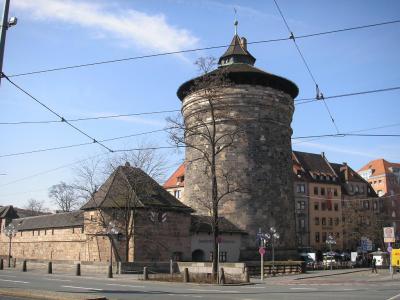


Frauentorturm (Women's Gate Tower), Nuremberg
The Women's Gate Tower, also historically known as the "Blau Q," stands as a significant medieval landmark in Nuremberg. This tower is one of the four major towers that were integral to the fortifications of Nuremberg’s Old Town. Positioned on the southeastern side, it was strategically placed to guard the Women's Gate, which was a crucial entry point into the city from the route leading to Regensburg.
The gate's name is derived from its proximity to the Poor Clare Convent of Saint Klara, hinting at the historical significance of the area in terms of both defense and local culture. Documentation regarding the construction of the Women's Gate Tower is sparse, but payment records to the gatekeeper from as early as 1386 suggest that the gate was operational by this time, marking the likely completion of its construction.
Originally, the tower formed part of an earlier phase of the city walls before being replaced by the current structure following the demolition of the inner Women's Gate in 1498-a change coinciding with the construction of the city’s customs house. In 1558, the Women's Gate Tower underwent significant remodeling to achieve its present-day rounded shape, which included the addition of a side gate.
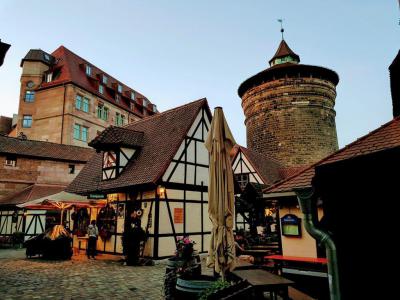
With the completion of the King's Gate in 1849, the Women's Gate was relegated to managing outgoing traffic. In contemporary times, the gate is exclusively pedestrian and hosts the Nuremberg Crafts Yard within what was once its armory, providing a vibrant cultural and commercial space for both locals and visitors.
The gate's name is derived from its proximity to the Poor Clare Convent of Saint Klara, hinting at the historical significance of the area in terms of both defense and local culture. Documentation regarding the construction of the Women's Gate Tower is sparse, but payment records to the gatekeeper from as early as 1386 suggest that the gate was operational by this time, marking the likely completion of its construction.
Originally, the tower formed part of an earlier phase of the city walls before being replaced by the current structure following the demolition of the inner Women's Gate in 1498-a change coinciding with the construction of the city’s customs house. In 1558, the Women's Gate Tower underwent significant remodeling to achieve its present-day rounded shape, which included the addition of a side gate.
With the completion of the King's Gate in 1849, the Women's Gate was relegated to managing outgoing traffic. In contemporary times, the gate is exclusively pedestrian and hosts the Nuremberg Crafts Yard within what was once its armory, providing a vibrant cultural and commercial space for both locals and visitors.
Want to visit this sight? Check out these Self-Guided Walking Tours in Nuremberg. Alternatively, you can download the mobile app "GPSmyCity: Walks in 1K+ Cities" from Apple App Store or Google Play Store. The app turns your mobile device to a personal tour guide and it works offline, so no data plan is needed when traveling abroad.
Download The GPSmyCity App



Frauentorturm (Women's Gate Tower) on Map
Sight Name: Frauentorturm (Women's Gate Tower)
Sight Location: Nuremberg, Germany (See walking tours in Nuremberg)
Sight Type: Attraction/Landmark
Guide(s) Containing This Sight:
Sight Location: Nuremberg, Germany (See walking tours in Nuremberg)
Sight Type: Attraction/Landmark
Guide(s) Containing This Sight:
Nearby Sights

Walking Tours in Nuremberg, Germany

Create Your Own Walk in Nuremberg
Creating your own self-guided walk in Nuremberg is easy and fun. Choose the city attractions that you want to see and a walk route map will be created just for you. You can even set your hotel as the start point of the walk.
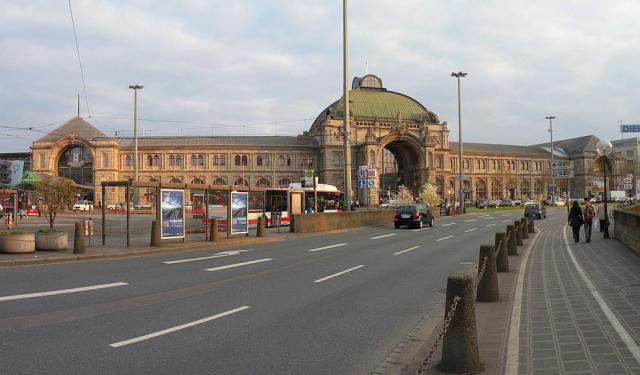
A Walk Through Nuremberg's Historical Old Town
American poet Henry Wadsworth Longfellow described Nuremberg as a “quaint old town of toil and traffic, quaint old town of art and song.”
Nuremberg has witnessed some of the most significant events in German history. For many people, the city is first associated with the rise of the Third Reich, the Nazi Party rallies, and the postwar trials of Nazi leaders. Indeed, Hitler regarded... view more
Tour Duration: 3 Hour(s)
Travel Distance: 3.8 Km or 2.4 Miles
Nuremberg has witnessed some of the most significant events in German history. For many people, the city is first associated with the rise of the Third Reich, the Nazi Party rallies, and the postwar trials of Nazi leaders. Indeed, Hitler regarded... view more
Tour Duration: 3 Hour(s)
Travel Distance: 3.8 Km or 2.4 Miles
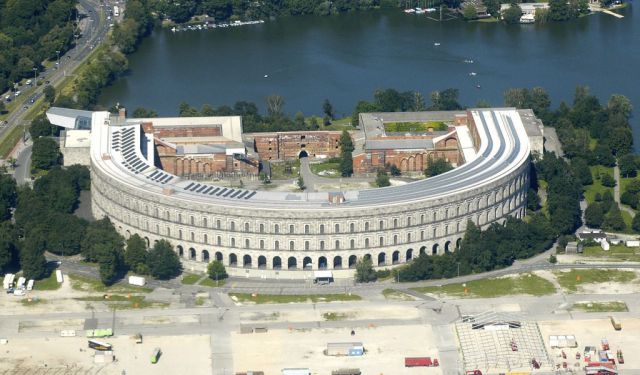
Hitler's Nuremberg Tour
Nuremberg’s association with Adolf Hitler and National Socialism is one of the darkest chapters in the city’s history. Although Nuremberg is known for its medieval architecture and storybook appearance, few German cities are as closely intertwined with the Nazi legacy. Hitler referred to it as the “City of the Party Rallies” and regarded it as a model for the ideal German city.
The... view more
Tour Duration: 2 Hour(s)
Travel Distance: 4.9 Km or 3 Miles
The... view more
Tour Duration: 2 Hour(s)
Travel Distance: 4.9 Km or 3 Miles