Custom Walk in Rhodes, Greece by lluster6636 created on 2022-09-27
Guide Location: Greece » Rhodes
Guide Type: Custom Walk
# of Sights: 10
Tour Duration: 2 Hour(s)
Travel Distance: 4.9 Km or 3 Miles
Share Key: 2C7UA
Guide Type: Custom Walk
# of Sights: 10
Tour Duration: 2 Hour(s)
Travel Distance: 4.9 Km or 3 Miles
Share Key: 2C7UA
How It Works
Please retrieve this walk in the GPSmyCity app. Once done, the app will guide you from one tour stop to the next as if you had a personal tour guide. If you created the walk on this website or come to the page via a link, please follow the instructions below to retrieve the walk in the app.
Retrieve This Walk in App
Step 1. Download the app "GPSmyCity: Walks in 1K+ Cities" on Apple App Store or Google Play Store.



Step 2. In the GPSmyCity app, download(or launch) the guide "Rhodes Map and Walking Tours".
Step 3. Tap the menu button located at upper right corner of the "Walks" screen and select "Retrieve custom walk". Enter the share key: 2C7UA
1) Old Town
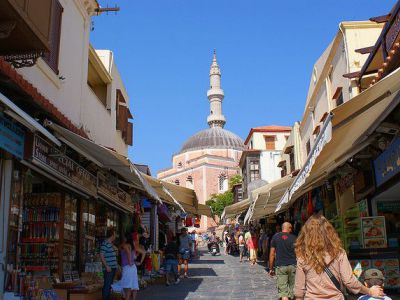
The Old Town of Rhodes is the oldest medieval town in Europe. There are about 200 streets in the Old Town of Rhodes, and no one has a name. So if you get lost on the streets of Rhodes just ask how you can get to Sokratous. It may be considered as the main street of the Old Town of Rhodes.
2) Mandraki Harbor and Windmills (must see)
Mandráki Harbour, historically the main port of the ancient city, today provides anchorage for numerous private sailboats along its lengthy eastern quay. During the summer months, the southwest quays come alive with colorful excursion boats that ferry passengers down the coast to Líndos or to nearby islands.
The harbor features a 400-meter-long breakwater jetty, at the end of which stands the Fort of Saint Nicholas ("Ágios Nikólaos"). Originally constructed by the Knights, the fort was last used militarily during World War II and now houses a lighthouse that aids modern vessels entering the port from the north. Despite popular myths perpetuated by local souvenirs like tea-towels, T-shirts, and posters, the ancient Colossus never actually stood here. Instead, the entrance to the harbor is marked by two columns, each topped with a bronze statue of a doe and stag, symbols of Rhodes.
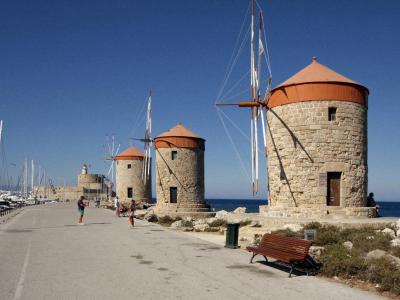
Visitors to Mandráki Harbor can also admire three iconic medieval windmills on the jetty, once used to grind grain from moored vessels. Originally, there may have been as many as 13 or 14 windmills. The remaining three have been extensively renovated and provide a picturesque setting for photographs, particularly stunning at sunrise when their silhouettes are cast against the dawn sky.
The harbor features a 400-meter-long breakwater jetty, at the end of which stands the Fort of Saint Nicholas ("Ágios Nikólaos"). Originally constructed by the Knights, the fort was last used militarily during World War II and now houses a lighthouse that aids modern vessels entering the port from the north. Despite popular myths perpetuated by local souvenirs like tea-towels, T-shirts, and posters, the ancient Colossus never actually stood here. Instead, the entrance to the harbor is marked by two columns, each topped with a bronze statue of a doe and stag, symbols of Rhodes.
Visitors to Mandráki Harbor can also admire three iconic medieval windmills on the jetty, once used to grind grain from moored vessels. Originally, there may have been as many as 13 or 14 windmills. The remaining three have been extensively renovated and provide a picturesque setting for photographs, particularly stunning at sunrise when their silhouettes are cast against the dawn sky.
3) Street of the Knights (must see)
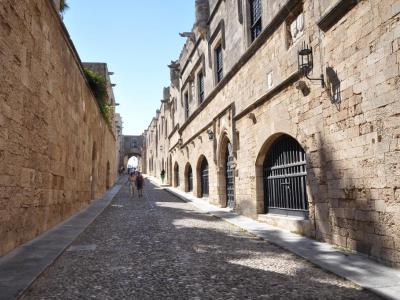
The Street of the Knights ("Odós Ippotón") is lined with many of the inns that housed the crusading order. Recognized as one of the most intact medieval streets in the world, it features buildings made from finely chiseled sandstone, presenting a unified facade that culminates in a striking double archway that spans the road at its highest point. The masonry is punctuated by small square windows and elegant arched doorways, wide enough to accommodate a horse and carriage or a knight on horseback. Intricate carvings, commemorative plaques, and other detailed ornamentation enhance the historic ambiance.
During the day, the street buzzes with tourists and large groups moving about, which can somewhat obscure the historical atmosphere of Knights convening for meetings or attending to their duties. However, at night, the atmosphere transforms; the soft, waxy glow from the streetlights, reminiscent of medieval oil lamps, casts a magical aura that more easily transports you back to the 14th century.
At the start of the street, on the right (north) side, stands the Inn of Italy, marked by a plaque honoring Grand Master Fabrizio del Carretto (1513–21) above its entrance. Adjacent is the smaller Palace of Philippe Villiers de l’Isle-Adam, Carretto's immediate successor and the Grand Master who was ousted by Sultan Süleyman in 1522. Further uphill, across the street, there is a quaint garden with an Ottoman fountain, part of the courtyard of the 15th-century Villaragut Mansion, restored in 2002 but only accessible via application to the Archaeological Museum. Directly opposite is the highly ornate Inn of France, housing a magnificent life-sized stone carving of a knight-possibly originally a tombstone-located just inside the courtyard. This courtyard also contains a chapel from the time of Grand Master Raymond Berenger (1365–74), although the facade facing the street is from more than a century later.
During the day, the street buzzes with tourists and large groups moving about, which can somewhat obscure the historical atmosphere of Knights convening for meetings or attending to their duties. However, at night, the atmosphere transforms; the soft, waxy glow from the streetlights, reminiscent of medieval oil lamps, casts a magical aura that more easily transports you back to the 14th century.
At the start of the street, on the right (north) side, stands the Inn of Italy, marked by a plaque honoring Grand Master Fabrizio del Carretto (1513–21) above its entrance. Adjacent is the smaller Palace of Philippe Villiers de l’Isle-Adam, Carretto's immediate successor and the Grand Master who was ousted by Sultan Süleyman in 1522. Further uphill, across the street, there is a quaint garden with an Ottoman fountain, part of the courtyard of the 15th-century Villaragut Mansion, restored in 2002 but only accessible via application to the Archaeological Museum. Directly opposite is the highly ornate Inn of France, housing a magnificent life-sized stone carving of a knight-possibly originally a tombstone-located just inside the courtyard. This courtyard also contains a chapel from the time of Grand Master Raymond Berenger (1365–74), although the facade facing the street is from more than a century later.
4) Archaeological Museum of Rhodes (must see)
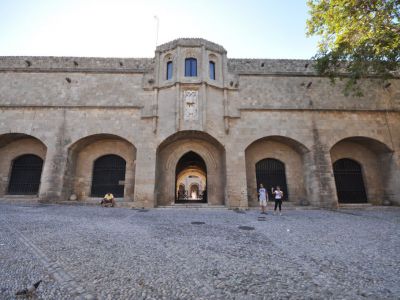
One of the most significant buildings in the Old Town, the Knights' New Hospital, now houses the Archaeological Museum of Rhodes. This structure not only displays artifacts from all the ancient sites on the island but also stands as a testament to the wealth and considerable engineering skills of its medieval builders.
Construction of the hospital began in 1440 and was completed nine years later under the guidance of Grand Master Pierre d’Aubusson. Designed as a state-of-the-art facility for its time, it provided medical care to Christians from across Europe. The building underwent restoration during the Italian occupation and required further repairs after sustaining bomb damage during World War II.
Inside, the museum features a large courtyard lined with arched porticoes, one graced by a lion statue from the Hellenistic period. The courtyard also displays piles of cannonballs from various sieges, including that led by Suleiman the Magnificent. To the left of the courtyard, a stone staircase ascends to the infirmary hall, a vast space with a roof supported by several stone columns, reminiscent of a medieval courtroom. This main ward originally accommodated over 100 beds and had special recessed rooms for the critically ill. Originally featuring minimal comforts, such as a fireplace, it now houses relics from the era of the Knights, including the gravestones of notable members complete with their familial coats-of-arms.
The rooms on the rest of the floor, including the large refectory, have been partitioned into smaller galleries displaying a variety of artifacts, including painted pottery, large storage jars called "pithoi", and grave artifacts from ancient sites like Ialysos and Kameiros, with sections devoted to finds from specific periods. Notably, rooms 6 to 8 focus on artifacts from Ialysos dating from the 9th to the 4th century BC, while rooms 9 to 15 showcase discoveries from Kameiros, all unearthed during the Italian period of excavation.
The atrium area, once the hospital kitchen, now exhibits a remarkable collection of Classical statuary and grave steles, notably one donated by Krito for her mother Timarista around 410 BC, crafted by a local artist in the Athenian style prevalent at that time. Nearby, visitors can also find an Archaic-era "kouros" and a small head of Zeus found near his temple on Mount Atávyros.
Other rooms display exquisite Hellenistic and Roman statues, including two marble representations of Aphrodite: Thalassia or Aidoumene, famously dubbed the 'Marine Venus' by Lawrence Durrell but notable for her sea-dissolved face, and the more accessible "Aphrodite Bathing", a crouched figure arranging her hair, which dates back to the 1st century BC but is thought to be a copy of a 3rd-century BC original. Adjacent to these, a sculpture garden displays a quirky mix of stylized animals both real and mythical, such as dolphin heads, lions, and sea serpents, all set among potted plants.
Construction of the hospital began in 1440 and was completed nine years later under the guidance of Grand Master Pierre d’Aubusson. Designed as a state-of-the-art facility for its time, it provided medical care to Christians from across Europe. The building underwent restoration during the Italian occupation and required further repairs after sustaining bomb damage during World War II.
Inside, the museum features a large courtyard lined with arched porticoes, one graced by a lion statue from the Hellenistic period. The courtyard also displays piles of cannonballs from various sieges, including that led by Suleiman the Magnificent. To the left of the courtyard, a stone staircase ascends to the infirmary hall, a vast space with a roof supported by several stone columns, reminiscent of a medieval courtroom. This main ward originally accommodated over 100 beds and had special recessed rooms for the critically ill. Originally featuring minimal comforts, such as a fireplace, it now houses relics from the era of the Knights, including the gravestones of notable members complete with their familial coats-of-arms.
The rooms on the rest of the floor, including the large refectory, have been partitioned into smaller galleries displaying a variety of artifacts, including painted pottery, large storage jars called "pithoi", and grave artifacts from ancient sites like Ialysos and Kameiros, with sections devoted to finds from specific periods. Notably, rooms 6 to 8 focus on artifacts from Ialysos dating from the 9th to the 4th century BC, while rooms 9 to 15 showcase discoveries from Kameiros, all unearthed during the Italian period of excavation.
The atrium area, once the hospital kitchen, now exhibits a remarkable collection of Classical statuary and grave steles, notably one donated by Krito for her mother Timarista around 410 BC, crafted by a local artist in the Athenian style prevalent at that time. Nearby, visitors can also find an Archaic-era "kouros" and a small head of Zeus found near his temple on Mount Atávyros.
Other rooms display exquisite Hellenistic and Roman statues, including two marble representations of Aphrodite: Thalassia or Aidoumene, famously dubbed the 'Marine Venus' by Lawrence Durrell but notable for her sea-dissolved face, and the more accessible "Aphrodite Bathing", a crouched figure arranging her hair, which dates back to the 1st century BC but is thought to be a copy of a 3rd-century BC original. Adjacent to these, a sculpture garden displays a quirky mix of stylized animals both real and mythical, such as dolphin heads, lions, and sea serpents, all set among potted plants.
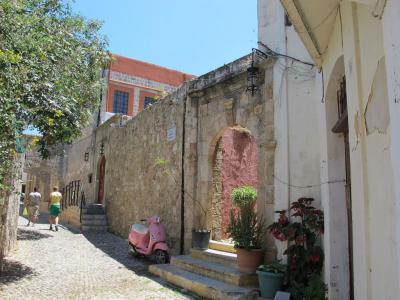
5) Kahal Shalom Synagogue (must see)
Completed in 1577, Kahal Shalom stands as Greece's oldest surviving synagogue still in active use. Its worshipers prospered under Ottoman rule into the 20th century; however, the Kingdom of Italy took over the Dodecanese Islands in 1912, and large numbers of the Jews of Rhodes had begun to emigrate during the 1930s, as they felt menaced by the Fascist Italian regime.
The architectural layout of the structure reflects typical Sephardic synagogue design, featuring a central 'biham' from which the Sefer Torah is read. Inside, the sanctuary has a striking mosaic floor crafted from local black and white stones, while two unique Torah arks can be spotted on either side of the door leading into the interior courtyard. In the courtyard, there is also a fountain used for handwashing.
A commemorative plaque within the synagogue pays tribute to the countless local Jews who tragically lost their lives under Nazi rule. Today, Kahal Shalom remains a site of worship and pilgrimage, with its former women's gallery now transformed into the Jewish Museum of Rhodes, preserving and sharing the rich heritage of the island's Jewish community.
The architectural layout of the structure reflects typical Sephardic synagogue design, featuring a central 'biham' from which the Sefer Torah is read. Inside, the sanctuary has a striking mosaic floor crafted from local black and white stones, while two unique Torah arks can be spotted on either side of the door leading into the interior courtyard. In the courtyard, there is also a fountain used for handwashing.
A commemorative plaque within the synagogue pays tribute to the countless local Jews who tragically lost their lives under Nazi rule. Today, Kahal Shalom remains a site of worship and pilgrimage, with its former women's gallery now transformed into the Jewish Museum of Rhodes, preserving and sharing the rich heritage of the island's Jewish community.
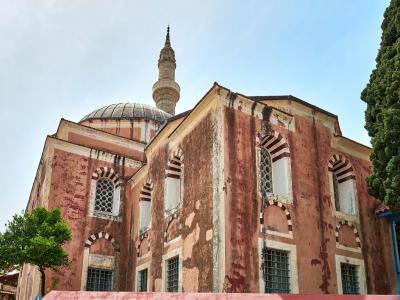
6) Mosque of Suleiman (must see)
One of the most striking sights along Socrates Street is the Mosque of Suleiman, with its magenta-tinted walls and distinctive minaret. Constructed in 1523 to mark the Ottoman conquest of the island, this impressive structure emerged from a long renovation process, including the construction of a new minaret. Although it is not yet open to the public, the best views of its large dome can be enjoyed from a small flight of steps on Odós Orféos.
The Ottoman sultan Suleiman the Magnificent, newly crowned at the time, led naval assaults on Rhodes, overcoming the vastly outnumbered Knights Hospitaller. The knights, who had established a strong presence on the island, were forced to flee, taking only what they could carry with them. As was common among conquerors, Suleiman had this grand religious edifice built over the ruins of the destroyed Christian Church of the Apostles. It is now the largest mosque in Rhodes. Conveniently located opposite the old Turkish Bazaar and adjacent to a picturesque library surrounded by a garden rich in Islamic history, it continues to dominate the landscape.
The Ottoman sultan Suleiman the Magnificent, newly crowned at the time, led naval assaults on Rhodes, overcoming the vastly outnumbered Knights Hospitaller. The knights, who had established a strong presence on the island, were forced to flee, taking only what they could carry with them. As was common among conquerors, Suleiman had this grand religious edifice built over the ruins of the destroyed Christian Church of the Apostles. It is now the largest mosque in Rhodes. Conveniently located opposite the old Turkish Bazaar and adjacent to a picturesque library surrounded by a garden rich in Islamic history, it continues to dominate the landscape.
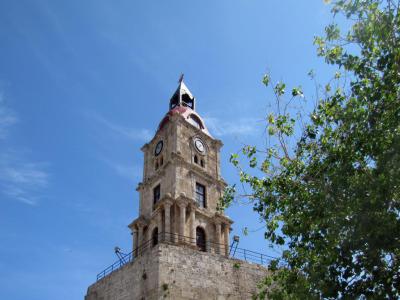
7) Medieval Clock Tower (must see)
Perched at the highest point in the Old Town, the robust clock tower, still in perfect working order, offers a spectacular panoramic view. Originally built in the 7th century, it suffered damage from an explosion in 1856 but was rebuilt with baroque elements by Fethi Pasha. Historically, it served an important function, keeping Greek locals aligned with Turkish time-a necessity due to the strict regulations imposed by the Turks regarding the comings and goings in Rhodes, where precise timing was crucial for adherence to these rules.
Visitors can ascend fifty-three steep wooden steps to reach a small chamber at the top that provides 360-degree views of the surroundings. The entrance fee includes a complimentary drink at the charming terrace cafe situated below. As you make your way up, you'll encounter photographs documenting the various stages of the clock tower's restoration, adding a historical layer to your visit.
Visitors can ascend fifty-three steep wooden steps to reach a small chamber at the top that provides 360-degree views of the surroundings. The entrance fee includes a complimentary drink at the charming terrace cafe situated below. As you make your way up, you'll encounter photographs documenting the various stages of the clock tower's restoration, adding a historical layer to your visit.
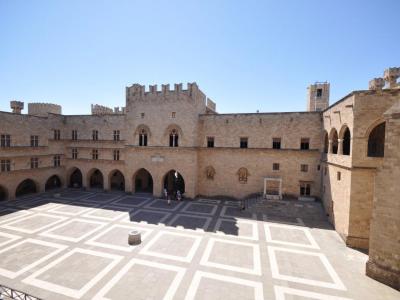
8) Palace of the Grand Master of the Knights of Rhodes (must see)
At the top of the Street of the Knights stands the Palace of the Grand Master, which once served as the administrative core of the Order of the Knights of Saint John and the centerpiece of the Knights’ Quarter. Neglected during the Ottoman era and used as a prison before being nearly destroyed by an explosion in 1856, the palace was later restored by the Italians in a renovation that remains contentious. The rebuild did not adhere to the original floor plan and introduced modern elements to the interior, including statues and mosaics from other Dodecanese islands, much to the chagrin of those islands that still mourn their loss.
Despite these controversies, the palace continues to awe visitors with its regal presence at the highest point in Rhodes. The use of columns and capitals from ancient sites throughout the interior, and the exterior's stone cladding, illustrate the architectural grandeur of the Knights’ Quarter at its peak. Notable features include the splendid wooden ceilings and the onyx window panes that cast a soft light inside. Many of the main rooms display magnificent Hellenistic and Roman mosaics, sourced from nearby Kos, and while their presence here raises ethical questions, they are nonetheless well-preserved.
Visitors enter the palace between two grand semicircular towers and are greeted by a large marble staircase that leads to the spacious upper-story rooms, deliberately kept sparsely furnished to highlight the architecture and mosaics. These mosaics include depictions of the Nine Muses, a nymph on a sea-horse, and Medusa's head, with motifs of fish and dolphins also prevalent.
The ground floor, once used as stables or as storage for grain and munitions during sieges, now encloses a courtyard adorned with Classical statues and houses a permanent exhibition that spans the first 2,400 years of Rhodes' history. This includes a medieval gallery up to the time of the Ottoman conquest, along with temporary exhibitions. The collections are exceptionally well-organized and labeled, even more so than those of the Archaeological Museum.
Despite these controversies, the palace continues to awe visitors with its regal presence at the highest point in Rhodes. The use of columns and capitals from ancient sites throughout the interior, and the exterior's stone cladding, illustrate the architectural grandeur of the Knights’ Quarter at its peak. Notable features include the splendid wooden ceilings and the onyx window panes that cast a soft light inside. Many of the main rooms display magnificent Hellenistic and Roman mosaics, sourced from nearby Kos, and while their presence here raises ethical questions, they are nonetheless well-preserved.
Visitors enter the palace between two grand semicircular towers and are greeted by a large marble staircase that leads to the spacious upper-story rooms, deliberately kept sparsely furnished to highlight the architecture and mosaics. These mosaics include depictions of the Nine Muses, a nymph on a sea-horse, and Medusa's head, with motifs of fish and dolphins also prevalent.
The ground floor, once used as stables or as storage for grain and munitions during sieges, now encloses a courtyard adorned with Classical statues and houses a permanent exhibition that spans the first 2,400 years of Rhodes' history. This includes a medieval gallery up to the time of the Ottoman conquest, along with temporary exhibitions. The collections are exceptionally well-organized and labeled, even more so than those of the Archaeological Museum.
9) Fortifications of Rhodes (must see)
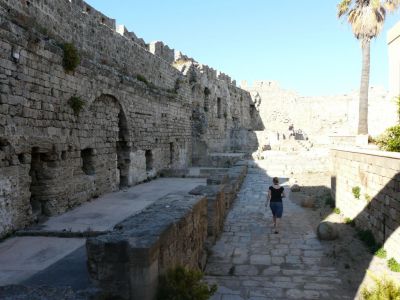
The first and arguably most impressive feature of Rhodes' Old Town are the fortified walls themselves. Stretching 4 kilometers, these formidable barriers were constructed to shield Rhodes from attacks by foreign empires and corsairs who roamed the waters of the Mediterranean and Aegean Seas during the Middle Ages. Although long deemed impenetrable, they were eventually breached by the Ottoman Turks in the early 16th century.
Mostly dating from the preparations for the 1480 siege, the walls stand strong and majestic, casting a beautiful glow at dawn with the sun's first rays or at night, illuminated by wrought-iron lamps. The Knights Hospitaller, who controlled Rhodes from 1309 to 1522, built upon what were initially modest Byzantine defenses. They created eight sections of curtain walls, each overseen by a different "langue" (or knightly division). Originally, each curtain section had a gate, but today, twelve gates remain in use, each with its unique design.
The walls are also dotted with several bastions and towers open to visitors, each filled with intriguing aspects that bring the ancient military history of Rhodes to life. Along the top, catwalks and ramparts, once patrolled by sentries or used for defense during sieges, offer a glimpse into medieval vigilance and warfare. An admission fee is required to explore these historic defenses more closely, with tickets available at the Palace of the Grand Master. Visitors can climb several of the towers and walk along the walls, perhaps imagining themselves as medieval knights.
Mostly dating from the preparations for the 1480 siege, the walls stand strong and majestic, casting a beautiful glow at dawn with the sun's first rays or at night, illuminated by wrought-iron lamps. The Knights Hospitaller, who controlled Rhodes from 1309 to 1522, built upon what were initially modest Byzantine defenses. They created eight sections of curtain walls, each overseen by a different "langue" (or knightly division). Originally, each curtain section had a gate, but today, twelve gates remain in use, each with its unique design.
The walls are also dotted with several bastions and towers open to visitors, each filled with intriguing aspects that bring the ancient military history of Rhodes to life. Along the top, catwalks and ramparts, once patrolled by sentries or used for defense during sieges, offer a glimpse into medieval vigilance and warfare. An admission fee is required to explore these historic defenses more closely, with tickets available at the Palace of the Grand Master. Visitors can climb several of the towers and walk along the walls, perhaps imagining themselves as medieval knights.
10) Acropolis of Rhodes (must see)
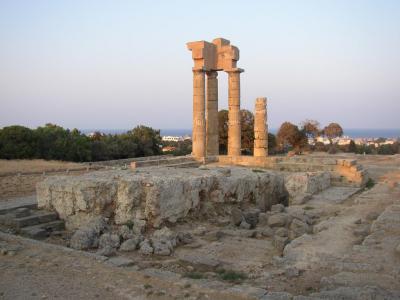
The Acropolis of Rhodes is an acropolis dating from the Classical Greek period (5th–3rd century BC) located approximately 3 kilometers from the centre of the city of Rhodes.
The partially reconstructed part of the site consists of the Temple of Apollo (also, as alternatives Athena Polias and Zeus Polieus) below which is a stadium and a small theatre. It is included in a large park, Monte Smith, named for English Napoleonic admiral William Sidney Smith.
The island of Rhodes is the largest of the Dodecanese, an island group in the southeastern Aegean Sea. In 408 BC, towards the end of the Peloponnesian War, three of the island's ancient cities merged to build an entirely new one – the city of Rhodes – on a site in the Ialysia region of the island. Admired for its beauty and luxury, the city flourished. After weathering a siege by Demetrios Poliorketes (the besieger) in 305–303 BC, Rhodes rallied and built the Colossus of Rhodes, a massive statue of the sun god Helios, to whom Rhodes is linked in Greek mythology. The Colossus is known as one of the Seven Wonders of the Ancient World. Following the great earthquake in 227 BC, which toppled the enormous harbor statue and devastated the city, Rhodes was rebuilt.
It was later raided by Cassius in 42 BC and never recovered. Another catastrophic earthquake in AD 515 caused Rhodes to be reduced and confined to the area of Palais Polis, the present day Old Town. Over the next centuries, it was raided by the Persians and the Arabs and after holding off the Ottoman Empire in 1480, Rhodes was conquered by the Turks in 1522. During the Italo-Turkish War the Italians occupied the Dodecanese islands in 1912, which were not liberated until 1945, at the end of World War II. At that time the British oversaw the islands until their eventual incorporation into Greece 1948. Most recently Rhodes (the island) has become a popular holiday destination for tourists.
The partially reconstructed part of the site consists of the Temple of Apollo (also, as alternatives Athena Polias and Zeus Polieus) below which is a stadium and a small theatre. It is included in a large park, Monte Smith, named for English Napoleonic admiral William Sidney Smith.
The island of Rhodes is the largest of the Dodecanese, an island group in the southeastern Aegean Sea. In 408 BC, towards the end of the Peloponnesian War, three of the island's ancient cities merged to build an entirely new one – the city of Rhodes – on a site in the Ialysia region of the island. Admired for its beauty and luxury, the city flourished. After weathering a siege by Demetrios Poliorketes (the besieger) in 305–303 BC, Rhodes rallied and built the Colossus of Rhodes, a massive statue of the sun god Helios, to whom Rhodes is linked in Greek mythology. The Colossus is known as one of the Seven Wonders of the Ancient World. Following the great earthquake in 227 BC, which toppled the enormous harbor statue and devastated the city, Rhodes was rebuilt.
It was later raided by Cassius in 42 BC and never recovered. Another catastrophic earthquake in AD 515 caused Rhodes to be reduced and confined to the area of Palais Polis, the present day Old Town. Over the next centuries, it was raided by the Persians and the Arabs and after holding off the Ottoman Empire in 1480, Rhodes was conquered by the Turks in 1522. During the Italo-Turkish War the Italians occupied the Dodecanese islands in 1912, which were not liberated until 1945, at the end of World War II. At that time the British oversaw the islands until their eventual incorporation into Greece 1948. Most recently Rhodes (the island) has become a popular holiday destination for tourists.
Sight description based on Wikipedia.
