Custom Walk in Naples, Italy by danielhmcdonald4567 created on 2023-03-22
Guide Location: Italy » Naples
Guide Type: Custom Walk
# of Sights: 16
Tour Duration: 6 Hour(s)
Travel Distance: 13 Km or 8.1 Miles
Share Key: BN38N
Guide Type: Custom Walk
# of Sights: 16
Tour Duration: 6 Hour(s)
Travel Distance: 13 Km or 8.1 Miles
Share Key: BN38N
How It Works
Please retrieve this walk in the GPSmyCity app. Once done, the app will guide you from one tour stop to the next as if you had a personal tour guide. If you created the walk on this website or come to the page via a link, please follow the instructions below to retrieve the walk in the app.
Retrieve This Walk in App
Step 1. Download the app "GPSmyCity: Walks in 1K+ Cities" on Apple App Store or Google Play Store.



Step 2. In the GPSmyCity app, download(or launch) the guide "Naples Map and Walking Tours".
Step 3. Tap the menu button located at upper right corner of the "Walks" screen and select "Retrieve custom walk". Enter the share key: BN38N

1) Terminal BUS Napoli Centrale
This custom location is created on gpsmycity.com website.
2) Duomo di Napoli (Naples Cathedral) (must see)
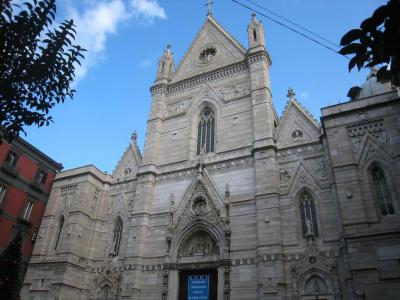
Naples Cathedral is also known as The Cathedral of the Assumption of Mary. The church is commonly called Cattedrale di San Gennaro in honor of Saint Januarius.
The construction of the cathedral began in the 13th century and was finally completed in the 14th century. The impressive Gothic cathedral was built on the ruins of previous churches' excavations. Over the years, Greek and Roman artifacts have been found underneath the cathedral.
The neo-Gothic facade wasn't completed until 1905. The interior features a gilded coffered ceiling. Artist Luca Giordano completed the baroque sections of the nave and transept.
Priest and architect Francesco Grimaldi designed the Chapel of the Treasury. Several renowned artists worked on the chapel, which was completed in 1646. Jusepe de Ribera created the stunning Saint Gennaro Escaping the Furnace Unscathed canvas. Giovanni Lanfranco created the magnificent dome fresco. Behind the altar, Saint Januarius's skull and two vials of blood are held in a silver strongbox.
The next chapel contains Saint Januarius's bones in an urn. More of the saint's remains are housed below the altar in the Cappella Carafa chapel.
Visitors will be impressed by the Basilica di Santa Restituta, originally built in the 4th century and renovated in the 17th century. This ancient church holds Europe's oldest baptistry, the Battistero di San Giovanni in Fonte. The baptistry is decorated with 4th-century mosaics.
A vial of blood belonging to revered Saint Januarius is brought out three times a year, and the dried blood usually liquefies. Legend says that when the blood doesn't liquefy, disaster will come to Naples.
Why You Should Visit:
This stunning medieval cathedral holds the miraculous blood of Saint Januarius, priceless artworks, and an early Christian basilica dating to the 4th century. It's a beautiful place to view Italian art and architecture and appreciate Naples' religious culture.
Tips:
The church is closed in the afternoon. Visit between 8:00 am and 12:30 pm, or 4:30 pm and 7:00 pm. The main cathedral is free to enter, but the baptistery charges a small fee.
The construction of the cathedral began in the 13th century and was finally completed in the 14th century. The impressive Gothic cathedral was built on the ruins of previous churches' excavations. Over the years, Greek and Roman artifacts have been found underneath the cathedral.
The neo-Gothic facade wasn't completed until 1905. The interior features a gilded coffered ceiling. Artist Luca Giordano completed the baroque sections of the nave and transept.
Priest and architect Francesco Grimaldi designed the Chapel of the Treasury. Several renowned artists worked on the chapel, which was completed in 1646. Jusepe de Ribera created the stunning Saint Gennaro Escaping the Furnace Unscathed canvas. Giovanni Lanfranco created the magnificent dome fresco. Behind the altar, Saint Januarius's skull and two vials of blood are held in a silver strongbox.
The next chapel contains Saint Januarius's bones in an urn. More of the saint's remains are housed below the altar in the Cappella Carafa chapel.
Visitors will be impressed by the Basilica di Santa Restituta, originally built in the 4th century and renovated in the 17th century. This ancient church holds Europe's oldest baptistry, the Battistero di San Giovanni in Fonte. The baptistry is decorated with 4th-century mosaics.
A vial of blood belonging to revered Saint Januarius is brought out three times a year, and the dried blood usually liquefies. Legend says that when the blood doesn't liquefy, disaster will come to Naples.
Why You Should Visit:
This stunning medieval cathedral holds the miraculous blood of Saint Januarius, priceless artworks, and an early Christian basilica dating to the 4th century. It's a beautiful place to view Italian art and architecture and appreciate Naples' religious culture.
Tips:
The church is closed in the afternoon. Visit between 8:00 am and 12:30 pm, or 4:30 pm and 7:00 pm. The main cathedral is free to enter, but the baptistery charges a small fee.
3) Via San Gregorio Armeno (St. Gregory of Armenia Street) (must see)
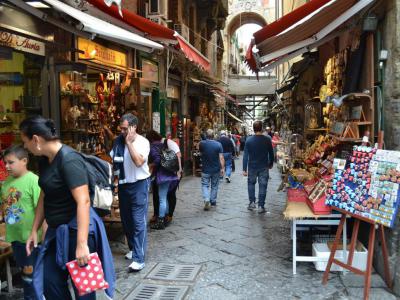
This ancient street was once home to a temple dedicated to Ceres, a Roman Goddess. The faithful would bring small figurines made in nearby shops to the temple. The tradition continues today as this street became famous for artists that create figurines for Nativity scenes.
Nativity scene creations include different size houses, terracotta shepherds, fruit vendors, or even a pizza vendor. In addition, shoppers can find mechanical items to complete the perfect scene, including windmills and waterfalls.
Today, workshops continue to create religious figures and more modern figures such as famous football players, celebrities, and politicians.
This beautiful, narrow alley is the perfect place to shop for a unique souvenir. Visitors might see the artists at work carving out the next figurine. Via San Gregorio Armeno is busy year-round but absolutely packed with locals and tourists during the Christmas season.
Nativity scene creations include different size houses, terracotta shepherds, fruit vendors, or even a pizza vendor. In addition, shoppers can find mechanical items to complete the perfect scene, including windmills and waterfalls.
Today, workshops continue to create religious figures and more modern figures such as famous football players, celebrities, and politicians.
This beautiful, narrow alley is the perfect place to shop for a unique souvenir. Visitors might see the artists at work carving out the next figurine. Via San Gregorio Armeno is busy year-round but absolutely packed with locals and tourists during the Christmas season.
4) Museo Cappella Sansevero (Sansevero Chapel Museum) (must see)
The Sansevero Chapel Museum is also known as the Chapel of Santa Maria della Pietà, named for a painting of the Virgin Mary.
The painting has a unique backstory. In the late 16th century, an innocent man was sent to prison. He was released thanks to the miraculous appearance of the Virgin Mary. The innocent man commissioned a painting, The Pietà. Soon, pilgrims flocked to view the painting. One of the pilgrims was John Francesco di Sangro, who was cured of an illness after viewing the painting.
He was so inspired by this miracle that, in 1590, he built a private chapel, which would later be used as a family burial chapel. Raimondo di Sangro, Prince of Sansevero, was responsible for renovating the chapel and commissioning the famous artwork that visitors see today.
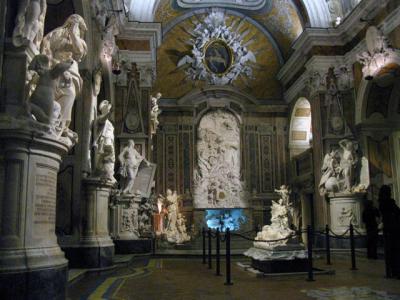
The chapel is home to nearly thirty important artworks. Artist Antonio Corradini created The Veiled Truth in 1752 as a monument to Cecilia Gaetani dell'Aquila d'Aragona, Raimondo's mother.
Giuseppe Sanmartino created The Veiled Christ in 1753. This stunning masterpiece was chiseled from marble and shows Christ's suffering body lying under a transparent shroud.
Francesco Queirolo's 1754 The Release from Deception was created as a monument to Raimondo's father. This statue shows a man wrestling a net that entangles him.
Surrounding The Veiled Christ are statues representing different virtues such as modesty, liberality, marital sweetness, education, and self-control.
Francesco Maria Russo painted The Glory of Paradise on the ceiling in 1749. The floor was originally in a black and white labyrinth design.
The chapel also has two unusual displays of preserved skeletons with silk and wax blood vessels and arteries.
Why You Should Visit:
The Sansevero Chapel Museum holds artwork by the most prominent 18th-century Italian artists. The chapel is unassuming on the outside but has a hauntingly beautiful and captivating interior.
Tips:
Make sure you use the audio guide to get the most out of your visit.
The painting has a unique backstory. In the late 16th century, an innocent man was sent to prison. He was released thanks to the miraculous appearance of the Virgin Mary. The innocent man commissioned a painting, The Pietà. Soon, pilgrims flocked to view the painting. One of the pilgrims was John Francesco di Sangro, who was cured of an illness after viewing the painting.
He was so inspired by this miracle that, in 1590, he built a private chapel, which would later be used as a family burial chapel. Raimondo di Sangro, Prince of Sansevero, was responsible for renovating the chapel and commissioning the famous artwork that visitors see today.
The chapel is home to nearly thirty important artworks. Artist Antonio Corradini created The Veiled Truth in 1752 as a monument to Cecilia Gaetani dell'Aquila d'Aragona, Raimondo's mother.
Giuseppe Sanmartino created The Veiled Christ in 1753. This stunning masterpiece was chiseled from marble and shows Christ's suffering body lying under a transparent shroud.
Francesco Queirolo's 1754 The Release from Deception was created as a monument to Raimondo's father. This statue shows a man wrestling a net that entangles him.
Surrounding The Veiled Christ are statues representing different virtues such as modesty, liberality, marital sweetness, education, and self-control.
Francesco Maria Russo painted The Glory of Paradise on the ceiling in 1749. The floor was originally in a black and white labyrinth design.
The chapel also has two unusual displays of preserved skeletons with silk and wax blood vessels and arteries.
Why You Should Visit:
The Sansevero Chapel Museum holds artwork by the most prominent 18th-century Italian artists. The chapel is unassuming on the outside but has a hauntingly beautiful and captivating interior.
Tips:
Make sure you use the audio guide to get the most out of your visit.
5) Santa Chiara Complex (must see)
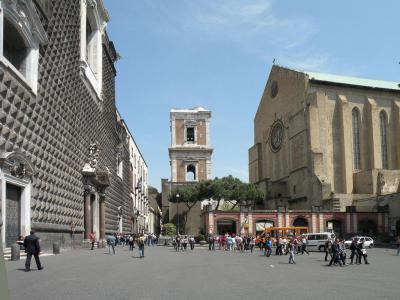
The Santa Chiara Complex is home to several religious buildings, including the Church of Santa Chiara, an archeological museum, tombs, and a monastery.
The complex was built by Queen Sancha of Majorca and King Robert of Naples in 1310. King Robert is buried in the complex.
The Church of Santa Chiara was originally built in Provençal-Gothic style; it was updated to the Baroque style in the 18th century. It was restored again after being damaged during World War II.
The west facade of the church has a central rose window but is otherwise plain. The interior is the largest in Naples, with ten chapels. The chapels have superb Gothic monuments.
The complex was built to hold the royal Anjou tombs. Joan I was buried here in 1382.
The church's cloisters are stunning. Seventy-two columns line the garden walkways. A series of benches connect these columns. The columns and benches are decorated with 18th century hand-painted Majorca tiles. Each tile is unique, and together the tiles show various scenes. Elaborate vines and flowers climb the pillars. Scenes show rural life and fishermen with their Mediterranean catch.
The cloister's porticoes have hand-painted 17th-century frescoes decorating the ceilings.
The gardens are filled with citrus and lavender trees. Visitors will also find a fountain in the middle of a Middle Age friar's refectory.
The museum features the ruins of a first-century Roman spa and sauna. Visitors will also find various ecclesiastical artifacts and historical displays in the museum.
Why You Should Visit:
This complex shows the dedication of King Robert the Wise and Queen Sancha to their saints, Saint Francis of Assisi and Saint Chiara. The beautiful cloisters are the biggest draw but don't miss the impressive church and well-preserved Roman ruins.
Tips:
The Cloisters get busier throughout the day. Arrive early and walk through the cloisters first.
The complex was built by Queen Sancha of Majorca and King Robert of Naples in 1310. King Robert is buried in the complex.
The Church of Santa Chiara was originally built in Provençal-Gothic style; it was updated to the Baroque style in the 18th century. It was restored again after being damaged during World War II.
The west facade of the church has a central rose window but is otherwise plain. The interior is the largest in Naples, with ten chapels. The chapels have superb Gothic monuments.
The complex was built to hold the royal Anjou tombs. Joan I was buried here in 1382.
The church's cloisters are stunning. Seventy-two columns line the garden walkways. A series of benches connect these columns. The columns and benches are decorated with 18th century hand-painted Majorca tiles. Each tile is unique, and together the tiles show various scenes. Elaborate vines and flowers climb the pillars. Scenes show rural life and fishermen with their Mediterranean catch.
The cloister's porticoes have hand-painted 17th-century frescoes decorating the ceilings.
The gardens are filled with citrus and lavender trees. Visitors will also find a fountain in the middle of a Middle Age friar's refectory.
The museum features the ruins of a first-century Roman spa and sauna. Visitors will also find various ecclesiastical artifacts and historical displays in the museum.
Why You Should Visit:
This complex shows the dedication of King Robert the Wise and Queen Sancha to their saints, Saint Francis of Assisi and Saint Chiara. The beautiful cloisters are the biggest draw but don't miss the impressive church and well-preserved Roman ruins.
Tips:
The Cloisters get busier throughout the day. Arrive early and walk through the cloisters first.
6) Gesù Nuovo Church
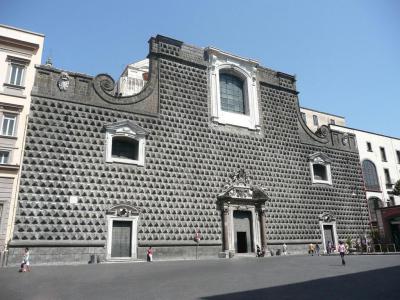
The Gesu Nuovo Church is managed by the Society of Jesus today and was initially built as a lavish residence. The unique exterior with diamond shaped stones has symbols believed to be a music score engraved upon them.
The Gesu Nuovo Church was built as the home of Roberto Sanseverino, Prince of Salerno in 1470. It was purchased by the Jesuits for 45,000 ducats in 1580 and turned into a church. Conversion of the building began in 1584 under the directions of renowned Jesuit architect, Giuseppe Valeriano and was completed in 1601. Although dedicated to Jesus and Mary of the Immaculate Conception, it has always been called the Gesu Nuovo Church.
The Gesu Nuovo Church is not only known for its unique exterior but also for its lavish interiors. It has the shape of a Greek cross with 11 chapels. The columns and altars are all covered with marble. Treasures inside the church are the fresco depicting the Expulsion of Heliodorus from the Temple by Francesco Solimena behind the façade and the frescoes depicting the life of the Virgin by Massimo Stanzione. The high altar was designed by F. Giuseppe Grossi was created by Neapolitan artists and covered with rare marbles, bronze and precious stones. Another treasure is the bas relief reproduction of Leonardo da Vinci’s Last Supper by Gennaro Calì.
The Gesu Nuovo Church was built as the home of Roberto Sanseverino, Prince of Salerno in 1470. It was purchased by the Jesuits for 45,000 ducats in 1580 and turned into a church. Conversion of the building began in 1584 under the directions of renowned Jesuit architect, Giuseppe Valeriano and was completed in 1601. Although dedicated to Jesus and Mary of the Immaculate Conception, it has always been called the Gesu Nuovo Church.
The Gesu Nuovo Church is not only known for its unique exterior but also for its lavish interiors. It has the shape of a Greek cross with 11 chapels. The columns and altars are all covered with marble. Treasures inside the church are the fresco depicting the Expulsion of Heliodorus from the Temple by Francesco Solimena behind the façade and the frescoes depicting the life of the Virgin by Massimo Stanzione. The high altar was designed by F. Giuseppe Grossi was created by Neapolitan artists and covered with rare marbles, bronze and precious stones. Another treasure is the bas relief reproduction of Leonardo da Vinci’s Last Supper by Gennaro Calì.

7) Gelateria Scimmia Factory
Gelato, which is Italian ice cream or sorbet, is a delightful aspect of life in Italy. Naples proudly claims to be the birthplace of gelato and boasts some excellent gelato shops.
In reality, Scimmia Factory originates from one of Italy's oldest gelato shops called "La Gelateria Della Scimmia." This gelateria was established in 1922 in Taranto by Michele Monacelli, with another branch opening its doors in Naples in 1933. Three generations of the Monacelli family have been raised with a deep passion for crafting gelato, and this passion eventually found its home in Rome with Luca Monacelli and his grandson Michele. Many decades have passed since the family patriarch and the founder of the gelateria first experimented with chilling cream using a mixture of ice and salt, but the store's commitment to quality and the finest ingredients remains unchanged.
The philosophy of Scimmia Factory places great importance on making gelato in a carapina, which is a steel gelato maker that results in a smoother and creamier gelato. However, Scimmia Factory offers more than just gelato; you can also expect yogurt, semifreddi (a semi-frozen dessert), and freshly blended fruit juices. What sets the Monacelli "method" apart is their dedication to developing new recipes and experimenting with a wide range of raw materials.
In reality, Scimmia Factory originates from one of Italy's oldest gelato shops called "La Gelateria Della Scimmia." This gelateria was established in 1922 in Taranto by Michele Monacelli, with another branch opening its doors in Naples in 1933. Three generations of the Monacelli family have been raised with a deep passion for crafting gelato, and this passion eventually found its home in Rome with Luca Monacelli and his grandson Michele. Many decades have passed since the family patriarch and the founder of the gelateria first experimented with chilling cream using a mixture of ice and salt, but the store's commitment to quality and the finest ingredients remains unchanged.
The philosophy of Scimmia Factory places great importance on making gelato in a carapina, which is a steel gelato maker that results in a smoother and creamier gelato. However, Scimmia Factory offers more than just gelato; you can also expect yogurt, semifreddi (a semi-frozen dessert), and freshly blended fruit juices. What sets the Monacelli "method" apart is their dedication to developing new recipes and experimenting with a wide range of raw materials.
8) Toledo Station of the Naples Metro
The Toledo Station won the 2013 Leaf Award as the Public Building of the Year. This impressive metro station was part of the Art Stations project, aimed at bringing art into people's daily lives. The Toledo Station is the most dazzling of the art installations and was nominated as the most beautiful transit station in Europe.
Visitors will notice three hexagonal pyramids outside the station. The Knight of Toledo, a steel statue, guards one of the entrances.
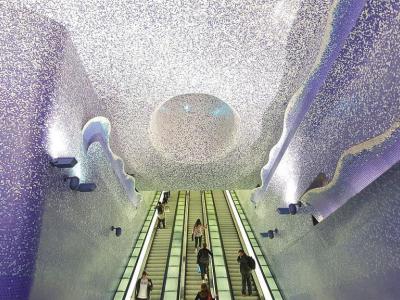
At 130 feet underground, the Toledo Station is one of the deepest stations in Naples. As you descend on the escalator, you will notice that each level has a different color representing a different theme.
The first floor is black, representing the asphalt of busy city life. Remains of ancient walls are included on the first floor. The atrium is decorated with mosaic tiles that depict historical scenes. One scene shows Saint Gennaro, Naple's patron saint, leading a procession. The second scene shows the construction of the subway.
Yellow and ochre walls portray the bright Naples sun and volcanic tuff. As visitors continue to descend, the colors turn blue and green to represent the sea. An 80-foot long LED-lit installation shows an image of the sea with continuous waves on the quay floor.
Visitors will notice three hexagonal pyramids outside the station. The Knight of Toledo, a steel statue, guards one of the entrances.
At 130 feet underground, the Toledo Station is one of the deepest stations in Naples. As you descend on the escalator, you will notice that each level has a different color representing a different theme.
The first floor is black, representing the asphalt of busy city life. Remains of ancient walls are included on the first floor. The atrium is decorated with mosaic tiles that depict historical scenes. One scene shows Saint Gennaro, Naple's patron saint, leading a procession. The second scene shows the construction of the subway.
Yellow and ochre walls portray the bright Naples sun and volcanic tuff. As visitors continue to descend, the colors turn blue and green to represent the sea. An 80-foot long LED-lit installation shows an image of the sea with continuous waves on the quay floor.
9) Castel Nuovo (New Castle) (must see)
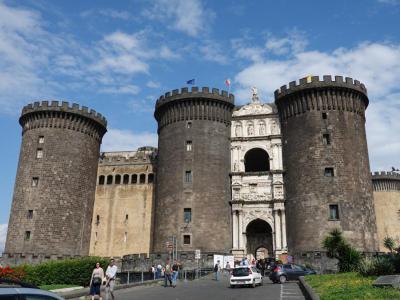
The New Castle is not new, it is a large medieval castle first built in 1279. Its scenic location and imposing size make the castle one of the main architectural landmarks of the city. It was a royal seat for kings of Naples, Aragon and Spain until 1815.
Commissioned by Charles I of Anjou and built between 1279-82 as the royal residence after the capital of the Sicily Kingdom shifted from Palermo to Naples, it became the venue for all important events during the rule of the Angevin dynasty. The Spanish Aragon dynasty that ruled Naples after the Angevins improved the structure and used it both as a royal residence and a military fortress. The marble entrance arch was created by sculptors from Catalonia in Spain to celebrate the beginning of the Aragonese rule of Naples.
The New Castle has housed the Neapolitan Society of National History since 1875 and the Civic Museum that contains works of art from churches around Naples. It is open for public viewing and managed by the Naples Ministry of Culture. Among the things to see are a display of weapons in the armory hall and the Palatine or Saint Barbara chapel located within the castle. Cultural events and exhibitions are held at the two levels of the southern courtyard and at the Charles V Hall and the Salla della Loggia inside the castle.
The castle is truly breathtaking when observing it from outside. Massive and beautiful, it can really impress. Make sure to visit the excavations underground and also take the elevator/stairs to the top, where the city view is extensive.
Tip:
If you go, it is highly recommended that you join a guided tour, if you want to make most of your visit - the small extra fee is worth it.
Commissioned by Charles I of Anjou and built between 1279-82 as the royal residence after the capital of the Sicily Kingdom shifted from Palermo to Naples, it became the venue for all important events during the rule of the Angevin dynasty. The Spanish Aragon dynasty that ruled Naples after the Angevins improved the structure and used it both as a royal residence and a military fortress. The marble entrance arch was created by sculptors from Catalonia in Spain to celebrate the beginning of the Aragonese rule of Naples.
The New Castle has housed the Neapolitan Society of National History since 1875 and the Civic Museum that contains works of art from churches around Naples. It is open for public viewing and managed by the Naples Ministry of Culture. Among the things to see are a display of weapons in the armory hall and the Palatine or Saint Barbara chapel located within the castle. Cultural events and exhibitions are held at the two levels of the southern courtyard and at the Charles V Hall and the Salla della Loggia inside the castle.
The castle is truly breathtaking when observing it from outside. Massive and beautiful, it can really impress. Make sure to visit the excavations underground and also take the elevator/stairs to the top, where the city view is extensive.
Tip:
If you go, it is highly recommended that you join a guided tour, if you want to make most of your visit - the small extra fee is worth it.
10) Galleria Umberto I
The Galleria Umberto is a public shopping arcade in Naples located opposite the San Carlo opera house. It was named after King Umberto I, who was the King of Italy at the time of its construction.
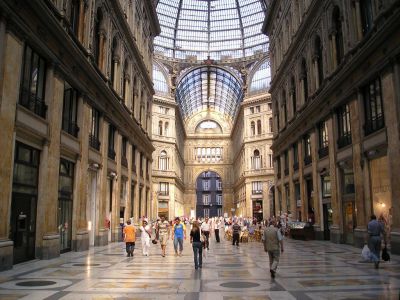
The Galleria Umberto was designed by architect, Emanuele Rocco and built between 1887 and 1891. It was meant to be a residential and commercial complex and has one of the largest glass roofs in the world. It was the most famous structures constructed during the ten-year Rebuilding of Naples that ended with the beginning of World War I.
The Galleria Umberto has three floors topped by a 184 feet tall arched dome. The dome is supported by 16 metal ribs. The arcade is designed in the shape of a cross with a beautiful mosaic depicting the signs of the Zodiac at the center of the floor. Shops, cafes and offices occupy the first and second floors and the third floor has residential apartments. It consists of four glass roofed wings. One wing opens to the main thoroughfare of the city, the Via Toledo and another opens to the San Carlo Theatre. The Galleria Umberto is the setting of the book, ‘The Gallery’, by John Horne Burns about life in occupied Naples in 1944 after World War II.
Tip:
The food here is amazing – you cannot go wrong with pizza and pastries.
The Galleria Umberto was designed by architect, Emanuele Rocco and built between 1887 and 1891. It was meant to be a residential and commercial complex and has one of the largest glass roofs in the world. It was the most famous structures constructed during the ten-year Rebuilding of Naples that ended with the beginning of World War I.
The Galleria Umberto has three floors topped by a 184 feet tall arched dome. The dome is supported by 16 metal ribs. The arcade is designed in the shape of a cross with a beautiful mosaic depicting the signs of the Zodiac at the center of the floor. Shops, cafes and offices occupy the first and second floors and the third floor has residential apartments. It consists of four glass roofed wings. One wing opens to the main thoroughfare of the city, the Via Toledo and another opens to the San Carlo Theatre. The Galleria Umberto is the setting of the book, ‘The Gallery’, by John Horne Burns about life in occupied Naples in 1944 after World War II.
Tip:
The food here is amazing – you cannot go wrong with pizza and pastries.
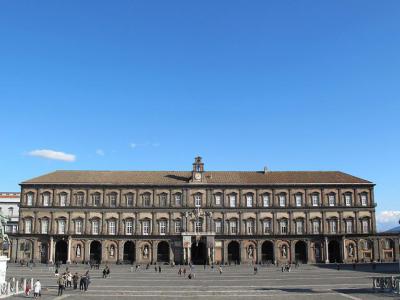
11) Royal Palace (must see)
The Royal Palace is located opposite the Basilica of San Francesco di Paola on the Piazza Plebiscito. It was used as a residence by the Bourbon kings who ruled Naples between 1730 and 1860.
The palace is on the site of an earlier residence, which had housed the former viceroy Don Pedro de Toledo, Marquis of Villafranca. Construction on the present building was begun in the 17th century by the architect Domenico Fontana. It was intended to house the King Philip III of Spain on his visit to this part of his kingdom. However the visit never materialized. Instead the palace initially housed the Viceroy Fernando Ruiz de Castro, count of Lemos.
In 1734, with the arrival of Charles III of Spain to Naples, the palace became the royal residence of the Bourbons. It was greatly expanded and embellished during the reign of King Ferdinand II. The most recent refurbishment was after the damage caused to the structure during World War II.
Today the Royal Palace houses the National Library of Naples, several city offices including the tourist office and a small museum. A magnificent double staircase takes visitors up to the former royal apartments with their lavish furniture and furnishings. The Royal Chapel has a large 18th century Nativity scene that is regarded as the building’s art treasure.
The National Library of Naples has an impressive collection of papyrus scrolls found during excavations at Herculaneum and a 5th century Coptic Bible. The western facade of the palace that faces the Piazza Plebiscito has statues of many of the kings from different dynasties that ruled Naples from the 12th century.
The palace is on the site of an earlier residence, which had housed the former viceroy Don Pedro de Toledo, Marquis of Villafranca. Construction on the present building was begun in the 17th century by the architect Domenico Fontana. It was intended to house the King Philip III of Spain on his visit to this part of his kingdom. However the visit never materialized. Instead the palace initially housed the Viceroy Fernando Ruiz de Castro, count of Lemos.
In 1734, with the arrival of Charles III of Spain to Naples, the palace became the royal residence of the Bourbons. It was greatly expanded and embellished during the reign of King Ferdinand II. The most recent refurbishment was after the damage caused to the structure during World War II.
Today the Royal Palace houses the National Library of Naples, several city offices including the tourist office and a small museum. A magnificent double staircase takes visitors up to the former royal apartments with their lavish furniture and furnishings. The Royal Chapel has a large 18th century Nativity scene that is regarded as the building’s art treasure.
The National Library of Naples has an impressive collection of papyrus scrolls found during excavations at Herculaneum and a 5th century Coptic Bible. The western facade of the palace that faces the Piazza Plebiscito has statues of many of the kings from different dynasties that ruled Naples from the 12th century.
12) Piazza del Plebiscito (Public Square) (must see)
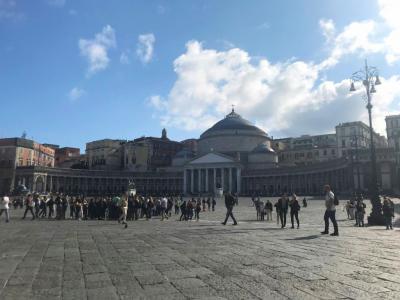
The Piazza Plebiscito is a square named after the plebiscite that resulted in the 1860 unification of Italy. It is the largest square in Naples.
The Piazza Plebiscito was laid under the orders of Joachim Murat, the brother in law of Napoleon who was installed as the King of Naples after the defeat of the Bourbon rulers. He ordered the demolition of an ancient abbey and a church to make way for the square. When the Bourbons returned to power after the defeat of Napoleon, Ferdinand I, the reinstated Bourbon ruler, completed the unfinished Piazza.
After World War II, the square was neglected and became a large parking lot until 1997, when it was restored to its former glory for the G7 summit held in Naples.
The Piazza Plebiscito has a semicircular shape. It has the Royal Palace at one end and the church of San Francesco di Paola on the other. The equestrian statues of the Bourbon kings, Ferdinand I and Charles III are placed in front of the church. Today, the square hosts New Years Eve and other festival celebrations and events like rock concerts. Large installations of contemporary art are also placed here periodically.
The Piazza Plebiscito was laid under the orders of Joachim Murat, the brother in law of Napoleon who was installed as the King of Naples after the defeat of the Bourbon rulers. He ordered the demolition of an ancient abbey and a church to make way for the square. When the Bourbons returned to power after the defeat of Napoleon, Ferdinand I, the reinstated Bourbon ruler, completed the unfinished Piazza.
After World War II, the square was neglected and became a large parking lot until 1997, when it was restored to its former glory for the G7 summit held in Naples.
The Piazza Plebiscito has a semicircular shape. It has the Royal Palace at one end and the church of San Francesco di Paola on the other. The equestrian statues of the Bourbon kings, Ferdinand I and Charles III are placed in front of the church. Today, the square hosts New Years Eve and other festival celebrations and events like rock concerts. Large installations of contemporary art are also placed here periodically.
13) Castel dell'Ovo ( Egg Castle) (must see)
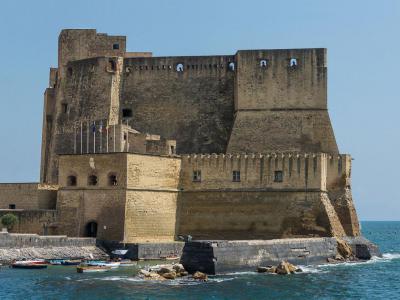
The Castel dell’Ovo or Egg Castle is a seaside castle in Naples, located on the former island of Megaride, now a peninsula, on the Gulf of Naples in Italy. The castle's name comes from a legend about the Roman poet Virgil, who had a reputation in the Middle Ages as a great sorcerer and predictor of the future. In the legend, Virgil put a magical egg into the foundations to support the fortifications. Had this egg been broken, the castle would have been destroyed and a series of disastrous events for Naples would have followed.
The Greeks from Cumae were the first inhabitants of the island and it was from the location of the fortress that they founded what later became the city of Naples. The present structure dates back to the 15th century and was built by the Aragonese rulers. It served both as a royal residence and the state treasury. A small fishing village grew around the Egg Castle in the 19th century and is well known today for its marina and seafood restaurants.
The castle's roof is beautifully paved with bricks, making an ideal platform for 360 views of the city, the Mediterranean, and Mount Vesuvius. The climb on foot is easy, via a wide, very gradually ascending thoroughfare. A few shops and one small art gallery occupy some castle space. There are myriad points for great scenic photos.
Tip:
Try to go towards the end of the day as the sun is setting, and be sure to bring a camera, binoculars, plus water! The castle is very close to the boat terminal and you can go back to Sorrento by boat if you stay there.
The Greeks from Cumae were the first inhabitants of the island and it was from the location of the fortress that they founded what later became the city of Naples. The present structure dates back to the 15th century and was built by the Aragonese rulers. It served both as a royal residence and the state treasury. A small fishing village grew around the Egg Castle in the 19th century and is well known today for its marina and seafood restaurants.
The castle's roof is beautifully paved with bricks, making an ideal platform for 360 views of the city, the Mediterranean, and Mount Vesuvius. The climb on foot is easy, via a wide, very gradually ascending thoroughfare. A few shops and one small art gallery occupy some castle space. There are myriad points for great scenic photos.
Tip:
Try to go towards the end of the day as the sun is setting, and be sure to bring a camera, binoculars, plus water! The castle is very close to the boat terminal and you can go back to Sorrento by boat if you stay there.
14) Napoli Lungomare (Naples Promenade) (must see)
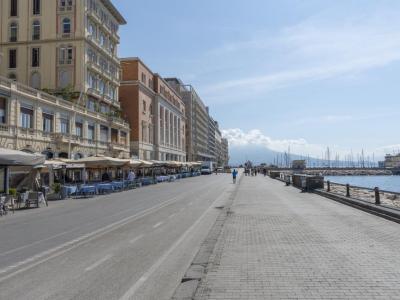
When it's time to take a break from hectic Naples, consider taking yourself to Lungomare, a pedestrian seafront promenade, hugging the bay from Mergellina to Via Partenope to Via Caracciolo and offering exquisite panorama of the sea, Mount Vesuvius and Naples Villa Comunale Park. This oasis of green, blue and quiet amid a hyperactive metropolis comes complete with boat rentals, a number of free small beaches, and lots of white rocks to sprawl on and soak up the Naples sun. If you have an appetite for more, there're plenty of kiosks serving cold drinks and snacks, as well as restaurants and cafes offering al fresco seafood and traditional Neapolitan Pizza.
Via Caracciolo is a long and wide promenade in Naples, which, flanking the Park of the Villa Comunale and the Riviera di Chiaia, constitutes (with via Nazario Sauro, via Partenope and via Acton) part of the city's waterfront.
Its name recalls Admiral Francesco Caracciolo, hero of the Neapolitan Republic, hanged in 1799 by Nelson from the mast of his ship and thrown into the waters of the Gulf of Naples, whose corpse re-emerged and was collected on the coast of Santa Lucia.
Created on a landfill in 1869 - 1880, the great road is considered one of the most beautiful coastlines in the world, and runs up to Mergellina with panoramic views over the city and the hills of Vomero and Posillipo.
The stretch of road that goes from Piazza della Repubblica to the confluence of Viale Dohrn (commonly called "Rotunda Diaz"), has been a pedestrian area since May 2013.
Via Caracciolo is a long and wide promenade in Naples, which, flanking the Park of the Villa Comunale and the Riviera di Chiaia, constitutes (with via Nazario Sauro, via Partenope and via Acton) part of the city's waterfront.
Its name recalls Admiral Francesco Caracciolo, hero of the Neapolitan Republic, hanged in 1799 by Nelson from the mast of his ship and thrown into the waters of the Gulf of Naples, whose corpse re-emerged and was collected on the coast of Santa Lucia.
Created on a landfill in 1869 - 1880, the great road is considered one of the most beautiful coastlines in the world, and runs up to Mergellina with panoramic views over the city and the hills of Vomero and Posillipo.
The stretch of road that goes from Piazza della Repubblica to the confluence of Viale Dohrn (commonly called "Rotunda Diaz"), has been a pedestrian area since May 2013.
15) Castel Sant'Elmo (Sant'Elmo Castle) (must see)
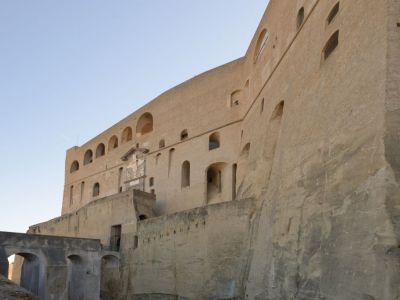
The Castel Sant’Elmo is a unique star shaped structure that was built to protect Naples from attacks from the sea. It has served many purposes through history and is one of the important landmarks of the city.
The first historical record of a fort on the site of Castel Sant’Elmo is that of a small structure built by the Normans in 1170. Later, relatives of Charles of Anjou built a large residence called Belforte on the site of the old fort in 1275. The Aragonese viceroy, Don Pedro de Toledo commissioned renowned military architect, Pedro Luis Escriva to enlarge the structure and the fort owes its unique shape to his design. It was enlarged between the years 1537 and 1547. From 1604 until 1956, it was used as a prison.
The Castel Sant’Elmo is a popular tourist attraction in Naples today. It hosts exhibitions, concerts and conferences from time to time. Two early churches within the fort are the Church of Sant’Elmo that dates back to the 16th century and the Chapel of Santa Maria del Pilar that dates back to the 17th century. A funicular takes visitors up the San Martino Hill to reach the Castel Sant’Elmo and the prison cells within the fort offer spectacular views over the city and bay of Naples.
The first historical record of a fort on the site of Castel Sant’Elmo is that of a small structure built by the Normans in 1170. Later, relatives of Charles of Anjou built a large residence called Belforte on the site of the old fort in 1275. The Aragonese viceroy, Don Pedro de Toledo commissioned renowned military architect, Pedro Luis Escriva to enlarge the structure and the fort owes its unique shape to his design. It was enlarged between the years 1537 and 1547. From 1604 until 1956, it was used as a prison.
The Castel Sant’Elmo is a popular tourist attraction in Naples today. It hosts exhibitions, concerts and conferences from time to time. Two early churches within the fort are the Church of Sant’Elmo that dates back to the 16th century and the Chapel of Santa Maria del Pilar that dates back to the 17th century. A funicular takes visitors up the San Martino Hill to reach the Castel Sant’Elmo and the prison cells within the fort offer spectacular views over the city and bay of Naples.
16) Catacombe di San Gennaro (Catacombs of San Gennaro) (must see)
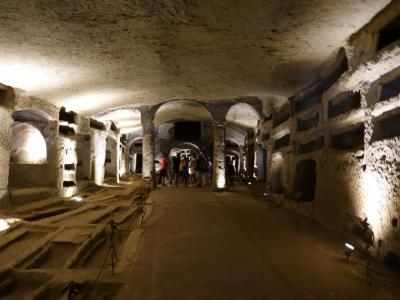
The Catacombs of San Gennaro, located in Naples, Italy, are subterranean sites used for Christian burials and religious activities during the paleo-Christian era. These catacombs were carved into tuff, a porous stone, and are situated in the northern part of Naples, on the slope leading up to Capodimonte. They consist of two levels known as San Gennaro Superiore and San Gennaro Inferiore. These catacombs are situated beneath the Rione Sanità neighborhood of Naples, which is sometimes referred to as the "Valley of the Dead." The site is now easily recognizable due to the presence of the large church of Madre del Buon Consiglio.
The tombs found in these catacombs come in various forms, including loculi, arcosoli, pits dug into the ground, and, less commonly, sarcophagi made of tuff or reused marble and stone from older graves. Loculi are simple, vertically aligned burial sites and represent the most basic style of burial discovered in the catacombs. However, they do not necessarily indicate the status of the deceased. On the other hand, arcosoli, designed for family burial areas, are incorporated into the walls of the galleries and cubicles and exhibit a more sophisticated design compared to loculi. Some of these arcosoli are adorned with mosaics or frescoes, and burials may be stacked horizontally. This type of burial is also found in Sicilian catacombs and is sometimes referred to as a "Siracusa" burial, commonly found in Greek catacombs. Occasionally, child burials are located in the lower part of the lunette, showcasing the efficient use of space in the catacombs.
The catacombs have yielded approximately 200 oil lamps dating from late antiquity to the Middle Ages. Among these lamps, 54 are of the African red slip variety. A comprehensive study of all the lamps will eventually provide insights into trade routes during the historical period, as well as the demographics of people who used the catacombs for burial and religious rituals. The oldest oil lamps discovered in these catacombs date back to the latter half of the third century and were produced in Naples itself.
The tombs found in these catacombs come in various forms, including loculi, arcosoli, pits dug into the ground, and, less commonly, sarcophagi made of tuff or reused marble and stone from older graves. Loculi are simple, vertically aligned burial sites and represent the most basic style of burial discovered in the catacombs. However, they do not necessarily indicate the status of the deceased. On the other hand, arcosoli, designed for family burial areas, are incorporated into the walls of the galleries and cubicles and exhibit a more sophisticated design compared to loculi. Some of these arcosoli are adorned with mosaics or frescoes, and burials may be stacked horizontally. This type of burial is also found in Sicilian catacombs and is sometimes referred to as a "Siracusa" burial, commonly found in Greek catacombs. Occasionally, child burials are located in the lower part of the lunette, showcasing the efficient use of space in the catacombs.
The catacombs have yielded approximately 200 oil lamps dating from late antiquity to the Middle Ages. Among these lamps, 54 are of the African red slip variety. A comprehensive study of all the lamps will eventually provide insights into trade routes during the historical period, as well as the demographics of people who used the catacombs for burial and religious rituals. The oldest oil lamps discovered in these catacombs date back to the latter half of the third century and were produced in Naples itself.
