Custom Walk in Philadelphia, Pennsylvania by tdiekow_879b8 created on 2025-03-24
Guide Location: USA » Philadelphia
Guide Type: Custom Walk
# of Sights: 14
Tour Duration: 3 Hour(s)
Travel Distance: 5.6 Km or 3.5 Miles
Share Key: UPKE6
Guide Type: Custom Walk
# of Sights: 14
Tour Duration: 3 Hour(s)
Travel Distance: 5.6 Km or 3.5 Miles
Share Key: UPKE6
How It Works
Please retrieve this walk in the GPSmyCity app. Once done, the app will guide you from one tour stop to the next as if you had a personal tour guide. If you created the walk on this website or come to the page via a link, please follow the instructions below to retrieve the walk in the app.
Retrieve This Walk in App
Step 1. Download the app "GPSmyCity: Walks in 1K+ Cities" on Apple App Store or Google Play Store.



Step 2. In the GPSmyCity app, download(or launch) the guide "Philadelphia Map and Walking Tours".
Step 3. Tap the menu button located at upper right corner of the "Walks" screen and select "Retrieve custom walk". Enter the share key: UPKE6
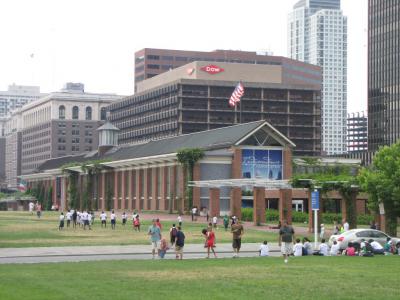
1) Independence National Historical Park (must see)
Independence National Historical Park in Philadelphia has been called "America's most historic square mile." Administered by the National Park Service, the 55 landscaped acres hold several often-visited historic sites within the Old City and Society Hill neighborhoods.
The heart of the Park is Independence Hall, the former Old State House of Philadelphia. This is where the Declaration of Independence and the Constitution of the United States were adopted. The first Continental Congress met in 1774 in Carpenters' Hall next door to Independence Hall, the home of the Second Continental Congress.
The Liberty Bell hangs in the Liberty Bell Center across from Independence Hall. The First Bank of the United States is in the Park. The Second Bank of the United States was closed down by President Andrew Jackson. Nearby is the City Tavern, a refuge of delegates and John Adams' favorite hangout.
The Park houses Franklin Court Museum dedicated to Benjamin Franklin. Another park resident is the United States Postal Service Museum. The three blocks immediately north of Independence Hall is Independence Mall. Besides the Liberty Bell Center, the Mall holds the National Constitution Center and George Washington's residence in his second term.
The first proposal for Independence National Historical Park was floated in 1915. Architects Albert Kelsey and David K. Boyd were driven to create a more sylvan locale for Independence Hall. The action was not taken until June 1948, when Congress authorized the creation of the Park. The Park is listed on the National Register of Historic Places.
The heart of the Park is Independence Hall, the former Old State House of Philadelphia. This is where the Declaration of Independence and the Constitution of the United States were adopted. The first Continental Congress met in 1774 in Carpenters' Hall next door to Independence Hall, the home of the Second Continental Congress.
The Liberty Bell hangs in the Liberty Bell Center across from Independence Hall. The First Bank of the United States is in the Park. The Second Bank of the United States was closed down by President Andrew Jackson. Nearby is the City Tavern, a refuge of delegates and John Adams' favorite hangout.
The Park houses Franklin Court Museum dedicated to Benjamin Franklin. Another park resident is the United States Postal Service Museum. The three blocks immediately north of Independence Hall is Independence Mall. Besides the Liberty Bell Center, the Mall holds the National Constitution Center and George Washington's residence in his second term.
The first proposal for Independence National Historical Park was floated in 1915. Architects Albert Kelsey and David K. Boyd were driven to create a more sylvan locale for Independence Hall. The action was not taken until June 1948, when Congress authorized the creation of the Park. The Park is listed on the National Register of Historic Places.
2) United States Mint
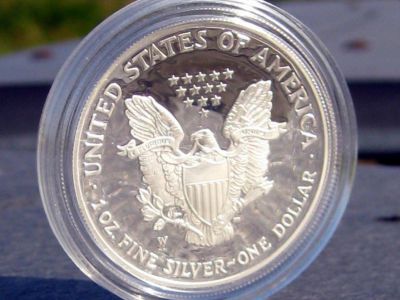
What to buy here: U.S Mint Silver Coins & Moneybag.
Collecting coins is one of the hottest hobbies around and when you’re in Philly you are at the heart of U.S coin operations. In 1792, Congress authorized construction of the first U.S. Mint in the nation's capitol, at the time, Philadelphia. For either lifelong coin hobbyists or youngsters just getting started, a coin collection gift from the United States Mint is a wonderful foundation to build on.
The new, multi-year America the Beautiful silver quarter collection is a must-have. High quality silver characterizes these uncirculated beauties, which can be purchased in a US Mint moneybag for a truly extraordinary gift. The quarters are all coded with a ‘P’ indicating their city of origin. Varies in price depending on the quantity but to give you an idea, 5 uncirculated America the Beautiful silver quarters are priced at $31.95, $49.95 for 100 identical coins in a U.S Mint moneybag.
Collecting coins is one of the hottest hobbies around and when you’re in Philly you are at the heart of U.S coin operations. In 1792, Congress authorized construction of the first U.S. Mint in the nation's capitol, at the time, Philadelphia. For either lifelong coin hobbyists or youngsters just getting started, a coin collection gift from the United States Mint is a wonderful foundation to build on.
The new, multi-year America the Beautiful silver quarter collection is a must-have. High quality silver characterizes these uncirculated beauties, which can be purchased in a US Mint moneybag for a truly extraordinary gift. The quarters are all coded with a ‘P’ indicating their city of origin. Varies in price depending on the quantity but to give you an idea, 5 uncirculated America the Beautiful silver quarters are priced at $31.95, $49.95 for 100 identical coins in a U.S Mint moneybag.
3) Christ Church Burial Ground
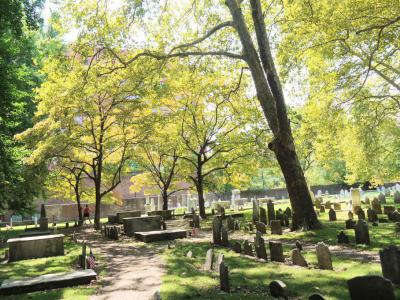
Christ Church Burial Ground in Philadelphia is one of those places where history both happened and decided to stay put. Still an active cemetery, it sits three blocks west of Christ Church itself, despite the name suggesting otherwise. The land was acquired back in 1719, when the original churchyard ran out of room, and this spot—then considered the edge of town—became the logical expansion. Today, it feels anything but remote.
Christ Church, founded in 1695, was the spiritual home of several key figures of the American Revolution, including George Washington. And just nearby, this burial ground gathers an equally impressive cast. Benjamin Franklin rests here with his wife Deborah, joined by four other signers of the Declaration of Independence: Benjamin Rush, Francis Hopkinson, Joseph Hewes, and George Ross. Two more—James Wilson and Robert Morris—are buried at the church itself, keeping things neatly divided.
The Burial Ground is open to visitors for a small fee, but even when the gates are closed, Franklin remains accessible—quite literally. At the corner of 5th and Arch Streets, a section of iron railing was added in 1858, so passersby could peer in. It didn’t take long for a tradition to form: tossing pennies onto Franklin’s grave, a small tribute to the man who famously advised that a penny saved is a penny earned...
Move a little farther from the crowd gathered around Franklin, and the atmosphere shifts. The space becomes quieter, with rows of lesser-known graves—carefully kept, often overlooked, and occasionally just as intriguing as the famous names that draw people in.
Christ Church, founded in 1695, was the spiritual home of several key figures of the American Revolution, including George Washington. And just nearby, this burial ground gathers an equally impressive cast. Benjamin Franklin rests here with his wife Deborah, joined by four other signers of the Declaration of Independence: Benjamin Rush, Francis Hopkinson, Joseph Hewes, and George Ross. Two more—James Wilson and Robert Morris—are buried at the church itself, keeping things neatly divided.
The Burial Ground is open to visitors for a small fee, but even when the gates are closed, Franklin remains accessible—quite literally. At the corner of 5th and Arch Streets, a section of iron railing was added in 1858, so passersby could peer in. It didn’t take long for a tradition to form: tossing pennies onto Franklin’s grave, a small tribute to the man who famously advised that a penny saved is a penny earned...
Move a little farther from the crowd gathered around Franklin, and the atmosphere shifts. The space becomes quieter, with rows of lesser-known graves—carefully kept, often overlooked, and occasionally just as intriguing as the famous names that draw people in.
4) Betsy Ross House (must see)
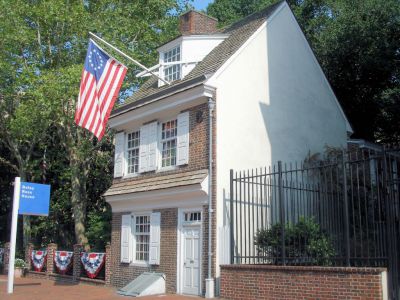
The story goes that Mrs. Eizabeth Claypoole, also known as Betsy Ross, had a visit from George Washington in 1776. She persuaded him, some say, that a five-pointed star was better than a six-pointed star. Betsy was an upholsterer, and she had been making flags for the Pennsylvania Navy. Flags were her specialty.
True or not, this captivating tale was told by her grandsons, William and George Canby, in the 1870s. People loved it, and it became a popular national legend. Number 239 Arch Street in Philadelphia is where Betsy is said to have lived with her third husband, John Claypoole. The house is a restoration done by architect Richardson Okie in 1940.
The "Betsy Ross" house that stands today may have been the house used by Betsy for her business. The residence of Betsy and her husband was adjacent to the present house. The houses next door were demolished and turned into a courtyard.
Richardson Okie used materials from the demolished houses in his restoration. A brick structure was built behind the house. Windows and a dormer were replaced. The whole property was gifted to the city of Philadelphia in 1941. In 1974 the courtyard was provided with a fountain.
As part of the American Bicentennial of 1976, city authorities moved the remains of Betsy and her husband, John Claypoole. They were reinterred in the courtyard of the Betsy Ross House. Betsy is thought to have resided in the house from 1776 until 1779.
John Ross, Betsy's first husband, a member of the militia, died in a gunpowder explosion. Her second husband, Joseph Ashburn, a mariner captured by the British, died in prison in Plymouth, England. John Claypoole was a fellow prisoner. He knew Ashburn. Betsy married Claypoole in 1783.
The Betsy Ross House is traditionally the site of Philadelphia's celebration of Flag Day. This legendary woman lived and worked here for a few short years when the Great Experiment began. Whatever else she may have done, she made flags.
True or not, this captivating tale was told by her grandsons, William and George Canby, in the 1870s. People loved it, and it became a popular national legend. Number 239 Arch Street in Philadelphia is where Betsy is said to have lived with her third husband, John Claypoole. The house is a restoration done by architect Richardson Okie in 1940.
The "Betsy Ross" house that stands today may have been the house used by Betsy for her business. The residence of Betsy and her husband was adjacent to the present house. The houses next door were demolished and turned into a courtyard.
Richardson Okie used materials from the demolished houses in his restoration. A brick structure was built behind the house. Windows and a dormer were replaced. The whole property was gifted to the city of Philadelphia in 1941. In 1974 the courtyard was provided with a fountain.
As part of the American Bicentennial of 1976, city authorities moved the remains of Betsy and her husband, John Claypoole. They were reinterred in the courtyard of the Betsy Ross House. Betsy is thought to have resided in the house from 1776 until 1779.
John Ross, Betsy's first husband, a member of the militia, died in a gunpowder explosion. Her second husband, Joseph Ashburn, a mariner captured by the British, died in prison in Plymouth, England. John Claypoole was a fellow prisoner. He knew Ashburn. Betsy married Claypoole in 1783.
The Betsy Ross House is traditionally the site of Philadelphia's celebration of Flag Day. This legendary woman lived and worked here for a few short years when the Great Experiment began. Whatever else she may have done, she made flags.
5) Elfreth's Alley (must see)
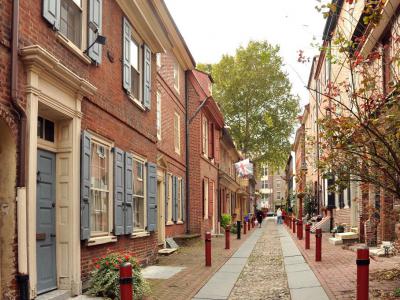
In the 18th century, Philadelphia became a bustling city, overcrowded with artisans, tradesmen, shipwrights, metalsmiths, glassblowers, and furniture makers. As a result, the landowners Arthur Wells and John Gilbert started a cart path from Front Street to Second Street in 1703. The path became Elfreth's Alley, named after Jeremiah Elfreth, an 18th-century blacksmith and a man of property in young Philadelphia.
By the 1770s Georgian and Federal-style houses lined the cobblestone Alley. Many of the structures were uniquely Philadelphian Trinity houses. These were three-story houses, exceptionally narrow, with one room on each floor. The floors were referred to as "Father, Son, and Holy Ghost." And that is how Trinity houses got their name.
In the 19th and 20th centuries, the industry started to close in on the Alley. A stove factory took its place in a row of residential houses. Immigrants, hoping for jobs, came in waves. In 1934 the Elfreth's Alley Association (EAA) was founded by Alley resident Dolly Ottey. Ottey fought to combat the deterioration of the Alley by encroaching industry in the early 20th century.
Elfreth's Alley Museum is located in houses 124 and 126. The museum preserves the home of 18th-century dressmakers. Tour guides discuss other homes and inhabitants of the Alley. On "Fete Day" in early June, which celebrates Alley's diverse ethnic heritage, the residents open their homes. There are historical reenactments with drum and fife bands. The Alley also host events for the 4th of July, Oktoberfestivities, and Halloween.
By the 1770s Georgian and Federal-style houses lined the cobblestone Alley. Many of the structures were uniquely Philadelphian Trinity houses. These were three-story houses, exceptionally narrow, with one room on each floor. The floors were referred to as "Father, Son, and Holy Ghost." And that is how Trinity houses got their name.
In the 19th and 20th centuries, the industry started to close in on the Alley. A stove factory took its place in a row of residential houses. Immigrants, hoping for jobs, came in waves. In 1934 the Elfreth's Alley Association (EAA) was founded by Alley resident Dolly Ottey. Ottey fought to combat the deterioration of the Alley by encroaching industry in the early 20th century.
Elfreth's Alley Museum is located in houses 124 and 126. The museum preserves the home of 18th-century dressmakers. Tour guides discuss other homes and inhabitants of the Alley. On "Fete Day" in early June, which celebrates Alley's diverse ethnic heritage, the residents open their homes. There are historical reenactments with drum and fife bands. The Alley also host events for the 4th of July, Oktoberfestivities, and Halloween.
6) Christ Church (must see)
Christ Church in Philadelphia dates back to 1695, when the Church of England set up shop in what was still very much a growing colonial town. Within a year, they had a wooden building up—but clearly, that didn’t hold the crowd for long. By the 1720s, they replaced it with something far more ambitious, creating what was considered one of the most elegant churches in the Thirteen Colonies.
The new parish became known as the “Nation’s Church,” and for good reason. Fifteen signers of the Declaration of Independence were part of this congregation. Names like George Washington, Benjamin Franklin, Robert Morris, and Betsy Ross all passed through these doors. If you’re wondering where they sat, you’re in luck—this place keeps receipts. Brass plaques mark their pews: Washington in #56, Franklin in #70, Betsy Ross in #12. No guessing required.
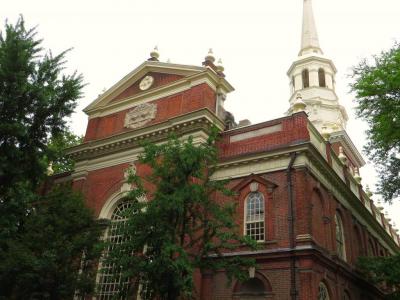
Architecturally, the church is themed around Georgian style, with a clear nod to Christopher Wren’s London designs—all that symmetry, tall arched windows, and a clean, orderly interior with fluted columns and rows of wooden pews. And instead of dramatic stained glass, you get clear windows—meaning plenty of natural light and a direct connection to the outside world. Revolutionary thinking, in more ways than one...
Construction stretched from 1727 to 1744, with the steeple added in 1754. At that point, it was the tallest building in what would become the United States, holding that title for over fifty years. Not bad for a church... Along the way, it saw changes, including a rebuild in 1777 and interior updates in 1883, but its overall character has held steady.
Step outside into the churchyard, and you’ll find the graves of Robert Morris and James Wilson, both signers of the Declaration of Independence. Today, Christ Church is still an active Episcopal parish and a National Historic Landmark, welcoming more than 250,000 visitors each year—so you won’t be the only one curious about who sat where...
And before you leave, take a moment to look at the artifacts. There’s a 14th-century baptismal font used for William Penn, the founder of Pennsylvania. Add in a rare book collection and communion pieces from the 1790s, and you start to realize: this place doesn’t just tell history—it quietly keeps it on display.
The new parish became known as the “Nation’s Church,” and for good reason. Fifteen signers of the Declaration of Independence were part of this congregation. Names like George Washington, Benjamin Franklin, Robert Morris, and Betsy Ross all passed through these doors. If you’re wondering where they sat, you’re in luck—this place keeps receipts. Brass plaques mark their pews: Washington in #56, Franklin in #70, Betsy Ross in #12. No guessing required.
Architecturally, the church is themed around Georgian style, with a clear nod to Christopher Wren’s London designs—all that symmetry, tall arched windows, and a clean, orderly interior with fluted columns and rows of wooden pews. And instead of dramatic stained glass, you get clear windows—meaning plenty of natural light and a direct connection to the outside world. Revolutionary thinking, in more ways than one...
Construction stretched from 1727 to 1744, with the steeple added in 1754. At that point, it was the tallest building in what would become the United States, holding that title for over fifty years. Not bad for a church... Along the way, it saw changes, including a rebuild in 1777 and interior updates in 1883, but its overall character has held steady.
Step outside into the churchyard, and you’ll find the graves of Robert Morris and James Wilson, both signers of the Declaration of Independence. Today, Christ Church is still an active Episcopal parish and a National Historic Landmark, welcoming more than 250,000 visitors each year—so you won’t be the only one curious about who sat where...
And before you leave, take a moment to look at the artifacts. There’s a 14th-century baptismal font used for William Penn, the founder of Pennsylvania. Add in a rare book collection and communion pieces from the 1790s, and you start to realize: this place doesn’t just tell history—it quietly keeps it on display.
7) City Tavern
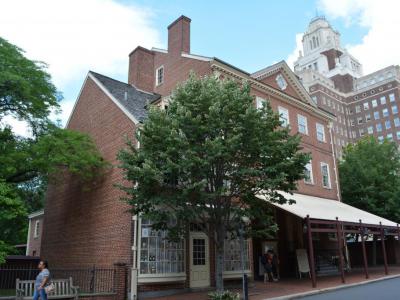
The City Tavern serves up great food, attentive service delivered by staff in full period dress, and an atmosphere that leans heavily into the 18th century—powdered wigs optional, enthusiasm required... It’s not the original 1773 building, though, but a painstaking 1976 reconstruction so convincing you might start checking for horse-drawn carriages outside.
The original tavern didn’t have such luck—it was damaged by fire in 1834 and eventually demolished in 1854. Recognizing its historical weight, Congress later pushed for its revival within Independence National Historical Park, restoring a place where the Founding Fathers once gathered to eat, drink, and debate the future of a nation—because nothing fuels political philosophy quite like a good meal and a strong ale...
And in a detail that feels oddly ahead of its time, it was Benjamin Franklin who introduced tofu to America. Today, you can try a tofu pasta inspired by his recipe, served in what’s styled as his private dining room.
A glance at the menu reads like a culinary time capsule: Thomas Jefferson’s sweet potato biscuits, chocolate bread pudding, turkey pot pie based on Martha Washington’s recipe, West Indies pepper pot soup, and ales brewed using recipes linked to both Washington and Jefferson. Clearly, subtlety never made it onto the menu here...
You can settle inside for the full colonial ambiance or step out into the garden for a slightly less formal experience. And if you’re visiting with younger travelers, the well-loved kids’ menu ensures this isn’t just a history lesson but a dinner that keeps everyone at the table happy...
The original tavern didn’t have such luck—it was damaged by fire in 1834 and eventually demolished in 1854. Recognizing its historical weight, Congress later pushed for its revival within Independence National Historical Park, restoring a place where the Founding Fathers once gathered to eat, drink, and debate the future of a nation—because nothing fuels political philosophy quite like a good meal and a strong ale...
And in a detail that feels oddly ahead of its time, it was Benjamin Franklin who introduced tofu to America. Today, you can try a tofu pasta inspired by his recipe, served in what’s styled as his private dining room.
A glance at the menu reads like a culinary time capsule: Thomas Jefferson’s sweet potato biscuits, chocolate bread pudding, turkey pot pie based on Martha Washington’s recipe, West Indies pepper pot soup, and ales brewed using recipes linked to both Washington and Jefferson. Clearly, subtlety never made it onto the menu here...
You can settle inside for the full colonial ambiance or step out into the garden for a slightly less formal experience. And if you’re visiting with younger travelers, the well-loved kids’ menu ensures this isn’t just a history lesson but a dinner that keeps everyone at the table happy...
8) Independence Hall (must see)
By the late 1720s, Philadelphia realized it was running a colony with big decisions to make, but was lacking a proper stage to make them—so, naturally, it decided to build one.
Construction began in 1732 on Chestnut Street, guided by architect Edmund Woolley, and by 1753, the Colonial Government of Pennsylvania moved in without hesitation. For nearly half a century, this was where the business of the province—and later the commonwealth—was handled, until the capital duties packed up and moved on in 1799.
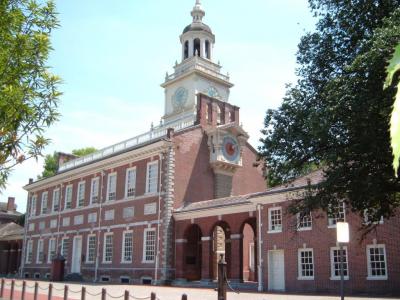
The building itself, now known as Independence Hall, keeps things elegantly symmetrical. Red brick, Georgian style, a central block crowned with a bell tower and a steeple rising 169 feet. Arcaded passageways link the main structure to its side wings, while nearby, Old City Hall, Congress Hall, and Philosophical Hall gather around Independence Square like a well-organized ensemble cast.
Inside, the layout is straightforward but loaded with history. The Assembly Room and Supreme Court Room sit on the ground floor, divided by a vestibule, with the Tower Stair Hall waiting just beyond the entrance. The interiors you see today are the result of careful restorations in the 19th and 20th centuries, all aimed at returning the building to its 18th-century look—because when your past includes founding a nation, you tend to preserve the décor...
And then, of course, came the moments. In June 1775, George Washington was appointed commander-in-chief of the Continental Army right here. A month later, Benjamin Franklin was named the first Postmaster General—arguably launching one of the longest-running institutions in American life. Between 1775 and 1783, this was the meeting place of the Second Continental Congress, where, on July 4, 1776, the Declaration of Independence was approved. Eleven years later, in 1787, the Constitution followed.
Since then, Independence Hall has remained more than just a historic building. It continues to serve as a backdrop for speeches, rallies, and protests—less a frozen monument, more an ongoing conversation about democracy, still very much in progress.
Construction began in 1732 on Chestnut Street, guided by architect Edmund Woolley, and by 1753, the Colonial Government of Pennsylvania moved in without hesitation. For nearly half a century, this was where the business of the province—and later the commonwealth—was handled, until the capital duties packed up and moved on in 1799.
The building itself, now known as Independence Hall, keeps things elegantly symmetrical. Red brick, Georgian style, a central block crowned with a bell tower and a steeple rising 169 feet. Arcaded passageways link the main structure to its side wings, while nearby, Old City Hall, Congress Hall, and Philosophical Hall gather around Independence Square like a well-organized ensemble cast.
Inside, the layout is straightforward but loaded with history. The Assembly Room and Supreme Court Room sit on the ground floor, divided by a vestibule, with the Tower Stair Hall waiting just beyond the entrance. The interiors you see today are the result of careful restorations in the 19th and 20th centuries, all aimed at returning the building to its 18th-century look—because when your past includes founding a nation, you tend to preserve the décor...
And then, of course, came the moments. In June 1775, George Washington was appointed commander-in-chief of the Continental Army right here. A month later, Benjamin Franklin was named the first Postmaster General—arguably launching one of the longest-running institutions in American life. Between 1775 and 1783, this was the meeting place of the Second Continental Congress, where, on July 4, 1776, the Declaration of Independence was approved. Eleven years later, in 1787, the Constitution followed.
Since then, Independence Hall has remained more than just a historic building. It continues to serve as a backdrop for speeches, rallies, and protests—less a frozen monument, more an ongoing conversation about democracy, still very much in progress.
9) Liberty Bell (must see)
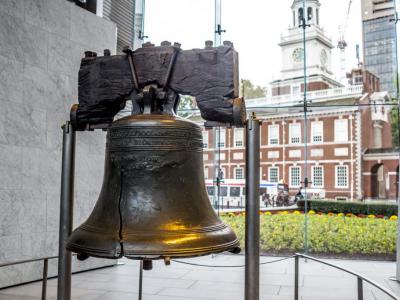
The Liberty Bell, an iconic symbol of American freedom and independence, has a rich and storied history closely tied to Philadelphia, Pennsylvania. Cast in 1752 by the Whitechapel Bell Foundry in London, England, the bell was originally commissioned to mark the 50th anniversary of Pennsylvania's original constitution and to symbolize the ideals of liberty and justice.
Initially hung in the Pennsylvania State House (now known as Independence Hall), the bell gained fame not only for its impressive size and sound but also for its role in important historical events. One popular but apocryphal story links the Liberty Bell to the reading of the Declaration of Independence on July 4, 1776, claiming that it rang out to announce the birth of the new nation. While there is no historical evidence to support this specific event, the bell did gain significance as a symbol of American independence in the ensuing decades.
The bell's inscription, "Proclaim LIBERTY Throughout all the Land unto all the Inhabitants Thereof," from the Bible, became its defining feature and a powerful statement in support of abolitionist movements in the 19th century. Its association with the abolitionist cause led to the bell being dubbed the "Liberty Bell" around the 1830s.
By the mid-19th century, as the bell's structural integrity deteriorated, it was retired from active service. In 1852, it was moved to a pavilion near Independence Hall where it became an object of public veneration. During World War II, the bell's iconic status was further solidified as it was used as a symbol of liberty and freedom, inspiring war bond drives and patriotic sentiment.
Today, the Liberty Bell is housed in the Liberty Bell Center, part of Independence National Historical Park in Philadelphia. It continues to attract millions of visitors each year who come to see and reflect upon its enduring message of liberty, justice, and the ongoing struggle for equality.
Initially hung in the Pennsylvania State House (now known as Independence Hall), the bell gained fame not only for its impressive size and sound but also for its role in important historical events. One popular but apocryphal story links the Liberty Bell to the reading of the Declaration of Independence on July 4, 1776, claiming that it rang out to announce the birth of the new nation. While there is no historical evidence to support this specific event, the bell did gain significance as a symbol of American independence in the ensuing decades.
The bell's inscription, "Proclaim LIBERTY Throughout all the Land unto all the Inhabitants Thereof," from the Bible, became its defining feature and a powerful statement in support of abolitionist movements in the 19th century. Its association with the abolitionist cause led to the bell being dubbed the "Liberty Bell" around the 1830s.
By the mid-19th century, as the bell's structural integrity deteriorated, it was retired from active service. In 1852, it was moved to a pavilion near Independence Hall where it became an object of public veneration. During World War II, the bell's iconic status was further solidified as it was used as a symbol of liberty and freedom, inspiring war bond drives and patriotic sentiment.
Today, the Liberty Bell is housed in the Liberty Bell Center, part of Independence National Historical Park in Philadelphia. It continues to attract millions of visitors each year who come to see and reflect upon its enduring message of liberty, justice, and the ongoing struggle for equality.
10) President's House
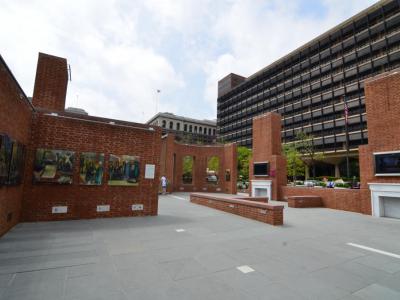
The President's House in Philadelphia holds a unique place in American history as the third U.S. Presidential Mansion and a pivotal site during the nation's early years. Occupied by George Washington from November 27, 1790, to March 10, 1797, and by John Adams from March 21, 1797, to May 30, 1800, this residence served as the executive mansion before the White House was completed.
Constructed around 1767 by Mary Masters, a widow, the house was situated just one block north of the Pennsylvania Statehouse, now known as Independence Hall. It briefly played a significant role during the British occupation of Philadelphia in 1777–1778, serving as headquarters for General Sir William Howe and the British Army. After the British evacuated in June 1778, the house became the headquarters for Military Governor Benedict Arnold.
Philadelphia was the national capital from 1790 to 1800, a period during which the city was the heart of American political life. The house was owned by Robert Morris, a financier of the Revolutionary War and a Founding Father, who provided it for George Washington's use. Reflecting the complexities of the era, Washington brought nine enslaved Africans from his Mount Vernon estate to work in the presidential household, a fact that underscores the entwined histories of freedom and slavery in the United States.
However, the exact location of The President's House was forgotten over time, leading to the unintentional demolition of its surviving walls in 1951. This loss sparked a significant historical and cultural reassessment, culminating in the 2010 commemoration of the site. This effort was driven by historians and African American groups, who advocated for the recognition of the house's complex legacy, including its role in the history of slavery in the United States.
Constructed around 1767 by Mary Masters, a widow, the house was situated just one block north of the Pennsylvania Statehouse, now known as Independence Hall. It briefly played a significant role during the British occupation of Philadelphia in 1777–1778, serving as headquarters for General Sir William Howe and the British Army. After the British evacuated in June 1778, the house became the headquarters for Military Governor Benedict Arnold.
Philadelphia was the national capital from 1790 to 1800, a period during which the city was the heart of American political life. The house was owned by Robert Morris, a financier of the Revolutionary War and a Founding Father, who provided it for George Washington's use. Reflecting the complexities of the era, Washington brought nine enslaved Africans from his Mount Vernon estate to work in the presidential household, a fact that underscores the entwined histories of freedom and slavery in the United States.
However, the exact location of The President's House was forgotten over time, leading to the unintentional demolition of its surviving walls in 1951. This loss sparked a significant historical and cultural reassessment, culminating in the 2010 commemoration of the site. This effort was driven by historians and African American groups, who advocated for the recognition of the house's complex legacy, including its role in the history of slavery in the United States.
11) Clothespin
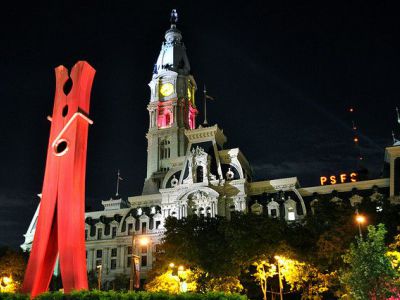
Clothespin is a distinctive weathering steel sculpture situated at Centre Square in Philadelphia, crafted by Claes Oldenburg. The artist, renowned for his large, stylized sculptures of everyday items, aims to make art more accessible to the public. True to his vision, Clothespin is strategically placed above Philadelphia's City Hall subway station, enabling thousands of commuters to encounter art in their daily routines.
Constructed from Cor-Ten steel, Clothespin is acclaimed for its velvety texture and a warm, weathered reddish-brown hue. A striking feature is its silvery steel "spring", which intriguingly resembles the numerals "76", commemorating the United States Bicentennial year. This aspect not only honors the historical context but also resonates with the year of its dedication.
The sculpture is more than just an oversized utility object; it is a symbol connecting Philadelphia's past and present. By juxtaposing the city's colonial legacy with contemporary civic challenges, Clothespin endeavors to bridge socio-economic divides, presenting a universally recognized form that appeals to a broad audience. Art critics have drawn parallels between its design and the "embracing couple" depicted in Constantin Brâncuși's famous sculpture, The Kiss, housed in the Philadelphia Museum of Art, further enriching its artistic and cultural dialogue.
Clothespin's influence extends beyond its primary location. There are at least two smaller-scale models. One, known as Clothespin – 4 Foot Version, completed in 1974, is typically exhibited in the Oldenburg gallery at the Denver Art Museum. The other, a 10-foot version completed in 1975, resides in the Contemporary Art Department of the Art Institute of Chicago, where it is displayed occasionally.
Constructed from Cor-Ten steel, Clothespin is acclaimed for its velvety texture and a warm, weathered reddish-brown hue. A striking feature is its silvery steel "spring", which intriguingly resembles the numerals "76", commemorating the United States Bicentennial year. This aspect not only honors the historical context but also resonates with the year of its dedication.
The sculpture is more than just an oversized utility object; it is a symbol connecting Philadelphia's past and present. By juxtaposing the city's colonial legacy with contemporary civic challenges, Clothespin endeavors to bridge socio-economic divides, presenting a universally recognized form that appeals to a broad audience. Art critics have drawn parallels between its design and the "embracing couple" depicted in Constantin Brâncuși's famous sculpture, The Kiss, housed in the Philadelphia Museum of Art, further enriching its artistic and cultural dialogue.
Clothespin's influence extends beyond its primary location. There are at least two smaller-scale models. One, known as Clothespin – 4 Foot Version, completed in 1974, is typically exhibited in the Oldenburg gallery at the Denver Art Museum. The other, a 10-foot version completed in 1975, resides in the Contemporary Art Department of the Art Institute of Chicago, where it is displayed occasionally.
12) Philadelphia City Hall
King Charles II owed a hefty sum of money to Admiral Sir William Penn, to wit 16,000 pounds. To discharge the debt, on 4 March 1681, the King signed a charter granting what is now Pennsylvania to the Admiral's son, William. William the Younger was a radical Quaker filled with democratic ideals. He set out for America.
Center Square was one of the original five squares marked out by Penn as the center of his city. It was simply a public square until the building of City Hall in 1871. By that time, it had come to be called Penn Square.
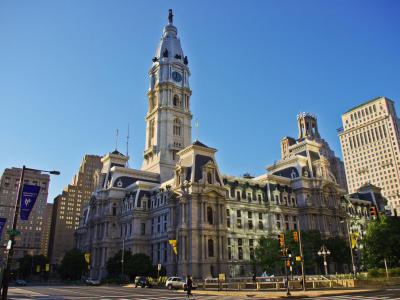
Located at number 1 Penn Square, City Hall was designed by architect John McArthur in the Second Empire style. It was in the process of construction from 1871 until 1901. Upon its completion, the Hall was the world's tallest habitable building.
The City Hall is a masonry building supported by brick and granite walls up to 22 feet thick. The outside walls are mainly limestone, granite, and marble. Sculptor Alexander Milne Calder created over 250 sculptured images of American ideals. With nearly 700 rooms, the Hall is the largest civic building in the country with the tallest clock tower in the world.
The tall clock tower has a clock face on each side. Four bronze eagles are perched above the clocks. A giant bronze statue of William Penn by Calder is at the top of the tower. Beneath the monument is a glass-enclosed observation deck.
Center Square was one of the original five squares marked out by Penn as the center of his city. It was simply a public square until the building of City Hall in 1871. By that time, it had come to be called Penn Square.
Located at number 1 Penn Square, City Hall was designed by architect John McArthur in the Second Empire style. It was in the process of construction from 1871 until 1901. Upon its completion, the Hall was the world's tallest habitable building.
The City Hall is a masonry building supported by brick and granite walls up to 22 feet thick. The outside walls are mainly limestone, granite, and marble. Sculptor Alexander Milne Calder created over 250 sculptured images of American ideals. With nearly 700 rooms, the Hall is the largest civic building in the country with the tallest clock tower in the world.
The tall clock tower has a clock face on each side. Four bronze eagles are perched above the clocks. A giant bronze statue of William Penn by Calder is at the top of the tower. Beneath the monument is a glass-enclosed observation deck.
13) Reading Terminal Market (must see)
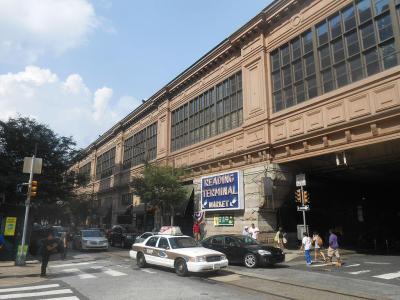
Open-air markets were popular in early Philadelphia. By the mid-19th century, markets along the Delaware River ran on for a mile or more, and High Street was renamed "Market Street." In 1859, the city dismantled everything under public pressure, which perceived open-air markets as dirty and unhygienic. Two indoor markets, Franklin Market and Farmers' Market opened at 12th and Market Streets. These two would be the foundation of the Reading Terminal Market.
With the coming of the railroads, architect Francis H. Kimball designed the Reading Railroad headhouse terminal in 1891. The train shed platform was built over the newly opened consolidated market. In 1893 an up-to-date refrigerated storage space was available for use in the market basement. Vendors could store perishable goods year-round.
After a period of prosperity, the Market experienced a long period of hardship. The Great Depression and the rise of competing supermarkets took their toll. Reading Railroad went bankrupt. In 1990 the City Council set up the non-profit Reading Terminal Market Corporation. The Market revived, and it is currently open seven days a week.
The Reading Terminal Market features arts, crafts, gifts, bakeries, confectionaries, eateries, flowers, ice creams, meats, seafood, Pennsylvania Dutch products, produce, and specialties. There are also diners, restaurants, and fast-food venues.
With the coming of the railroads, architect Francis H. Kimball designed the Reading Railroad headhouse terminal in 1891. The train shed platform was built over the newly opened consolidated market. In 1893 an up-to-date refrigerated storage space was available for use in the market basement. Vendors could store perishable goods year-round.
After a period of prosperity, the Market experienced a long period of hardship. The Great Depression and the rise of competing supermarkets took their toll. Reading Railroad went bankrupt. In 1990 the City Council set up the non-profit Reading Terminal Market Corporation. The Market revived, and it is currently open seven days a week.
The Reading Terminal Market features arts, crafts, gifts, bakeries, confectionaries, eateries, flowers, ice creams, meats, seafood, Pennsylvania Dutch products, produce, and specialties. There are also diners, restaurants, and fast-food venues.
14) Chinatown Friendship Gate
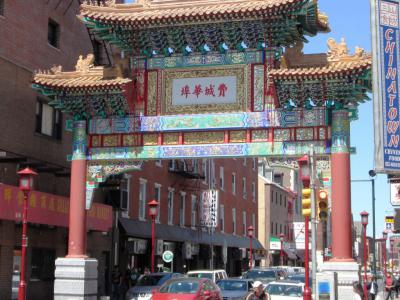
This gateway at 10th and Arch Street is a beautiful, welcoming entrance into the lively Chinatown district filled with great Asian restaurants, bakeries, shops, markets, and places of worship. A symbol of cultural exchange and friendship between Philadelphia and its sister city of Tianjin, it is the first authentic Chinese Gate built in America by artisans from China.
Weighing about 88 tons and standing 40 feet high, the Gate has bright colors and elaborate designs that reflect early Chinese imperial construction. One may see themes of mythical creatures and graphic patterns typical of the Ming and Qing Dynasties; the phoenix is meant to ensure good luck while the dragon, said to have the magical power of retaining water in its mouth, is intended to protect the structure of the Gate and the community from fire.
Originally dedicated in 1984, the Gate was rededicated on November 19, 2008, after being repainted with the help of Tianjin artisans using ancient techniques and traditional materials. Take your pictures, then find a place to eat and/or shop!
Tip:
Serious foodies will not want to miss the EMei Restaurant – a nice, no-frills eatery serving classic Chinese dishes alongside spicy Sichuan specialties. Mei Cai Kou Rou (steamed pork with preserved mustard) is something to die for!
Weighing about 88 tons and standing 40 feet high, the Gate has bright colors and elaborate designs that reflect early Chinese imperial construction. One may see themes of mythical creatures and graphic patterns typical of the Ming and Qing Dynasties; the phoenix is meant to ensure good luck while the dragon, said to have the magical power of retaining water in its mouth, is intended to protect the structure of the Gate and the community from fire.
Originally dedicated in 1984, the Gate was rededicated on November 19, 2008, after being repainted with the help of Tianjin artisans using ancient techniques and traditional materials. Take your pictures, then find a place to eat and/or shop!
Tip:
Serious foodies will not want to miss the EMei Restaurant – a nice, no-frills eatery serving classic Chinese dishes alongside spicy Sichuan specialties. Mei Cai Kou Rou (steamed pork with preserved mustard) is something to die for!
